Menu

Winter 2026

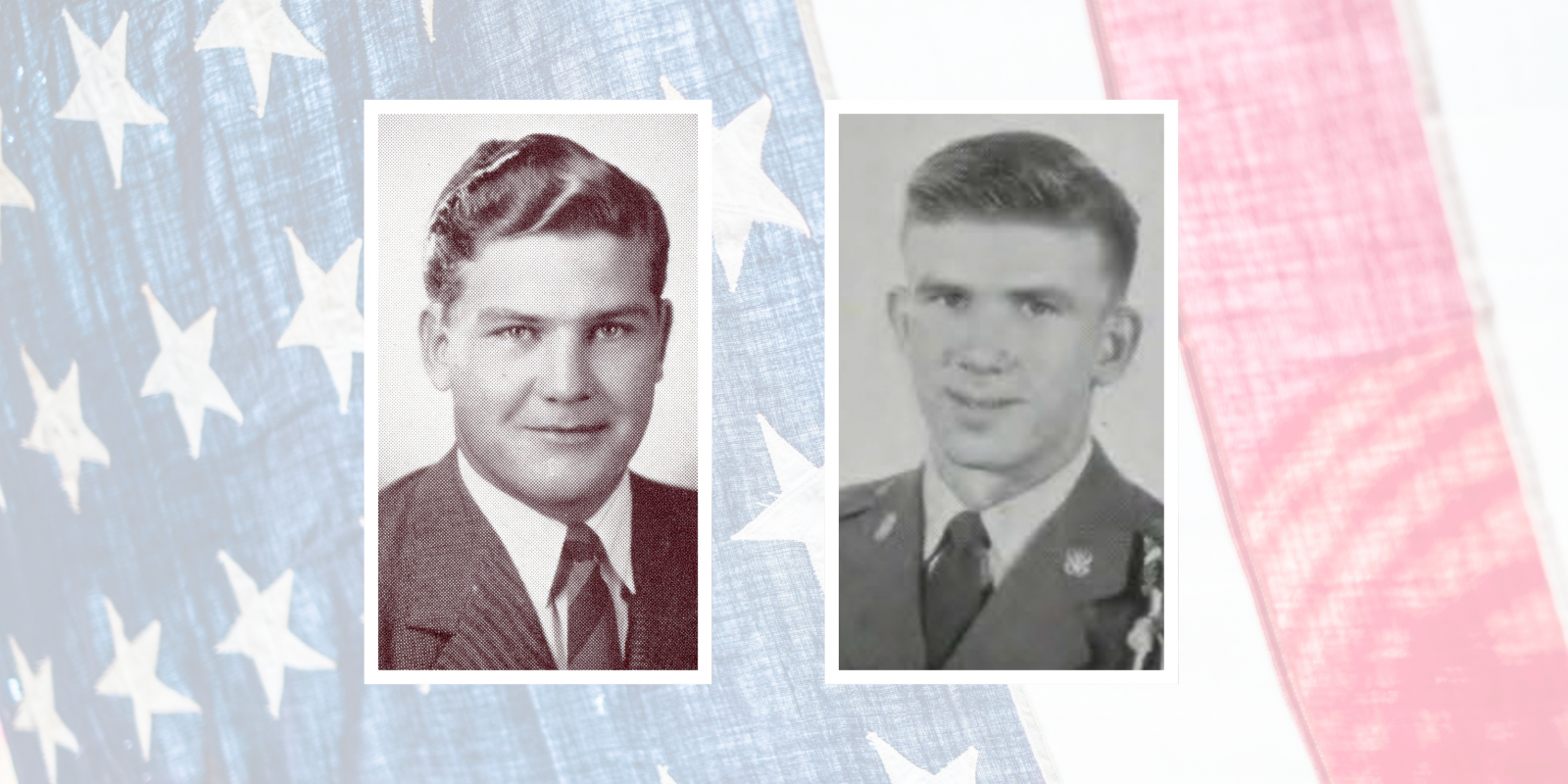
Two black-and-white yearbook portraits with white borders set side by side against a faded American flag. On the left, a young Bill Ramsey smiles in a suit and patterned tie. On the right, Mitchell Sadler wears a military uniform.

Marine Capt. Billy Ray Ramsey, left, and Air Force Capt. Mitchell Sadler ’65 were both military pilots. Left: 1941 Horned Frog yearbook. Right: 1964 Horned Frog yearbook

Waiting and Hoping: How Families of Missing Service Members Cope With Uncertainty and Grief

Of the 113 TCU graduates and former students lost to war, 22 are still missing, including Bill Ramsey, who went missing over Papua New Guinea in 1944, and Mitchell Sadler, who went missing over Laos in 1970.
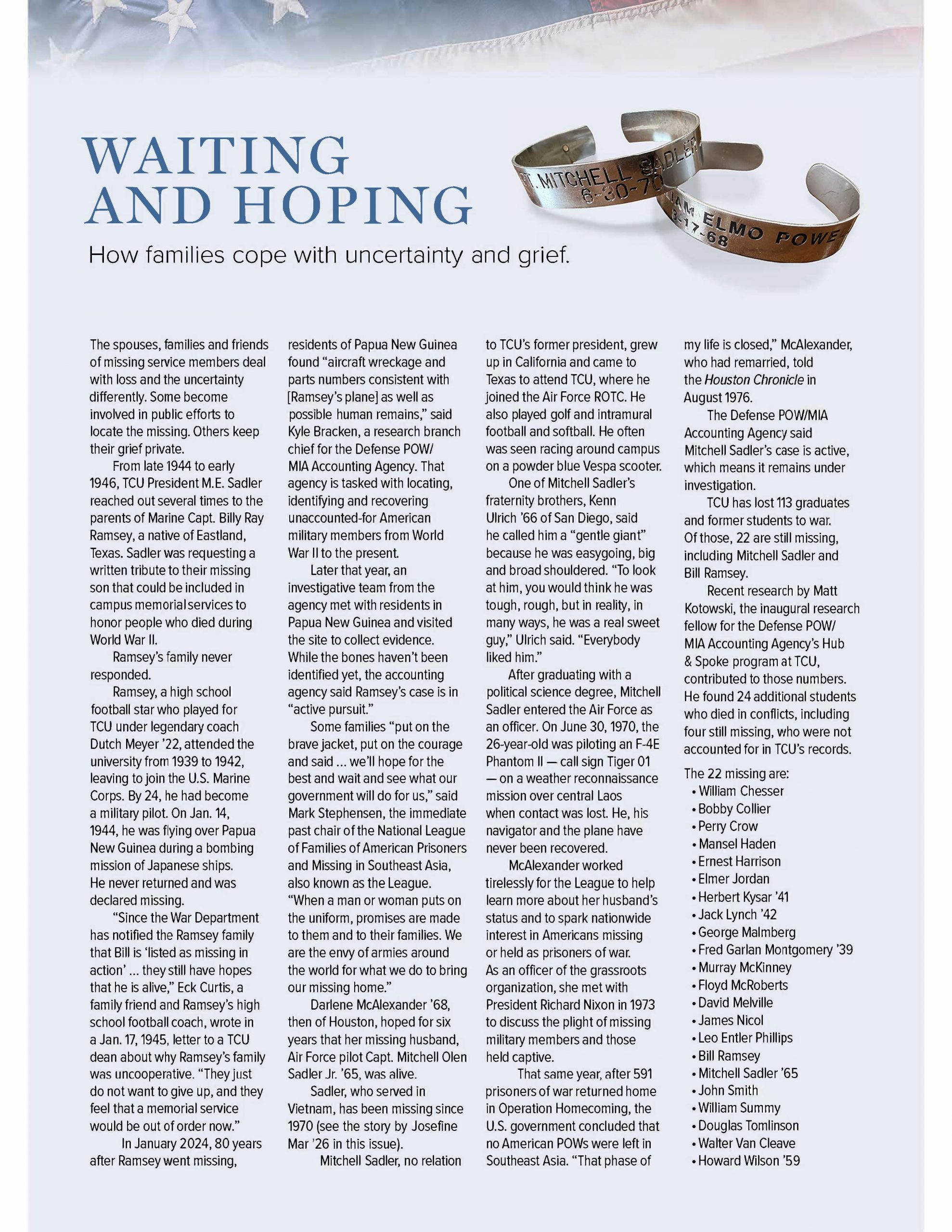
Waiting and Hoping: How families cope with uncertainty and grief. By Sheryl Jean. Includes a photo of two POW/MIA bracelets engraved with the names Mitchell Sadler and Elmo Powell. The spouses, families and friends of missing service members deal with loss and the uncertainty differently. Some become involved in public efforts to locate the missing. Others keep their grief private. From late 1944 to early 1946, TCU President M.E. Sadler reached out several times to the parents of Marine Capt. Billy Ray Ramsey, a native of Eastland, Texas. Sadler was requesting a written tribute to their missing son that could be included in campus memorial services to honor people who died during World War II. Ramsey’s family never responded. Ramsey, a high school football star who played for TCU under legendary coach Dutch Meyer ’22, attended the university from 1939 to 1942, leaving to join the U.S. Marine Corps. By 24, he had become a military pilot. On Jan. 14, 1944, he was flying over Papua New Guinea during a bombing mission of Japanese ships. He never returned and was declared missing. “Since the War Department has notified the Ramsey family that Bill is ‘listed as missing in action’ … they still have hopes that he is alive,” Eck Curtis, a family friend and Ramsey’s high school football coach, wrote in a Jan. 17, 1945, letter to a TCU dean about why Ramsey’s family was uncooperative. “They just do not want to give up, and they feel that a memorial service would be out of order now.” In January 2024, 80 years after Ramsey went missing, residents of Papua New Guinea found “aircraft wreckage and parts numbers consistent with [Ramsey’s plane] as well as possible human remains,” said Kyle Bracken, a research branch chief for the Defense POW/MIA Accounting Agency. That agency is tasked with locating, identifying and recovering unaccounted-for American military members from World War II to the present. Later that year, an investigative team from the agency met with residents in Papua New Guinea and visited the site to collect evidence. While the bones haven’t been identified yet, the accounting agency said Ramsey’s case is in “active pursuit.” Some families “put on the brave jacket, put on the courage and said … we’ll hope for the best and wait and see what our government will do for us,” said Mark Stephensen, the immediate past chair of the National League of Families of American Prisoners and Missing in Southeast Asia, also known as the League. “When a man or woman puts on the uniform, promises are made to them and to their families. We are the envy of armies around the world for what we do to bring our missing home.” Darlene McAlexander ’68, then of Houston, hoped for six years that her missing husband, Air Force pilot Capt. Mitchell Olen Sadler Jr. ’65, was alive. Sadler, who served in Vietnam, has been missing since 1970 (see the story by Josefine Mar ’26 in this issue). Mitchell Sadler, no relation to TCU’s former president, grew up in California and came to Texas to attend TCU, where he joined the Air Force ROTC. He also played golf and intramural football and softball. He often was seen racing around campus on a powder blue Vespa scooter. One of Mitchell Sadler’s fraternity brothers, Kenn Ulrich ’66 of San Diego, said he called him a “gentle giant” because he was easygoing, big and broad shouldered. “To look at him, you would think he was tough, rough, but in reality, in many ways, he was a real sweet guy,” Ulrich said. “Everybody liked him.” After graduating with a political science degree, Mitchell Sadler entered the Air Force as an officer. On June 30, 1970, the 26-year-old was piloting an F-4E Phantom II — call sign Tiger 01 — on a weather reconnaissance mission over central Laos when contact was lost. He, his navigator and the plane have never been recovered. McAlexander worked tirelessly for the League to help learn more about her husband’s status and to spark nationwide interest in Americans missing or held as prisoners of war. As an officer of the grassroots organization, she met with President Richard Nixon in 1973 to discuss the plight of missing military members and those held captive. That same year, after 591 prisoners of war returned home in Operation Homecoming, the U.S. government concluded that no American POWs were left in Southeast Asia. “That phase of my life is closed,” McAlexander, who had remarried, told the Houston Chronicle in August 1976. The Defense POW/MIA Accounting Agency said Mitchell Sadler’s case is active, which means it remains under investigation. TCU has lost 113 graduates and former students to war. Of those, 22 are still missing, including Mitchell Sadler and Bill Ramsey. Recent research by Matt Kotowski, the inaugural research fellow for the Defense POW/MIA Accounting Agency’s Hub & Spoke program at TCU, contributed to those numbers. He found 24 additional students who died in conflicts, including four still missing, who were not accounted for in TCU’s records. The 22 missing are: William Chesser, Bobby Collier, Perry Crow, Mansel Haden, Ernest Harrison, Elmer Jordan, Herbert Kysar ’41, Jack Lynch ’42, George Malmberg, Fred Garlan Montgomery ’39, Murray McKinney, Floyd McRoberts, David Melville, James Nicol, Leo Entler Phillips, Bill Ramsey, Mitchell Sadler ’65, John Smith, William Summy, Douglas Tomlinson, Walter Van Cleave, Howard Wilson ’59.

Photo by Caroline Collier