
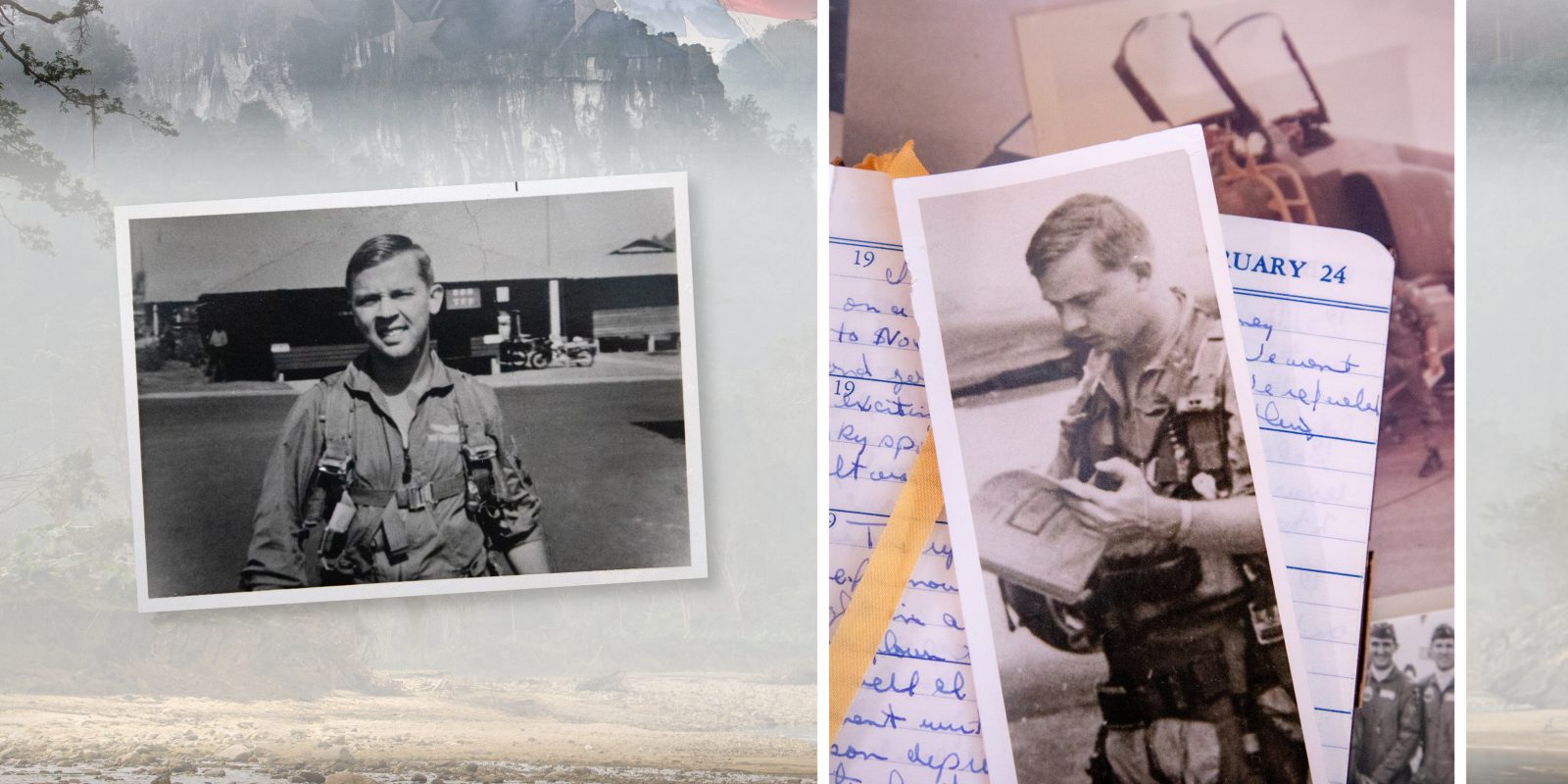
Capt. William Elmo Powell kept a diary during his time as a fighter pilot in Thailand. Left: Courtesy of the Powell family. Right: Photo by Joyce Marshall
The Long Search for Capt. William Elmo Powell, Lost Over Vietnam in 1968
For decades, the TCU fighter pilot’s family waited for answers, and some questions remain.
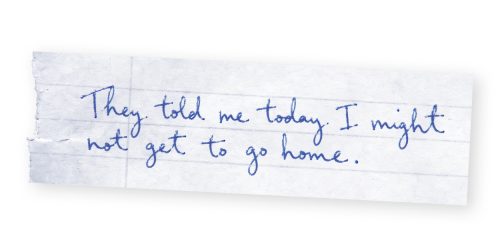
Dear Elmo
We Wish you Were Home with us.
We Love you.
— Mark Powell, then age 6
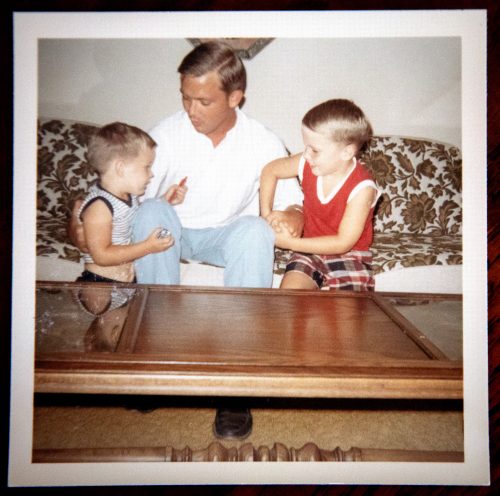
As an uncle, Powell was a larger-than-life presence, says nephew Mark Powell, right. Mark was 6, and his brother Bryan, left, was 4 when the Air Force captain went missing. Courtesy of the Powell family
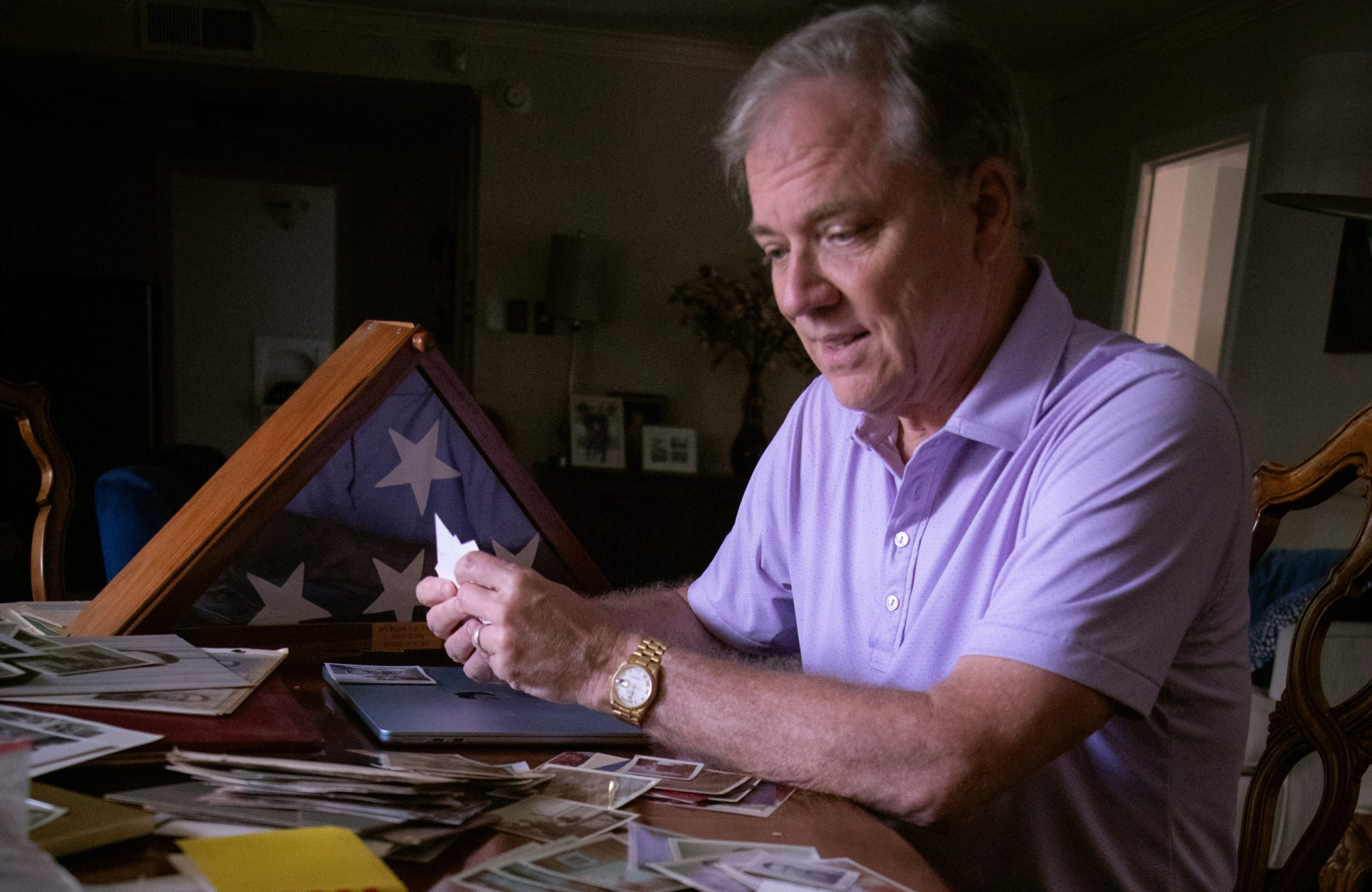
While sorting through piles of photographs, yellowed articles and other memorabilia, including his own hand-scribbled note, Mark Powell ’84 unearthed a tattered cardboard box with a glittery red cover.
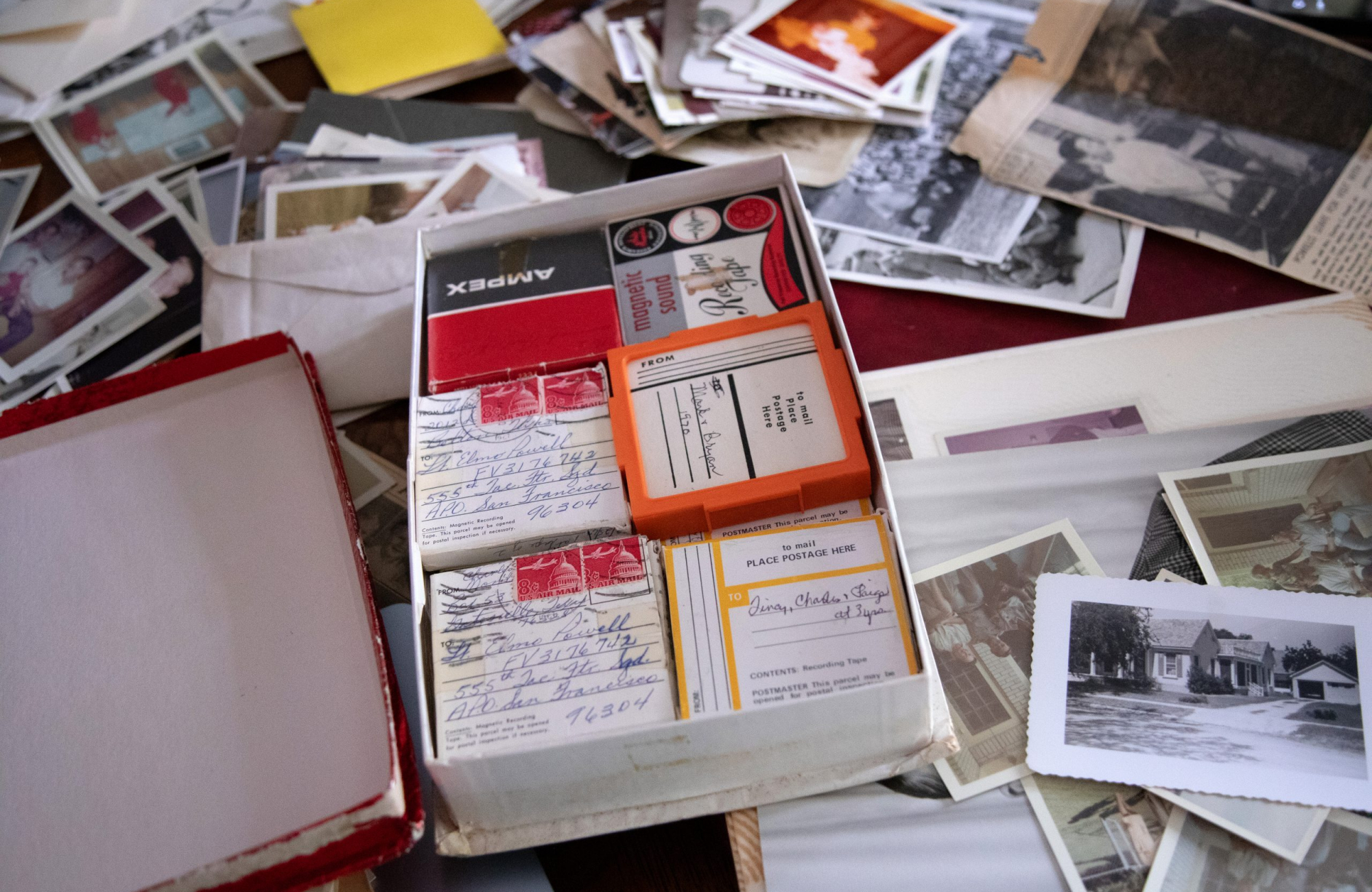
The old Pangburn’s chocolate box no longer contained candy but instead a dozen small audiotapes his grandmother had mailed to his uncle, Air Force Capt. William Elmo Powell ’65, when he was stationed in Thailand during the Vietnam War.
“My grandmother would send these boxes of Doublemint gum, handwritten letters, underwear, socks and T-shirts with other things he liked,” said Mark, who lives in Dallas. “We would make audio recordings on little bitty reel-to-reels … and tell him what was going on.”
Those boxes made their way to Elmo, or Mo, as he was called by family and friends, while he was about 9,000 miles away from his Central Texas hometown of Gatesville.
Mark remembers his 25-year-old uncle as a handsome fighter pilot with a larger-than-life presence, bearing exotic gifts of silk pajamas on visits home. He can still picture the large world map on his grandparents’ wall that marked Elmo’s base in Southeast Asia and their home in Texas.
“He was like the cool uncle,” Mark said. “He was single, young and good looking — the whole nine yards.”
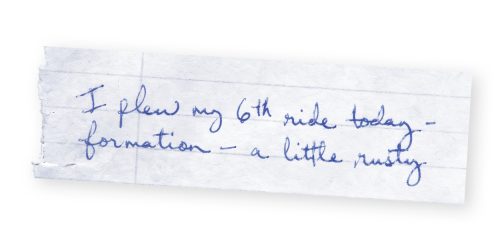
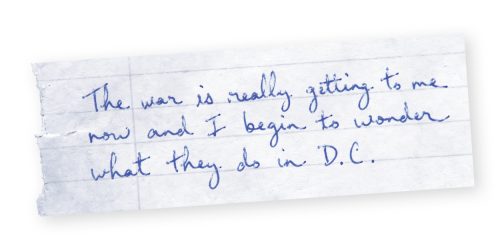
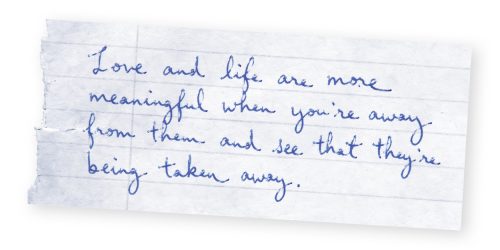
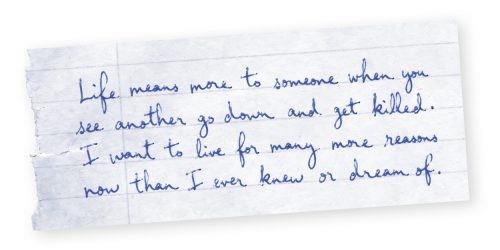
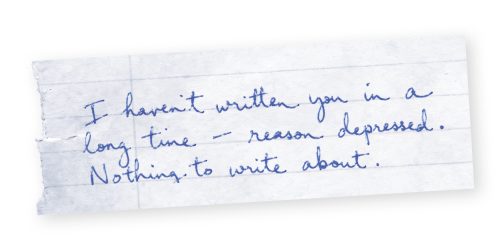
Diary entry of William Elmo Powell, Thailand, 1968
He Loved Flying
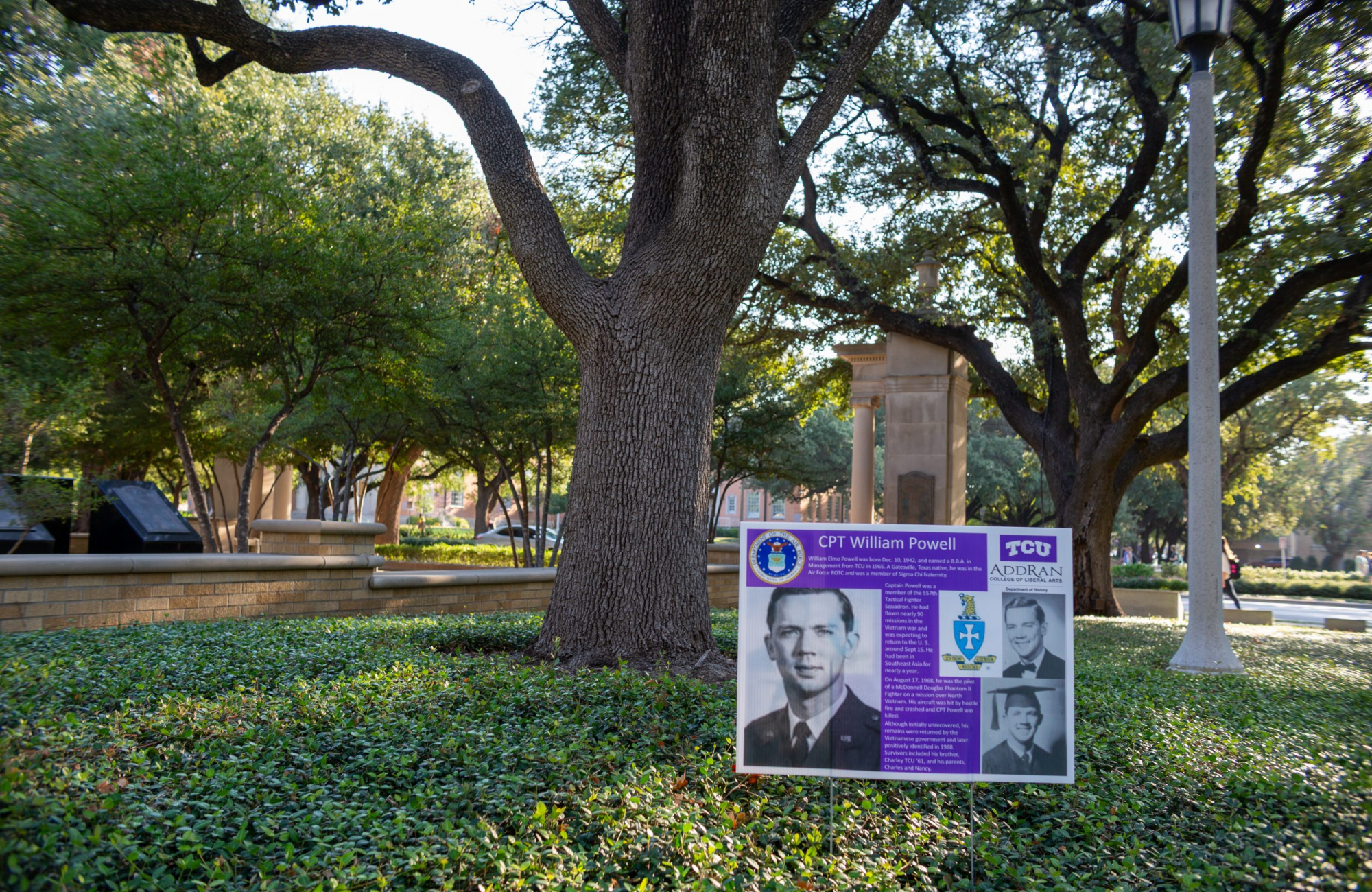
Elmo was born Dec. 10, 1942, to Charles and Nancy “Tincy” Powell in Gatesville, then a town of about 3,000 people. His parents were Coryell County giants, owning several businesses and a farm. Charles was mayor of Gatesville from 1956 to 1960.
Elmo played football on Gatesville High School’s regional championship team in 1960 and was active in the First Baptist Church. One teacher recalled Elmo as a good student with “a million-dollar smile.” He was close to his older brother, Charley Powell Jr. ’62, following him to TCU. The brothers, who both earned bachelor’s degrees in management, were the third generation of a family whose TCU connections now span more than a century.
At TCU, Elmo joined the Air Force ROTC a few years before the U.S. government began deploying large numbers of troops to Vietnam. Patriotism drove his decision, but he also just wanted to fly. He loved flying.
“He was more about ‘I want to be a pilot,’ not necessarily ‘I have to support the United States’ efforts in Vietnam,’ ” Mark said. “His plan was to come back and work for one of the big U.S. airlines.”
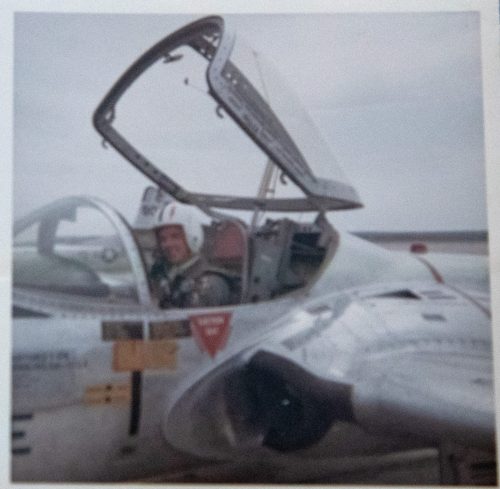
Powell excelled at fighter pilot training. He was looking ahead to working for a U.S. airline after he returned home, Mark Powell says. Courtesy of the Powell family
Soon after graduating, Elmo and friend Robert “Billy Bob” Sherley ’65 embarked on a 12,000-mile flying tour of the northwest United States, Alaska (where they hunted bear) and Canada in Sherley’s twin-engine Cessna plane.
Later that year, Elmo was commissioned as an officer in the Air Force and began pilot training at the former Laredo Air Force Base in South Texas. During some training flights, he flew over his parents’ house in Gatesville, spotting signs his mother had fashioned from paper towels, held down with rocks, spelling “Hi Mo” and “We Love Mo!” He would reply by barrel-rolling his plane.
On one trip home, the daredevil bought a new blue T-top Corvette and stored it in his parents’ garage for his homecoming.
On his 24th birthday, Elmo finished his technical training, earning his “wings.” He continued his fighter pilot training at the former George Air Force Base in Victorville, California, where he teamed up with Larry Steed, now a retired lieutenant colonel, as his backseat navigator. Elmo excelled in weapons and radar training, so much so that a few months later the Air Force chose him to become a front-seat pilot, Steed said.
Steed, now 91 and living in Kaysville, Utah, said Elmo was nervous and reluctant to fly as a front-seat pilot.
“He didn’t have the experience being right out of pilot training,” Steed said. “Most of the time in the back seat, you don’t do a lot of flying. You operate the radars, long-range navigation systems, read checklists and keep your eyes open for antiaircraft missiles.”
Elmo needed to learn in a hurry, as his deployment to join the escalating Vietnam War was imminent.
The Front Seat
The Air Force sent Elmo and Steed to Ubon, Thailand, in 1967. They were based at the Royal Thai Air Force Base, a critical U.S. hub during the war.
Elmo was flying weather reconnaissance and strike missions over North Vietnam. It didn’t take long for him to start losing some of his convictions. His diary entries from early 1968 show an eager new pilot growing depressed and having trouble sleeping. He wanted to fly more but didn’t agree with how the U.S. government was fighting in Southeast Asia.
“There was despair in his writing,” Mark said of Elmo’s diary entries and letters home. “I think reality set in over there.”
By mid-August 1968, Elmo had flown about 90 missions. He needed 100 to return home.
On Aug. 17, Elmo was piloting an F-4D — call sign Vegas 02 — on a mission in North Vietnam. He and copilot Capt. Arthur Hoffson soared over Quảng Bình Province about 25 miles west of the Gulf of Tonkin, an area of North Vietnam that was heavily bombed by the United States. The region, dotted with limestone hills and farms, is honeycombed with caves the North Vietnamese used as hospitals and ammunition depots.
After a first run at “a cave in which ammunition was stored,” they were circling back when enemy fire struck the plane, Hoffson later told The Gatesville Messenger and Star-Forum. After being hit with “murderous flak,” the plane’s controls failed.
Hoffson ejected first, per protocol. He lost sight of the plane as North Vietnamese soldiers riddled his parachute with bullets, but he saw a fireball when the plane collided with the earth. A beeper — a radio beacon in the survival kit that switches on when a seat separates from a plane — could be heard strong and steady for nearly two minutes, then intermittently for 10 more minutes, and then silence.
The official search for Elmo was suspended the same day.
A Rocket With Wings
A few days after Elmo crashed in North Vietnam, two Air Force officers delivered the news to his parents at their Gatesville home. Elmo was officially missing in action.
“I unfortunately remember vividly when the pastor came and notified my father of his brother going down, and my dad had what I could only classify as a fit,” Mark said. “I wish I could get it out of my head. He was just distraught. [Elmo] was his only sibling.”
Elmo’s parents hoped he was alive in a prison camp. Tincy wrote letters and sent packages to him until at least 1970. That same year, she and Elmo’s father traveled to Southeast Asia with Texan Ross Perot Sr.’s organization to glean more information about his whereabouts.
They didn’t learn much.
Mark and his younger siblings, Bryan Powell and Paige Rendon ’93, said the uncertainty profoundly affected the entire family.
“It was very confusing and caused a lot of sadness in the adults who knew him,” said Bryan, who canceled his plans to become an Air Force fighter pilot at his parents’ request. Ambiguities, combined with bits and pieces of information that trickled in from various sources, upset his grandparents, who simply “wanted to know what happened to their boy.”
He and Mark also witnessed the impact Elmo’s disappearance had on their father.
As the war waged on, Charley “was depressed for a long period of time,” Mark said. “He drank too much at night. The family dynamics related to Elmo just weighed on him … and that affected my relationship with my father.”
Older brother Charley remained eager for Elmo to return so he could ride in his jet. Elmo “said it was like flying a rocket with wings,” he remembered.
For years, Mark and Bryan wore one of the millions of POW/MIA bracelets distributed to keep military members who were missing or prisoners of war visible in the public mind. Their bracelets were engraved with Elmo’s name, rank and missing date.
On Jan. 27, 1973, the Paris Peace Accords secured a cease-fire in the Vietnam War and mandated the return of all U.S. prisoners held captive in North Vietnam.
Two months later, nearly 600 U.S. service members, including future Sen. John McCain, were released and returned to the United States. Hoffson was among them. He had spent 4½ years in prison camps in and around Hanoi, North Vietnam.
One week after being freed, Hoffson called Charles and Tincy Powell from Andrews Air Force Base near Washington, D.C. He said there was no way Elmo had survived the initial crash. He later visited Gatesville, telling the family he hadn’t seen a parachute deploy before the explosion. (Hoffson died in 2006.)
“My grandparents didn’t believe him,” said Bryan, who lives in Dallas and was 4 when Elmo went missing.
In May 1973, the Air Force sent Elmo’s parents a letter changing his status to killed in action.
Elmo’s family held a memorial service in Gatesville. Hundreds of people attended. Jets crossed the sky in formation, with one peeling off and climbing until the roar of it faded to nothing. It’s called a missing man flyover, a symbolic salute to pilots who don’t come home.

Despite the ceremonial closure, Elmo’s parents had no definitive answers and doubted the official conclusion. “There was still a lot of talk that there’s little POW camps here and there, and there’s people surviving on their own in the jungle,” Mark said. “They assumed it was possible.”
“They never gave up the idea that Mo’s going to come home,” Bryan added.
As the United States and Vietnam began the gradual process of healing and rebuilding after a long and brutal war, Elmo was one of about 2,500 Americans still unaccounted for in the mid-1970s.
Box No. 3
Facing growing public distress, distrust and disillusionment after the war, the U.S. government vowed to find out what had happened to those who never returned.
After South and North Vietnam reunified as one country in spring 1976, the communist government committed to pursuing peace and economic stability. Eventually, relations with the United States thawed. In 1982, high-level representatives from the U.S. Defense and State departments arrived in Hanoi to meet with Vietnamese officials solely to discuss Americans missing or held as prisoners.
Those conversations led to the first on-site investigations and recovery efforts in Vietnam. Also that decade, Vietnam began returning remains of U.S. servicemen.
One of the earliest returns occurred on Dec. 4, 1985, when the Vietnamese government repatriated the remains of seven servicemen in wooden boxes. One of those boxes, No. 3, was labeled Air Force Capt. Terrin D. Hicks, who crashed on Aug. 15, 1968, about five miles from where Elmo crashed two days later. That box contained the remains of multiple servicemen.
When the U.S. Central Identification Laboratory in Hawaii examined those remains, a skull and an associated skeleton didn’t fit together.
Dental records matched Elmo to the skull but not the rest of the skeleton in Box 3. Hicks has never been accounted for.
In fall 1987, Elmo’s parents died about a month apart. They had kept his blue Corvette in their garage for 20 years.
“I don’t think they believed Elmo died even when they went to their graves,” Mark said.
In early 1988, the government notified Charley of the skull match after delaying communication “in anticipation of receiving the major missing portions of his remains” from the Vietnamese government.
The Air Force returned the skull to Charley, who decided to hold a second, full military burial that April with another flyover and a three-volley rifle salute. On a sunny day, a teenage Paige sang “The Lord’s Prayer” a cappella at the hilltop Restland Cemetery in Gatesville. As with the original memorial service, hundreds of people attended.
“It was a big deal to me even though I didn’t know him,” said Paige, who lives in Belton, Texas, and was born two years after Elmo went missing. “It was like this is my contribution to what happened.”
What the Villagers Remembered
Although the military officially resolved Elmo’s case in 1988, investigators kept pulling at threads.
In 1991, a joint U.S. and Vietnamese investigative team visited a Hanoi military museum called a tradition house and found a display tag captioned in Vietnamese: “Pilot’s Identification Card Belonging to Pirate Pilot Powell William Elmo.” The card itself was gone.
Seven years later, analysts in Washington, D.C., were still trying to work out why Elmo’s skull had arrived without a body. The Defense Prisoner of War/Missing Personnel Office sent the Army’s identification laboratory in Hawaii a list of questions.
Vietnamese officials had passed along some new information. A memo noted local people in Phúc Trạch village — “where case 1253 died” — said they had dug up a grave and “placed the remains in two fertilizer bags.” Case 1253 was the number the U.S. government had assigned to Elmo.
“They said there were still signs on the remains where the pilot’s hand had been amputated,” the memo continued. Then the office asked the lab to start searching for skeletal remains with evidence of an amputated hand to try to make a match.
The following January, a Vietnamese team went back to the village to learn more.
The team worked its way through Quảng Bình Province. On Jan. 7, it reached Phúc Trạch, a farming village at the foot of Chay Lap mountain, in poor country still seeded with unexploded U.S. ordnance.
There, the team interviewed Phan Phuong, then 67, who had been the village’s public security chief during the war, and Nguyen Nghiem, then 73, who had run the village infirmary. The U.S. military translated the account four months later.
Only one aircraft had ever crashed at Phúc Trạch, the men said, one afternoon in 1968. Villagers found a single aviator, a Caucasian man they remembered as tall and big, with reddish hair and whiskers. He was “wounded in the arm, then brought to the village infirmary,” the report stated.
Nghiem, who treated him, said no one there spoke a language the man understood.
“The aviator would not agree to be bandaged, so his wounds became infected [and] the arm had to be amputated,” the report said. The pilot died 20 days later.
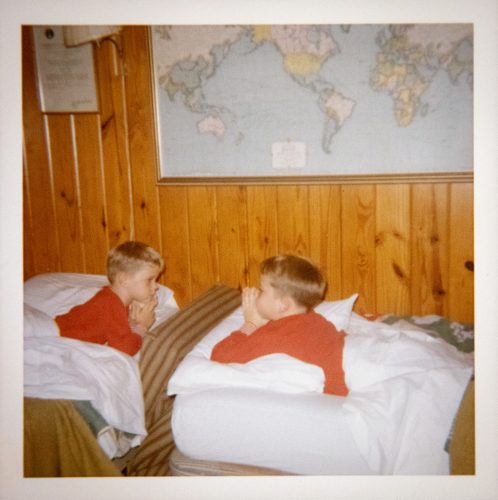
Bryan and Mark Powell’s grandparents hung a large world map at their house marked with their uncle’s base in Southeast Asia and their Gatesville, Texas, home. Courtesy of the Powell family
After the war, the village militia exhumed his remains, handing them over to the Vietnamese government, which eventually returned them to the U.S. government. The remains were “relatively complete,” the report stated, “only missing the forearm that had been amputated and buried in a different location.”
U.S. analysts wrote that the account “correlates” with Elmo’s case based on the location, the general date of the crash, the time of day and the fate of the two crewmen. They concluded that the description of the injured aviator “generally resembles” Powell and that the villagers’ account was “consistent with eyewitness accounts obtained during the previous joint investigation.”
The family was never notified of this account of Elmo’s death, Mark said, and he and Bryan both reject the report for a variety of reasons. The villagers’ account was hearsay, they said, collected 30 years after the fact, and they note that the physical description doesn’t match that of Elmo, who was of medium build and had brown hair, not red.
“ ‘Generally resembles’ is not good enough to change the narrative,” Mark said.
“The working theory is, and we’ll never really know, is that the missile that hit the plane severed his arm,” Bryan said. “He probably bled to death pretty quick.”
The family and the villagers, however, agree on one point: When the rest of Elmo finally came home, a piece of his arm was missing.
Recovery Helps Heal
Bryan and Mark remember their father getting a phone call in the early 2000s. The government wanted to swab the inside of his cheek.
DNA testing had advanced enough by then to achieve what a forensic examination in the 1980s could not.
“By the time the last portions [of Elmo’s remains] were identified in the early to mid-2000s, a relatively complete skeleton had been identified,” said Sean Everette, a spokesman for the Defense POW/MIA Accounting Agency.
Elmo’s identification and return process took a long time because his “remains were comingled with the remains of another service member when they were turned over to the U.S. by Vietnam in 1985, which is why there was some question that his remains may have belonged to someone else,” Everette added.
Bryan remembers that the skeleton the family received was missing part of a finger and about 3½ inches of its right upper arm.
Still, questions remain. “Did they send the remains back in different amounts?” Mark wonders. “Did the government mix them up in Hawaii? Did the Vietnamese hold back some [remains] and then send them piecemeal?”
Two Air Force officers from San Antonio drove Elmo’s DNA-matched bones to Gatesville. They exhumed the skull his family had buried in 1988 and assembled it with the new remains inside a new uniform, with new shoes, a new belt and new medals.
For the third time, the Powells memorialized Elmo. Now they laid most of him to rest next to his parents, who had died nearly 20 years earlier without learning the truth about what had happened to their beloved son. Just a small group of friends and family attended.
“They never gave up the idea that Mo’s going to come home.”
Bryan Powell
“Those events were very difficult for our whole family,” Bryan said. “Nobody should have to bury the same person twice after already having a memorial service.”
Whatever their doubts about how Elmo died, Bryan and Mark say they have none about whose remains they buried. Charley, who died in 2015, didn’t either.
From World War II to today, nearly 81,000 American service members remain unaccounted for. Among the missing are 22 TCU students and graduates.
Elmo is the only missing Horned Frog recovered to date.
Editor’s note: The diary passages throughout this story are from the writing of Air Force Capt. William Elmo Powell while he was stationed in Thailand. We are grateful to the Powell family for entrusting us with Elmo’s words and for sharing their memories openly with the TCU community.
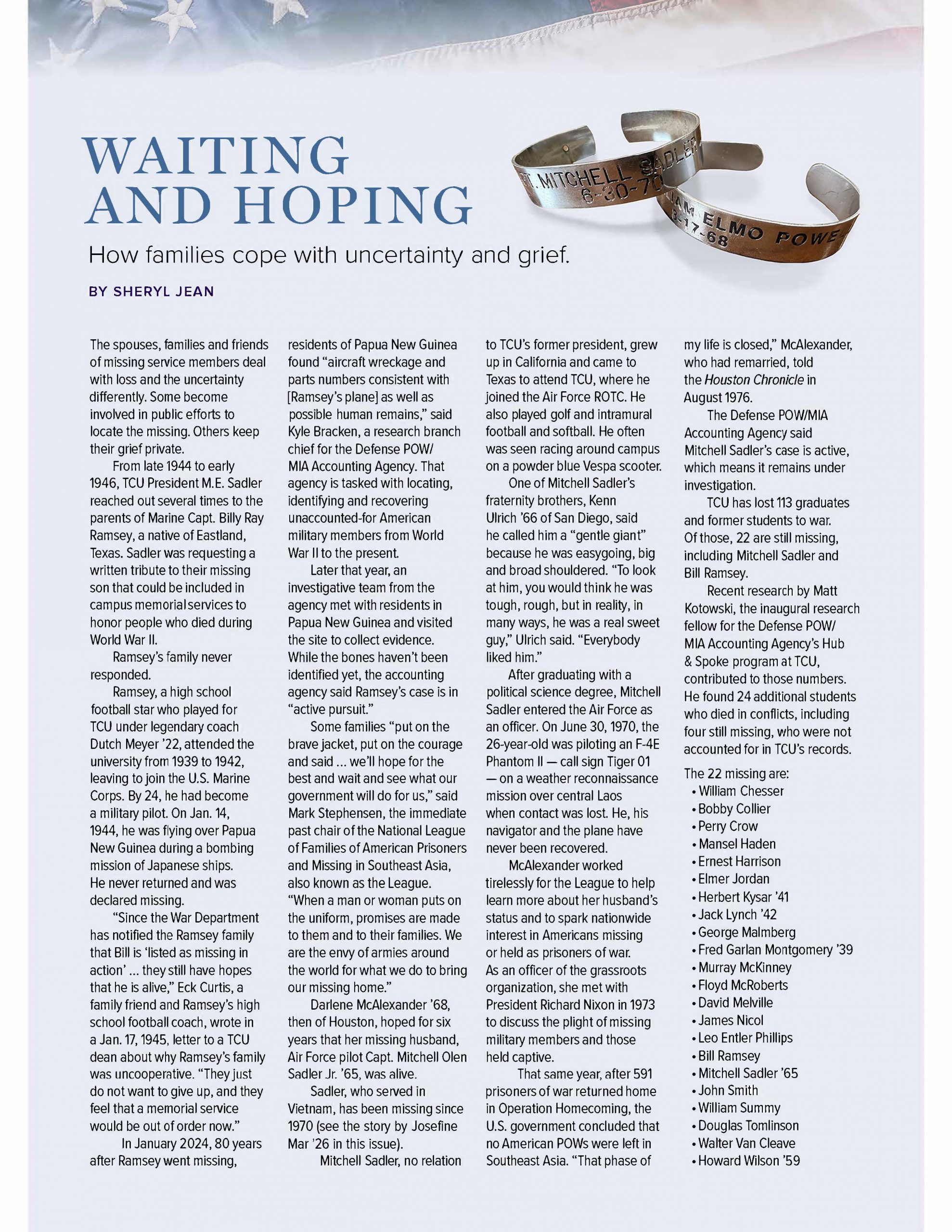
Photo by Caroline Collier
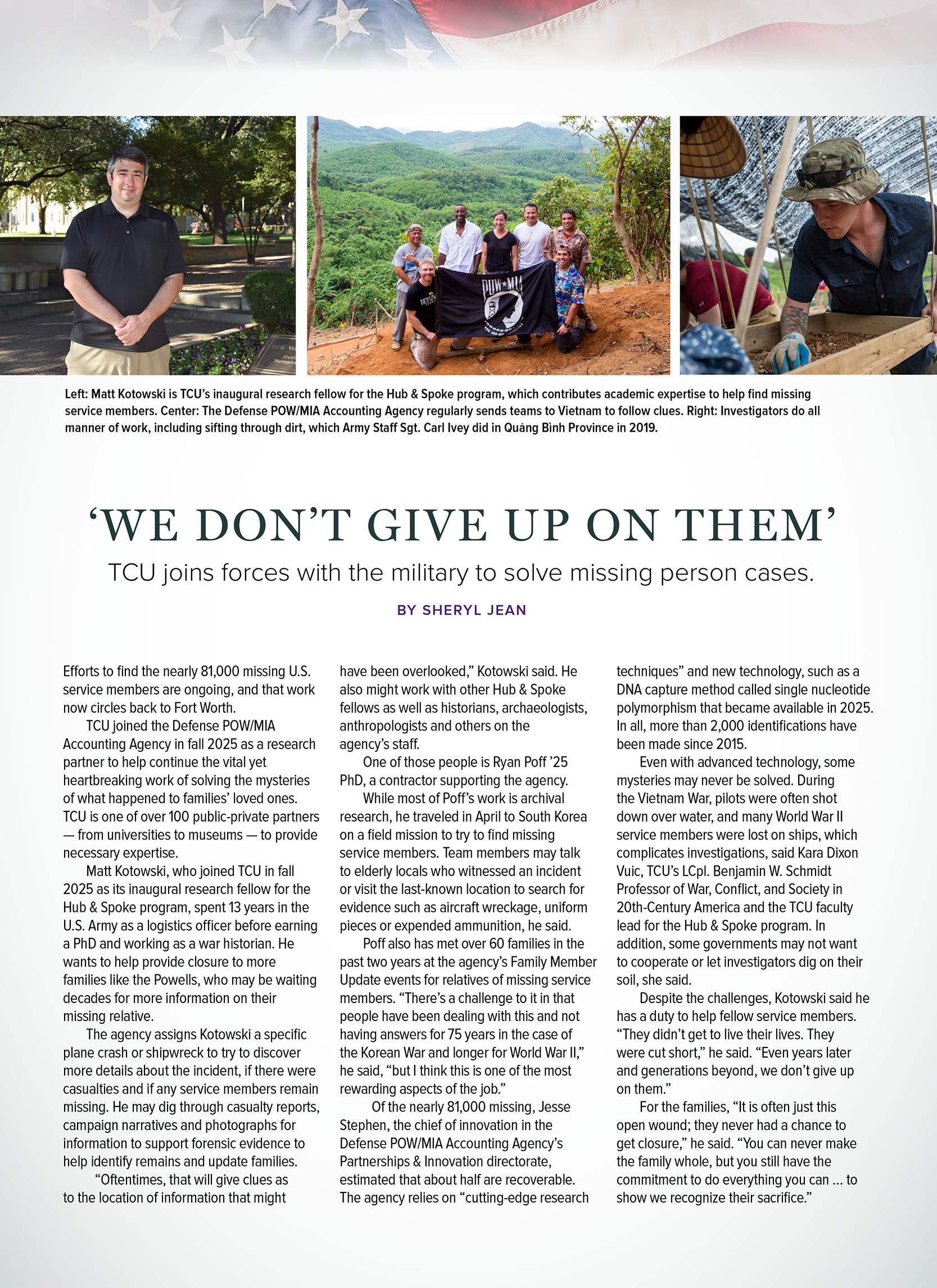
Left: Photo by Riane Cleveland. Center: Courtesy of Defense POW/MIA Accounting Agency | Armando Velez. Right: Courtesy of Defense POW/MIA Accounting Agency | Jeremy Laramore
Your comments are welcome
Comments
Related reading:
Features
Maj. Horace S. Carswell Jr. Would Not Leave a Crewman Behind
TCU’s only Medal of Honor recipient sank two warships with a single bomber. Eleven days later, eight men bailed out on his order, and he stayed with the one who couldn’t jump.
Features, Research + Discovery
Vietnam Nurses Struggled on Two Fronts
Army nurses faced bloodshed overseas and miniskirts at home.
Alumni, Features
Veterans Share Their Experiences in New Book
The collection of personal accounts covers military life from World War II to the present day.