Menu

Winter 2026

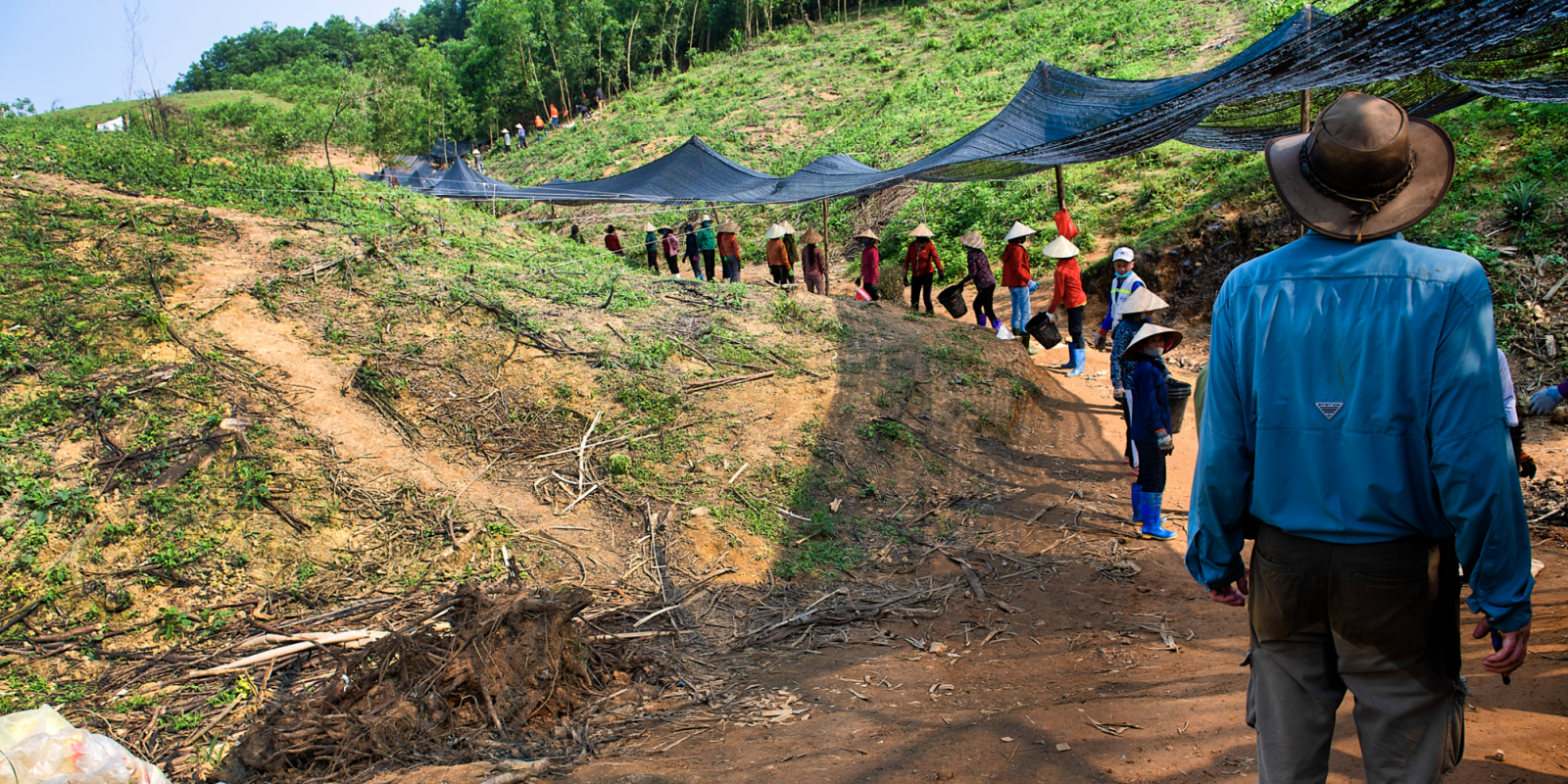
A man in a wide-brimmed hat and blue jacket stands on a dirt path, looking toward a long line of people working along a terraced hillside under shade netting.

Defense POW/MIA Accounting Agency teams search for evidence such as aircraft wreckage, uniform pieces and expended ammunition. Courtesy of the Defense POW/MIA Accounting Agency

‘We Don’t Give Up on Them’: TCU Helps Find Missing Service Members

Nearly 81,000 U.S. service members remain unaccounted for, and in fall 2025, TCU joined the Defense POW/MIA Accounting Agency as a research partner.
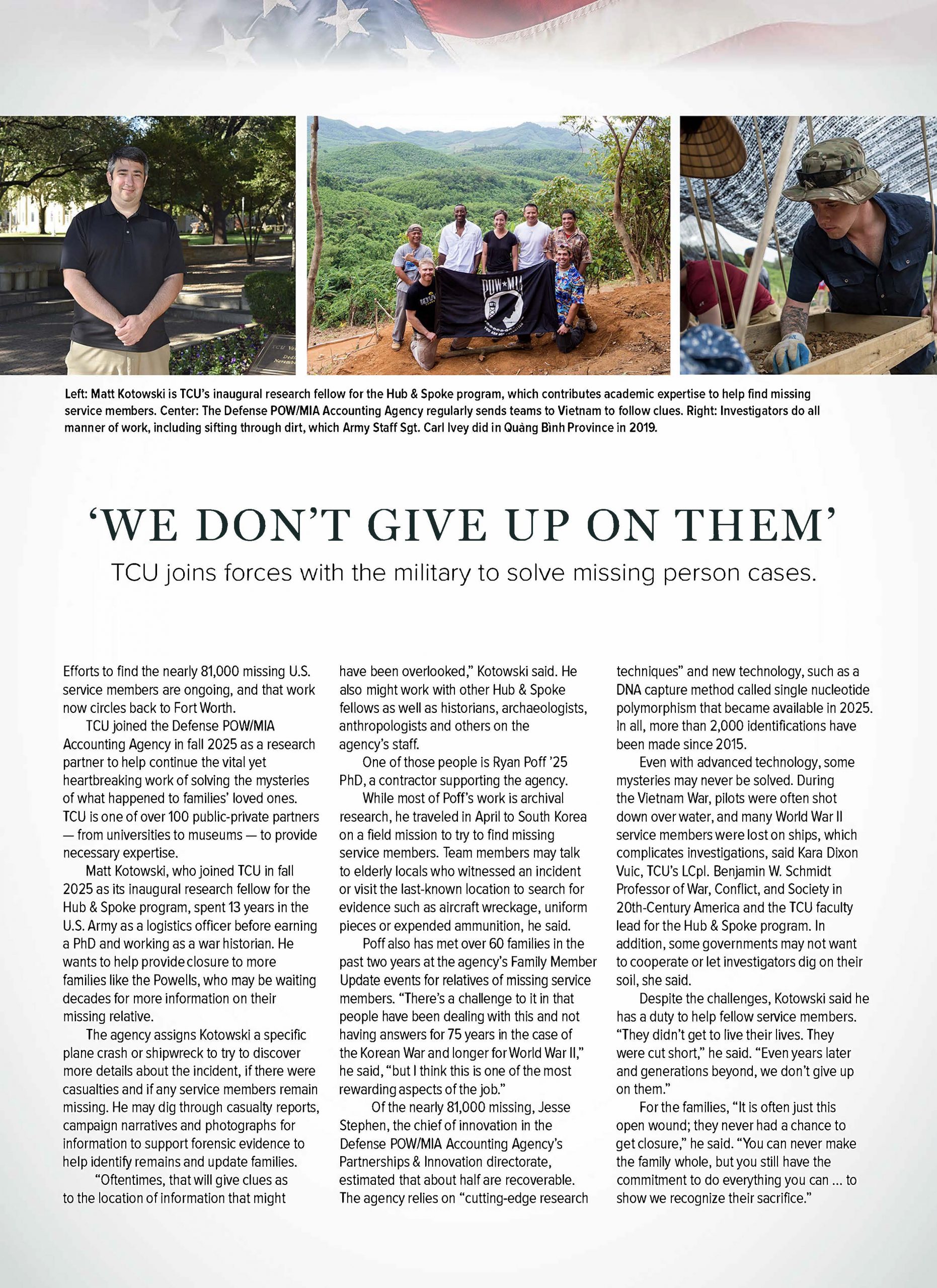
‘We Don’t Give Up on Them’: TCU joins forces with the military to solve missing person cases. Includes three photos. Left: Matt Kotowski is TCU’s inaugural research fellow for the Hub & Spoke program, which contributes academic expertise to help find missing service members. Center: The Defense POW/MIA Accounting Agency regularly sends teams to Vietnam to follow clues; a group poses on a hillside holding a black POW/MIA flag. Right: Investigators do all manner of work, including sifting through dirt, which Army Staff Sgt. Carl Ivey did in Quảng Bình Province in 2019. Efforts to find the nearly 81,000 missing U.S. service members are ongoing, and that work now circles back to Fort Worth. TCU joined the Defense POW/MIA Accounting Agency in fall 2025 as a research partner to help continue the vital yet heartbreaking work of solving the mysteries of what happened to families’ loved ones. TCU is one of over 100 public-private partners — from universities to museums — to provide necessary expertise. Matt Kotowski, who joined TCU in fall 2025 as its inaugural research fellow for the Hub & Spoke program, spent 13 years in the U.S. Army as a logistics officer before earning a PhD and working as a war historian. He wants to help provide closure to more families like the Powells, who may be waiting decades for more information on their missing relative. The agency assigns Kotowski a specific plane crash or shipwreck to try to discover more details about the incident, if there were casualties and if any service members remain missing. He may dig through casualty reports, campaign narratives and photographs for information to support forensic evidence to help identify remains and update families. “Oftentimes, that will give clues as to the location of information that might have been overlooked,” Kotowski said. He also might work with other Hub & Spoke fellows as well as historians, archaeologists, anthropologists and others on the agency’s staff. One of those people is Ryan Poff ’25 PhD, a contractor supporting the agency. While most of Poff’s work is archival research, he traveled in April to South Korea on a field mission to try to find missing service members. Team members may talk to elderly locals who witnessed an incident or visit the last-known location to search for evidence such as aircraft wreckage, uniform pieces or expended ammunition, he said. Poff also has met over 60 families in the past two years at the agency’s Family Member Update events for relatives of missing service members. “There’s a challenge to it in that people have been dealing with this and not having answers for 75 years in the case of the Korean War and longer for World War II,” he said, “but I think this is one of the most rewarding aspects of the job.” Of the nearly 81,000 missing, Jesse Stephen, the chief of innovation in the Defense POW/MIA Accounting Agency’s Partnerships & Innovation directorate, estimated that about half are recoverable. The agency relies on “cutting-edge research techniques” and new technology, such as a DNA capture method called single nucleotide polymorphism that became available in 2025. In all, more than 2,000 identifications have been made since 2015. Even with advanced technology, some mysteries may never be solved. During the Vietnam War, pilots were often shot down over water, and many World War II service members were lost on ships, which complicates investigations, said Kara Dixon Vuic, TCU’s LCpl. Benjamin W. Schmidt Professor of War, Conflict, and Society in 20th-Century America and the TCU faculty lead for the Hub & Spoke program. In addition, some governments may not want to cooperate or let investigators dig on their soil, she said. Despite the challenges, Kotowski said he has a duty to help fellow service members. “They didn’t get to live their lives. They were cut short,” he said. “Even years later and generations beyond, we don’t give up on them.” For the families, “It is often just this open wound; they never had a chance to get closure,” he said. “You can never make the family whole, but you still have the commitment to do everything you can … to show we recognize their sacrifice.”

Left: Photo by Riane Cleveland. Center: Courtesy of the Defense POW/MIA Accounting Agency | Armando Velez. Right: Courtesy of the Defense POW/MIA Accounting Agency | Jeremy Laramore