
August 10, 2026
Q&A: Author and Art Educator Lauren Horn
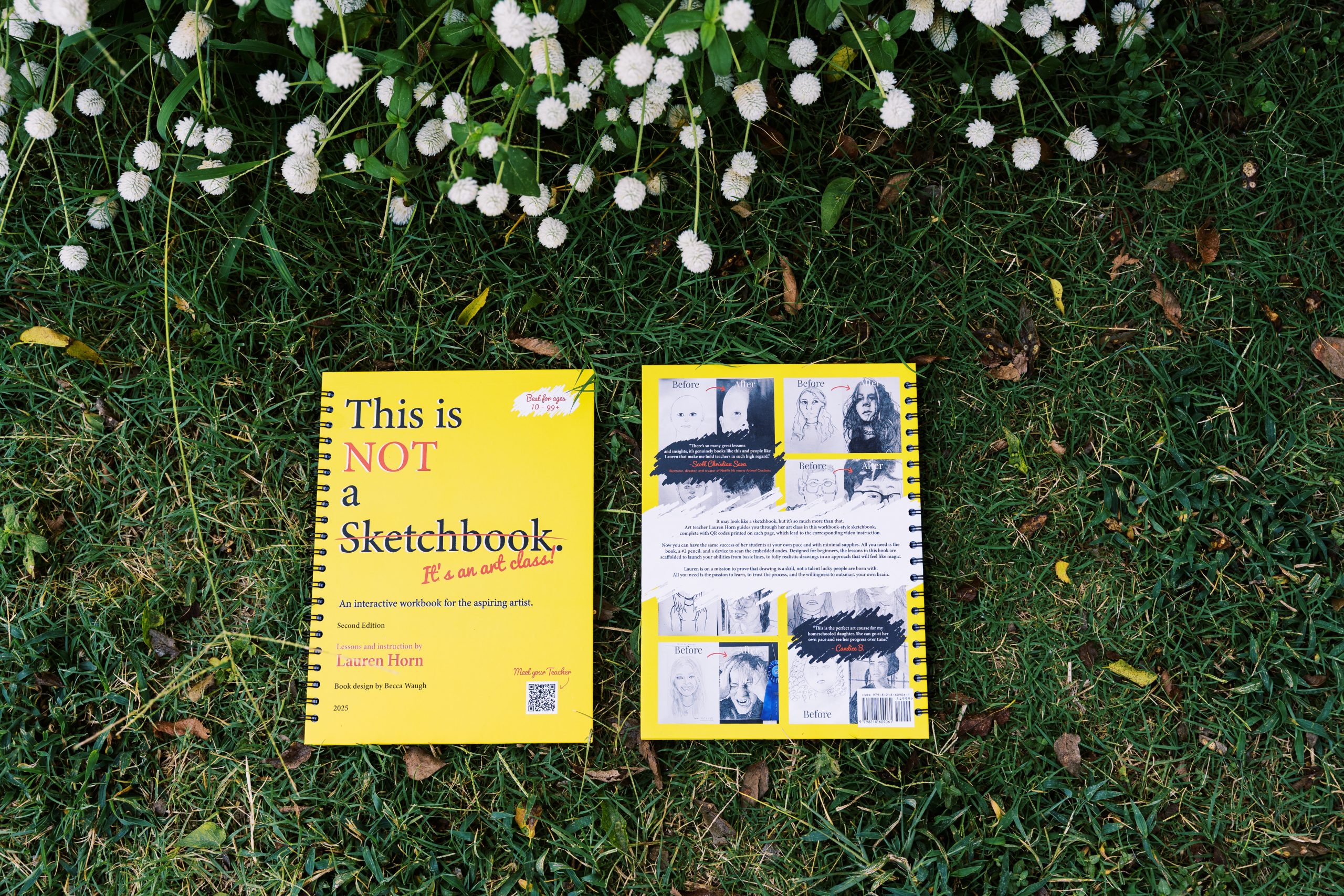
The back cover of Lauren Horn’s workbook shows before-and-after drawings from her students. Courtesy of Lauren Horn | Kinsey Linnae LLC
August 10, 2026
Q&A: Author and Art Educator Lauren Horn
In 2020, Lauren Horn ’12 was a high school art teacher who started a TikTok account to bridge the gap with her students learning at home during the pandemic. One of her first videos — showing a student’s art progress over nine weeks in her class — went viral. Requests poured in for her to teach her methods, and Horn found herself hosting late-night TikTok Live classes after her own kids went to bed. That desire to teach beyond the classroom led to This is Not a Sketchbook, It’s an Art Class, a workbook with QR codes linking to video lessons from Horn.
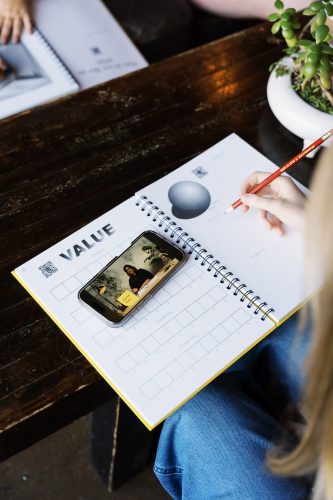
The workbook is meant to be drawn in, not just read. Courtesy of Lauren Horn | Kinsey Linnae LLC
How did you get into art? Did you always know you wanted to pursue it full-time?
My family was really encouraging of art, but it was actually really on the back burner my whole life. I think what was cool was that my parents were always pulling out a pencil and paper, drawing and giving me lots of compliments, which I think is huge for little kids. Even when I went to TCU, I didn’t think I wanted to major in it, so it ended up being my minor. TCU was the first time I took a serious art class, so that was the first moment of “Oh, this actually could be something.” I think when you have a little bit of natural ability, you kind of think that’s it. Then, you get a teacher who makes you grow, and you realize you can climb up this mountain. When I was teaching high school, a lot of my students were there just for an art credit. But those were my favorite kids to pull in, because it really taught them that they could apply themselves and grow.
What inspired you to start teaching?
It was Frog Camp. I was a counselor all the way through, and then became a director, and it was the time of my life. It was by far the most rewarding thing I did. I liked the mentorship idea, and I kind of had it in my head that I would like to teach and coach. When I met my husband right after we graduated, he was being moved by the Army. That’s when I pivoted into teaching.
You’ve said art is a teachable skill, not an innate gift. Can you tell us more?
I think that’s the foundational thing I want to get across: art can be taught. It’s been talked about as a talent for so long, and of course, I do think there are people born with better hand-eye coordination, but the ability to draw can be taught. I think it’s the world’s most universal language. I think more people would understand how teachable it is if it were more present in education.
Walk us through your decision to leave teaching. Was there a moment when it came to you, or was it a slow build over time?
Both. In my last year of teaching, I was also on maternity leave, having my third kiddo. I was also lucky enough to have a really great student teacher that year. It was nice because I could kind of step back. For the first time, I was really focused on teaching her to be a great teacher. I think with all teaching, especially public school teaching, you have this almost cult-like feeling of “If I leave, I’m abandoning these kids.” I was working on the book while she was teaching sometimes, and I felt like I was working two jobs at once. So, it was this realization that the kids would be in great hands without me there. I also have three boys at home who need me and want that flexibility.
How did being a military spouse affect your life at that time?
I learned to be more independent than I ever thought I’d have to be, and it really inspired the book in so many ways. I knew so many people in similar situations. They had kids. They had a spouse who was traveling or not around for whatever reason, or no spouse. It gave me the insight I needed to create a product people could pick up and put down whenever they needed to.
When you created the book, did it ever feel like a side project, or did you always see it as a business?
I call that “the buzz.” When I first came up with the idea, I had a buzz in my head. I knew it was a good idea. I knew it was going to connect and work with a lot of people, which is maybe not the coolest thing to say, but I just had a good feeling. My dad’s an entrepreneur, and my mother’s an entrepreneur, so I have that background. I sold stuff on Etsy; I’ve done other little things to make money. A lot of teachers have that side hustle mentality, but for some reason, with the book, I was just like, “I know this is gonna take off.” It helped to have a built-in audience on TikTok. All these people were waiting and asking, so I felt like I was answering a demand.
Is there anything you miss about the classroom?
I totally miss teaching. Being around kids of that age is just funny; they’re hilarious, and they’re so sweet. I taught a blended special needs class that I really loved, and I really miss working with those kiddos, for sure. I miss a ton, to the point where maybe I’ll be back one day. Maybe when my kids are driving and stuff, doing their own thing. Maybe if the right spot opens up.
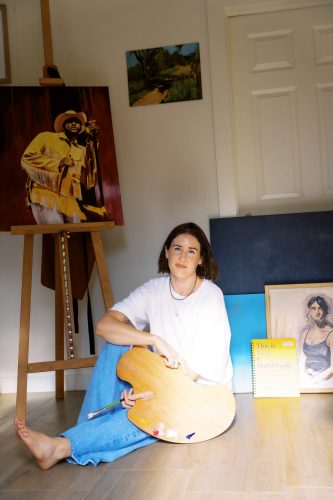
Horn began painting cowgirls after studying photographers who shot them. Courtesy of Lauren Horn | Kinsey Linnae LLC
Tell us about your work on Western female art.
I think living in Fort Worth is so interesting because we have all these little pockets of our city — I live in the artsy historic area, but then there’s the Stockyards that are full-on going back in time. My husband’s family has a lot of people who truly ride horses and stuff, and I started thinking about how interesting it is that those women are presented as feminine as possible. They’ve got jewelry and hair done and dresses, but they also do these dirty, gritty jobs. I really started looking at cowgirls and being inspired by them. So, I started studying some photographers who were doing cowgirl photos, and then eventually decided to start painting them. I think with the Taylor Sheridan stuff coming out, too, people are seeing a different side of Fort Worth. It’s fun when that little group kind of bleeds out into the rest of Fort Worth, and you see the Western influence.
What are your plans over the next few years?
I’ve been working on a new book for the past year or so; I hope to have it out in the next couple of months. It’s different because it’s a combination of a book and art supplies. The whole first book is designed to be done with a No. 2 pencil because I wanted it to be as easy as possible. Now that people have that foundation, I can start adding in materials. So, I’m coming out with what’s, more or less, a product line. It’s been fun, but I’m learning manufacturing now. I’m sourcing from all these different factories that make pencils, erasers or sharpeners, so it’s added a different element for me.
What would you tell someone who has a side project or a business that they’re working on, but they’re afraid to dive into it and take it seriously?
If you feel that it’s a good idea and like it’s going to work, then lean into that feeling. If you’re really unsure, then wait a little bit. There’s nothing wrong with the side hustle being a side hustle until you get some confidence. But I think when you feel brave enough, taking a leap is great. When I left teaching, I was basically resigning with apologies. I was like, “I’m so sorry, but I feel like it’s time,” and a mentor that I had and really admired stopped me and said, “This isn’t the decision; it’s a decision.” I really carried that; like, it doesn’t need to have that much weight. The risk is not as big as you’re making it in your head.
Is there anything else you want to talk about?
The only regret from my time at TCU is that I should have leaned into what I was loving and made it my major earlier. I was in advertising and public relations. I really liked the classes, but I loved my art and psychology classes. If I had realized that then, I think I would have had maybe a different degree, maybe gotten where I was faster, but ultimately it worked out. I think a lot of people who are really artistic and enjoy art think they can’t make money from it, and that’s totally not true. Especially in today’s world, movies, cartoons, animation, and interior designers need artists. I could go on and on about how art can be a ton of jobs, but for some reason, there’s this idea that if you’re an artist, you can’t make money. I wish people would trust their instincts.
Editor’s Note: The questions and answers have been edited for length and clarity.
Your comments are welcome
1 Comment
What a good example of life somehow leading us to find our true interests! By any chance is Ms. Horn related to Dr. Jeff Horn who was a professor in TCU’s education department many years ago?
Related reading:
Features
Crystal Bridges exhibition gives Alejo Benedetti a chance to work with Annie Leibovitz
The 2023-24 exhibit, which included 20 new works, marked the legendary photographer’s first museum commission.
Alumni
DJ Perera Leads Students on the Digital Frontier Where Art Meets AI
Artist, educator and mentor DJ Perera is shaping Fort Worth’s art ecosystem one student at a time, blending tradition with technology.
Campus News: Alma Matters
TCU Painting Major Caya Crum Brings Fort Worth’s Western Spirit to the Canvas
Cowboys, cactus and a lot of pink. The TCU senior’s work turns up all over Fort Worth, from Near Southside to Sundance Square.