
TCU Cardiologist Dr. Mohanakrishnan Sathyamoorthy on Research, Medical Education and Heart Disease
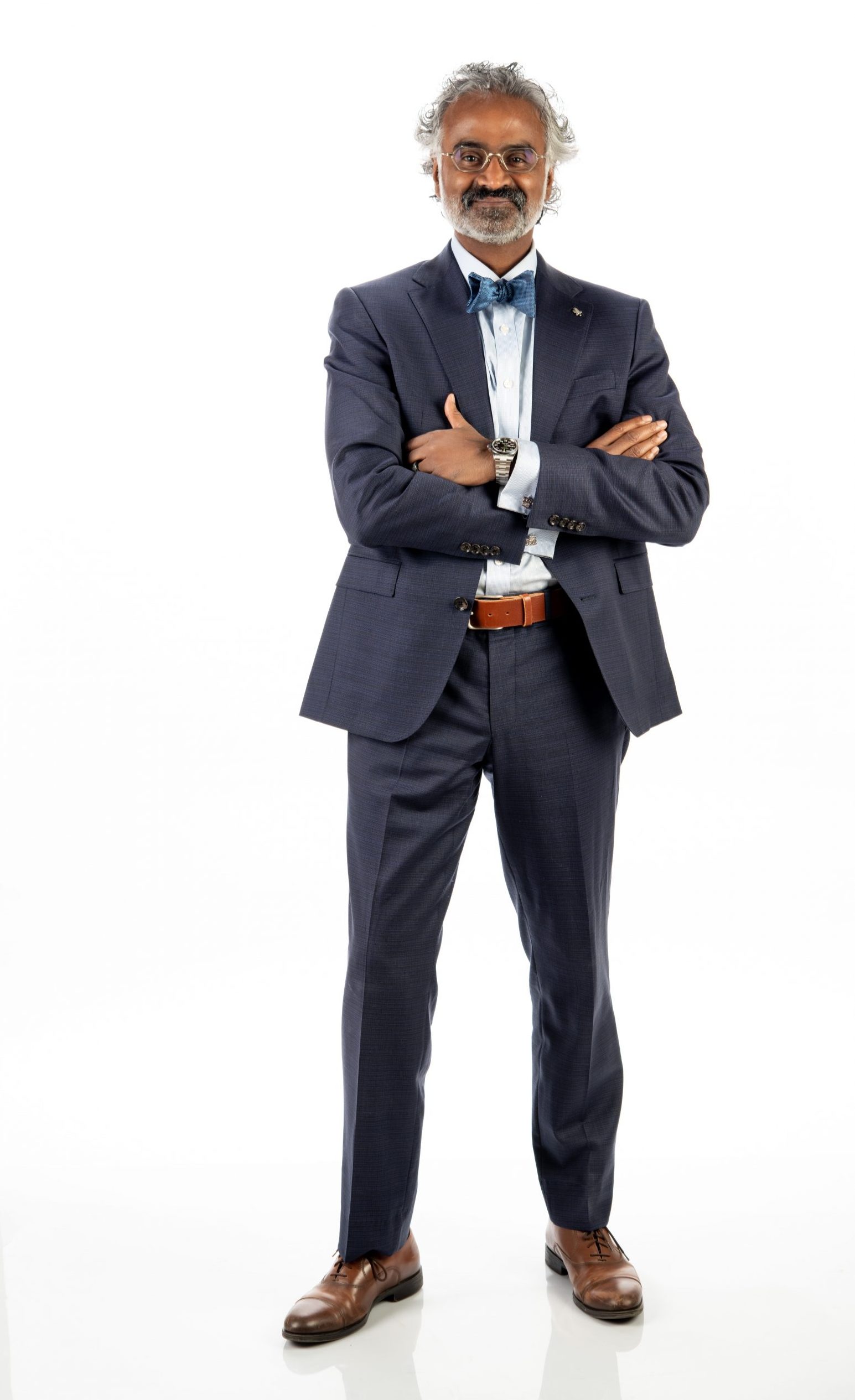
Dr. Mohanakrishnan Sathyamoorthy’s research group submitted the Burnett School of Medicine’s first NIH R01 grant application. Photo by Glen E. Ellman
TCU Cardiologist Dr. Mohanakrishnan Sathyamoorthy on Research, Medical Education and Heart Disease
Dr. Mohanakrishnan Sathyamoorthy — better known as Dr. Mo — serves as chair of internal medicine at the Anne Burnett Marion School of Medicine at Texas Christian University, treats cardiac patients in his private practice and leads the Sathyamoorthy Lab/Research Group. His medical investigations address health issues his patients face, like aneurysms, and serve as a teaching opportunity.
You knew as early as kindergarten that you wanted to be a doctor. What led you to pursue engineering before medical school — and when did you realize cardiology was your calling?
I steered into engineering because of the advice of my father, a professor of aerospace engineering. His advice was, “If you change your mind and you decide not to go to medical school, you can take an engineering degree and do a lot of things with it.” The engineering I studied — biomedical engineering — was highly applicable to a life in medicine.
I was exposed to research as an undergraduate very early on, and I just got hooked. It happened to be in cardiac research.
I realized later in medical school and then eventually in residency, I just felt like a heart person. It was ultimately the best fit for me, in terms of the type of disease, the type of patients, the acuity of the cases.
After training as a physician-scientist at Vanderbilt University School of Medicine, you stayed to serve as chief fellow in cardiovascular medicine, joined the faculty and led a research program. What brought you to Fort Worth in 2009?
My dad became the associate provost at the University of Texas at Tyler, and so Mom and Dad moved to Tyler. My younger brother was training at Baylor College of Medicine in Houston.
Being from an immigrant family, I felt like this was a chance for me to bring our family as close together as possible. I came to Fort Worth and put on a hat as a full-time cardiologist, and left my research life and teaching life behind, which was very, very difficult to do, but with joy in my heart to practice medicine full-time and serve patients and my community.
When you joined the Burnett School of Medicine in 2018, you were already serving in leadership roles at local hospitals. What made you open to the TCU opportunity, and what were your priorities?
I had never intended to leave academia, so being invited back to help elevate the medical school with such a strong leadership team felt like coming home. This time, though, I returned with the added depth of many years as a practicing clinician. I still have to pinch myself.
After about a year of effort in helping to start the administrative build, I decided to put my research group together. I really wanted to create a research enterprise that would feature, elevate and accelerate passion for research among students.
A student that gains experience in our research environment has been exposed to asking and answering important questions. I’ve always felt that having that research background makes everyone a better physician.
You’re mentoring dozens of medical students through the Sathyamoorthy Lab/Research Group. What’s one heart ailment your research explores?
We’re looking at 35 genes that, to date, are the genes that are linked with aortic aneurysmal disease. We’ve been doing this ever since commercial testing for gene sequencing became a little bit cheaper and more commercially accessible to clinical practices.
Aneurysms develop for various reasons. The old-school literature reports that maybe about 15% to 20% of cases may have a genetic linkage. If a person has any type of dangerous alterations in their gene and protein structure, we might be looking at their aorta more frequently, we may operate on it earlier.
Looking at the genes, you can get three results: You can have no mutations; you can have what’s called a variant of unknown significance, meaning as of this moment, that is not considered a dangerous mutation; or there’s something called a pathogenic mutation, meaning a disease-causing mutation. We’ve operated on many of those patients in the last group earlier and maybe as a result saved some of these folks from catastrophic outcomes.
We published a report about 10 of our patients who had a genetic mutation that wasn’t considered dangerous. We showed how these variants actually may be more dangerous. In the past year, people from around the country and around the world have been reading this and have been reaching out to us and saying, “Hey, we’d like to become research subjects in your program.”
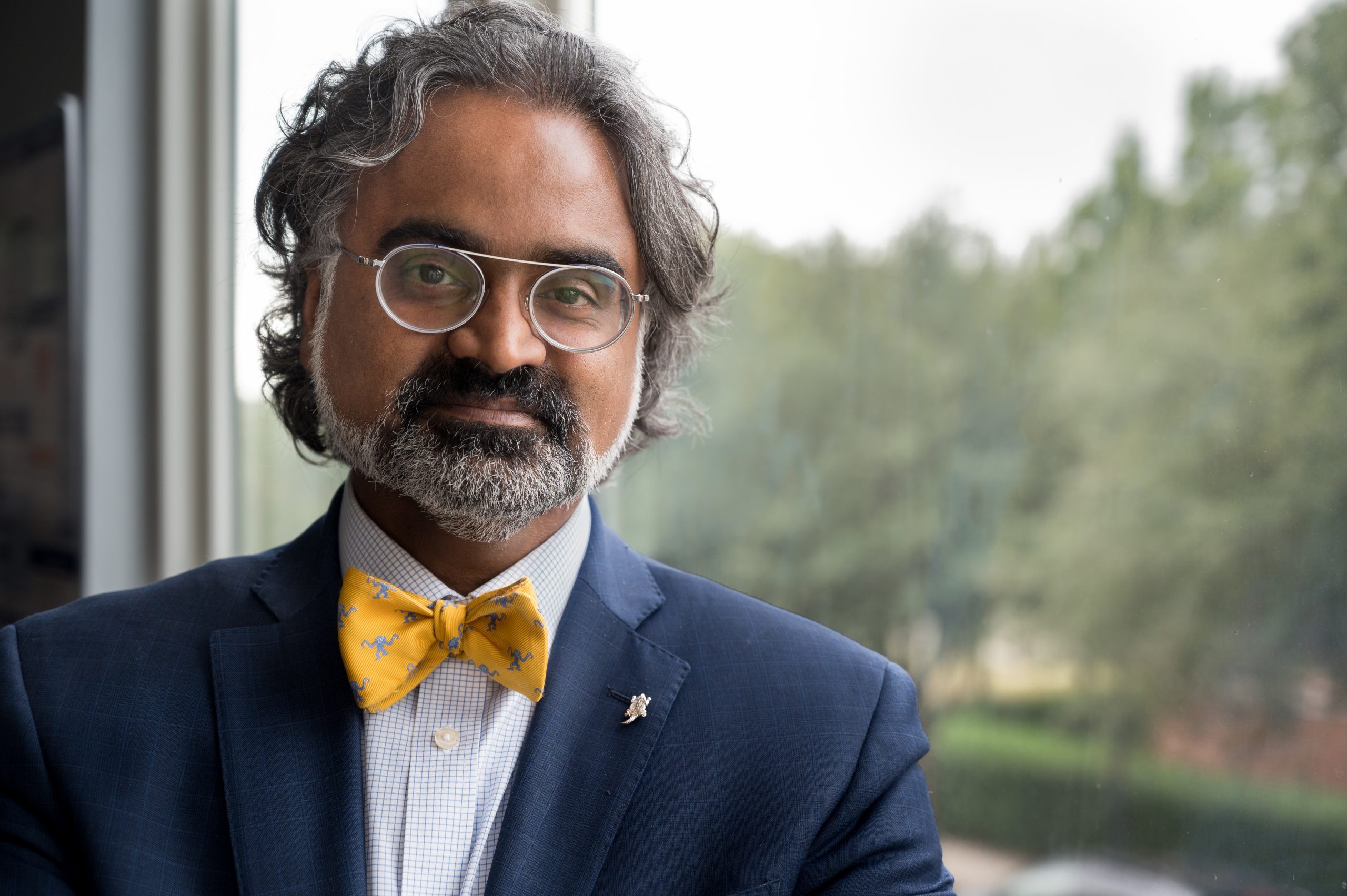
Sathyamoorthy’s research is based on data from patients in his practice, gathered with their permission. Photo by Leo Wesson
How does conducting research in your own cardiac practice impact both your patients and your students?
The research that we focus on is patient-centered, patient-driven and it’s meant in service to our patients, whom we care for and adore in the practice, but then it’s broadly applicable to society at large. It is based on our patients’ data, which we extract with their permission.
That type of work is extremely valuable, because it lets our student investigators see and make contact with our patients, learn more about their history. They become much more connected to the human side of the scientific investigation that they’re doing, and patients love being a part of those discussions.
We’re on the way to building a private research foundation, the Fort Worth Institute for Molecular Medicine and Genomics Research. It’s going to be located across the street from Arnold Hall, so our students can come over and sit down with our scientists in the lab, learn about how those experiments are done, do those experiments with their own hands, learn how to be good hands-on scientists and then sit down and look at data together and work on those manuscripts and publish and report our data, present our data at meetings. I envision this as a crucial site for PhD or MD-PhD training.
“I’ve always felt that having that research background makes everyone a better physician.”
Mohanakrishnan Sathyamoorthy
Your lab submitted the Burnett School of Medicine’s first National Institutes of Health R01 research project grant application, one of the nation’s most prestigious pathways for funding independent biomedical research. What is the significance of that milestone?
It takes years to build a track record to be able to write a grant of that magnitude, submit it and then have the NIH take it seriously enough to put in front of reviewers and get it scored for funding. You have to have preliminary data and science, you have to have a strong publication track record, you have to have acceptance in the scientific community that you might have some degree of expertise in the area because those funds are very competitive. They’re looking at the likelihood of success.
I advised Stuart [Flynn, founding dean of the Burnett School of Medicine] and others, “The goal here is not to get a funded grant the first time we do it; the goal is for us to get the gears as a medical school turning to support novel faculty-led, NIH-sponsored research.” I want to do this for not just my research group, I want to do this for the medical school, and I want to demonstrate proof of principle that we can actually align all the resources necessary to submit a grant, because I want to set that template so that the other members of our department, and then broadly across the medical school, are motivated to do so.
I told Stuart, “I will consider this a victory if this doesn’t get triaged,” meaning it’s just thrown away, return to sender, which the NIH does all the time. So that first email we got in December, I literally clicked my heels, gave my wife a hug, and said, “They’re going to take this thing to study section, and other scientists are now going to read our work, and they’re going to give us critical feedback, and then they’re going to score this thing.”
Though the grant is not likely to be funded, it was graded competitive, and we got very good feedback prompting our plans for resubmission. I consider this a huge victory for us, because we met all the goals I had hoped for in this endeavor.
Our students deserve 100% of the credit because they led our efforts on this grant. Medical students are rarely asked to be a part of a grant-writing team at any university, but because these are our values, we are a student-centered lab, I mentored our team through this whole process.
And I think if you ask any of them, especially the ones that were going to their final year and were able to talk about this experience during their residency interviews, that’s an immediate major star that’s placed next to their name when one of our students is interviewing at a top institution.
As a cardiologist and a father, what advice do you give both your patients and your family?
Four things: Exercise daily, really think about what you’re eating and have good knowledge of nutrition, get good sleep every night, and socialize.
Socializing as human beings is almost as important as all those other variables, and there are a lot of great clinical studies — it’s a very hot field of research — about how important those social bonds are with family, with friends, with community. Fundamentally, that’s part of our program as human beings. The reason why we have been so successful as a model organism on Earth is because of our socialization skills.
Editor’s Note: The questions and answers have been edited for length and clarity.
Your comments are welcome
Comments
Related reading:
Campus News: Alma Matters
Dr. Terence McCarthy Leads New Medical School’s Emergency Program
The doctor is the John M. Geesbreght MD, MS, FACEP Chair of Emergency Medicine — the first endowed chair position at the TCU and UNTHSC School of Medicine.
Research + Discovery
Unwanted Inheritance
Mikaela Stewart’s research is geared toward disarming a deadly breast cancer gene.
Research + Discovery
Deeper Compassion
Joe Hoyle’s capstone project examines the impact of empathy training on scuba volunteers.