

Joy Purcell Rich’s mother, a nurse, instilled in her children the value of serving others.
Joy Purcell Rich ’86 on Leading Susan G. Komen Greater Fort Worth
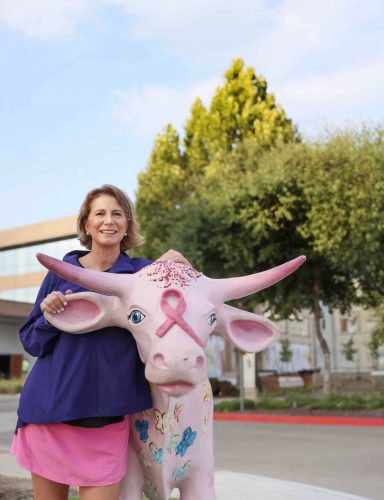
Susan G. Komen, a national nonprofit, has invested more than $1.1 billion in research since its inception.
Joy Purcell Rich ’86, executive director of Susan G. Komen Greater Fort Worth, said that she got her first full-time job — in marketing research for Pier 1 — in part because of an unusual entry on her résumé: salmon slimer.
For two summers as a TCU college student, Rich traveled to Kenai, Alaska, with a friend to work in a cannery, where seasonal employees net long hours and overtime-padded paychecks for cleaning salmon. The experience, Rich said, built grit.
Phil Schneider, then director of advertising at Pier 1, must have agreed.
“He looked at my résumé. He’s like, ‘You don’t really have any experience, but tell me: What’s a salmon slimer?’ ” Rich said. “And so he hired me.”
While her determination was hard-won, Rich always had heart. When Pier 1 partnered with Susan G. Komen, a national nonprofit dedicated to ending breast cancer and saving lives, Rich volunteered on the organization’s very first Fort Worth Race for the Cure committee. Nearly 30 years later, she was recruited to lead Komen’s efforts in Fort Worth.
The nonprofit funds breast cancer research, lobbies on behalf of patients’ rights, educates the community and provides free nurse navigator services, directing people to resources such as free mammograms.
“It doesn’t matter where you live,” Rich said. “Komen’s patient care center is available to anyone, anywhere in the U.S.”
Under Rich’s leadership since 2021, Komen’s annual More Than Pink Walk in Fort Worth has more than doubled in participation — and raises more than $500,000 every year.
“One of the things that I really like to do,” Rich said, “is just bring people together for a good cause.”
Finding Her Footing
Rich grew up in San Francisco, where her father was based as an American Airlines fleet service crew chief. Her mother, a nurse who took time off to raise Joy and her three siblings, instilled in her children the value of serving others.
“My mom was the consummate volunteer,” Rich said. In addition to giving her time to the local school and Episcopal church, her mother had the whole family serve at a soup kitchen.
Rich, a dancer, was excited to come to TCU to major in ballet, but her first year was difficult: Her father, who’d been diagnosed with lung and brain cancer, died that year.
She also grappled with her growing concern that she didn’t have the feet or physique for professional ballet. Rich began considering alternative careers that would allow her to continue tapping into her creativity. She landed on public relations.
As graduation approached, Rich reached out to Pier 1’s Marvin Girouard, then senior vice president of merchandising, who helped her secure the interview for the marketing research position.
“That’s not really what I wanted to do,” Rich said, “but it was a full-time job.”
She began volunteering with an organization that did pro bono public relations for arts nonprofits, including the Chamber Music Society of Fort Worth. Girouard noticed Rich’s efforts. After he became president and chief operating officer, he offered her a public relations job and a challenge: He wanted to see Pier 1 merchandise in magazines.
Rich delivered by visiting magazine editors across the country and providing store products for magazine photo shoots. She also began working on cause-related campaigns, such as inviting a local nonprofit to a store opening event and donating a percentage of proceeds to it.
Girouard had been instrumental in making Pier 1 the largest retailer of UNICEF greeting cards. The business donated 100% of card proceeds to the organization that provides humanitarian aid to children worldwide. Rich built on the program by launching an annual children’s art contest in 1992, using the winning designs on UNICEF holiday cards and awarding scholarship money to the young artists. By 2018, Pier 1 had raised more than $47.6 million for UNICEF.
Pier 1 found a national philanthropy partner in Susan G. Komen. The company supported Race for the Cure, Komen’s flagship fundraising 5K held across the nation, by paying employees’ entry fees and hosting mobile mammography units at store locations. That connection is how Rich first came to work with Komen.
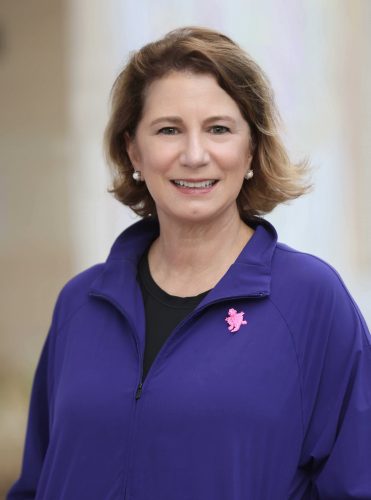
Rich spent a dozen years raising money for the annual fund at All Saints’ Episcopal School.
Following the Mission
After moving on from Pier 1, Rich embarked on a series of jobs that built her fundraising skills, especially in forging and maintaining donor relationships.
First, she was recruited by All Saints’ Episcopal School as the annual giving manager. In her dozen years with the Fort Worth private school, Rich raised money for the annual fund, which paid for everything from faculty development to student financial aid to classroom technology.
“Joy has endless big ideas,” said Keira Breeden Moody ’92, who then served as director of advancement at All Saints. “We would strategize about which ones were the most effective in driving long-term donor stewardship.”
Rich’s next stop was serving as director of annual giving at Communities in Schools of Greater Tarrant County, which places social workers in schools to connect students with mentors and resources. She had no plans to leave when she was recruited in 2021 to lead Susan G. Komen Greater Fort Worth as executive director.
By the time Rich joined the nonprofit, Komen was hosting an annual More Than Pink Walk in Fort Worth each October, a counterpart to Dallas’ Race for the Cure. The walk, Rich said, has no registration fee; instead, it asks participants to fundraise peer-to-peer. Held the first Saturday in October, Fort Worth’s More Than Pink Walk has grown dramatically under Rich’s leadership — from 2,000 participants to nearly 5,000.
Lisa Moore, a four-time breast cancer survivor, said that fundraising is her focus as a longtime board member of Komen of Greater Fort Worth, so the organization can continue its work to end breast cancer. Participants of the walk, she said, find meaning in the event.
“When you see that many survivors, you know you’re not in this alone,” Moore said. “I think it just gives the others hope that they can make it.”
Moore, who served as chair of the 2024 More Than Pink Walk, is especially passionate about the event’s Hope Village, a gathering space for survivors that offers community as well as giveaways, refreshments, massages and face-painting designs with the number of years a person has survived breast cancer.
“I’m 34 years into this, but every year it is so close to my heart,” she said. “It’s just … butterflies that I made it another year — and there’s so many that have come after me, and they’re surviving also. And there are some that didn’t survive; we’re walking in memory of them.”
Rich has also helped grow Pink Tie Guys, a Komen ambassador program that invites North Texas men to compete in a 72-hour fundraising spree. The event surpassed its 2026 goal of $186,000, raising more than $250,000. Sofia Olivarez, executive director of Susan G. Komen North Texas, credits Rich’s ability to forge community connections.
“You really have to have that one-to-one personal connection to do what we do — to work in development,” Olivarez said. “She’s just a star at it.”
Other community events — which have recently included an annual ladies’ golf tournament, a TCU women’s basketball “pink out” game, a Mother’s Day Rangers game with the first pitch thrown by a survivor — also help support Komen of Greater Fort Worth.
Making a Difference
The efforts make a tangible impact. Komen has invested more than $1.1 billion in research since its inception. The national organization funded the scientists who discovered that mutations in BRCA1 and BRCA2 genes can cause hereditary breast cancers and helped develop new treatments for those patients.
Komen advocates have led efforts to pass legislation in 32 states to ensure patients don’t have to pay for follow-up imaging after a screening mammogram. The nonprofit has also lobbied Congress to pass the federal Access to Breast Cancer Diagnosis Act, which would require private health insurance plans nationwide to cover diagnostic costs.
“Health equity is another big piece,” Rich said, “because Black women are 40% more likely to die of breast cancer.”
“When you see that many survivors, you know you’re not in this alone.”
Lisa Moore
Komen has educated more than 5.3 million people with breast health information, many of them through community programs. One such effort is Worship in Pink, through which Komen trains church leaders to educate their communities on the warning signs of breast cancer and to share resources for screenings.
Rich distilled it to a few imperatives: “Know your normal, know your risk, know your family history, lead a healthy lifestyle and get screened.”
Her goals include continuing to bring people — and organizations — together in the service of a good cause. Komen staff have helped with Texas Health Resources’ Puttin’ on the Pink Fashion Luncheon event, nominating survivors to walk in the fashion show. The Texas Health Resources event helps fund its no-cost mobile mammograms, which Komen-trained nurse navigators direct patients toward.
“I think one of my visions when I came in this role,” Rich said, “was for our community to all work together.”
Your comments are welcome
Comments
Related reading:
Alumni
A Legacy of Joy
Tammy Krause’s Bags of Fun honor her daughter’s memory.
Alumni
Mental Health Advocates Jim and Kate Lykes Offer Empathy and Guidance
The TCU alumni draw on their experiences with a family member to support others facing similar challenges.
Alumni
Volunteering at Camp Fire First Texas Leads Brian Miller to a Lifelong Passion for Helping Children Heal
As president and CEO of the nonprofit, Brian Miller combines his passion for mental health and the outdoors to help children grow and thrive.