

Jim Lykes, left, has held board positions at the Harris Center since 2019. Kate Lykes directs community collaborations for adolescents and families at Houston’s Menninger Clinic.
Mental Health Advocates Jim and Kate Lykes Offer Empathy and Guidance
The TCU alumni draw on their experiences with a family member to support others facing similar challenges.
When a family member started struggling with mental health issues as a teenager, Jim Lykes ’89 and Kate Lykes ’92 found themselves part of a community that was far larger than they imagined. One in seven youths and one in five adults in the U.S. struggle with their mental health, reports the National Alliance on Mental Illness.
“Every classroom, every office team and every family Thanksgiving is impacted,” Kate said.
The Lykeses’ determination to help not only their family member but others as well led Kate to a career pivot, Jim to become a community mental health advocate and both of them to support TCU’s Counseling & Mental Health Center so that students can find the care and safe space they need.
“Kate and I did not choose mental health as our passion — it chose us,” Jim said. “We can make a difference.”
Strengths to Rely On
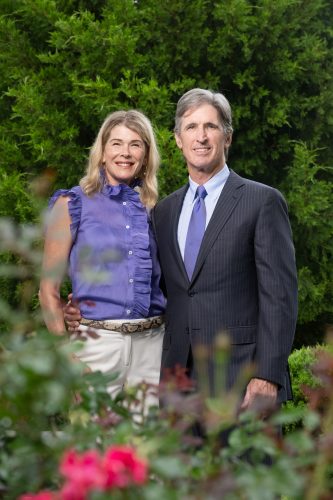
Kate Lykes, left, and Jim Lykes did not meet until after both had graduated from TCU. Their families have known each other for four generations, and the couple raised four children in the Houston area.
Jim’s and Kate’s families have known each other for four generations. Still, the two didn’t meet until after both had graduated from TCU — Jim with a finance degree and Kate with an accounting degree — and had embarked on careers in banking and with a healthcare consulting firm, respectively. They crossed paths a few times and began dating after making a connection at the wedding of Kate’s cousin in 1997; a year later, they married. The Lykeses raised their four children in the Houston area.
Jim admires Kate’s unfailing optimism. “She always sees the good in everything,” he said. “It’s the lifeblood of our family.”
Kate appreciates Jim’s gift as “the grand connector.” “He listens to your story. He asks questions,” she said. “If he knows anything or anyone that can help you, he will connect you two within 24 hours.”
Those strengths, as well as a willingness to ask for help and a commitment to be united in their decisions, aided them along their journey. Mental health challenges impact not only the individual but also the loved ones who support them. The Lykeses’ faith was a comfort to them as well.
“I thought, ‘If God can make this world, he had a plan for that, so he certainly has a plan for this — for us,’ ” Kate said. “That gave me some peace and brought me some calm. When Jim and I were calm, it showed our family that we could handle it, even when they couldn’t.”
Jim also drew on his own lessons learned as a child of a parent with mental health struggles. His father had bipolar disorder and would go through severe manic depressive mood swings when he stopped taking his medication. Jim’s father was a doctor in their small town, so the family felt they couldn’t talk publicly about their struggles because of the stigma surrounding mental health at that time.
“We saw how hard it was for my father not to be able to communicate what was going on with him outside of our family,” Jim said. “Kate and I made a conscious decision that, whatever struggles we were dealing with, we would communicate it with others.”
Connecting Resources, Changing Lives
The support the Lykes family received was so instrumental that it inspired Kate to leave her job as a chief financial officer for a healthcare consulting firm and become a licensed clinical social worker.
“I absolutely believe treatment saved our family,” she said. “Mental health education and treatment improved both our ability to see another’s perspective through their lens versus ours and our family’s ability to communicate through those differences with empathy, validation and boundaries.”
Kate now serves as director of community collaborations for adolescents and families at the Menninger Clinic, a nationally ranked leader in the treatment of serious mental illness.
“I feel passionately that the foundation of our mental health is a feeling of connection and belonging,” Kate said. “The heart of the work I do now is to foster building that foundation — building the collaborative systems that create the connection and resource-sharing opportunities within communities. The evidence says it is measurable and improves the trajectory of school and beyond outcomes.”
Jim has always been a relationship builder; in fact, his title at Origin Bank is executive vice president and commercial relationship manager. He also serves as a board member for several Houston-area mental health organizations.
“My goal is to eradicate the stigma of mental health,” Jim said. “I want people to understand that mental [illness] is a disease, no different than cancer or diabetes.”
Acting as the banker for the Center for Healing Arts and Sciences in Houston, Jim guided John Price ’01 (BS ’07), the center’s co-owner and a depth psychotherapist and educator, through the financial complexities of small business ownership. Along the way, Jim became a mentor and a friend as well.
“What makes Jim unusual is that he also cares for the mental health of the people doing the mental health work,” Price said. “The financial stress of serving others can wear on the people providing the care. Jim understands that.”
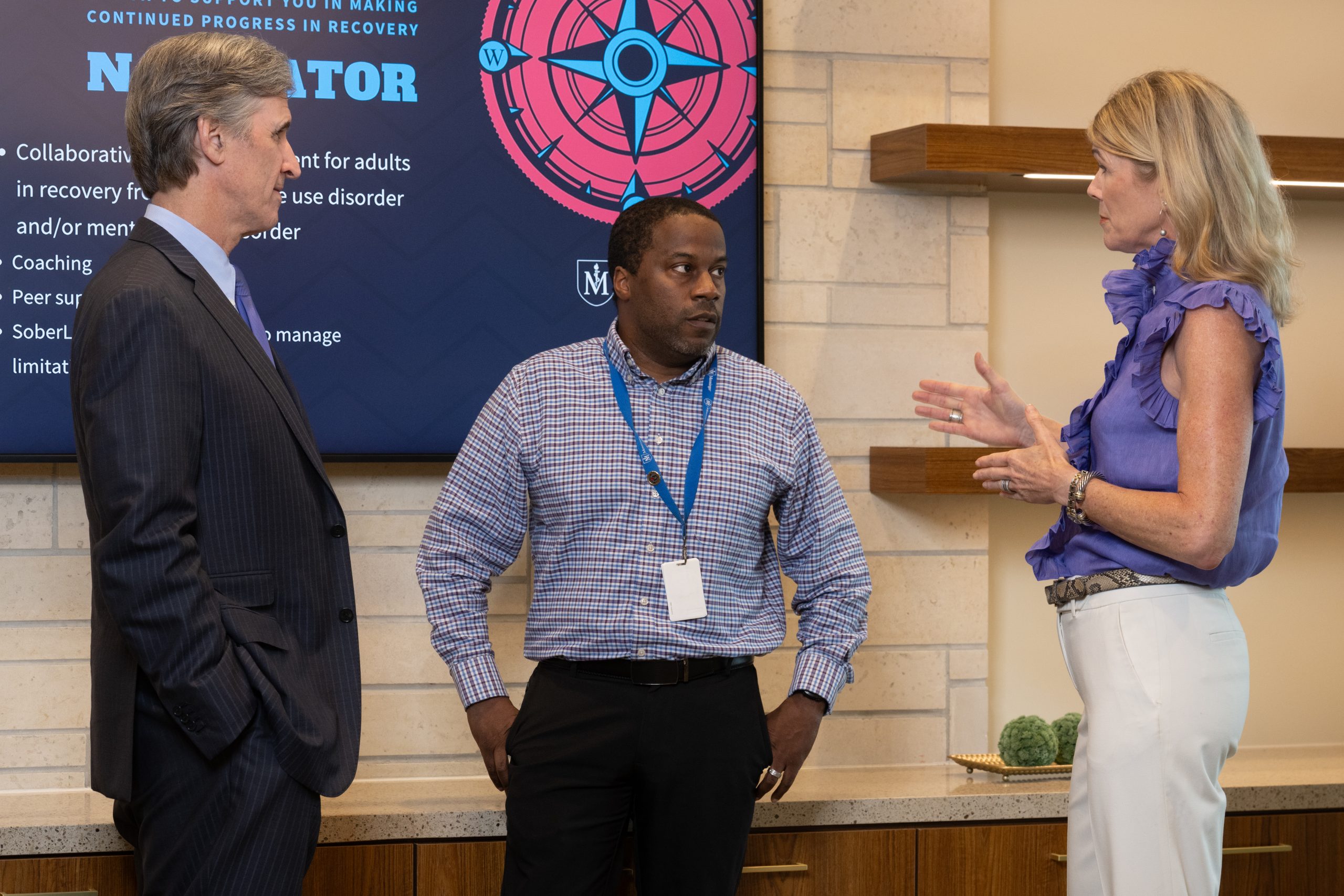
Kate Lykes, right, left a job as a chief financial officer and became a licensed clinical social worker. Jim Lykes, left, is executive vice president and commercial relationship manager at Origin Bank. Alton Bozeman, center, directs the Menninger Assessment Center.
Since 2019, Jim has held several board positions for the Harris Center for Mental Health and Intellectual and Developmental Disabilities, also based in Houston. It’s the largest community mental health center in Texas and one of the largest in the country, and it focuses on providing care for those who otherwise can’t afford it.
“Jim’s personal commitment to expanding our mission has helped position our organization to reach more individuals and families and deepen our impact across the community,” said Wayne Young, CEO of the Harris Center. “He brings thoughtful leadership, strong business acumen and a valuable private sector perspective.”
The Lykeses also support TCU’s Counseling & Mental Health Center, which has been recognized as one of the leading higher education counseling centers. The couple established an endowment for the center’s innovative programs and co-hosted a Houston fundraiser to kick-start its financing.
“The Lykeses’ passion and dedication is extraordinary,” said Eric Wood, director of TCU’s Counseling & Mental Health Center. “I can’t explain just how much that consistent funding means to us.”
Wood has developed the transformative Comprehensive Collaborative Care Model. Its four pillars include specialized on-campus programs for high-need students, dedicated triage and crisis services, peer support and aftercare communities, and campus partnerships for “subclinical concerns,” such as time management. Since 2020, Wood and his staff have trained personnel from more than 100 higher education institutions on various aspects of the model.
“TCU has created a campus-wide culture of connection where students feel like they belong,” Kate said. “Mental health can be so disruptive to your life. When you feel you belong and are cared for, you don’t struggle alone. You can struggle and still stay in school, maintain relationships — you can struggle and still do you.”
Supporting TCU’s efforts, Jim said, “was a perfect pairing of what Kate and I wanted to achieve and what Eric wanted to achieve — to help students everywhere stay in school while receiving the help they need with their mental health so that they continue to be the best they can be.”
The Lykeses reflected on what they’ve learned about mental health:
Early intervention is key. Most mental illness presents itself between the ages of 10 and 24. Early intervention can improve the long-term positive trajectory. If you see your loved one struggling, lean in.
Be curious and ask questions. We’re not with our loved ones 24/7. We don’t know what even those in our closest relationships feel or think unless we ask. Give them plenty of time to answer. If we jump in with a guess or another question, we risk not hearing an authentic answer to the original question.
Model disclosure. Share what you did that day. Include your dreams and fears — be human. Our children want to know us as people, not just parents. This conveys that you do not think you have all of the answers or always get it right the first time. You make it safe for them to not have the answers and to make mistakes.
Present a united front. That was foundational for us. It doesn’t mean you have to agree. Presenting a united front creates clear direction for all and reduces the likelihood of others trying to split you over the differences of opinion.
Communicate openly with others. We get a call at least once a week from friends or family who have loved ones struggling with mental health. We feel honored to help others, just as we were helped — whether to offer resources or simply a nonjudgmental, supportive ear.
Help your child become more resilient. In today’s society, parents oftentimes feel the need to protect their children by stepping in and handling life’s situations. However, letting our children experience the natural consequences of their choices is not bad parenting; it’s a gift of growth.
Be discerning with social media. Social media should be a source of enjoyment, but too often it becomes a driver of comparison. Have authentic conversations with your children about how they feel during and after scrolling. Model social media use for your children: Curate feeds to increase your exposure to the people and material that have a positive impact on the way you feel, and minimize what does not serve you well.
Your comments are welcome
Comments
Related reading:
Features
Caring for the Whole Student
TCU’s Counseling & Mental Health Center supports students in innovative ways.
Alumni, Features
Generation Z Embraces Therapy
Parents often resist the counseling that their children welcome.
Features
TCU Alumni Judges Transform Lives Through Award-Winning Mental Health Court
At a conference table instead of a bench, two Texas judges help people erase criminal charges through treatment and second chances.