
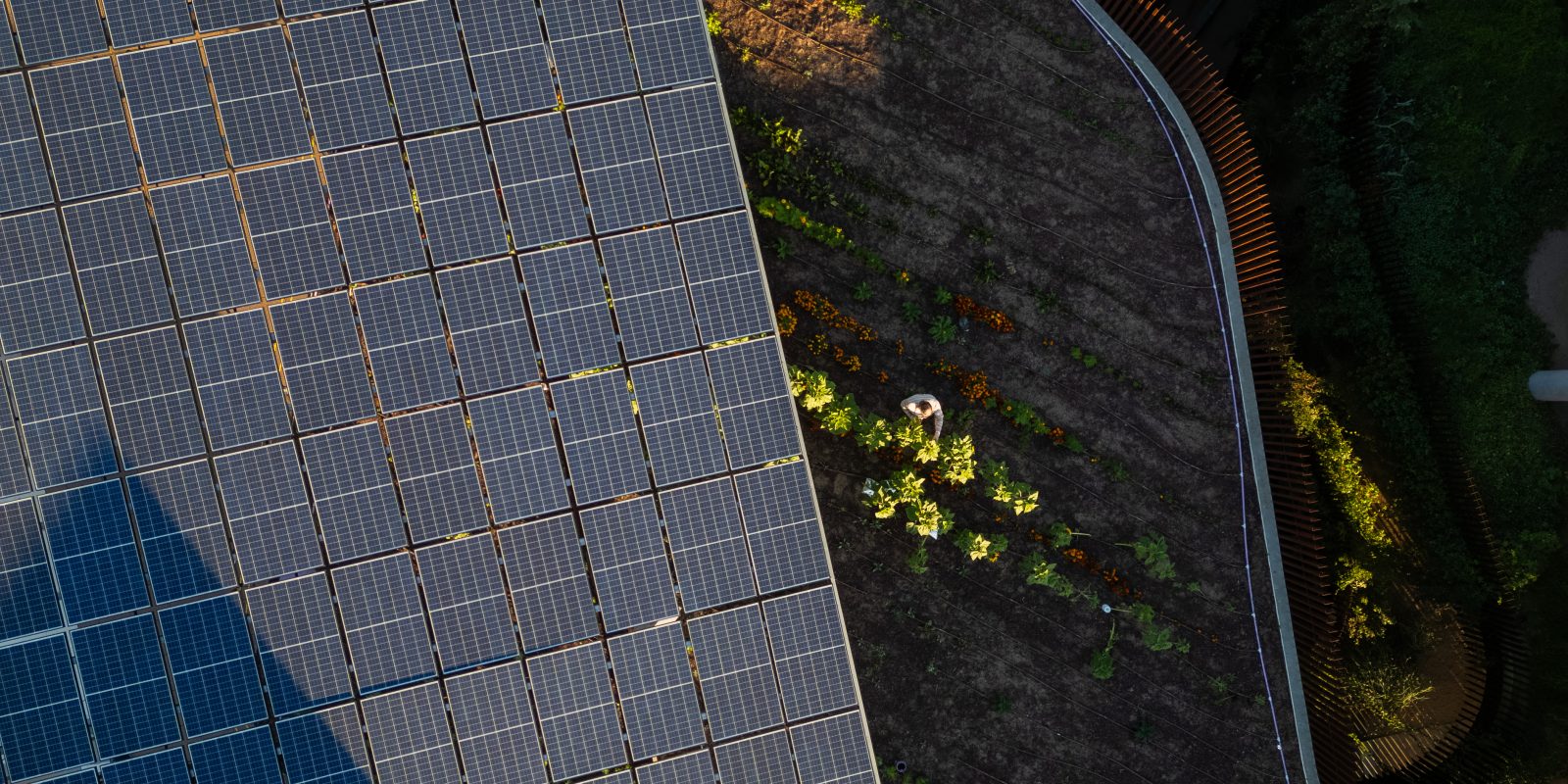
Greg Barron-Gafford tends plants on a rooftop at the University of Arizona, part of his research into “agrivoltaics,” the co-locating of agriculture and solar panels to grow crops in harsh conditions. Photo by Deanna Dent/PHXVis
Sustaining Our Food Supply
TCU-trained innovators work to preserve our resources and curb waste.

Flowers and vegetables grow beneath solar panels at Barron-Gafford’s research site on the University of Arizona’s Tucson campus, a practice known as agrivoltaics. Photo by Deanna Dent/PHXVis
Since widespread temperature record-keeping began in 1880, the planet’s hottest year was a matter of months ago: 2024. The second hottest was 2023. Heat and droughts are squeezing many farmers and ranchers: Fields dry up, vegetables wither, livestock pant for shade. Farms also suffer damaging rain and wind as weather patterns shift.
Faced with these pressures, many farms are veering away from sustaining the nation’s food supply. Millions of acres have been converted to housing and commercial development in recent decades. In addition, food prices often outpace inflation, and food insecurity has worsened in the last five years. One in 6 U.S. households is food-insecure.
Maggie Hanna ’15, a fourth-generation rancher in El Paso County, Colorado, deals with such problems every day as the city of Colorado Springs encroaches. The roar of a stock car racetrack floats over her pastures; other neighbors include a waste treatment plant, a power plant, a solar development and housing subdivisions. The river that waters Hanna Ranch faces extra runoff with every acre of land that gets paved over for development, and sometimes it floods. Calamities like hailstorms and fire also bedevil the ranch.
“It will always be more valuable to put a house on these acres than it will to keep grass right side up,” Hanna said.
For years, she has battled a proposed six-lane highway that would “reach around the city of Colorado Springs and literally will come down my driveway,” Hanna said. “If we are trying to move away from fossil fuels, why do we continue to build communities that are fully dependent on cars?”
Hanna has a different proposition for the land, one that defines her land management ethos: use sustainable ranching practices that include protecting, not paving over, the area’s native grasslands and habitat.
“We’re taking care of this place. We’re producing food and fiber,” she said. “And still we aren’t doing it enough to be considered a benefit to growing cities and municipalities.”
That tension between development and sustainable food production is accelerating across the globe.
Worldwide, more than 40 percent of agricultural production depends on groundwater extracted at rates that aren’t sustainable. Beneath the Great Plains, the Ogallala Aquifer, which waters one-fifth of the nation’s major crops, is drying up. It will require at least 6,000 years to refill naturally. Climate change is expected to slash yields of staple U.S. crops, including corn, soy and oats, in the next few decades. Given the resource depletion baked into modern food systems, some researchers consider much of our food to be like a fossil resource — as unrenewable as oil.
“It will always be more valuable to put a house on these acres than it will to keep grass right side up.”
Maggie Hanna
Yet promising solutions are emerging from unexpected places: a grocery store magazine rack, a grove of mesquite trees sharing water with grass, a ranch where cattle rotate through smaller paddocks.
In 2013, Gina Jarman Hill was standing in a grocery line when a goat caught her eye. The charismatic creature’s photo on a magazine cover inspired her to buy a copy on impulse.
Leafing through the pages, she found an article about food waste in the United States. The information affected her profoundly.
“I was dumbfounded. I was just shocked at how much food was thrown away,” said Hill, now a TCU professor and chair of nutritional sciences. The U.S. Department of Agriculture estimates that the country wastes about one-third of its food supply. That amounted to 133 billion pounds and $161 billion worth of food in 2010 alone.
As a farmer’s daughter from the Texas Panhandle, Hill knew how much work goes into raising and preserving vegetables and other crops. Though she is a registered dietitian, she said the article was her first glimpse of the scope of the problem: “At that time, it wasn’t something that was being communicated very much to dietitians.”
As a doctoral student, Greg Barron-Gafford ’98, another Texas native, noticed something that contradicted decades of ranching wisdom. Observing greener grass under mesquite trees, he began to doubt that the grasses and trees competed for water, a belief that had long shaped a traditional management technique “based in 1950s science,” he said. The science had concluded that more mesquite trees meant less grass for cattle: “They thought if you knock down the trees, there’ll be more water for the grasses.”
But the opposite was true: The plants were sharing water. After studying mesquite trees and grasses, he found that shade provided by West Texas dryland trees cools the air and the ground, reducing water evaporation after rains and leading to lusher grasses.
Today, Barron-Gafford has turned that insight into work on agrivoltaics, a practice that allows crops and grazing animals to coexist with solar panels. The technique can ease the effects of a scorching sun.
These moments of revelation — a magazine article, greener grass under trees, a six-lane highway threatening a sustainable ranch — are helping TCU faculty and graduates answer some of the most urgent challenges facing food systems.
HOLISTIC LAND CARE
Produce, of course, as well as eggs and meat, begins on farms and ranches. For Hanna, who studied ranch management at TCU, tending to the land is a multigenerational family business. Living along Colorado’s Front Range, Hanna raises commercial Angus cattle and irrigated hay on approximately 14,000 acres just south of Colorado Springs. The operation includes sheep and goats, hunting, beehives and outreach programs, including to bird groups, artists, schools and community organizations.
From the late 1940s through the ’70s, her family ran the ranch much as their neighbors did, grazing animals in the same pasture for long periods with a few water stations. Then her father left to learn ranch management at TCU. Armed with new ideas, Kirk Hanna ’78 returned home to Hanna Ranch to put holistic management practices in place at a time when such approaches were barely on neighbors’ radars.
“At that time,” Maggie Hanna said, “all that stuff kind of made you a little bit of a kook.”
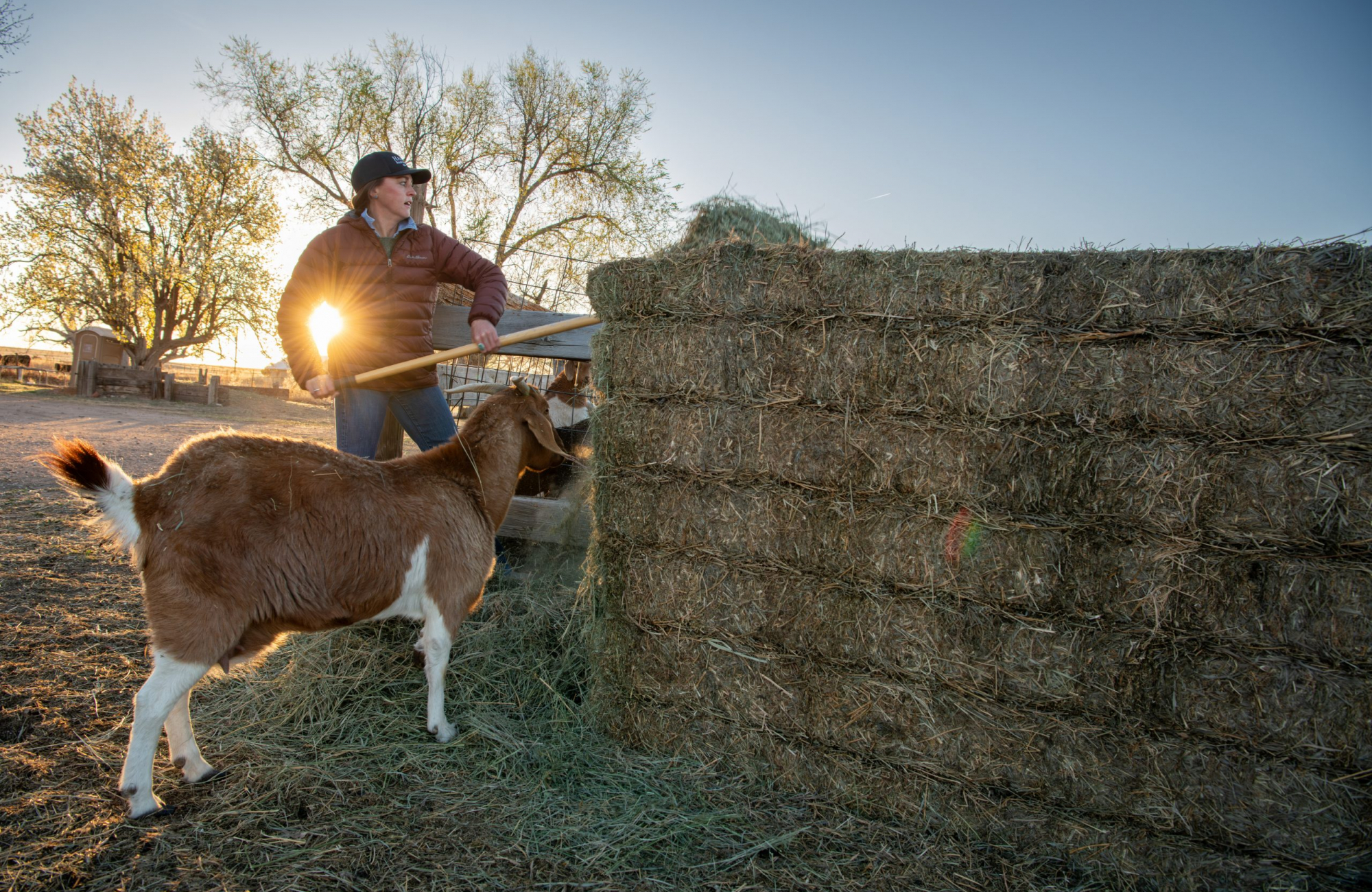
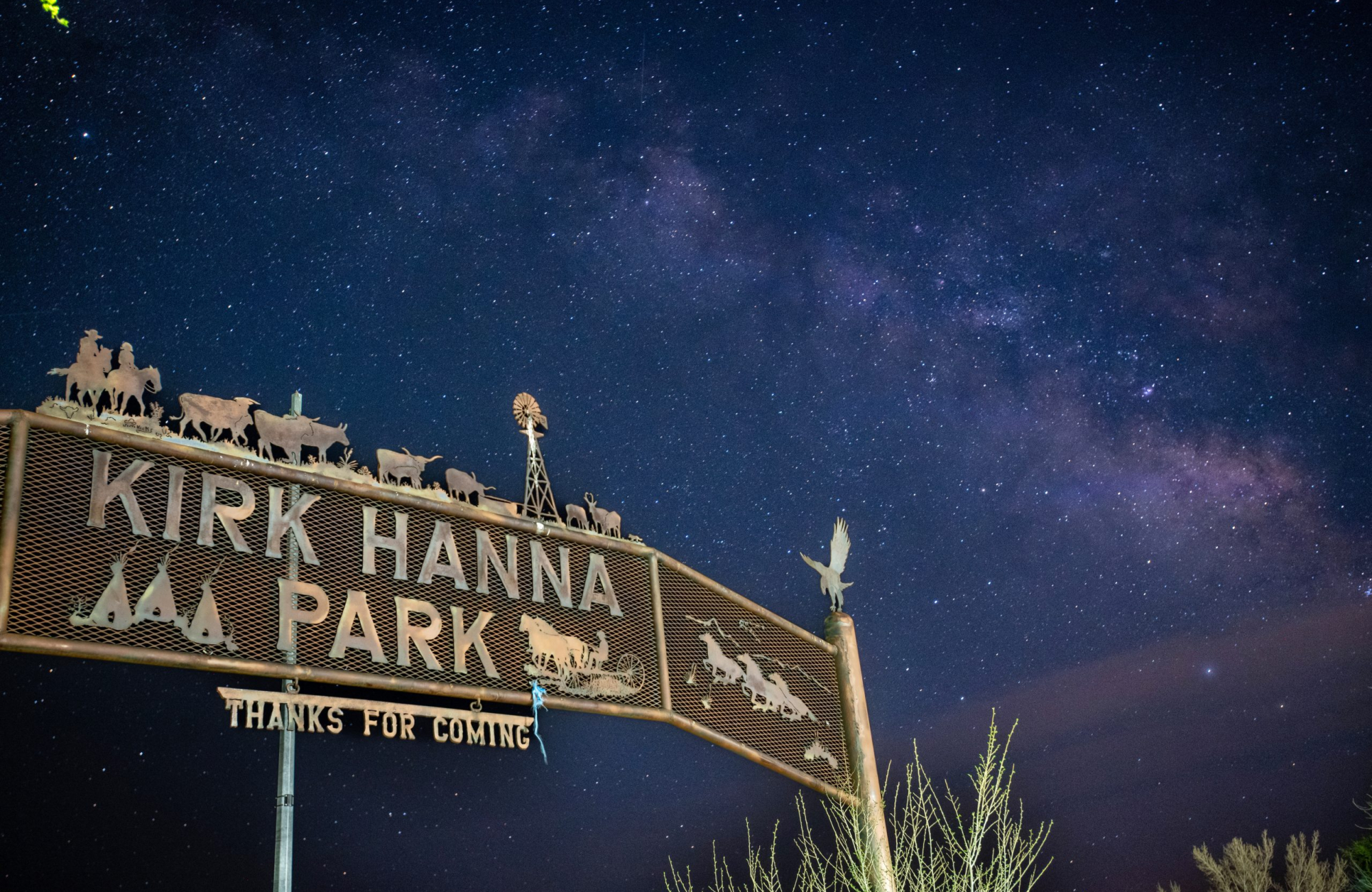
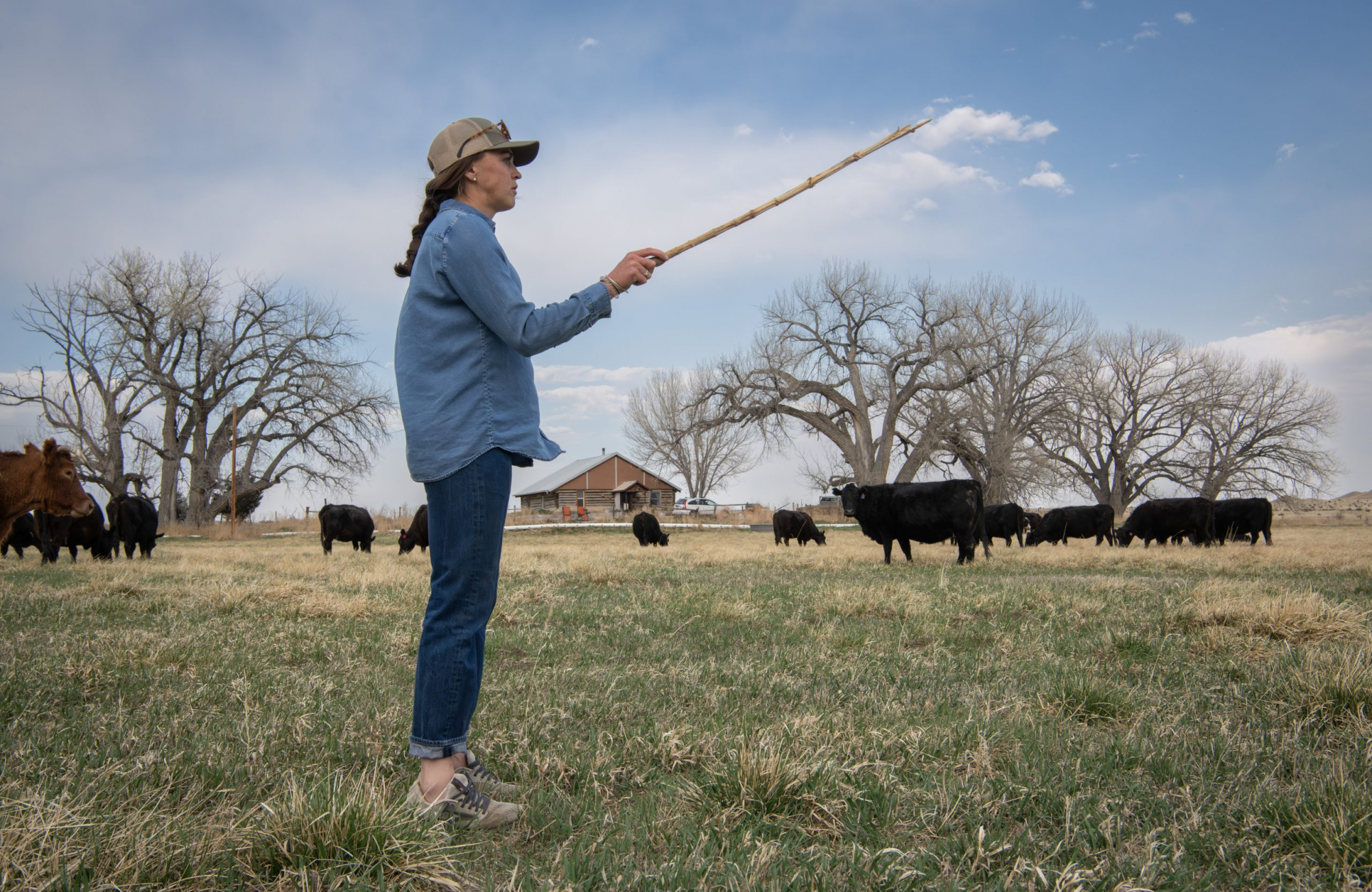
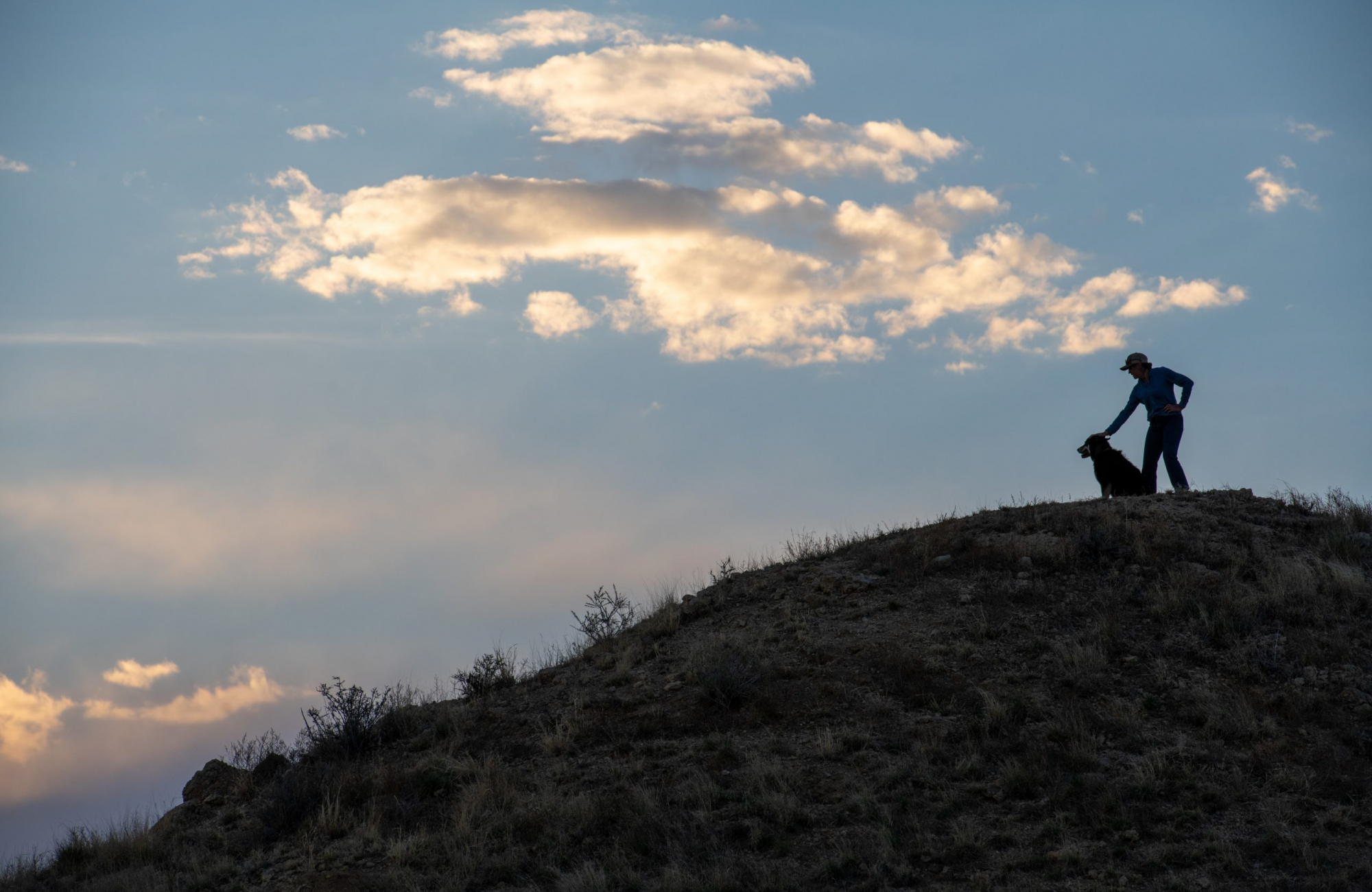
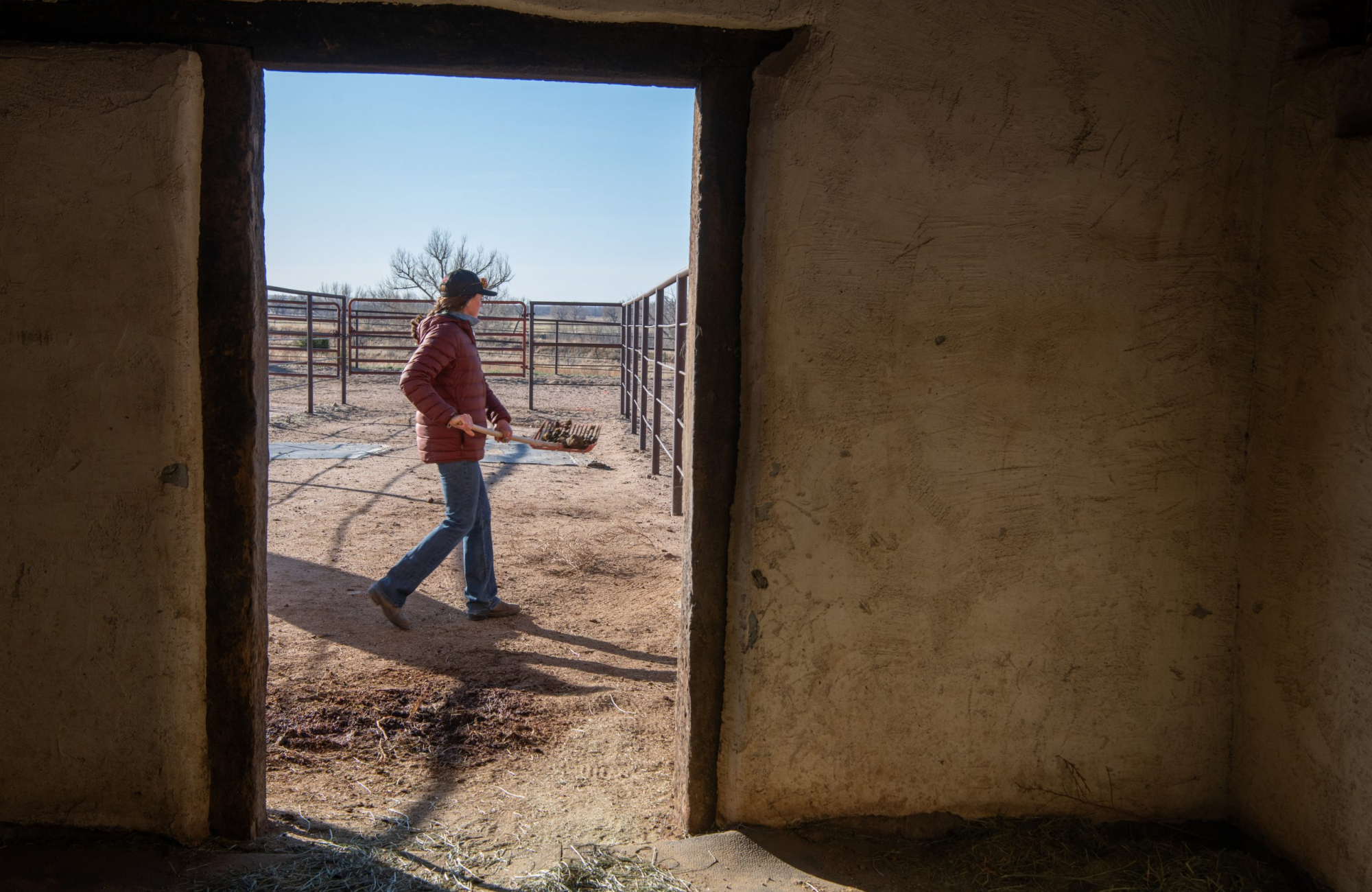
Photos by Chuck Bigger
Yet her father became a respected leader in area organizations, including the Nature Conservancy in Colorado and the Colorado Cattlemen’s Association, even as he faced community critics, including his own brother. Tragically, Kirk Hanna died by suicide when his daughter was 9. The family’s story was told in the 2014 documentary Hanna Ranch.
Today, Maggie Hanna continues her father’s holistic ranching legacy. The ranch avoids cattle insecticides, plant pesticides and chemical fertilizers. It rotates cattle frequently among smaller paddocks, which allows the land to rest and recover much as it did for millennia when bison roamed over it. Avoiding overgrazing means more healthy grasses and broad-leaf plants that help the soil absorb rainfall and fewer bare, impermeable spots — crucial in a climate with 12 inches of rainfall a year. “What catches water is functional soil and plants,” Hanna said.
As interest grows in financially rewarding producers for good stewardship — for example, with carbon credits or payment for ecosystem services — “data is the game,” Hanna said, referring to soil monitoring. “You have to know what you have to be able to put it on a market. … One of the incentives to being an early adopter is that I now have many years of data to show this is moving in a direction that I want.”
Hanna also works to conserve grasslands as director of the Central Grassland Roadmap Initiative. Holistic ranch management, she said, considers all the systems that play roles in the ranch’s capacity, including soil, water, family and community.
Meanwhile, though development pressures eased somewhat in 2025 amid changes in the economy, Hanna doesn’t think they will cease. El Paso County was home to 74,523 people in 1950, and as of 2026 to over 764,000. Officials expect nearly a million residents by 2040. And much of the development is happening outside city limits.
“The hard part of ranching — and ranching with perpetuity in mind and trying to live in a way that is regenerative or sustainable — is that we can’t get lazy. Even though those issues are not choking us today, they will reappear,” Hanna said. “We are never going to be farther from town.”
NEW POWER, NEW FOOD
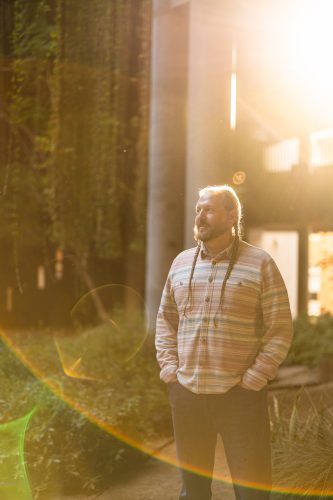
Barron-Gafford has spent his career proving that shade is a resource. His research into agrivoltaics at the University of Arizona is helping farmers grow food and generate solar power on the same land. Photo by Deanna Dent/PHXVis
A 5,000-acre former ranch near Hanna’s property has converted to producing solar energy rather than food. Amid the West’s historic water crisis, many farms and ranches are doing the same. Drought and diminishing aquifers have severely restricted water supplies, often making irrigated farming impractical and driving land managers to adopt solar. Lands that once rippled green with thirsty crops like alfalfa and corn are turning black with solar panels.
“So many of the ranchers and farmers just don’t have enough water to sustain the previous herds or crop production they were doing,” Barron-Gafford said. “That means they need to find another income source to keep the farms alive. That big transition with solar going more into cropland is because people need to sell their land — they don’t have the water to produce like they used to.”
In one 2024 estimate, of 3,177 utility-scale rural solar projects constructed between 2012 and 2020, 43 percent were built on cropland, reports the U.S. Department of Agriculture. Twenty-eight percent more were built on pasture.
But there are ranch- and crop-friendly ways to install solar panels, and Barron-Gafford is proving it. As a professor at the University of Arizona, he studies agrivoltaics, the use of land for the simultaneous production of solar energy and agriculture. The technique can boost crop yields in harsh climates while preserving precious water and generating energy. And it lets farmers maintain their identity and livelihood as farmers and land stewards.
“The secret is out,” he said. “In some places, we might be able to have sustainable food production into a warmer and drier future because of the renewable energy.”
Barron-Gafford first built his knowledge through TCU’s environmental science program, where the interdisciplinary, solutions-oriented approach, he said, was “way ahead of the curve.” He added more knowledge through Arizona’s Biosphere 2, an enclosed laboratory of more than 3 acres funded by Fort Worth businessman and philanthropist Ed Bass. Barron-Gafford is now Biosphere 2’s director of food, energy and water resilience solutions.
In his PhD program analyzing the false “competition” between trees and grasses, Barron-Gafford realized that shade can be a resource. This simple truth became the foundation for his life’s work. “It was an aha moment,” he said. He started to see similar patterns elsewhere, like in a corner of a ballfield shaded by a solar panel: “The Bermuda grass was still green in the winter and in the heat of the summer when the irrigation was otherwise off.”
Looking at solar installations, he had an idea: “What if we put plants back into the system?”
Plants’ microscopic pores release water to cool down, which also cools their surroundings, he explained, “like your favorite Mexican restaurant in the summer with the misters going.”
With a 2013 seed grant, Barron-Gafford bought rolls of turfgrass plus a couple of solar panels, which he mounted on a toboggan to pull over bare dirt and grass. The grass cooled the overhanging solar panels by about 15 degrees, he found, boosting their efficiency. In turn, the panels’ shade cooled the soil, making it easier for plants to germinate and retain moisture. He later found that tomatoes, peppers and cilantro do well under solar panels’ shade.
WATER SAVINGS
In hot climates, plants slow photosynthesis during the hottest, brightest hours to conserve water, a phenomenon called midday depression. By buffering extreme heat and light, shade can create a more hospitable microenvironment for growing.
“You can actually cut out like two-thirds of the direct sunlight, and you don’t cut out two-thirds of the photosynthesis,” Barron-Gafford said. “People across the country have plants on their back porch that are doing just fine.”
That last point is key. Agrivoltaics’ ability to save water may allow otherwise doomed farms to continue growing food. One such water-starved farm in Colorado, unable to irrigate a hay crop through a single season and prohibited by zoning from switching outright to solar, began working with Barron-Gafford to install agrivoltaics. What became Jack’s Solar Garden was a rousing success. Beets, radishes, spinach, lettuce, kale, chard, beans, peppers and eggplant are among the many crops thriving under solar panels there, plus ducks to eat pests and the occasional sheep or cow that grazes off-season.
“The solar is installed exactly the same width and spacing as it would be if it was optimized for solar,” Barron-Gafford said. “We produce 8,000 pounds of food per acre in that space in what would have otherwise been a growing food desert because of a lack of water and a land-use transition.”

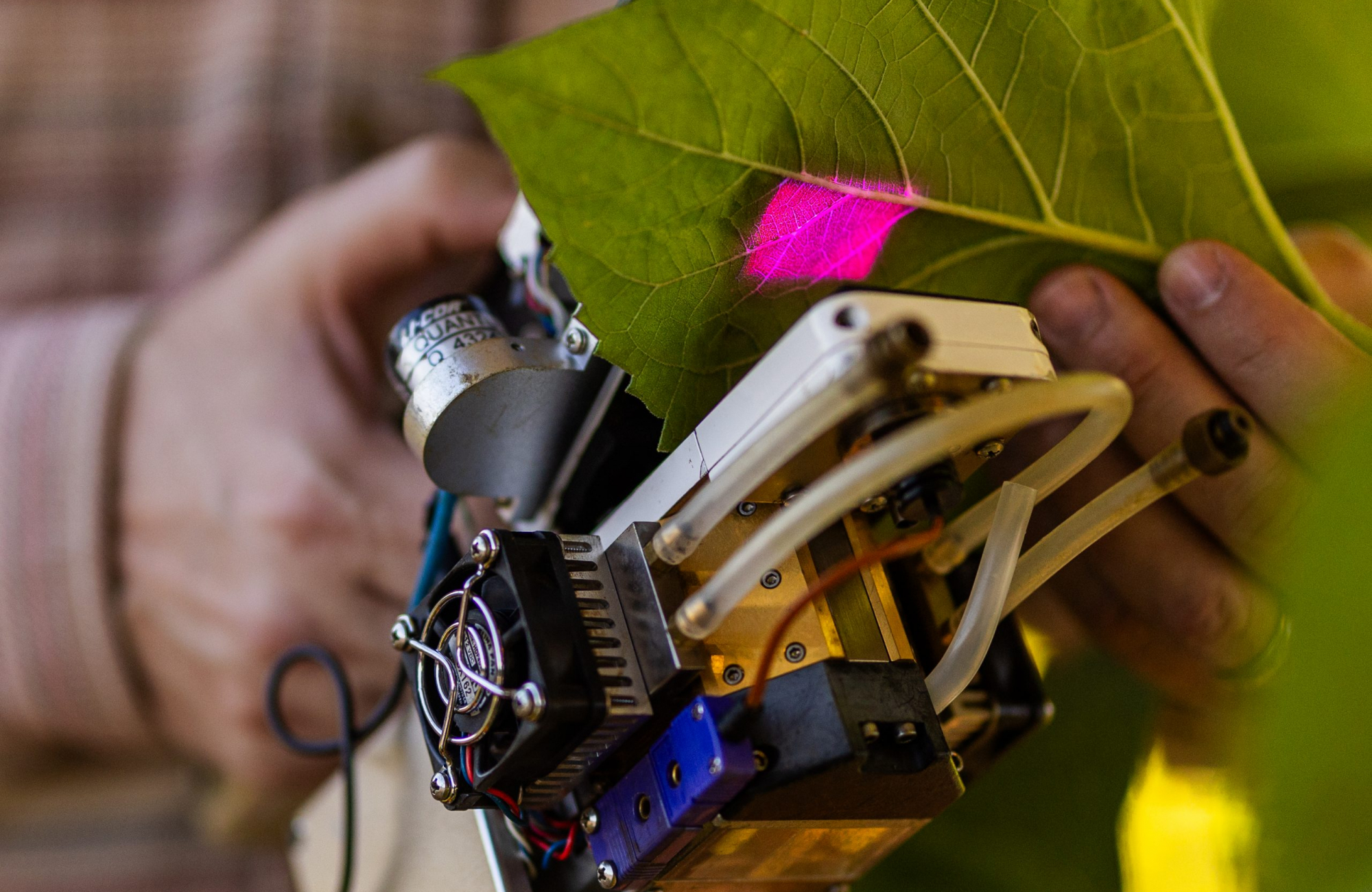
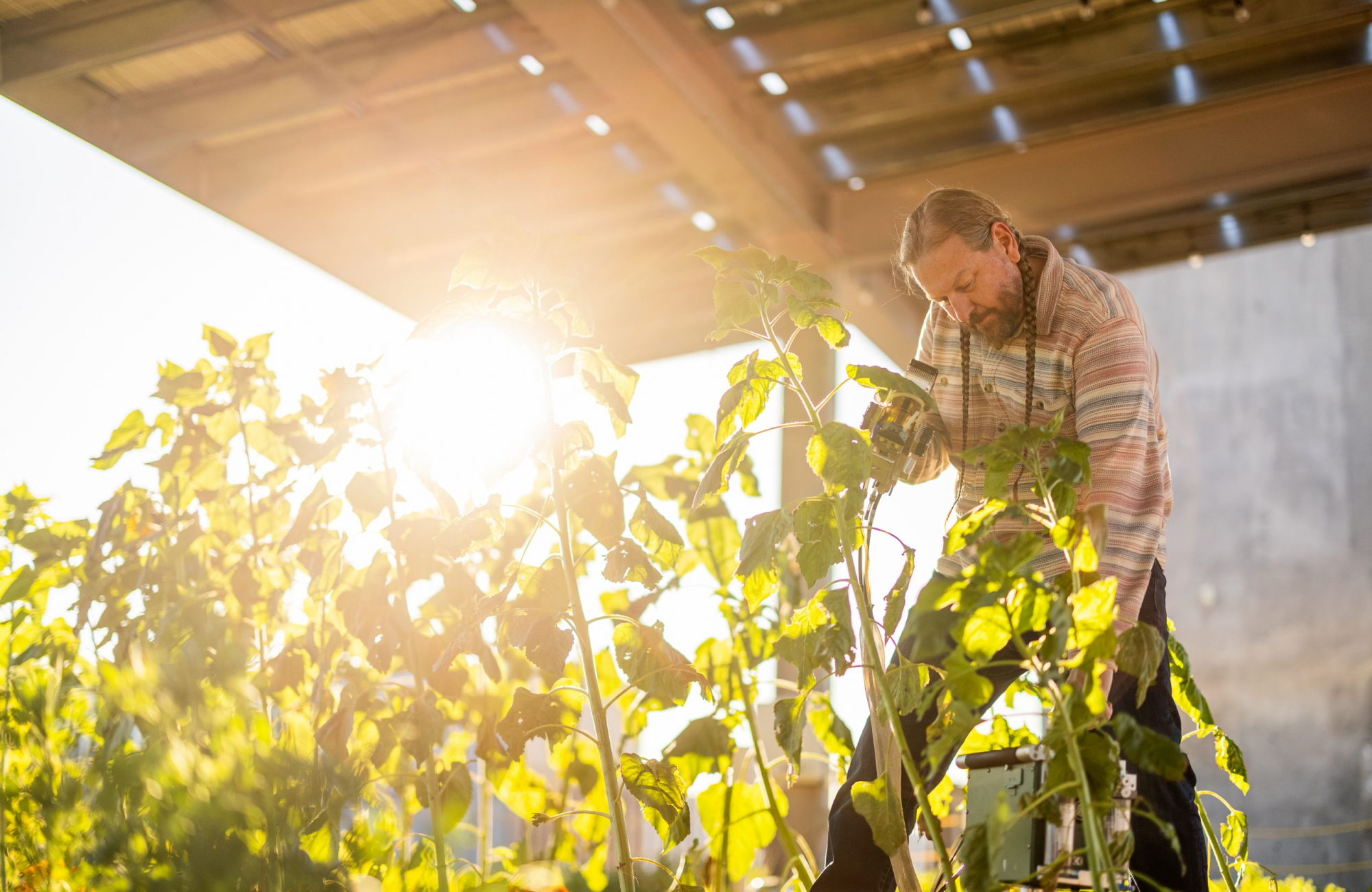
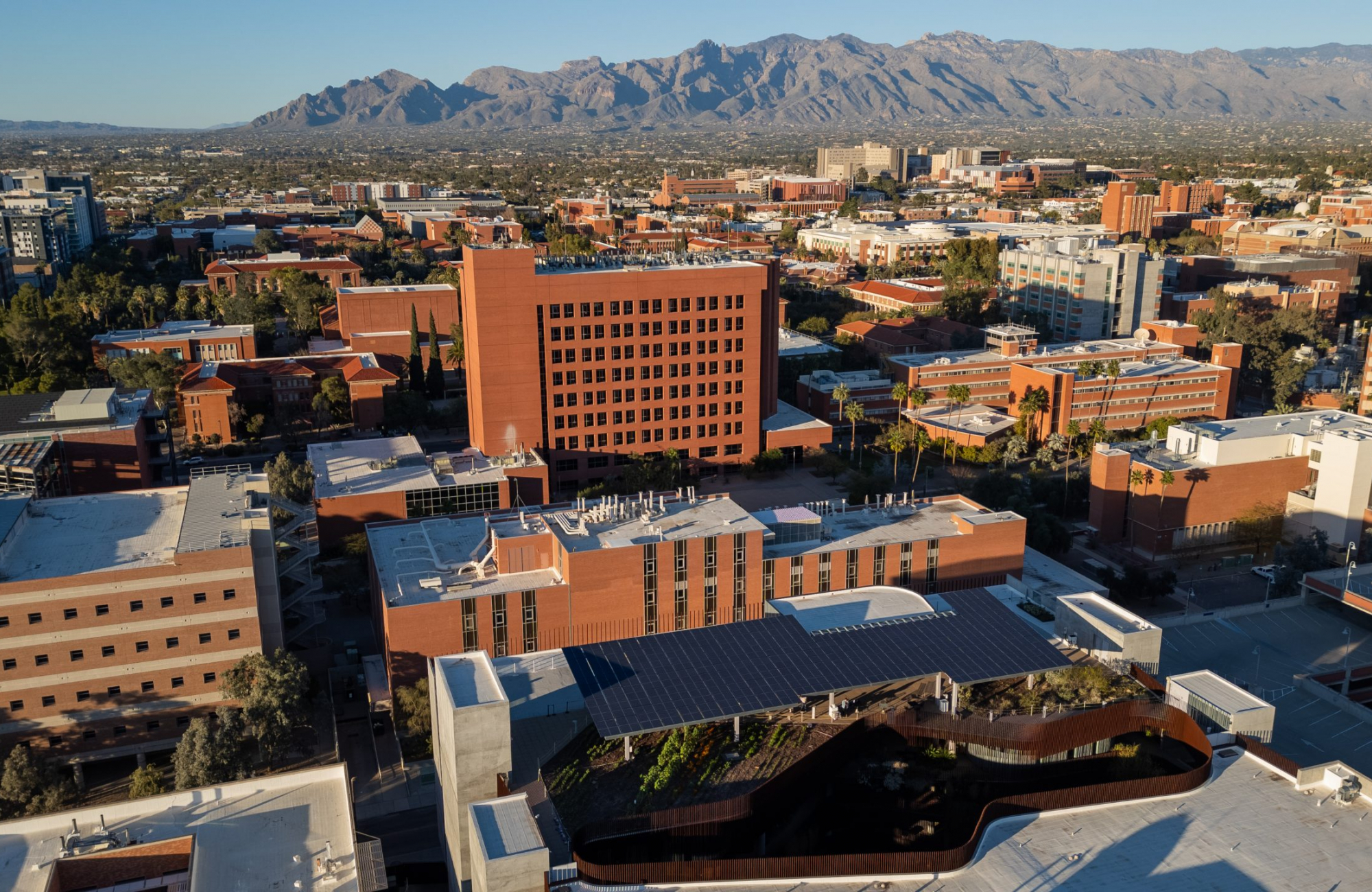
Photos by Deanna Dent/PHXVis
Livestock, too, are increasingly part of the mix, giving rise to the solar grazing industry. Sheep are well-suited to graze under low-mount solar arrays, per the American Solar Grazing Association. And the shade protects forage plants and the sheep from too much sun.
“Solar grazing is really the easiest entry into agrivoltaics,” Barron-Gafford said. “It provides those same benefits that I was seeing with the mesquite tree for the forage [and] the sheep.”
In short, agrivoltaics may offer growers in a hotter, drier world more options, not fewer.
“I want a broader approach to a sustainable future,” Barron-Gafford said. “I don’t want to just solve one problem. I want to solve multiple.”
Those stacked benefits show up in other TCU-connected food innovations, reflecting the fact that even the most sustainably produced food creates waste and leaves neighbors hungry if distribution fails.
PREVENTING WASTE AND FEEDING NEIGHBORS
Following her revelation about the tons of food that wind up in American landfills, Hill said, she began teaching TCU students about food waste. Now “they get this message pretty early and often from our faculty in their lecture classes and through the food labs.”
In 2016, Hill began advising a group of students determined to save food from the trash. Today, TCU’s chapter of the Food Recovery Network works with campus cafeterias to rescue ingredients or prepared foods that don’t make it onto a tray, plus post-football game leftovers from the stadium suites. It all goes to Union Gospel Mission, a Fort Worth shelter for the unhoused.
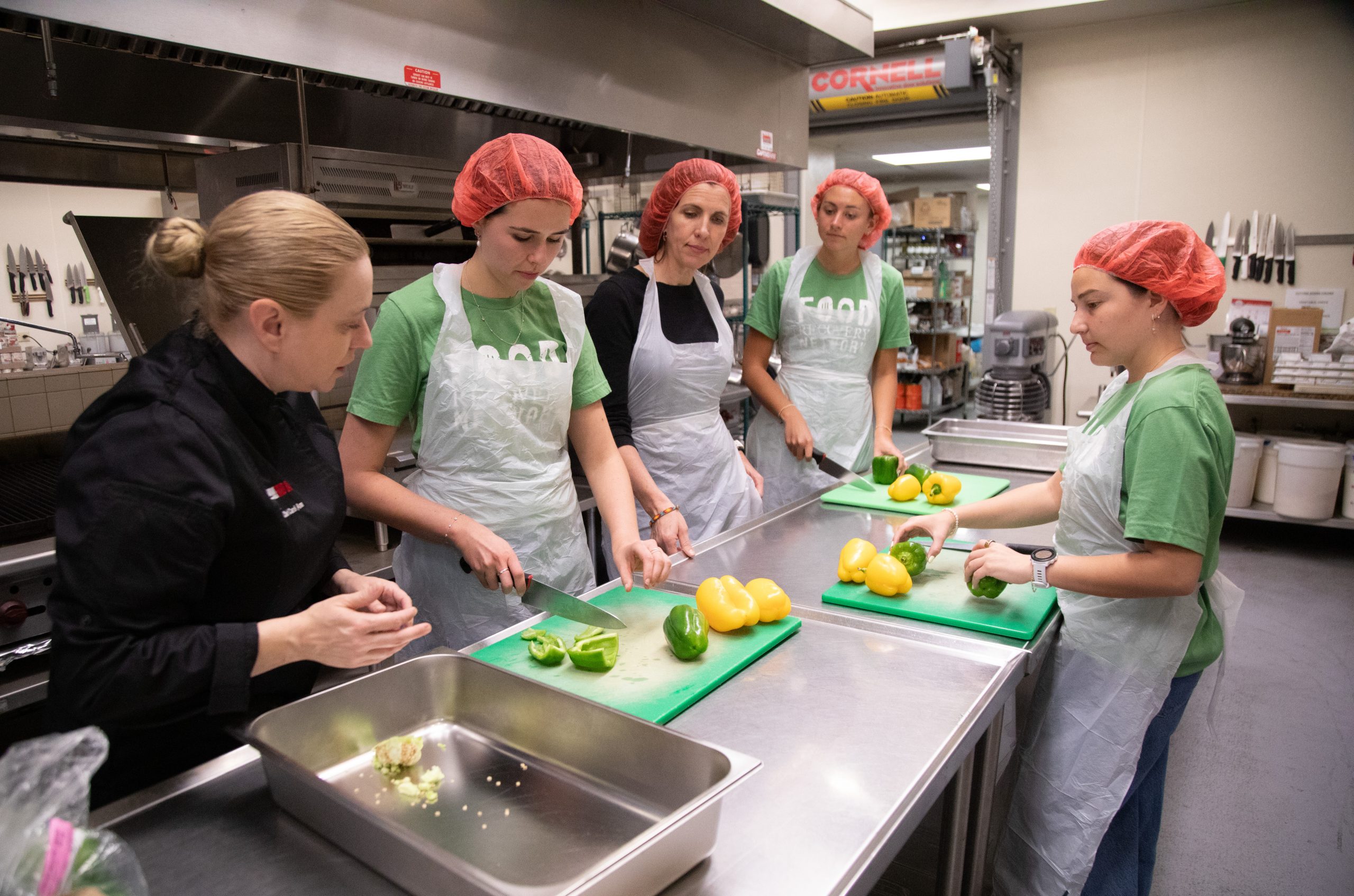
Chef Carol Ann Kroehler, left, gives a prep lesson at the Tarrant Area Food Bank. With a focus on healthy foods, the food bank has increased the share of fresh produce in its distribution to more than 40 percent. Photo by Joyce Marshall
“They get very excited for whatever we’re bringing,” said Megan McGeary, the chapter’s recent president. And it adds up: The record, set in fall 2017, was 10,000 pounds.
Students like McGeary also learn about food waste in class.
“Many people in our community struggle with finances, eating produce and managing food waste,” McGeary said.
Hill’s graduate course, Nutrition, Ecology, Food and Sustainability, examines various ecological issues related to food and nutrition, including food waste as well as how inputs like transportation, pesticides, water and land resources get wasted, stunting the amount of discarded food that could go to people in need. In another course, Community Nutrition and Public Health, students visit a landfill to witness firsthand how large the waste stream is and to discuss the relationship between food insecurity and food waste.
“All of us can do something about it, because the food waste from the consumer level is enormous,” Hill said. “It starts in the home, in your own refrigerator, in your own pantry.”
PAYING IT FORWARD

Julie Butner works to alleviate hunger as the head of the Tarrant Area Food Bank. Photo by Joyce Marshall
Union Gospel Mission isn’t the only place Horned Frogs protect food supplies and help ensure neighbors get fed. Julie Butner ’88, who studied nutrition and coordinated dietetics at TCU, steers a massive effort to feed residents of 13 Texas counties as president and CEO of the Tarrant Area Food Bank, a position she’s held since January 2020. With its community partners, the food bank distributes more than a million meals each week to a half-million people. Some 12 percent of its employees are TCU graduates.
During her time leading the food bank, Butner has worked to ensure that clients receive more nutritious foods. Charitable food organizations like the food bank increase their reach by pooling resources and buying items in bulk to cut costs. The food bank also keeps nutrition in mind, declining donations of sugary drinks and candy and investing in fresh, locally sourced foods that can be distributed both to partner agencies and the community served by the Tarrant Area Food Bank.
“We have been working to ensure that clients have greater access to nutritious options. With the opening of the Sid W. Richardson Agricultural Hub — where we source fresh Texas produce — we’ve increased the share of fresh produce in our distribution from 23 percent to more than 40 percent,” Butner said. “By being more deliberate and thoughtful about the kinds of food we distribute, we can impact not only individual lives but also the overall health and well-being of our community.”
Texas households are among the country’s hungriest, with 17.6 percent experiencing food insecurity, per Feeding America. In the 13-county area served by the Tarrant Area Food Bank, about 572,050 people are food-insecure, and one-third of them are children.
The 21st-century city encroaching on Hanna Ranch will not be the same city that Kirk Hanna came home to after gaining a different vision of food production at TCU. It will be hotter, drier, more crowded, with different types of energy. But it will also inherit people who learned, under those pressures, how to grow more food with less water, how to graze sheep in the shade of solar panels, how to rescue a thousand pounds of hot dogs and beans and get them to someone who needs them before midnight. The problems have compounded for decades. So has the know-how to solve them.
Your comments are welcome
Comments
Related reading:
Features
Sustainable Sportswear: How TCU Grad Kim Drenner Enforces Patagonia’s Environmental Standards
Kim Drenner leads Patagonia’s environmental impact work, driving supply chain decarbonization and pushing the industry toward net zero.
Research + Discovery
TCU Nursing Professor Lori Borchers on Frog Supply, Food Insecurity and Community Cafes
“You can’t take care of your mental health if you’re not fed.” TCU’s Lori Borchers on food insecurity, dignity and pay-what-you-can cafes.
Campus News: Alma Matters
TCU Senior Mark Sayegh Builds One Shade Greener Into Multi-Campus Environmental Nonprofit
A student movement tackles food insecurity through campus cleanups and community gardens across seven universities.