
TCU Nursing Professor Lori Borchers on Frog Supply, Food Insecurity and Community Cafes
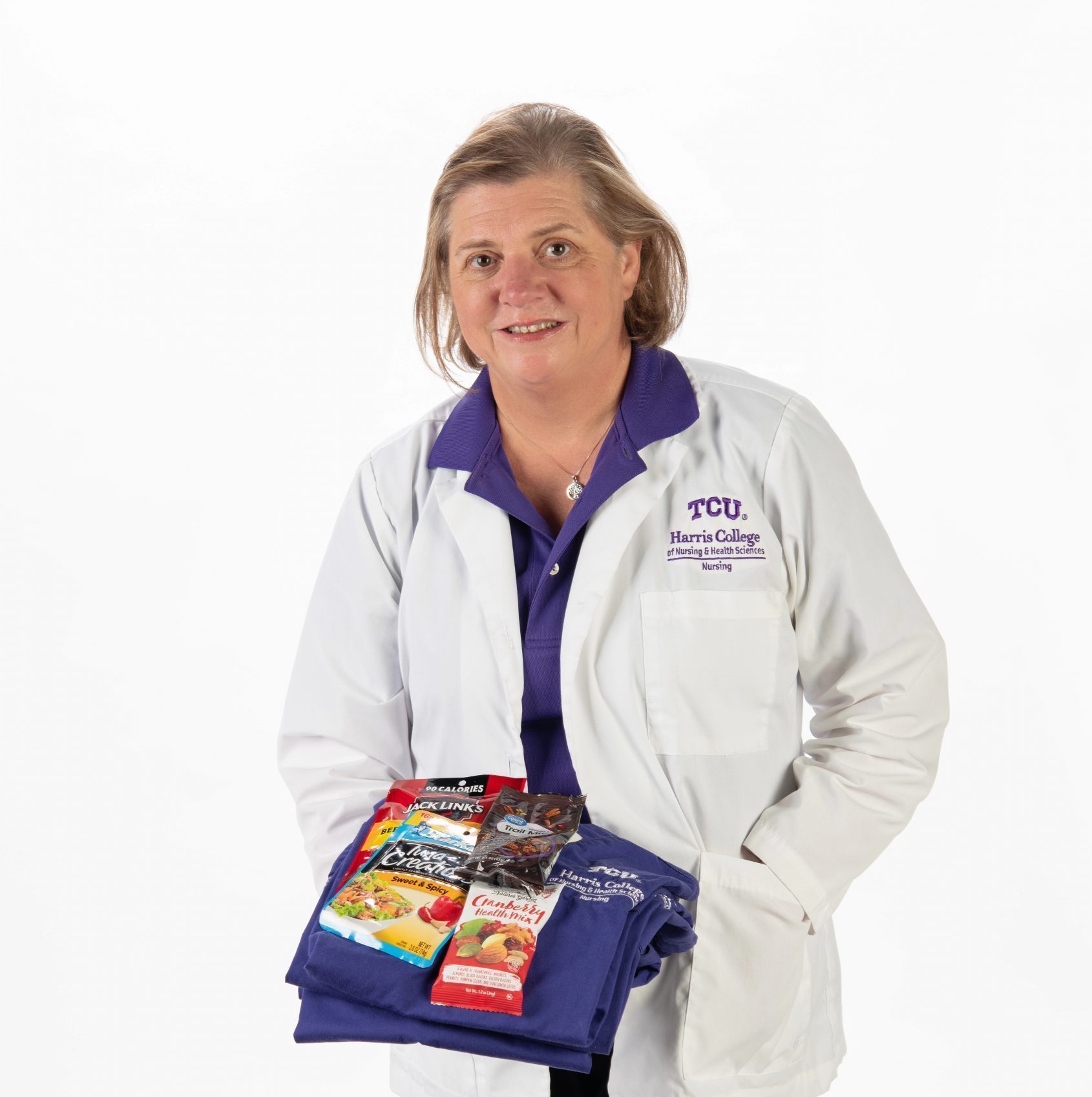
Beef jerky disappears fast. So do the protein shakes and the tuna and chicken packets. Lori Borchers stocks them all at Frog Supply, the pay-what-you-can store she opened for TCU nursing students in October 2024. Photo by Glen E. Ellman
TCU Nursing Professor Lori Borchers on Frog Supply, Food Insecurity and Community Cafes
Lori Borchers ’21 PhD, assistant professor in the Harris College of Nursing & Health Sciences, teaches Public Health Nursing and Clinical Reasoning and Simulation, among other classes. Her research examines efforts to address food insecurity through pay-what-you-can community cafes. Borchers serves on the board of One World Everybody Eats, a nonprofit that supports a national network of such restaurants. She also established a pay-what-you-can supply store for TCU nursing students.
What did your career look like prior to joining the TCU faculty?
I’ve been a nurse for over 30 years, and for the first third of my career, I worked in inpatient hospitals and home care. I focused on rehabilitation, specifically patients with spinal cord injuries, brain injuries and strokes.
For the second part of my career, I started on the postpartum unit, then got pulled to the nursery more often and eventually became the breastfeeding educator. After that, I transferred to Texas Health Resources in Bedford, where I completed much of my lactation consultant training.
I worked a lot in the outpatient center and became friends with Laura Thielke, who was a TCU nursing faculty member at the time. I started working with her students, and we kept in touch. One day she said, “Hey, Lori, if you ever want an adjunct position, we always need instructors.”
I started as an adjunct in summer 2009 and continued in that role for about five years. During that time, I worked as a lactation consultant while also teaching, which gave me the flexibility to manage a good work-life balance. Then, in January 2014, I joined full-time. The last third of my career has primarily focused on education.
What inspired your interest in pay-what-you-can community cafes like Fort Worth’s Taste Community Restaurant?
I applied to the PhD program here at TCU in education leadership, but I didn’t really know what I wanted to study yet. Around that same time, I heard something about this community restaurant and thought, “Oh, now that’s a good idea!”
My advisor Don Mills ’72 MDiv, formerly vice chancellor for student affairs, was the one who said, “Why don’t we look at food insecurity and a sense of community in college students who dine or volunteer at a pay-what-you-can cafe?” So that’s how I got interested in my research.
Also, like all good moms, I was trying to find volunteer opportunities for my kids. For a while, my husband, my boys and I were all volunteering at Taste.
“I don’t think you can take care of your mental health if you’re not fed.”
Lori Borchers
How has volunteering at a pay-what-you-can cafe shaped your understanding of food insecurity at the community level?
You can’t tell who’s hungry and who isn’t, and you can’t really tell who has financial means and who doesn’t. You could have some clues that maybe somebody may not have financial means, but you’re also assuming a lot there. It’s a silent epidemic.
To be able to go in, sit down at the restaurant, be treated with dignity, order off the menu, have wonderful food and truly only pay what you can — that’s amazing, right?
With so many places, if you can’t afford it, you can’t even walk in the door. But at these pay-what-you-can restaurants, everyone gets to enjoy the better cut of steak. When you think about human beings, we all need food to survive. I think these restaurants are doing a great thing.
You connect food insecurity with mental health outcomes in your research. How do these areas overlap?
I don’t think you can take care of your mental health if you’re not fed.
I think the other thing the cafes do is provide that social connection piece. You have a community table, and many times, if you’re dining alone, you might sit down, and then someone you never would’ve interacted with sits down next to you. All of a sudden, you’re talking.
So a connection builds. I’ve heard stories — like a lawyer down the street sitting next to someone who’s having trouble finding housing, and they start talking. And then, lo and behold, the lawyer knows someone who’s hiring, and so on.
I think it’s about putting everyone on the same playing field. Everyone can participate if they want to.
What has been your experience with food insecurity among college students?
Well, it exists. When you look at all the research together, about a third of students are food insecure. And that’s across the board — it doesn’t matter if it’s private, public, two-year — it’s pretty consistent when you look at all the studies combined.
Suzy Lockwood, the associate dean for nursing and nurse anesthesia, tasked me with starting a food pantry for nursing students. So I tasked my spring 2024 Public Health Nursing class with designing Frog Supply, a pay-what-you-can supply store. They worked on it, then my summer group worked on it, and finally my fall 2024 group officially opened it in October 2024. We’ve tried to stock semi-healthy, nonperishable foods, and we’ve also got a freezer full of food and other supplies.
We’ve got a code up where people can scan to donate what they can. If the idea of pay-what-you-can can catch on, then it’s truly equitable, right? Maybe this time they can’t pay, maybe next time they can. Everybody can come in and benefit from it.
How has Frog Supply evolved?
We have four students who are interns in an honorary nursing society, and they wanted to take more of a leadership role. They give me the shopping list, and the students take what I buy and restock the pantry. One of the things I want the students to work on is, towards the end of the spring semester, when everybody’s getting ready to move out, how can they publicize donating unused nonperishable food to Frog Supply?
I’ve got some items that always go, like beef jerky. The protein shakes — they’re a big hit, too. I’ve got individual meat packets — tuna, chicken, salmon — when I went in this week, they were all gone.
We have toiletries and personal hygiene items in addition to food items. And we do have a freezer that has a variety of frozen meals: beef and pork entrees, chicken entrees, vegetarian entrees, Hot Pockets, Uncrustables, burritos.
I had a student last semester who said, “Could I ask other seniors to donate used uniforms?” So she organized a collection, and she got over 120 items, because they’re probably not going to wear purple where they work. It’s just another way of reducing, reusing and recycling.
I’ve got a comment board so they can write suggestions; we get a lot of thank-yous. My hope is, in a future study, I can interview the students and see what a difference it’s made.
You created an online course that helped students develop their own pay-what-you-can cafe concepts. What kind of tasks did the students complete?
I created that course while I was working on my PhD. It was part of the Master of Liberal Arts program at TCU, which is primarily online.
I designed the course to let students develop their own pay-what-you-can cafe concepts. I had them pick a community — their hometown or wherever they felt connected — and do a community needs assessment. They used tools like census data and information from local food banks to identify challenges related to food insecurity in that area. Then I had them create a mission and vision statement for their cafe and come up with a name.
Another part of the course focused on food waste. I asked students to visit a grocery store and talk with a manager or employee about what they do with leftover food; many discovered that it’s often thrown away when new shipments come in. They also interviewed their favorite restaurant to learn about how it handles food waste and spoke with a nonprofit involved in food recovery or distribution. These assignments were submitted as discussion posts, and I think they were really eye-opening for the students.
What are some hands-on opportunities you’d like TCU students to have?
My dream is to start a community cafe on campus someday. I truly see it as an interdisciplinary project. I see business students helping with the nonprofit side. I see nutrition and nursing students working together to plan healthy meals. I see design students designing the space. Then maybe engineering students could work with the design students, figuring out where the electrical outlets go and things like that. Could we build a plant bed and grow food to use?
I really see it as a multidisciplinary effort. And I see it as a way to bring people together who wouldn’t normally cross paths. There are so many learning opportunities and real-life skills that students could take with them.
I did study abroad with Anne VanBeber, who’s a nutrition professor, and she had three or four students who were really excited about this idea because they volunteer at Taste. They’re food management majors, and part of their program requires volunteer hours at places like Taste. So, who knows — maybe one day.
What potential do you see in the pay-what-you-can model to address food insecurity on both a local and national scale?
I think it could make a difference in a lot of communities. When I talk about a community cafe, I’m specifically talking about cafes that are part of the One World Everybody Eats network.
Yes, we’re a nonprofit, but really, we’re more like a network of cafes that help each other. It just takes like-minded individuals who have the dream and the idea to get it off the ground.
There are going to be ups and downs and roadblocks, but if more communities could come together and do something like this, I think everyone would benefit. Our dream that we often joke about on the board of One World is to have a community cafe by every McDonald’s — community cafes everywhere.
But we also know it’s just a drop in the bucket. Some of our cafes are only open limited hours, and people get hungry more than once a day. So, it’s a help and it’s meeting a need, but it’s not meant to replace everything.
Tell us about your recent research.
The One World Everybody Eats team finished a national community cafe survey. We ran it from November 2023 through June 2024. Anyone who dined at a cafe in the One World Everybody Eats network was able to participate. I presented some of the findings at the Association for Community Health Nurse Educators conference.
We worked on the I-HEAL (Improving Health Equity Among Low-Income Adults) research project. A local pay-what-you-can cafe was applying for a Texas Health Resources Community Impact grant; they wanted to start offering additional services — including health assessments — to culinary apprentices and guests. And they got the grant; it was about $750,000 over two years and started in January 2023.
By April 2023, my nursing research assistants and I began seeing patients and collecting data. We provided individualized health education — things like, “Your blood pressure is high. Do you know how often to check it? Do you add a lot of salt to your food? That can raise it,” and so on.
I worked with two pre-med students and our statistician to write up the program results, and we have written a journal article with that data. It’s under peer review right now.
We’re still trying to do additional studies with the community cafes. I’m part of an interdisciplinary research team that involves Texas A&M AgriLife and UT Dallas.
Editor’s Note: The questions and answers have been edited for length and clarity.
Your comments are welcome
Comments
Related reading:
Features
Food Justice Class Shines Light on Hunger, Nutrition
Community gardening, interviews and delivering nourishment to food deserts are all part of the curriculum.
Alumni, Features
Master of Liberal Arts Program Encourages Critical Thinking
The degree gives graduate students a chance to take lifelong learning and leading a step beyond.
Features
Pioneers in Purple Scrubs
TCU’s first nursing students of color have made their mark in health care and opened doors for others to follow.