
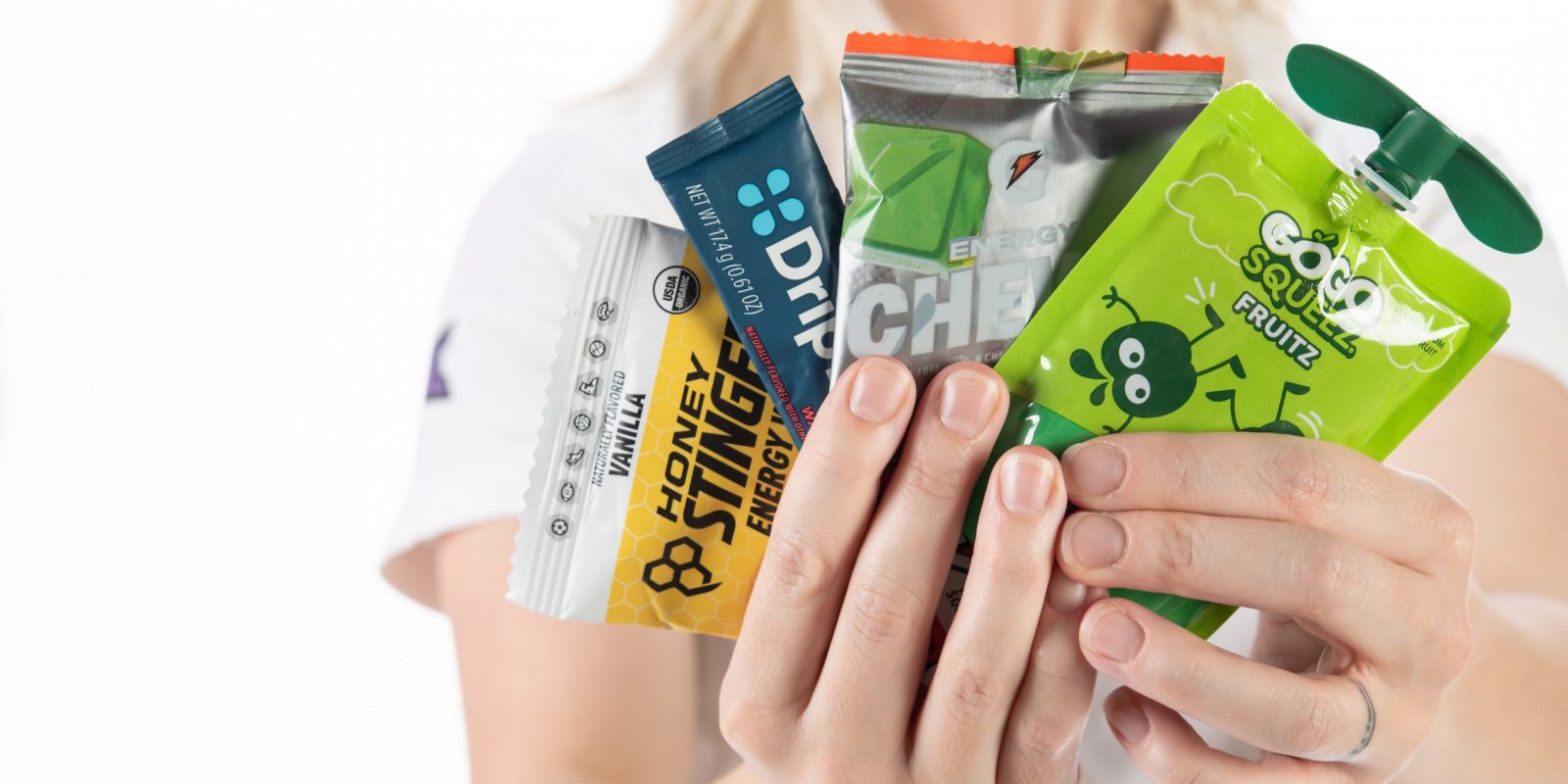
From energy chews to fruit pouches, Jessica Hylander helps student-athletes navigate the products and trends they encounter daily, including the ones reaching their feeds through NIL opportunities. Photo by Glen E. Ellman
Jessica Hylander Explains the Science of Sports Nutrition at TCU
Jessica Hylander’s journey into sports nutrition began almost by chance during her undergraduate years, when she spoke to her university volleyball team about eating well. This simple nutrition education experiment ignited a genuine passion.
Roles at Northwestern University and later at the University of Florida plunged her into the high-stakes world of collegiate athletics, revealing the crucial role nutrition plays in athletes’ performance and success. Those experiences shaped her holistic philosophy, one that transcends physical nourishment to include mental wellness.
Since joining TCU in 2019 as a sports nutrition graduate assistant, Hylander has elevated the program through personalized athlete consultations, team education and staff mentorship. Her role has taken on new dimensions with the recent opening of TCU’s state-of-the-art Human Performance Center, which is transforming how nutrition services are delivered and integrated into athletes’ daily lives.
As the current assistant athletics director for sports nutrition, Hylander focuses on practical, sustainable nutrition, supporting athletes with pre-game meal planning, hands-on learning at the Performance Athletics Dining facility and off-campus dining guidance.
What is your typical workday like?
Something I love about my job is that it’s different every day. I attend interdisciplinary meetings with the sports medicine team, academics team, administration, and strength and conditioning to provide holistic care and enhance support for athletes.
I spend a lot of time one-on-one with the athletes I oversee, specifically the baseball and swimming and diving teams. I lead team talks and educational sessions covering broad topics, but since nutrition isn’t one-size-fits-all, I often meet individually to tailor advice on hydration, pre- and during-competition eating, and what that looks like for each athlete.
Much of my time is also spent on meetings to keep the department running smoothly, managing budgets and ensuring systems and inventory are in order so we can provide consistent support.
What are some of the main nutritional challenges college athletes face?
Often, it’s the basics that are the hardest to grasp. For student-athletes, the biggest issue I see is skipping meals. Their schedules are packed, and they have very little time to prepare food or even grab something to eat. Many of my meetings focus on figuring out how to fit in three meals a day, which I always say are non-negotiable. Every human needs three meals a day, athlete or not.
Hydration is another big one. Being in Texas comes with a different level of heat, and many of our athletes come from different parts of the world where they are not used to this type of weather. I work with them on individual hydration plans. We focus on small goals, and I meet them where they are so they can reach what they are trying to accomplish through nutrition.
What role does the Performance Athletic Dining facility play in athlete performance and wellness?
The facility is incredible. It gives athletes hands-on access to the same concepts we cover in one-on-one meetings and team education. It is an interactive learning space they can use in the moment, and they can also carry those concepts into any other eating environment, whether they are dining out, eating at the Brown-Lupton University Union or cooking for themselves.
One model is our red, yellow, green system. Red foods are the most calorie-dense, yellow are moderate, and green are the lightest. When we meet with athletes, we talk about their goals and how to use that system. If an athlete needs more calorie-dense meals to support performance, we might tell them to choose mostly red and yellow foods. They can then visualize what that plate looks like. Outside the performance dining facility, they may not have the color coding, but they can still build meals that look similar. The goal is longevity. We want them to use these tools to be successful athletes, but also successful humans at TCU and beyond.
The Performance Athletic Dining facility also plays a big role in building community. All athletes eat there, not just specific teams. It is great to see a soccer player sitting with someone from tennis, or swimming and diving mixing with a triathlon athlete. It helps them get to know each other, and it gives dietitians a relaxed space to mingle, talk and build the relationships athletes need in order to trust us.
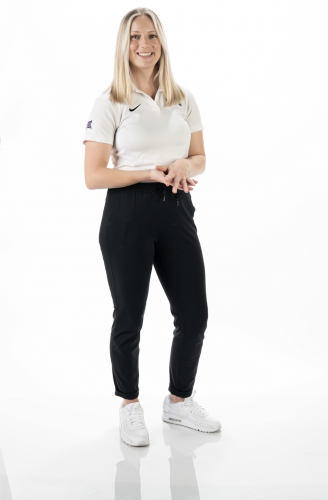
Hylander’s approach to nutrition counseling extends beyond the plate, drawing on intuitive eating tools and close coordination with mental health professionals. Photo by Glen E. Ellman
How do you incorporate mental health and overall wellness into your nutrition counseling?
I always say you cannot make progress with nutrition if you are not doing well internally and mentally. As dietitians, we often reach a point in a consultation where something is beyond our scope. If an athlete needs a mental health professional to move forward, we involve one. We refer to mental health services all the time so the athlete can address what they need to address.
We use concepts like intuitive eating, which focuses on how a person feels rather than how they are perceived or what a number says, whether that is a scale number or a performance metric. In sessions, an athlete might say they want to be 200 pounds. Instead of staying focused on that number, I will ask if they have been 200 pounds before and how they felt at that weight. Did they perform well? Did they feel slow? Did they feel better at a different weight? It is about helping them connect with their body, brain and emotions rather than anchoring everything to a number, which athletics often do.
We also care for many athletes who struggle with eating disorders or disordered eating. We make sure they are supported nutritionally and connected with the right mental health professionals. We have seen these issues grow more prevalent since Covid. A lot of this work also involves celebrating different meals and helping athletes build a healthier overall relationship with food.
What’s one go-to recipe or snack you would recommend for athletes that might also appeal to non-athletes?
I always want to make sure it is a balanced snack, so I look for something with a carb and a protein. We do a lot of smoothies because they are easy and great in the Texas heat. I always add protein powder and fresh or frozen fruit. It is simple but really refreshing.
I know this sounds odd, but I have also been loving scrambled eggs with cottage cheese over toast or a bagel. I will eat it for breakfast and then use it as a snack later too.
Are there any food trends, like plant-based eating, functional beverages or recovery snacks, that you see crossing over from mainstream dining into sports nutrition?
Our athletes are really tuned in to Instagram and the latest trends, especially with NIL, because they’re constantly approached to represent brands or products. Energy drinks are definitely one of the biggest trends I see. Probiotic drinks are another popular one.
What role does Fort Worth food culture play in how you educate athletes about making smart dining choices off campus?
Our off-campus athletes receive extensive education on how to eat out. We also partner with Red Card, a company that works with select Fort Worth restaurants to offer our athletes healthy options. The administration can load money onto a card that’s used only for food, ensuring athletes get good meals rather than spending per diem funds elsewhere.
We educate athletes on the restaurants in this program and guide them on what plates to choose for regular days versus before or after competition. Beyond that, with tools like the performance dining facility, athletes can apply these concepts at any restaurant they visit.
We also partner with local restaurants to highlight cultural events, like Hispanic Heritage Month in October and Black History Month in February. During these times, we feature predominantly Black-owned or Hispanic-owned restaurants to showcase the rich and diverse food culture Fort Worth offers.
How do you envision the Human Performance Center transforming the way TCU approaches sports nutrition?
It allows us to do much more for our athletes. For example, we can now provide collagen shots. We can also customize smoothies and improve food preparation thanks to the larger space.
The new center has helped our department evolve by improving the ease of service and flow. Nutrition stations are spread throughout the facility, so athletes have easy access to vitamins, pre-fuel, hydration and recovery options.
It takes our collaboration to the next level. For me, being in the new facility means I’ll get to see athletes more often while they’re lifting and using the nutrition stations.
Will the new facility allow you to track and personalize nutrition for student-athletes in ways that weren’t possible before?
Definitely. We now have a program that lets us track smoothie orders by team and individual. This helps us see who’s participating and recovering well, and who’s taking advantage of the free resources we offer.
When it comes to individualizing nutrition, we can now spot trends in what athletes choose. Before, it was more of a free-for-all. Now, during meetings, I can pull up their choices and say, “It looks like you picked this smoothie, but if your goal is to gain weight, let’s try this one instead.”
“A big misconception is that lighter equals faster.”
Jessica Hylander
How do you see technology such as body composition scans or other data analyses shaping your work?
We have a new body composition machine called a Dual-Energy X-ray Absorptiometry (DEXA) scanner. It measures body composition more accurately than before and also tracks bone mineral density.
One key use is with the swimming and diving teams. Because swimming is a low-impact sport, athletes’ bones can become less dense. The DEXA helps us monitor their risk for stress fractures and other bone injuries.
Additionally, body composition data helps us assess soft tissue and prevent related injuries, allowing us to individualize care and recommendations.
What excites you most about the future of sports nutrition at TCU?
We’re actively working to partner with on-campus researchers, and that progress excites me most. I’m looking forward to building a sports science side where different groups come together to provide even more holistic care and help our athletes perform at a higher level.
What are some of the common misconceptions you encounter about sports nutrition?
A big misconception is that lighter equals faster. Many athletes believe weighing less will make them faster, but I’ve seen plenty succeed when they’re a bit heavier because they carry more muscle and power.
What advice would you give your younger self when you were just starting out in sports nutrition?
It’s not always like the textbooks say. Give yourself grace and focus less on following the textbook perfectly. Instead, meet the athlete where they are and be more in tune with their individual needs.
Editor’s Note: The questions and answers have been edited for length and clarity.
Your comments are welcome
Comments
Related reading:
Features
A New Frontier for TCU Athletics
TCU bets on world-class facilities and a supportive culture to build an elite athletics program.
Features
Beyond the Game
TCU prepares Horned Frog student-athletes to succeed in careers after sports.
Research + Discovery
Probing Into Probiotics
Elisa Marroquín says they help restore gut health after antibiotics.