

Happy Herman, left, and Diarra Niang have created an education platform that will be accessible to communities that lack reliable internet service. Photo by Ty Harper
How TCU Is Teaching Students to Work Alongside AI
Faculty are emphasizing AI literacy and critical evaluation skills as employers increasingly expect graduates to be fluent in AI tools.
Curby Alexander had a student who’d been turning in average reflection papers all semester. One day, the student submitted something else entirely. Alexander, an associate professor in the TCU College of Education, remembers thinking the piece might have been better than what he’d have written himself.
He chewed on a theory about pay-for-hire essay sites. His colleague had a different suspicion: The student had probably put a prompt into ChatGPT. This was 2022 or 2023. Alexander fed in a prompt for the next assignment and read the output.
“I was shocked at what I got back,” he said. “I was like, ‘Oh, my word. If I were grading this, I would just think this student took the time to really write a thoughtful paper.’ ”
That was the watershed. A finished paper no longer meant what it used to. Something else was in the classroom now. And not just in Alexander’s.
MIND THE GAP
The question used to be whether students were using artificial intelligence. That debate is over.
A 2025 survey by the Higher Education Policy Institute, an independent British think tank, found that 92% of 1,041 U.K. undergraduates reported using AI in some form, up from 66% the previous year. U.S. adoption is similarly widespread: A 2026 Lumina Foundation-Gallup study showed that 57% of college students use AI in their coursework at least weekly.
Yet institutional readiness lags behind. About half of U.S. students report that their schools discourage or prohibit the use of AI, while only 36% of respondents to the U.K. survey said their institutions trained them in AI skills.
That imbalance shapes how Beata Jones teaches. The professor of professional practice in business information systems requires her students to use a pro-grade AI platform, asking them to not just generate answers but to evaluate, refine and critique AI outputs. Most of her students use Claude or ChatGPT; when Google Gemini began to offer free one-year access for college students, it gave some who otherwise couldn’t afford a subscription a way in.
Alexander points to another layer of the same problem: Students on free plans may be working two or three iterations behind the paid versions, giving those who pay a clear advantage.
“If we’re not thinking innovatively on how to work alongside this technology, what kind of disadvantage are we creating for our students when they’re now working alongside people who have been given the opportunity to work alongside this technology, and they know how to leverage it?”
Curby Alexander
And the gap doesn’t stop at the individual student. A November 2025 study of 343 global universities published in the journal Discover Computing found that 52% leave AI decisions to individual instructors.
Some universities are teaching students how to work with AI. Most are punting. TCU falls into the first camp, with an institution-wide AI policy, the infrastructure to back it and the awareness to know neither is finished. A few years from now, those two sets of graduates will be competing for the same jobs.
“If we’re not thinking innovatively on how to work alongside this technology,” Alexander said, “what kind of disadvantage are we creating for our students when they’re now working alongside people who have been given the opportunity to work alongside this technology, and they know how to leverage it?”
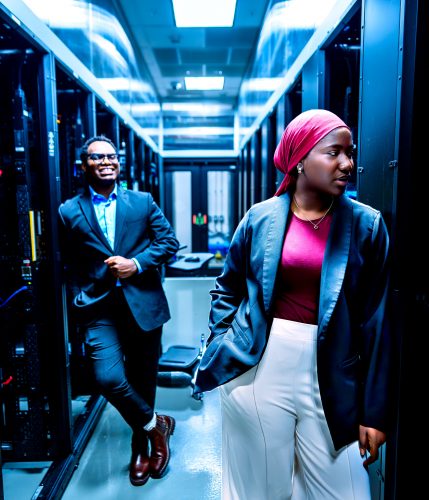
Bakame AI won the top Global Best M-Gov Award in February at the World Governments Summit in Dubai. Herman, left, and Niang launched the venture through TCU’s CREATE accelerator, where it earned $8,000 in seed funding. Photo by Ty Harper
AI SKEPTICISM TO STARTUP
Students are watching all of this happen. Diarra Niang, a double major in business information systems and economics, has witnessed the classroom shift from restriction to structure.
“At first, professors were like, ‘Do not use AI, do not use ChatGPT,’ ” she said. “But I think everybody is realizing that AI is happening whether you like it or not.”
In response, she has seen more courses define AI use case by case rather than banning it outright. “I’ve been in so many classes where literally in the syllabus it will tell you, ‘You’re allowed to use this AI for this purpose,’ ” she said. “ ‘You’re not allowed for this purpose.’ ”
In one of those courses — Deep Learning Technologies, taught by Kelly Slaughter, a professor of professional practice in information systems and supply chain management — Niang was introduced to the technical foundations behind large language models, the AI systems powering tools such as ChatGPT and Google Gemini.
For Niang, those concepts did not stay theoretical for long. The TCU senior is trying to close the gap Alexander describes, not between TCU students and their peers but between students in the Global South and the AI revolution passing them by.
Niang and fellow student Happy Herman are building Bakame AI, an education platform designed to reach communities where smartphones and reliable internet access are not always available. Instead of requiring an app or browser, the system is designed to operate through phone calls.
Herman, a TCU junior who grew up in a low-income household in Rwanda, said he did not have access to a computer or phone connected to the internet until he joined a program that helped him come to the United States three years ago. He added that the average Rwandan high school student may get only eight hours connected to the internet annually. “I think I’ve already spent eight hours since morning today,” the economics and finance double major said of his own use of technology.
In Niang’s native Senegal, internet connectivity and smartphone access can be too costly for many households, she said. In 2024, the median price of an entry-level 2GB mobile broadband plan in Africa was 4.2% of monthly gross national income per capita. “Most people would prefer getting food on the table than buying internet or buying a smartphone,” Niang said.
The Bakame platform is built on an education framework that draws on a curated curriculum from schools or governments, ensuring instruction remains grounded in approved materials.
Bakame’s earliest iteration took shape through TCU’s CREATE program, a yearlong student venture accelerator housed in the Neeley School of Business’ Institute for Entrepreneurship and Innovation, with mentorship from TCU’s University Innovation & Commercialization Office. In spring 2025, Bakame was one of eight student ventures to share a $50,000 prize pool at the program’s final pitches, earning $8,000 in seed funding. “Beyond the financial aspect,” Niang said, “it was also the mentors that we gained.”
In February, Bakame took home the top Global Best M-Gov Award at the World Governments Summit in Dubai. The prize recognizes student-built mobile innovations from around the world.
Bakame is still in its early pilot phase and is designed to run on existing mobile networks.
The market it is entering has largely excluded places like Senegal and Rwanda. Partech, a global venture capital firm that tracks Africa’s tech ecosystem, noted in its 2024 report that the continent’s tech investment has yet to benefit from the AI-driven boost that now accounts for about 30% of global venture capital funding.
STRM DESIGNER | Adobe Stock
“It’s a problem I’ve lived through and a problem for so many kids in the Global South who have a story like mine,” Herman said. He noted that “2.9 billion people who could end up somewhere like here … are still stuck there, you know, waiting for that signal, for that frequency, for that phone number, for that internet.”
In Dubai, Herman met W.K. Mutale Nalumango, the vice president of Zambia and a former teacher of 25 years. Nalumango described a problem her government is addressing: Water is clean when it leaves the well but gets contaminated between collection and consumption, and waterborne disease follows. She asked whether Bakame’s voice agents could call people and walk them through how to keep their water clean, two minutes at a time — a fix, Herman said, that was “more like a behavioral problem than it is like an economic problem.”
“I just hope that people are keeping their humanity in mind when they’re building with AI,” Niang said, “that people really try to bring everybody to the table and not only people in the West or other people who are already privileged.”
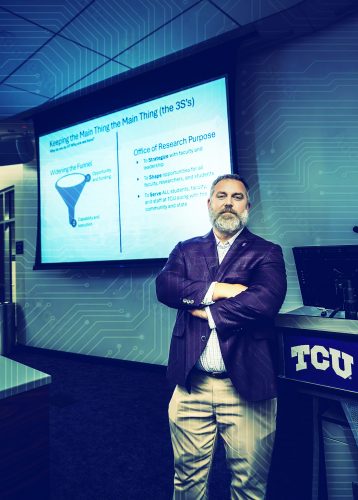
Reuben F. Burch V, TCU’s vice provost for research, expects people to overtrust AI until it gives them a reason to remember it was designed by human beings and isn’t perfect. Then they will swing to the other extreme. Photo illustration by Kim Baker | Original photo by Ty Harper
THE FULL SPECTRUM
Back on campus, the question of how to teach alongside AI is being shaped by, as much as anyone, M. Francyne Huckaby ’96 MEd.
As associate provost for faculty affairs, executive director of the Koehler Center for Teaching Excellence and chair of the university’s AI Teaching and Learning Policy Committee, Huckaby sits at the intersection of faculty, students and the policies that govern the classroom.
By Huckaby’s reading, no one on the committee argues that AI belongs in every circumstance or that it has no place. What unites them, she said, is the committee’s affirmation that higher education must remain a process in which students develop knowledge and judgment. The committee’s charge is to design an ethical teaching and learning policy broad enough to hold across every class syllabus, every faculty member, every student.
That includes a course called A Human-Centered AI Future, co-taught by Curt Rode, which examines AI’s effects on people. The senior instructor of English and director of the Digital Culture & Data Analytics major and minor uses AI in his own work. He is also concerned about what it flattens. “You’re in college to distinguish yourself,” he said. “AI won’t do that for you. AI pulls you into the static.”
The static is well-crafted and easy to read, he said, “but it’s very standardized.” A professor, he said, might receive emails from students, colleagues and journalists alike. If they all started in Claude, “I’d hear only three slight variations of the same voice.”
In Neeley, Beata Jones teaches as if AI is already waiting at her students’ first jobs. Early in the semester, students can use AI but can work with only the Python code they’ve already been taught. “If there’s any code that we haven’t learned in class, that’s an automatic zero,” Jones said. Later in the semester: “All bets are off, AI all the way. But everything has to be verified.”
AI is supposed to save time. For Jones, it’s done the opposite. “What I’m finding myself is not that I have more time,” she said. “I have less time because of AI, because I’m so inspired to do more with it.” For students, her priority is protecting the learning process. “Let’s not circumvent critical thinking,” Jones said, “because that would just be a disaster.”
The disaster Jones worries about has a shape Reuben F. Burch V recognizes. TCU’s vice provost for research is an engineer whose work draws on human factors — how people interact with complex systems — and he sees a familiar pattern coming. His own truck can drive itself on certain roads. “You immediately jump to overtrust because you see so many data points, and you believe it’s handling everything properly,” he said. “But then as soon as there’s one blip or a mistake, you immediately jump to undertrust, and you may be stuck in that stage the rest of your life.” His truck once tried to steer him into a concrete wall because of how the road was marked. He hasn’t let it drive since.
“AI is going to be the same way,” Burch said, “where we have significant overtrust until it gives us a reason to remember it was designed by human beings and isn’t perfect. Then we’re going to go to the other extreme.”
“SOMEONE WHO KNOWS AI”
Outside the TCU bubble, the market is moving faster than any committee. A 2025 Graduate Management Admission Council poll of corporate recruiters and hiring managers found that know-how with AI tools has grown measurably in importance since last year and that it ranks first on the list of skills employers expect to prize five years from now. LinkedIn’s 2025 Skills on the Rise report ranked AI literacy the single fastest-growing skill in the United States. The consulting firm PricewaterhouseCoopers, analyzing nearly a billion job ads for its 2025 Global AI Jobs Barometer, found that jobs requiring AI skills commanded a 56% wage premium in 2024, more than double the 25% premium a year earlier.
Burch has a line for all this. He picked it up during his previous post at Mississippi State University from a Google executive who spent a lot of time in Mississippi during the rollout of the state’s AI initiative and whose standard answer to the employment question Burch has repeated ever since.
“AI isn’t going to take your job,” Burch recalled the executive saying. “Someone who knows AI is absolutely going to take your job.”
Your comments are welcome
Comments
Related reading:
Features
Inside TCU’s AI Infrastructure and Its R1 Push
Features
What AI Skills Do Employers Want? TCU’s Mike Caldwell Explains
About 10% of job listings on Handshake mention artificial intelligence. Here are the AI skills those listings actually ask for.
Research + Discovery
How AI Deepfakes and Bias Threaten Elections, Health Care and Public Trust
TCU researchers expose how artificial intelligence is spreading political misinformation, worsening medical disparities and eroding confidence in institutions.