

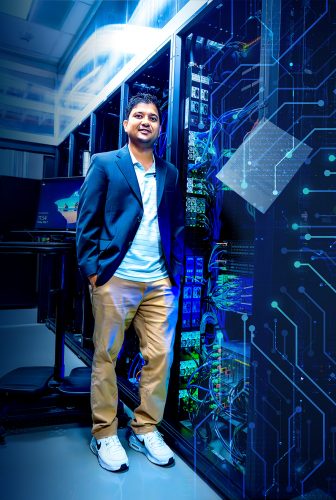
Bingyang Wei spent the past two years advocating for the infrastructure behind AI², short for Accelerating Institutional AI. Photo illustration by Kim Baker | Original photo by Ty Harper
Inside TCU’s AI Infrastructure and Its R1 Push
Inside the William E. and Jean Jones Tucker Technology Center, seven undergraduate researchers are training an AI model to predict when a child in a Dallas hospital needs to be moved to the ICU.
The work unfolds in the NextGen AI Lab, which Robin Chataut relocated to TCU two years ago when he arrived on campus as an assistant professor and director of graduate studies in computer science. Workstations line the space, most paired with a small, tripod-mounted eye tracker ready to log where a subject’s gaze settles or skips. The pediatric project is one of several happening in the room. Others span cybersecurity, healthcare and the science of how students learn.
None of it is running on the machine TCU is about to turn on. The machine has a name: AI², short for Accelerating Institutional AI, and Reuben F. Burch V, the university’s vice provost for research, learned about it on his second day on the job. Chancellor Daniel W. Pullin, Provost Floyd L. Wormley Jr. and Chief Technology Officer Bryan Lucas ’96 (MBA ’10) had already set the investment in motion before Burch arrived. “I walked into this great opportunity,” Burch said, describing how the three had envisioned AI as “a resource that every single person on campus may need to use or understand or both.”
Lucas, one of the architects, conceptualizes AI² not as a single piece of hardware but as a strategic framework organized into three categories: learning, research and operations.
TCU’s AI² system will enable Robin Chataut’s NextGen AI Lab to run complex simulations in far less time. Photo illustration by Kim Baker | Original photo by Ty Harper
PREDICTING THE UNPREDICTABLE
The pediatric project begins about 35 miles away, at a Dallas hospital bed. The team is training an AI system to identify hospitalized children who may be deteriorating before the signs become obvious. Today, clinicians rely on vital signs, Pediatric Early Warning Scores and their own clinical assessments to monitor patients. The system aims to supplement that process by flagging children who may need closer attention or a higher level of care sooner than current methods detect. “Sometimes deterioration is recognized only after a child’s condition has significantly worsened,” Chataut said. “We are studying whether AI can help identify those children earlier and provide clinicians with more time to intervene.”
Through a partnership with Children’s Medical Center Dallas, the flagship hospital of the Children’s Health system, Chataut’s team is training an AI model to flag kids headed for the ICU before the current manual process might otherwise catch it.
The clinical side of the project runs through Christina Smith ’25 DNP, a clinical nurse specialist team leader at the hospital. Danielle Walker ’03, associate professor of nursing at TCU’s Harris College of Nursing & Health Sciences, connects the two worlds, understanding the clinical side and speaking the language of research. Both institutions’ review boards have approved the study. The hospital has provided a full year of anonymized data, including vital signs, physician observations and reasons for admission, to train the model.
Smith’s path to the project began when she worked as a patient safety specialist reviewing cases of patient decline, including medical emergency events resulting in ICU transfers. She noticed a pattern: Nurses were calculating Pediatric Early Warning Scores after children had already declined, not before. The score is a bedside tool that combines vital signs and clinical observations to flag early signs of deterioration, but nurses weren’t using it as intended. “The nurses felt like it wasn’t accurate,” Smith said. “It didn’t work. It didn’t give a good picture of their patient.” Automating the score didn’t solve it; the calculation could draw only from what clinical staff had documented, and if data wasn’t entered in or near real time, the score still lagged.
The problem, Walker explained, is that early warning scales can work only with what nurses manually enter. But electronic health records capture far more. “All this data is already being captured,” she said. “We just need somebody who knows how to gather it all and sort it for our benefit.”
That somebody is the model Chataut’s students are building: a machine learning system, a tireless set of eyes on more data than any one person can watch. To train it, his students feed the algorithm the hospital’s anonymized records, split into the children who declined and were moved to the ICU and those who did not, so the model can learn the patterns that distinguish them.
Seven undergraduate researchers in Robin Chataut’s NextGen AI Lab are training an AI model to predict when a hospitalized child needs to be moved to the ICU. Photo by Ty Harper
Walker said lab results are collected every eight to 12 hours on many of these patients, and values might be trending downward while still falling within normal range. Assessment notes might describe a child using different muscles to breathe or their nostrils beginning to flare, subtle signs that don’t fit neatly into a numerical scale but could signal trouble.
Once the model reaches the accuracy Chataut has described as satisfactory, somewhere in the 80% to 90% range, and can predict that a child is hours away from the ICU, it will be deployed inside a sandbox version of Epic, the patient records platform that Children’s uses. The sandbox is a walled-off test environment, separate from the live system, and the model will run there side by side with what the hospital uses now, so Children’s can compare the two. If the model holds up in that parallel test and Children’s signs off, the partners can move toward broader clinical deployment.
TESTING THE TEACHER
The same TCU lab is finishing a $50,000 study, financed by the dean’s opportunity fund, on how college students learn with AI compared to other methods. Chataut and his team — Uma Tauber, professor of psychology and director of graduate studies; Justin Luningham, assistant professor of psychology; and Bingyang Wei, chair and associate professor of computer science — recruited 106 students, evenly split between computer science and psychology. Students were randomly assigned to four learning modalities: an AI large language model, internet use without AI, printed handouts or self-study that allowed them to choose any combination of resources. The assignment centered on quantum blockchain, an advanced computing topic chosen precisely because it isn’t taught at TCU and was new even to most computer science students, Chataut said.
Students took a test immediately and again 15 days later, while eye trackers captured attention and stress. The AI group scored higher initially but showed steeper decline over two weeks, a pattern the team is now preparing to submit to Nature Communications. To run the same study at a national scale, Chataut and his collaborators have submitted a $900,000 grant proposal to the National Science Foundation, partnering with West Virginia University and Dallas College to test the question across a broader range of institutions.
What both projects share is a limitation that, until recently, campus infrastructure did not adequately address. The pediatric modeling, eye-tracking analysis and other computational experiments required dozens of hours of processing, only to reveal that a single variable in the model was off. Much of that work runs on a departmental server without the kind of processing power that AI training demands, Chataut said, turning the iteration process into slow cycles of computation and revision.
“It takes days to run a simulation,” Chataut said. “And if you figured out after three days that something was wrong, then you have to rerun, fix one thing and then rerun it for a couple of days again.”
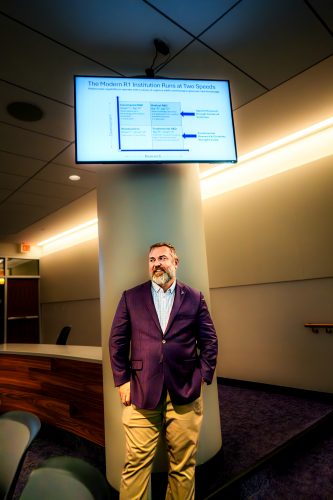
Reuben F. Burch V says TCU administrators envision AI² as “a resource that every single person on campus may need to use or understand or both.” Photo by Ty Harper
BUILT, WIRED AND WORKING
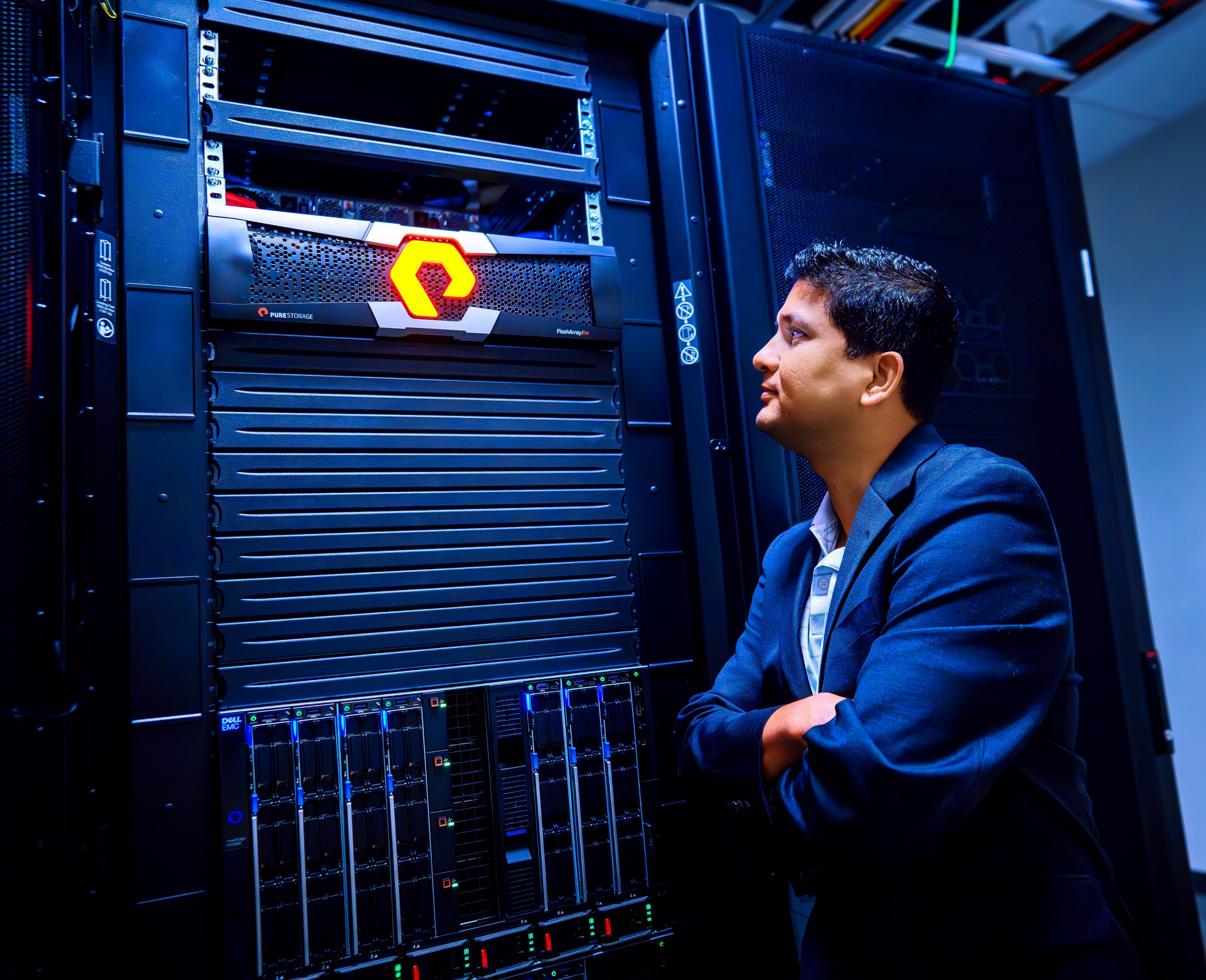
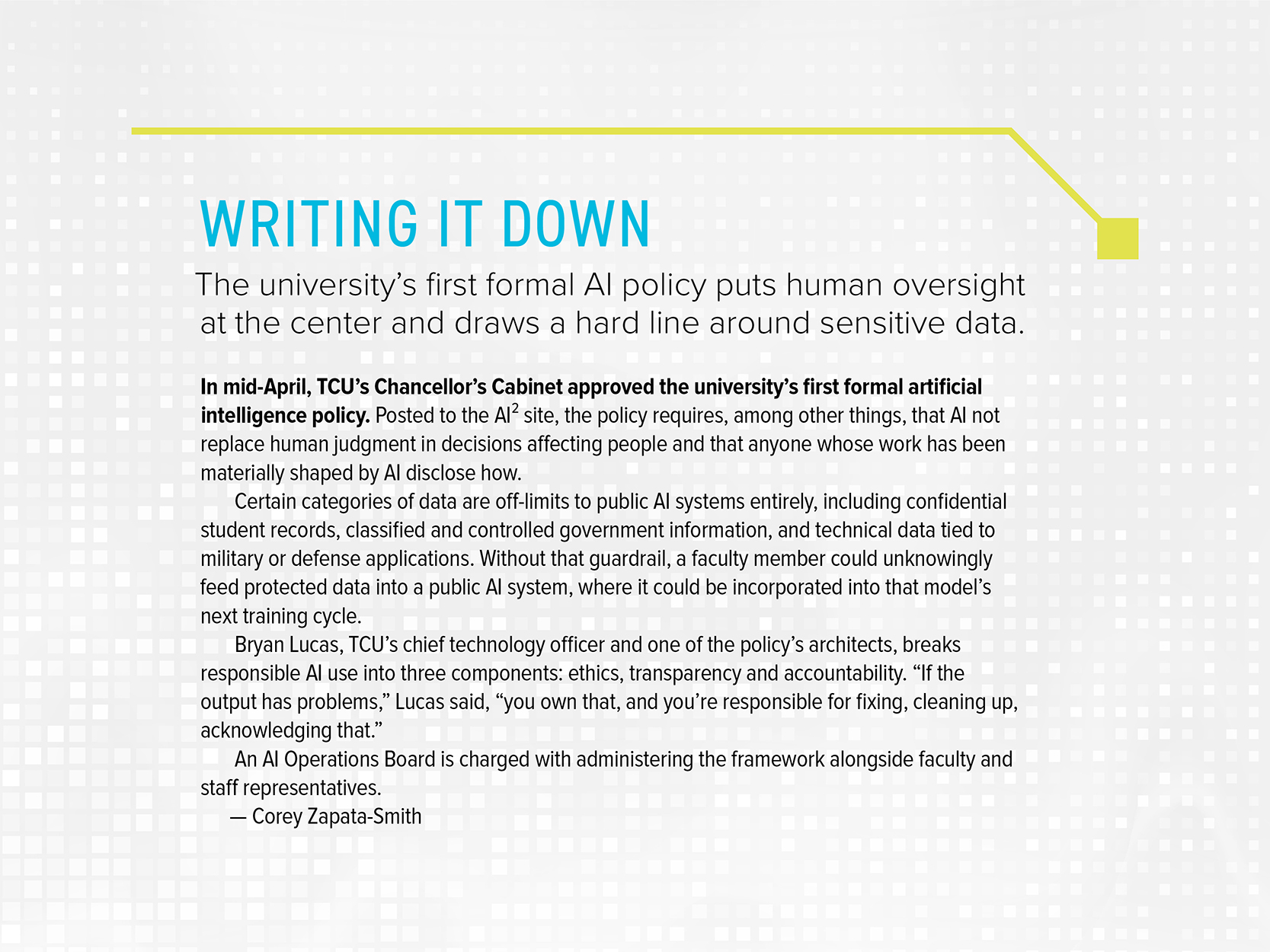
That processing bottleneck helped drive the creation of AI². Sixteen Nvidia GPUs — specialized chips built to handle the massive, simultaneous calculations that AI training demands at a far faster rate than a standard processor — now sit in the university’s data center, purchased through TCU’s partnership with Dell and wired into contractual partnerships with Amazon and Microsoft for cloud overflow.
Together they hold more than 2 terabytes of memory built specifically for training AI models. Shelley Shuga, TCU’s associate director of computer systems, offered a sense of scale: Loading a single 70-billion-parameter model is like keeping the text of roughly 350,000 novels in active memory at once, a task an ordinary laptop cannot at all execute; the cluster can run 16 of them in parallel. Work that would have taken months on individual machines can now finish in hours or days. By design, the most sensitive research stays on TCU’s own servers; everything else routes to the cloud. Burch calls it intentional.
“It is fully operational,” Burch said. The intake system is nearly complete, and faculty are writing grant proposals that utilize it. “It’s already available and already has consistent users on it.”
The research office has used AI to optimize its most critical processes; proposal requirements review alone has reduced some review times by as much as 66%. Regardless of those efficiency gains, Burch said, the human is still essential.
THE FLYWHEEL
Wei, who has spent the past two years advocating for the infrastructure, sees AI² in cycles. “Better computing resources enable more research, more research leads to more external funding, and that funding helps us expand our research capabilities even further.”
That cycle, in his telling, is also the path to R1 — the Carnegie designation given to universities that, on average, spend at least $50 million on research and development and award at least 70 research doctorates a year. The most concrete down payment is a PhD in computer science approved for fall 2026, which is the first new doctoral program at TCU in eight years. “Achieving R1 status requires more than ambition,” Wei said. “It requires sustained investment in research infrastructure, talented faculty and graduate education, and TCU is making those investments.”
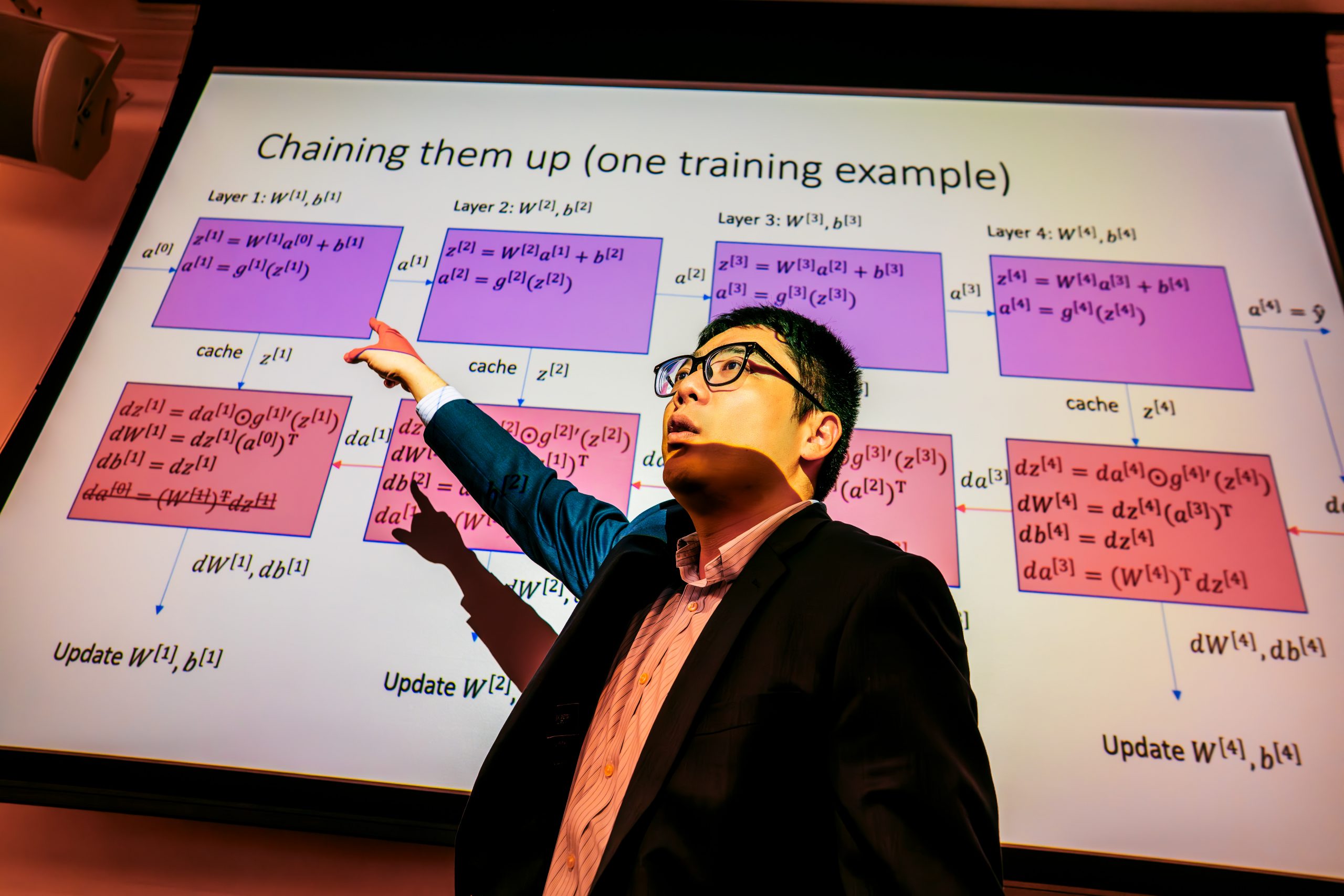
Bingyang Wei has led the launch of TCU’s first PhD program in eight years — a fully funded computer science doctorate in artificial intelligence and cybersecurity that welcomes its inaugural cohort of eight students this fall. Photo by Ty Harper
The harder work, Lucas said, is what happens between the machine and the grant money. When his team reorganized last year, two staff members — Kyle Stagner ’25 and Josiah Miller ’03 — were redirected into a newly formed IT Research Computing Group, with Jeff Tang, a Dell-supplied resident, working alongside them as a subject matter expert. Stagner is the facilitator, the person who sits with a faculty member and, in Lucas’ words, helps “convert that use case, that business idea into technical speak.”
Lucas expects the need to assist faculty and staff to ease over time, the way formal instruction around software like Microsoft Word has largely faded as familiarity grows. The on-premise hardware and cloud partnerships are already in place, and the AI policy that governs them is posted on the AI² site, written, as Lucas puts it, in the spirit of “don’t let perfect be the enemy of good.”
Your comments are welcome
Comments
Related reading:
Features
How TCU Is Teaching Students to Work Alongside AI
Faculty are emphasizing AI literacy and critical evaluation skills as employers increasingly expect graduates to be fluent in AI tools.
Research + Discovery
AI in Academia
Xiaolu Zhou is working to bring TCU classrooms into the future.
Research + Discovery
AI on Fashion’s Cutting Edge
Instructor Leslie Browning-Samoni weaves AI into her merchandising curriculum.