
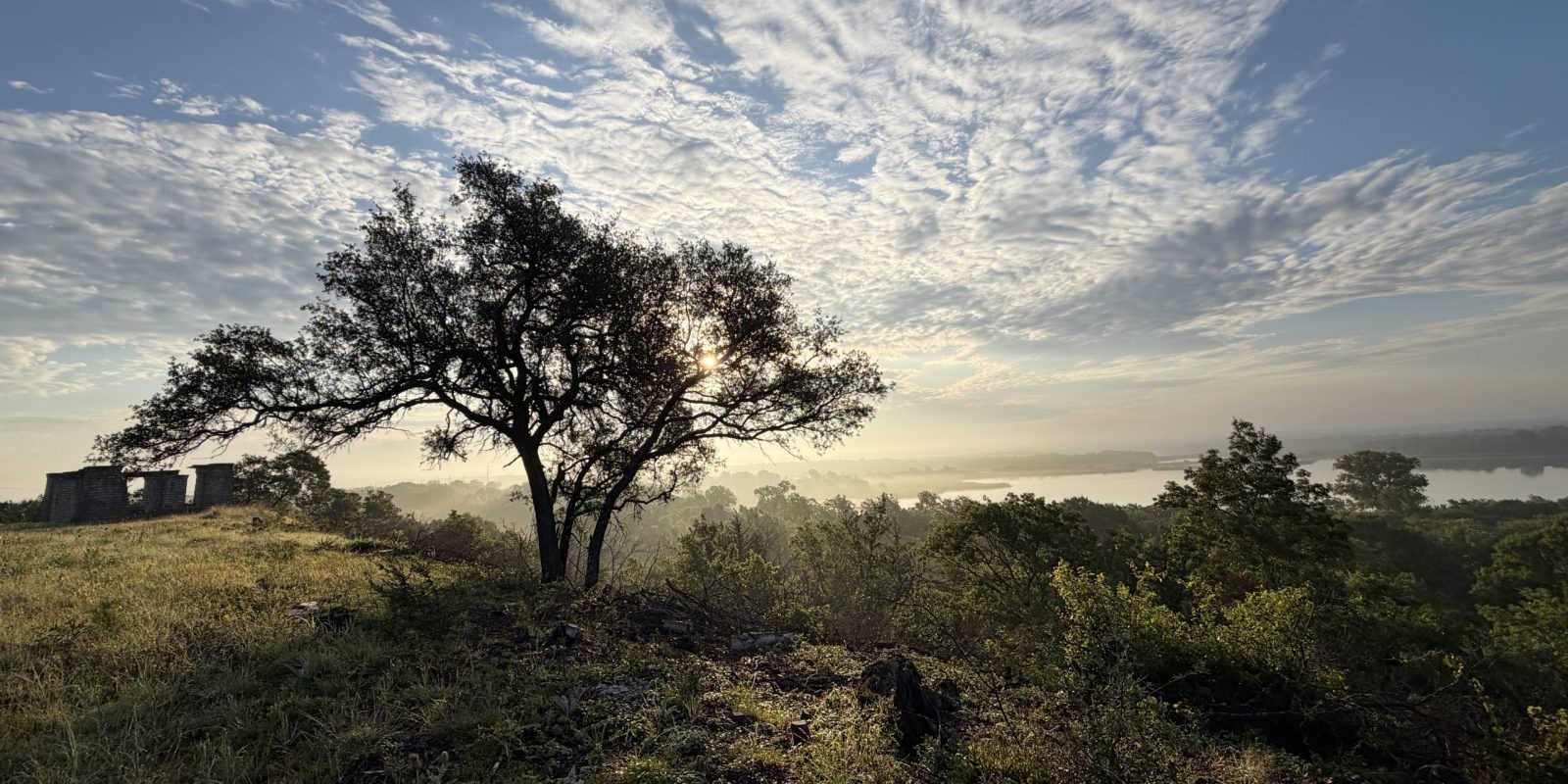
Broadview Park, a Civilian Conservation Corps site in the Fort Worth Nature Center & Refuge, looks out over Lake Worth toward downtown Fort Worth in the distance. Photo by Joyce Marshall
TCU Partners with Fort Worth Nature Center to Build Urban Research Hub
A five-year partnership turns 3,600 acres of prairie, marsh and river bottom into a classroom for TCU faculty and students.
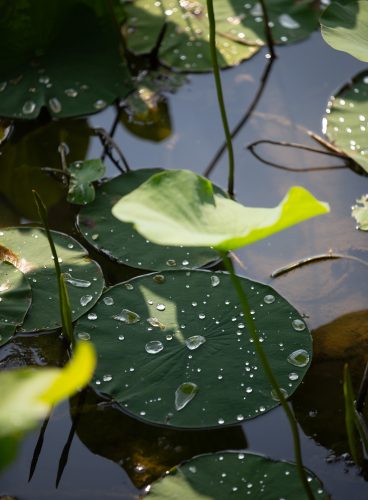
Lotus marshes line the West Fork of the Trinity River at the Fort Worth Nature Center & Refuge. Photo by Joyce Marshall
Fort Worth is still wild in places, if you know where to look.
On a bluff above Lake Worth, a stone shelter catches the May morning sun while birds circle in the wide Texas sky. Around it, native wildflowers bloom in yellows and pinks from roots that waited years in patient hibernation. Downtown rises on the near horizon, close enough to remind visitors that this reclaimed landscape is not an escape from the city so much as a rediscovery of what sustains it.
The shelter was built in the 1930s by young men in President Franklin D. Roosevelt’s Civilian Conservation Corps, who cut stone from the land to tame a property once slated to become Texas’ 31st state park, until a lack of funding passed it back to the city.
Today, the Fort Worth Nature Center & Refuge encompasses 3,600 acres of prairie, marsh, woodland and river bottom inside the city limits; it’s four times bigger than New York’s Central Park. The West Fork of the Trinity River, a stretch of it home to alligators, flows near where bison graze in rolling grasslands.
Only 20% of Fort Worth residents have ever visited the park, said Jared Wood, manager of the nature center, where 21 miles of trails are available to anyone for a small day-use fee.
He saw the opportunity clearly: one of the largest and most diverse urban preserves in the country, sitting next to one of the fastest-growing large metropolitan areas in the United States. As it leapfrogs America’s most populous cities into the Top 10, Fort Worth is losing about 50 acres of natural space a week to development. The nature center holds the 3,600 acres in trust.
What Wood needed was a partner equal to the scale of the place.
TCU is stepping into that role through a new five-year agreement with the city of Fort Worth, one that turns the nature center into a living laboratory for faculty research and student learning. The partnership draws on the expertise of faculty across campus, bringing biologists, environmental scientists, educators, historians, artists and more into a landscape where Fort Worth’s natural past and urban future intersect.
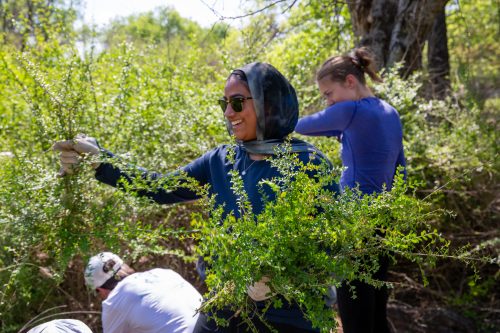
Sara Sharif and her classmates from Treks and Texts: Journeys in Nature cut piles of invasive privet from the Fort Worth Nature Center & Refuge. Photo by Caroline Collier
The Partnership
Long before the partnership existed on paper, TCU was already showing up on the trails.
Dan Williams, director of TCU Press and honors professor of humanities, has been bringing students to the center for about a decade. Students in his Treks and Texts: Journeys in Nature course read legendary environmental writing by authors such as Edward Abbey and Henry David Thoreau. They then move outside to serve the land; this year, they cut back Chinese privet and bamboo at the center.
If Williams brought students to the nature center through literature and service, Omar Harvey saw how the place could also become a platform for public-facing research.
Harvey, a professor of geology, leads TCU’s Natural Resources Research Initiative, a university-wide effort to position TCU as a regional research engine in energy, water, food and climate. His philosophy is direct: “Large funding is not going to go for research that sits only in my lab,” he said. “Your research has to be translatable to the community.”
The nature center offered exactly that type of impact, a place where scientific questions and civic needs could converge around cleaner water, restored native habitat, a healthier urban ecosystem.
When Harvey approached the nature center about establishing a formal relationship, he discovered the timing was right: Fort Worth Mayor Mattie Parker had tasked Parks and Recreation to seek university collaborators through her Good Natured Greenspace Initiative, which aims to reclaim 10,000 acres of open land inside city limits. The partnership expanded TCU’s role in both efforts.
What distinguishes TCU’s involvement from the nature center’s other valuable university relationships, Wood said, is that “most of these partnerships pertain to a single department. TCU is the only university with which we are developing a partnership across all colleges and departments.”
“This was not just walking on a trail or looking at scenery. We were physically interacting with the environment … changing the space ourselves.”
Sara Sharif
The Work
On a recent Tuesday afternoon, 16 Treks and Texts students, supplied with loppers and handsaws, walked into a thicket of privet, which was introduced to North Texas as decorative lawn hedging and is now one of the refuge’s most persistent adversaries. The invasive growth was dense enough to block the view of bison grazing beyond. Once it’s cleared, the herd will be visible from a greenhouse that Williams’ previous students helped build, where native plants are still growing.
By late afternoon there were two privet piles, each 6 feet high and 10 feet across, fodder for a future controlled burn.
“This was not just walking on a trail or looking at scenery,” Sara Sharif ’26, a neuroscience graduate, wrote in her blog afterward. “We were physically interacting with the environment … changing the space ourselves. … It felt more real and meaningful than just looking at it from a distance.”
Michael Kelly ’26, a finance graduate, had spent the semester writing about smaller acts of attention: noticing pansies planted along campus pathways, hearing acorns crunch underfoot on a morning walk to the gym. At the nature center, that practice found larger ground. “We’re part of the ecosystem,” he said. “We’re not above the ecosystem, which I think sometimes we think we can be.”
Across the university, other threads are forming. Ashley Coles, an associate professor of geography, brought the partnership into the classroom by directing five students in projects the nature center requested. She was already a dues-paying member when Harvey’s invitation arrived. “I jumped right on that,” she said. “It’s one of my favorite places in Fort Worth.”
During the spring semester, one of her geography students mapped species density and biodiversity. Another served as a roving naturalist; he helped people overcome their fear of snakes by showing them how to handle the live specimens in the visitors center. And students in environmental science are building internship pipelines through work in the green space, pathways that have already led one former student to a parks position in Montana.
“There are often gaps between scientific research and community engagement,” Wood said. “Partnerships with academic institutions like TCU are crucial for bridging this gap.”
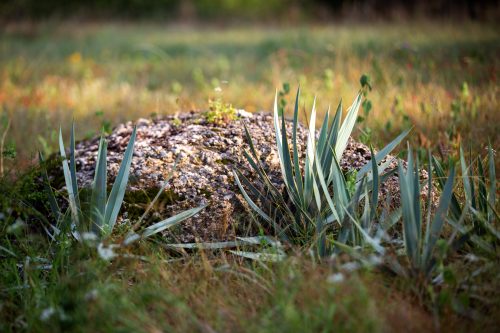
Wildflowers and other native plants and grasses grow throughout the Fort Worth Nature Center & Refuge. Photo by Joyce Marshall
What It Could Become
Wood imagines a future in which the nature center is not only visited by the TCU community but also studied: how water moves through the refuge, where bats fly after dark, what happens to wildlife corridors as the city grows around them.
The land itself is already responding to the extra attention. Prairie dogs, absent from the refuge between 2015 and 2024, were reestablished last year, and there are babies now, darting through the grasslands. Four bison calves were born this spring. The wildflowers that returned after years of controlled burns and privet removal bloomed all spring.
Kristen Valdiviez ’26, who just embarked on a career in finance, wrote this near the end of her Treks and Texts semester at the nature center: “I think throughout this course I’ve begun to think about what society would have looked like if ‘wild’ was something we cherished rather than something we tried to destroy.”
Your comments are welcome
1 Comment
This sounds extremely interesting!
Related reading:
Research + Discovery
How TCU’s Teacher-Scholar Model Evolved
The university charted its course with a balanced emphasis on instruction and research.
Features
Sustaining Our Food Supply
TCU-trained innovators work to preserve our resources and curb waste.
Research + Discovery
The Boller Review Showcases Undergraduate Research at TCU
For nearly a decade, TCU’s student-run research journal has published undergraduates studying everything from termite-inspired HVAC systems to vocabulary development in deaf children.