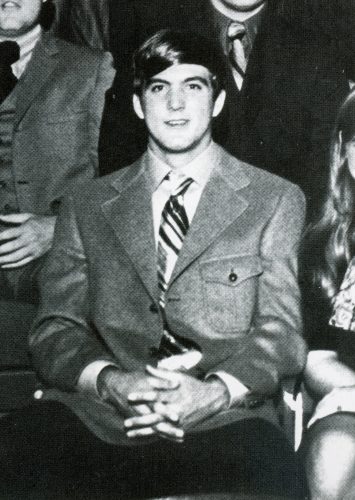
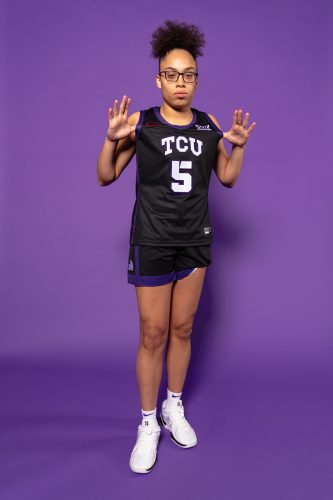
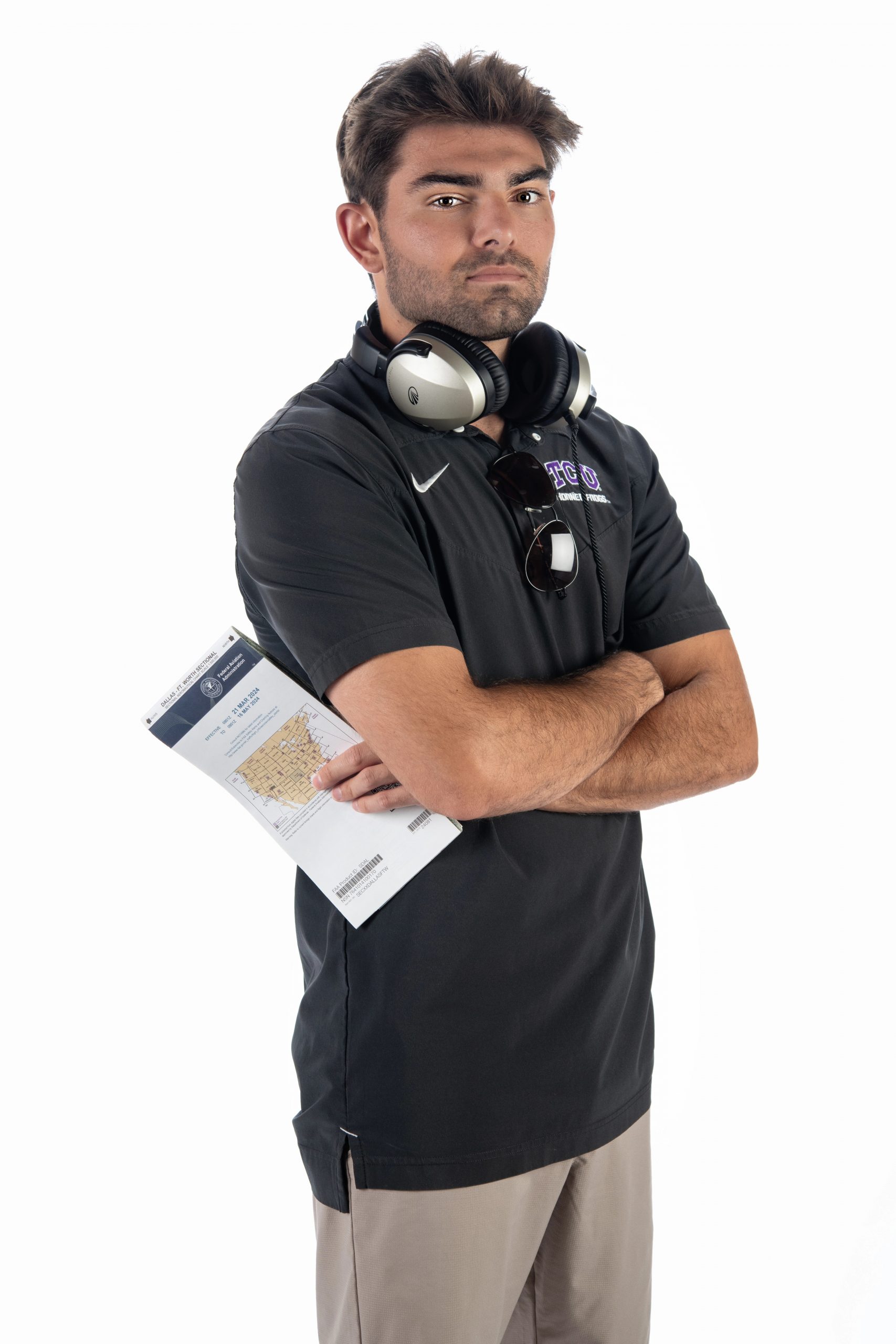
The Kansas City chapter of the alumni association straddles a state line, including Horned Frogs from Kansas and Missouri. Joey Stasi ’15, chapter president, said the board, including Anthony Macha ’22, Allie Baxter ’20 and Meredith Trank ’16, is working to expand the group. “We welcome everyone.”
Game-Watching Parties:
Alumni gather to watch select Horned Frog football games at Maloney’s Sports Bar & Grill in Overland Park, Kansas, where a TCU flag hangs on the wall and local Boulevard Brewing Co. beer is on tap.
In June, members of the Kansas City chapter met for a spin class, taught by Meredith Trank ’16, followed by doughnuts and bubbly. “She’s a therapist by day,” Joey Stasi ’15 said of Trank, “and a spin instructor by night.”
Nationwide Welcome Happy Hour:
The Kansas City chapter hosted a Nationwide Welcome Happy Hour event in August to meet and greet alumni who are new to the area — and to see off the next class of Horned Frogs heading to Fort Worth.
To call someone Taylor Swift’s biggest fan is bold, but of her admirers in academia, Andrew Ledbetter, professor of communication studies, might hold that title. He blogs regularly to share thoughts on the artist’s communication style and to detail his favorite Taylor Swift songs — “All Too Well” and its 10-minute version are tied for first place.
“It’s her magnum opus,” he said. “Every note and lyric just feels so carefully chosen to cultivate the emotional impact.”
Andrew Ledbetter wears his fandom proudly, with Swift’s signature friendship bracelets and a display of memorabilia in his office. Photo by Desiree Rios
Ledbetter’s fandom merged with academic inquiry in a 2024 Communication Quarterly study that linked Swift’s lyrics with fans’ reception of her music.
Forbes has labeled Swift the world’s second-youngest female self-made billionaire, and The New York Times estimated that her 21-month Eras Tour was the highest-grossing concert tour in history at more than $2 billion just in ticket sales. Ledbetter said she is also a successful communicator, “and any celebrity’s success is jointly co-created with the audience.”
Dedicated Swift fans — called Swifties — believe her music’s popularity comes from its interconnected storylines, Ledbetter said. They have likened her discography to the interwoven films of the Marvel Cinematic Universe, affectionately calling it the “Taylor Swift Cinematic Universe” or “Taylorverse.”
If the fans’ theory is correct, Ledbetter hypothesized, her most popular songs would share common themes, with deeply interconnected songs being the most popular.
Ledbetter used TCU’s Schieffer Media Insights Lab to analyze Swift’s lyrics; the facility allows faculty and students to analyze and visualize social media conversations with data analytics tools. After the computer created a map of the links between songs based on words they shared, he applied fantasy theme analysis, the process of locating concepts that connect common words, to the results.
“All Too Well” turned out to be statistically significant, with so many shared words it placed fourth among Swift’s most centralized songs.
His conclusion? The Swifties are right. “It is the connections between the songs,” he wrote on his blog, “as well as the artist and her fans, that animates her art and fuels its success.”
The Tortured Poet
Through the lab, Ledbetter measured the popularity of Swift’s songs by quantifying social media engagement. He also collected streaming data from Spotify and factored in evaluations from professional music critics to gauge the success of individual songs.
He examined Swift’s lyrics using fantasy theme analysis, an element of symbolic convergence theory, which asserts that social groups create a collective identity based on shared narratives. Through the lens of the theory, he writes, “one reason for her success may be her ability to craft compelling fantasy themes that unite her audience into a rhetorical community.”
Ledbetter said fantasy in this context is not about fiction but rather how someone uses symbolism in storytelling, which Swift is known for. A famous example mentioned in the paper is the red scarf referenced in “All Too Well.” The scarf’s symbolism is hotly debated by hardcore fans, but Ledbetter interprets it as indicative of a romance’s “initial passion and eventual collapse.”
Using data analytics tools and fantasy theme analysis, Andrew Ledbetter confirmed what Swifties know all too well: Her most popular songs share the most interconnected storylines. CC by 2.0 Paolo Villanueva
He identified four types of stories — called fantasy types — that constitute the Taylorverse: Villains and Heroes, Longing and Regret, Finding the Extraordinary in the Ordinary and Empowered Voice.
The Villains and Heroes fantasy type is most prominent in Swift’s earliest work and contrasts good and evil, wrongdoer versus victim. The central verbs he identified in this category are fighting, running, keeping, holding and waiting. He notes she also occasionally employs military metaphors, especially in her songs “Ivy” and “The Great War.”
Songs in Longing and Regret explore heartbreak, exemplified by the somber verbs leaving, falling, changing, wishing and missing.
Finding the Extraordinary in the Ordinary songs focus on domestic imagery and assign emotional significance to the seemingly ordinary. The words home, car, door and room are common in this narrative arc. “All Too Well” and its heavily symbolic reference to an everyday object — the red scarf — appear in this section.
“This is Taylor the poet,” he writes of this category, “using her command of language to cast the world in a beautiful and epic light, leveraging specific details to voice insight and meaning to her experiences.”
Finally, in Empowered Voice, Ledbetter says, Swift’s lyrics grow bold to the point of sarcasm. Songs in this group push back against her critics, with the terms yeah, wanna and gonna juxtaposed with levity in the words play and fun. This last group, he says, is where she most asserts her agency, displaying a power almost nonexistent in her earliest music.
Throughout her career, he says, Swift’s settings have shifted from small towns to big cities, and characters — including her depiction of herself — have become more complex. Her subject matter has expanded to include career challenges and gender politics.
The latter speaks to what Ledbetter calls Swift’s “feminist rhetorical vision,” in which she validates women and girls’ lived experiences, no longer relying on male authority figures’ approval. Such vision may be particularly valuable for academics, who often use symbolic convergence theory to study powerful figures like politicians but rarely pop culture personalities. He said this preference could leave young women’s voices underrepresented in such research by favoring older male perspectives.
The biggest shift in Swift’s music is in her “sanctioning agents,” meaning characters or entities that either legitimize or delegitimize the speaker’s narrative, Ledbetter writes. This is where her feminist message is arguably most pronounced. In her early song “Love Story,” Swift depicts herself as Juliet and her love interest as Romeo, falling in love despite her father’s objections. The song deviates from Shakespeare’s tale and ends with Romeo proposing after finally earning her father’s blessing. This song revolves around a stark power imbalance with a patriarch gatekeeping Swift’s happiness.
“One reason for her success may be her ability to craft compelling fantasy themes that unite her audience into a rhetorical community.” Andrew Ledbetter
Ledbetter says Swift began gradually inserting her feminist rhetoric in her 2010 album Speak Now. Her song “Mean,” he writes, shows Swift pushing back against a male music blogger’s criticism, while “Long Live” portrays Swift and her fans “fighting dragons” together.
In her 2014 album 1989, Ledbetter says, Swift guides her fans to embrace their own empowerment and self-validation.
“The release of 1989 was not only a shift from country to pop,” he writes, “but also Swift shaking off these sanctioning agents and becoming her own, via connection with her listeners. In other words, it became the (feminine) symbolic convergence achieved by her fans, positioned against the lack of understanding from other (masculine) audiences, that legitimated the rhetorical vision.”
Taylor Swift’s appeal is historically vast. A 2023 Forbes survey found that 53 percent of U.S. adults identify as fans of Swift, with 16 percent counting themselves as “avid” fans. CC by SA 3.0 Beth Garrabrant
And Soon Enough You’re Best Friends
Ledbetter’s TCU colleague Naomi Ekas, professor of psychology, teaches a course called Psychology (Taylor’s Version). The class uses Swift’s work to analyze topics such as loss, infidelity and love through a developmental psychology perspective.
Ekas and Ledbetter bonded over their shared fandom, and he later sent her early drafts of his paper. She said his work engages students and helps them learn by applying academic theory in real-world contexts. “I think ultimately, as academics,” she said, “that’s at the heart of what we’re trying to do.”
Students get excited when they learn Ledbetter is a fellow Swiftie. They often talk to him outside of class about her music, discussing the latest albums and debating which tracks are her best.
Gianna Arganbright, a master’s student in communication studies, said Ledbetter’s research is academically valuable. “Especially with the way that our culture is going with social media … it’s just so relevant.”
Ledbetter said that he probably isn’t the singer’s target demographic but that anybody can be a Swiftie — even, as he called himself on his blog, a “40-something bald professor.”
“I know it’s a different expectation in terms of age and gender and some of those things,” he said, “but I think we’ve seen her music has a huge appeal across a whole bunch of audiences.”
David Lay Williams ’92 has been passionate about economicinequality for most of his career as a philosophy professor. “We can’t simply dismiss inequality as unproblematic,” he said, “as we have been doing for largely the last four decades.”
Ignorance begets an environment in which “we have really big problems on our plate,” said the loyal Horned Frog who is now a professor of political science at DePaul University in Chicago.
Since 1976, the wealth of the top 1 percent of Americans has grown by an average of $16 million per family. The top 0.01 percent has netted$85 million, and the top 0.001 percent gained an unfathomable $440 million in that time. Conversely, the less wealthy half of the country only captured $12,000 per family on average during the same timeframe. “The wealthiest 10 individuals have more than the poorest 40 percent of humanity,” Williams writes in The Greatest of All Plagues: How Economic Inequality Shaped Political Thought from Plato to Marx, his book on the matter that was published by Princeton University Press in 2024.
Williams’ career in intellectual curiosity began in misunderstanding. In high school, he admired Carl Jung and Sigmund Freud for their explorations of “ideas more so than facts.” The Police’s Synchronicity, an album co-opting Jung’s theory of the subconscious, piqued Williams’ interest in the Swiss psychiatrist. Williams conflated his passion for thought with psychology, later realizing he had been enamored with philosophy all along.
A TCU philosophy course taught byprofessor Gregg Franzwa, who died in 2016, led to a realization: “That stuff that I liked about my high school psych class, that’s actually what we now call philosophy,” Williams said. “I felt like I had a true passion. And that’s when I resolved to be a professor.”
David Lay Williams draws on decades of philosophical study to challenge today’s conversations about wealth and fairness.
In his PhD studies, Williams negotiated both political science and philosophy. He devoted his mind to literature, art and an overall compulsion to “make myself a well-rounded intellectual.” His time at TCU “whet my appetite for learning.”
Charles Lockhart, who taught political science at TCU from 1974 to 2014, had a major hand in shaping Williams’ thinking and career. Lockhart gave Williams “special assignments,” including a paper on the political philosopher John Rawls, to introduce the then-undergraduate to challenging ideas.
Lockhart’s recommendation to one of his own mentors at the University of Texas led to Williams’ admittance to a PhD program.
Williams landed a faculty role at DePaul in 2011 and earned his way to tenure, at which point he turned his ambitions to writing The Greatest of All Plagues, which he calls the great work of his career.
Lockhart encouraged Williams to tackle economic inequality, a concept he called “the elephant in the room. … Most philosophers who are in this field had tacitly acknowledged that you couldn’t have a democracy or a representative government when there was too much economic inequality.”
Echoes Through Time
The Greatest of all Plaguesis the culmination of a decade of effort. Combining Williams’ dovetailing interests, the book braids wisdom from canonized philosophers about economic inequality.
“I wanted to spend that time with thinkers that I really cared about, people that in most cases I’ve been teaching for a very long time,” he said. Featured in the 403-page book are Plato, Jesus Christ, Jean Jacques Rousseau, Thomas Hobbes, Adam Smith, John Stuart Mill and Karl Marx. Williams said his goal in choosing these thinkerswas to“keep these conversations moving forward. …Often they understand fundamental issues better than we do in our own times.”
Plagues reasserts “that people have been talking about inequality forever. It didn’t just start to happen when Ronald Reagan became president. This has been going on since the ancient Greeks.”
Williams is an ambassador for meritocracy. He said flawed conceptions of who is“deserving”further facilitate growing inequality and the economic systems that allow such concentration of capital. “It has to do with moral psychology. The sense that the rich really think they deserve everything that they have, that they are that much smarter and that they work that much harder than everyone else. That can lead to problems associated with pride, vanity, arrogance and hoarding,” Williams said. “On the flip side of that are the people who suffer from bad luck in the economy. They’revery poor, and they’re made to feel as if they’re worthless. That can be debilitating in lots of ways.”
Williams cites Andrew Carnegie and his public donation of thousands of libraries across the country as a prime example of a self-aware member of the gilded class, one who acknowledges that maybe meritdoesn’t have everything to do with fortune.
Williams said he deliberated about including Christ in the book, a decision complicated by his own thorny history with orthodoxy. He recounted his return to faith after a period of separation: “I took my intro philosophy course with Professor Franzwa. He assigned passages from the New Testament. He’s like, ‘We’re going to read this as philosophy, not as theology, and we’re going to talk about the ideas in the Bible.’ ”
“People have been talking about inequality forever. It didn’t just start to happen when Ronald Reagan became president. This has been going on since the ancient Greeks.” David Lay Williams in “The Greatest of All Plagues”
Williams found his intellectual curiosity in scripturereignited by Franzwa’scourse and, later in life, Williams had a personal reconciliation with the text. “This will be great for me,” he remembers thinking, “not just as a religious experience, or as a scholarly experience, but as a personal experience. And it was very moving for me to read the Bible after such a long separation from it. It’s changed certain things for me very fundamentally.”
After creating the Plagues chapter on St. Augustine, Williams said he had a change of heart. “As I read in the Bible, it occurred to me, ‘Well, this is actually the chapter.’ I know writing about the Bible can be controversial, and it is not common at all. In my field, some people write about the Old Testament. No one writes about the New Testament. I realized that it had a lot to say about these issues, and a lot more people read the Bible than read Plato or Thomas Hobbes or John Stuart Mill. I should meet people where they are.”
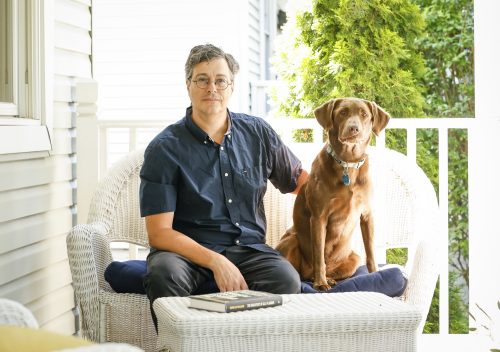
David Lay Williams at his suburban Chicago home with his dog, Penny.
Beyond the Degree
Williams has deep connections to TCU and to higher education. His mother, grandmother and great-grandparents attended TCU, some when the school was still in Waco. His mother was a classmate of legendary newsmanBob Schieffer ’59. Some of Williams’ fondest memories come from his time in purple and white, playing jazz and staying late at professors’ homes discussing moral philosophy and life.
He believes in the value of higher education, and notices with dismay some of the challenges facing the industry in terms of funding, especially in the humanities. Williams insists he will continue to “make the case that universities keep hiring in fields like this. [College is] not just a place where you’re there to get a degree and check some boxes and then make a lot of money, but a place where you really talk about consequential ideas; you attempt to get a better understanding of the world that you inhabit, maybe even a better idea of yourselves. Those things sometimes get lost when we talk about college these days,” he said.
Williams’ reflection on his work and personal history yielded frank insights.
Take classes that have nothing to do with your career goals. Students shouldn’t feel compelled to be totally focused on the singular goal of getting a degree. That’s a waste of a unique and wonderful opportunity. I strongly encourage students to take classes that have nothing to do with their career goals, but just where they can read great books and have great conversations.
Study this stuff while you can. Something very magical happens when you go into the classroom and start reading great books and talking about them. They stimulate the kinds of conversations that people have been having at universities for thousands of years. I leave the classroom with a buzz. I still love the way my brain feels when I have these conversations. And the students do too because they tell me. They’ll come to me, especially now, and say, I didn’t know that you could do this in college. I didn’t know you could discuss ideas like democracy, for example, and get deep into what it means to have a democracy and how you might lose a democracy.
Connect and reconnect. I got into jazz at TCU, and it’s a regular part of my life. I play gigs with a small group and a big band. It’s very edifying and keeps me balanced. In college, I really connected with my professors. I was always hanging out at their houses because we had band rehearsals. We talked about philosophy and life. It was all these amazing TCU memories of this incredible mentorship from my professors. I really felt like I mattered. These professors weren’t just walking into the classroom, delivering their lectures and leaving; they were invested as true mentors.
Touch grass. I take a long bike ride to school. I live in Evanston, which is a suburb of Chicago. It takes me an hour to bike to school, soI’ve got an hour to think before I get there. The bike ride helps get me ready for the day and clears my head. I do get out a fair amount between bike riding and dog walking. These are things to keep me sane.
ANGEL GUYTON ’21 was a junior transfer student in her first day of class at TCU when Kat Barger, associate professor of physics and astronomy, told students that anyone interested in conducting research should see her.
“I remember sitting there the entire class,” Guyton said, “and just being like, ‘OK, I need to be one of the first ones that runs up there and shows my interest.’ ”
She found an opportunity in the lab of Hana Dobrovolny, professor and department chair of physics and astronomy. “We focused on cancer cells and nanoparticles,” Guyton said, “and it was all about drug delivery into those cancer cells — basically being able to kill off the cancer cells without having to kill any of the normal cells.”
The experience, she said, deepened her scientific understanding and ultimately led her to a career in research. She went on to secure research jobs in labs focused on Alzheimer’s disease and molecular biology. In her current full-time role as a scientist with Alcon, Guyton tests products to make sure they meet FDA regulations.
Last year, she started a master’s in medical science, balancing studies with her career and learning how to apply her scientific skills to the medical field.
“TCU is more than just my alma mater — it is the foundation that has propelled me toward a career in research and medicine,” she said. “The university instilled in me the values of academic excellence, service and perseverance, which continue to guide me.”
When Indiana-born Arvid Ray “Buddy” Dike ’58 received a scholarship offer from the University of Wisconsin, he wasn’t sure which position the football coaches had in mind for him. That uncertainty led him to consider other options.
Dike’s father knew TCU head coach Abe Martin ’32 (MEd ’45) from their days working together in Fort Worth and suggested his son pay a visit. Martin and Dike hit it off immediately, beginning what would become a long family legacy with TCU, said Dike’s son David Dike ’82.
Dike flourished as a TCU football star and served as team captain in 1957. He was named TCU’s Valuable Alumnus in 1978 and inducted into the TCU Block T Hall of Fame in 1979. He later became a TCU Trustee.
He died July 8 at age 90.
Buddy Dike saw multiple children and grandchildren follow in his footsteps as Horned Frogs. Courtesy of the Dike family
During his first year at TCU, Dike experienced another life-changing moment during Ranch Week. One evening featured a “Paul Jones” dance, with women moving in one direction in an inner circle while men moved the opposite way in an outer ring. When the music stopped, those facing each other became dance partners.
Sara Waters’ first impression of the man standing before her? “This guy can’t dance,” she thought as Dike’s boots mashed her toes. Yet she and Buddy became partners not just for that night but for a 67-year marriage. “He was my everything,” she said.
Dike’s outgoing personality served him well as an award-winning insurance salesman. The prizes often included vacations, and Sara remembers the “many overseas trips ― to London, Ireland, Scotland.”
Family vacations often centered on TCU sports. David Dike can easily list the bowl games and championships they all attended together.
Even during life’s most difficult moments, the family’s devotion to TCU did not waver. When their son Scott died in a car accident in 1981, Buddy and Sara established the Scott Dike Memorial Scholarship in his honor.
In addition to his wife and son David, Dike’s Horned Frog survivors include daughter Susanne Dial ’95, brother David B. Dike ’68, and grandchildren Benjamin Dike ’23 and Ethan Dial ’25.
A CLOUD OF CIGARETTE SMOKE wafted over bar-goers as they squeezed into the House of Pizza on West Berry Street one autumn night in 1990.
From a stage at the back of the room, Richard Galvin, professor of philosophy, started strumming his guitar. Alongside him was fellow philosophy professor Gregg Franzwa on the electric keyboard. The song: The Rolling Stones’ “Sympathy for the Devil.”
“It could get pretty raucous,” Galvin, now the Betty S. Wright Chair in Applied Ethics, said of the crowds, with patrons dancing on tables and younger fans chanting “Pico is Messiah.”
By day, Galvin and Franzwa taught courses on Kantian ethics and American philosophy. By night, they were the founders of the philosophy department’s unofficial rock band, Pico de Gallo. Franzwa was the ringleader and keyboardist; Galvin played lead guitar and arranged the music. Both sang.
After filling in for a few shows post-undergrad, Blake Hestir ’88 became Pico’s bass player upon joining the department as a professor in fall 1998.
From 1983 to the early 2010s, Pico de Gallo played covers of ’60s and ’70s rock hits — a mix of Chuck Berry, Lou Reed and others — along with a few academia-themed originals.
Galvin and Franzwa started the band to nurture their love of playing music while also raising funds for student organizations and charities. Instead of charging a cover, they collected money for initiatives such as TCU Hunger Week and Amnesty International.
The band had many names over the years, but Pico de Gallo lasted the longest, an homage to the condiment Galvin and another member enjoyed. Galvin said the band was most popular from 1988 to 1995, with a crowd of regular fans among students, faculty and school administrators.
They started changing their name before each gig in later years after noticing a suspicious trend. “With alarming regularity,” Galvin said, the places where the band played would close immediately or shortly after their shows. He recalled more than six venues shuttering soon after their gigs, with one bulldozed a week later.
Galvin on Lead Guitar
When he was 11, Galvin bought his first guitar from a Brooklyn pawnshop. He had played with several bands by the time he became a professor. When he met Franzwa at an American Philosophical Association meeting in the early 1980s, they immediately bonded over music.
Galvin came to TCU in 1982, and Pico de Gallo was born a year later. The band’s first show was on the steps of Brachman Hall, a residence hall that’s since become a parking lot.
“It was a quick gig because the cops shut us down right after we started playing,” he said.
That was the first of multiple occasions when the band had to call it early due to noise complaints. They didn’t have much money or space for equipment or rehearsals, so they practiced at a bandmate’s house.
Once they found their footing and built a reputation on campus, Galvin said, students and faculty often wanted to join Pico de Gallo. They had a harmonica, a saxophonist — even a trombonist dropped by once or twice. One former member said some nights, the stage felt just as crowded as the audience.
Still, there were some mishaps over the years, like when a drummer got so into the music that he and his drum kit fell off the stage at the White Elephant Saloon.
“One of our bass players actually wound up falling out of the back of a pickup truck on his head on his way to a gig with us,” Galvin said, “so we had a little trouble with bass players at first. But Blake stabilized that.”
Hestir on Bass
Hestir said the band brought the TCU community together, using music to encourage philanthropy and dialogue on serious subjects, such as anti-war protests and human rights campaigns.
“When the band worked,” Hestir said, “that’s what we were doing, and that’s what I loved about it.”
In their heyday, band members rehearsed weekly and performed about once a month, typically at The House of Pizza or The Moon on West Berry Street. Hestir said that those gigs were fun communal experiences but that students and faculty performing together at bars wouldn’t work today.
“Now TCU has rules where faculty and students can’t be in the same bar,” he said. “But then it was much more open. … Those were different times.”
Galvin said Hestir was one of the musicians who dramatically improved Pico de Gallo’s sound. Hestir’s take was different, saying even with him there, the band was “not very good.”
“Which was part of the joke,” he said. “I think it wouldn’t have been as impactful if we had gotten a serious face on and played like professionals.”
“It was the talk of the dormitory that these kooky professors had their own band. … I thought, ‘Any professor who has his own rock band is somebody I want to know.’” David Lay Williams
Williams on Guitar
David Lay Williams ’92, professor of political science at DePaul University, said Pico de Gallo was legendary when he was an undergrad at TCU. That’s what inspired him to take his first philosophy class.
“It was the talk of the dormitory that these kooky professors had their own band. … I thought, ‘Any professor who has his own rock band is somebody I want to know,’ ” he said.
After learning Williams played guitar, Franzwa invited him to play with the band. Williams joined as a junior in 1990.
Despite the group’s popularity in the off-campus pub scene, several other gigs didn’t go well. Their most infamous was in 1991, when they played for the American Bankers Association. They didn’t know how to play what the audience requested, so they opened with “Green River” by Creedence Clearwater Revival. At first, Galvin thought they were standing up to dance. They weren’t.
“They were not into us” and started streaming out the door, Williams said. Eventually, all who remained were the band, the woman who arranged the gig, a sound guy and two of Galvin’s students who were in the building for an ROTC banquet.
“You couldn’t have cleared that room more efficiently with a fire alarm,” Williams said.
Brown on Guitar
Tyler Brown ’07 said he brought his Les Paul with him to campus but put aside his aspiration to be a music producer. After hearing about Pico de Gallo in a philosophy class, he watched the band perform at the University Pub and wished he could be onstage.
In 2004, Hestir invited him to join their next rehearsal. After Brown played the solo from “Great Balls of Fire” by Jerry Lee Lewis, Franzwa suggested he play the opener at their upcoming gig.
“I had a gang for the first time,” Brown said of joining the band. “A group of guys. They just happened to be these really great educators.”
Pico de Gallo was his first band, and while he’s been with several since college, Brown said none have compared. His time with the group didn’t give him just stage and performance experience but also acceptance and validation.
“It was only two or three years of my life,” he said, “but … they made me a musician.”
Many of his Pico de Gallo anecdotes involve Franzwa, whom Brown and the others spoke of with reverence.
“To this day,” Brown said, “I think he is the funniest person I’ve ever known.”
Franzwa on Keys
The band’s final show was in December 2016. This time, the occasion was emotional: a tribute to Franzwa, who had died that fall. They hadn’t performed for several years, but Franzwa requested it in his will instead of a memorial.
A sketch by former TCU studio art student Susan Marshall, circa 1990, depicts, from left, Gregg Franzwa, David Lay Williams, Roger Martin and Blake Hestir. Courtesy of David Lay Williams
Before a crowd of mourners at The Grotto on University Drive, Galvin took Franzwa’s seat at the keyboard. They played all of Franzwa’s favorites: from the Stones songs he’d sing to the band’s medley of “Under My Thumb” and Chuck Berry’s “Nadine.”
Franzwa’s bandmates described him as a dry-humored, nurturing man with a “Mick Jagger swagger.” A short, bearded academic with piercing dark eyes, he liked to joke with audiences, introducing himself onstage as Chancellor Victor J. Boschini, Jr., the vice chancellor for academic affairs or the governor of Texas.
“He was a showman,” Galvin said, “and he was very, very good at it.”
That humor still beats throughout Pico de Gallo’s legacy — one of friendship, snark and rock ’n’ roll.
“It really was an interesting ride,” Galvin said. “And it all started as a one-off kind of deal on the steps of Brachman that ended catastrophically.”
In this new series, TCU Magazine visits with alumni in the food and beverage industry. Send recommendations to tcumagazine@tcu.edu.
Reginald “Reggie” Robinson ’15 MEd is the chef and co-owner of Lil Boy Blue BBQ, a Texas-based pop-up that honors his grandfather’s legacy by creating authentic food and proudly sharing it. He also serves as a sous chef at The Potter’s House ofDallas. Robinson brings heart and hospitality to every plate, especially through Tha Cool Kids Supper Club,an intimate, subscriber-first dining experience designed to build community around shared meals. Through curated menus, personal connections and what he calls “serving love,” Robinson encourages guests to slow down, connect and experience food intentionally.
Was food always a part of your upbringing? What are some of your earliest memories tied to barbecue or cooking?
Food is the only thing I’ve done consistently, and it may be the only thing I’m good at. I am a professional eater, so, in that way, I’ve always been fascinated by flavors, textures, stories and the way food elevates our sense of self.
My brother and I spent a lot of time at Grandma and Grandpa’s house when we didn’thave school. Grandpa would always have the smoker going. He was a butcher, and he would always have different cuts of meat, and he would give us these tales from the pit.
What has it meant to work alongside your brother and carry on your grandfather’s legacy?
We decided that the best way I can love you is to serve you, and that the best way I can serve you is to love you. So, our mission is just that.
We’re obsessed with serving love and loving serving, and to be able to partner with my brother and bringthat into full manifestation has been mythical.
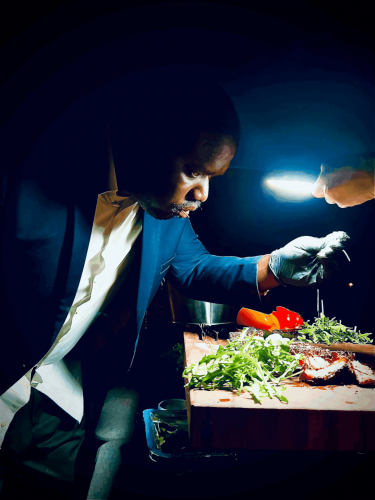
Reggie Robinson brings intentionality and experimental flavors to the menu at Lil Boy Blue BBQ. Courtesy of Crystal Wise
How did you and your brother go about putting together the menu? There are some unexpected items on there, such as seafood and desserts. What inspired you to branch out beyond traditional barbecue?
My brother is such a rich artist. He paints. I’m of science; I was pre-med as an undergraduate student. So, what happens is we bring art and science together with our love of food.
We’ve been all over the U.S., and we’ve gone out of the country, just to experience their food. There’s a story in every ingredient, and we’re junkies for those stories. What we will do is bring those stories and experiences back to folks who don’t have that access, and that’s what happens with our menus.
Do you have a preferred wood for smoking?
It’s oak. In that way, we are purists. I prefer live oak, but red oak gets it done.
What oak does whenever you burn it in specific temperatures is it releases these vanilla notes,it releases these caramel notes, that interact with whatevermeat you’re cooking.
Barbecue has always been local, in that you use the wood available. For us, and that sort of Central Texas Hill Country, it’s oak.
How do you approach building community, whether through pop-ups, social mediaor customer relationships?
I think the first part is getting rid of transactions. In our capitalistic sort of society, it’s“You give me the good, I give you the money,” and we try to mitigate that as much as possible.
We believe in unreasonable, unrealistic hospitality. We want to show up and under-promise and over-deliver; that’s one of the lessons Grandpa taught us.
What has the reaction been like from the community? Are there any regulars or particular memories that stand out to you?
There was a moment at one of our supper clubs, where we had fried some chicken. A lady came up to me, and she had tears in her eyes, and she said, “This is not only the best fried chicken I’ve had, but it reminds me of my grandmother.”
When we do what we love and we do it brilliantly, we remind people of their past, their heritage, their legacy, their inheritance. Food, for us, is the great equalizer.
Editor’s Note: The questions and answers have been edited for length and clarity.
Clarence Scharbauer III ’73, whose visionary leadership as Chair of the TCU Board of Trustees helped guide the university through a transformative era of growth and distinction, died on October 22, 2025. A devoted Trustee for almost three decades, Scharbauer’s steadfast commitment to his alma mater and his West Texas community left an enduring mark on both.
Scharbauer’s path to TCU began with a dream that never came true — and led to everything that did. He came to Fort Worth in 1969 to play baseball, having never set foot on campus. Former Athletic Director Frank Windegger’57 had offered the Midland High graduate a tryout, and that was enough. Scharbauerdidn’t make the team, but he found something more lasting.
“I loved every minute of my four years here, I really did,” he told interviewer Christie Shields ’13 (MS ’16) for the TCU Oral History Project in 2013. “I have a passion for this place.”
Born into the prominent Scharbauer family of Midland — whose roots in West Texas stretch back to the 1880s — Clarence was the first in his family to earn a college degree when he earned a BBA in business. During his senior year, he married Kerry Wallace ’73, the love of his life. The two met in Midland and were high school sweethearts, and their partnership spanned a lifetime — raising two daughters, supporting countless causes and building a legacy of generosity grounded in humility.
“He was very hands-on, a fantastic dad who never missed a ballet recital, horse show or game,” said daughter Charlotte Scharbauer French ’98, who now serves as a TCU Trustee. “He loved my basketball career in high school — I think it was one of his favorite times of his life — and he’d still tell people about it 30 years later.”
A Leader Who Lifted Others
In 1990, at age 39, Scharbauer joined the TCU Board of Trustees. His first meeting coincided with a changing of the guard: Bayard Friedman stepped down as Chair and John Roach ’61 (MBA ’65) assumed the role. Over the next three decades, Scharbauerplayed a pivotal role in shaping the university’s modern trajectory.In time, as Board Chair himself, he would preside over one of the most ambitious eras in TCU history.
The Vision in Action strategic plan, shepherded under his leadership, transformed the campus and elevated the university’s national standing. He helped guide major initiatives, including TCU’s entrance into the Big 12 Conference, the revitalization of the Mary Couts Burnett Library and the founding of the Anne Burnett Marion School of Medicine at Texas Christian University.
“Getting into the Big 12 and the medical school, those were the things he was most proud of,” French said. “He believed everything we do is for the students.”
“This is TCU’s finest moment,” Scharbauer told TCU Magazine in 2012. “We have a leadership team that is committed, a faculty that is engaged, a Board that is supportive and students who are energetic and talented.”
Former Board Chair Luther King ’62 (MBA ’66) described Scharbauer as “a steady, unwavering friend and leader at TCU.” He added, “Whatever Clarence said, you could count on it. He was trusted, reliable and all in on whatever needed to be done.”
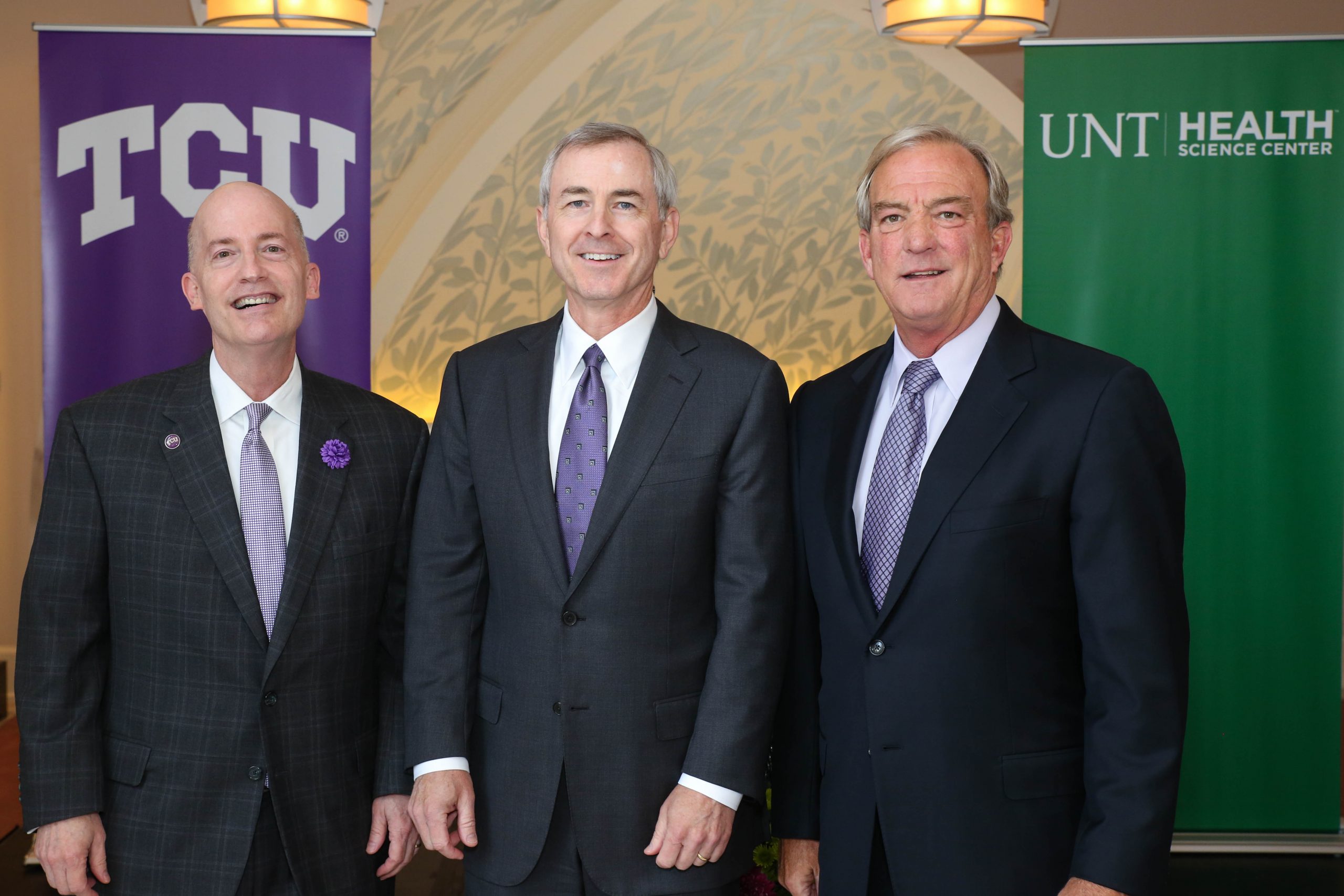
Clarence Scharbauer III, right, joins Trustee and immediate past Chair Mark Johnson, center, and Chancellor Emeritus Victor J. Boschini, Jr., left, at TCU’s 2015 announcement of a joint medical school with the UNT Health Science Center. Photo by Amy Peterson
King recalled Scharbauer’s essential role in the West Campus expansion and the rebuilding of Amon G. Carter Stadium. “He stepped forward as one of the six founders of [the West side expansion project] when we had a very tight fundraising deadline,” King said. “He was a staunch supporter of TCU Athletics and a key part of what we achieved over the last few decades.”
Chancellor Emeritus Victor J. Boschini Jr. reflected, “Clarence’s leadership as Board Chair changed the course of our history. He has meant so much to me personally and professionally over the years, and I will be forever grateful for Clarence’s friendship, wisdom and support.”
Chancellor Daniel W. Pullin called him “a defining leader in Texas Christian University’s history,” adding: “Our community owes him a debt of gratitude for his vision, his support for our students and his legacy of generosity.”
The Man Behind the Title
Though Scharbauer’s name graces Scharbauer Hall, home to the AddRan College of Liberal Arts, he preferred wide-open spaces to boardrooms. “He wasn’t a coat-and-tie guy,” said longtime friend Rex Amini. “He was a cowboy. That’s how he grew up, and he loved being outdoors.”
Even as his influence grew, humility remained his compass. “If he were on the phone right now,” Amini added, “he’d be totally embarrassed by all this talk about him. He’d tell us to stop and let it go. He didn’t need people to know what he’d done.”
Clarence Scharbauer III appears in a Phi Delta Theta fraternity group photo from the 1971 Horned Frog yearbook. Photographer unknown
King saw the same quality in him. “With his name, he could have been different,” he said. “But he wasn’t. He was very regular, a true West Texan. A handshake meant more to him than any contract.”
Kit Moncrief, chair of the Board of Trustees, said that “Clarence’s vision, leadership and generosity shaped TCU in profound and lasting ways. … His commitment to excellence leaves an indelible mark on our university.”
“He was the first in his family to graduate from college, and that shaped everything,” French said. “He believed education was the key to changing lives. He was honest, hardworking, philanthropic and funny — that was our dad.”
A Legacy of Generosity and Joy
Beyond his professional and philanthropic roles, Scharbauer was a husband, father and grandfather who lived his values daily. “Ideas and buildings are what they are, but people make the difference,” he told the TCU Oral History project.
French recalled his unstoppable enthusiasm for TCU. “We used to joke on family vacations that we should take bets on how long it would take him to mention TCU to a stranger,” she said. “He met so many people that way; we laughed that he probably did more publicity for TCU than us winning the Rose Bowl.”
King said Scharbauer’s leadership reflected his belief that “diverse viewpoints made TCU stronger.” He added, “He might disagree with you, but once a decision was made, he was there. You could always count on him to carry it forward.”
Clarence Scharbauer’s legacy will continue through his family’s ongoing service to TCU. He is survived by Kerry Wallace Scharbauer ’73; daughters Kelly Scharbauer Whittenburg ’02 and Charlotte Scharbauer French ’98; sons-in-law Kirk French ’97 and Ben Whittenburg; and three grandchildren.
Chancellor Pullin added: “On behalf of the TCU community, Annie and I send our sincere condolences to his beautiful family, who continue his legacy of leadership at TCU.”
Scharbauer’s family shared his essential life advice: “Be honest, be loving, be kind, always be generous to others, never take yourself too seriously, laugh, make others laugh louder, stop to think, respect the views of others, love those closest to you deeply, understand that it’s OK to not be understood, always try your hardest, try even harder when life gets tough, your toe is a long way from your heart and holy dang cow never stop cheering on the Horned Frogs!!”
They say defensewins championships, and No. 17 TCU loaded up on it through the transfer portal this offseason.
Olivia Miles led Notre Dame with 5.8 assists per game last season, helping the Fighting Irish reach their fourth straight Sweet 16. Photo by Zach Campbell | TCU Athletics
Chief among the newcomers is senior center Kennedy Basham, who arrives in Fort Worth after a 2024-25 season at Arizona State, where she led the team in defensive rebounds, totaling 34 more than any other Sun Devil, and averaged 2.6 blocks per game, good for second in the Big 12.
She’s not the only defensive-minded addition. The Frogs also brought in senior guard Veronica Sheffey, who stacked up seven steals in a three-game span en route to Mountain West Conference Tournament MVP honors, as she willed San Diego State to the Big Dance for the first time in 13 years.
And that’s not to mention guard Olivia Miles, a graduate student, whose 15.4 points per game last season marked a career best, punctuating a Notre Dame career that will all but certainly see the two-time AP All-American inducted into the program’s Ring of Honor.
With those reinforcements, plus several key veteran holdovers from the 2024-25 squad that reached the Elite Eight for the first time in school history, TCU enters Year 3 of the Mark Campbell era, its roster rich in talent.
What changed since last season
Nothing on the coaching front. Associate head coach Xavier Lopez and assistants Minyon Moore, Nia Jackson, Nolan Wilson and Jessie Craig all return under Coach Campbell, along with Adeola Akomolafe, director of recruiting operations and student-athlete development.
The roster, however, is reloaded. Last season’s Big 12 Player of the Year, Hailey Van Lith, went 11th overall in April’s WNBA Draft after leading the Frogs in points and assists. If a player in the 2025 portal class can match that level of offensive firepower, it’s Miles, projected by ESPN as a top-2 pick.
Transfers Marta Suárez, right, and Veronica Sheffey bring NCAA Tournament experience to a veteran TCU roster. Courtesy of TCU Athletics
TCU adds size and experience up front to replace defensive stalwart Sedona Prince ’25 MLA. Graduate student and forward Marta Suárez joins the Frogs with 80 career Power Four starts, while 6-foot-7 sophomore center Clara Silva arrives from Kentucky, giving TCU another post presence alongside Basham and first-year center Emily Hunter. Graduate student and forward Natalie Mazurek returns for what will be her second year with the Frogs after transferring from South Dakota.
Helping to counter the departure of sharpshooter Madison Conner ’24 is graduate student and guardMaddie Scherr, who missed all of last season with injury. The former Kentucky Wildcat brings a proven scoring touch: in 2022-23, she led the SEC by making 92 percent of her free throws, and her 1.4 three-pointers per game in 2023-24 marked a career high.
Sophomore guard Taliyah Parker signed on after a season at Texas A&M, where she averaged one steal over 18 minutes per game, adding defensive energy off the bench. First-year players Sarah Portlock, a 6-foot-8 Australian center, and guardClara Bielefeld, who made history as the youngest competitor on Germany’s senior national team at the FIBA Women’s EuroBasket Championship, bolster TCU’s depth. The Frogs will be without senior forwardAaliyah Roberson for the duration of the season after she suffered a torn ACL in the spring. The former San Antonio area high school standout still holds one year of NCAA eligibility.
Biggest storyline heading into the season
How will the backcourt gel? Five of the Frogs’ six leading scorers last season were guards, but only junior Donovyn Hunter and senior Taylor Bigby return from that group.
On paper, TCU boasts a dynamic mix of playmakers, but how quickly this unit develops chemistry will go a long way in determining the effectiveness of an offense that could be largely driven by guard play.
Are the Frogs better positioned than a year ago?
Very possibly, and for the rest of the Big 12, that’s a scary thought. The Horned Frogs swept the conference titles last season, topping three-time national champions Baylor in both the regular-season finale, which left TCU a game ahead at 16-2 in conference, andthe Big 12 championship game just a week later.
The Frogs retain the top-end talent and deep bench that carried them to new heights a season ago, and the stability of the coaching staff serves as another plus as TCU sets out to defend its conference crown.
Player to watch
Donovyn Hunter. She may not finish as the team’s top scorer, but the ex-Oregon State Beaver contributes on both ends of the floor. She showed her sharpshooting potential by hitting all four of her three-point attempts — and each of her six field goals — in TCU’s 85-70 NCAA Tournament win against Louisville and appears to be locked in for a breakout campaign, routinely pacing the team in preseason sprint drills.
Newcomer who could make the biggest difference
Suárez is perhaps the favorite to lead TCU’s frontcourt in scoring, having averaged double figures for Cal in each of the past two seasons. But the answer here has to be Miles. Among the more impressive numbers from the former Fighting Irish star last year: Her 40.6 percent mark from three — second best in the ACC — represented a jump of more than 13 points from her previous career high.
Statistic to watch
Turnover ratio. TCU lost the turnover battle in each of its four losses last season.
For a starting group that featured three of the Big 12’s top six players in offensive rating in 2024–25, ball security was one of its few weaknesses. The Frogs’ 12.4 giveaways per game were lowest in the conference, but the miscues proved costly in key moments. Tightening up — especially with eight newcomers among 14 total players — will again be essential to sustaining success in March, and maybe into April.
Toughest stretch on the schedule
The Frogs’ final six regular-season conference matchups, between Feb. 12 and March 1, include three against preseason AP Top 25 teams: No. 16 Baylor, West Virginia (receiving votes), No. 14 Iowa State, Houston, Cincinnati and a second meeting with No. 16 Baylor.
What success looks like this season
Dare I say a trip to Phoenix for the NCAA Women’s Final Four? For a team that finished last in the Big 12 with a 1-17 league record just three seasons ago, it sounds crazy. And yet, with a talented but balanced roster and a phenom guard leading the way, it feels within reach.
One bold prediction
The Frogs this season take the next step, reaching the program’s first Final Four behind a first-team All-America-caliber campaign from Miles.
Not all 19-year-olds can say they’ve flown a plane over Santa Catalina Island, but Matthew Miamidian can.
The junior, a double-major infinance and entrepreneurship and innovation, was 13 when he first piloted aplane, though he’s quick to point out he was being coached by hispilot friend at the time. When that friend,who flew for Southwest Airlines,invited him onto his RV-6A — a homebuilt two-seater, single-engine aircraft —Miamidian said hethought he was just going along for a ride and would take photos out the window. Instead, his host had him sit in the captain’s seat and began explaining the controls.
When asked if he wanted to take the controls to fly, the teenager went for it. While Miamidian has flown many times since then, he appreciates that early opportunity.
“He had a lot of confidence in a 13-year-old,” he said of his friend.
Today, Miamidian is a full-time student taking morning classes at TCU and flying Piper Arrows and Warriors and Cessna 172s and 182s in the afternoons. He earned his private pilot license last spring and is working toward completing the 250 flying hours needed fora commercial pilot certificate.
What he enjoys most about piloting is the blend of raw excitement and technical, intellectual challenge. “Flying instruments,” which means flying under poor visibility and relying solely on one’s equipment, keeps Miamidian mentally stimulated, while liftoff appeals to his love for adrenaline. He even likes the turbulence, which he said feels “like a free massage.”
“There’s something about being in control and being a few thousand feet in the air that’s kind of surreal,” he said.
Bonding Onboard
Miamidian has been drawn to aviation since he was 3. He said he played a lot of flight simulator games, which gave him a feel for aerodynamics and takeoff and landing procedures. But those simulations failed to fully capture how thrilling — and nerve-wracking — it is to fly.
“It’s one thing [taking off and landing] on a flight simulator, it’s another thing putting it into practice in real life,” he said.
It is illegal for children under 16 to fly a plane solo, certified flight instructor Samantha Woodward said, but kids taking the captain’s seat under supervision isn’t uncommon. She started at age 7.
Miamidian’s first flight went well from start to finish, and now he is the one bringing friends on board. He once flew some buddies over Santa Catalina Island, California, and still remembers their stunned reactions as they looked out the window. Another time, he took his fraternity brother, roommate and another friend on a day trip to Choctaw Casino & Resort-Durant in Oklahoma to play poker. They rented a plane and were back in Fort Worth by dinnertime.
Santa Catalinais one of his favorite places to fly because of its sometimes-challenging landing and beautiful views, he said, thougha recent flight in Hawaii was memorable.
“The views around Hana were breathtaking,” he said.
Woodward teaches at Huffman Aviation in Burleson, Texas, and has worked with Miamidian for almost two years. She described him as a safe and competent pilot whom she would trust to fly her own family.
“I have a lot of students,” she said, “and when I see him on my schedule, I’m excited because I know I don’t have to stress about almost dying that day.”
Because the commercial pilot certificate program requires 300 nautical miles of cross-country flying experience, Woodward said she and Miamidian have many fun trips. Their longest flight was a 285-mile trek to Mustang Beach in Port Aransas, Texas. They made a pitstop in Lockhart for barbecue on the way back. Such long flights give them an opportunity to talk about career aspirations and what Miamidian is up to at school.
“It’s fun to hear his stories about life at TCU,” she said.
From mock flight simulators to real skies over Catalina Island, TCU junior Matthew Miamidian has turned childhood curiosity into a calling. Photo by Glen E. Ellman
Aviation and Academics
Michael Grohman, an instructor in the Neeley School of Business’s management and leadership department, said Miamidian’sdrive and ambition caught his attention when Miamidian took Grohman’s Business and Society course in 2023. He was one of only a few students who showed up on Day 1 having already read the syllabus and prepared to introduce himself, Grohman said.
The course was discussion-based and entailed many conversations about students’ life experiences,so it didn’t take long for aviation to come up. While discussing business models and corporate strategy, Miamidiangave examples he’d seen from the aviation industry.Grohman said he was surprised to learn about Miamidian’s hands-on experience.
“That intrigued me,” he said, “because it’s not every day you meet a college student who’s also pursuing a commercial pilot’s license.”
“There’s something about being in control and being a few thousand feet in the air that’s kind of surreal.” Matthew Miamidian
Flying became a regular topic of conversation in class. When Grohman asked students about their weekend plans, the young pilot’s schedule often involved flying and accruing more flight hours.That unique perspective and openness to share helped drive class engagement, Grohman said, and when the class broke into groups and picked companies to research andanalyze for their final project, Miamidian’s group chose Boeing.
“It really created an interesting dynamic,” Grohman said of Miamidian’s insights, “and being able to have kind of an open dialogue at that level with … as much understanding [as] he had was refreshing.”
Miamidian hopes to pursue a career in aviation law, which covers issues from noise complaints and personal injury to insurance and liability. He has considered flying for an airline but said that’s not his long-term goal.
Grohman said he wouldn’t be surprised to see Miamidian step into a leadership role in any organization or industry, but he suspects he’llultimately land “an amazing position in aviation.”
Though Miamidianloves being airborne, he is afraid of heights and said there’s one flying-related activity he won’t do.
“People ask me if I’ll ever go skydiving,” he said. “No.”