
The Legend of Pico de Gallo
Rockers from the philosophy department remember their band’s heyday, from adoring fans to tanking gigs.
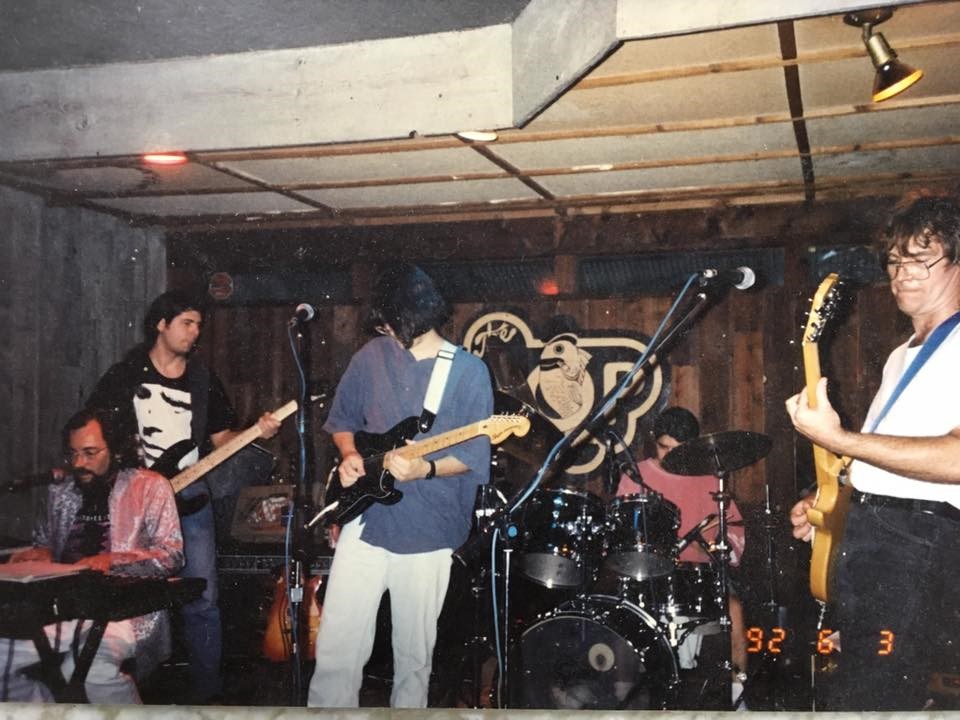
TCU philosophy faculty and students take the stage as Pico de Gallo. The band played around Fort Worth between 1983 and the early 2010s. Courtesy of David Lay Williams
The Legend of Pico de Gallo
Rockers from the philosophy department remember their band’s heyday, from adoring fans to tanking gigs.
A CLOUD OF CIGARETTE SMOKE wafted over bar-goers as they squeezed into the House of Pizza on West Berry Street one autumn night in 1990.
From a stage at the back of the room, Richard Galvin, professor of philosophy, started strumming his guitar. Alongside him was fellow philosophy professor Gregg Franzwa on the electric keyboard. The song: The Rolling Stones’ “Sympathy for the Devil.”
“It could get pretty raucous,” Galvin, now the Betty S. Wright Chair in Applied Ethics, said of the crowds, with patrons dancing on tables and younger fans chanting “Pico is Messiah.”
By day, Galvin and Franzwa taught courses on Kantian ethics and American philosophy. By night, they were the founders of the philosophy department’s unofficial rock band, Pico de Gallo. Franzwa was the ringleader and keyboardist; Galvin played lead guitar and arranged the music. Both sang.
After filling in for a few shows post-undergrad, Blake Hestir ’88 became Pico’s bass player upon joining the department as a professor in fall 1998.
From 1983 to the early 2010s, Pico de Gallo played covers of ’60s and ’70s rock hits — a mix of Chuck Berry, Lou Reed and others — along with a few academia-themed originals.
Galvin and Franzwa started the band to nurture their love of playing music while also raising funds for student organizations and charities. Instead of charging a cover, they collected money for initiatives such as TCU Hunger Week and Amnesty International.
The band had many names over the years, but Pico de Gallo lasted the longest, an homage to the condiment Galvin and another member enjoyed. Galvin said the band was most popular from 1988 to 1995, with a crowd of regular fans among students, faculty and school administrators.
They started changing their name before each gig in later years after noticing a suspicious trend. “With alarming regularity,” Galvin said, the places where the band played would close immediately or shortly after their shows. He recalled more than six venues shuttering soon after their gigs, with one bulldozed a week later.
Galvin on Lead Guitar
When he was 11, Galvin bought his first guitar from a Brooklyn pawnshop. He had played with several bands by the time he became a professor. When he met Franzwa at an American Philosophical Association meeting in the early 1980s, they immediately bonded over music.
Galvin came to TCU in 1982, and Pico de Gallo was born a year later. The band’s first show was on the steps of Brachman Hall, a residence hall that’s since become a parking lot.
“It was a quick gig because the cops shut us down right after we started playing,” he said.
That was the first of multiple occasions when the band had to call it early due to noise complaints. They didn’t have much money or space for equipment or rehearsals, so they practiced at a bandmate’s house.
Once they found their footing and built a reputation on campus, Galvin said, students and faculty often wanted to join Pico de Gallo. They had a harmonica, a saxophonist — even a trombonist dropped by once or twice. One former member said some nights, the stage felt just as crowded as the audience.
Still, there were some mishaps over the years, like when a drummer got so into the music that he and his drum kit fell off the stage at the White Elephant Saloon.
“One of our bass players actually wound up falling out of the back of a pickup truck on his head on his way to a gig with us,” Galvin said, “so we had a little trouble with bass players at first. But Blake stabilized that.”
Hestir on Bass
Hestir said the band brought the TCU community together, using music to encourage philanthropy and dialogue on serious subjects, such as anti-war protests and human rights campaigns.
“When the band worked,” Hestir said, “that’s what we were doing, and that’s what I loved about it.”
In their heyday, band members rehearsed weekly and performed about once a month, typically at The House of Pizza or The Moon on West Berry Street. Hestir said that those gigs were fun communal experiences but that students and faculty performing together at bars wouldn’t work today.
“Now TCU has rules where faculty and students can’t be in the same bar,” he said. “But then it was much more open. … Those were different times.”
Galvin said Hestir was one of the musicians who dramatically improved Pico de Gallo’s sound. Hestir’s take was different, saying even with him there, the band was “not very good.”
“Which was part of the joke,” he said. “I think it wouldn’t have been as impactful if we had gotten a serious face on and played like professionals.”
“It was the talk of the dormitory that these kooky professors had their own band. … I thought, ‘Any professor who has his own rock band is somebody I want to know.’”
David Lay Williams
Williams on Guitar
David Lay Williams ’92, professor of political science at DePaul University, said Pico de Gallo was legendary when he was an undergrad at TCU. That’s what inspired him to take his first philosophy class.
“It was the talk of the dormitory that these kooky professors had their own band. … I thought, ‘Any professor who has his own rock band is somebody I want to know,’ ” he said.
After learning Williams played guitar, Franzwa invited him to play with the band. Williams joined as a junior in 1990.
Despite the group’s popularity in the off-campus pub scene, several other gigs didn’t go well. Their most infamous was in 1991, when they played for the American Bankers Association. They didn’t know how to play what the audience requested, so they opened with “Green River” by Creedence Clearwater Revival. At first, Galvin thought they were standing up to dance. They weren’t.
“They were not into us” and started streaming out the door, Williams said. Eventually, all who remained were the band, the woman who arranged the gig, a sound guy and two of Galvin’s students who were in the building for an ROTC banquet.
“You couldn’t have cleared that room more efficiently with a fire alarm,” Williams said.
Brown on Guitar
Tyler Brown ’07 said he brought his Les Paul with him to campus but put aside his aspiration to be a music producer. After hearing about Pico de Gallo in a philosophy class, he watched the band perform at the University Pub and wished he could be onstage.
In 2004, Hestir invited him to join their next rehearsal. After Brown played the solo from “Great Balls of Fire” by Jerry Lee Lewis, Franzwa suggested he play the opener at their upcoming gig.
“I had a gang for the first time,” Brown said of joining the band. “A group of guys. They just happened to be these really great educators.”
Pico de Gallo was his first band, and while he’s been with several since college, Brown said none have compared. His time with the group didn’t give him just stage and performance experience but also acceptance and validation.
“It was only two or three years of my life,” he said, “but … they made me a musician.”
Many of his Pico de Gallo anecdotes involve Franzwa, whom Brown and the others spoke of with reverence.
“To this day,” Brown said, “I think he is the funniest person I’ve ever known.”
Franzwa on Keys
The band’s final show was in December 2016. This time, the occasion was emotional: a tribute to Franzwa, who had died that fall. They hadn’t performed for several years, but Franzwa requested it in his will instead of a memorial.

A sketch by former TCU studio art student Susan Marshall, circa 1990, depicts, from left, Gregg Franzwa, David Lay Williams, Roger Martin and Blake Hestir. Courtesy of David Lay Williams
Before a crowd of mourners at The Grotto on University Drive, Galvin took Franzwa’s seat at the keyboard. They played all of Franzwa’s favorites: from the Stones songs he’d sing to the band’s medley of “Under My Thumb” and Chuck Berry’s “Nadine.”
Franzwa’s bandmates described him as a dry-humored, nurturing man with a “Mick Jagger swagger.” A short, bearded academic with piercing dark eyes, he liked to joke with audiences, introducing himself onstage as Chancellor Victor J. Boschini, Jr., the vice chancellor for academic affairs or the governor of Texas.
“He was a showman,” Galvin said, “and he was very, very good at it.”
That humor still beats throughout Pico de Gallo’s legacy — one of friendship, snark and rock ’n’ roll.
“It really was an interesting ride,” Galvin said. “And it all started as a one-off kind of deal on the steps of Brachman that ended catastrophically.”
Your comments are welcome
3 Comments
I really enjoyed your article… Brought back many memories… But not many folks referred to that place as house of pizza… Most people called it the HOP…
Love this article, I didnt know any if this after I graduated but Franzwaa had a different band in 88/89. I played with Hester then in a band called “Hand Fulla Buttock”. This was before I joined the greatness of Buda Kooda.
I remember going to see them when I was an undergraduate. Great shows! I have a vague recollection of a song they sang called “You’re a Piss Ant.” Lol. I think it was an original rather than a cover, but I could be wrong. I had taken a couple of Dr. Franzwa’s classes, and he was an amazing teacher as well as an entertaining performer. A true original. RIP.
– Maureen R. Class of ‘89
Related reading:
Research + Discovery
Music Without Borders
Till MacIvor Meyn’s choral compositions reach an international audience.
Features, Research + Discovery
The Music of Mexico
Laura Singletary’s deep dive into a high school’s mariachi program spurred the start of one at TCU.
Mem’ries Sweet
Where We Hung Out: TCU’s Lost ’90s Landmarks
TCU’s campus has seen seismic change over the past quarter century, but the memories remain.