
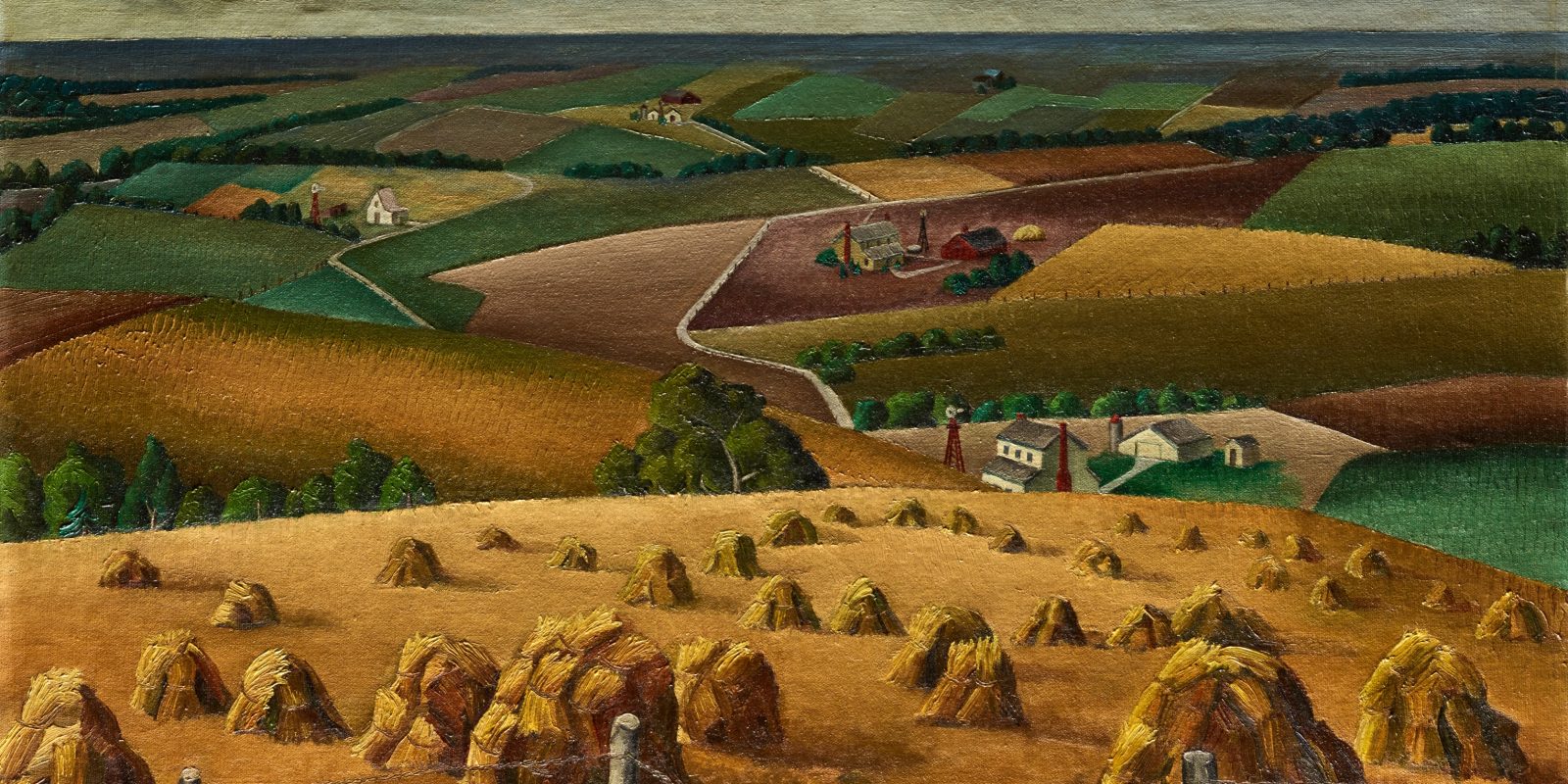
“Squaw Creek Valley,” a 1937 oil painting by Texas artist Florence E. McClung, depicts the wheat fields and farmsteads of a North Texas landscape now largely vanished from popular memory. Courtesy of Dallas Museum of Art
How Wheat Made Bob Wills, Pappy O’Daniel and the Kimbell Art Museum Possible
TCU historian Rebecca Sharpless’ book reveals the surprising ways that wheat — not oil, cotton or cattle — shaped North Texas’ history, culture and civic life from the 1840s to the 1970s.
Visitors to Fort Worth’s Kimbell Art Museum might assume the family fortune came from oil. Or cattle. Or cotton — the familiar currencies of Texas myth.
It was wheat.
Long before the museum’s vaulted concrete ceilings drew pilgrims of modern art, wheat profits moved through North Texas fields, mills and bank accounts, quietly underwriting a region’s rise. That fact startled even Rebecca Sharpless, a professor of history at TCU.
Her realization began years earlier, while she was researching the lives of farm women in Central Texas. She was struck, she said, by how vividly people recalled the food of their childhood — the taste of biscuits, the texture of bread dough. All foods that began as wheat.
If food could affect memory so powerfully, Sharpless began to wonder, shouldn’t venerable wheat regain its central role in North Texas history?
Her latest book, People of the Wheat: Culture and Cultivation in North Texas (University of Texas Press), draws on local histories, oral histories and old cookbooks to recover an unusual and largely unknown chapter in the agricultural history of Texas. In a state largely known for cattle and cotton, Sharpless traces how wheat gained a significant foothold in North Texas starting in the 1840s.
The book explores how wheat was cultivated, processed, sold and consumed in Cooke, Grayson, Denton, Collin, Tarrant and Dallas counties — what Sharpless calls the North Texas Wheat Belt — well into the 1970s.
Wheat’s influence transcended the agricultural markets. Fort Worth’s Burrus Mill sponsored a musical variety program on local radio station KFJZ, and fiddler Bob Wills and his band were among the first to perform on the show. They called themselves the Light Crust Doughboys, named after the mill’s Light Crust brand.
W. Lee “Pappy” O’Daniel, the sales manager for Burrus, allowed the band members, who were mill employees, to stop working as long as they practiced their music for eight hours a day. Wills would later become known as the father of Western swing. O’Daniel, who Sharpless describes as “one of the most notorious politicians in Texas history,” would go on to be elected governor of Texas and serve in the U.S. Senate.
FLOURISHING WITH FLOUR
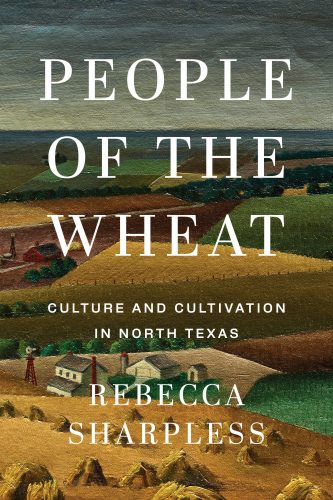
Courtesy of University of Texas Press
Abandoned grain silos, some repurposed and some simply left standing, still dot the North Texas landscape — vestiges of the wheat heyday that once defined the region. So pervasive was wheat in 19th-century regional culture that in 1885 the Dallas County community of Sprowls’ Corner changed its name to Wheatland.
James Giesen, a historian of American agriculture at Mississippi State University, said Sharpless’ book accomplishes one of the best functions of history: “Seeing something in your backyard and realizing there’s a history there. That silo was built by somebody, and people worked there. Think about all these people and the lives they lived there.”
The crop — or the silo — is only part of the story: “This book is not really about wheat but about people: the people who planted wheat, harvested it, milled it, baked it and ate it,” Sharpless writes in the book’s introduction. “It’s about how people used wheat, wheat flour, and items made from wheat as organizing principles of their lives that determined how they spent their time and their money and how they prepared their food.”
William Cochran, a farmer who moved to North Texas from Tennessee, was among the first to bring wheat to Texas, planting it on a tract northwest of Dallas in 1845. Sharpless writes that Cochran and all his neighbors “were overjoyed at its astonishing yield.”
People living in the region at the time had come from other places, often areas with ready access to wheat and flour. But bringing flour to North Texas was too expensive and impractical for most newcomers.
So farmers were thrilled to find that winter wheat tolerated Texas weather and could be rotated with cotton, which is typically planted in spring and harvested in late summer. By 1860, Sharpless writes, 60 North Texas farmers were each growing more than 1,000 bushels of wheat.
More wheat created a need for mills, which entrepreneurs built to process the grain into flour.
“Mills created communities by fostering local businesses that drew customers from far and wide,” Sharpless writes. “They were items of wonder.”
FROM FIELD TO OVEN
Kitchens and dinner tables throughout North Texas showcased the mills’ success. Families long accustomed to cornbread with their meals started to enjoy biscuits as a new staple. Mothers made biscuits, often with ham or sausage, for children to take to school for lunch.
“Mills created communities by fostering local businesses that drew customers from far and wide. They were items of wonder.”
Rebecca Sharpless
Many of the mills promoted the use of their flour by publishing cookbooks and hosting baking competitions and cooking shows. Sharpless writes that a cookbook published in 1909 by the Baptist Ladies’ Aid and Missionary Society of the First Baptist Church of Bowie, Texas, may have been the first to explicitly praise Texas flour. The book included recipes for breads, pies, cakes and more. The cookbook was popular enough to justify four editions.
Bewley Mills in Fort Worth brought in home economists and a “domestic economy expert” to host cooking schools in the early 20th century, Sharpless writes. “Each cooking demonstration and competition tried to yoke the idea of excellence with a certain brand of flour.”
There were rolls, muffins, gingerbread and fruit cobblers. “North Texans also fried wild game,” Sharpless writes. “Rabbit and squirrel pieces received a good coating of flour before they were ‘fried in lard till brown.’ ”
As Dallas and Fort Worth continued to grow in the mid-20th century, wheat production in North Texas began to wane. Wheat farming began moving to the Texas Panhandle around 1900, Sharpless writes, when farmers started digging wells and installing windmills to tap into groundwater for irrigation. “The drier air in West Texas discouraged disease, and observers also noted the benefits of the flat terrain,” she writes.
But the surprising influence of wheat’s heyday in Texas is still evident today, Sharpless said. “I had no idea. … If you had asked me, ‘What did they grow in North Texas?’ I would have said cotton. The idea that wheat played as big a role as it did … this really mattered to people. The choices that they made, the way they lived, the way they spent their money, the way they educated their children were all directly tied together and make us how we are today.”
Your comments are welcome
Comments
Related reading:
Features
TCU Helps Sow Urban Agriculture in East Fort Worth
Professors and students partner with local nonprofits to bring healthy produce to an under–resourced community
Features, Research + Discovery
We’re Running Out of Fresh Water
TCU researchers focus on protecting our most precious resource.
Alumni
Pete Bonds Is Ranching’s Maverick
Alumnus rides the ups and downs of ranching.