
TCU Dean of Students Karen Bell Morgan on Helping Students Thrive
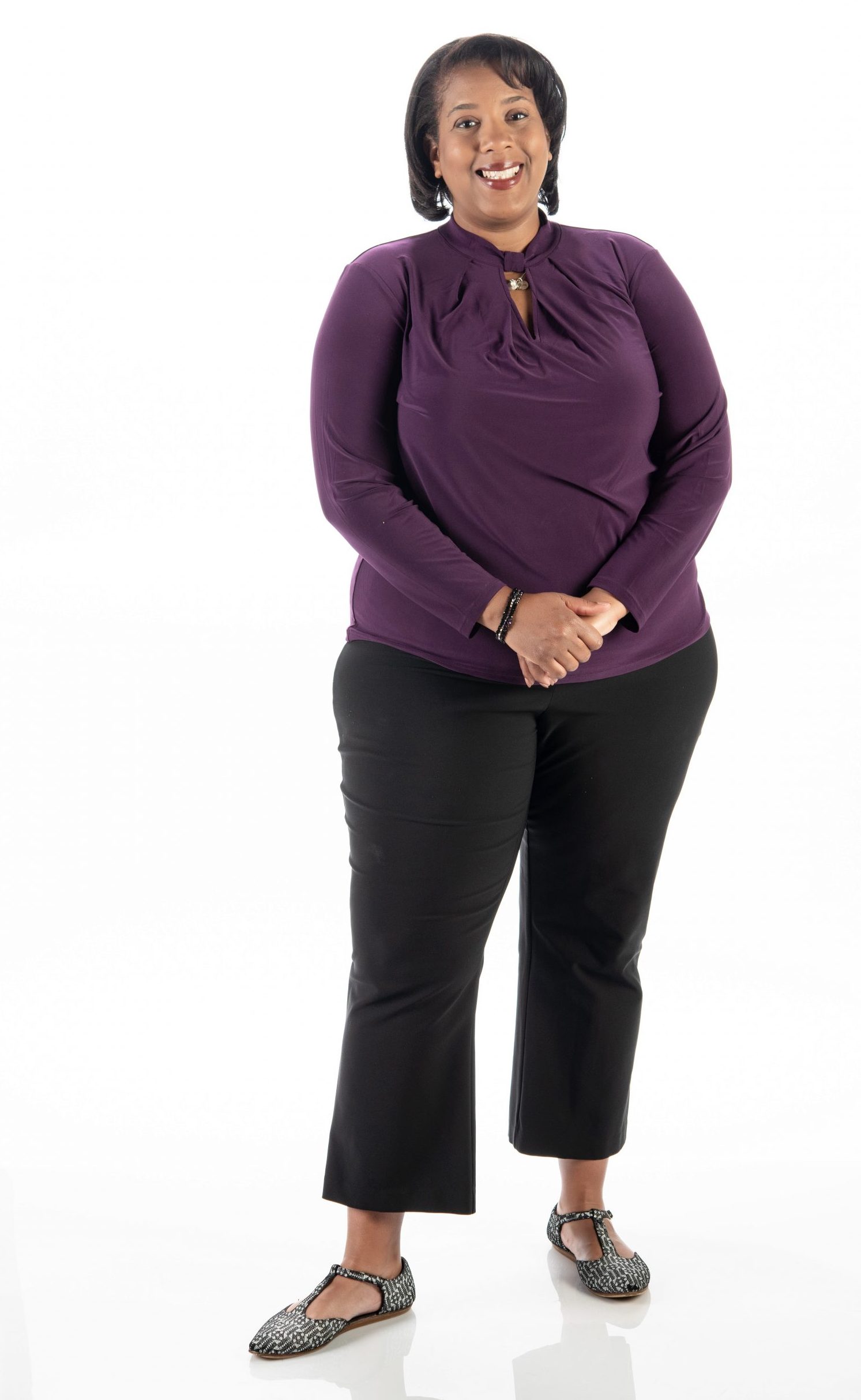
Karen Bell Morgan studied nutrition at TCU, worked as a public health educator and taught at UNT Health Science Center before returning to campus, where she has led the dean of students office since 2021. Photo by Glen E. Ellman
TCU Dean of Students Karen Bell Morgan on Helping Students Thrive
Karen Bell Morgan ’02 has spent much of her adult life at TCU — first as a student, and later working in the dean of students office, which she now leads. Morgan, who has a trio of degrees in the health sciences and a background as a public health educator, works with her staff to handle student concerns, personal emergencies and the conduct process, including disciplinary hearings. But Morgan said her office isn’t just the “principal’s office” — she and her team make sure students have access to the resources they need to thrive, helping them to develop personally and academically.
Who were some of your biggest influences growing up?
My parents because they were very hardworking. My dad is a doctor, and my mom was the principal of an elementary school. They were very instrumental and said, “You’ve got to go to college, and you’ve got to figure out what your purpose is going to be.”
How did your nutrition studies at TCU inspire you to continue your education, earning a master’s in public health from UNT Health Fort Worth?
I had great mentors. Mary Anne Gorman was really instrumental. I was a student who struggled and she was like, “You need to find opportunities to get involved,” and so that’s when I joined my sorority. Lyn Dart was also very instrumental in nurturing the whole idea of public health. And then Anne VanBeber, who still works here, was that encourager. She has a silent little swagger about her that just helps you say, “OK, I think I can do this.” The nutrition department was really instrumental in me moving forward and not having my academic struggles keep me in one spot.
You worked as a health educator for the Fort Worth Public Health Department before returning to TCU as assistant dean of students. What drew you to work in higher education?
I came from a family of educators; I think that’s really what appealed to me. When I started working in student affairs, I didn’t realize what it was — what they do is help develop students morally. My student affairs mentor was Darron Turner ’87 (EdD ’11). He was associate vice chancellor for student affairs and helped the Black sororities and fraternities — the National Pan-Hellenic Council — work collaboratively with the Interfraternity Council and the Panhellenic Council sororities and fraternities. Just seeing him in action, I’m like, “Oh, well, maybe I want to keep doing this.”
You earned a PhD in health studies and worked as an assistant professor at UNT Health Science Center, where you directed the Master of Public Health program. What brought you back to TCU as associate dean?
TCU really, even as a student, felt like a home. I kept coming back because the community brought me back. I’ve seen how TCU has grown and developed and gotten better as far as addressing things that maybe weren’t great for some students, trying to figure out how we can make changes to make it better for the students that come after us. And I’ve appreciated that.
“I just want this office to be a place that people see as a resource, not a barrier.”
Karen Bell Morgan
You were promoted to dean of students in 2021. What does your job entail?
Every day is almost like a new day, just because there’s so many different things that happen. A lot of people think about the dean’s office as the principal’s office — yes and no. We oversee the student code of conduct; if a student is accused of violating the code, then we will invite them in for a meeting to discuss how their alleged behavior aligns or doesn’t align with our TCU code and values. We will work with them through that conduct process with the goal of trying to help them develop and make better decisions the next time. We work closely with Housing & Residence Life to address conduct issues that happen in the residence halls, as well as conduct that might happen off campus.
The other part of our office is care, support and advocacy. Oftentimes, students will have some type of a struggle, and they don’t really know where to go for help. That side of my office works to support students, understand what the problem is and then get them connected to resources that can help them.
If a faculty member is concerned about a student — maybe they haven’t been to class since the first day of school — they can submit a student of concern form and then we can refer that student to our student success team where they’ll work with a staff member to try to identify the barrier for going to class and then figure out, “Is this salvageable or do we need to get you to drop the class?”
If a student has had a death in the family, maybe the parent calls us and lets us know. We can get that student connected to counseling or the office of religious and spiritual life to try to get some additional support, as well as communicate with their faculty members to let them know that the student is struggling. Our goal is to try to be like a linchpin or a connector for students.
What is your general philosophy when it comes to helping students?
To provide them with an individualized approach to getting the support that they need. We understand that every student’s situation is different, and we want every student to feel like they are being seen and that they’re being heard and that the issue is being addressed. It may not end up being addressed in the way that they want it to be addressed when they initially come in, but at least it is being addressed in a way that is either going to be best for or congruent with how we work as a university, our policies or helping the student.
What is your advice for students transitioning from high school to college?
Try new experiences. Don’t think that you know everything and don’t push yourself beyond what you’re comfortable with — students understanding their boundaries and respecting their boundaries and making sure that other people are respecting their boundaries. And if not, then figure out how to move on from that person, because your first- and second-year friends may not be the same friends your third and fourth year, and that’s OK. You evolve.
When a student comes to you seeking help, what is the first step you take, and what are your favorite campus resources to recommend?
I first try to listen to them and hear them out. Kathy Cavins-Tull, our vice chancellor, has that great demeanor to where she’ll sit you down and just let you talk and insert when appropriate. I like that approach — just allowing the person to talk, not interrupt, but when there’s an opportunity for some type of consideration, bringing that point. And then after letting them talk, just reiterating the things that you can or can’t do.
We love the counseling center in my office, the office of religious and spiritual life — those are probably our go-tos. For the academic student success side, the student success team, access and accommodations, TCU Police and we’re on call 24/7.
Do you have any student success stories you can share?
I don’t work with the students as much as I used to when I was an assistant dean, but I really enjoy seeing the success stories. It’s really interesting to see the students develop and grow from a first-year student to, “I’m doing my internship,” “I’ve got a job offer,” “I’m going to do graduate school.”
I had one student, when I was working with mental health issues, who was hospitalized so many different times, and she wanted to study abroad. And so, I was like, “OK, so you want to study abroad? Let’s talk about what you’re going to do and how it’s going to be.” And she’s like, “I found a counselor in the country that I’m thinking about going to that speaks English. I know who to call if I need help.” And she was able to study abroad and have a wonderful time.
I find so much joy and comfort knowing that this person who was hospitalized was able to study abroad successfully.
What are your goals as dean of students?
My boss, Mike Russel ’05 MBA (EdD ’11), is interested in doing a medical leave policy. I’ll be super excited when we get that up and going. This medical leave absence policy will be very instrumental if our students do have to take a break and not have to go through hoops to come back to campus when they’re ready.
Something that we started working on about two or three years ago was restorative practices. So, if a student harmed another person, they can go through the conduct process but we can also try to do mediation or restorative justice practice where we have a circle and have students come together who were involved in the situation to figure out how we can repair the harm that was done and move forward. I’m still really trying to figure out ways that we can try to get that more ingrained.
What are your favorite memories from your career so far?
I went to Frog Camp Munich, and that was so much fun to experience a different country with students — that was a really rich and rewarding experience.
I get jazzed when some of those health programming ideas are still here — Don’t Cancel That Class [a program that provides a workshop for students on topics like stress, communication or time management if their professor has to miss a class meeting] was one of those health programming things that I did as an assistant dean that’s still here. I’m like, “Dang, I started that, and it’s still happening 15 to 16 years later.”

Morgan’s print honors Jamie Dulle, a former assistant dean at TCU. Photo by Glen E. Ellman
For your staff website profile, you selected the quote “She believed she could, so she did” by R.S. Grey. What inspired you to choose it?
That is in honor of a staff member who passed away, Jamie Dulle ’18 EdD. That was just one of the quotes that she loved. She was a single mom, came to Texas for an assistant dean job with her two boys, and she was just a person with spitfire and determination. I think that if you believe in yourself, then you can do it.
What kind of legacy do you want to leave at TCU?
I just want this office to be a place that people see as a resource, not a barrier — as an opportunity for help and support. I do think, back in the time when I was a student, I could have benefited from going to the campus life office or to the dean of students’ office. So I just want people to know that we are here, that we exist. I want family members to know that we are here to help support your student. That would be the legacy — that it just continues to be an office that evolves and that thrives and gets better.
Editor’s Note: The questions and answers have been edited for length and clarity.
Your comments are welcome
Comments
Related reading:
Features
Caring for the Whole Student
TCU’s Counseling & Mental Health Center supports students in innovative ways.
Features
Easing Student Stress: A Q&A with Eric Wood
The director of counseling and mental health says colleges must support students.
Alumni, Features
Generation Z Embraces Therapy
Parents often resist the counseling that their children welcome.