
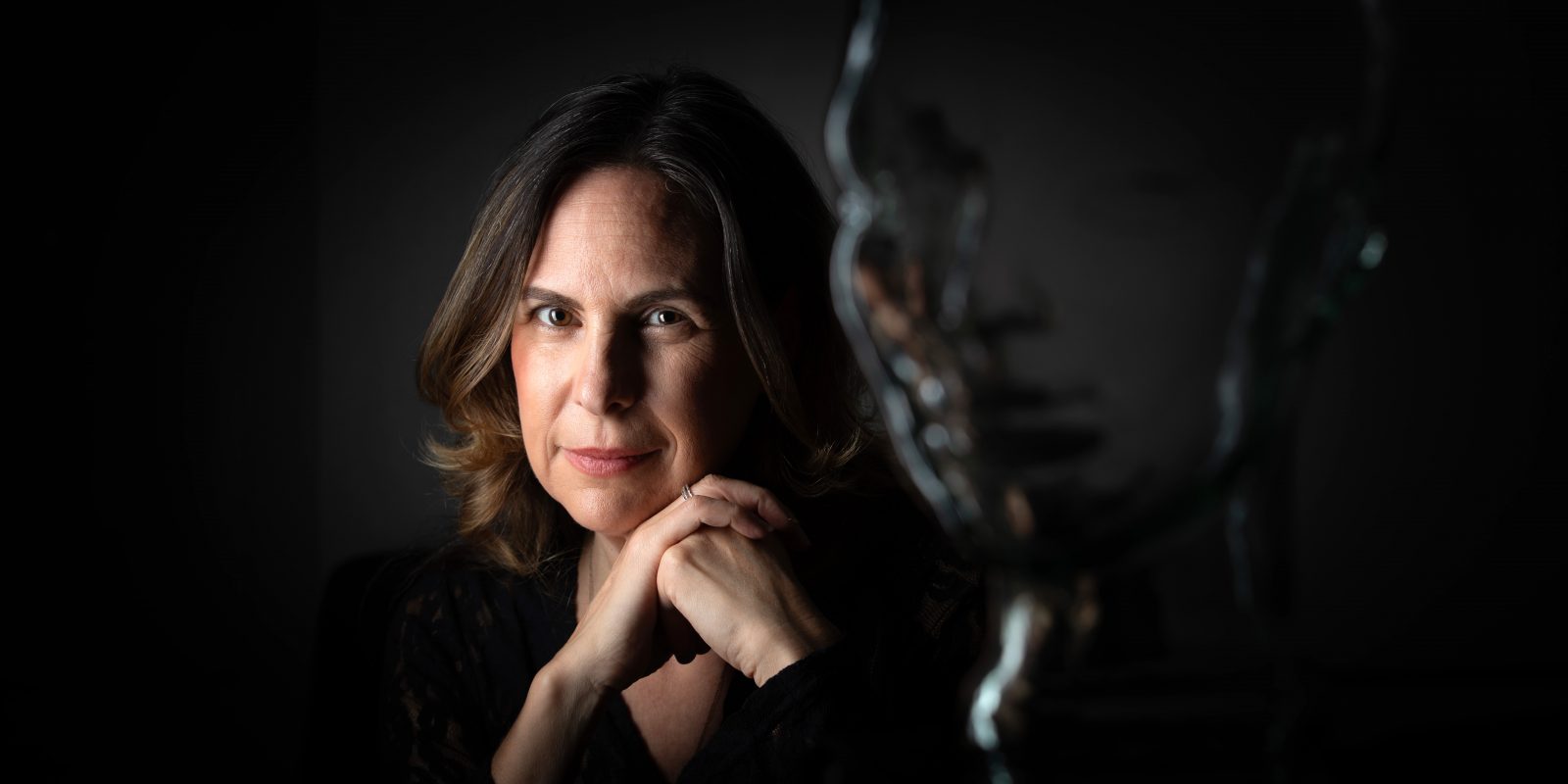
Sharrona Pearl, Andrews chair of interdisciplinary studies at TCU, researches the intersection of facial identity, privacy and surveillance technology. Photo by Joyce Marshall
Facial Recognition Has Made It Nearly Impossible to Disappear
Sharrona Pearl explores the link between physical appearance and identity and how technology threatens privacy.
MARGO PERIN WAS 13 and living in Scotland with, to her mind, a perfectly fine nose, when her father forced her onto a plane to London for cosmetic surgery.
Perin’s sister had begged her to go through with the procedure, afraid as the children were of their father’s disappearances, his anger and his beatings.
Later in life, Perin learned the truth about her father through extended family and FBI files detailing his lengthy criminal history of fraud and theft. She also discovered their Jewish heritage and concluded that he had feared her “Jewish nose” would blow his cover.
Perin’s story captured the imagination of Sharrona Pearl, the Andrews chair of interdisciplinary studies in TCU’s John V. Roach Honors College, whose research interest has always been about the face.
In her chapter, “Fugitives, Physiognomy, Surgery, and Face Recognition Technology in the Modern Surveillance State,” included in the 2024 DeGruyter book Physiognomy at the Crossroad of Magic, Science, and the Arts, she seeks to understand the face in the context of criminals and plastic surgery.
Through this lens, she also confronts pressing issues of privacy in the age of face recognition technology.
THE SCIENCE OF FACES
Physiognomy, one of Pearl’s many interests, is the study of facial features and their relationship to character. “The face is an elemental feature of how we relate to one another, build intimacy, create relationships,” she said. “It is the germinal building block of who and how we are in the world.”
Albeit an imperfect tool for understanding identity, she said. “What we imagine we know about other people based on how they look says a lot more about us than it does about them.”
When recognizing a face was a matter of memory and intuition, some criminals turned to a desperate method of evasion: plastic surgery.
“If you’ve ever gone into a store, if you’ve ever traveled on a plane, if you’ve ever crossed the border, they have your face.”
Sharrona Pearl
In the book, Pearl considers the cases of Perin, Ronnie Biggs and Juan Carlos Ramírez Abadía. All three underwent plastic surgery in an attempt to divorce their faces from themselves.
Biggs robbed a train in England, escaped from prison and fled the country, covering his tracks with face-altering surgery. His surgery suspended the link between his face and self long enough for him to flee, eventually to Brazil, where he lived openly for years.
Colombian drug trafficker Ramírez Abadía, through comprehensive facial surgeries, totally erased the connection between his face and self. Authorities were unable to match his new look to his criminal history. They were, however, able to identify him through voice recognition; he failed the evasion attempt.
Perin believes her criminal father hoped to distance her from his past and their shared ethnic heritage, specifically the stereotype of the Jewish nose. The stereotype is “a complete invention, empirically speaking,” Pearl said.
Massimo Ciavolella, the Franklin D. Murphy chair in Italian Renaissance Studies at the University of California, Los Angeles and co-editor of the 2024 Physiognomy book, said Pearl’s subjects “show also how we have moved from a surgical attempt to hide one’s face” to today, when “recognition is done through dots in a computer. This idea that it’s almost impossible to hide is a fascinating one, especially in view of cameras everywhere.”
TECHNOLOGY OUTPACES SURGERY
Pearl recounts how physiognomy has long been the method for states to regulate border crossings. Drawings, photographs and retinal scans evolved into the detailed digital mapping systems used by 21st-century face recognition technology. These modern methods recognize people using distinct facial data points, like the distance between points on the face, nose shape, the curve of the jawline.
Pearl writes that face recognition technology is evolving at a faster pace than surgery.
“It’s gonna get more and more difficult to get off the grid and hide and render yourself invisible,” she said. The right to move around anonymously may be a thing of the past. “If you’ve ever gone into a store, if you’ve ever traveled on a plane, if you’ve ever crossed the border, they have your face.”
Ciavolella said he worries about privacy, too: “The moment the state has this capacity to recognize everyone, wherever you are, at that very moment, the idea of a police state becomes very scary.”
AN INTERDISCIPLINARY PATH
Pearl describes herself as a historian who never followed the standard trajectory. She taught history and literature, specialized in media studies, then found her calling in health humanities, a discipline that brings literature and philosophy into the medical field.
Last July, she joined the advisory board of the Electronic Privacy Information Center in Washington, D.C. “I am really interested in thinking about questions of privacy and how vital they really are. And I’m very concerned about our increasing lack of privacy and the ways in which the algorithms and technologies are outstripping the legislation around it.”
For example, government agencies have used the technology, often provided by private companies, for social control. In 2016, Baltimore police identified protesters through their faces on social media to arrest those with outstanding warrants. More recently, the increasing use of satellite imagery and police drones is raising privacy concerns.
If someone in control of facial recognition deems someone a threat, there could be no way, not even using the time-honored method of plastic surgery, to escape, Pearl said. “I think that we need to have smart, ethical people creating technologies, legislating around technologies, understanding technologies, using technologies.”
Your comments are welcome
3 Comments
I won’t be recognized because I am black face-rec has a very hard time recognizing us .
Facial recognition uses the angles and distance between the tips of your nose, center of your eyes, and the middle of your chin, all of those angles and distances are measured down to 1/1000th of an inch and can be photographed and properly catalogued from miles away. It does not even take into account the color of your skin…Good advice, don’t do anything in public you could be thrown in jail for is MUCH BETTER thinking than “they can’t ID me”, because they can. P.s., this article, and all other articles about tech, are YEARS behind what the govt has, which they would NEVEE divulge in a public forum, so they are way way ahead of this tech by now. Besides if you read the article they caught one guy by voice recognition, so unless you don’t talk on the phone, they already got all of us catalogued.
Norris Spencer
Related Reading:
Research + Discovery
TCU Partners with Fort Worth Nature Center to Build Urban Research Hub
A five-year partnership turns 3,600 acres of prairie, marsh and river bottom into a classroom for TCU faculty and students.
Research + Discovery
TCU Dean of Students Karen Bell Morgan on Helping Students Thrive
A public health educator before she returned to TCU, she now leads the office where discipline and care share a door.