Investors in the TCU community have new financial opportunities through the Horned Frog Investment Network.
Rodney D’Souza, managing director of the Institute for Entrepreneurship and Innovation, leads the investment network alongside program managers Andrew Hicks ’13 (MBA ’21) and Joe Dickerson ’11 (MBA ’20).
Founded in March 2022, the Horned Frog Investment Network brings together various stakeholders, including investors, startup leaders and Neeley School of Business MBA students, with the goal of funding select startups. While most members of the network have a direct affiliation to TCU, either as alumni or parents, others live in the Fort Worth community.
“We started the Horned Frog Investment Network to give people access to investment opportunities that they had traditionally not seen before when it comes to the venture capital/private equity space,” Hicks said. He teaches new venture development as an adjunct professor at Neeley and manages the investment network while also serving as a principal at RevTech Labs Capital, a North Carolina venture capital firm and accelerator that works with burgeoning fintech companies.
“A big part of that is connecting our network of investors with really high-quality opportunities around the country,” Hicks said.
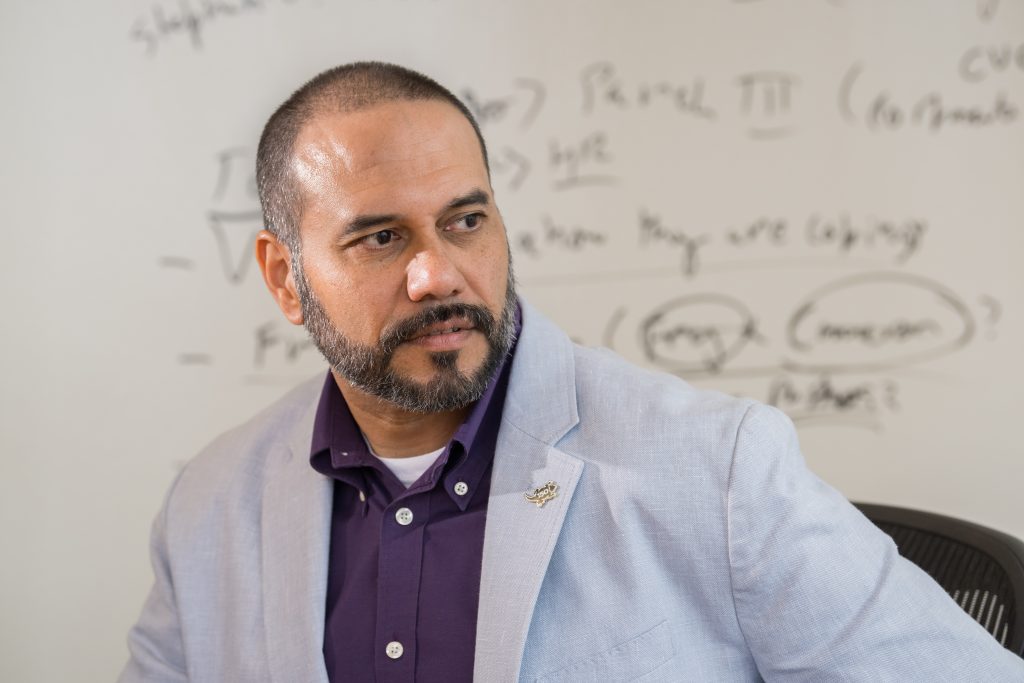
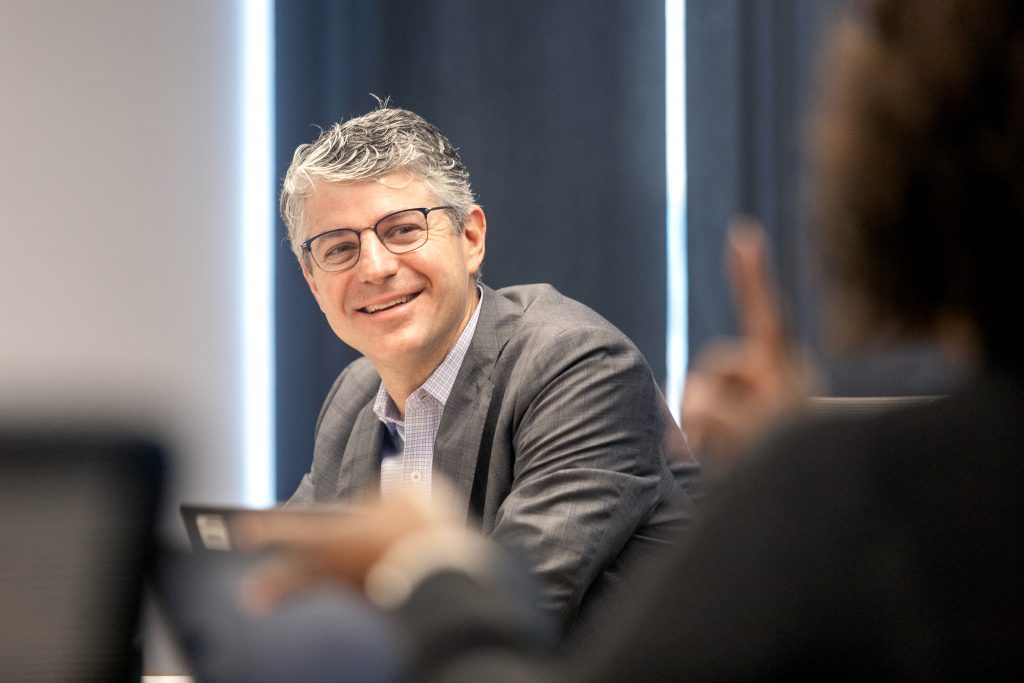
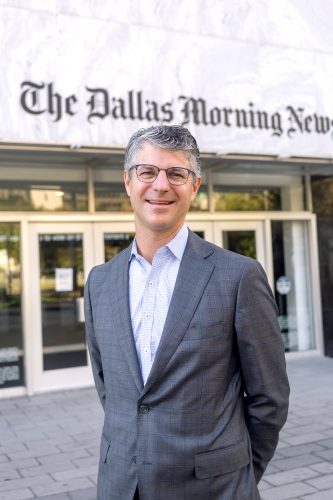
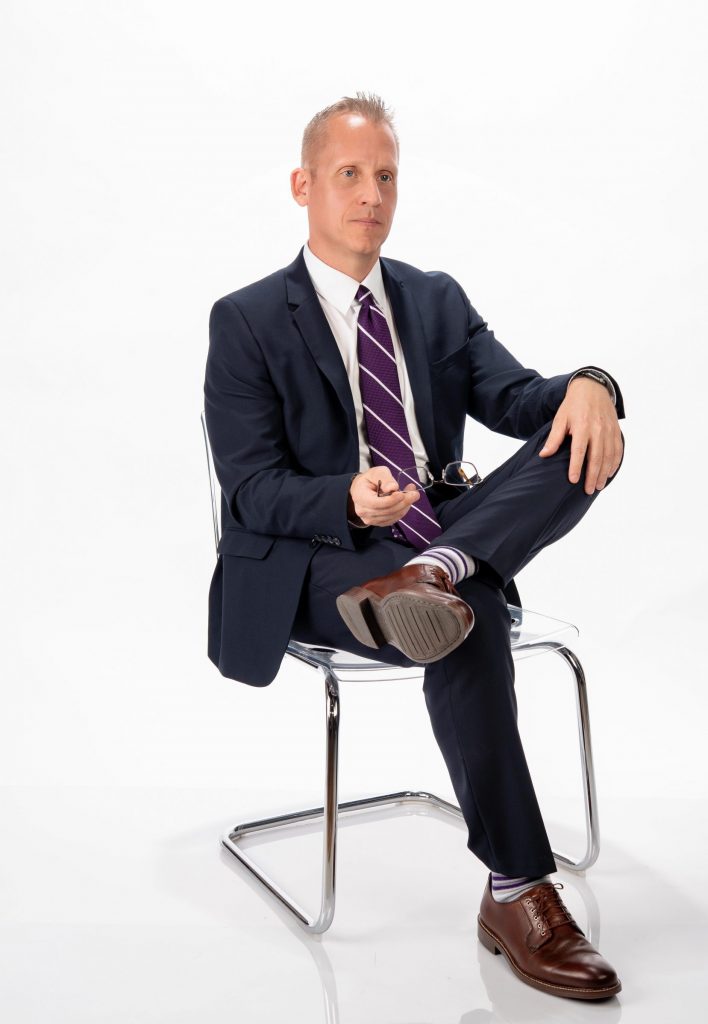
Rodney D’Souza, the managing director of the Institute for Entrepreneurship and Innovation at TCU, leads the Horned Frog Investment Network along with alums Andrew Hicks and Joe Dickerson. Photo by Leo Wesson.
The network fills a need based in part on geography, D’Souza said.
“This part of the country — flyover country — obviously isn’t getting the attention that the coasts are,” D’Souza said, noting that epicenters for venture capitalism include California’s Silicon Valley, New York City, Seattle and Boston.
Horned Frog Investment Network membership affords access to events and educational opportunities. Most of all, it paves the way for select investment opportunities that MBA students have rigorously vetted.
Each year, the network hires two or three MBA students who are studying venture capitalism, D’Souza said. The students evaluate hundreds of companies to determine whether they’re a good fit for the investment network.
“There are very, very few schools in the country that have any sort of exposure to do real transactions in the venture capital world,” Hicks said, adding that the students “are basically given a massive leg up when it comes to entering the job market from both being prepared and having that true experience.”
In spring 2023 and based on the students’ recommendations, founders of three companies made pitches to a gathering of about 50 members of the network. Similar meetings happen several times a year.
“The students at TCU are getting in-class training of looking at deals, what are red flags and how do you overcome them, how to negotiate, all those kinds of things,” D’Souza said. “At the same time, community members who have an inclination and have the capital are also being trained on what to look for in deals, where to source them from.”
The Horned Frog Investment Network helps close a geographical gap between the coasts. “This part of the country — flyover country — obviously isn’t getting the attention that the coasts are,” Neeley associate professor Rodney D’Souza said. Photo by Leo Wesson.
Once those seeking funding step out of the room, the potential investors discuss the pros and cons of each opportunity. If a company inspires sufficient interest, the group schedules a deep dive to learn more in an hourlong meeting.
From there, members opt in only to what excites them.
One of the fintech companies that piqued the interest of network members was the Austin, Texas-based Spot Insurance, which specializes in embedded insurance. At the time of ticketing for anything from a flight to a ski pass, a consumer can check a box to add insurance to the trip’s total.
While raising $30 million in financing, representatives of Spot Insurance were invited to make a pitch to the Horned Frog Investment Network. Several network members took a chance on the startup, investing a total of $850,000 to $900,000.
“The technology that goes behind actually underwriting things like that at scale would blow your mind,” Hicks said.
Altogether, Horned Frog Investment Network members have made investments to the tune of $4.5 million since its inception.
“We’re really just getting started,” D’Souza said.
Growing up in Lincoln, Nebraska, Leigh Owen Sendra ’98 was the neighborhood kid always saving creatures large and small. She followed her older brother and sister to TCU, where she earned a BS in psychology and discovered a passion for animal rescue. As a college student, Sendra fostered her first dog, followed by a cat.
“It was truly innate, a natural desire rather than something I was taught. While my family certainly holds deep respect and love for animals, none of them ever developed a passion for it like I did,” Sendra said.
After graduation, Sendra spent two years in Atlanta working in IT recruiting and sales before putting down roots in Dallas, where her efforts to help animals gained momentum. Eventually, in addition to fostering, she donated proceeds from jewelry she made to various rescue groups.
Inspired to do more, Sendra opened a boutique to support rescue efforts, leasing a small building in the Lakewood area of Dallas. There, she sold jewelry, clothing, artwork and even succulents.
Leigh Owen Sendra opened a boutique in Dallas to help fund her animal rescue efforts and eventually was inspired to open Doodle Rock Rescue and CHEW. Photo by Mark Graham
“Although my boutique wasn’t a booming success, it was so much fun and did generate some money, which I gladly dedicated to supporting rescues,” she said.
Sendra’s generosity did not go unnoticed. She received a call about a labradoodle languishing in a Corsicana, Texas, shelter. She took in Leroy, who had a mass on his leg, and launched a “Lovin Leroy” page on Facebook to raise funds for his medical care.
“Within a month we had about 2,000 followers for him,” she said. “We ended up amputating his leg and then chemotherapy, which cost $14,000 for everything. But we had all these followers who wanted to donate and were rooting for Leroy. He was one of the sweetest dogs ever.”
Leroy passed away eight months after chemotherapy, but phone calls about other poodle crossbreeds were flooding in.
“Getting all those calls, I realized there was obviously a big problem,” Sendra said. “With all the breeders and people who wanted poodle mixes, I knew we would eventually have more supply than demand. So I decided to close the boutique and open up Doodle Rock Rescue.”
Since its launch in March 2017, Doodle Rock Rescue and its all-volunteer team has rescued, fostered, rehabilitated and rehomed more than 1,700 dogs. Most are poodle mixes, but some terriers sneak in too.
“Many of the dogs we rescue have endured difficult circumstances, such as coming from large breeding facilities where they lacked companionship, love and even basic physical needs,” said Sendra, who owns three dogs and still manages to foster on occasion. “Witnessing these dogs transition from such a challenging environment to thriving in a loving home is just amazing.
“We have an unbelievable group of volunteers. They do everything from intake, mentor fosters, complete medical clearances, social media, adoptions, contracts, fundraising and more. This organization wouldn’t be where we are today without them.”
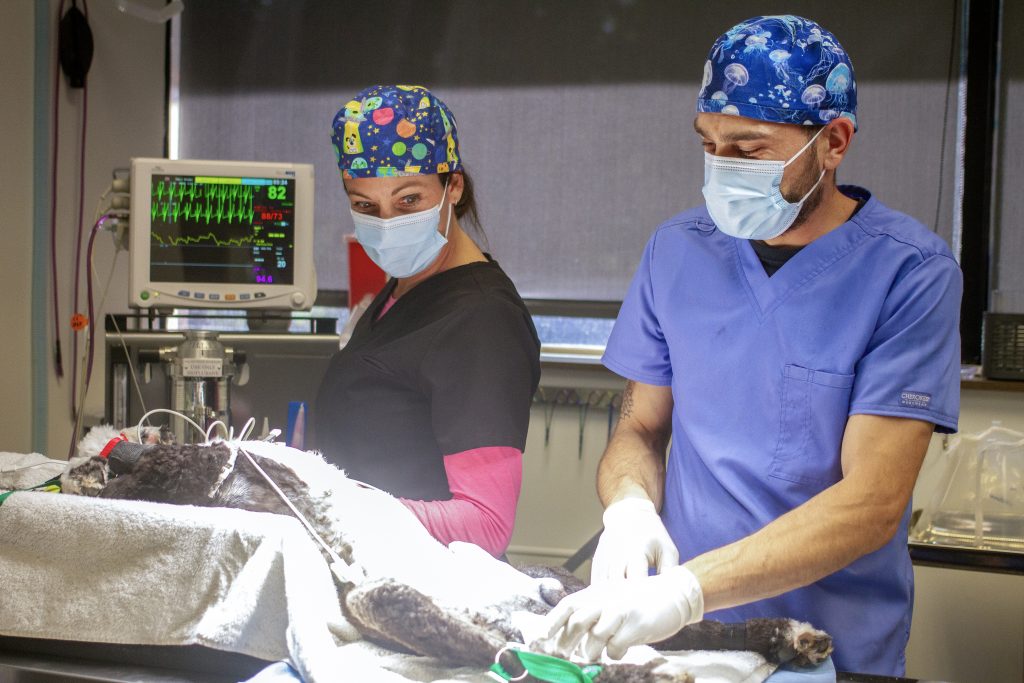
“While there are clinics offering affordable vaccines and spay/neuter services, we take pride in positioning our hospital as an advanced nonprofit veterinary hospital,” Sendra said. “We’re the only nonprofit clinic in the Dallas-Fort Worth area that offers everything — wellness, preventive care, full diagnostics with digital radiology and ultrasound, specialty surgeries and even orthopedic surgeries.”
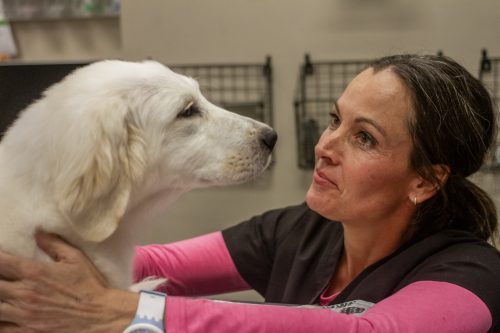
Leigh Owen Sendra, left, said that CHEW is “the only nonprofit clinic in the Dallas-Fort Worth area that offers everything — wellness, preventive care, full diagnostics with digital radiology and ultrasound, specialty surgeries and even orthopedic surgeries.”
CHEW’s fees are 30 percent to 50 percent lower than those charged by traditional clinics, Sendra said, and its need-based Compassion Fund helps under-resourced families offset costs for larger expenses such as lifesaving surgeries. The fund receives support from private donors and participates in North Texas Giving Day, the largest communitywide giving event in the nation.
Since opening, CHEW has logged more than 12,000 appointments, caring for more than 6,200 pets. Now the 2,900-square-foot clinic has launched a capital campaign, including naming rights, to help fund an 1,800-square-foot expansion that would include two operating rooms, a treatment room, a dedicated dental suite and more room for medical boarding. With the building expansion, CHEW plans to add a HOPE (Helping Owners with Pet Essentials) pantry.
“Many families find it difficult to afford essential pet supplies, such as dog food, deworming, beds, leashes, etc. due to the rising costs. Through the HOPE program, we aim to provide these supplies for free, ensuring that families have access to the necessities their pets require,” Sendra said.
Jaime Aronson, who has worked in marketing for more than 20 years, met Sendra while fostering for Doodle Rock. Aronson now serves as volunteer director of social media and marketing for Doodle Rock and CHEW.
“I absolutely adore Leigh and the work she does,” Aronson said. “She’s an inspiration, and I say that she lives my dream. She founded a rescue and then founded a way to help sick animals and families.”
Aronson has been involved in rescue work for close to two decades.
“One of the biggest things I’ve seen with Leigh is when people tell her it’s impossible, she says, ‘No, it’s not. We can work through that.’ There’s no obstacle in front of Leigh,” Aronson said. “She has built a network of people through trust and compassion that has allowed her to not only grow CHEW Animal Hospital and Doodle Rock, but to save animals. And that’s what it’s about.”
The demands of an expanding clinic and growing rescue group can be hectic, but Sendra, who is also a wife and mom, loves what she does.
“What I find rewarding about it is being able to support pet owners who may not have a lot of financial resources but still deeply care for their pets,” she said. “It’s important to recognize that anyone can love their pet regardless of their financial situation.”
Here are some lessons Sendra has learned along the way:
Fostering is wonderful. It gives your family the opportunity to see if they are ready for a dog, but at the same time, you are helping a rescue group take in another dog. I think people are fearful of fostering because it’s the unknown. For most dogs, if you can give them a little time to get used to the new environment, they will settle in and it’s a wonderful thing.
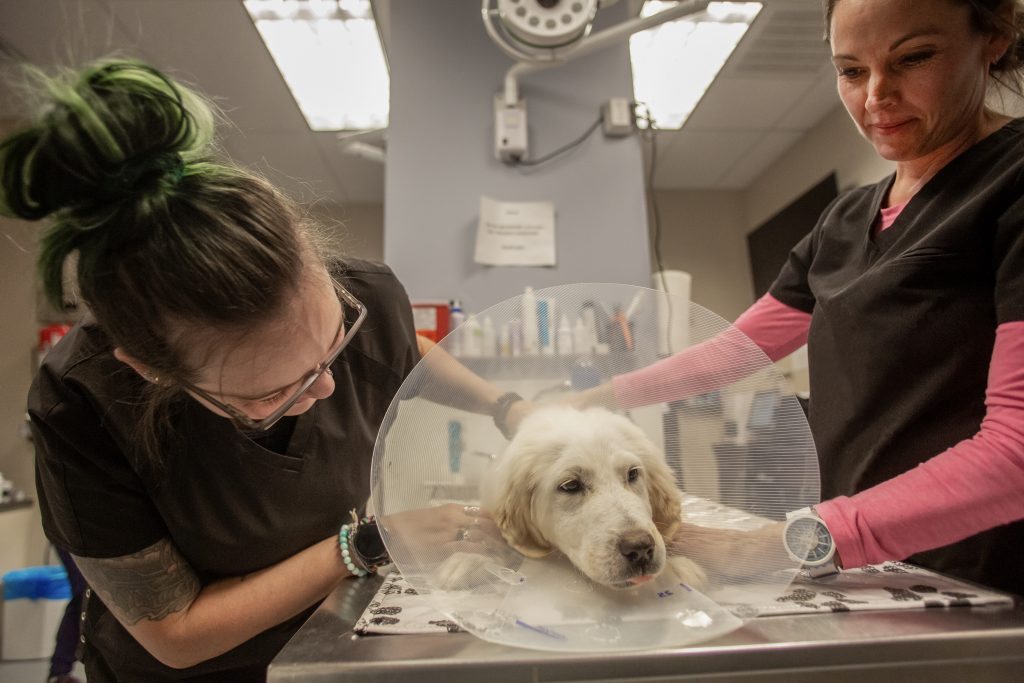
Kirstin Eakin, left, is a nurse at CHEW, an advanced nonprofit animal hospital founded by Leigh Owen Sendra, right.
Make sure you are really, really, really ready for a dog. In a lot of the emails we get, the first sentence is, “I really thought we were ready.” Make sure everyone in the family is ready. Are we ready to take on the responsibility of socializing this dog? Do we have the financial means?
Not every dog is the right fit for every family. Puppies tend to be pretty adaptable, but if you’re getting an older dog, I love the idea of working with a rescue group that knows each dog really well. They should know if they are placing it with the best fit.
Keep your dog’s vaccinations up to date. Parvo and distemper are everywhere. If your dog isn’t vaccinated, taking him to the dog park or even just for a walk around your neighborhood puts him at risk.
Make sure your dogs are well socialized. Socialize them at a very young age. Socialize them with children — but safely. Have people come into your home so the dog doesn’t get a territorial personality. If you can’t afford to work with a trainer, there are plenty of training videos online.
If you have a dream, go for it. Everyone says that, but I literally didn’t even know how to make an e-collar — that big cone dogs and cats wear after surgery — when I opened this vet clinic. I had been in the back of only two vet clinics in my entire life and I opened a fully functioning veterinary clinic. If you’ve got something that is your ultimate goal, you can do it.
TCU’s commitment to educating leaders on the digital frontier recently expanded to include a financial technology certificate from the Neeley School of Business. The three-course program featured in this issue of TCU Magazine spotlights machine learning, artificial intelligence and blockchain. Our students are learning about ChatGPT, cryptocurrency and other emerging technologies right as they hit the market.
In this issue we’ll also introduce you to David Aspinall ’18 MBA, who helps people on the autism spectrum find employment in the tech sector. As CEO of auticon US, he is making significant strides in addressing the 85 percent underemployment rate among workers with autism.
Opportunities abound for people who thrive by innovating during periods of change, and in 2024, technology is reshaping our world on a seemingly daily basis.
Now and into the future, TCU intends to remain at the forefront of information, ideas and education. Horned Frogs seek to do more than observe the world as it evolves at an accelerating pace. We plan to shape it — as ethical leaders and with our mission statement and values ever at heart.
TCU conferred almost 700 degrees at the fall 2023 commencement. The ceremony capped the university’s anniversary celebrations. “Our students are the heart of everything we do at TCU, so I can’t think of a better way close out this sesquicentennial year than celebrating their success and achievement,” said Chancellor Victor J. Boschini, Jr. Photo by Glen E. Ellman
As the CEO of a leading employer of tech workers on the autism spectrum, David Aspinall MBA ’18 offers a brighter, more meaningful future for its nationwide neurodiverse workforce. While on the auticon payroll, these workers are placed at companies such as Disney, ESPN, Nationwide Insurance and Fidelity Investments to perform a range of technology-related jobs.
“This is not a charitable endeavor, but we do have a social mission,” said Aspinall, who began leading auticon US just as the Covid-19 pandemic hit North Texas in March 2020.
“We use the principles of business to provide high-quality technology careers to autistic adults, 85 percent of whom are either unemployed or underemployed,” he said.
Armed with an executive MBA from TCU’s Neeley School of Business, Aspinall runs the U.S. business for auticon. Since its founding in Germany in 2011, auticon has placed more than 500 neurodiverse people in positions in software development, data analysis, engineering and other tech professions around the world.
HELPING WHERE NEEDED
The term “neurodiversity” refers to differences in brain function and is most frequently used in the context of those on the autism spectrum.
“When people join us, they have been unemployed on average for 14 months, which is amazing because we’re talking about people who can do an in-demand job,” Aspinall said. “Huge numbers of people who have come to us previously worked in fast food, even though they might be amazing software developers.”
At auticon US, David Aspinall leads a company that helps place workers on the autism spectrum into jobs in the tech industry. Photo by Ralph Lauer
The process starts when auticon hires an employee through a recruitment process that’s friendly to those on the spectrum, which often means moving away from a formal interview. “We don’t even use the word ‘interview,’ which we’ve realized can be such a cause of anxiety to our individuals,” Aspinall said. Instead, auticon’s hiring team gamifies the hiring process “so we can better understand the cognitive strength of the individual.”
Employment through auticon gives workers high-quality health insurance and 401(k) plans. The company also provides ongoing job coaching as well as project management support to help ensure their success in the workplace.
Outside employers contract with auticon to place the company’s tech workers on their teams. Recently, auticon also began consulting with employers on how best to manage members of a neurodiverse workforce that might also include people with ADHD, dysgraphia and dyslexia.
“We now help companies assess how they are doing on recruitment, accommodations, policies and communication, then give them pathways on how they can fix any problems or next steps,” Aspinall said.
Tweaks to office routines can yield big dividends when it comes to worker satisfaction, productivity and fit. Aspinall described one team member with autism who struggled during a company’s daily stand-up meetings.
“He thought these were meetings for everybody to understand what he was doing rather than him being part of a team,” Aspinall said.
After identifying the issue, an auticon job coach asked the team leaders to put out a written agenda so that the tech worker could read the objectives of the meeting before the group gathered.
“A lot of the advice that our job coaches give is actually just good business, like clear communication, not making assumptions and backing up verbal instructions with written instructions,” he said.
ROAD TO AUTICON
Aspinall’s path to becoming a CEO started in Manchester, England. The son of an electrical engineer and a stay-at-home mother, he graduated from the University of Sheffield, then moved to London to work as a bid manager for Atos, a global tech firm.
Verizon brought him stateside in 1999 to work as a sales director in Chicago, where he met his wife, Laura Yesley. Aspinall jumped to AT&T in 2004.
During his 11 years with the company, he and his family moved to Maryland and then to Toronto when he became president of AT&T’s Canadian operations. Relocating to Dallas-Fort Worth, home of AT&T’s headquarters, was already on his radarwhen Sprint Business tapped him as region president.
Aspinall had long excelled at identifying talent and building a positive business culture for the people he managed. What he craved was a formal business education at a U.S. university. During his time at Sprint, he enrolled in TCU’s executive MBA program, earning his degree in a year and a half. Two-week stints in Greece, Dubai and India rounded out what he described as an exceptional experience.
“It was in the entrepreneurship class where I first heard the term ‘intrapreneur,’ which is somebody that has an entrepreneurial approach to business but is operating within a bigger company,” he said. “A light bulb went off.”
“In that course it was clear to see David’s leadership abilities and his talents,” said Ray Smilor, emeritus professor of professional practice in management, entrepreneurship and leadership at Neeley. “Part of what the TCU EMBA does is take a very personal approach to each student in the class to help them identify something personally, powerfully and emotionally important to them.
“We would talk about creativity and innovation and thinking entrepreneurially,” Smilor said, “which gets people like David excited.”
David Aspinall’s ties to TCU go beyond his MBA. His wife, Laura Yesley, became executive program development director at the Neeley School of Business in June 2023. Photo by Ralph Lauer
In June 2023, Yesley became executive program development director at the Neeley School of Business, which only strengthened her husband’s ties to the school. The couple live in Fort Worth with their teenagers, Tom and Olivia.
While working toward his MBA, Aspinall became a member of the Young Presidents’ Organization, which he also credits for much of his success. The group, with more than 34,000 members, is the largest worldwide community of CEOs and other top business professionals.
“Through YPO, which I never would have joined if I hadn’t gone to TCU, I got to understand the world of private equity,” Aspinall said, “and I got to understand that there were groups of investors investing in companies that had problems I could help solve.”
As an MBA student, he founded a boutique consulting agency called Sales Enablement Partners that worked with clients like Luther King Capital Management and Satori Capital primarily on sales and marketing. The year he graduated from Neeley, Sales Benchmark Index acquired his consulting agency, where he stayed on as managing director until auticon US recruited him.
“At auticon, David’s passion and purpose came together,” Smilor said.
“He excels at proving the business case, that it’s an advantage to hire our team of technologists on the autism spectrum,” said Ivette Marina, chief operating officer of auticon US. “For many autistic individuals, social things like making eye contact during a job interview can be challenging and barriers to employment.”
DIVERSITY FIRST
Aspinall built a diverse U.S. leadership team, half of whom are women.
“One of his biggest contributions is believing in his team and really seeing how to match everybody up to their strengths,” Marina said. “His confidence in our business model and his belief in our team made a huge difference to our existing clients and also to bringing new clients on board.”
“We see this as a win-win-win for autistic professionals, companies and society.” David Aspinall
The wider business community has taken notice. The Dallas Business Journal honored him with its 2023 Leader in Diversity award. A few months later, the San Fernando Valley Business Journal honored him as CEO of the Year as part of its diversity, equity and inclusion awards.
Aspinall said that tech workers on the spectrum bring unique attributes to the workplace. Many are adept at spotting patterns in large amounts of data.
“They also often look at a problem in a different way, which is appealing to employers,” he said.
Aspinall hopes to continue growing the business as rates of autism in the U.S. have hit an all-time high. The Centers for Disease Control and Prevention reported in March 2023 that 1 in 36 American children have been diagnosed with autism, a 178 percent increase since 2000.
“The demand for this work is overwhelming, which only adds urgency to what we do,” Aspinall said. “We see this as a win-win-win for autistic professionals, companies and society.”
SALARY IS ONLY PART OF THE STORY WITH A JOB OFFER.From medical insurance and sick leave to vacation days and employer retirement contributions, good benefits are worth serious money and can also help support a healthy work-life balance. In a survey of college students, the National Association of Colleges and Employers found that 73.1 percent ranked a 401(k) retirement account as very or extremely important. We talked to Mike Caldwell, executive director of TCU’s Center for Career & Professional Development, about the value of benefits.
Is it possible to put a dollar amount on benefits? Absolutely; I think it’s important to calculate benefits that way. I’d encourage someone to do their research and see what purchasing healthcare independently would cost and what that difference would be in receiving employer-provided or employer-supplemented health care. Fidelity has a pretty good salary evaluator; you can put in things like matching retirement and it will do the calculation for you and tell you if offer A is going to be better than offer B. It’ll also factor in the location if you’re working in a different city where your cost of living is going to be different. And I just encourage people with an offer to work with their human resources department or the recruiter to get that information so you can really make a smart call on the offer.
How important are good job benefits to new graduates?I think it used to be almost an assumption that recent grads are not thinking about that as much. But I’ve seen a change in that. We had a student panel recently, and one of the students was specifically talking about when employers asked them how they evaluated offers, they went through the benefits and talked about how that definitely was a factor in their decision-making process.
Do you attribute that to the students becoming more savvy or to maybe healthcare and other benefits costing more? I think it’s a combination of those things. I think students do their research, so they’re seeing more than just what the immediate impact of the job is — the salary that they’re going to receive — but long-term how that’s going to impact them. And I also think they have a lot more conversations with their parents. And I think their parents and faculty and other advisors around them are also encouraging them to think more carefully and critically about benefits.
In some of the data that our National Association of Colleges and Employers presents in terms of importance, students point to things like family-friendly leave, so that might be vacation leave, family leave and flexible policies. We are seeing a trend upward in that scheduling and leave availability — it is definitely more and more important.
Yurii Karvatskyi | IStock | Getty Images
At the top of the list was a 401(k). Why should employees look closely at that?I think students are calculating salary and cost of living; if you calculate that 401(k) match or benefit into your earnings, that’s going to be a differentiator in some cases. If an employer is matching up to 5 or 10 percent, that’s going to mean a bump in your salary. So if you’re comparing salary A versus salary B, that may be something that’s the deciding factor.
Our folks over in campus wellness in the rec center, they have a financial literacy seminar that they produce. Brad Stewart, associate director of the Wellness Center, goes through those things with students and gives them some really great materials in terms of what that match means and how it can compound over time. I would definitely advise alumni and students look at [vesting] time — will you have to be there one year, two years?
Is the ability to work from home considered a benefit?I think a lot of times employers present it as a benefit. And I think that it depends on the employer, it depends on the arrangement and depends on the position as well. That’s really important as you’re evaluating an offer that you don’t make the assumption that this position is remote and will stay remote, because things may change. I’ve seen it directly with folks who have started one way, maybe they were fully remote and now they’re going back to three days. Maybe you relocated and now you’re going to have to move back.
Are some benefits disappearing in the current job climate? I would say anecdotally, tuition reimbursement. I think employers utilized that more frequently in the past. Now, that may also include a clause that requires you to continue employment with that organization for a number of years, or to have been there a length of time before you can obtain that benefit. I think that some employers are doing more short-term things like executive education programs, in-house training programs and other ways to meet those needs.
“That’s really important as you’re evaluating an offer that you don’t make the assumption that this position is remote and will stay remote, because things may change.” Mike Caldwell
Are employers starting to offer new types of benefits? I think the trendy one is benefits for pets, because employers know that family-friendly also might mean pet-friendly. It might mean that you’re able to bring a pet into the office or that there is pet health care offered in addition to health care. That way, it makes the workplace more inclusive for those new hires who don’t have children or don’t plan to have children.
I see a lot of different things on the idea of the “unlimited vacation” — it’s a little bit of a misnomer. The way it works is you submit a request. Now whether that request might be granted, it might depend. You still have a schedule, you still have deadlines to meet. So in theory — if the business or your supervisor allowed it — you could potentially have as much as a month, two months off of work.
But one thing I caution is that sometimes that also means that you don’t get that as a payout. If you have vacation time with an employer that grants two weeks a year, for example, if you still have a week of vacation, you’re going to get paid that benefit if you leave that job. If they have an unlimited PTO policy, you’re not going to have any benefit at all. And I think some people don’t fully understand that when they see those exciting things.
Are there benefits that go unused or underused? Sometimes a life insurance benefit, sometimes long-term disability. In some cases, there may be benefits such as counseling benefits, employee assistance programs, fitness memberships. If you’re evaluating two offers, knowing which health insurance provider is offered can be important as well. And as more and more people are looking at remote jobs, that can definitely be a factor, because you want to know: “Am I going to have to stay within network?” There are some California health care providers that are not able to operate outside of the state. So that creates some challenges.
After ChatGPT reached 100 million users in just two months following its Nov. 30, 2022, release, Union Bank of Switzerland research confirmed the AI application has one of the fastest growing user bases in internet history. Some TCU professors, while mindful of the technology’s potential consequences, are teaching students how to use generative artificial intelligence — AI tools that create new content — to prepare them for an evolving job market.
“I don’t think anyone really knows what we’re going to be looking at three or four years from now. I know some very smart people are very worried, and that makes me worried,” said Brad Lucas, associate professor of rhetoric and composition. “But we’re definitely going to have to figure out ways to work with the AI products … rather than just pushing them aside.”
LIFELONG LEARNING
Beata Jones, professor of professional practice in information systems and supply chain management, became interested in Eliza, a program that processes natural language, after reading about the technology when she was a teenager. Created by John Weizenbaum, Eliza was one of the original AI chatbots; it emulated a psychotherapist, allowing users to type in questions and responding in a therapeutic manner.
After continuing to follow developments in such technology for four decades, Jones is now integrating AI platforms into her courses and helping others do the same.
Curt Rode, shown in an AI-enhanced portrait, has embraced the technology’s potential benefits. “I originally thought AI was going to make that perpetual struggle with plagiarism much more challenging,” he said, “but that was way before I started playing with it.”
Beginning in spring 2023, Jones required students in her Business Information Systems Development class to sign an ethical agreement verifying that they would not use AI tools to shortcut assignments as they learned Python programming. But later in the semester, Jones gave them free rein with their final project.
“All bets were off. They could use any generative AI tool to help develop the code for the project,” Jones said. “I was comfortable that they knew the basics and allowed them to go anywhere with their project implementation.”
Students primarily used the generative code tool GitHub Copilot to produce code sequences. If they had trouble understanding the code, they then inserted the sequences into ChatGPT, which offered explanations.
Jones said she also uses AI tools for personal tasks such as writing emails or recommendation letters — or generating practice study questions.
“I use it every day,” Jones said, “and it’s most helpful.”
JOINING FORCES
In summer 2023, Jones led a presentation at the Technology in Business Schools Roundtable conference, hosted by TCU, where she taught directors of information technology how faculty can incorporate generative AI tools into their courses. Jones also keeps professors in the Neeley School of Business updated on developments in AI.
Patricia Walters, professor of professional practice in accounting, introduced AI tools into her class projects as a result of Jones’ encouragement.
“She’s effectively the Neeley School guru on AI, and we get at least weekly, if not daily, emails on AI from Dr. Jones,” Walters said.
The Center for Digital Expression, where students, faculty and staff go for help with digital projects, has become a hub of discussion for professors interested in learning more about using AI in the classroom. Jones has collaborated with the center to host discussions on artificial intelligence.
“She’s [Jones] been very good at getting that conversation going and keeping the conversation going with me,” said Curt Rode, senior instructor in poetry and digital humanities and associate director of the center. “The Center for Digital Expression had a roundtable discussion back at the end of March that brought together people from the Koehler Center, fine arts, computational linguistics and then the Center for Digital Expression themselves to talk about what our thoughts and our experiences are with AI in the classroom.”
After experimenting with generative AI tools, Rode began to see the potential benefits the technology could bring to his students’ projects.
“I originally thought AI was going to make that perpetual struggle with plagiarism much more challenging,” Rode said, “but that was way before I started playing with it.”
When Rode determined that his webpage design assignment would better serve students if he taught them to make responsive design, or mobile-first designs that would work as well on mobile devices as desktop ones, he turned to ChatGPT for help.
“It talked me through the basic core concepts and media queries for responsive design,” Rode said. Media queries detect the device that a website is running on, allowing the page to adapt its layout, among other details, to a phone, tablet or computer. “I was able to teach my students a lot more than I had originally planned or was capable of with the assistance of ChatGPT.”
“I was able to teach my students a lot more than I had originally planned or was capable of with the assistance of ChatGPT.” Curt Rode
In his Digital Culture and Digital Analytics capstone class, a group of students wanted to create a website where users could learn whether the brand of shampoo they use contains toxic ingredients. The students used Python code to develop the tool that lets users enter their shampoo brand into a database and receive a list of toxic ingredients. Rode allowed them to use ChatGPT to help convert the Python code to JavaScript to embed the tool in a user-friendly website.
“They had their own experience, which was using the code that they had written themselves to produce usable JavaScript, which they were able to embed into their website that was then deliverable for the project,” Rode said. “There’s no way I could have possibly helped students develop a web application like that in previous years.
“I think every discipline that requires the internet for information should be acquainted with this tool.”
ADVANCING WRITING AND MEDICINE
Lucas, who teaches technical writing and English composition, believes AI skills should not be excluded from writing classes.
“I don’t see it as something to opt in or out of,” he said. “I think it’s something that’s just coming.”
In his composition classes, Lucas addresses how his students can use ChatGPT to assist in coursework instead of discouraging his class from using the tool altogether. In his Advanced Technical Writing class in spring 2023, he replaced one of his traditional writing assignments with a group project to encourage students to experiment with generative AI tools.
Adam Jennings, reimagined in a futuristic world, uses an AI program that simulates patient interactions as part of students’ clinical training in the Anne Burnett Marion School of Medicine.
Lucas believes other professors should be having similar discussions because of the relevance and progression of AI technology.
“It’s important to make sure the conversations or the thinking doesn’t go in the wrong direction. I know a lot of folks, their initial response was, ‘Well, we have to figure out a way to ban it, to outlaw it, to detect it, to punish,’ ” Lucas said. “And it’s ridiculous because it’s already fully integrated in a lot of our online life and becoming much more public and accessible as a tool.”
Adam Jennings, executive director for simulation education, innovation and research at the Anne Burnett Marion School of Medicine, participated in a panel discussion with Jones on ethical uses of AI for medical students in fall 2023.
One such use is the Oxford Medical Simulation, a new AI technology program that the Burnett School is preparing to introduce into clinical training. Students ask the avatar medical questions, and the technology simulates real patient responses based on Jennings’ data input.
“It allows for a more fluid and realistic patient encounter,” Jennings said, “so I can actually tell what students are learning or not learning.”
Additionally, Jennings encourages his students to use ChatGPT to understand difficult medical concepts and to create personal study guides for exams. He uses the platform to complete personal daily writing tasks, like crafting detailed emails to students.
In fall 2023, the Koehler Center for Instruction, Innovation and Engagement began offering regular Artificial Intelligence Interest Group sessions to help professors learn how to harness its possibilities as a teaching tool. And in spring 2024, Elijah Clark, instructor of marketing, debuted a new class that teaches students to use AI and automation in their marketing efforts
“Everybody can really benefit from using AI,” Jones said. “The future is about integrating AI into our workflows, and those will be the successful employees of the future.”
“I would say most industries in general should be having these conversations, too,” Rode said. “Because if you don’t know how to use it and don’t embrace it, but your competitors do, your competitors now have an edge.”
During a blockchain class in fall 2022, Rose Hoang ’23 asked professor Kelly Slaughter about a new technology released earlier that week.
“He told us that ChatGPT looked like it has potential,” Hoang said. “In his next class, we had this whole discussion about it.”
Heralded as revolutionary within hours of its release, ChatGPT is a language-based artificial intelligence tool from OpenAI. The free platform works with Microsoft’s search engine, Bing, to answer questions and perform such tasks as writing emails or essays. It can even invent song lyrics in the style of anyone from Billy Joel to Billie Eilish.
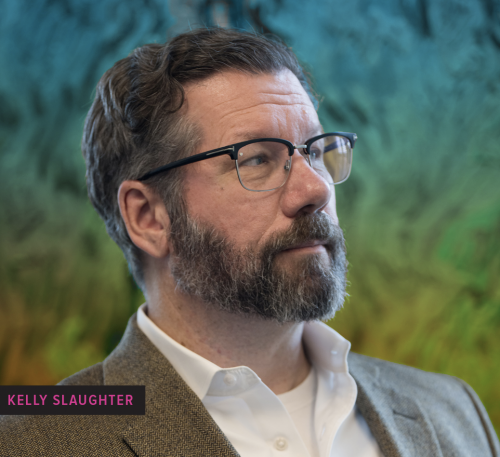
Kelly Slaughter, the director of the business information systems program at the Neeley School of Business, was instrumental in creating TCU’s fintech certificate program after then-Neeley dean Daniel W. Pullin encouraged more fintech curriculum.
For someone pursuing a business career, ChatGPT can analyze data, identify market trends and improve customer service. The business applications are as limitless as the program itself.
“It was amazing to learn about this kind of technology in real time,” Hoang said.
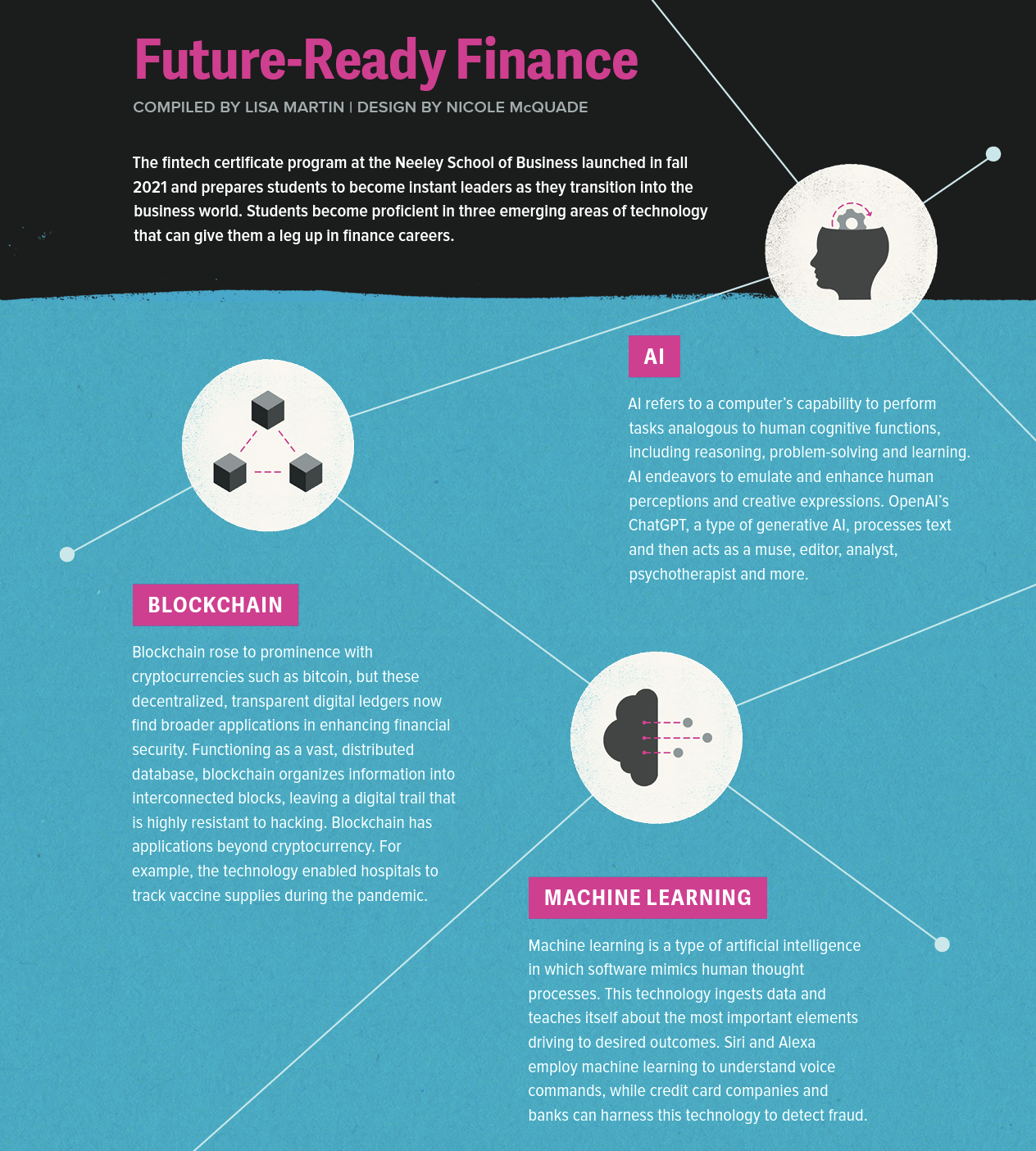
Embracing the latest technology is at the heart of the Neeley School of Business’ fintech certificate program. Around 150 students will have earned the certificate by May 2024 by completing three classes: blockchain, machine learning and AI (artificial intelligence).
As a finance major and first-generation college student from Vietnam, Hoang pursued the certificate to make herself more marketable to potential employers.
So, too, did Sam Eisenberg ’23, a graduate in accounting and finance.
“I want to find a way where I can leverage what I’ve learned in those classes with my new employer,” said Eisenberg, who began working as a financial modeling analyst at Origin Bank, a community bank in suburban Dallas, shortly after graduating.
“I feel like I can create value in my career in the domains of machine learning and AI,” he said, noting he’s the youngest in his office “by a wide margin.” He succeeded in fall 2023 in convincing the Mortgage Warehouse Lending team to create a model that predicts future loan and deposit balances. He is building multiple models, including, he said, one employing “the same algorithm that was utilized several times in the machine learning course.”
“There’s a lot of improvement to be made using AI as a predictive model rather than just relying on historical data,” he said. “What just happened in the stock market doesn’t fully explain or predict what it could do the next day.”
FINTECH EXPLAINED
A mashup of finance and technology, fintech has become better known in the last five years, though scholars and business leaders look to the first trans-Atlantic cable as the category’s true beginning.
Laid in 1866, that wire globalized financial markets by allowing European and North American commodities traders on both sides of the ocean to know the prices of coffee, grain, cotton and gold in a timely manner.
One hundred and fifty years later came the arrival of the third wave of fintech, an age in which machines do everything from making recommendations for certain stocks to writing corporate memos. Today, companies utilize mobile applications, machine learning, blockchain (public ledgers with digital distribution) and data analytics to improve efficiency in online banking, crowdfunding and more.
“Technology generally supports a firm by doing the same thing better or cheaper,” said Slaughter, director of the business information systems program at Neeley, who was instrumental in creating TCU’s fintech certificate program. He’s also a professor of professional practice in information systems and supply chain management.
“Like many of the new, innovative initiatives across TCU, the roots of those ideas can really be attributed to the external environment,” Pullin said, noting that the business marketplace in Dallas-Fort Worth helped shape the new curriculum.
So, too, did the Neeley alumni on the fintech advisory council, who gave input on designing the curriculum. Council members include Diane Ellis ’88, senior managing director at IntraFi and former executive at the Federal Deposit Insurance Corp.; angel investor Aaron Grieshaber ’02; and Ed Koellner ’89 MBA, a senior attorney at USAA.
Students first began working toward the fintech certificate in fall 2021.
“In many ways,” Pullin said, “with this certification we are playing matchmaker between the aspirations of our students and the growing needs of our employers and community leaders.”
MACHINE LEARNING ON THE MARCH
To earn the fintech certificate, students must take a class on machine learning, an element of AI focused on the creation of the algorithms and models that allow computers to learn and make predictions on their own. Thanks to a variety of statistical techniques, computers can learn from large amounts of data, leading them to make accurate predictions.
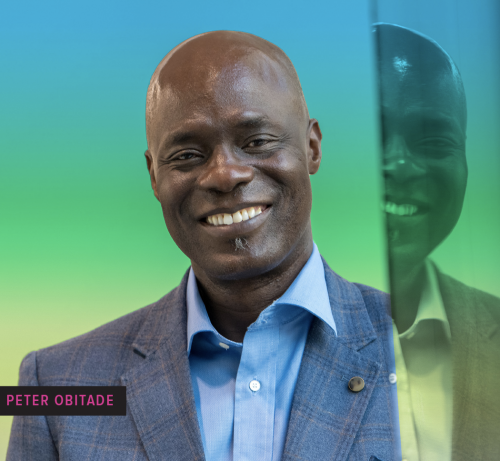
“If you have a kid and you’re trying to train them to learn to ride a bike, you hold onto them and they start riding, then eventually you release them,” said Peter Obitade, assistant professor of professional practice in business information systems. “Machine learning is the same way. You train it to make predictions based on past data.”
TCU assistant professor Peter Obitabe said machine learning, in simple terms, is similar to teaching a child how to ride a bike. “You train it to make predictions based on past data,” he said.
When self-driving cars finally hit the market, they’ll be a product of machine learning. Sensors on a vehicle’s exterior will transmit data that will enable the car to navigate not just the rules of the road but also an ever-changing environment, whether it’s a quiet cul-de-sac or bumper-to-bumper traffic on the highway. Today, that little Roomba vacuum whizzing along floors uses machine learning technology to avoid getting tangled in cords and cables.
Machine learning also does everything from detecting credit card fraud to filtering spam emails. Virtual assistants such as Alexa and Siri, which understand questions and form responses, owe their existence to machine learning.
Obitade uses his experiences as a senior data engineering/analytics manager at Wells Fargo and Chevron Corp. to teach Neeley students how machine learning algorithms are being leveraged by financial institutions and banks to solve strategic business problems.
“You look for females from ages 25 to 49 who live in certain ZIP codes, and you look for predictions on the behavior of that group,” Obitade said, noting the data can help bankers anticipate everything from retail spending patterns to credit card applications from a given demographic.
Understanding the value of information in financial markets helps students better grasp what machine learning brings to the table. The class delves into Python, a popular programming language that has a reputation for simplicity. Python allows students to build advanced machine learning algorithms to predict everything from stock prices, to bank customer segmentation and targeting, to the performance of an initial public offering.
“We’re not going to be software engineers, but anyone who gets the fintech certificate knows the basics of coding, something that was brought up in my job interviews,” said Lucia Simovicova ’23, who came to Fort Worth from Slovakia to swim for TCU.
“The purpose of the fintech certificate is to make us middlemen where we know the business side of things and have a technical perspective,” said Simovicova, who now works as a technology risk consultant at the Dallas office of Ernst and Young.
BITCOIN, BLOCKCHAIN AND BEYOND
In fall 2022, Simovicova took the blockchain class, which focuses in large part on bitcoin, the world’s first cryptocurrency. Like the internet, bitcoin is an entity rather than a company or a nonprofit.
When he’s explaining bitcoin to students and others, Obitade refers to Investopedia’s definition: “Bitcoin is a cryptocurrency, a virtual currency designed to act as money and a form of payment outside the control of any one person, group or entity, thus removing the need for third-party involvement in financial transactions.”
Every bitcoin transaction appears on its open ledger. Nearly all bitcoin buyers, however, have pseudonymous usernames to mask identities.
A technology called blockchain makes bitcoin possible. Stanford Online defines blockchain as “blocks of data linked into an un-editable digital chain. This information is stored in an open-source decentralized environment, in which each block’s information is confirmable by every participating computer. It’s designed to have decentralized management instead of the traditional hierarchical systems.”
About the time Simovicova and her peers were taking their final exams, real life again intruded in the classroom when Sam Bankman-Fried, founder of the cryptocurrency trading firm FTX, was arrested in the Bahamas on fraud charges. On Nov. 2, he was convicted of seven counts related to multibillion-dollar fraud.
Bankman-Fried’s case sparked calls for tighter regulations on this growing segment of fintech. Skeptics worry, for example, that the use of pseudonyms in cryptocurrency transactions makes money laundering easier on a practical level and harder to detect.
But bitcoin has plenty of proponents.
“With blockchain, when people hear secure, they think hidden, they think encryption, they think like what happens to your credit card when it goes over the web, but it’s really not that at all. It’s actually quite transparent, and the way the math works, it’s almost impossible to hack.” Kelly Slaughter
Eisenberg considers the blockchain class his favorite in the fintech sequence.
“Bitcoin is immutable,” he said. “People can’t go in and fudge the numbers or create false transactions because you’re going to have all of these other computers telling you what they believe is the current transaction and what the correct balances are at every single point in time.”
Proponents of bitcoin and other digital currencies also talk about the minimal fees associated with transactions, particularly those that cross borders. “If someone doesn’t have any faith in their currency, bitcoin is a great option because it’s so safe,” said Matt Minnis ’86 (MBA ’88), a member of Neeley’s fintech advisory board and former TCU basketball star.
“With blockchain, when people hear secure, they think hidden, they think encryption, they think like what happens to your credit card when it goes over the web, but it’s really not that at all,” Slaughter said. “It’s actually quite transparent, and the way the math works, it’s almost impossible to hack.”
His former student Simovicova is especially bullish on blockchain, which has applications that go beyond digital currencies.
“I’m not going to say it’s going to solve world hunger, but it could help a lot of people where governments are corrupt,” Simovicova said. “People could have their land titles on blockchain so that no one in the government could change records.”
She said blockchain technology can also make banking more accessible for people in poor or remote areas.
“Because of blockchain,” she said, “anyone who has a smartphone and a password has access to their money.”
AI COMES OF AGE
Artificial intelligence revolves around computer systems performing tasks that previously relied on human intelligence. AI can simulate human language, learning, problem-solving, reasoning and perception.
When someone finishes binge-watching a show on Netflix and sees recommendations for a new series, that’s AI in action. Video games in which characters adapt to player strategies? Also AI. The popular da Vinci Surgical System that helps guide an OB-GYN through a patient’s hysterectomy: Thank AI for unrivaled precision.
“Our students really need to leverage all of these new technologies, especially AI and machine learning, to improve financial and operational performance. It gives them a competitive edge.” Peter Obitabe
“The difference between machine learning and AI is that machine learning isn’t trying to mimic human intelligence,” said Mary Jania ’23, who graduated in May with a degree in finance and will soon start a job as a management consultant for KPMG in Chicago.
“Being able to have a conversation about AI was a differentiator from other applicants,” she said. “It’s definitely a hot topic right now at a lot of big professional services firms.”
Anyone worried about AI leading to robots taking over the world — think HAL in Stanley Kubrick’s 55-year-old 2001: A Space Odyssey — should pump the brakes on the anxiety.
“The press is way ahead of reality when it comes to AI,” said Slaughter, who is excited to see the fruits of the immense collaborative opportunities between humans and AI.
In spring 2023, Jania and Eisenberg collaborated on a class project about how AI could improve financial well-being by helping American consumers understand credit card minimum payments along with budgeting, credit scores and more.
“Based on the data, we’re recommending launching seminars in high school,” Jania said. “Budgeting apps can also be a powerful tool.”
“Our students really need to leverage all of these new technologies, especially AI and machine learning, to improve financial and operational performance,” Obitade said. “It gives them a competitive edge.”
On a Monday morning in October, Grant Moise ’04 MBA, the CEO of DallasNews Corp. and publisher of The Dallas Morning News, fielded questions from Hettie Richardson, interim dean of the Neeley School of Business. Their discussion before a packed audience at TCU centered on the evolution of media in the age of technology disruption.
Just 24 hours later, on an earnings call, Moise took questions from investors about capital allocation and employee pension plans. And midweek, he participated in one of the many civic boards he set up to better understand what’s happening in North Texas.
“We have our opinions all over the editorial pages. Well, if you’re going to weigh in with an opinion on a daily basis and the publisher doesn’t understand what’s happening in your city or region, people discount the opinion of the newspaper,” Moise said. “It’s how I keep my finger on the pulse.”
The median age for print subscribers to The Dallas Morning News is 64, while digital subscribers average 44. Grant Moise is trying to solve the “digital paradox.”
The Dallas Morning News is a 138-year-old newspaper fighting through a seismic digital disruption, one that already has shuttered hundreds of newsrooms worldwide. Moise is steering both the company and newspaper through uncertain times, headlined by rapidly changing readership behaviors, new competitors and the onslaught of artificial intelligence.
The median age for The Dallas Morning News print subscribers is 64, and they spend 29 minutes reading daily; by contrast, the median age of DallasNews.com digital subscribers is 44, and they might spend 80 seconds. At one time, newspapers were the main medium through which advertisers could pitch customers. Now through social media, advertisers have more direct access to audiences.
“In the heyday of when The Dallas Morning News, as people like to say, was printing money, we had less than 700,000 people reading our content,” Moise said.
“So this is the digital paradox we’re facing. Today we have 7 million people reading [every month]. It shows you the internet’s power over supply and demand for advertisers.”
ALIGNING PASSION WITH SKILL
Originally from Albuquerque, New Mexico, Moise grew up with a passion for journalism. His father, an attorney, helped him land an internship at the local NBC TV station affiliate at 15. He called it his “happy place” and initially planned a career as an on-air personality.
During high school at Albuquerque Academy, Moise was on the yearbook staff and worked for the school paper. He also was on the back-to-back state champion basketball teams in 1992 and 1993.
Moise pursued a journalism degree at the University of Kansas. His first two years were rough; he said he didn’t enjoy the heavy load of prerequisite classes.
“But, boy, when I got to that junior and senior year, I started working for the school newspaper, I was taking all the right classes, and that’s when I realized this just wasn’t some passing curiosity — I loved it,” Moise said. “I remember laughing and thinking, ‘I can’t believe I get to go to school to learn this stuff, because I just enjoy it so much.’ ”
Grant Moise meets with senior leaders in the news offices. He initiated “The American Middle” series, prompted by research showing that two-thirds of Americans are politically in the center.
After graduating Moise worked in sales for a CBS affiliate in Denver. It was there that he became convinced that he could someday lead a news organization.
Moise paid close attention to the decisions that the general manager made to best position the station. He watched how the general manager became a fixture in the community and the standard-bearer of ethical journalism. And he realized that if he were to ever run a station on his own, he needed to learn the fundamentals of business.
“I understood my limitations at the time. I knew my desire to be a leader was high, but I was also smart enough and humble enough to know that I just didn’t have the skill set. The tools were not in the toolbox, and that’s what brought me to TCU,” Moise said.
“The Neeley School was so good for me because the class size was small enough where I got the amount of personal attention I needed. And I’m still close to some of those professors today, 20 years later.”
The decision to go back to school is in line with the advice he often gives others trying to find their career path: “You’ve got to find where the passion of your heart meets the skills of your brain.”
Katy Murray, president and chief financial officer for DallasNews Corp., has observed that intersection in Moise’s work.
“Grant was meant to be a CEO,” Murray said. “He is passionate about what we do, and it’s clear when he talks to employees. He balances the successes and the opportunities for us to do better. Employees appreciate his openness and transparency.
“He acknowledges his strengths and looks for strong leaders to lead the areas that are not his expertise. … He is always studying and putting in the time to make sure he understands all aspects of the business and how he can assist without micromanaging.”
CONSUMER-FOCUSED STRATEGY
More than 7 million unique visitors view stories online from The Dallas Morning News in a month, outpacing print readership of 839,000 over the same time.
During these uncertain times, Moise said he expects people will come to value trusted news sources even more. He has worked to build trust in The Dallas Morning News by strengthening relationships to the community and, since becoming publisher in 2018, tripling the size of his business intelligence team to ensure they understand what customers want.
Stephen Garrison, CEO of an Austin, Texas-based software company and a close friend of Moise for nearly 20 years, noted how important relationships are to Moise.
“Grant is somebody who is extraordinarily optimistic and totally loyal. … That kind of person who is genuine in public and private is just so rare in the world today. And we need more people like Grant to be able to be role models and leaders in the business community.”
Among the challenges to building trust, Moise said, is “disintermediation” between the journalism and the reader.
“People have gotten between us and our customer. It might be Google, maybe Facebook, Twitter or X, whatever we want to call it today. So that’s difficult,” he said. “You have to be aware of your brand name and how is your brand relevant on a social media platform versus people consuming your brand directly.”
Moise and his leadership team have blocked AI crawlers from siphoning and aggregating the news organization’s content — “our intellectual property” — for anyone to use without attribution.
His plan is to double down on giving readers the high-quality content they need to make informed decisions, using customer-focused research to make sure content stays relevant. His hope is that strong content will enable The Dallas Morning News to leverage the power of social media and AI, rather than being a victim of them.
Moise is particularly proud of an editorial series he spearheaded at The Dallas Morning News in September 2022 called “The American Middle,” inspired by reader and community feedback. The media company’s research showed that about two-thirds of the nation is politically in the middle.
“The problem is the 10 percent on the left and 10 percent on the right are getting so much of the attention that we felt like the American middle was being lost,” Moise said. “We asked ourselves, ‘How can we establish trust? Can we bring the temperature down a little bit, and can we make people smarter rather than just getting their passions, you know, elevated?’ ”
Another connection to the community comes from Katrice Hardy, executive editor of The Dallas Morning News, who sends an email every week to upward of 400,000 readers with a behind-the-scenes look at the week’s news stories and why the journalists covered them. Her team stays receptive to comments from readers on issues they find important.
Grant Moise turned to TCU’s Neeley School of Business after realizing he had some limitations that would keep him from successfully leading a newspaper.
Hardy’s team won national praise for a September 2023 series about the dangers of fentanyl to North Texas teens.
“For me and for our staff, the wakeup call really was news that three young people had died in a middle school right outside of Dallas in one school year. And more than a handful of others had overdosed — some multiple times. And it was time to really step back and think, ‘What is going on in our community?’ ” Hardy said while appearing on CNN Newsroom With Jim Acosta.
Since the series debuted, more than 234,000 people have read the stories online, with some writing in that it was “mandatory reading” and noting “this excellent reporting is what keeps me subscribing to The Dallas Morning News.”
Moise said keeping customer feedback front and center in decision-making is imperative in every meeting.
“We want to know what the data is telling us and what is the consumer telling us,” Moise said. “And if we keep focusing on the consumer, no matter what the disruption is, I think we find that we get much closer to success.
“If our product was a printed newspaper, then yes, what’s happening digitally is putting the printed newspaper on a path where it will one day just be gone,” he said. “But when the journalism is the product and when the content is the product, you focus on the 7 million people it’s reaching.”
Jaden Oberkrom ’15 broke Big 12 records as a kicker for the Horned Frog football team. One of his favorite memories was the 2014 field goal he hit as the clock ran out to secure a 31-30 win over West Virginia. Oberkrom graduated with a degree in psychology and earned a trip to the NFL Combine.
But he surprised friends and fans when he walked away from a professional contract with the Cleveland Browns. With his heart dedicated to college football, he wanted to start his own business doing what he felt called to do — coaching up-and-coming kickers.
Jaden Oberkrom started Oberkrom Kicking in 2016. It now has five locations in North Texas and one in Oklahoma City. Courtesy of TCU Athletics | Photo Keith Robinson
He launched Oberkrom Kicking in 2016 in a muddy grass field. While the first six months were tough, wife Havyn Rogers ’16 supported his fledgling business.
Oberkrom Kicking, with students from fourth grade to college age, now has five locations in North Texas and one in Oklahoma City. In addition to small-group kicking instruction and summer camps, he also offers instruction in punting and snapping.
Among Oberkrom’s former students is TCU senior kicker Griffin Kell. Other students have gone on to play for Baylor, Texas and Georgia Tech. Oberkrom said he gets more nervous watching them on TV than he ever did when he was kicking for the Frogs.
“It’s really cool to do something that you love and that has an impact on people as well as get paid for it,” he said. “It’s kind of like a win-win-win.”
Keith Hmieleski is a professor of entrepreneurship, the academic director of the Institute for Entrepreneurship and Innovation, and the Robert and Edith Schumacher Executive Faculty Fellow in Innovation and Technology in the Neeley School of Business. A prolific author, presenter and reviewer whose research on entrepreneurship is frequently cited, Hmieleski also serves as associate editor of the Strategic Entrepreneurship Journal.
How did you first become interested in entrepreneurship?I remember when I was about 10 years old having a conversation with my mother. She had just come home from work, and there were certain things about her job that she didn’t enjoy. I asked why she didn’t just quit and find a job that suited her better. She replied that it wasn’t that easy and that I was too young to understand. That answer never sat well with me. I continued to be curious about the notion of how people can shape their work to align with who they are and who they want to become to maximize their happiness and success. I didn’t know that this would lead to an interest in entrepreneurship, but over time, that’s how things evolved.
What path did your education take?I began my undergraduate studies in engineering. At the beginning, I enjoyed the foundational classes such as physics and chemistry, but I started to lose interest when it got into the more engineering-specific classes such as thermodynamics and fluid mechanics. So, I dropped out of school for a semester and went back to study psychology instead, which is what I was passionate about. I knew that I had found the right major because I loved everything I was doing. After completing my undergraduate degree in psychology, I went to Rensselaer Polytechnic Institute to study industrial and organizational psychology.
While in the master’s program, I worked in a lab where we did evaluation of online education. This was right at the very beginning stages of distance education. We spun out a business in the university’s technology incubator doing online training assessment. One of our products was what we believe to be the first commercialized university online course evaluation system. And that’s when I started making the connections between psychology and entrepreneurship and growing my interest in that area. I eventually ended up going into the PhD program in business at the same university. And just by luck, the top professor in the world doing research at the intersection of psychology and entrepreneurship, Robert A. Baron, was at the same school and ended up becoming my advisor and mentor.
TCU professor of entrepreneurship Keith Hmieleski said that shared leadership is most important with innovation. “The person who is most suited at the moment, based on their expertise or vision, will rise as a leader,” he said. Photo by Glen E. Ellman
How does personality impact entrepreneurship? The personality characteristics of entrepreneurs can be more extreme than the general population in optimism. Entrepreneurship is a very risky area; you need to start with a positive mindset if you’re taking the leap into starting a business. Yet that optimism can later work against business founders. For example, entrepreneurs are notorious for being overconfident and making unrealistic projections. So, it’s important that they learn how to self-regulate their optimism and get feedback on what things can go wrong.
There’s a concept called defensive pessimism, which is about trying to think through all possible things that could go wrong, so that you are prepared in advance to deal with those things if they do indeed occur. Another important habit has to do with having unlimited opportunity; this creates a need for them to be able to focus on clear goals. They also need to identify where they can delegate, making sure that they bring people on board who can fill out the team with different skills. One of my favorite quotes is by John Wooden, who said, “Things turn out best for the people who make the best of the way things turn out.” There are going to be lots of highs and lows. The focus must always remain on moving forward, learning, taking corrective steps, being humble and remaining positive.
In your writing you connect the Aristotelian view of the good life to entrepreneurship. Where do financial gain and professional gain fall into this equation? What Aristotle was talking about is referred to as eudaimonia. From a eudaemonic perspective, things like financial success and career advancement are necessary, but not sufficient for life satisfaction. People need a basic number of financial resources to survive and are partly motivated by general accomplishments such as career advancement. But in order to live “the good life,” you must also be able to have success in ways that benefit others.
You’ll see entrepreneurs that have very successful careers, they become millionaires or billionaires, and look back and think, “Is that all there is?” If they didn’t feel that their business itself gave enough back, they’ll want to fill that gap existing within them by doing good. We’ve seen this throughout history in people like Andrew Carnegie and J.P. Morgan. These two individuals spent most of their lives competing in industry, and then later in life they challenged each other in philanthropy.
Can you explain how both vertical and shared leadership might have a place in an entrepreneurial organization?Shared leadership is important when you’re dealing with anything around innovation or creativity. It’s very important that everybody is seen as equal and can share honest and open feedback with one another. The person who is most suited at the moment, based on their expertise or vision, will rise as a leader. And then that leadership will shift to somebody else as different demands arise.
For example, as you go through the creative process, at first you need to be a little bit wild in your thinking and come up with a lot of crazy ideas; some people are very good at that part. And then you need to eventually refine the logic behind your solutions and become very strategic. There are different people who are good at that end. With shared leadership, it’s really about the cause and the outcome rather than being about one individual having power over the others. Yet, there are instances in which immediate decisions must be made and vertical or more directive forms of leadership become imperative to survive or capitalize on fast shifting opportunities.
You have talked about organizational improvisation as key in discovering new opportunities. Could it be seen as negligent to place faith in something so intangible?Oftentimes in organizations, improvisation is seen as a dirty word because it’s viewed as making things up in the moment without any grounding in science or critical thinking or due diligence. But improvisation is a very structured form of behavior. Teams and organizations that are good at improvisation are improvising in areas in which they have a base of knowledge. If you look at even comedic improvisers, they have a framework and general set of principles that they follow. And this is an important process for entrepreneurs because the ability to identify and exploit unforeseen opportunities in the moment oftentimes may require improvisation.
Moreover, improvisers are very good at going with the flow and not being fearful of uncertainty. In fact, much like an entrepreneur, the role of a professional improviser, whether it be comedic or musical, is to turn uncertainty into opportunity. Recognizing the importance of improvisation in the entrepreneurial process, our entrepreneurship program at TCU has had an ongoing relationship with the acclaimed Four Day Weekend improv troupe based in Fort Worth, who have previously served as executives-in-residence within our Institute of Entrepreneurship and Innovation.
Keith Hmieleski is a professor of entrepreneurship, the academic director of the Institute for Entrepreneurship and Innovation and the Robert and Edith Schumacher Executive Faculty Fellow in Innovation and Technology. Photo by Glen E. Ellman.
How much should entrepreneurs rely on organizational improvisation and serendipity? You want to be selective; you don’t want to show up for work every day and be continually improvising every task. It should be strategic. And, in fact, research has shown that organizations and startups that are continually improvising in order to take on new and diverse opportunities tend to crash and burn. Startups or established organizations should be open to using it selectively and to building improvisational capabilities. In terms of serendipity, we are talking about unforeseen opportunities. They are, as Four Day Weekend calls them, “happy accidents.”
Entrepreneurs should certainly be open to happy accidents and the opportunities that they bring. Yet, all opportunities that may come via serendipity may not be equal. Some could bring you too far off course. In improvisation there is a concept referred to as “yes, and” where you build on every opportunity. In the business world this could sometimes result in biting off more than you can chew. Therefore, the key is balance and strategically taking advantage of serendipitous moments only when they fall within the path of the goals that you are trying to achieve.
Prosocial behavior includes helping, cooperating, comforting and sharing. Why is it important for entrepreneurs to engage in prosocial behavior? One reason is to create an environment that people care about, so that they want to show up and feel like they are contributing toward something that is meaningful. This is especially important when you are in a labor market where it’s very difficult to attract and retain top talent. At some point, financial salaries are not going to be the differentiating factor in terms of why an individual selects one employer over another. There needs to be a sense that an individual worker can be the best of who they are while contributing to something that is bigger than themselves.
What is the relationship between our inner lives and our professional success?One of the topics I’m researching now is the concept of calling as it pertains to entrepreneurship. Somebody who feels that their work is a calling perceives there to be alignment of their inner self or identity with their work. This is a key point that I focus on when I’m teaching entrepreneurship. I try to help students identify not only what their talents are, but also what they’re deeply passionate about, who they are, what their identity is and how they can combine these things to create entrepreneurial ventures that essentially become their calling.
What opportunities are there for TCU students, alumni and friends interested in entrepreneurship?We have an undergraduate major for Neeley students and a minor for any students outside of the business school, and we have an MBA specialization for graduate students. Through our institute we have a plethora of activities in which any TCU student, regardless of major, can participate, such as the Entrepreneurship Club, the Values and Ventures Business Plan Competition and the CREATE program aimed at systematically assisting students to test their entrepreneurial ideas and help to get them off the ground. For alumni and community friends, the institute offers many opportunities to get involved in mentoring, judging competitions or working with our students as interns. In addition, we have recently launched the Horned Frog Investment Network to bring together an empowering community of accredited investors to support the next generation of innovators.