TCU has always cultivated an ambitious vision centered on the highly personalized academic experience we provide to our nearly 13,000 undergraduate and graduate students.
Our impact is embodied by more than 100,000 living alumni who carry ethical leadership across the globe. The sum of TCU is much larger than our numbers: Leading On involves each of you as expressions of our undeniably spirited community and as representatives of our core values.
Chancellor Victor J. Boschini, Jr.
Every TCU story gives us a reason to cheer our connected community. In this issue of TCU Magazine, you will learn about how faculty and staff in business, communication and more are teaching students to be torchbearers in the evolving realm of social media, including a peek behind the scenes at TCU’s award-winning social media team. You will get to know legendary newsman and Honorary Trustee Bob Schieffer ’59 — and hear his perspective on ethical leadership in media — and find inspiration in the many opportunities presented by an even stronger Big 12 Conference.
TCU’s connection to our community, both locally and globally, represents much more than a purple logo; we have a purpose to prepare our students for a lifetime of being agents for the greater good. As we enter a new phase of envisioning our next 150 years, TCU Trustees and President Daniel W. Pullin are leading an inclusive strategic planning process that will be informed by your voices and your vision for TCU. We have heard from thousands of you via recent surveys, which speaks to your care and commitment to our shared mission. This process relies on our collective participation in TCU’s future as loyal Horned Frog supporters, educators, alumni, students and fans.
Following a record number of applications, in August we will welcome a new class of talented students ready to expand their knowledge and become leaders in their fields. Thank you for being a key ambassador in their success stories, and for ensuring an excellent future for our next generation of Horned Frogs.
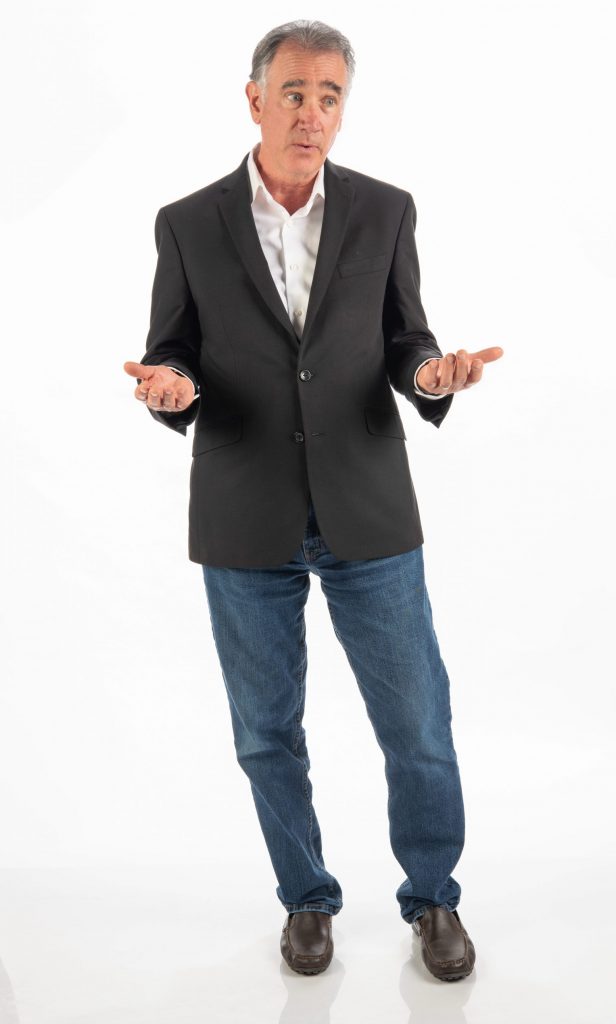
Russell Mack, instructor II in the Bob Schieffer College of Communication, teaches several upper-level strategic communication courses, including Strategic Writing and PR Case Studies. Before Mack began teaching, his experience in the communication field stretched fromthe White House and Capitol Hill to the airline industry. Heshares those experiences with students as he helps them become communication professionals.
When did you first realize that you might want to pursue a career in strategic communication?
Probably when I was in high school, although I didn’t realize what strategic communication was — I just knew that I was a good writer and that I wanted to write. So, I started writing for my school newspaper. Then I became the editor of the newspaper and won some writing awards. Then I went to college in Washington, D.C., and was really interested in public affairs. That’s what got me into PR. Eventually I realized that I was a strategic communicator, despite not knowing that stepping into my career.
How do you define strategic communication?
I think it means using a wide range of communication skills, like public relations, marketing, persuasion, and others, for a specific purpose. The purpose might be to sell a product or service, it might be to tell a company’s story, to advocate for a cause or to elect a public official. It can be a lot of things; my career is an example of that. During the course of my career, I worked in a lot of different areas of strategic communication. Working in the U.S. Senate is very different from working at American Airlines.
What sparked your interest in studying history as an undergraduate at American University?
I’ve always loved history ever since I was a kid. To this day, when I have free time, one of the things I do is I read history books. I think that history is a repeating loop. It’s as if the same movie repeats itself again and again and again. And we, all of us, get to be actors in the movie one time. The characters change from one generation to the next, the costumes change, the scenery changes. But the basic storyline doesn’t change. And if we watch movies from previous generations, we can learn a lot that can help us in this movie that we’re actually in.
Russell Mack spent time in the U.S. Capitol and the White House, and he can translate those experiences when teaching at TCU. Photo by Glen E. Ellman
When you read history, you’re seeing people go through a version of the same experiences we’re going through, and I think it’s a huge mistake for people to think that our experience right here and now is the first and only time that this has ever happened. I can take what’s going on right now in the political scene in this country, and I can go back to the 1850s and I can see many of the same things happening back then. Anyone who doesn’t take the time to look at history is begging for trouble.
You went to law school at George Washington University. How did that inform your career?
Going to law school helped my career in a thousand different ways, despite not becoming a lawyer. Most of my fellow students in law school wanted to become lawyers for a living; I realized pretty quickly that I didn’t want to become a lawyer for a living, but I did want to understand the law. When I was at American Airlines and we dealt with labor issues and labor controversy, I had taken labor law and understood what to do. When I was in the White House and we dealt with First Amendment and constitutional law issues, I had taken constitutional law. And it’s especially been useful here at TCU because I’ve been able to talk with my students about communication law, and my solid foundation of it comes from law school.
You spent time on Capitol Hill working under senators, representatives and even President Reagan. How did those experiences impact you?
I loved every minute that I was in D.C. Counting my four years at American University, I was there for 16 years. I got a chance to understand how our government works. I was able to see firsthand that our government is not made up of a bunch of crooks and losers; it’s actually made up almost entirely of genuinely good people who are trying to do their best. I also met my future wife there.
One can also probably imagine what it was like for a history buff like me to walk into the Oval Office. My job allowed me to sit there and realize I’m in this historic place where these incredible things happened. You don’t even have to work in the White House to have that experience in Washington; I felt that when I would walk through the Capitol. Every time I walked through the Senate chamber or the White House, it was as if I was in a dream, because I’m thinking to myself, “Here you are going to your job every day in this incredible place, where all these giants of American history have worked. And their ghosts are all around you.” For me, that was a feeling that never got old.
I would encourage any student who has a chance to spend even a little time in D.C. to do it. By the time I left, I had been to college and law school there, I’d worked in the House, the Senate, the U.S. Department of Health and Human Services, the U.S. Department of Education and the White House. I felt as if I had done what I wanted to do, and now it was time to turn the page and move to a completely different chapter.
Over the course of your career, what has been the biggest change in communication?
The most profound change was the technology of communication. And that’s both positive and negative. The positive part is, thanks to technology, the mechanics of writing have gotten easier. I can produce material, change it, and share it with people much more easily than I could, for example, back when I was in the White House. The negative of it, however, is that it’s created a lot more noise and confusion, making it harder to get your message through.
When I was in the airline industry, we knew what had happened before anybody else did, and we could manage the message. Whereas now the world finds out about it before we do. And so it has reversed the order of how a professional communicator operates. Most professional communicators now are reacting instead of acting. But what hasn’t changed is in the end, communication is one human being talking to another. And the people who start with that tend to be the best communicators. The people who start with the technology often are the worst communicators.
What are the most important qualities of an effective communicator?
Clarity and thoughtfulness, because a lot of times in communication, people just skim the surface — they communicate at the level of bumper stickers, they communicate with just short bursts, they communicate with cliches — they don’t communicate thoughtfully. They don’t think about what they’re communicating; they just blurt it out. And the best way to be a really good communicator is to spend time thinking about what you’re saying and how you’re saying it.
When Russell Mack came to TCU, he quickly “learned that students want to hear about real-life experiences. I knew that the main thing that I had to offer was I could talk about my actual experiences and what it’s really like out in the real world.” Photo by Glen E. Ellman
You’ve received several awards, including the Bronze Medallion Seal Award from the U.S. Department of Health and Human Services and the Secretary’s Achievement Award from the U.S. Department of Education. Which honor means the most to you and why?
The honor that means most to me is really not either of those two honors, or anything that I’ve received. As a professional communicator, the thing that makes me feel the most honored is when I get emails or communications from former students who say, “Hey, professor, I really appreciate what we learned in your class because now that I’m out in the world, I realized that something you taught me has helped me in my job, or you really helped me become a better writer.” When I get messages like that, that’s an honor, and it really touches me.
What made you want to become a professor, and what drew you to TCU?
Gradually throughout my career, I began to get the feeling that I’d like to share all of this knowledge someday as a teacher. I did a few lectures over the years, individual classes at various places, and I loved doing them. At a certain point, I started to feel like I had had enough of the corporate world, and I had done everything I wanted to do. A person who had worked for me at Mary Kay, who I respected very much, had subsequently left and taught here at TCU. I contacted him and said, “Hey, I’m really interested in potentially teaching at TCU. Can you introduce me to somebody there?” He introduced me to the head of the department at the time, and that led to a job offer as an adjunct. And so I taught one class one semester, and I absolutely loved it. Then the next semester, I taught two classes as an adjunct, and I liked it twice as much. So I applied for a full-time position, and here we are.
What have you learned from teaching college students?
I’ve learned that students want to hear about real-life experiences.When I came here, I knew that the main thing that I had to offer was I could talk about my actual experiences and what it’s really like out in the real world. They’re eager to learn, they concentrate, and they’re interested. I think one mistake students are making — not all, but many students — is they just don’t read enough. And I think if they did, it would really help them develop their skills. But I’ve been really thrilled by the students who I’ve been able to teach here these last six years; they’re bright and they’re eager to learn. They have a lot of good questions. And that’s been a real joy for me.
The other thing I’ve learned is you can’t go into a classroom with a preprogrammed lesson; every class, every student, every day is different. When you start talking it’s a one-of-a-kind lecture; you’re not just repeating something — it’s a new conversation.
What is the greatest piece of advice you’ve ever been given?
Positive breeds positive and negative breeds negative. Somebody I worked with years ago said that, and I think it’s very, very true. I think it’s easy in this world, in this life, to slip into the dark hole of negativity and cynicism. Yes, there are bad things in this world, but we can’t wallow in that negativity. I think there’s so many things we should be positive about. Most people in the world — most people throughout history — would give anything to be where we are and have what we have in the TCU community in this country in 2023. I think it’s such a terrible waste to not appreciate the positives that surround us.
How does that advice translate to students graduating and entering the communication world full-time, and to your job?
I think the way it translates is to have a positive attitude about your job, even if you don’t love everything about it. Have a positive attitude about your responsibilities as a citizen, even though our nation has its flaws. Realize how lucky you are to have this education and to be starting down this career path.
For me, grading papers is hard. And sometimes there can be a tendency to focus on the mistakes or the errors. But that’s why the students are here, to make errors and to learn from them. So for me, it’s knowing that even the tough parts are all part of a very positive experience. I come in to school every day, and I’m just thankful that I’m here. I mean, this is the best job I’ve ever had, the most enjoyable job I’ve ever had. The irony of my job is I work very hard, but it doesn’t feel like a job; it feels like a calling. It’s something I want to do. And I’m just thankful to be able to do it. To help my students, that’s an extraordinary blessing to be able to do that.
What is one thing you hope students take away from your class?
I want them to walk out of my classroom prepared to behave and act as a professional in their jobs. And that means a lot of things, like using your skills, taking your work seriously, having a high standard, being honorable and ethical. It means giving it your best. I want them to be able to look back and say, “Professor Mack helped me learn how to be a professional.” Because that’s why they’re here, right?
When thinking about American history, does the Chicano Movement come to mind? The answer is often no, said David Colón, a professor of English at TCU. Social studies textbooks focus disproportionally on white historical figures as compared to historical Latin American communities. The Chicano Movement, which refers to widespread political and social activism by Mexican Americans during the civil rights era, was a major force in shaping the United States of the 21st century.
Social studies textbooks tend to follow the “great men of history approach of the Founding Fathers,” Colón said. “And then there’s labor history, social history … but both of those narratives have centered on Anglo-Americans to the point of erasing the histories of other communities.”
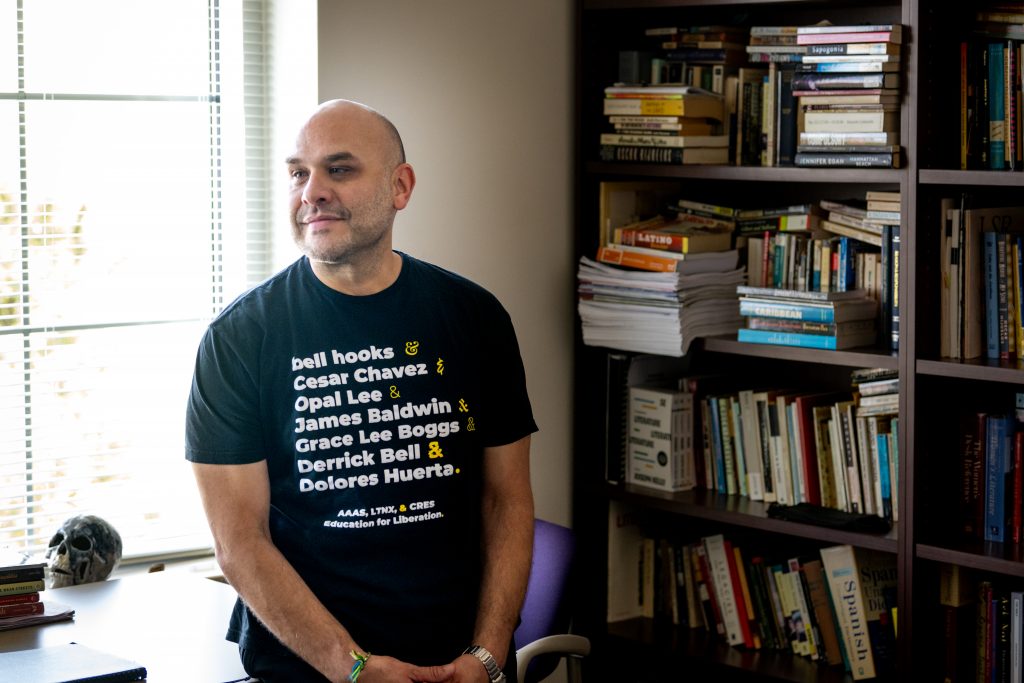
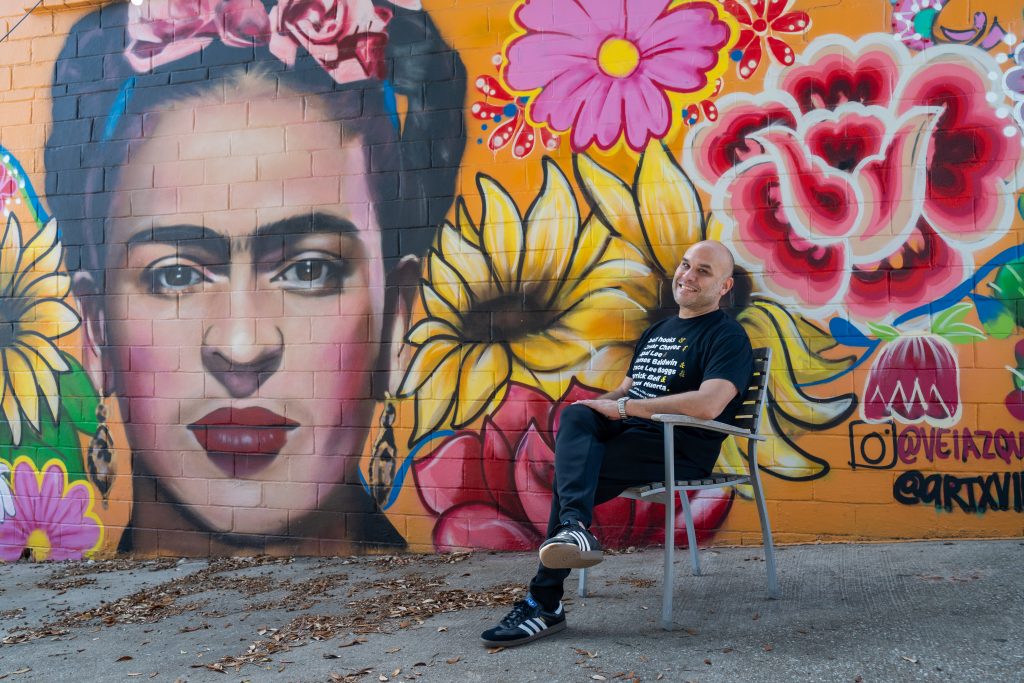
David Colón, professor of English at TCU, is the co-creator of Latinx Studies Curriculum in K-12 Schools, a project that started in 2018 after the Fort Worth Independent School District sought help developing an overlay for its existing social studies curriculum.
When Colón talks about Latin American culture, he does so with passion. His parents were born and raised in Puerto Rico, and he said he seeks to empathize with students who may not see themselves reflected in mainstream education.
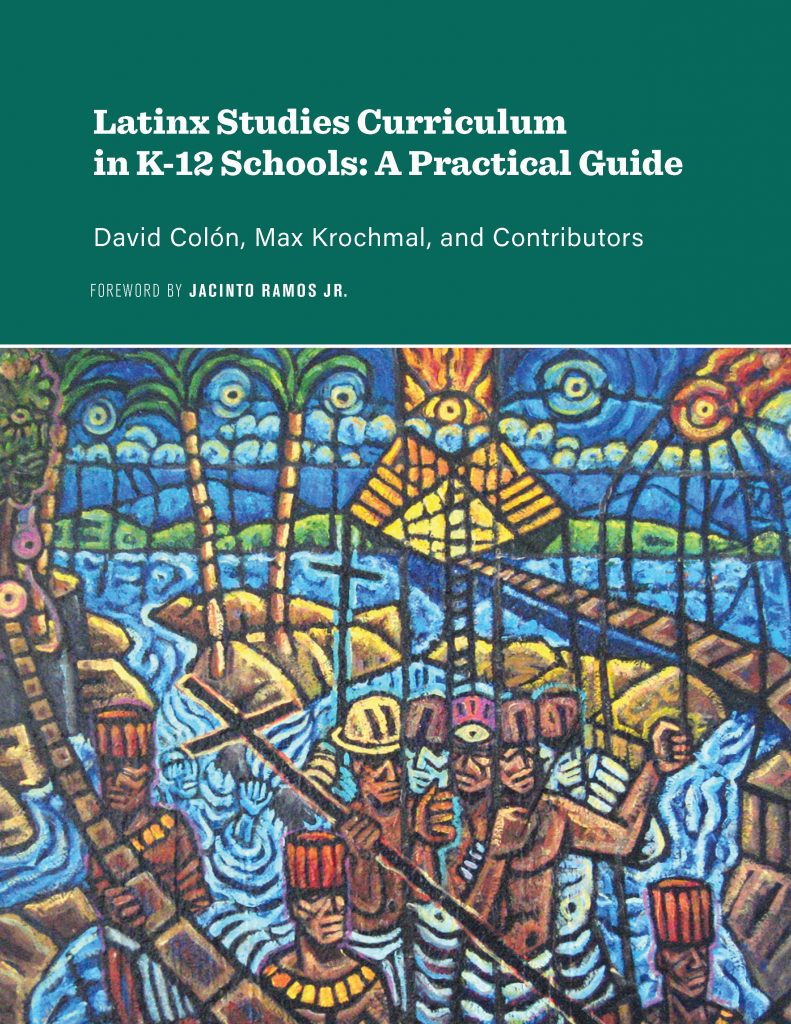
Colón is the co-creator of Latinx Studies Curriculum in K-12 Schools, a social studies guidebook and curriculum designed to help teachers instruct students about the cultural contributions of Latin American communities as well as significant historical events not typically covered in classrooms.
He cited the Pueblo Revolt of 1680 — a revolution in which the Pueblos of New Mexico fought against Spanish colonization — and the Treaty of Guadalupe Hidalgo, an agreement in which Mexico transferred 55 percent of its territory to the U.S. to end the Mexican-American War.
The project began in 2018, when the Fort Worth Independent School District asked scholars to help the district develop an overlay for its existing social studies curriculum. Colón said TCU’s Comparative Race & Ethnic Studies program “answered the call,” which involved providing the district with curriculum resources and bibliographies, a guide with ideas for national and regional field trips, and a 26,000-word essay on the field of Latinx studies.
Colón said the need for additional instruction was inspired by changing student demographics. The Fort Worth Independent School District reports that 64.8 percent of its students are Hispanic or Latino.
Colón said the curriculum overlay was also intended to help teachers expand their awareness of Latin American culture so they can better relate to and connect with their students. “A lot of times,” Colón said, “an Anglo teacher will find themselves in a classroom with 37 Mexican students.”
A Group Effort
Research for the initial version of the guidebook was led by Max Krochmal, then-chair of TCU’s Department of Comparative Race & Ethnic Studies, and Colón. Krochmal served as principal investigator, while Colón was the primary author.
Faculty from the journalism, religion, political science, education and comparative race and ethnic studies departments also contributed, as did Cecilia Sanchez Hill, who was then a doctoral student of history. Hill spent seven years as an educator in the Fort Worth district and gained experience researching Mexican American history for her master’s degree, which she said was helpful when working on the book’s section on local history.
The curriculum guidebook emphasizes history relevant to the groups represented in Fort Worth’s population, primarily Mexican, Puerto Rican and Central American, David Colón says.
One of the first steps was hosting town hall-style discussions with district stakeholders, including teachers, students and parents. The goal was to determine the district’s objectives for the guidebook and how the TCU team could help achieve those goals.
Melita Garza, then a TCU faculty member and now associate professor of journalism at the University of Illinois Urbana-Champaign, contributed to the curriculum and was present for the discussion sessions with district constituents. She said a major stakeholder request was that “Latinos not appear as a monolithic group” and that the curriculum include representation of Puerto Rican, Cuban, Central American and South American people.
The team figured out how to present Latin American history in chronological and thematic order. Colón said the book emphasizes history relevant to the constituency groups represented in Fort Worth’s population — primarily Mexican, Puerto Rican and Central American.
The team audited the district’s curriculum to correct inaccuracies and find ways to improve its perspective of Latin American people, such as reviewing language that could influence students’ impressions of these communities.
During the audit, Hill said, she objected to an eighth-grade reading assignment. The text said that “ ‘Americans looked west to what they saw as a vast wilderness, ready to be taken,’ but does not clarify that it was not a vast wilderness,” Hill said.
Additionally, discussions of immigration from the Colonial era to Reconstruction focused heavily on Chinese and European immigrant experiences but did not mention Mexicans.
Colón later revamped the guidebook to become a stand-alone text. The updated guidebook was published by TCU Press in 2022.
Included is Garza’s research focus on immigration, Mexican Americans, democracy and the media. She said she wanted the guidebook to discuss the advent of Latinx media so students could learn about inclusive journalism.
“I was particularly interested in the topic of migration,” she said, “and particularly wanted to see the broad topic of the emergence of Latinx media included in the curriculum.”
She said students should learn about the historical importance of news entities such as the Spanish-language publication La Prensa, which was founded in San Antonio in 1913. She said the contributions of Latin American journalists and publications tell a story of agency and ability that shouldn’t be overlooked in social studies curriculums.
While he was compiling resources for the guidebook, Colón said, some findings surprised him, like when he read about systemic slavery under Spanish colonization and how it differed from the English model. In his reading, he learned about societies of African descent across Latin America that became independent despite colonialism. He said he thought findings like this would inspire students and free them from absolutist thinking.
The curriculum overlay that his team developed is also intended to help teachers expand their awareness of Latin American culture, says David Colón, here in front of a mural by artist Juan Velázquez on the Islas Tropicales restaurant.
The value of perspective
Public understanding of Latin American issues is improved when discussions include insights from people with complex relationships to those topics, Colón said. “We’re trying to amplify [non-Latinx] students’ and teachers’ and administrators’ abilities to be able to have a vicarious experience of a different culture.”
While students are learning about the 1960s, TCU professor of English David Colón said, “there were other things that were going on simultaneously that really have laid the bedrock for equal opportunity equity today.”
He said students need exposure to the perspectives of Latin American people to have a well-rounded understanding of American society. “They’re learning about the ’60s and they’re hearing about Woodstock or they’re hearing about NOW or they’re hearing about Watergate,” he said, but “there were other things that were going on simultaneously that really have laid the bedrock for equal opportunity equity today.”
Hill said the Civil Rights Movement becomes more nuanced when Latin American activism is included in the conversation. By hearing historical voices, she said, students learn about civil rights topics such as the Chicano Movement and the establishment of the Young Lords Party. Originally a street gang in Chicago, the Young Lords organization was a Puerto Rican civil rights activist group founded in 1968 and modeled after the Black Panthers.
“There’s that section that’s titled ‘The Long and Wide Civil Rights Movement,’ ” Hill said, “because, you know, it starts much earlier than what you were traditionally taught in school.”
Garza said the guidebook builds on the U.S. Constitution.
“When the Constitution of the United States was written in 1787, the first of its stated goals was to establish justice,” she said. “We are still working on our more perfect union more than 200 years later.”
She said understanding the contributions of Latinx people is important for all Americans and can help decrease tension between racial groups. “I feel strongly that improving education and knowledge of history through a project like the Latinx Studies Curriculum is one important way to build a more perfect union and to promote a just and inclusive society.”
Last fall, Nina Martin, a professor of dance, showed 20 students how to stretch out like a starfish to take up maximum space. These weren’t fine arts majors honing the craft. Instead, Martin staged a two-day takeover of a Neeley School of Business class for upper-level management students.
Tracey Rockett, professor of management practice, invited her School for Classical & Contemporary Dance colleague to work with her Team Dynamics juniors and seniors. Martin presented a series of exercises geared toward improving awareness of how an individual moves through space. Rockett’s goal was to make her students more effective leaders by expanding their perceptions of power.
Martin began her career as an avant-garde improvisational dancer in New York City in the 1970s. Two decades later, she created Ensemble Thinking, a method of social learning that helps people pay keen attention to their environments and the people occupying them.
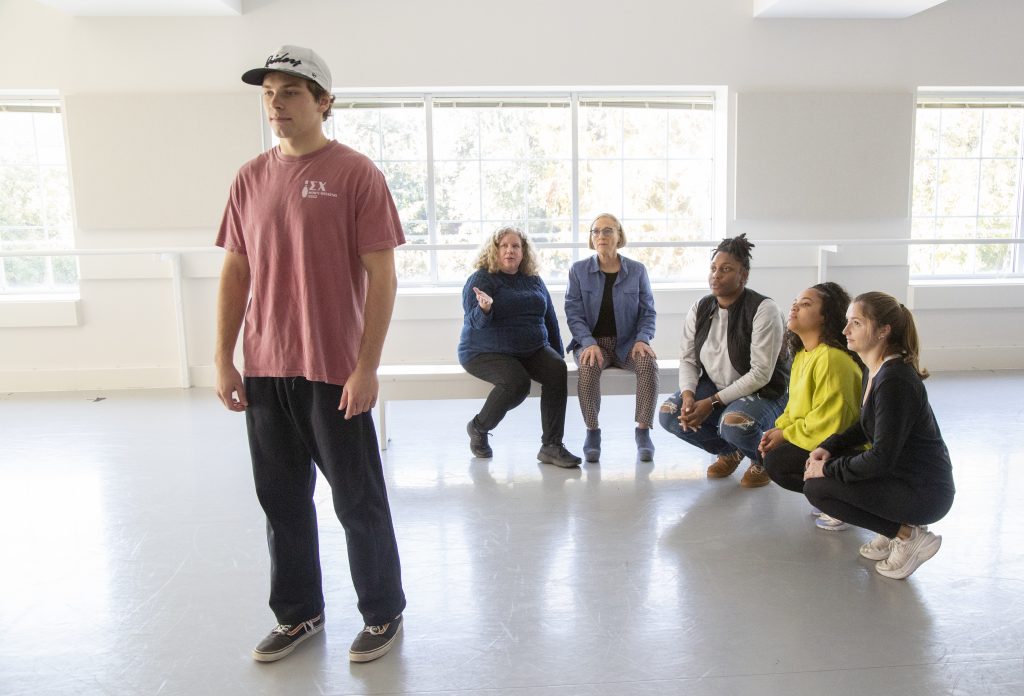
Neeley School of Business professor Tracey Rockett, left, shifts gears on her Team Dynamics students by having them spend time with School for Classical & Contemporary Dance professor Nina Martin, who teaches Ensemble Thinking.
“Ensemble Thinking also sharpens perception of how nonverbal communication works in human society,” said Martin, adding that the program sensitizes a person to read the spatial and visual cues that communicate power dynamics. The guy who sprawls in his seat on the subway staring down passengers, for instance, gives off a more intimidating vibe than a small woman with her knees drawn up to her chest, eyes closed and head down.
Far more subtle interactions happen all the time and can impact productivity and job satisfaction, Rockett said.
Ensemble Thinking’s origins date to Martin’s work as a choreographer with Lower Left Collective, a group she co-founded in 1994. The basis of Ensemble Thinking began with Martin focusing on “how the brain makes sense of what the eye sees while it interprets the surrounding environment.”
Social literacy, she said, makes this type of training relevant to future managers who will seek to elicit the best work from their employees. The more those in management become attuned to their own patterns of behavior, perceptions and tendencies, she said, the more effective they’ll be in leading others.
Over the years, Martin has worked with an array of professionals outside the dance world, including software teams. The fall 2023 semester was the third time Martin taught Rockett’s students.
“When I first told them a dance professor was going to lead the class that week, they all looked nervous,” Rockett said. “I know that they were expecting Nina to teach them steps or some kind of routine to perform, even though I told them to expect something completely different.”
The two days of instruction, Rockett said, dovetailed with her class curriculum by showing students how team members read and react to body language. Her students learned firsthand how position, proximity and height levels all matter and shape the dynamics of a group.
Ensemble Thinking
As soon as the management students arrived, Martin told them to push back the tables to create a makeshift stage inside the Hays Hall classroom. She began by leading the group in warmup exercises, which included instructing them to power pose with arms and legs as wide as possible. Then she had them “get really small, head to tail,” in a tight crouch.
“How did you feel?” she asked during and after the movements. “Silly? Productive? Powerful?”
Business management students, led by professor Tracey Rockett (seated, left), learn during time spent with dance professor Nina Martin (seated, middle) how movement can be used to better understand nonverbal communication.
Heads nodded. All of those things. Martin asked the students to remain silent while forming a circle, telling them to pay attention to nonverbal communication such as eye contact, smiles or pinched expressions. Did they feel awkward? Engaged? Both at once?
Martin then divided the group in half, with eight students taking seats to form an audience. Martin called out the name of one of those still standing, Joseph “Joey” McGuinness, a senior management major from Orange County, California, and instructed his peers to find ways to indicate that he “was the most important guy in the room.”
They pointed, genuflected and encircled him. When another student’s name was called, McGuinness and his peers fell to the ground in a posture of worship.
“It felt embarrassing at first,” McGuinness said. “But this built a sense of camaraderie in the class.”
Students on the sidelines offered feedback, shouting out thoughts on what worked and what didn’t. The roles then reversed.
In a final exercise, Martin put the students in pairs. She instructed them that when one moved, so would the other. The point wasn’t to mirror the action of their counterparts. Instead, Martin wanted them to react so quickly that an observer couldn’t tell which one had the role of leader.
“One of the things I really noticed was how much we were looking each other in the eye,” McGuinness said. “I think you don’t really get that day to day anymore as you’re not looking at people’s facial expressions as much.
“Maybe that’s because of Covid or maybe it’s because our generation is different with our phones,” he said. “Everything is vying for your attention right now, so it felt like there was a real human quality to what we were doing.”
Unspoken Dynamics
To complement Martin’s Ensemble Thinking exercises, Rockett asked the students to read a chapter in Group Dynamics for Teams by Daniel Levi and David Askay that highlights social influence and power.
“The dynamics of power in teams is a major influence on the leader’s behavior, how team members interact, the impact of those in the minority and the amount of influence members have on one another,” the co-authors write.
Ensemble Thinking is used by professor Nina Martin (seated, right) to teach students how “the brain makes sense of what the eye sees while it interprets the surrounding environment.”
Mariana Martinez, a senior from Mexico City who is studying management as well as entrepreneurship and innovation, said the exercises gave her a new appreciation for nonverbal communication. During the sessions with Martin, she said, she learned about “fostering trust, promoting collaboration, facilitating problem-solving, influencing leadership dynamics, encouraging active listening and fostering cross-cultural awareness.”
“What I thought was the best part,” Martinez said, “was that [Martin and Rockett] created a very safe environment in which we all felt comfortable as we did this crazy running around.”
Kylie Daly Pedersen, a junior marketing and management major from the Denver area, said the energy in the classroom felt even more positive on the second day, when everyone had a better idea of what to expect.
“Everything clicked,” she said. “One of the themes that we kept coming back to in that class was perception. And when you are concentrating on what everyone else is doing and not saying anything because we couldn’t talk during the exercises, it gives a lot of clarity.”
Soft Power
Martin designed the exercises to give participants a feel for power dynamics in the room, something the textbook also addressed.
Levi and Askay define harsh power in the workplace as an employee’s formal role at a company — think job title. That contrasts with their view of soft power as “an individual’s characteristics or personality.”
Rockett said future managers need to understand behavior — their own and that of others — to get the best performance from their teams.
“Students at this age don’t necessarily think about how their behavior is influencing others,” Rockett said.
TCU students (back, from left) Evan Serynek, Lexi Chandler, Se’Myris Morris and Sarah Walls spend time learning about nonverbal communication from dance professor Nina Martin, front left, while taking business professor Tracey Rockett’s Group Dynamics course.
During her time with the Neeley students, Martin told the class that “teamwork requires people to step up, even the people who don’t necessarily want to stand out from the crowd. You come into the world with propensities to be extroverted or introverted. But to be able to function in a team, you have to be able to stretch yourself and learn new skills.”
“The goal of these sessions wasn’t just to get the students to feel more confident and more comfortable at being themselves,” Rockett said, “but to improve how they respond to others.
“Leadership isn’t just about spouting off good ideas or being in your head,” she said. “It’s always a back and forth.
On TCU Horned Frog Nation, a private Facebook group with more than 22,000 members, TCU sports enthusiasts gather online to interact the way diehard fans do best — they make predictions, celebrate wins, commiserate over losses, complain about referees’ calls, post photos from the game, and share articles, videos and podcasts that further fuel the conversation.
Facebook, 20 years after its founding, is the most popular social media platform in the world, with 3 billion active users each month — that’s more than one-third of the world’s population. The platform is home to more than 10 million groups, where members connect with one another based on a common interest, whether a neighborhood, profession, hobby, belief or even a disease.
“What Facebook groups allow us to do is to connect with others who share similar interests, values or have similar problems to solve,” said Guy Golan, associate professor of strategic communication. “Now think about the power of building a community with people like that.”
Golan, who developed a social media class for strategic communication majors, said that students who post consistently can position themselves as thought leaders. “I encourage them to be platform agnostic,” he said, “and to go where the audience/community is.”
But he has to work to convince them of Facebook’s value, because Gen Z tends to think of the 20-year-old platform as the realm of older generations. Often-fractious Twitter, now known as X, is also a hard sell.
Students instead gravitate toward TikTok, filled with short, funny videos, and Instagram, where users post photos and share short videos, or reels. Many students will join LinkedIn, a platform for professional networking where users post résumés and career updates.
“We try to get them to embrace social media, understanding that it could provide a platform for them to have further success, from a career standpoint in the future as well as trying to capitalize on building a brand while they’re at TCU.” Ray Walls
TikTok came under fire when the U.S. Congress voted to require the app’s Chinese parent company to sell TikTok or face a ban in the U.S. Critics of TikTok believe the app could be used by China for surveillance or spreading propaganda, making it a threat to national security; defenders of the app see the proposed censorship as a violation of free speech.
The half of Americans under 30 who use social media to get their news concerns journalists, who find themselves competing with less scrupulous social media posters who claim to be reporting news. A 2022 survey from the Pew Research Center revealed that of respondents in 19 countries, at least half believe social media has made people easier to manipulate, more divided in their political opinions and less civil.
In spite of the risks, strategic communicators and those in any field that requires self-promotion can’t afford to ignore social media.
“There’s no way around it,” said Ray Walls ’12 MEd, associate athletics director for student-athlete experience and brand management, who educates student-athletes about name, image and likeness and serves as TCU’s NIL contact. “We try to get them to embrace social media, understanding that it could provide a platform for them to have further success, both from a career standpoint in the future as well as trying to capitalize on building a brand while they’re at TCU.”
The Student-Athlete
Damilare Olukosi, a sophomore mechanical engineering major and triple jumper for Track & Field, had zero expectations when he posted his most popular TikTok to date, which shows him dancing in anticipation of his sophomore season. Set to ScarLip’s “Blick,” a pulsing hip-hop track, the clip collected 3 million views.
“Sometimes you put so much effort into one and it really doesn’t do as well as you expect it to,” he said. “It’s always the ones you don’t expect that blow up.”
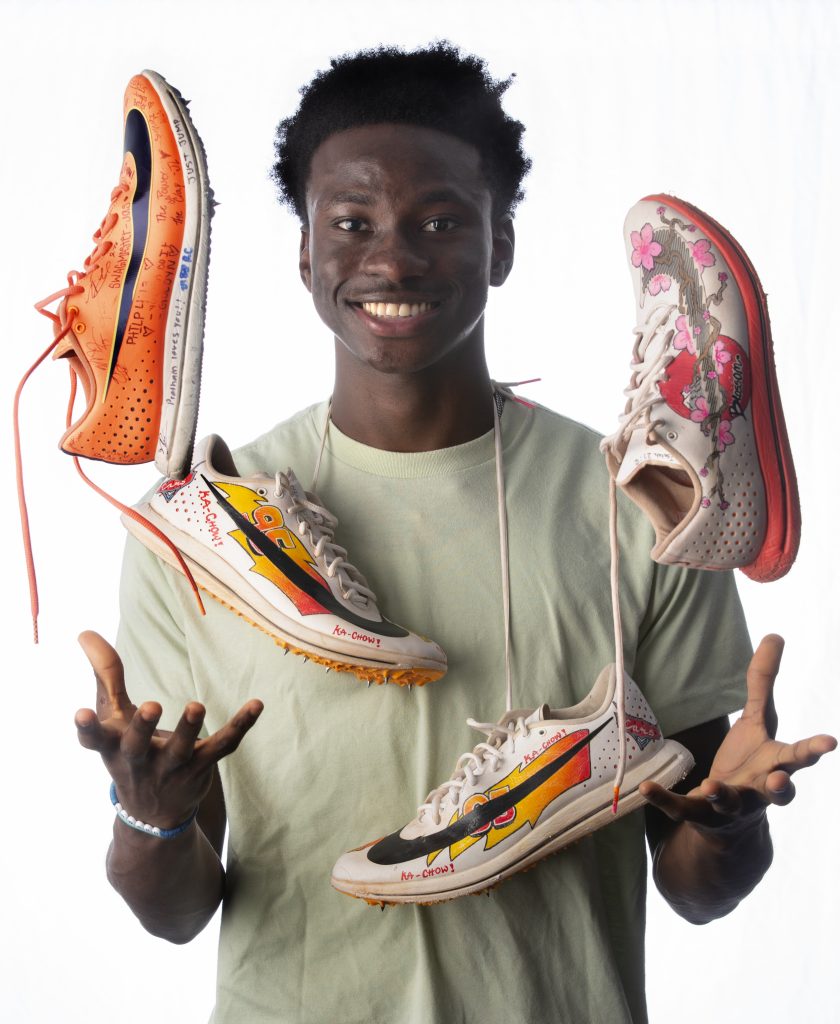
Damilare Olukosi said the popularity of a social-media post doesn’t always reflect the effort put into it. “It’s always the ones you don’t expect that blow up.” Photo by Joyce Marshall
While TikTok posts can be unpredictable, Olukosi, who was born in Nigeria, has identified some key factors. Timing is critical, he said. He likes to post at 9:13 a.m. Good music helps, too. But the main criteria for TikTok is to grab viewers’ attention in the first three seconds.
“When you have to write a paper, you have to have a hook,” he said. “It’s pretty much like that.” Olukosi hopes to become a mechanical engineer and a professional athlete supported by sponsorships. He believes the strategic use of social media can help.
TCU Athletics’ student-athlete development program has assisted Olukosi in his efforts. The department hosts mandatory workshops three times a semester on using social media and building a brand. Walls said the staff begins by helping student-athletes figure out who they are so they can tell their stories. Olukosi, they learned, is a self-taught artist.
The triple jumper began painting on his track spikes as a first-year when he was injured and couldn’t compete. He developed a process — removing the shoes’ finish, applying designs in leather paint and sealing them. Among his favorite designs is one featuring pink cherry blossoms and anime characters.
Olukosi’s shoe videos on YouTube and TikTok have drawn so much interest that he is considering a side business.
“On social media, we encourage student-athletes to dig deep into their personal lives, their values and the message that they want to get across to their audience,” Walls said. “When you understand who you are, you can build your brand around that.”
Olukosi earned an NIL deal promoting a country song for Sony Music. He’s also paid through TikTok’s Creativity Program Beta, which challenges people with more than 10,000 followers to create videos that are more than a minute long. But Olukosi said he’s focusing on the quality of his audience rather than on acquiring followers.
“As good as social media is to grow things, you should be careful what you post,” he said, mindful that he represents his school. “You can’t just post recklessly; you’ve got to post with purpose.”
A TikTok video about his track fails, Olukosi said, resonated with followers who are athletes. “I noticed I was able to inspire and connect with people,” he said, “by also showing my flaws.”
The Journalist
Shortly after The Princeton Review declared TCU to be home to the happiest college students in the nation, junior journalism and communication studies major Ryan Thorpe, an intern with the TCU social media team, set out to prove it.
Together with senior education major Lia Perez, he walked around campus with a microphone asking students, “Are you happy?” (Spoiler alert: They are.) The resulting Instagram Reel on TCU’s main account earned 52,000 views and nearly 4,000 likes.
A popular social-media post, Ryan Thorpe discovered, is one that is liked, shared and tags others. Photo by Amy Peterson
As a social media intern, Thorpe has learned to come up with videos that he knows students will enjoy and be quick to engage with — by liking, sharing and tagging friends — which prompts more views.
“It’s real student responses,” Thorpe said, “and it’s what actual students want to see.”
TCU social media interns meet once a week and volunteer to take on assignments as their schedules allow. The job has earned Thorpe press credentials to TCU football and basketball games, allowing him to capture and share content from the field or floor, and front-row seats to campus comedy shows and concerts. Like many in his generation, he doesn’t mind being on camera when needed.
Amy Peterson, TCU’s assistant director of social and multimedia strategy, said that students benefit from learning on-camera skills. “It also works really well for us,” she said, “because we need a lot of talent to be in the TikToks, to be on camera, to be the face of TCU.”
Thorpe learned how to use video editing software in his Introduction to Visual Journalism class. In News Production, he finessed his video-editing skills while creating news packages for class — projects later broadcast by TCU News Now, a show from the student-run outlet TCU 360. One such project, produced with junior journalism major Delaney Vega at the beginning of the 2023 football season, focused on three football players who transferred from Alabama to TCU.
The same video production skills involved in journalism — interviewing, producing, filming and editing — also make for high-quality social media content; pointing a phone and pressing record doesn’t produce the same results.
Balancing so many video assignments through his internship has given Thorpe enough experience to streamline his process. “I have a vision before I step out onto the field to actually grab stuff,” he said. “And I’ve taken that with me into my class to make my news packages.”
Thorpe is leaning toward a career in digital media, which could mean working for an agency, a sports organization or a media outlet. “The skills that I’ve learned to create a good, coherent, well-built and visually appealing story — I think that’s going to go so far,” he said. “I’m definitely going to be able to wrap my head around whatever is thrown at me.”
The Actress
By the time Alicia Nolley ’23 graduated with a degree in acting, she had developed another skill — running social media for arts organizations.
When she was new to TCU, Nolley said, a faculty member asked students what they wanted to see improved about the theatre program.
Alicia Nolley helped the TheatreTCU Instagram profile grow to 31,000 visits in 2023, an increase of 25 percent. Courtesy of Alicia Nolley
“We all talked about how we’re not as discoverable as some other programs.” The next semester, Jessica Humphrey, assistant professor of theatre, put together a social media plan. She plotted out topics to share and assigned the creation of posts, including photography, writing and design, to student helpers. Nolley volunteered.
“I think it is important to have the student perspective guide our social media channels,” Humphrey said. “They know what trends are happening, what is important for prospective students to know.”
Growth has been steady since TheatreTCU joined Instagram in February 2020. In 2023, the account tallied more than 31,000 profile visits, a 25 percent increase over the previous year.
TheatreTCU’s social media platforms — which also include Facebook, TikTok and YouTube — now serve to promote its program and productions. An annual student-produced video welcoming the incoming class gets thousands of views. “Booked & Busy” posts celebrate student appearances in professional productions. Alumni spotlights laud graduates including Alex Vinh ’18, who recently joined the national tour of Wicked.
The efforts have also succeeded in attracting prospective students. “We hear all the time, ‘Oh, I saw you on Instagram,’ ” Humphrey said. “It is a huge part of our recruitment.”
Learning on the job was a big part of Nolley’s experience, but theatre majors also receive social media guidance in the classroom. Humphrey teaches Professional Seminar, in which seniors build their websites with headshots, résumés and YouTube videos.
Aspiring actors, like other performing artists, might spend as much time selling their talents as they do rehearsing; building a following on social media can help. Actress Sophie Turner publicly credited her role in Game of Thrones to her popularity on the platforms.
“If you’re a name online,” Nolley said, “you often have a higher chance of getting cast because you’re going to bring in your audience to their project.” Nolley is now a digital marketing management master’s student at the University of Westminster in England. In addition to acting, she envisions a future helping arts organizations build audiences through social media marketing.
“My dream is to work for a theatre in London,” she said. “I just love the arts; talking about it online and creating content for it has become another outlet for me as an artist.”
The Marketer
On her personal TikTok, senior marketing major Dalia Charif went viral for a cheeky photo montage of Top Gun: Maverick star Miles Teller, whom she met at the Indianapolis 500, set to Berlin’s “Take My Breath Away.” The clip, featuring her kissing a photo of Teller, garnered 2.4 million views.
Charif has been using social media since middle school, and she believes those skills will be incorporated into almost any marketing job in her future. Her Digital and Social Media class with Elijah Clark, an instructor of marketing in the TCU Neeley School of Business, helped her transition from social to professional influence.
Dalia Charif uses a professional headshot for her LinkedIn profile to help raise her chances at landing new employment, a tip she learned at TCU. Courtesy of Dalia Charif.
Clark said that during his semester-long class, students begin to understand the difference between personal posts and corporate social media. While being informative and funny can be successful in either realm, he said, marketing professionals have more to consider. “We have to stick to brand standards,” he said, explaining that everything from logos to color palettes to messaging must align with the company.
In his class, Clark assigns a semester-long project to create a digital marketing plan for a small business. “And that I think is really practical,” Charif said, “because that’s what we’re going to be doing in the real world.”
Charif and her team chose Rockwood Go-Karts & Mini-Golf in Fort Worth. The group created a social media calendar with suggested posts, such as showing a young customer with a promotional keychain. They also shared a storyboard for a 30-second video for use on social media, designed to give viewers an authentic look at customers having fun. The team advised Rockwood to post consistently at strategic times and to tag organizations likely to book the venue, including TCU Greek organizations.
In a different class, Clark helps his students build or improve LinkedIn profiles. Charif took his advice to include a headshot with some personality — she’s pictured in business attire with a warm smile — and to keep text professional.
Charif’s updated LinkedIn profile outlines her many accomplishments, including a 2023 internship with Rogue Marketing Agency. Among her tasks at Rogue was creating posts for Vogel Alcove, which helps families experiencing homelessness in Dallas. To engage viewers and inspire potential donors, Charif created emotional posts showing young clients playing and shared data about homelessness and its impact on education.
Last November, Charif shared the news on LinkedIn that she landed a job with research firm Gartner, which has a long list of Fortune 500 clients. Clark’s comment on the post? “Slay!”
The Entrepreneur
Real-world experience has taught Parker Burross, a junior strategic communication and political science major, that a business’s social media content needs to be genuine, consistent and fun.
One of his social media clients, the co-owner of Parker County Beef Co. in Springtown, Texas, wanted help launching his efforts to sell directly to consumers. While some of the company’s social media focused on the future of agriculture or using dry ice in shipments, the most popular post was a TikTok Burross created of the fourth-generation cattle rancher pretending to be stuck in his freezer trailer.
“I really was just another Gen Z kid that thought I knew everything about social media. Taking strat-comm classes has refined that because I can do my elevator pitch to a potential client, get a meeting and then a week later walk in with a strategic communication plan.” Parker Burross
“A lot of people take it way too seriously, and it doesn’t seem to work for them,” he said. “It’s about finding ways to express your brand voice in a really fun way. That’s how you get people to fall in love with your brand.”
In a fall 2023 meeting of his Social Media class, Golan, the strategic communication professor, made a case to his students for using Facebook groups to build trust with an audience.
Burross shared with the class that because of his work doing wedding photography, video and social media content creation for couples, he’s a member of the DFW Weddings Facebook group. There, he follows industry trends, gathers visual inspiration, establishes trust with prospective clients and occasionally offers specials on his services.
In high school, Burross began working with clients at his family’s Paradise, Texas, wedding venue, the Barn at Twelve Acres Ranch. He first offered free services shooting photography and video and uploading Instagram posts and TikToks for couples who wanted their celebration shared but didn’t want to spend their wedding day editing videos and images. Soon he had paying customers.
While at TCU, he successfully pitched content creation services to Electric Cowboy, a local country dance bar he was frequenting. Today, Burross Media Management, which includes a freelance graphic designer, videographer and editor, typically juggles between six and 12 clients. Burross said that his team, by creating consistent, targeted social media content, is taking a chore off of clients’ plates.
“Parker is an entrepreneur,” Golan said. “I have several students who own businesses, and they take what they learn in my class and apply it to their business on Day One.”
“I really was just another Gen Z kid that thought I knew everything about social media,” said Burross, who hopes to attend law school after graduation. “Taking strat-comm classes has refined that because I can do my elevator pitch to a potential client, get a meeting and then a week later walk in with a strategic communication plan.”
The Lead Intern
“And the winner of the Bluebonnet Battle is … TCU!!!” An Instagram post on TCU’s main account celebrated the win against Baylor with a slideshow of images showing the action on the field and in the stands, including SuperFrog dancing with TCU Showgirls, Dutchmen in purple-and-white striped overalls and fireworks capping the victory. The post garnered more than 4,600 likes.
Marina Magnant said that her time interning for the TCU social media team was instrumental in landing a job with Goldman Sachs in New York City after graduation. Courtesy of Marina Magnant
Marina Magnant, a senior supply chain and marketing double-major who serves as lead intern for TCU’s main social media accounts, was behind the camera.
“She has attended every home football game to capture photos and videos to share with TCU’s community,” said Amy Peterson, assistant director of social and multimedia strategy. “Her content is consistently some of the highest performing on our social media accounts, specifically her sports coverage.”
The international student from Portugal said her position with TCU’s social media team, run by Peterson and Mya Thatsanaphon, TCU’s social media specialist, paved the way for a full-time position in marketing with Goldman Sachs in New York City after graduation.
Magnant has become a skilled photographer, using one of the university’s professional cameras for events and gleaning tips from Peterson, a longtime photojournalist. For quick turnarounds on game days, Magnant relies on her iPhone. She switched service providers to get better reception at Amon G. Carter Stadium so she can share big moments immediately — as when TCU beat Iowa State to go 12-0 in the 2022 season.
“The content was posted right at the second that it was happening since it was such a huge moment for TCU,” Magnant said, adding that the experience inspired her honors thesis about how universities leverage athletic success to make strategic branding decisions.
With four years of experience, Magnant now arrives at major events like commencement with a storyboard vision in mind of what she wants to post.
“I have an idea of how many student and parent testimonies I want for the stories, how much of the ceremony we’re featuring and key moments that are happening, like at the December 2022 graduation when Max Duggan walked across the stage and a SuperFrog graduated and took off the head on stage,” Magnant said. “Being prepared ahead of time allows for the content to be generated and posted in an organic yet organized manner.”
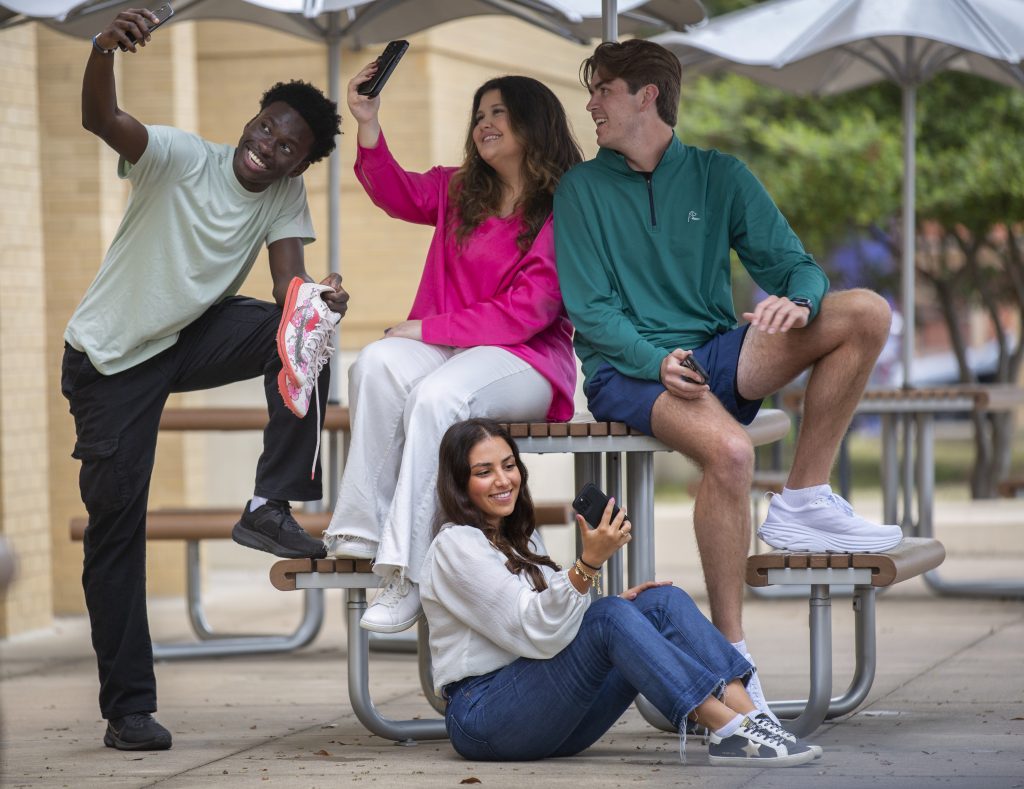
Damilare Olukosi, Marina Magnant, Ryan Thorpe and Dalia Charif, seated, have grasped onto social media to help built their brand as they head into the workforce. Photo by Joyce Marshall
Know Thy Audience
From the beginning to the end of the semester in Golan’s Social Media class, as in Clark’s class, students experience a paradigm shift. They might arrive talking about numbers of followers or viral views on their personal accounts without being able to define their audience or goals. “We try to prioritize research and data over creativity, and strategic planning over virality,” Golan said.
Professional use of social media, he said, isn’t about acquiring the most followers — success requires consistency, along with a focus on relationship-building.
“I don’t want just anybody to follow me for any reason,” Golan said. “I want people following me because I provide value to their community.”
Students don’t have to look far for creative examples of connecting with a specific audience; TCU’s rabid fan base is a perfect case study. During the 2022-23 season, TCU Football’s social media team began posting victory videos on X, formerly Twitter; many were so hilarious, weird and original that fans checked X at the end of each game to see what the social team thought of next.
Jon Petrie, coordinator of creative video and photo for TCU Football, was behind the series.
One of his efforts, after TCU beat the Texas Longhorns, was a video showing upside-down horns (those on animals, movie characters and even musical instruments — but no cattle) flashing to the country song “If You’re Gonna Play in Texas.” Sports Illustrated dubbed it an “expert troll job” in its end-of-season online roundup celebrating the videos.
The videos found their way to Facebook, where members of the Horned Frog Nation group delighted in the silliness and snark.
Meanwhile, on X, TCU Football followers wrote, “Keepin it classy while trolling. It’s masterful memery,” and, perhaps more to the point, “How can you not want this to win?”
Veteran journalist Bob Schieffer ’59 covered the assassination of JFK, the Vietnam War, Watergate and the 9/11 attacks. He anchored the CBS Evening News for 23 years. As chief Washington correspondent, he reported on the Pentagon, the White House, Congress and the State Department. He moderated three presidential debates. And he led Face the Nation, one of the country’s longest running TV news programs, from 1991 to 2015.
Schieffer, an eight-time Emmy Award winner, doesn’t think about individual accomplishments when he contemplates his legacy. “The thing that I get the greatest satisfaction out of right now, at this time in my life, is watching these kids who worked for me,” he said. “I’m just so proud of them.”
Among the Schieffer protégés is Kaylee Hartung, who served as his assistant on Face the Nation from 2007 to 2012. She is now a contributing correspondent for NBC News’ Today show and a sideline reporter for Amazon Prime Video’s Thursday Night Football NFL broadcast.
“Although I did not go to TCU, I like to say I’m a graduate of the Schieffer school, taught by the legend himself,” Hartung said. “Nothing makes me light up after a broadcast quite like seeing an email pop up from Bob with his observations and encouragement.”
Other journalists Schieffer mentored include Jacqueline Alemany, congressional investigations reporter for The Washington Post; Kylie Atwood, national security correspondent for CNN; and Nicole Sganga, homeland security reporter for CBS.
“And how about that kid Elizabeth Campbell?” Schieffer said. “She was just a star immediately.”
Campbell ’18, a CBS News field producer, met Schieffer while interning at Face the Nation as a TCU student. The show’s executive producer, Mary Hager, hired Campbell before she graduated. Campbell went on to work as Schieffer’s producer on coverage of the 2017 presidential inauguration.
“After that, a partnership was formed,” Campbell said. “We’ve done pieces over the years together on everything from Jan. 6 to the World Series to Jimmy Carter.
“The real lessons Bob has shared are the ones about how you approach being a journalist — the idea that you have a responsibility to the truth even when it’s uncomfortable or that sometimes the simplest questions can get the best answers.”
Early Years
At TCU, Schieffer majored in journalism and English, worked as sports editor of the TCU Daily Skiff and got a full-time job at KXOL, a local radio station. He covered the police beat, reporting on the scene of car wrecks and crimes.
“I may be the only reporter who ever got carded at a murder scene,” he said. “There was a gangster bombing out at a place called the Penguin Club.” Schieffer showed his press card, but police stopped him at the door; at 20, he was too young to enter.
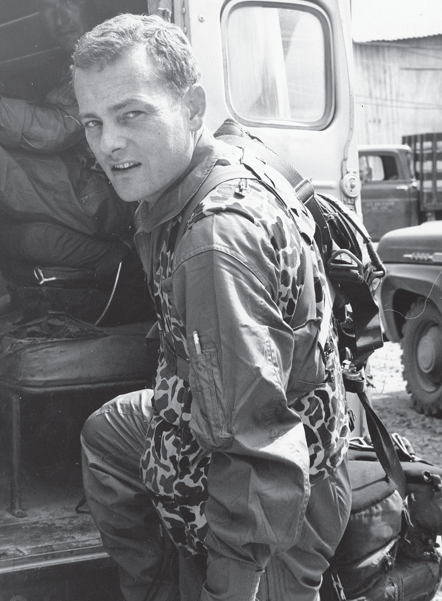
The Fort Worth Star-Telegram sent Schieffer to Vietnam, where he flew with a U.S. military pilot and reported on Texas soldiers. Courtesy, Fort Worth Star-Telegram Collection, UTA Special Collections
Following graduation, Schieffer joined the Air Force; he had been in ROTC, an experience he credits for life-changing lessons in leadership and responsibility.
After three years of military service, he returned to Texas to work as the night police reporter for the Fort Worth Star-Telegram. He dictated reports over the phone to editor Phil Record, whose guidance, he said, helped him sharpen his storytelling skills.
On Nov. 22, 1963, the day President John F. Kennedy was assassinated, Lee Harvey Oswald’s mother phoned the Star-Telegram asking for a ride to Dallas. Schieffer answered the call, enlisted a ride from another reporter and sat in the back seat with Marguerite Oswald, getting an exclusive interview. He also distinguished himself by reporting from Vietnam during the war, sending back stories about local soldiers.
“The Star-Telegram was very good to me,” Schieffer said. “They gave me a job. When I came back from the Air Force, they sent me to Vietnam [to report], which was kind of a turning point in my career. And then they found me a wife. I don’t think they did that for everybody.”
Family Life
George Ann Carter, the wife of Star-Telegram publisher Amon Carter Jr., played matchmaker for the young journalist. She called Schieffer after he became an anchor at WBAP-TV to ask if he was single. She then invited him over to introduce him to Patricia Penrose ’61, a society columnist for the Star-Telegram.
“I got up my courage and showed up there on a Sunday afternoon and there was Pat. And about two months after that, we decided to get married,” Schieffer said. “And when my daughters came along, I had to tell them many times, ‘Girls, this is not how you do it. We just got lucky.’ ”
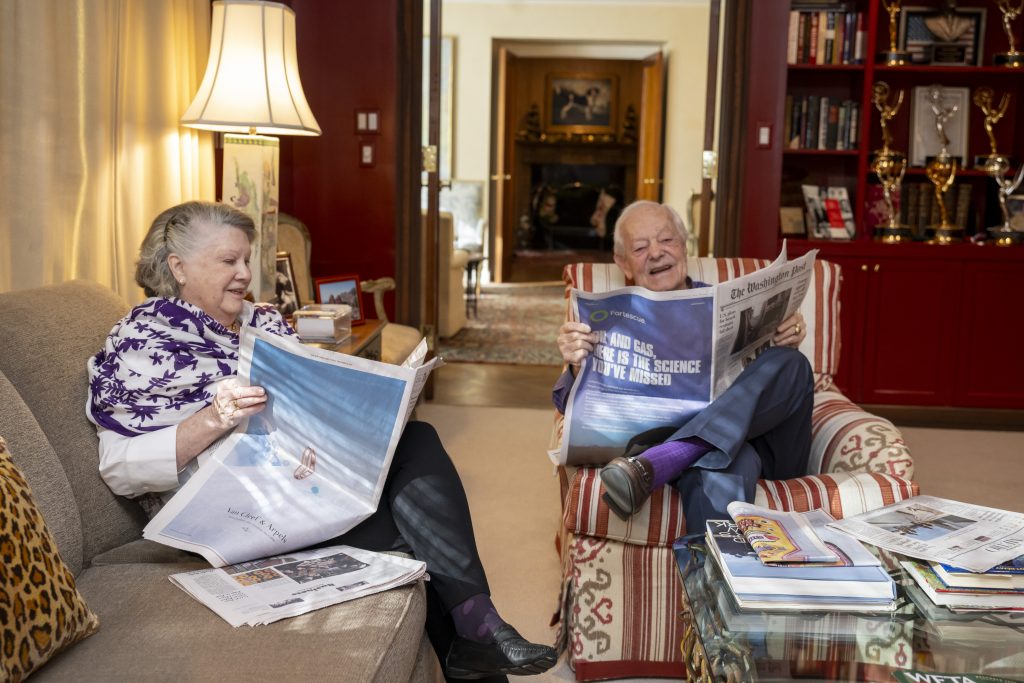
Bob Schieffer and his wife, Pat, read in their Washington, D.C., home. The couple met while he was an anchor at WBAP-TV and she was a society columnist for the Fort Worth Star-Telegram.
The pair began talking politics on their first date and never stopped. A couple of years after they wed, Schieffer got a job offer in Washington, D.C.
“I said, ‘I’ve wanted to live in Washington all my life. When do we go?’ ” Pat Schieffer said. “I knew that he was ambitious and whatever he did, he would do well.”
The Schieffers moved in 1969 and embraced life in the nation’s capital. Once there, Schieffer stopped by the CBS offices, inadvertently slipped into an interview slot intended for a different Bob and was offered a reporting job. (Robert Hager went on to a career at NBC.) Over the next four decades, Schieffer interviewed every president from Richard Nixon to Joe Biden.
The couple enjoyed meeting politicians, diplomats and bureaucrats, Pat Schieffer said. Their two daughters shared their interest in politics, interning as congressional aides.
“I couldn’t have had the career I had, I couldn’t have had the life I had if it were not for Pat,” Schieffer said. “When I was writing all those commentaries, which I would do at the end of Face the Nation every week … I would say, ‘I just can’t think of anything to write a commentary about,’ and she would say, ‘Well, you’ve been ranting all week about this or that. Why don’t you do that?’ ”
Daily News
Schieffer, who retired from Face the Nation in 2015, subscribes to print editions of The Washington Post, The New York Times and The Wall Street Journal — and reads them in that order. Other media habits include watching the CBS Evening News and watching CNN throughout the day.
“Sometimes I agree with their coverage and sometimes I don’t,” he said. “But I think those are all reputable publications and television; they have editors, and they don’t go with wild stories that nobody has checked out.”
“I’m really proud of that book because we talked about things like the decline of newspapers and how we’ve switched … to a situation where we’re so overloaded with news, we can’t sort it out,” he said. “What newspapers used to do is they were the curators of the news; they told us what was important. … Now everybody brings their own facts to the argument.”
Schieffer said journalists can combat that loss of confidence among audiences by avoiding mistakes and immediately correcting any that are made. But he remains concerned that people who can’t afford news apps aren’t getting the same information as those who can.
“This is probably the most dangerous period in American history since at least the Cuban missile crisis and maybe beyond that,” Schieffer said. “Making sure people are properly informed and understand if the information is correct or if it’s not — that’s one of the reasons journalism schools are so important now.”
Bob Schieffer subscribes to the print editions of the The Washington Post, The New York Times and The Wall Street Journal. He reads them in that order.
Journalism Then and Now
Schieffer learned how to be a journalist from on-the-job mentors. But today, he said, with fewer traditional newspapers and more digital jobs, that’s not always possible.
“A lot of these kids are coming out of college and headed to a job where the reporter will actually file the story before an editor has looked at it,” he said. “What journalism schools today do is critical and is, quite frankly, more important than it was when I was in school.”
Having TCU’s Bob Schieffer College of Communication named for him in 2013, he said, is his “single most treasured recognition.” The honor came nearly a decade after TCU’s department of journalism was named for him in 2005.
“I’ve won a lot of journalism prizes over the years, and that’s great, but that people would actually choose my name to put on their journalism school — sometimes I still don’t believe it,” he said. “I have tried to take as active a role as I can in helping people get to know about the school and what it does.”
He hosted the annual Schieffer Symposium at TCU from 2005 to 2015, bringing such media luminaries as Bob Woodward and Norah O’Donnell to campus. Schieffer reprised the symposium in honor of the 10th anniversary of the Schieffer College’s naming in November, returning to TCU with a panel of top national journalists, including Omar Villafranca ’00, a CBS News correspondent.
Schieffer credited Kris Bunton, dean of the college, for assembling the faculty and doing the work that has made the Schieffer College what it is today, and Chancellor Victor J. Boschini, Jr. for the university’s trajectory.
“We are proud as a college to be named for Bob Schieffer because he is a person of integrity who sets an example for all of our students who are training to be professional communicators,” Bunton said at the Schieffer Symposium in November.
In 2016, Bob Schieffer, an honorary Trustee, and Pat Schieffer, who served as a TCU Trustee for 30 years, endowed a scholarship in honor of Schieffer’s mother. The Gladys Payne Schieffer Scholarship covers all educational expenses for up to four students a year.
“During the 21 years I have been fortunate enough to observe TCU,” Boschini said, “Bob and Pat have both been stalwart supporters — making an impact on just about every area on campus.”
Processing Through Paint
At 87, Schieffer is still embarking on firsts. His debut one-man art exhibition, “Looking for the Light,” was curated by presidential historian Michael Beschloss. The New York Times covered its April opening at American University in Washington, D.C. The show features 25 of his 30-by-40-inch oil paintings, mostly of current events.
For the last few years, Schieffer has started each day with coffee and a paintbrush. Painting is not relaxing, he said, but helps him process the news. Schieffer compared his paintings to the commentaries he wrote for Face the Nation.
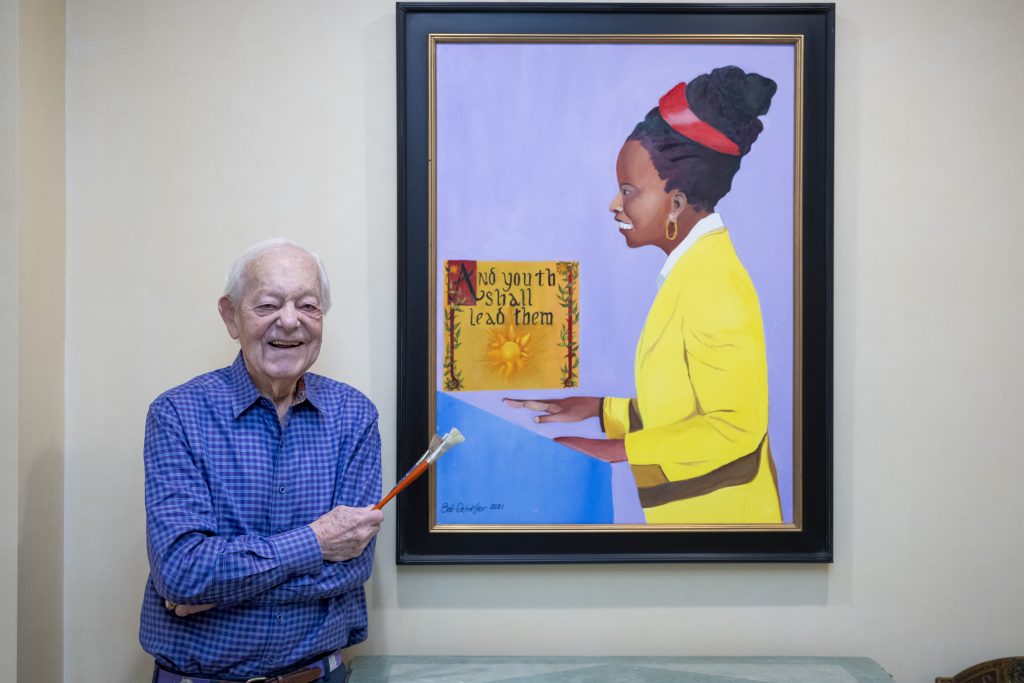
A lifelong artist, Bob Schieffer began painting in earnest during the pandemic. A portion of his dining room serves as a studio where he works on portraits, including this one of the late U.S. Supreme Court Justice Ruth Bader Ginsburg.
“He gets very intense,” Pat Schieffer said. “These ideas sometimes flow so fast that he almost can’t get it all down.”
The lifelong artist’s devotion to painting deepened as the Covid-19 pandemic hit the U.S. The crisis became personal for Schieffer when Hartung, his former assistant on Face the Nation, contracted the virus in March 2020 while reporting in Seattle on the country’s first outbreak. Schieffer reacted by painting Americans being put into ambulances.
As the news cycle continued, Schieffer painted George Floyd. He depicted statues of Confederate generals plastered with Black Lives Matter posters, and he captured the events of Jan. 6, 2021.
“The Capitol is the center of our politics, and that people would treat it like that … that was a terrible day,” Schieffer said. “And I kept thinking, ‘What if my daughters were still working up there?’ ”
Some of Schieffer’s paintings offer historical context, including his composition featuring George Washington, Franklin Roosevelt and Abraham Lincoln. “For all the difficulties of going through the Covid era, each of those presidents had far greater problems to resolve,” he said. “They didn’t try to change history or erase history or gloss over history. They just met the problems head on.”
At the center of the exhibition is “The Poet,” his painting inspired by Amanda Gorman’s reading of “The Hill We Climb” at the 2021 presidential inauguration. Schieffer was especially moved by the poem’s last lines — “For there is always light, if only we’re brave enough to see it, if only we’re brave enough to be it.”
His painting shows the youth poet laureate in profile, wearing a bright yellow coat against a purple background. The art bears the inscription, “And youth shall lead them.”
“The best and most useful gift we can pass on is an accurate history, which is why I think journalism is so important,” Schieffer said. “Free speech and an accurate history are as important to democracy as the right to vote, and we must never forget that.”
An exhibition of Bob Schieffer’s paintings, including this portrait of youth poet laureate Amanda Gorman, is on display at American University in Washington, D.C. He was inspired by her poem “The Hill We Climb,” which she read at President Joe Biden’s inauguration in 2021.
As a student at the Anne Burnett Marion School of Medicine, Joe Hoyle ’18 observed the impact the innovative curriculum made on his experiences with patient care. The school emphasizes the science of medicine and soft skills such as active listening and empathetic communication.
Through the Compassionate Practice® curriculum, medical students like Hoyle train to provide positive patient interactions, learn stress management techniques and hone skills that foster empathy through everything from role-playing to penning personal reflections.
Every TCU medical student must complete a Scholarly Pursuit and Thesis project before graduating. Hoyle combined his longstanding love of scuba diving with a burgeoning interest in how volunteer work emotionally benefits people. In designing his research project, he partnered with the Handicapped Scuba Association to study the impact of the organization’s empathy training on its volunteers.
Lisa Selmar, left, and Besher Kuzbari, right, assist handicapped diver Jeremy Perez during an Adapt-Able dive at the Texas Wesleyan Pool in Fort Worth. TCU student Joe Hoyle studied the impact that empathy had on the volunteers.
Four times a year, the certified professionals volunteering at Adapt-Able Scuba’s Discover Scuba events teach children and adults with disabilities to dive. In September, the volunteers led adaptive divers in above-water training and equipment tests before heading into an indoor pool. The disabled divers spent up to an hour 4 feet to 10 feet underwater, flanked by the pros.
“He is weightless in the water,” said Theresa Adair, mother of 13-year-old Jeremy Perez, who has sacral agenesis, a congenital spinal condition that compels him to use a wheelchair at times. “This is something he’s good at.”
The scuba volunteers who became the subjects of Hoyle’s research worked alongside divers with disabilities including paraplegia and autism. In 2021, the U.S. Census Bureau reported that more than 42.5 million Americans live with some type of disability.
“I wanted to see whether learning firsthand about the challenges and limitations that the disabled divers faced made an impact on how the dive buddies felt,” Hoyle said. “Neuroscientists have proven that empathy, though it’s a trait that is innate, can be enhanced or improved when you actively flex that muscle to increase it.”
The Handicapped Scuba Association offers empathy training to its volunteers. To measure the impact of that training, Hoyle surveyed volunteers using the Hogan Empathy Scale. The scale measures social self-confidence, even-temperedness, sensitivity and nonconformity. Participants also answered questions from the newer Perth Empathy Scale, a more comprehensive assessment.
Besher Kuzbari, left, assists handicapped diver Jeremy Perez, middle, in maneuvering during a dive as part of a research project into how techniques used to teach Adaptive Scuba to can be teach empathy to medical students and volunteers.
Hoyle’s research explores a bigger question: What part of the experience made the most ongoing impact on the volunteers outside of the pool? He sought to discover whether the volunteers might feel more empathetic in other situations, such as driving in traffic or when dealing with a difficult relative at home, because the volunteerism changed their mindset.
He has experienced the impact of empathy training firsthand. The Burnett School of Medicine, he said, expanded his thinking by helping him walk in his patients’ shoes. During his medical studies, he has observed the growth of his own empathic responses. Hoyle will begin his residency in anesthesiology at St. Louis University School of Medicine this summer.
“Joe really connected with some of the pieces of our mission to treat the patient as a whole person, and that it doesn’t take massive amounts of time and energy to understand your patient isn’t just the heart failure guy in Room 22,” said psychologist Erin Nelson, Hoyle’s thesis adviser and the Burnett School’s assistant dean of physician communication. “His project is such a beautiful example of research that can be generalized to every aspect of human life.”
Hoyle isn’t the only Burnett student to study empathy. Kavneet Kaur ’23 MD looked at the relationship between patient and physician through a lens of perceived empathy. Her abstract posited that physician mental health can impact the quality of care the provider gives patients. She also noted how compassion fatigue, which she defined as “the distress associated with repeated exposure to people who have gone through traumatic life experiences,” is a potential vulnerability for many doctors.
For his part, Hoyle is breaking ground as the first researcher to “measure empathy with scuba instructors,” said Michael Bernas, the director of the Scholarly Pursuit and Thesis program. “Like anything in science, you need proof.”
While the initial survey showed that volunteers did indeed feel more empathy after their work with the disabled divers, the results were less definitive than Hoyle had expected. He said this might be in part because people volunteering to teach disabled populations are empathetic at the outset.
“Sometimes the measures we have aren’t concrete and specific enough to relate to this sort of hands-on work with people with disabilities,” he said, expressing an interest in someday creating an empathy-measurement instrument of his own.
Hoyle also noted that his training as an Empathetic Scholar® influenced his perceptions when it came to learning from those seeking help and care. During his first and second years of medical school, patients spoke to his class about their lived experiences to frame content the class was about to study. A teenager with cystic fibrosis made a particular impact on him.
“He spoke very candidly about how much mucus would build up in his lungs and about his infertility,” Hoyle said. “Med school for us wasn’t always preparing for standardized tests and residency. These kinds of experiences shaped our thinking.”
A scuba-themed capstone project by Anne Burnett Marion School of Medicine student Joe Hoyle explores the impact of empathy training on volunteers.
At a time in the national consciousness when practically every issue seems split along party lines, cryptocurrency has emerged as a unicorn: A certain type of investor, regardless of left/right leanings, has embraced crypto as a hedge against inflation.
“Broadly speaking, cryptocurrency has a lot of political science implications,” said Grant Ferguson, an instructor of political science at TCU.
Ferguson, who researches and teaches political psychology, and two other political scientists conducted groundbreaking research into who is buying cryptocurrency. The results might come as a surprise.
Grant Ferguson, an instructor of political science, found that those who invest in cryptocurrency are younger, as expected, but “we saw a huge range of different race and ethnicity identification.”
Ferguson said he expected the findings to support a stereotypical vision about cryptocurrency investors: a young Caucasian male “who was basically this libertarian single guy.” His work with colleagues provided a far more nuanced profile of the roughly 1 in 7 Americans who own crypto, per data from the Pew Research Center.
Based on the results of the nationally representative survey they conducted with 2,500 American adults in May 2022, the political scientists generated “the first robust profile of the personalities, demographics and political attitudes of cryptocurrency owners,” they write. Titled “The Personality and Politics of Cryptocurrency Investors,” the study was published in the December 2023 issue of American Politics Research.
Ferguson encouraged co-authors Kathryn Haglin, assistant professor of political science at the University of Minnesota Duluth, and Soren Jordan, an associate professor of political science at Auburn University, to include questions about crypto ownership on a joint survey that looked at universal basic income policies and other economic issues.
Those buying crypto “tend to be younger, as we probably would have guessed,” Jordan said, “but we saw a huge range of different race and ethnicity identification, being stripped of a lot of things that are usually traditionally very divisive in politics.”
The average age of the 14 percent of those surveyed who reported that they own cryptocurrency was nearly 42 versus an average age of 49.7 for all those responding. Nearly 65 percent of those crypto owners identified as male.
As for race, the authors report that data indicated crypto owners “are significantly less white but are significantly more likely to be Asian and Hispanic.” Black men, they learned, gravitate toward cryptocurrency as well.
“When inflation is high, Americans could be more likely to use cryptocurrency as a medium of exchange and as a place to store value,” Grant Ferguson said.
The political scientists also discovered that a higher percentage of crypto owners surveyed held college or graduate degrees than the sample average: 42 percent versus 33 percent.
While scrutinizing their data, Ferguson, Jordan and Haglin determined that hedging against inflation served as a huge draw for crypto investors.
“This suggests that when inflation is high, Americans could be more likely to use cryptocurrency as a medium of exchange and as a place to store value,” Ferguson said. He noted that in 2021, El Salvador became the first country in the world to adopt bitcoin as legal tender.
Bitcoin remains by far the most popular cryptocurrency since its debut in 2008. Bitcoin’s anonymous creator said at its launch that the peer-to-peer digital currency would naturally resist inflation because it wasn’t tied to any government entity. Today the so-called digital gold has a market cap north of $500 billion. At its peak, a single bitcoin was worth more than $65,000 in November 2021 compared with $45,509 in January 2024.
The study concluded that crypto owners are significantly more likely to be in favor of reducing government spending than non-crypto owners. Owning stock, meanwhile, was a strong predictor of someone’s decision to buy crypto in the first place.
Some 77 percent of the crypto owners surveyed said they owned traditional stocks. That’s in stark contrast to 42 percent of all the survey participants who reported owning stocks.
Ferguson plans to use this initial study as a foundation for research into how cryptocurrency shapes political discourse and elections.
“In the future, politicians might try and win voters by pitching policies that were favorable or unfavorable to cryptocurrency,” Ferguson said. “It will be interesting to see how politicians adapt at all levels to this political and economic tsunami.”
“SO WHENEVER I’M IN A NEW SITUATION AND I’M ASKED TO PARTICIPATE IN AN ICEBREAKER that essentially wants me to share something unique about myself, I always, always, always am tempted to say, ‘Hi, everyone. My name is Tricia, and I grew up in a doomsday apocalyptic cult.’ ”
That startling revelation from Tricia Jenkins, professor of film, television and digital media in the Bob Schieffer College of Communication, opens the podcast Worldwide: The Unchosen Church. Jenkins, who earned a PhD from Michigan State University, did not initially think others would be interested in her experiences growing up in the Worldwide Church of God, which had close to 150,000 members globally at one point and hosted a weekly broadcast ministry on radio and then television for 60 years.
But Jenkins’ friend and colleague Charity Robinson, instructor of film, television and digital media, recognized a broader story that needed to be told. Over 11 episodes, with Jenkins as writer and host and Robinson as editor and sound designer, they wove together the narratives of former Worldwide Church of God followers into an award-winning podcast that chronicles not only the broader trajectory of the Worldwide Church of God but also the personal journeys of its members.
A Pro Steps In
While Jenkins was new to podcasting, Robinson was already a pro. She owns Thirteen Media, which produces such podcasts as You, Me & Mike for HGTV personality Jenn Todryk. Robinson teaches podcasting at TCU and has her own podcast, ABC Story Sisters, in which her three young daughters bring children’s literature to life.
In her Worldwide podcast, Schieffer College professor Tricia Jenkins said growing up she knew her religion “was not in sync with almost anybody else’s.” Adobe Stock
“We’re in a time with podcasting when we have the unique ability as independent podcast creators to compete in a space with organizations like National Public Radio and still be able to be discovered,” Robinson said.
“I thought her story was going to resonate with so many other people who didn’t necessarily grow up inside of a cult but inside of an abusive religious institution. Being able to share those stories so we don’t perpetuate them was something I thought was incredibly important.”
Contrary to the stereotype of cult members as uneducated, lonely and desperate people secreted away in a compound, Jenkins viewed her fellow Worldwide Church of God members, for the most part, as normal people hidden in plain sight in the community. However, that didn’t mean church teachings were mainstream.
“I think I always knew that my religious upbringing was not in sync with almost anybody else’s,” Jenkins said.
The Worldwide Church of God was founded in 1933 by Herbert Armstrong, a charismatic American newspaper advertising designer. As described in the podcast’s first episode by former member and skeptic DJ Grothe, “What [Armstrong] did was look around and look at all these kooky and interesting religions, and he did a sort of greatest hits.”
Jenkins cataloged the church beliefs that she grew up with: Members weren’t allowed to perform military service or vote. Women were expected to be subservient to men. Followers didn’t celebrate mainstream Christian holidays like Christmas and Easter because of their pagan origins. Members were discouraged from seeking medical treatment and instructed to rely on God for healing.
“A voyeuristic shaming emerges the moment people discover someone they know has a relationship to a cult,” said Glynn Washington, a former Worldwide Church of God member featured in Worldwide and himself the host of the popular storytelling podcast Snap Judgment. “This series helps close the gap between them and us.”
End Times
Armstrong’s white supremacist and homophobic doctrines dictated the demographics of the members, or chosen people, who were warned of an imminent World War III.
“When you honestly believe the world is going to end, you don’t do a lot of things that normal people do,” Jenkins said. “You don’t put money into your 401(k). You don’t save for your child’s college education. I never expected to live past the age of 20; I could never envision myself as an adult.”
Said Tricia Jenkins: “When you honestly believe the world is going to end, you don’t do a lot of things that normal people do. … I never expected to live past the age of 20; I could never envision myself as an adult.” Adobe Stock
Throughout the podcast, guests share the lasting impact of their cult upbringing. In the episode “Blessed and Happy Is the Man — But What About the Woman?,” three former members talk about how the expectations for women affected their careers, marriages, parenting and sexual relationships.
In “Trust in God and Stand in Awe,” a member mourns the death of his 3-year-old sister to leukemia because his pastor father refused her medical care.
And in “The Worldwide Church of Pod,” Washington describes how he struggles to understand why his Black family joined the Worldwide Church of God given its overt racism.
“I have hopefully garnered lessons from my experience,” he said, “to help prevent myself and others from falling into similar traps.”
In the 1990s, the Worldwide Church of God did an abrupt about-face by deradicalizing itself. In Episode 10, Jenkins describes how Armstrong’s successors, Joseph Tkach and Joseph Tkach Jr., “ended up rejecting all of the church’s heretical teachings and became what today would be labeled as a mainstream evangelical church. That move from the fringes to the fold came at an incredible cost.”
The organization lost more than half of its membership — including Jenkins. After her undergraduate education she moved to Thailand. Living amid a Buddhist culture gave her the distance she needed from the cult to form a new spiritual identity, she said.
“A lot of people reached out to say, ‘I thought I moved past this, but the podcast has forced me to go back and think about how that experience has influenced my adult life. I consider this podcast to be a form of therapy that I didn’t know I needed.’ ” Tricia Jenkins
Earning Praise
As Robinson predicted, Worldwide resonated with listeners, who downloaded the show more than 61,000 times between May 2022 and August 2023. Statistics from the hosting platform show that the podcast performed in the top 5 percent of all podcasts on Buzzsprout for weekly downloads in 2022. It averaged a rating of 4.9 stars on a 5-star scale on Apple podcasts and charted in 25 countries.
“A lot of people reached out to say, ‘I thought I moved past this, but the podcast has forced me to go back and think about how that experience has influenced my adult life. I consider this podcast to be a form of therapy that I didn’t know I needed,’ ” Jenkins said. “That has been the most rewarding part of making this podcast.”
Jenkins and Robinson were thrilled when the podcast won the audio documentary category and best of festival award at the Broadcast Education Association’s 2023 Festival of Media Arts.
“We felt so proud to share the podcast within the context of education and see it was appreciated outside of the WCG and circles in which it already had been consumed,” Robinson said. TCU colleagues also praised their work.
“Tricia and Charity’s podcast exemplifies the type of innovative and publicly engaged work scholars should be doing,” said Ashley English, associate professor of strategic communication. “Their research creates conversation beyond academic circles, which is a critically important role for academia today.”
While Jenkins and Robinson have moved on to other projects, Worldwide: The Unchosen Church lives on.
“The cool thing about podcasts is that they are timeless for the most part,” Robinson said. “As long as they live on the platform, we will have new people discovering our stories.”