
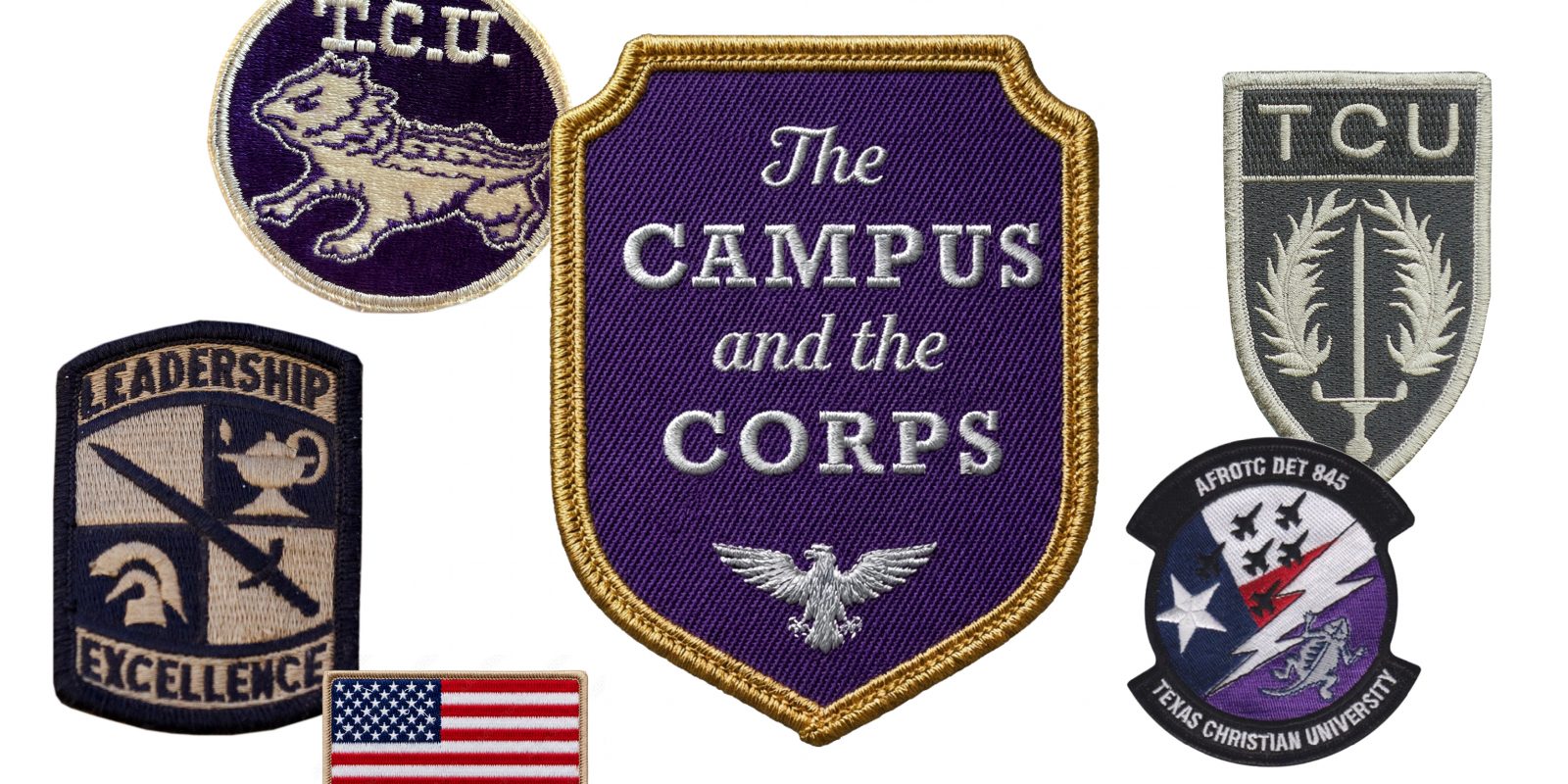
TCU’s Army and Air Force ROTC programs have continued uninterrupted since 1951, training thousands of Horned Frogs for careers of service. Photo illustration by Corrie Demmler with patches courtesy TCU ROTC and AdobeStock | Alex Darts
ROTC at TCU: 75 Years, From M.E. Sadler to Combat Nurses
From President Sadler’s 1940s lobbying effort to an Army nurse deployed to Helmand Province, TCU’s ROTC has educated officers through seven decades of American conflict.
On Oct. 5, 1951, The Skiff published a headline that would influence TCU through today: “Howdy, ROTC!” The student newspaper celebrated the arrival of Army and Air Force Reserve Officer Training Corps programs to campus as anchors for a nation sliding into the Cold War.
Behind that casual greeting lay seven years of determined effort by university president M.E. Sadler, who had written to generals, admirals and U.S. Sen. Lyndon B. Johnson to convince the federal government that Fort Worth, and TCU, belonged in the national defense effort.
The two programs have continued uninterrupted into the 21st century, weathering the demands of eras fraught with conflict, sweeping social and cultural changes and the fluctuations of higher education. Together, the programs have educated and trained thousands of Horned Frogs who have gone on to distinguished careers of service, both inside and outside the U.S. armed forces.
The essays that follow trace how those programs shaped and were shaped by campus life across seven decades; they follow the cadets who wore the uniform and the students, particularly women, who were excluded from wearing it until the early 1970s.
Each essay that follows was written by a TCU undergraduate history major as a capstone project. Their work culminated in an 84-page special publication, Fighting Frogs: A History of Army and Air Force ROTC at TCU, condensed and adapted for TCU Magazine.
Here and across the nation, ROTC, at its heart, is an idealistic project that aspires to uphold the nation’s democratic values and the highest ideals of military professionalism. At ROTC’s creation in 1916, its architects housed the program in civilian universities in a deliberate effort to draw officers from the whole of the citizenry they would defend.
They hoped that universities would take citizens and future officers and make them scholars, steeping them in the values, inquiries and analytical tools of a well-rounded education that would prepare them to think broadly and deeply about the world and their place in it. On the 75th anniversary of TCU’s ROTC programs, we affirm the university’s role in this important work.
— Kara Dixon Vuic, LCpl. Benjamin W. Schmidt Professor of War, Conflict, and Society in 20th-Century America, and Michael Fung, PhD candidate in U.S. History
1917–1945: THE UNIVERSITY AS MILITARY TRAINING GROUND
During both world wars, the sounds of boots on the drill field blended with the usual cadence of university life at TCU. Many male students enrolled in federal defense programs that trained them as scholars and service members.
The men who marched during World War I were part of the Student Army Training Corps, a program that bound continued education to military service. The arrangement was total: Cadets completed more than 40 hours of weekly academic work alongside 13 hours of military drills, following a regimented schedule that dictated everything from early reveille to lights out at 10 p.m. Mandatory textbooks, including War Aims, taught student-soldiers to develop proper morale, demonstrate obedience and understand the responsibilities of military life.
Program leaders dug trenches behind the football bleachers, converted dorms into barracks and assigned officers to classrooms in an effort to prepare for both military and civilian life.
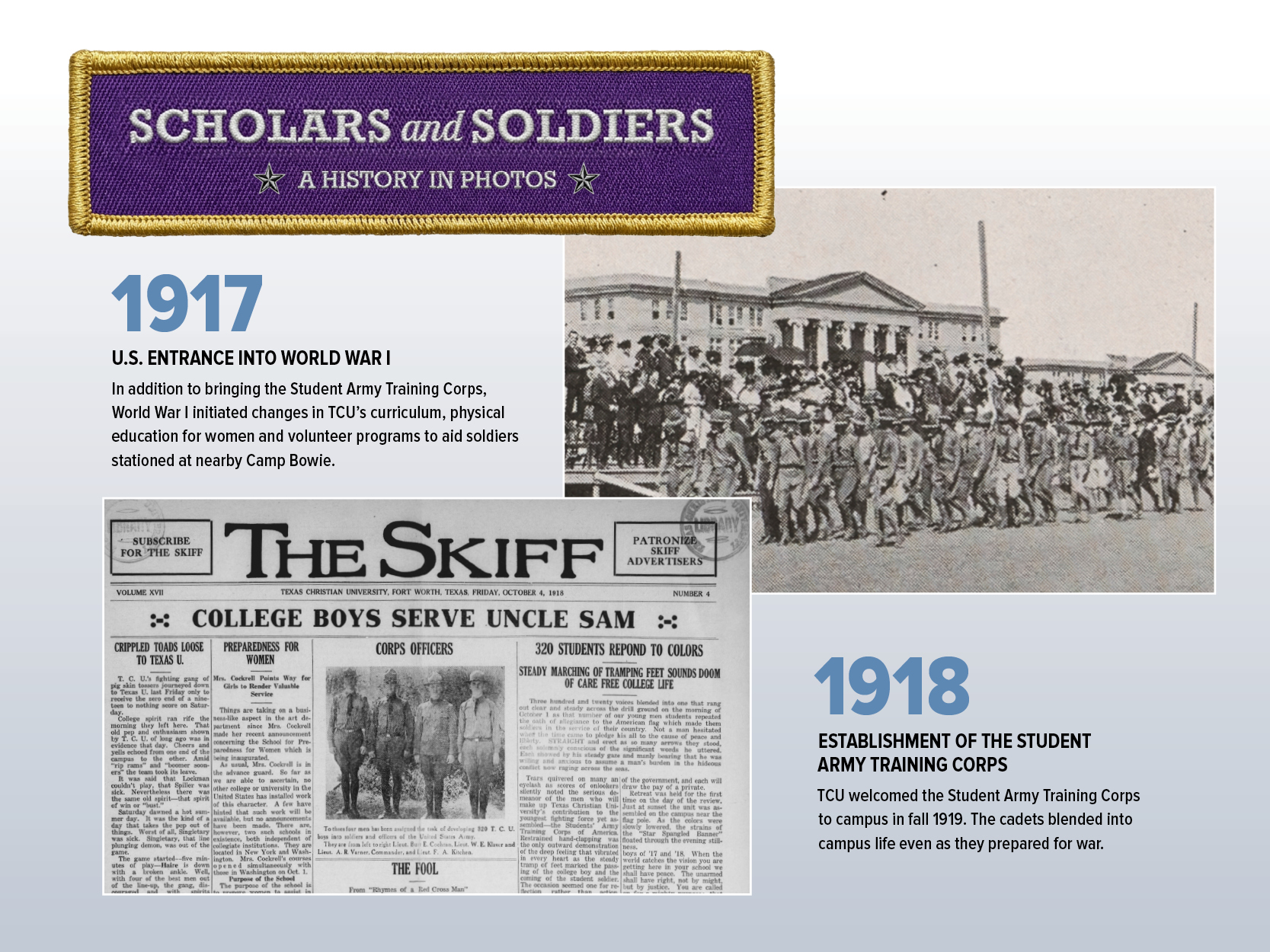
Left: The Skiff, Oct. 4, 1918. Right: 1919 Horned Frog
Women also joined the war effort through physical training and lifesaving courses, though the military barred them from enlisting for active duty. They also learned trades such as metalworking and woodworking, in which wounded soldiers were often employed, preparing to support those men as they returned to civilian life.
Twenty-five years later, in the midst of a second world war, TCU once again hosted a military training program, this time the Navy’s V-12 program. Hundreds of sailors marched in the same areas where other students congregated between classes. Women joined the expanded war effort through Red Cross work and assumed campus leadership roles vacated as male students shipped out.
Together, the Student Army Training Corps and the V-12 program demonstrated that higher education and national defense could be successfully combined. When these programs dissolved, they left behind an institutional memory and a demonstrated willingness that made TCU a natural home for the permanent ROTC programs that would arrive in 1951.
— Olivia Loffland ’26
1944–1951: COLD WAR CLASSROOMS
The Skiff didn’t just report the arrival of Army and Air Force ROTC in 1951 — it celebrated the programs as an anchor for campus life at a moment when the world felt anything but anchored.
As Americans faced the sobering consequences of global combat and the unprecedented threat of nuclear warfare, the looming specter of violence wove its way into every aspect of citizen life. In this new era of a burgeoning Cold War, ROTC programs blended educational missions, moral convictions and the imperatives of national security.
Between 1944 and 1951, TCU President M.E. Sadler penned letters to admirals, generals and civic allies. They included Fort Worth Star-Telegram publisher Amon G. Carter, whom Sadler asked to “speak to some of the influential persons at Washington” on TCU’s behalf, and U.S. Sen. Lyndon B. Johnson, who helped Sadler argue that Fort Worth was “necessary in this defense effort.”
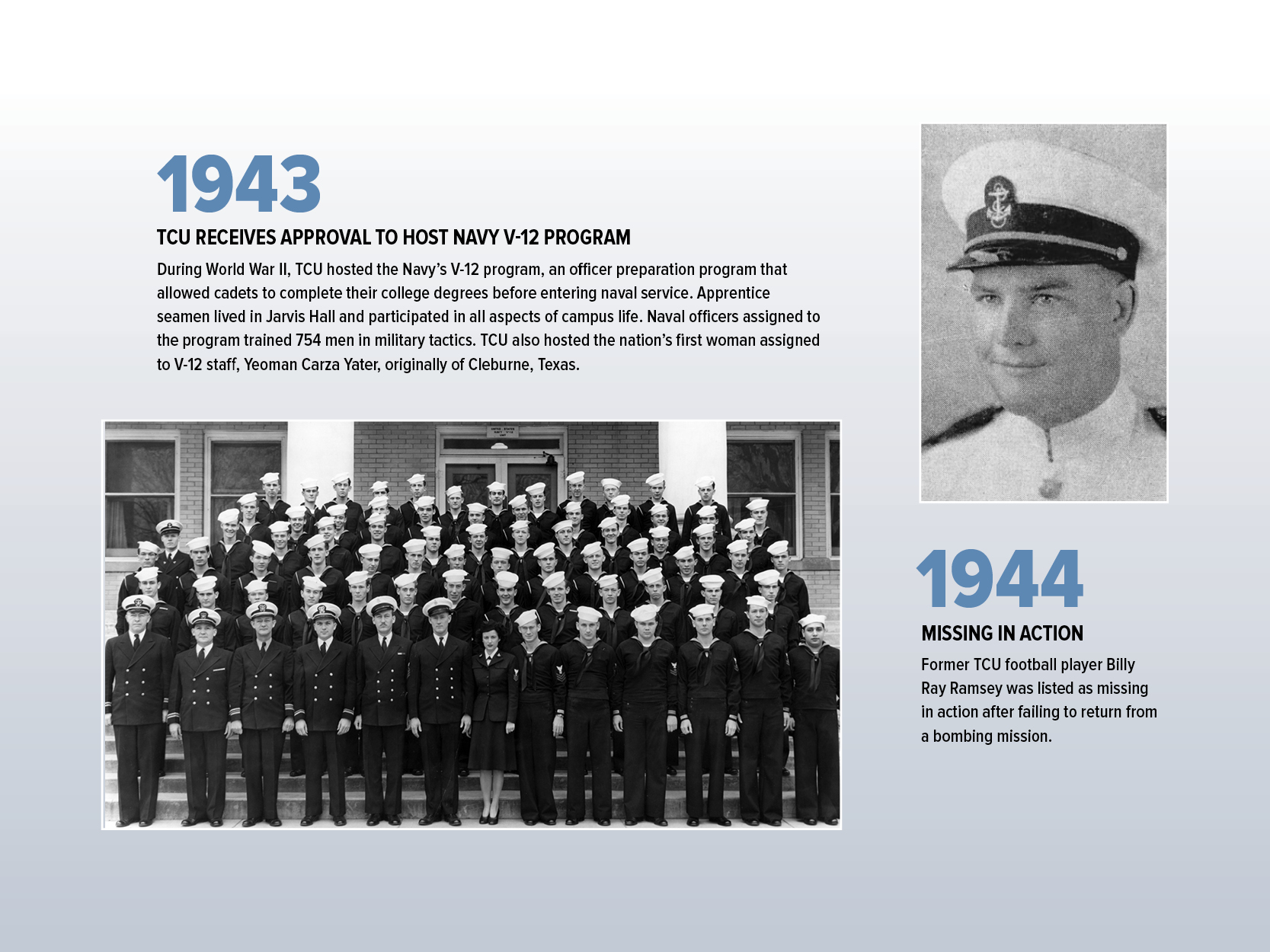
Left: Courtesy of TCU Library Special Collections. Right: Courtesy of Defense POW/MIA Accounting Agency personnel profile
In fall 1951, that effort paid off. By late October, 1 in 10 male TCU students was enrolled in an ROTC program, 177 in the Air Force and 118 in the Army, totaling 295 cadets under the instruction of 14 military staff members. Those numbers reflected more than patriotic enthusiasm: The draft had been reinstated, the Korean War was escalating, and ROTC offered young men a path to an officer’s commission and, crucially, a deferment that kept them on campus to finish their degrees while the conflict played out.
Soon, both programs permeated university life, with cadets participating in parades and ceremonies, attending sporting events, hosting dances and broadcasting a weekly KTCU radio program about world affairs and defense education.
TCU’s ROTC programs demonstrated that patriotism could be cultivated not only on the front lines but also in the classroom. They helped define what it meant to be both a scholar and a service member in midcentury America. For the cadets, ROTC offered something equally concrete: a way to regain control of their own futures at a moment when the Cold War had made the nation’s future deeply uncertain.
— Tatum Keller ’26
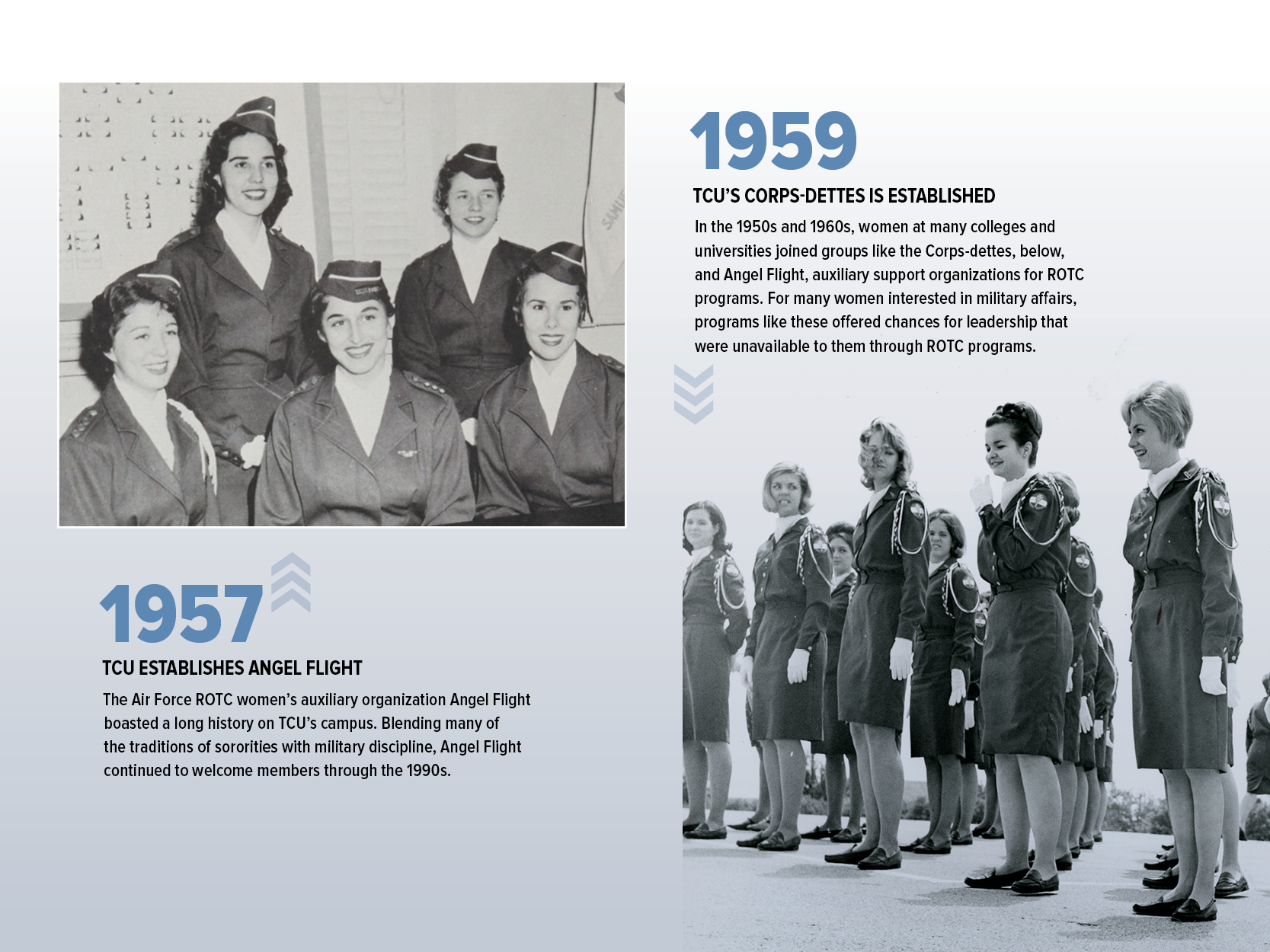
1952–1995: ANGEL FLIGHT
Angel Flight formed in 1952 as a women’s auxiliary to the Arnold Air Society, a national honorary organization for Air Force ROTC cadets that was named for Gen. H.H. “Hap” Arnold. Angel Flight translated the disciplined patriotism of the World War II and early Cold War eras into a campus setting.
Through Angel Flight, women performed a distinctly feminine form of citizenship by organizing service projects and fundraisers and representing the Air Force at civic functions. The organization prepared university women to advance interest in the Air Force, to support the Arnold Air Society’s mission and to engage with military culture, all while remaining outside the formal military training that was closed to them.
Cathy Pate ’72 and Jane Manning ’72 pledged Angel Flight during years marked by profound social change — Vietnam War protests, shifting norms of femininity and debates over women’s expanding public roles. As they preserved traditions of weekly uniform wear and ceremonial particularity, they ensured that women’s appearance and conduct projected the moral virtue associated with Cold War patriotic womanhood.
Two decades later, Shannon Stephens ’96 pledged Angel Flight at TCU and found much of that world intact. The candlelight induction still blended sorority-style sisterhood with military precision. The traditions Pate and Manning had tended were still being passed down.
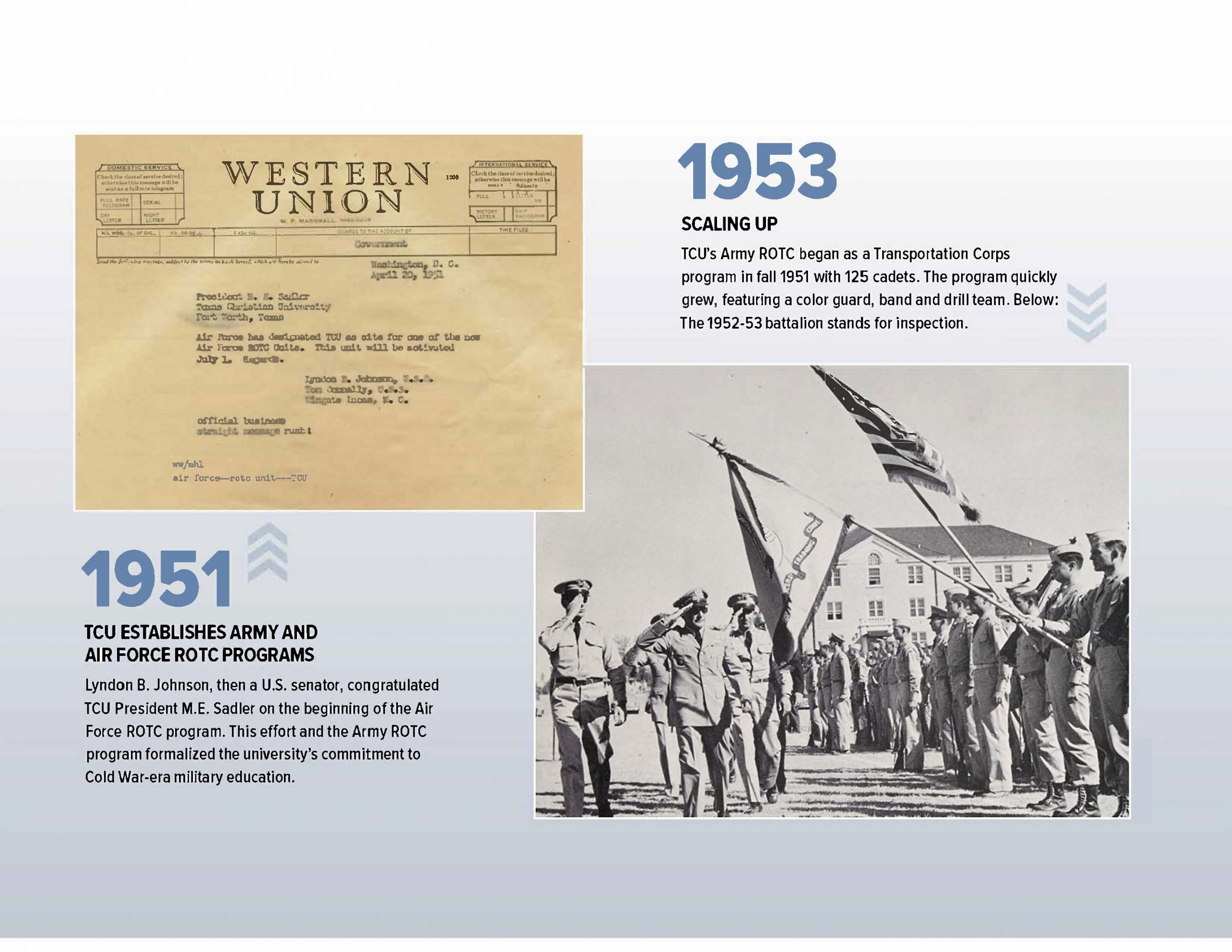
Left: Courtesy of Lyndon Baines Johnson Presidential Library. Right: 1953 Horned Frog
Across the generations of Angel Flight, the experience proved deeply meaningful to its members. Pate, Manning and Stephens each recalled Angel Flight as a source of friendship and purpose, offering opportunities for leadership that might not have been accessible elsewhere on campus. The uniforms and service projects gave them structure, responsibility and a sense of belonging.
Laura Lingle ’94, who served as the TCU chapter’s chief of protocol from 1992 to 1993, captured the spirit: “Everybody in those organizations were good people,” she said. “I think we all were like-minded in that we want to serve our country in some way or be patriotic in some way.”
For all the women, Angel Flight’s emphasis on discipline and service provided a pathway that fostered personal growth, shaped their identities and affirmed the value of women’s contributions within a military framework.
— Jules McCardell ’26
1970–2025: POW-MIA
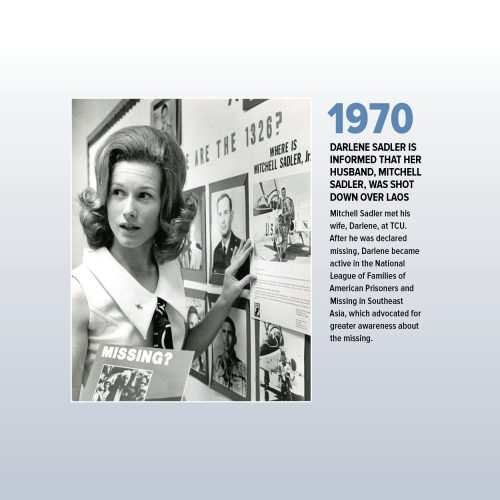
On June 30, 1970, Air Force Capt. Mitchell Olen Sadler Jr. ’65 flew over Laos to refuel his plane while serving in the U.S. war in Vietnam. During that flight, Sadler’s plane was shot down. Because his body could not be recovered, the Air Force declared him missing in action.
Over the next few years, his wife, Darlene ’68, and mother, Helen, raised public awareness of Sadler and other missing men as part of the National League of Families of American Prisoners and Missing in Southeast Asia. “If there is a hell on earth,” Darlene Sadler said, “it is waiting to hear whether your husband is dead or alive.” Through petitions, letters and lobbying, the League hoped to gain information from the Vietnamese government and prompt the U.S. to take further action.
A significant part of Darlene and Helen’s activism also came through spreading a meaningful symbol of remembrance: the POW-MIA bracelet.
Thousands of Americans, including Stephanie Barr, a high school student in New Jersey, ordered and wore POW-MIA bracelets engraved with a service member’s name and the date he went missing or was captured as a prisoner of war. The name and date on her bracelet: “CAPT. MITCHELL SADLER JR. 6-30-70.”
With this bracelet on her wrist, Barr felt a tangible connection to the war and the pilot’s sacrifice. “I wore Mitchell Sadler’s MIA bracelet with pride,” she said, explaining that she was “wearing the name of a hero who never left my thoughts.”
Barr said she felt patriotic and proud of her nation’s efforts to ensure each service member’s safe return home. In 2025, she rediscovered the bracelet and promptly searched for Sadler’s story, only to find that his remains have never been recovered. Barr donated Sadler’s bracelet to TCU so the campus can continue to remember his legacy.
These deliberate contributions to public awareness — and the passage of Sadler’s POW-MIA bracelet across more than half a century — illustrate how personal losses from war resonate far beyond a service member’s immediate families and friends. Through a simple strip of metal, Sadler’s legacy of bravery and sacrifice has been passed down and his memory kept alive.
— Josefine Mar ’26
1966–2011: INTEGRATION
“We were literally rappelling off the side of the TCU football stadium,” Col. Jayme Sutton ’87 said, laughing at the memory. She was going over the wall, stepping backward into open air with a rope in her hands, less than a decade after women were allowed to join ROTC, during a period when female cadets were still fighting for legitimacy in military training environments.
Her presence on that stadium wall was the product of decades of policy change and individual persistence.
By the time Sutton was commissioned as a distinguished military graduate, women and people of color had been full ROTC participants for more than a decade. TCU formally desegregated in January 1964; Anthony Cregler ’69 became the first Black student to participate in TCU’s Army ROTC program in May 1966. Women entered Army ROTC programs nationally in 1972, and six women enrolled at TCU the following fall.
Left: 1959 Horned Frog. Right: Courtesy of TCU Library Special Collections
Sutton traced many of her early lessons in confidence and leadership to moments like these. Those drills marked the beginning of a career that would take her through airborne training, multiple deployments and senior command roles. It began at TCU, where she first learned what it meant to lead and discovered a sense of belonging within the program.
Sutton’s path, and those of the cadets who followed, were shaped not only by policy changes — desegregation, opening ROTC to women and the end of “Don’t Ask, Don’t Tell” in 2011 — but also by the daily realities of campus life in Fort Worth.
— Jennifer Spector-Townsend ’25
1968–2010s: NURSES IN UNIFORM
In the early 2010s, one of the biggest and busiest trauma centers in the world was not in a gleaming hospital complex. It was a built-in-a-day facility in Helmand Province, Afghanistan, known as Camp Bastion, and Army Capt. Elizabeth Clapp ’08, a TCU nursing graduate commissioned through Army ROTC, was one of the nurses working there.
“The hospital was — I won’t even say brick and mortar,” Clapp said. The context was entirely unlike any civilian ward: She was in uniform, surrounded by combat units, and at one point was required to work with a firearm strapped to her leg because some local interpreters had turned against U.S. forces.
“We did some training with the Afghan medical personnel,” she said. “They would bring in one of their soldiers that had been blown up, and there would be times where we could sew the limbs back on and save them.”
Clapp’s experience was a long way from TCU but not so far from the experience of an earlier generation of TCU nurse-officers. Fort Worth native Jane Westpheling Hudak ’70 was commissioned through the Army Student Nurse Program and at the 95th Evacuation Hospital in Da Nang during the Vietnam War. Her chief nurse insisted on a standard that cut against the chaos around her: Every patient expected to die was to be placed on a bed, bathed and put in fresh clothes, with a nurse and chaplain beside him. “A soldier when he’s about to die,” Hudak said, “says, ‘Oh God, I want my mama.’ She wanted a female voice to be like a surrogate mother to be with him.”
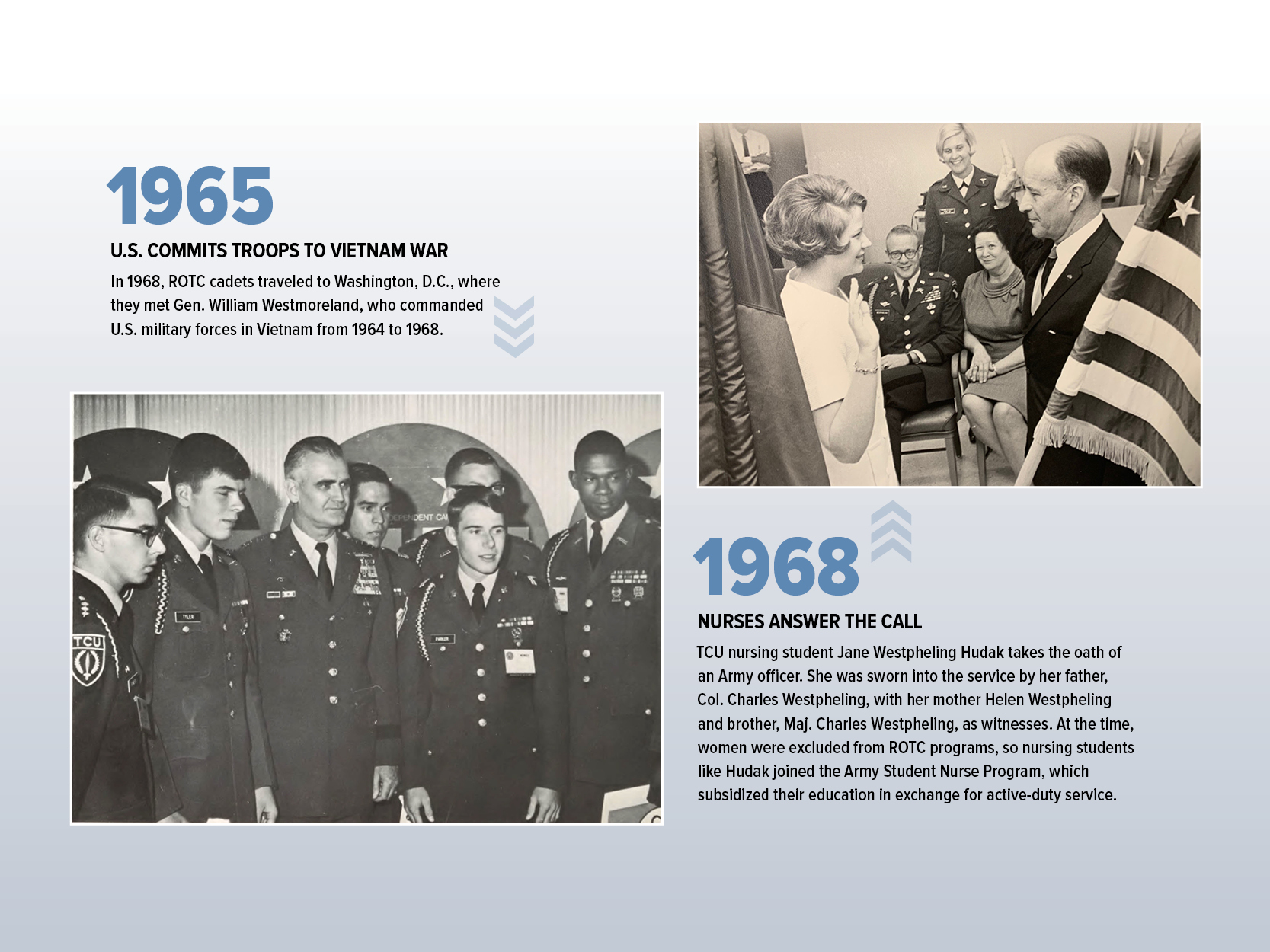
Left: 1969 Horned Frog. Right: Courtesy of Jane Westpheling Hudak
Rosie Bennett ’02, another TCU nursing graduate commissioned through Army ROTC, deployed with the 82nd Airborne in 2008 to Iraq, where she was one of only four women on a base that came under mortar fire. “You’d be fearing for your life while trying to save somebody else’s,” she said.
Clapp completed four years in both the ROTC and nursing programs before her deployment. Her experiences, and those of Hudak and Bennett, call attention to a larger and often overlooked truth about 21st-century American warfare: TCU was producing not just nurses and not just officers, but people who would have to make clinical and ethical decisions on battlefields that most Americans would never face. As Clapp put it: “Becoming a nurse is hard and becoming a soldier is hard. Doing them both at the same time is very hard.”
— Paige Detzler ’25
1969–1974: PROTEST ERA
Courtesy of TCU Library Special Collections
On the morning of Oct. 15, 1969, while TCU students hurried to their classes and prepared for a football game against Texas A&M, a few students gathered outside the student center to read the names of the 40,000 Americans who had died in the Vietnam War.
Later that day, as most students caught up with friends and discussed weekend parties and dates, others attended a panel of five professors who spoke about the war in Vietnam and its impact on the subjects they taught.
These events were part of the Moratorium to End the War in Vietnam, held on college campuses nationwide. At many other universities, these events erupted into violence. TCU’s campus protests largely went unnoticed; most students, according to both campus protesters and ROTC members, were absorbed in Greek life and football, not thinking much about the war. “My general impression,” ROTC cadet Rudy Purificato ’74 said, “was that they were oblivious to the fact that the war was going on.”
Meanwhile, other students, some of whom also questioned the war, prepared for it as part of TCU’s ROTC programs. Protests had a significant impact on Purificato’s view of his service. He said he felt alienated, as though he had to deal with the harsh realities of military service without much sympathy.
Across the country, cadets and protesters clashed as both fought to end the war, one through combat, the other through activism. While many college campuses were hotbeds of tension during the war, at TCU the groups mostly coexisted. Former student activist Ted Coonfield ’70 (MFA ’72), who lived alongside ROTC members in the same dorm, described their interactions as “tolerant and cordial”: different opinions aired, no minds changed, no one attacked.
— Eugene Ditaranto ’26
1990–2003: WAR ON TERROR
As the Cold War came to a close in the early 1990s, the U.S. armed forces downsized dramatically. The Army cut 50 ROTC programs around the country, slashed four-year scholarships by more than half and diverted funding to less expensive public universities. The Army even hand-selected a new Cadet Command chief specifically because he had little attachment to existing programs and could execute the cuts without sentiment.
As a result, TCU cadets had fewer opportunities and inferior scholarships. Still, ROTC carried on, producing classes of cadets who trained on the intramural fields and practiced at the rifle range. TCU Trustee Brian Cox ’96 was a battalion commander from 1995 to 1996. He finished at the top of his commissioning class and still got assigned to a quartermaster job he didn’t want because the Army simply didn’t need many new officers. Cox said he felt as though the Army was saying it didn’t really need him anymore.
When jetliners struck the World Trade Center in New York City in 2001, Andrea Pratt ’03 was driving to TCU. “When I got to campus,” she said, “all of the TVs in the Student Center were turned on to the same news channel, and people were standing still and frozen like zombies all watching the screens instead of eating.”
For TCU ROTC cadets like Pratt, the attack cemented a new reality. They had joined ROTC in a time of peace and downsizing, but they would enter the armed forces during a time of war. Facing an immediate need to commission more officers, the military again invested in ROTC programs. Scholarships improved, stipends increased and enrollments swelled. “We started to hear about the battalion members who’d graduated before us being deployed right away,” Pratt said. “We knew there was a good chance we might deploy.”
— Bradley Johnson ’26
Your comments are welcome
Comments
Related reading:
Campus News: Alma Matters
A Salute to Service
At TCU, support for student veterans runs deep, from application to graduation.
Campus News: Alma Matters
TCU Cadet Fayette Jiang Trains for an Air Force Commission While Studying Nursing
As a high school student, she watched the Armed Forces Bowl from the stands at Amon G. Carter Stadium. Now that campus is hers.
Features
Waiting and Hoping: How Families of Missing Service Members Cope With Uncertainty and Grief
Of the 113 TCU graduates and former students lost to war, 22 are still missing, including Billy Ray Ramsey, who went missing over Papua New Guinea in 1944, and Mitchell Sadler, who went missing over Laos in 1970.