
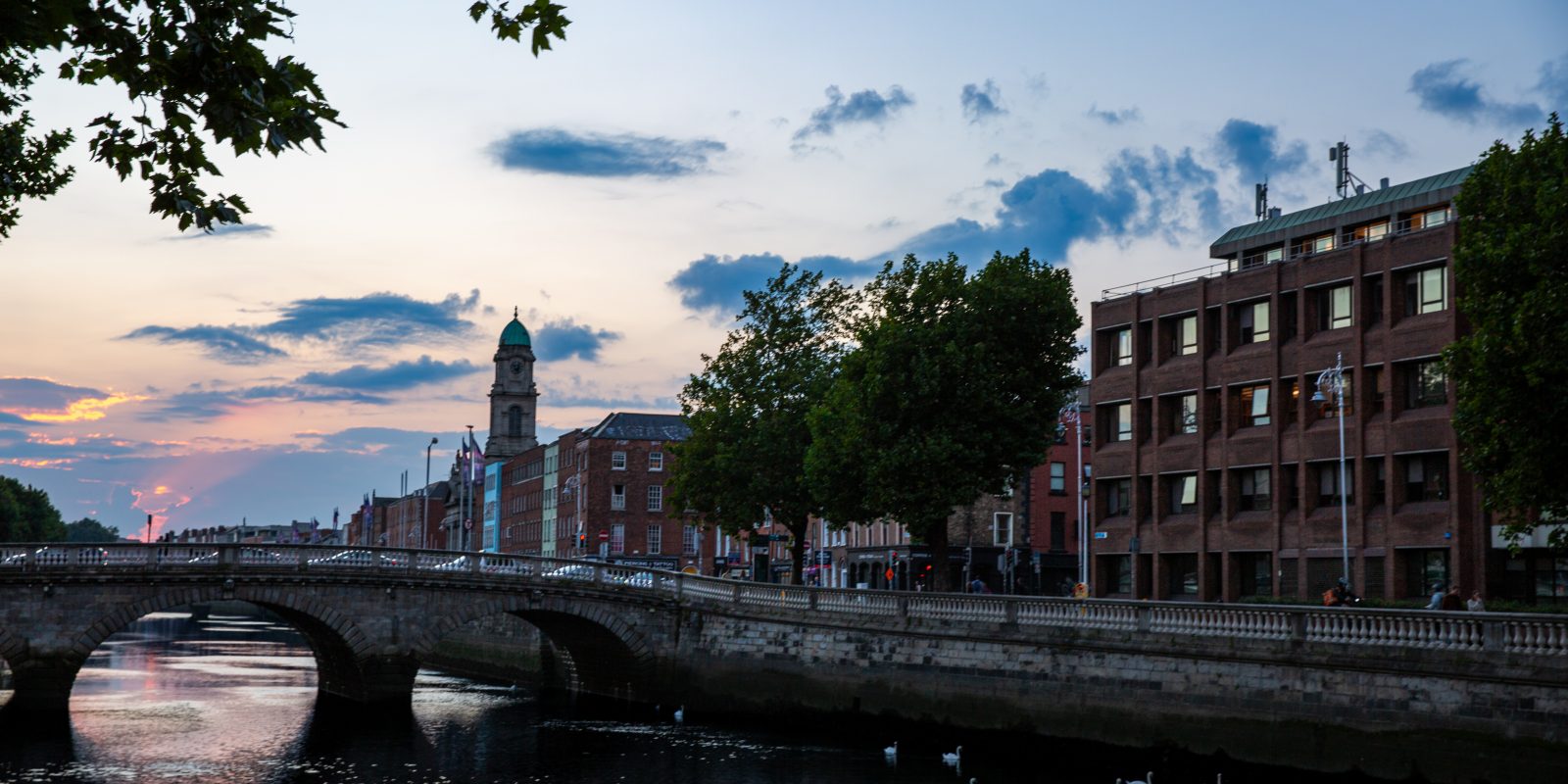
In late August, the Irish capital doubled as a Horned Frog home base. Photo by Caroline Collier
TCU in Dublin: What the Aer Lingus Classic Revealed
Inside a week of receptions, business case competitions and one very old book — and what 10,000 traveling Horned Frogs made of Ireland.
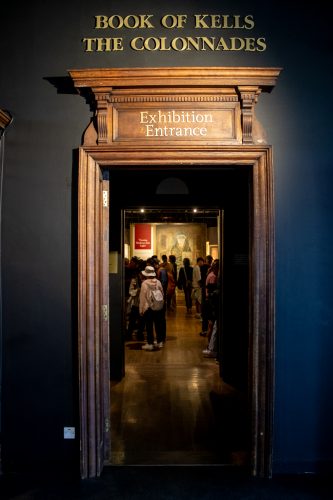
Visitors enter the Book of Kells exhibition at Trinity College Dublin. Photo by Corey Zapata-Smith
At Trinity College in Dublin, the Book of Kells sat under glass, open to the sixth chapter of John.
No one chose that particular passage for the TCU event that August evening. Keepers of the 680-page manuscript of lavishly decorated Gospels flip the 1,200-year-old pages only three or four times a year, on a schedule set long before a contingent of Horned Frogs arrived for a football game.
That segment of the Gospel of John details a scene in which a crowd asks what it should do, and the answer involves bread, feeding a crowd and abundance.
Upstairs in Trinity’s Old Library was a collection of gilded volumes of Gulliver’s Travels. Author Jonathan Swift arrived at Trinity in 1682 and later spent more than 30 years as dean of St. Patrick’s Cathedral, a mile southwest. His seminal novel is about what new places reveal about home.
A football game had brought TCU fans in droves to the Emerald Isle. By the time people were arriving, Dublin was already deepening the experience.
Ireland had gone weeks without rain, Dublin’s Lord Mayor Daryl Barron told an audience at City Hall; U.S. Ambassador Edward Walsh put the dry stretch at 50 days. Both lines got a laugh because the sky had opened that afternoon, two days before the big TCU-North Carolina game that would kick off the 2026 college football season. The skies washed away thoughts of triple digits back in Texas. Outside City Hall, the raincoat-clad Pride of TCU shared its version of “Deep in the Heart of Texas,” a trade in a round of songs with the Tar Heel band.
By then, Dublin had gone purple and light blue. Banners bearing both schools’ logos ran the length of the streets around the rollicking Temple Bar area. SuperFrog materialized on Parliament Street. At Fitzsimons, the multistory pub that transformed into Horned Frog headquarters for the week, fans in purple climbed floor to floor and fit right in with the city’s craic, an Irish term for good times.
Larissa Clemente, who works at Fitzsimons, liked her Horned Frog customers, most of whom were enjoying Guinness. “They’re pretty nice people, actually,” she said. “Super nice.”
The packed rooms were welcome, she said. Temple Bar erupts in flowers on weeks when the tourists descend for special occasions.
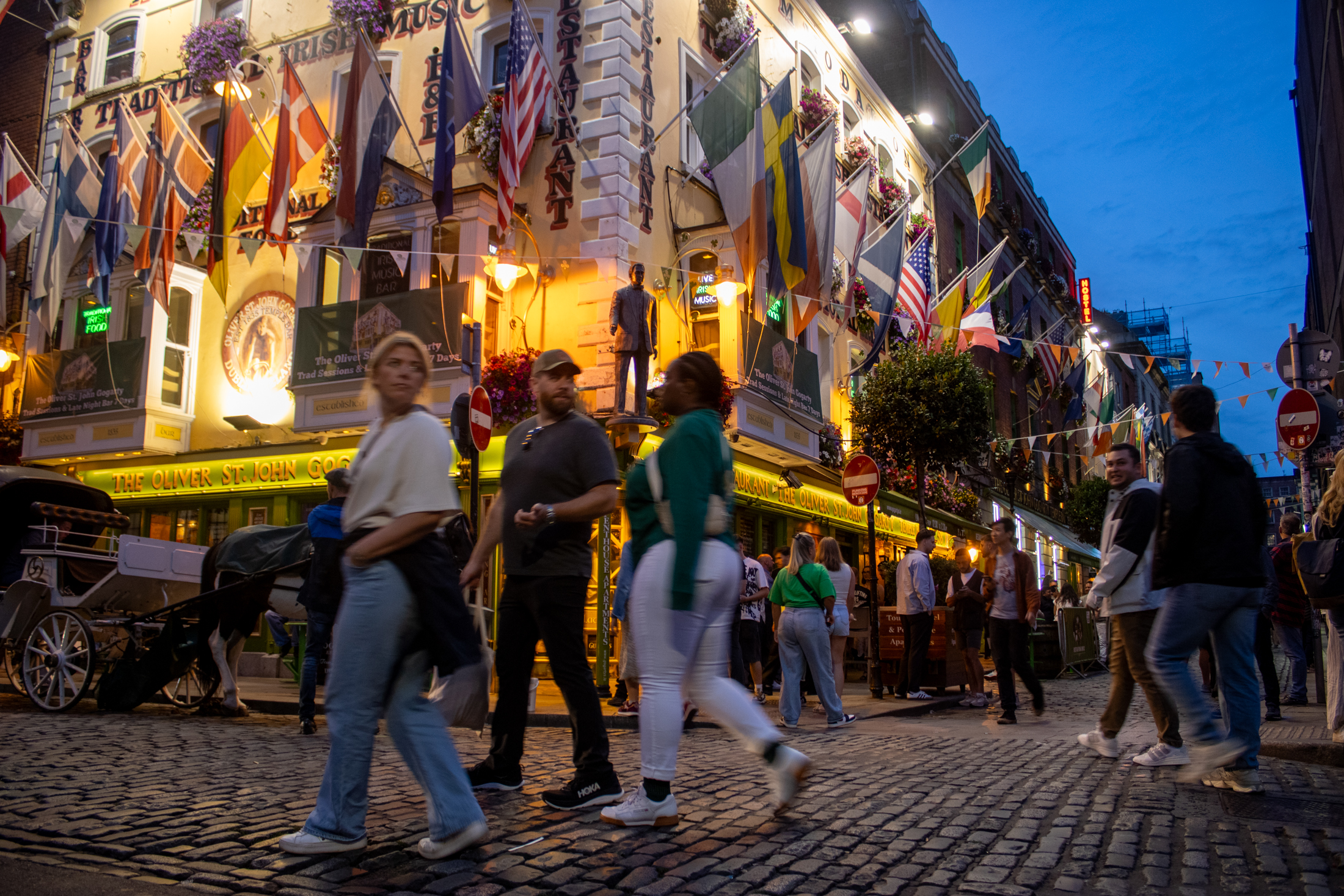
Night falls on Dublin’s Temple Bar area. Photo by Corey Zapata-Smith
Why They Came
Ten thousand people sounds like a crowd. Up close, it was a collection of individual decisions to follow the Frogs across an ocean.
Claire Coutras ’23 booked her flight five days before the game. Her friends were too busy to join her, but the Fort Worth resident went anyway. “I would rather go alone than not go at all,” she said. “It was a point I reached.”
Marah Nelson moved to Fort Worth for work in 2009, went looking for a football game and fell for TCU. She has season tickets in Amon G. Carter Stadium’s north end zone. When the Dublin announcement arrived in April 2025, she started planning that day. She came alone and landed the day before the game with a suitcase packed full of purple gear.

Horned Frogs traveled to Dublin from Texas and as far away as Alaska. Photo by Caroline Collier
Terry O’Grady grew up in Fort Worth and has been a TCU fan her whole life. She came with her friend Terrie Farris of Decatur, Texas, whose two children graduated from TCU. They spent three days in Scotland first, then made a beeline for Fitzsimons as soon as they reached Dublin because this was “a once-in-a-lifetime opportunity” to be in community, Farris said.
For Dana McAlpine, the reason was more sacred. She traveled from Alaska with her husband. Their son Sean enrolled at TCU in 2002 and would have graduated in 2006 but died in a car accident. The McAlpines have kept their TCU season tickets because Sean loved the Horned Frogs. They had visited Ireland the year before, but when they heard TCU was coming, they came back, “just to see TCU.”
When Worlds Meet
University leaders had their own reasons for making the trip. Football may have supplied the stage, but they seized on the opportunity to forge connections and show off to the world all that TCU is becoming.
Deans from the Neeley School of Business, the Anne Burnett Marion School of Medicine and the College of Education spent the week meeting their Irish counterparts. At a Dublin investment conference, a few days before the Aug. 29 game, Jason Safran ’01, TCU’s chief investment officer, described how the U.S. economy is shifting toward Texas. He explained to international audiences how Texas is the second-largest state economy at $2.9 trillion and has attracted more than 100 corporate relocations since the pandemic.
Ireland is on the rise as well. Research and development projects accounted for a quarter of all foreign direct investment in 2025, more than double the 12% share three years earlier — signs that the country is reversing longtime emigration trends by offering compelling employment opportunities for its young people. Safran called Ireland a gateway economy and Texas a gravity economy: one a platform through which the world reaches Europe, the other a place where companies and capital collect. Ireland never had to replace London to matter, he said, just as Texas does not have to replace New York.
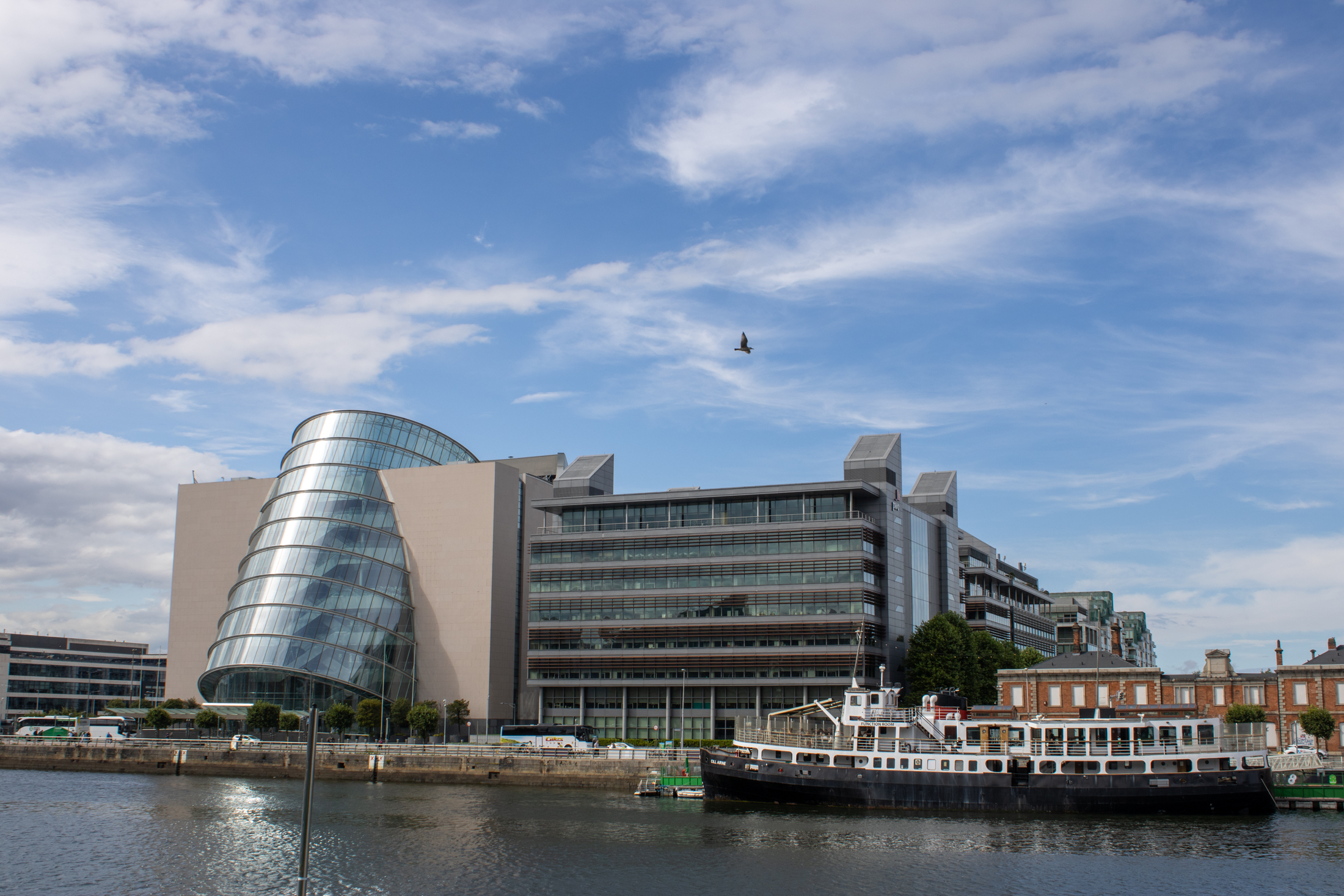
Jason Safran called Ireland a gateway economy, a platform through which the world reaches Europe. Photo by Corey Zapata-Smith
On Friday morning four Neeley students presented at Google’s Dublin headquarters on mixed teams with students from North Carolina, the University of Limerick and Munster Technological University. Each team assembled one student from each of the four universities to make a case for how Ireland might turn big international events, including the 2027 Ryder Cup and UEFA Euro 2028, into successes.
The winning team included TCU junior Mark Centeno.
Centeno, whose team proposed a multipronged case to make Europe’s premier soccer tournament a sustainable fan experience, said he and his North Carolina teammate arrived thinking like business students, while their Irish teammates pushed the group to consider culture and social impact. Before Dublin, he hadn’t really considered government or nonprofit work. He said the case competition showed him another use for his finance and sociology majors: public service. “I’m really looking forward to more opportunities to serve others.”
More Than Four Quarters
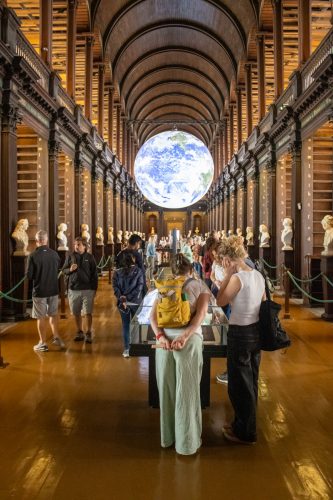
Jonathan Swift, who arrived at Trinity College in 1682, wrote Gulliver’s Travels, a novel about what new places reveal about home. Photo by Corey Zapata-Smith
Kickoff arrived Saturday afternoon under a fine mist at Aviva Stadium. The TCU football team emerged on an Irish field alongside the band, cheerleaders, showgirls and Rangers. Amon G. Carter Stadium seemed to have been set down on the wrong continent. Fort Worth Mayor Mattie Parker and Lord Mayor Barron exchanged gifts on the field. Fans drank Guinness from reusable cups. At its peak, 5.8 million people watched on ESPN.
TCU lost 15–10. The end came on fourth down deep in North Carolina territory, close enough to make the flight home feel a little longer.
By Sunday morning, Dublin Airport was full of purple. Some of it was headed home to Texas. Much of it was going somewhere else first: Galway, Cork, Kerry and across the Celtic Sea to London, Paris and Lisbon.
The 10,000 Frogs had not traveled to Dublin for four quarters. They scattered across a country and a continent, wearing the name of a school in Fort Worth, chasing history and community and the stories that fold over one another to compose a life. Swift sent his traveler into strange nations and brought him home unable to see his own country the same way. That is roughly the promise a university makes when it sends anyone abroad.
Jaclyn Gordon ’04 now lives in Belfast, Northern Ireland, where her husband, Paul Gordon ’06, is working on a doctorate in psychology. She came down for the weekend in a TCU hat with a shamrock and found herself in a room full of people dressed like her.
“It’s just so surreal,” she said. “Fort Worth came to us.”
Your comments are welcome
Comments
Related reading:
Features
Africa’s Allure
A safari takes Traveling Frogs on a journey that goes beyond river cruises and wildlife encounters.
Horned Frogs Abroad: Kierstyn Wright
A TCU student finds Buenos Aires is an underrated study abroad spot.
Alumni, Recollections
Frogs Recall Meeting Other Frogs All Over the World
Have you met a fellow Horned Frog somewhere unexpected?