
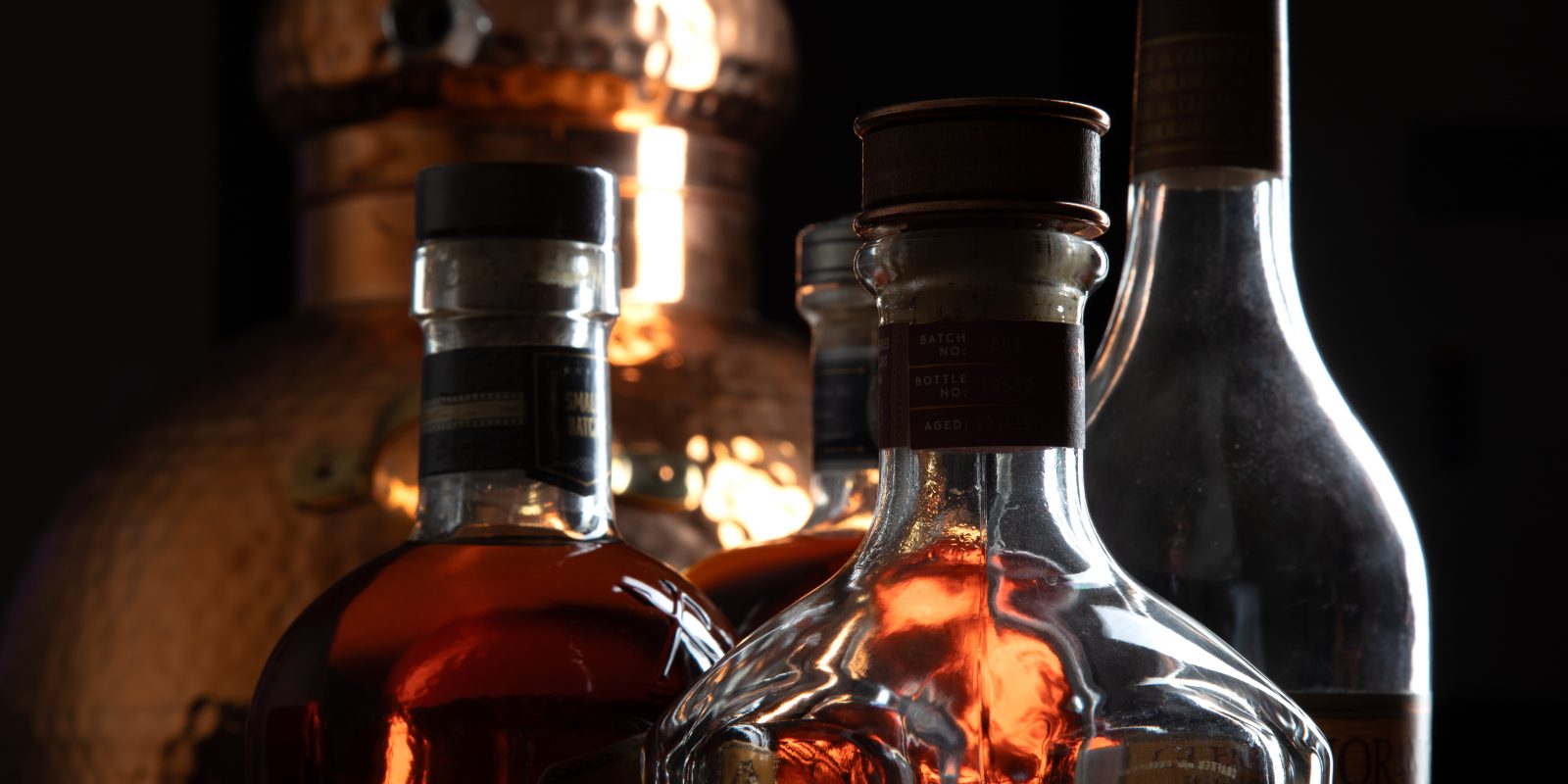
The science behind whiskey starts with photosynthesis and runs through fermentation before it ever reaches a bottle.
A TCU Chemist’s Case for Teaching Science Through Whiskey
Shots of Knowledge, co-authored by TCU chemistry professor Eric Simanek and distiller Rob Arnold, uses whiskey to make science relatable to anyone curious enough to ask why.
Since grade school, Eric Simanek had imagined becoming a science teacher. The deeper he got into the scientific material — chemistry, biology, “what have you” — the more he wanted to share it. A research career at Harvard did nothing to change that passion. What he lacked when he arrived at TCU in 2010 as the Robert A. Welch Chair of Chemistry was a subject worth teaching to students who hadn’t signed up to be scientists.
He found it in a hallway, talking to Rob Arnold, a Fort Worth-based distiller who was hunting wild yeast.
That encounter, and the decade that followed, produced Arnold and Simanek’s Shots of Knowledge: The Science of Whiskey, published by TCU Press in 2016, and Whiskey: Science and History, a course that drew students from across campus.
But the whiskey, Simanek said, was almost beside the point. The real story is about a chemist who believes making science accessible is not just good teaching, it is essential citizenship. “I think it’s the responsibility of any professional in any field to make knowledge available.”
Whiskey was the door that happened to be open.
THE RIGHT SUBJECT
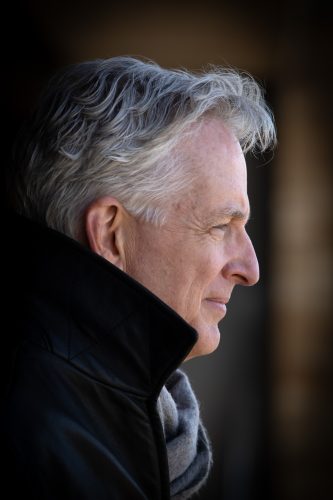
Eric Simanek’s book “Shots of Knowledge” turns the whiskey distilling process into chemistry lessons that are palatable to non-scientists.
Simanek was building a science course for non-majors with a specific set of requirements: a subject within his expertise, broad enough to draw students from any corner of campus and compelling enough that someone with no obligation to care about chemistry might actually want to engage with it. “All one needed,” he said, “was a topic.”
At the time, Arnold was the master distiller at Firestone & Robertson Distilling Co., makers of TX Whiskey. He was working on a yeast isolation project in a TCU biology lab. The two met just outside Simanek’s office — the same office he still occupies — and within 10 minutes had decided to write a book together.
What Simanek saw was a distiller doing something no one had attempted since the years just after Prohibition in the United States: hunting a wild yeast strain to use in an original distillation project, applying genetic techniques to confirm what he found.
Arnold joked that when Troy Robertson and Leonard Firestone asked in his job interview whether he could isolate a wild yeast strain to produce whiskey, he had no idea if he could. But he said he could anyway because he wanted the job.
“I figured it was not that different than isolating marine bacteria from ocean sediment, which is what I was doing in grad school,” said Arnold, now CEO of Advanced Spirits and co-founder of Unreined Whiskey. “It’s a lot of the same techniques.”
TCU provided the bridge. Through a chain of introductions, Arnold secured lab space with Dean Williams, a TCU professor of biology. Together, they worked through the methodology needed to confirm whether yeasts isolated from the collected samples were Saccharomyces cerevisiae, the species predominantly used to make whiskey, and whether any candidates could deliver the spicy, fruity and floral notes suitable for Firestone & Robertson’s whiskey.
Arnold spent weeks gathering specimens from across North Texas — grasses, fruits, bark and other indigenous vegetation — and positioning beakers of nutrient solution across the Dallas-Fort Worth area to capture airborne yeasts. Among his stops was Rancho Hielo Brazos in Glen Rose, where ranch manager Rhett Johnson spent most of a day showing him around.
Genetically characterizing the strain to determine how unique it was compared with other known strains formed the basis of undergraduate Lizzy Do’s honors thesis. Do ’15, now an intellectual property attorney in California, said working in Williams’ lab was “one of the highlights of my college years.”
The ultimate test was sensory analysis. Over several days, Arnold, Firestone and Robertson each evaluated the five strains by flavor and nose. In every round, all three chose the same one: a yeast taken from a pecan at the Glen Rose ranch. Firestone and Robertson still use that strain today in TX Bourbon Whiskey, which the distillery describes as carrying flavor notes of vanilla bean, honey butter and caramel.
“I think it’s the responsibility of any professional in any field to make knowledge available.”
Eric Simanek
For Simanek, the yeast hunt was not just Arnold’s story. It was a story he could teach: science as it actually happens, unpredictable, dependent on institutional support and culminating in a result that could be tasted. That kind of narrative, he said, was exactly what non-scientists needed to understand what the science was.
The book he and Arnold wrote put that principle into practice.
PANCAKES, POWER PLANTS AND PEDAGOGY
Shots of Knowledge describes chloroplasts as “a pouch of pancakes in syrup,” a way into the photosynthesis that converts sunlight, carbon dioxide and water into the organic molecules that eventually become grain starch. Yeasts become “coal-fired electric power plants,” burning sugar for energy. A teacher moving children through a museum by linking them hand in hand shows how nature bonds glucose into starch — and how mashing later breaks those chains back into the simple sugars that the yeast can ferment.
The book’s approach was directly informed by Simanek’s training. His PhD adviser at Harvard, George Whitesides, has written books communicating scientific ideas to the general public. “The format for these books was a compelling visual image, which people would look at,” Simanek said, “and as few words as possible, which people may or may not read.”
Following that model, Simanek and Arnold complemented each essay with a very short “shot of knowledge” included as a margin note.
The theoretical case for the approach was equally deliberate. “Much of what any professional does exists in the abstract, in fragments of knowledge that can’t be communicated in context efficiently without cutting a lot of corners,” Simanek said. “The advantages to metaphors are, one, that they facilitate communication, and two, lead to really fundamental questions that the non-scientist can pose, which can completely shatter paradigms and serve as inspiration for future inquiry.”
Arnold brought the distilling knowledge; Simanek provided the pedagogical framework. And the collaboration ran both directions.
“I learned that from Eric,” Arnold said of the teaching approach. Understanding the science behind flavor profiles, he added, elevates the drinking experience: “You have a real connection to the people that were involved going all the way back to the farm.”
THE CLASS AND THE LESSON
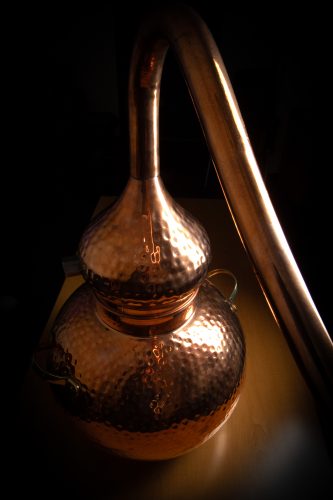
Inside a copper pot still, alcohol-rich vapor rises, cools in a condenser and emerges as the raw spirit that, after aging, becomes whiskey.
Arnold and Simanek ended up touring the country to share the science of whiskey, appearing at distilleries, museums, bars and universities. At the Culinary Institute of America in Napa, California, they spoke to an audience bonded by a shared passion for food and drink. The most memorable stop, Simanek said, brought them to a historic theater in Louisville, Kentucky, “the breadbasket of whiskey,” where their book was nominated for an award by the International Association of Culinary Professionals.
Arnold went on to write The Terroir of Whiskey, published by Columbia University Press in 2020 and translated into Japanese in 2024.
Simanek’s course, which is not currently being offered, evolved over its run. What began as more than 60 students boarding buses to visit local distilleries became an intimate seminar of 11 students gathered around a single table.
“It started off being a very science-heavy course and rapidly morphed based on input from students into something that was a little bit more balanced between science and history,” Simanek said. The smaller format allowed for field trips beyond distilleries: a sommelier at a local seafood restaurant, annual end-of-semester visits to a craft ice cream store. Some students went into the whiskey industry. Years later, former students still reach out when they’re in town.
What Simanek built was not a course about whiskey. It was a course about what science is, why it matters and how to think with it — taught through a subject that gave students a sensory, historical and human reason to pay attention. That, too, was Simanek’s grade school ambition finally realized.
In the book’s final pages, Arnold and Simanek address what they could not in good conscience ignore: that whiskey enhances pleasure rather than inducing it and that the substance at the center of their collaboration does real damage in the world.
“I do sometimes struggle with the fact that I’m so involved intellectually and professionally in something that does cause a lot of harm to people and society,” Arnold said. “When it is handled responsibly, it can be a wonderful thing. … There’s no way to rationalize it one way or the other. There’s good and bad that come from it.”
Simanek, who gave up drinking two years ago, describes the course with only slight exaggeration as “a semester-long public service announcement for the evils of drink.”
“Addiction is a disease,” Simanek said, “and everyone, almost everyone, I suspect, is crippled by an addiction of some kind or other.”
It is a blunt statement from a man who spent a decade teaching people to love what he has since set aside. But it fits the larger argument. Science literacy, for Simanek, is not cheerleading for any particular product or field. It is about being able to look clearly at what things are and what they do — the beautiful and the harmful at once.
Your comments are welcome
Comments
Related reading:
Campus News: Alma Matters, Research + Discovery
Faculty from Other Disciplines Use Liberal Arts
How do you merge the liberal arts with your curriculum?
Latest News, Web Extras
Horned Frog Foodies: Andrew de la Torre
The TCU alumnus’ La Pulga Spirits brings authentic Mexican tequila, mezcal and sotol to the U.S.
Features
Students Get Hands-On Experience With Projects Thanks to TCU Science & Engineering Research Center Grants
Horned Frogs develop Alzheimer’s treatments, study food insecurity and create AI health tools through TCU research grants.