

Elephants touch trunks at twilight on a river island in the Chobe River in Botswana, where the surrounding national park is home to as many as 50,000 of the animals.
Africa’s Allure
A safari takes Traveling Frogs on a journey that goes beyond river cruises and wildlife encounters.
The lioness appeared just before dawn, a ripple of muscle and shadow slinking down the dry dirt track, close enough to touch. No glass, no fence, no warning. Just us and the wild.
In a calm, hushed voice, our Botswanan driver told us not to be afraid.
Someone behind me in the open-air jeep gasped, a faint disruption in the quiet winter chill.
The big cat padded toward the Chobe River and paused. It turned its amber eyes toward us — 16 U.S. travelers frozen in awe.
We had come to southern Africa for moments like this. But none of us expected how much more we’d find.
THE JOURNEY BEGINS
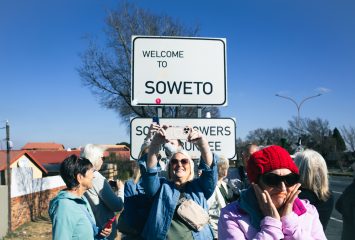
The Traveling Frogs stopped at the entrance to the Soweto neighborhood in Johannesburg, South Africa.
Two weeks earlier, most of us were strangers — alumni and friends of TCU assembled by the university’s Traveling Frogs program. Our July trip, Africa’s Wildlife, which also included six adventurers affiliated with Arizona State University, had been expertly mapped by the travel company Odysseys Unlimited.
Over 14 days, we would crisscross southern Africa: from Johannesburg’s streets of resistance to the roaring curtain of Victoria Falls, across Botswana’s elephant-dense Chobe River region and into the leopard dens of Zambia’s South Luangwa National Park.
A century and a half before any of us saw a giraffe crane its neck over our midmorning coffee, British imperialist Cecil Rhodes had settled in the region to establish the world’s largest diamond company.
Our tony hotel in Johannesburg’s upscale Rosebank neighborhood was a monument to the treasures and luxury of South Africa. Johannesburg, Africa’s wealthiest city, sprang into existence on account of being the epicenter of the largest gold rush known to humankind. The Dutch and then the English set sail to capitalize on the riches. The Africans who left traditional villages for the lure of economic opportunity were eventually relegated to the shantytowns of apartheid.
In Johannesburg, we visited the Soweto neighborhood, the beating heart of South Africa’s movement against the apartheid segregation system. At the Hector Pieterson Memorial, we learned that in 1976, students marched against a mandate to learn in the imposed language of Afrikaans, a regional hodgepodge derived primarily from Dutch.


Many of those young people, including 12-year-old Hector, never came home. His sister, Antoinette Sithole, who lost him almost 50 years ago, met us outside the museum and explained how life’s essential fragility became sacrosanct as time marched on. Hector was an ordinary, peaceable boy, she told us in a voice blending song and speech, asking us to ponder why his death had eclipsed his life.
That first day signaled that this trip would stretch us — emotionally, physically, intellectually. Subsequent days would see us also stretch toward deep connections with the land, the animals, the people and one another.
MIST AND MEMORY
In Zimbabwe, we were initiated by mist. Victoria Falls — Mosioa-Tunya, “the smoke that thunders” — drenched us.
Though one of the Seven Natural Wonders of the World rises spectacularly behind it, Zimbabwe faces challenges that are impossible to miss. Because of ongoing political turmoil, its currency is so unstable that all prices are listed in U.S. dollars. This land boasts one of the highest literacy rates in Africa, but the unemployment rate is above 8 percent, and poverty is pervasive.
That contradiction hit home when we visited Chamabondo Primary School in the town of Victoria Falls.
The school was overflowing. Students attended in half-day shifts because of overcrowding. The library held just three rows of shelves. When a poised 11-year-old, selected by her teachers to welcome us because of her leadership and excellent grades, confessed she’d never heard of Harry Potter — the best-selling book series in the world’s history, translated into almost 90 languages — a hush fell over our group.
Jan Norton ’76, a retired international financial manager visiting her 43rd country, later said, “I’ve traveled a lot, but this struck me. It’s hard to reconcile so much promise with so few resources.
THE LAND OF THE RHINOS
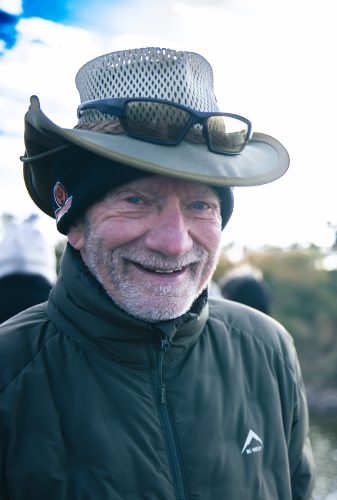
South Africa-based Keith Martyn, who grew up next to Victoria Falls, was the expert guide for the Traveling Frogs adventure.
Our first game drive in Zimbabwe began before dawn. We rose at 5 a.m. and clambered into open-air vehicles. Keith Martyn, our Cape Town, South Africa-based tour director, had warned us: “If you’re late, you get left.”
Keith is a man who carries southern Africa in his bones. Born in today’s Zambia, what was then Northern Rhodesia (yes, named after Cecil Rhodes), he camped under stars as a child, mapping the bush with his England-born father, a game warden. His British mother led tours of Victoria Falls. Their home was so close to the falls, he said, “If I closed the door to my bedroom when the river was in flood, it would rattle.”
That morning in the Stanley & Livingstone Private Game Reserve, we glimpsed a rare creature: a dehorned black rhino, one of a handful in the reserve, which is heavily patrolled by anti-poaching units. Her nose hovered just above the orange dust as Keith explained that she was searching for the scent of younger members of her critically endangered tribe, which is considered extinct in the wild.
We saw one rhino. One.
David Livingstone, the 19th-century Scottish explorer who documented this land’s wildlife in obsessive detail, would have wept. Where he sketched thriving populations, human development has left devastating scarcity. But that solitary female represented more than loss; she embodied a global fight for survival. Conservationists worldwide are working to reverse the decline of the rhino. Coming to the rescue are TCU faculty and students from the Institute for Environmental Studies, who partner with South African wildlife advocates through Planet Rhino. There is hope for a species on the brink.
That evening, while a storm gathered back home in Texas, we cruised the Zambezi River as the sun turned the sky into molten purple and the water shimmered like mercury. Keith pointed out the Old Drift, where Livingstone Town was first situated and where dozens of early white explorers succumbed to blackwater fever caused by malaria.
Those days are long gone, he said, because of anti-malarial drugs and a largely peaceable populace. “A lot of people who come here are absolutely amazed because they didn’t realize how safe it is.”
A WELCOME COLONY
Crossing the border from Zimbabwe into Botswana, we dipped our shoes in disinfectant, an entry requirement to prevent hoof-and-mouth disease but also, in hindsight, symbolic. Here, in a country where bold conservation efforts have paid off, something shifted again. Gone were the scarcity-born improvisations. In their place: smoother roads, strip malls and functioning 5G.
Botswana felt like a preview of what’s possible when modern people with money and technology partner with unspoiled nature, when a clash of civilizations builds something beautiful.
We arrived at Chobe Bush Lodge in the modern town of Kasane. There we were greeted by Malebogo “Lebo” Baatlhodi, a 28-year-old tourism professional who had studied international tourism management through England’s University of Derby. In Botswana, she was our host, our companion and, in a few quiet moments, our teacher.
Her personal story illuminated Botswana’s unique path.
“With my father working in the diamond industry, we stayed in a small town,” she told me of her childhood and her studies in an English-speaking school. “We stayed in a house with free electricity, free water, a rent-free house. I had the privilege of getting the best education, and I got to decide what I wanted to be.”
Lebo chose tourism — one of Botswana’s main economic engines, along with diamonds — because it allowed her to meet people from all over the world and contribute to her country’s growth. She had bet on her own future by taking a bus alone to Kasane years ago, marketing herself door-to-door to find an internship.
She spoke proudly of how multiple tribes coexist peacefully under a shared national identity and of Botswana’s zero-tolerance policy for poaching and commitment to conservation. “There’s so much more to our country than just diamonds and animals,” she said. “It would be such an honor for people to just come and try to learn about our history and where we come from as a nation.”
Botswana’s approach represents perhaps the most successful postcolonial economic model in Africa. Since its independence in 1966, it has transformed from one of the world’s poorest countries to a thriving nation, largely through diamond revenues reinvested in education, infrastructure and conservation.
We knew we were lucky to be there, roaming game parks and floating down sun-kissed rivers.
WHERE THE ELEPHANTS ROAM
The Chobe River flows wide and still, pooling into oxbows and shallows where life congregates. On a boat with a bar, we again watched the sun melt into the water. We marveled as a massive gang of young elephants wrestled on a river island, their giant bodies splashing and tumbling in play.
In this part of Botswana, elephants are everywhere. Females carry their calves for 22 months, a testament to the long arc of life here. In Chobe National Park — more than 4,500 square miles of preserved wilderness that is home to as many as 50,000 elephants — herds roam freely across forest and floodplain.
Chobe was also where our human herd began to come together. “Small-group travel allows you the safety and security of being together, and all of your travel plans are made for you: hotels, restaurants, various excursions and experiences,” said Bruce Epstein, founder of the 27-year-old Odysseys International company. “If you travel with a small group, you’re still going to maintain some of your own independence and individuality.”



Colleen Kleuser ’80 said that sharing the wonder of wildlife with fellow travelers, who were “like a ready-made group of friends,” elevated the experience from amazing to extraordinary.
Somewhere between the early mornings in open-air jeeps and the golden-hour river cruises, we began to thrum as a unified group. We shared jokes, binoculars, hand sanitizer, silence.
Lebo noticed the change. Our TCU group struck her as unusually positive and patient. “That makes a good group,” she told me. “People that hardly complain … who are just here for the fun of it.”
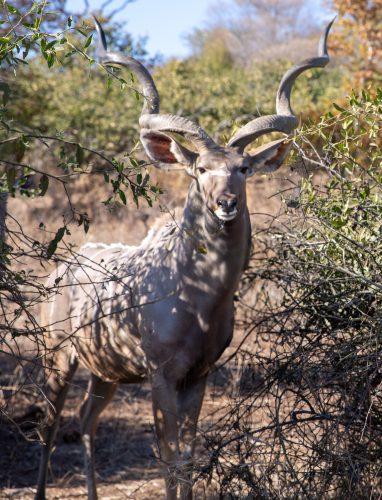
A kudu in Chobe National Park, Botswana.
RIVER LIGHT
On our final night in Botswana, we again drifted into the golden hush of the Chobe River. As the sun began its descent, a lone elephant gathered the courage to hike up a bluff. Hippos blinked up at us while birds skimmed the calm waters. An unmoving crocodile oversaw the tangle of movements from its hiding spot in the tall river grasses.
We had taken several sunset cruises by then, but this one felt different. We were quieter. Still dazzled by the beauty, yes — but softened, too, by the grief curling its fingers around the edges of the thrill of travel.
Back home in Texas, a real-time tragedy was unfolding. The Guadalupe River had risen with terrifying force, sweeping away cabins and campers in the Hill Country. Two of our pack, Chuck and Suzy Fields, had close family connections to two of the missing girls at Camp Mystic.
As we sat on that boat, wrapped in the easy glow of a golden happy hour, we were also wrapped in a recognition of how easily beauty and heartbreak intertwine. That rivers, too, can change form in an instant. That this peaceful surface, here in Botswana, had a mirror image thousands of miles away, darkened by disaster.
The heightened emotion drew us together. We poured a little more into our conversations. Laughed more freely and cried a little too. We knew, in a new way, that nothing was promised. That a good day, a safe return, a pink-lit river — these were not givens. They were gifts.
“It makes you realize how fragile life is,” said Teri O’Glee ’78, past president of the TCU Alumni Association. “You take joy when you can get it.”
Back at the lodge, I asked Lebo what she hoped we would carry home from Botswana.
She didn’t hesitate: “Our kindness. … Carry that with you as you go. Just be kind and just be welcoming. Because sometimes you never know what someone is going through.”
WHERE THE GIRAFFES STARE BACK
By the time we reached Mfuwe Lodge in Zambia, recently named the No. 3 hotel in the world by Travel + Leisure, we had grown accustomed to luxury in the wild. But this was something else.
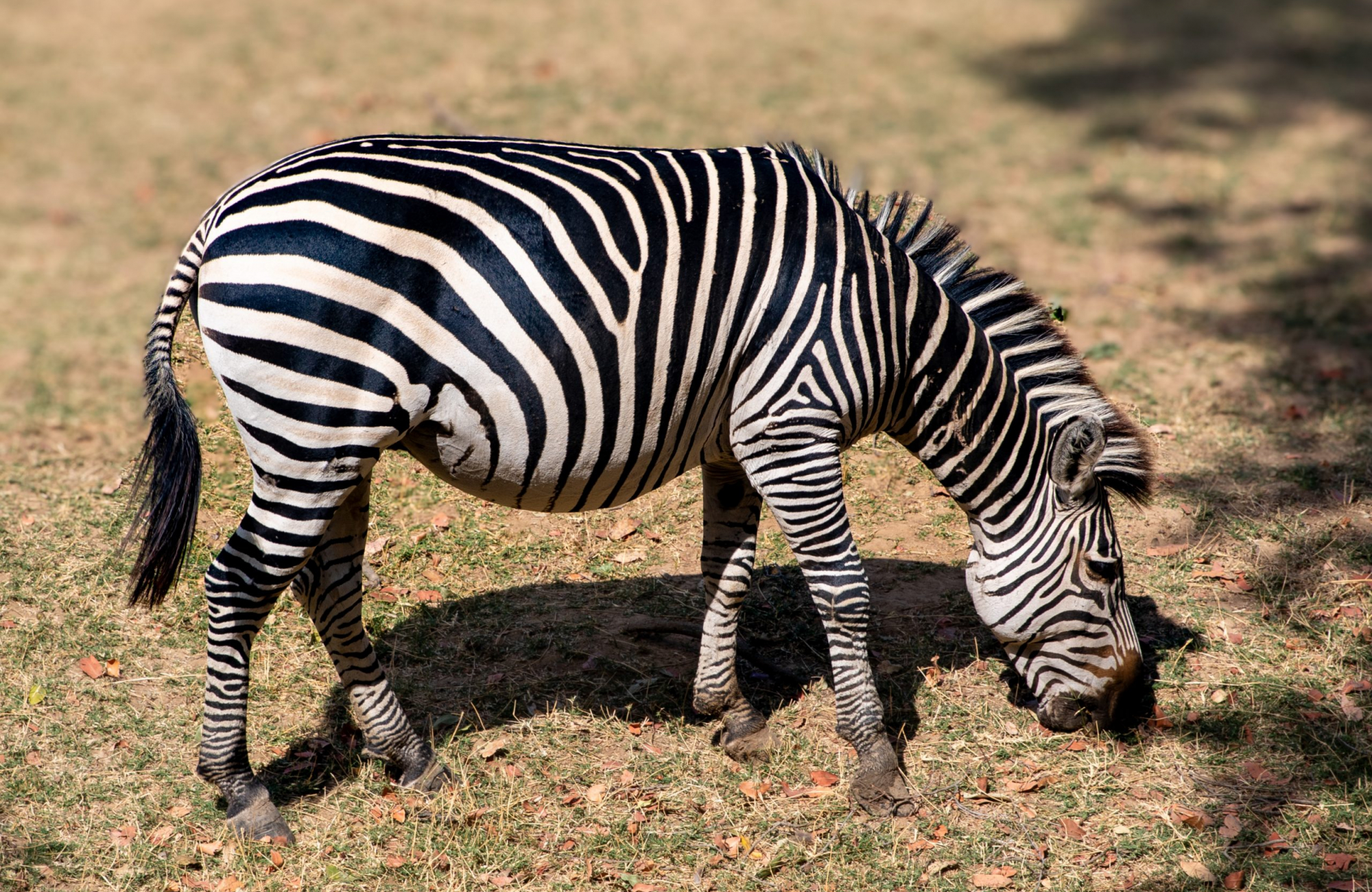
The lodge was inside South Luangwa National Park. Hippos huffed in the lagoons on the property. Zebras grazed past our cabins. Baboons screamed and squabbled like caffeinated toddlers from the trees overhead.
Mfuwe Lodge offered a striking juxtaposition: a pool and an open-air bar connected by walkways to luxurious, air-conditioned cabins that required armed escorts after dark. Just the week before, a mother elephant had trampled and killed two tourists on a walking safari inside the park. Here, wonder and danger shared the same pathways, a reminder that authentic wildlife experiences carry inherent risks that zoo encounters cannot replicate.
We didn’t shrink from it. Some of us laced up our shoes for walking safaris, where we learned to see more by looking smaller: giraffe droppings the size of marbles, scorpion tracks in the sand, scarred bark where elephants had used a tree as a towel.

Adventurers in Botswana, from left, Charles Breed, Malebogo Baathlodi, Courtney Grimm ’97, Laura Grimm ’93, Janis Breed, Gil Federico and Shirley Arsenault, board a jeep at Chobe Bush Lodge in hopes of spotting Botswana’s famed lions.
Mid-walk, we stopped for coffee next to a tower of giraffes also enjoying a morning snack. “I’ve traveled a lot, but I don’t think I’ve ever seen anything like this,” Scott O’Glee ’78 said. “Eleven giraffes that were less than 100 yards from us, standing there, looking at us, like, ‘Who are y’all?’ That’s pretty unbelievable.”
Later that day, during an after-dark game drive, a hyena, the 30th species we’d spotted since the trip began, gnawed a sun-bleached giraffe skull. Stephen Mvula, also known as “Big Steve,” our Zambian guide and wildlife encyclopedist, answered our questions about everything from Parliament to predators.
THE EDUCATION OF A HERD
In Zambia, we saw leopards, meaning we had spotted Africa’s “Big Five” species. “It was emotional,” Colleen said, “the elephant, the leopard, the lion, the cape buffalo and the rhino, all up close and personal.”
One evening, a local theatre troupe performed a play about a young woman deciding whether to leave the bush for the city. She considers new horizons but ultimately stays, having learned by observing the animals, the rhythms, the tourists that home still has something to teach her.
Over dinner, Big Steve shared his thoughts on education, too — not just for tourists, but for his own children. While he’s content living near the park, he hopes they’ll chart their own paths, even if that means leaving for Lusaka, Zambia’s capital.
“I think they’ll do fine,” he said. “Whatever they want, I’ll support that.”
A small detail of our stay made a big difference: a $15 nightly surcharge added to every guest’s bill. That fee helps support the broader South Luangwa-area community, funding schools, clean water systems and sustainable farming initiatives. Our presence felt directly reinvested, a gesture that made us feel like partners, not just outsiders.

Boston provided security during a walking safari in Zambia’s South Luangwa National Park.
“There are very few places in the world that are better than this,” Keith said.
We agreed. Zambia had invited us into something sacred — not just wildlife and wonder, but perspective. “Here, I’ve found nothing but peace and joy, a commitment to maintaining this beautiful country,” Teri said. “It’s humbling.”
THE CRADLE AND THE FUTURE
“Eleven giraffes that were less than 100 yards from us, standing there, looking at us, like, ‘Who are y’all?’ That’s pretty unbelievable.”
Scott O’Glee
On our last morning in Zambia, the chill was intense. We bundled into Big Steve’s open-air jeep before sunrise, breath visible, eyes still adjusting to the dark. No one spoke much. We passed hippos sunk into the mud like sentries seeing us off. Hundreds of children wearing school uniforms waved as they made their way to seize their futures.
This final ride to the airstrip marked the end of our time together in southern Africa — two weeks, four countries, 30 animal sightings, countless conversations and a hundred quiet shifts within.
In the weeks that followed, my thoughts returned often to Africa. To how the crisp air would be weighted with heat after the rainy season arrived.
The cycle again. In the place where humankind began.
“This is the cradle,” Jan said. “But modern African civilization is barely a hundred years old. Much of its political history has happened in our lifetimes. That’s a rare thing to witness.”
And we were witness to it as guests. Temporary neighbors. Curious students. Frogs flung far from Fort Worth, bringing our own culture of warmth and connection, a way of being that helped us experience the world more generously and be experienced kindly in return.
Southern Africa reminded us of what progress can cost. There’s a hunger for education there, a yearning for what’s possible. But to access it, many young people must leave the countryside, leave tradition, leave behind the trees and animals that taught them. It’s a growing chorus all over the 21st-century world, this belief that to participate in the future, we must leave the struggle with wild nature behind.
And yet: In the silence of the bush, in the gaze of a giraffe, the future felt already present. A new world in the making, transcending its wars, divisions and tragedies. Not paved over the old but growing out of it. A cycle, not a severance.
A few months after we flew home, the rainy season would return to southern Africa. Dust would turn to mud. Plants would push upward through cracked earth. Animals would roam farther, fed by new green. The world — still fragile, still holy — would remake itself again.
This story is dedicated to Lila Bonner, the 9-year-old daughter of Blake ’08 and Caitlin Bonner, who lost her life in the 2025 Guadalupe River floods. Lila wanted to open an animal rescue one day. May we all treat the world and its beings with special care and kindness in her honor.
Your comments are welcome
2 Comments
Wonderful trip! Our family, kids and grandchildren, spent two weeks traveling the same countries and experiences summer of 2024. Hearing so much of what we saw too but a few things we missed makes me want to make that trip again.
Can you share your itinerary with me?
Absolutely! Here you are!: https://www.odysseys-unlimited.com/tours/africa-the-middle-east/africas-wildlife/
Related reading:
Latest News
To Save A Species
Woodrow Blagg’s detailed drawing captures TCU’s Rhino Initiative at work in Africa.
Features
Educational Ambassador
Alonso Sánchez helps developing countries make the grade.
Alumni, Recollections
Frogs Recall Meeting Other Frogs All Over the World
Have you met a fellow Horned Frog somewhere unexpected?