
Michael Faggella-Luby has spent years working to improve outcomes for the 3.5 million college students in the U.S. living with disabilities. Photo illustration by Kim Baker | Original photo by Glen E. Ellman
TCU Professor Michael Faggella-Luby Reimagines Disability Support in Higher Education
When renowned scholars from three major research universities converged at TCU’s Bailey Building last September, they came to plan something ambitious: an international collaboration that would reshape how universities worldwide support students with disabilities. At the center of that effort is Michael Faggella-Luby, a TCU professor of education whose influence extends far beyond his Fort Worth classroom.
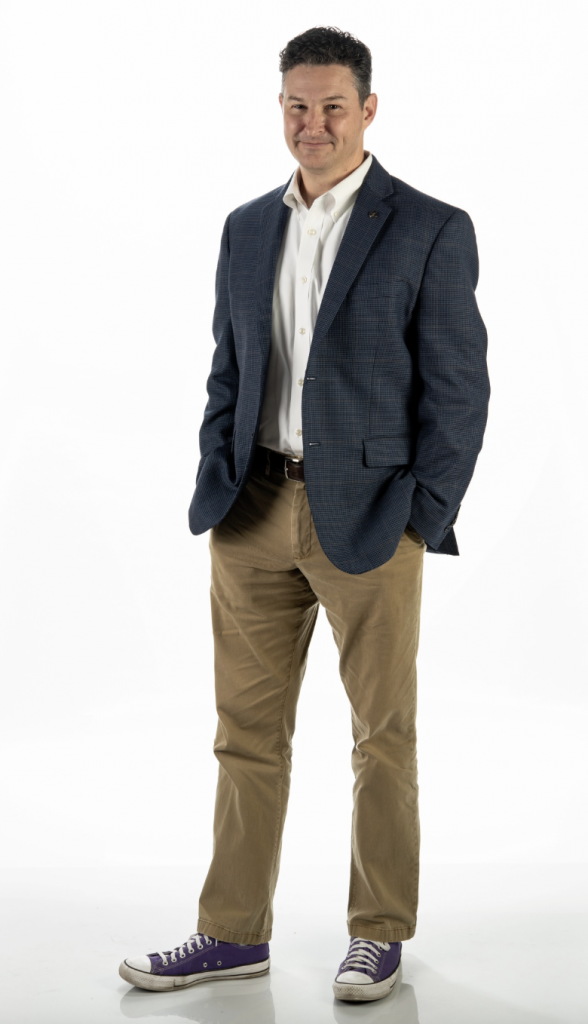
Michael Faggella-Luby of TCU’s College of Education brings both expertise and a signature style to his work in special education and learning disabilities. Photo by Glen E. Ellman
As core faculty of the Alice Neeley Special Education Research and Service Institute and associate editor of the Journal for Learning Disabilities since 2017, Faggella-Luby has spent years at the forefront of an evolving field. Along with longtime collaborators Joseph Madaus and Nicholas Gelbar from the University of Connecticut and Lyman Dukes III of the University of South Florida, he has helped document an explosion in research on higher education and disability — a nearly 200 percent increase in scholarly articles published from 2013 to 2021 compared with the six decades between 1952 and 2012.
That surge, which the scholars highlighted in an article published in Frontiers in Education last July, reflects both growing awareness and urgent need. Today, 3.5 million college students in the U.S. have some type of disability — up 56 percent in two decades. Yet the challenge extends beyond American borders, which is why Faggella-Luby and his collaborators are organizing a gathering in Maine this June that will draw educators from around the globe.
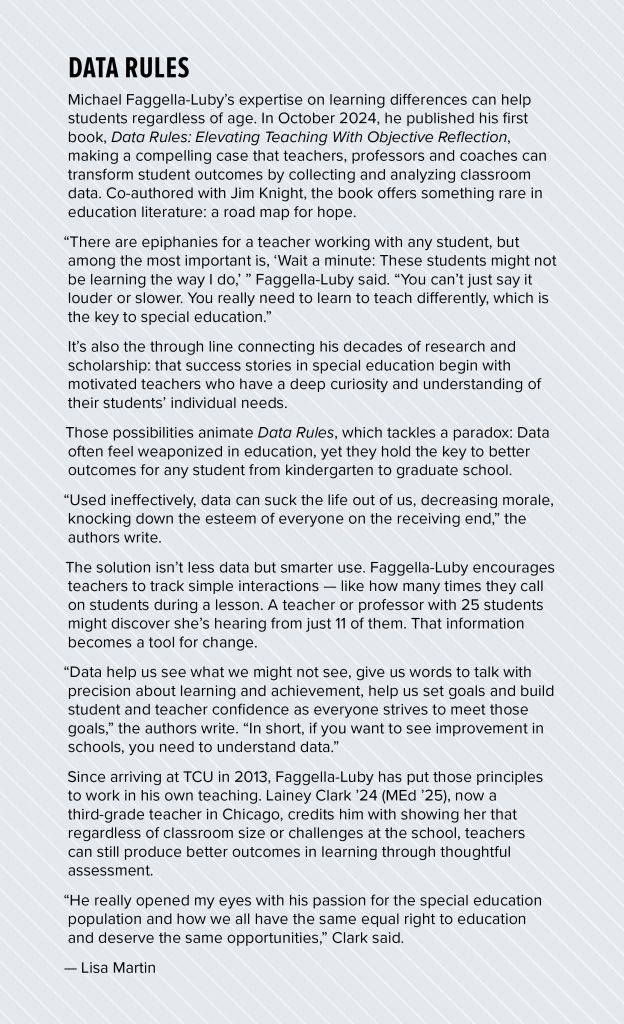
The annual conference represents yet another way Faggella-Luby is shaping the learning experiences of students at any age and ability regardless of setting. He’s authored a well-received book on collecting data as a tool for teachers to assess how well students understand concepts and lessons. He consults with Catholic schools nationwide on best practices for the meaningful inclusion of students with learning differences. And he studies the ongoing impact of remote learning and service delivery on postsecondary students with disabilities.
A core faculty member of TCU’s Andrews Institute for Research in Mathematics & Science Education, Faggella-Luby has also served as the president of the Division for Learning Disabilities of the Council for Exceptional Children. His latest co-authored book, Specially Designed Instruction: The Definitive Guide, was published by Bloomsbury in September 2025.
Amid all these avenues of research as well as his ongoing collaborative endeavors, Faggella-Luby has become an evangelist of sorts for the ethical responsibility that schools and society share to meet disabled students where they are to help them learn, grow and succeed.
“Improving outcomes of students with disabilities is not just the right thing to do, it’s the smart thing to do,” Faggella-Luby said. “And at the college level, if I think about my work in a nutshell, it’s how do we enhance the learning experience for students with disabilities without watering down the content?”
Spoiler alert: “The answer is we train educators differently, and we provide a different level of service,” he said, “all while maintaining the integrity of what we’re trying to achieve as outcomes.”
BRIGHT BEGINNINGS
Faggella-Luby’s insights didn’t come from textbooks. Fresh out of undergrad at College of the Holy Cross, the Massachusetts native joined AmeriCorps and found himself teaching, coaching and serving as an administrator at a Catholic school in Florida. Shakespeare and Beowulf proved difficult to convey to students who struggled with comprehension in ways his own education hadn’t prepared him to address.
“I had students who couldn’t keep track of the initiating event,” Faggella-Luby said, “and I started realizing we had lots of kids with comprehension issues that some people call hyperlexia, where they struggle with meaning.”
Those early teaching experiences deepened his understanding of students with executive function challenges — those who spent all night on homework but left it in their locker, forgot it was there, missed detention and wound up in Saturday school.
“That’s how I have this kid on my disciplinary list,” he said, “and I have to find a way to help him.”
“Improving outcomes of students with disabilities is not just the right thing to do, it’s the smart thing to do.”
Michael Faggella-Luby
That determination to support struggling students sent Faggella-Luby back to school, leading to his PhD. Madaus chaired the search committee that hired him for his first faculty role in a tenure-track position at the University of Connecticut.
“The energy he brought and the personal engagement he had with people right away is amazing, and he brings a depth of knowledge in different areas that he’s able to interconnect for important research,” said Madaus, who directs the school’s center on postsecondary education and disability, which promotes access to education for college students with disabilities.
Faggella-Luby “is as inspiring in collaboration as he is in front of a room full of students,” Dukes said. “His energy, empathy and depth of knowledge constantly push our team to think bigger about what’s possible in higher education.”
A GLOBAL CHALLENGE
One issue occupies Faggella-Luby’s thoughts with increasing urgency: disclosure. On average, only 37 percent of college students with learning differences disclose their disability to their institution, per a 2022 report from the National Center for Education Statistics. At some universities abroad, that number doesn’t reach double digits.
Understanding why students stay silent — and how universities can better serve them regardless — drives much of the planning for the June conference. The work involves identifying barriers across different cultural and institutional contexts.
“Every college and university is so different in how they support students with disabilities that the more we can share, the more a program doesn’t have to start from ground zero or reinvent the wheel,” said Nicholas Gelbar, a psychologist and associate research professor at the University of Connecticut.
The conference’s intimacy — fewer than 350 attend annually — facilitates the kind of deep conversations that lead to lasting change. Faggella-Luby appreciates bringing together educators from around the world to discover where their challenges align and where they diverge.
“One of the important things we’re working on is how we provide professional development and learning so we can help people working on behalf of persons with disabilities around the world network and grow,” he said.
The work always circles back to that teacher in Florida years ago, struggling to reach students who learned differently. The scale has changed, but the mission remains: ensuring every student has the opportunity to thrive.
Your comments are welcome
1 Comment
Thank you for this article! My daughter is a sophomore at TCU, and absolutely thriving on campus. Her brother, who is 17, has several disabilities despite being acutely intelligent. I’m having a hard time even finding a starting point to plan his higher education journey. So many programs are aimed at early intervention, but relatively few see families like ours through the life journey of these students. I would appreciate any additional information available on the topic from TCU or to join a mailing list if there is one.
And as an aside we enjoyed meeting you all in Atlanta on the Rif Ram Tour. Thank you all for all you do.
Kindly,
Catherine Dunham McGahan
Atlanta TCU Parent
Related reading:
Research + Discovery
Parent-Teacher Relationships Can Support Positive Behavior in Students
Kathleen Strickland-Cohen and Kathleen Kyzar want to foster partnerships while problem behavior is mild or moderate.
Research + Discovery
Seeking Strategies to Help Children With Dyslexia
Tracy Centanni hopes her research leads struggling readers to success.
Research + Discovery
Starpoint School Book Club Fosters a Love of Reading in Children With Learning Difficulties
Jan Lacina launched a book club for children with dyslexia that fosters empathy and confidence while training graduate students in research.