

Dave Aftandilian's research explores how Native American religions view animals as spiritual individuals, kin and teachers — a perspective he hopes readers will adopt. Photo by Joyce Marshall
Sacred Cows, Evil Serpents: How Religion Shapes Animal Treatment
Every religion has a place for animals. TCU’s Dave Aftandilian co-edited an anthology exploring whether that place treats them as spiritual beings or mere objects.
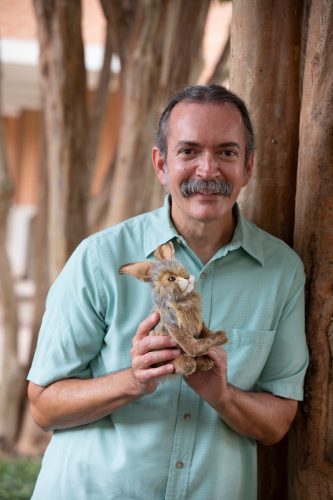
The hare is the mascot of the human-animal relationships minor that Dave Aftandilian directs.
DO OUR PETS HAVE SOULS? What is the meaning behind sacred cows and sacrificial goats? How do our faiths shape how we engage with animals?
Western theologians have long argued that humans’ unique connection to the divine makes us separate from and superior to other species. But the co-editors of Animals and Religion, a new anthology published by Routledge, write that thinking about humans and animals as connected “leads to a fuller account of religion and a deeper understanding of animals.”
“Every religion that I’ve ever looked at has a place for animals,” said Dave Aftandilian, associate professor of anthropology and director of TCU’s human-animal relationships minor. “What that place is and how central it is and whether the animals are viewed as subjects or objects, that differs.”
Aftandilian, who contributed multiple chapters to Animals and Religion, co-edited the project with Barbara Ambros, professor of East Asian religions and chair of the religious studies department at the University of North Carolina at Chapel Hill, and Aaron Gross, professor of religious studies at the University of San Diego. The team intends for the anthology to be used as an accessible textbook for classes on animals and religion.
The authors look at how religions interpret boundaries between animals and humans, from following a vegan diet as a spiritual practice to viewing animals as thinking, possibly spiritual beings.
ETHIC OF CARING
Worldwide, religions express deep concern for animals, even in the more human-centric Western faiths.
“In the Old Testament, there is a pastoralist ethic,” Aftandilian said. “Even if it’s the Sabbath — you’re not supposed to do any work — if an animal is stuck in a hole, you’re supposed to lift them out, even if they’re the animal of your enemy. So kindness to animals trumps everything else.”
“Humans are a pretty lonely species in some ways. We’ve set ourselves so far apart from the natural world that it can be hard for us. It can be depressing, and for many people, they don’t go outside, even though we know that just a little bit of time out in green nature is good for us.”
Dave Aftandilian
This ethic of caring stems from shared origins in Judeo-Christian tradition: Animals are fellow creatures of God. In the Bible, God provides water and food for animals. “If God cares for all the creatures,” Aftandilian said, “maybe we should care for all the creatures.”
Ambros said in faith traditions like Buddhism, “the most important thing is not that beings were created by some other being, but that they’re living beings, that they have lives … and that their lives matter.”
But religious views can also harm animals.
“I was speaking to an animal rescuer who focuses on herpetofauna [reptiles] in Chicago,” Aftandilian said. “And he said the worst thing that ever happened to snakes was the story of the Garden of Eden, which portrays the serpent as a wicked tempter.”
In Western culture, that story has spawned media depictions of snakes as evil and treatment such as rattlesnake roundups that kill the reptiles. But in many traditional religions in the Americas and India, snakes are positive figures, seen as bringers of fertility for crops, Aftandilian said.
“So the stories that we tell, the symbols that we use involving animals, affect real animals in their lives.”
WHO COUNTS AS A PERSON?
Aftandilian’s research focuses on Native American religions, which view animals as spiritual individuals, kin and teachers. “For Native peoples,” he said, “there’s no question that animals are persons.”
A “person” can recognize and engage in relationships with other individuals, like a coyote and badger hunting together or a human riding a horse.
Science, Aftandilian points out, supports Indigenous knowledge of animals: Other-than-human animals can think, communicate and understand the difference between the self and the other. But human relationships with other beings have been severed by cultural and, increasingly, physical divisions from animals and nature.
“Humans are a pretty lonely species in some ways,” Aftandilian said. “We’ve set ourselves so far apart from the natural world that it can be hard for us. It can be depressing, and for many people, they don’t go outside, even though we know that just a little bit of time out in green nature is good for us. So what I find is: Animals are a great bridge to connect us to the natural world.”
To repair broken bonds, Aftandilian suggests contemplative practices like meditation and prayer, which, he writes in the text, can help humans “become more mindful of ourselves and others, including animal others.”
MEET YOUR NEIGHBORS
Aftandilian teaches his students mindfulness exercises to focus their attention and asks them to observe their animal neighbors. When students look closer, an individual animal, from a moth to a turtle, becomes a “who,” not a “that.”
Seeing animals eat, play and raise families helps observers build connections and develop compassion for them. In the anthology, the authors share how diverse faith communities apply religious texts, teachings and morals to nurture animals and the environment.
Buddhist nuns walk barefoot to avoid trampling insects.
Urban places of worship plant gardens to support wildlife.
Faith communities by the ocean organize beach cleanups and restore coral reefs.
“When you do it in a religious context, an ordinary beach cleanup, which is a good thing to do, becomes a holy act,” said Rabbi Ed Rosenthal, founder of the Repair the Sea nonprofit in Tampa, Florida.
A SPIRITUAL SIDE?
In the text’s final chapter, four scientists ask: If humans can infuse ordinary actions with religious or contemplative intention, could other-than-human animals do the same?
Scientists have documented animals demonstrating what appear to be awe and grief. For example, elephants pause by the bodies of individuals they knew, touching and covering the corpses with vegetation. “In our culture,” Aftandilian said, “we would call that mourning.”
Whether animals possess their own spiritual lives, the text makes clear that they figure significantly into ours as saints and sacrifices, deities and connections to the spirit world — and as fellow beings.
Aftandilian said he hopes Animals and Religion helps readers from all backgrounds view animals in a new light: “I want them to look in the eyes of animals and see them as living beings … to whom we owe a debt of care and compassion.”
Your comments are welcome
1 Comment
Excellent work on the subject of animals as beings. I think more of this commentary on our relationships with animals being less hierarchical and more about the interpersonal and relational aspects of all beings is valuable. We share the same ecosystem after all.
Thanks for the exceptional insight Dave and company!!!
Related reading:
Research + Discovery
Facial Recognition Has Made It Nearly Impossible to Disappear
Sharrona Pearl explores the link between physical appearance and identity and how technology threatens privacy.
Research + Discovery
Jessica Zeller’s Student-Centered Approach is Transforming Ballet Education
A new book explores how traditional ballet teaching causes harm and envisions a student-centered revolution through humanizing pedagogies.
Research + Discovery
Are DNA Ancestry Tests Harmful?
Debunked science resurfaces when consumers misunderstand results.