
When renowned scholars from three major research universities converged at TCU’s Bailey Building last September, they came to plan something ambitious: an international collaboration that would reshape how universities worldwide support students with disabilities. At the center of that effort is Michael Faggella-Luby, a TCU professor of education whose influence extends far beyond his Fort Worth classroom.
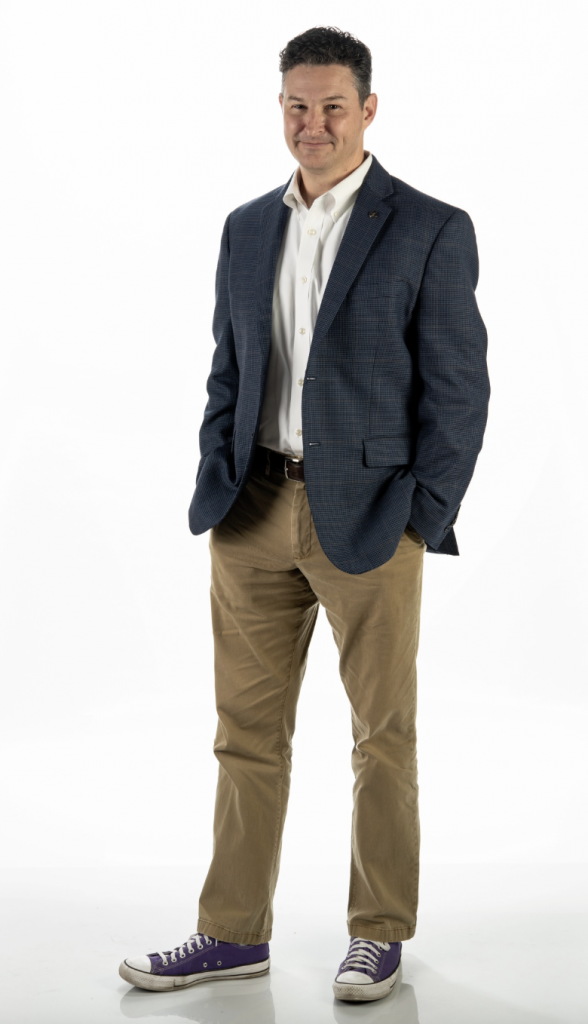
Michael Faggella-Luby of TCU’s College of Education brings both expertise and a signature style to his work in special education and learning disabilities. Photo by Glen E. Ellman
As core faculty of the Alice Neeley Special Education Research and Service Institute and associate editor of the Journal for Learning Disabilities since 2017, Faggella-Luby has spent years at the forefront of an evolving field. Along with longtime collaborators Joseph Madaus and Nicholas Gelbar from the University of Connecticut and Lyman Dukes III of the University of South Florida, he has helped document an explosion in research on higher education and disability — a nearly 200 percent increase in scholarly articles published from 2013 to 2021 compared with the six decades between 1952 and 2012.
That surge, which the scholars highlighted in an article published in Frontiers in Education last July, reflects both growing awareness and urgent need. Today, 3.5 million college students in the U.S. have some type of disability — up 56 percent in two decades. Yet the challenge extends beyond American borders, which is why Faggella-Luby and his collaborators are organizing a gathering in Maine this June that will draw educators from around the globe.
The annual conference represents yet another way Faggella-Luby is shaping the learning experiences of students at any age and ability regardless of setting. He’s authored a well-received book on collecting data as a tool for teachers to assess how well students understand concepts and lessons. He consults with Catholic schools nationwide on best practices for the meaningful inclusion of students with learning differences. And he studies the ongoing impact of remote learning and service delivery on postsecondary students with disabilities.
A core faculty member of TCU’s Andrews Institute for Research in Mathematics & Science Education, Faggella-Luby has also served as the president of the Division for Learning Disabilities of the Council for Exceptional Children. His latest co-authored book, Specially Designed Instruction: The Definitive Guide, was published by Bloomsbury in September 2025.
Amid all these avenues of research as well as his ongoing collaborative endeavors, Faggella-Luby has become an evangelist of sorts for the ethical responsibility that schools and society share to meet disabled students where they are to help them learn, grow and succeed.
“Improving outcomes of students with disabilities is not just the right thing to do, it’s the smart thing to do,” Faggella-Luby said. “And at the college level, if I think about my work in a nutshell, it’s how do we enhance the learning experience for students with disabilities without watering down the content?”
Spoiler alert: “The answer is we train educators differently, and we provide a different level of service,” he said, “all while maintaining the integrity of what we’re trying to achieve as outcomes.”
Faggella-Luby’s insights didn’t come from textbooks. Fresh out of undergrad at College of the Holy Cross, the Massachusetts native joined AmeriCorps and found himself teaching, coaching and serving as an administrator at a Catholic school in Florida. Shakespeare and Beowulf proved difficult to convey to students who struggled with comprehension in ways his own education hadn’t prepared him to address.
“I had students who couldn’t keep track of the initiating event,” Faggella-Luby said, “and I started realizing we had lots of kids with comprehension issues that some people call hyperlexia, where they struggle with meaning.”
Those early teaching experiences deepened his understanding of students with executive function challenges — those who spent all night on homework but left it in their locker, forgot it was there, missed detention and wound up in Saturday school.
“That’s how I have this kid on my disciplinary list,” he said, “and I have to find a way to help him.”
“Improving outcomes of students with disabilities is not just the right thing to do, it’s the smart thing to do.”
Michael Faggella-Luby
That determination to support struggling students sent Faggella-Luby back to school, leading to his PhD. Madaus chaired the search committee that hired him for his first faculty role in a tenure-track position at the University of Connecticut.
“The energy he brought and the personal engagement he had with people right away is amazing, and he brings a depth of knowledge in different areas that he’s able to interconnect for important research,” said Madaus, who directs the school’s center on postsecondary education and disability, which promotes access to education for college students with disabilities.
Faggella-Luby “is as inspiring in collaboration as he is in front of a room full of students,” Dukes said. “His energy, empathy and depth of knowledge constantly push our team to think bigger about what’s possible in higher education.”
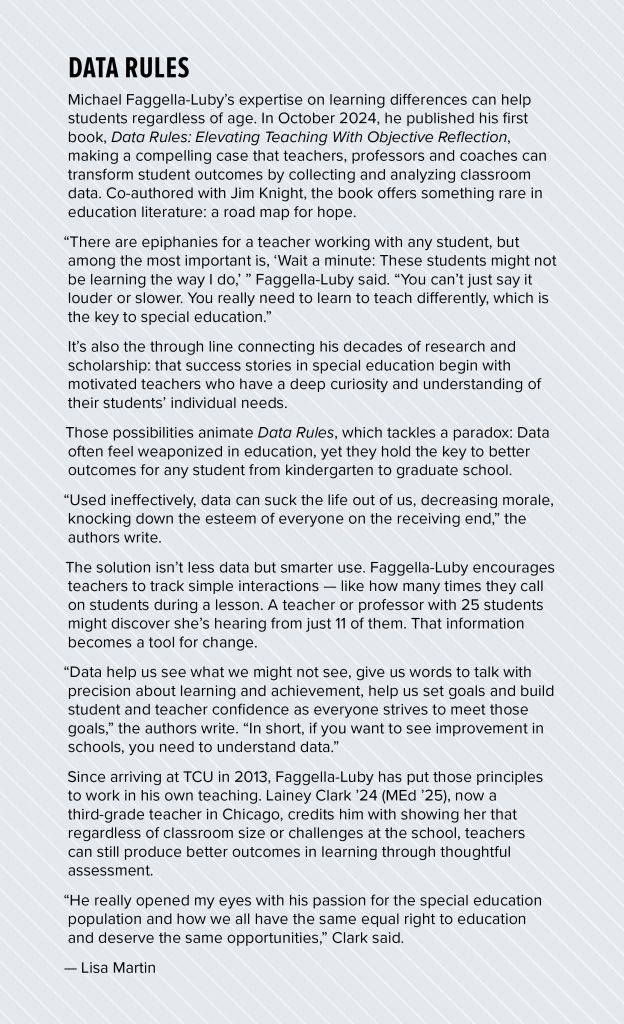
One issue occupies Faggella-Luby’s thoughts with increasing urgency: disclosure. On average, only 37 percent of college students with learning differences disclose their disability to their institution, per a 2022 report from the National Center for Education Statistics. At some universities abroad, that number doesn’t reach double digits.
Understanding why students stay silent — and how universities can better serve them regardless — drives much of the planning for the June conference. The work involves identifying barriers across different cultural and institutional contexts.
“Every college and university is so different in how they support students with disabilities that the more we can share, the more a program doesn’t have to start from ground zero or reinvent the wheel,” said Nicholas Gelbar, a psychologist and associate research professor at the University of Connecticut.
The conference’s intimacy — fewer than 350 attend annually — facilitates the kind of deep conversations that lead to lasting change. Faggella-Luby appreciates bringing together educators from around the world to discover where their challenges align and where they diverge.
“One of the important things we’re working on is how we provide professional development and learning so we can help people working on behalf of persons with disabilities around the world network and grow,” he said.
The work always circles back to that teacher in Florida years ago, struggling to reach students who learned differently. The scale has changed, but the mission remains: ensuring every student has the opportunity to thrive.
More than four months after historic floods devastated the Texas Hill Country, Austin Dickson ’03 was driving across the now-tranquil Guadalupe River on a sunlit November day, taking stock of the drastically altered landscape more than 30 feet below.
Louise Hays Park, located under a downtown bridge in Kerrville, Texas, was once a recreational centerpiece for this city of nearly 25,000, shaded by a canopy of towering trees and offering activities ranging from a fitness center to kayaking. Now, Dickson said, it resembled “the surface of the moon.”
July 4 floodwaters rose more than 35 feet to just under the bottom of the bridge, destroying scores of trees, many more than a century old, or leaving them bent toward the ground in a sobering testimonial of the flood’s enormous force. The 64-acre park, which includes hiking paths, picnic areas and recreational equipment, was largely destroyed. While some of its trails reopened in October, much of the park remains closed for renovation.
Dickson, a Waco, Texas, native, is at the center of the massive rebuilding effort as CEO of the Community Foundation of the Texas Hill Country.
Under Dickson’s leadership, the foundation has raised more than $100 million in donations that have been applied toward a variety of needs, from rehousing flood victims and restoring small businesses to providing health care to survivors. More than 700 families have received assistance through foundation grants distributed by nonprofits.
“The foundation is truly just moving mountains for our community,” said Mary Campana, executive director of Kerr County’s Habitat for Humanity, which was gifted a $3 million grant from the community foundation to help rebuild and repair homes.
She called Dickson “an unsung hero” of the Hill Country. “[The Community Foundation] hit the ground running,” she added, “and if they hadn’t, none of this would be happening.”
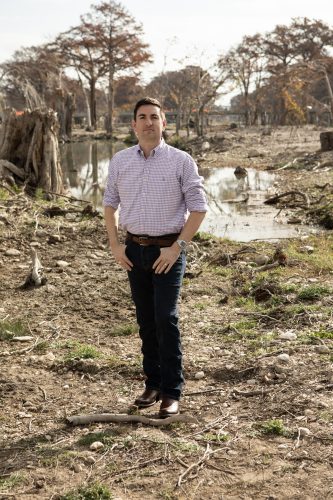
Austin Dickson, CEO of the Community Foundation of the Texas Hill Country, has led efforts to distribute more than $40 million in flood relief grants since the July 4 disaster.
More than 130 people in Kerr County and the surrounding Hill Country died in the July 4 flood, including 27 campers and counselors at Camp Mystic, a popular girls’ retreat near the Guadalupe River. Dickson knew at least four people who died in the flood, including Dick Eastland, Camp Mystic’s director.
Dickson, who has headed the Community Foundation for the Texas Hill Country since 2017, is headquartered in Kerrville’s Guthrie Building, a 138-year-old limestone structure that formerly housed a newspaper and the town’s city hall. It sits a block away from the Guadalupe River.
“One of my jobs is to connect needs in the community with passions that philanthropic people have,” he said. “I believe that my religion degree and my liberal arts education at TCU have given me the interpersonal skills in my career in general and particularly at this moment.”
Dickson and his family live on a hill away from the river. Their household also includes three dogs: Jake the black Labrador, Stanley the rat terrier and Indiana the Brittany.
They were home July 4, looking forward to enjoying the holiday weekend, before overnight torrential rains sent the Guadalupe out of its banks and turned Kerr County into a national disaster zone. At 9:48. a.m. July 4, alerted by a succession of text messages, Dickson called the foundation’s three other staff members to action and remotely created the Kerr County Flood Relief Fund to begin raising donations for what would become a full-scale rebuilding and recovery campaign.
“The rest of that day turned into a nightmare,” Dickson said, recalling an onslaught of “very dramatic and traumatic situations” that included scores of drowning deaths and missing people, in addition to high-water rescues that miraculously kept the toll from going even higher. “A lot of destruction happened that day,” he said, adding that “the full scale of how tragic this event was wasn’t immediately clear.”
Dickson has often been the face of the recovery effort, appearing in news conferences, TV interviews and on social media. In August, he made a high-profile appearance at an “Applause for the Cause” benefit concert organized by musician Robert Earl Keen, a parent of two TCU alumnae, to generate donations for the Community Foundation of the Texas Hill Country.
Buc-ee’s founder and CEO Arch “Beaver” Aplin III, whose ubiquitous travel center chain sponsored the benefit, said in a statement that “we were all in” after learning that “100 percent of our commitment goes to the Community Foundation of the Texas Hill Country.”
The August concert at Whitewater Amphitheater in New Braunfels drew more than 5,000 people and raised over $3 million. Dickson went on stage to accept the proceeds from Keen and Aplin.
Although Kerrville and surrounding communities still face a long road to achieve full recovery, many of those on the receiving end of the relief fund say the future now seems considerably brighter in contrast to the dark hours they endured during the flood and its immediate aftermath.
Floodwaters forced Maria Martinez, her husband and their 2-year-old daughter to escape their mobile home in Center Point near Kerrville and flee to higher ground. The family — Maria was more than six months pregnant — then spent more than five hours under a wooden deer blind along with her parents and others escaping the rising waters.
Several bodies were found not far from their home. Nearby trees, basketball courts and park benches were washed away “like a bomb went off,” Martinez recalled.
After returning home, the family discovered that their residence had become uninhabitable due to mold. They stayed with her parents, who live next door, and then spent nearly two months in temporary housing provided by Airbnb through a grant from Dickson’s organization. The foundation’s $3 million grant to Habitat for Humanity is helping fund the renovation of the Martinez family’s home.
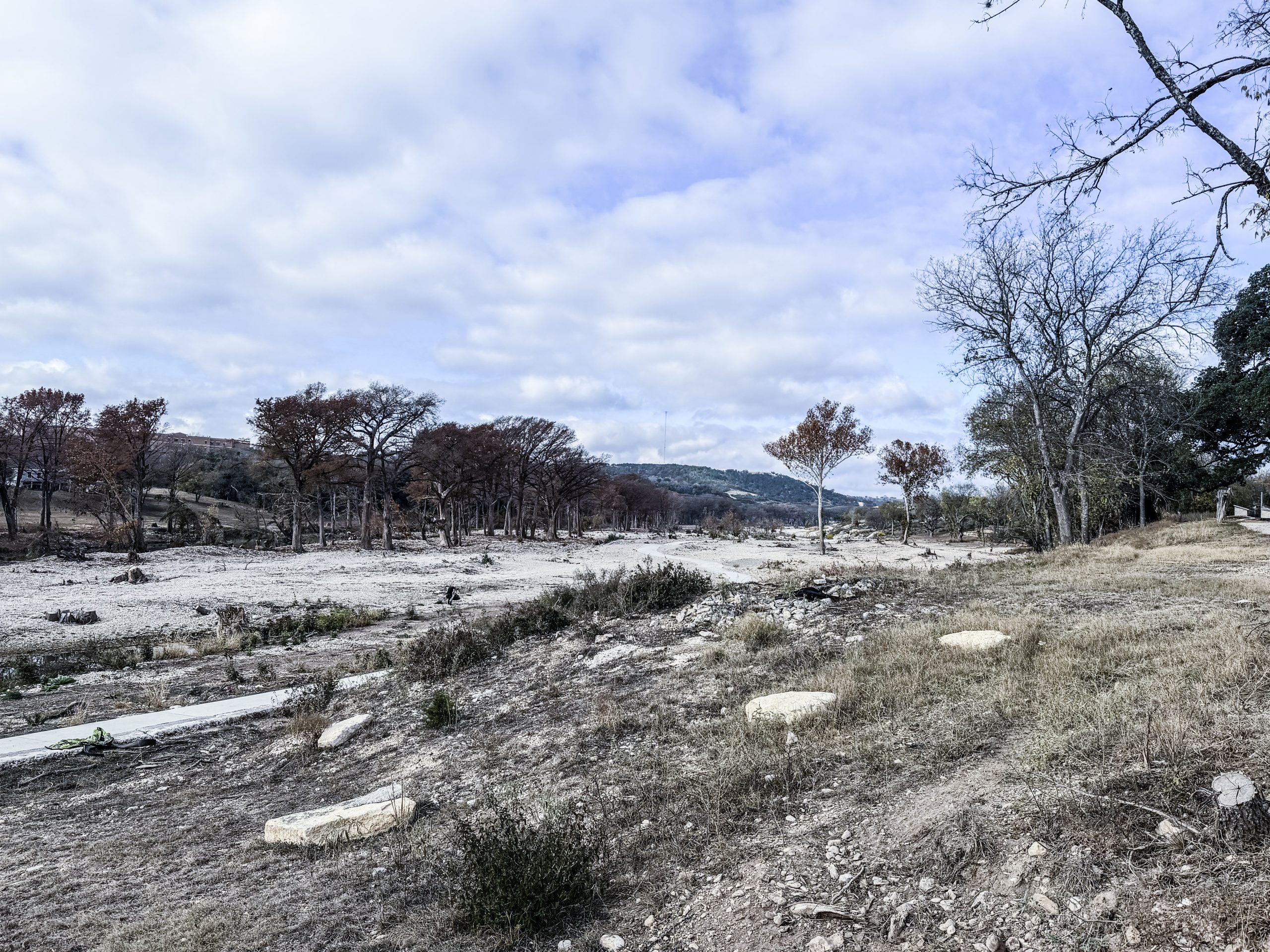
Floodwaters surged to within inches of the bottom of a downtown Kerrville bridge on July 4, more than 35 feet above the floor of Louise Hays Park, which once served as a recreational hub for the city of nearly 25,000.
“It was really sweet to see how many people … came afterward to try to put this place together,” said Martinez, who gave birth to a second daughter Oct. 13. “It was a tragic thing, but it was a beautiful thing.”
Kerrville’s nearly 60-year-old gathering place for seniors, the Dietert Center, was closed for nearly four months after a 6-inch-deep carpet of water swept across every corner of the 20,000-square-foot ground floor July 4. A $500,000 grant from the community foundation, along with funding from other sources, helped an army of volunteers restore the building so it could reopen in late October.
“Their gift was awesome,” Dieter Center executive director Brenda Thompson said. “We’ve been able to get this building back up and running.”
“I think in tragedy and times of great stress, our character is revealed.”
Austin Dickson
The Community Foundation of the Texas Hill Country was founded in 1982 to serve a 10-county region, funding more than 250 charitable nonprofits each year and providing scholarships to help students pursue higher education. On average, the foundation distributes approximately $6 million each year, according to its website, a fraction of the $40 million in grants that have been distributed under the Kerr County Flood Relief Fund.
The foundation has also helped ease the aftermath of other disasters during Dickson’s leadership, including the fatal shooting of 19 students and two teachers in 2022 at Robb Elementary in Uvalde, which is less than 100 miles southwest of Kerrville.
Dickson’s organization also helped fund the recovery from the Crabapple wildfire that burned nearly 10,000 acres near Fredericksburg in neighboring Gillespie County.
Philanthropy, religion and higher education have served as key elements of Dickson’s professional trajectory. After graduating from TCU, he earned master’s degrees in religion from the School of Divinity at the University of Edinburgh in Scotland and the Candler School of Theology at Emory University in Atlanta. He also holds a master’s degree in public policy from the Jimmy and Rosalynn Carter School of Public Policy at Georgia Tech.
Dickson lived in Atlanta for 13 years, leading several nonprofits and working for the Community Foundation for Greater Atlanta. Although he returned to Texas in 2017 to take his current position, he still teaches graduate courses at Emory.
Dickson believes his extensive educational background, including leadership programs at TCU, has fortified his ability to deal with the immense challenge presented by the Hill Country floods. “There’s a lot of grief left to process,” he said, “but for me personally, the moment has required leadership, it has required action, and that is what is propelling me forward right now … to be of service to my community in the recovery.”
“I think in tragedy and times of great stress,” he added, “our character is revealed.”
People who have watched Dickson’s ascent from his TCU days praise his commitment to the flood-ravaged Hill Country.
Darren Middleton, a professor in the honors college at Baylor University in Waco, was on the faculty at TCU for 24 years and recruited Dickson as his student assistant in the religion department. “He was a bright young man, very outward-going, very charismatic, never met a stranger.”
Lindy Segall ’74, a former PR executive who now lives in Fredericksburg, Texas, was a classmate of Dickson’s father, David Dickson ’74. He didn’t connect with the younger Dickson until decades later when they became acquainted through philanthropic activities several years ago.
“I came across the community foundation that Austin heads up and noticed in his bio sketch that he was a TCU grad,” Segall said. After the floods swept through Central Texas, Segall said he reached out to Dickson offering to help and quickly discovered that “the wheels were already turning” through the foundation’s newly created relief fund.
“They jumped in and took care of the people who were in dire straits,” said Segall, who has also worked to raise donations for the flood rescue. “What this young man has achieved since the devastating and deadly Guadalupe River Flood of July 4 is the stuff of Horned Frog legends.”
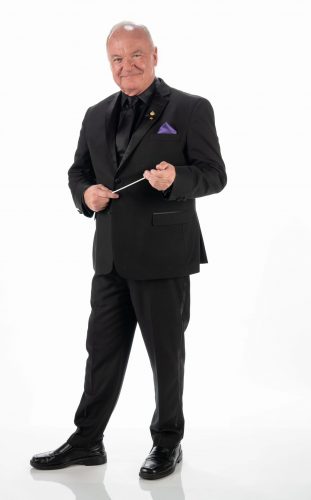
The former clarinet and saxophone player guest-conducts the nation’s top military bands and serves as chairman of the board for the American Bandmasters Association. Photo by Glen E. Ellman
Twenty-five years into his tenure, Bobby R. Francis, director of bands and professor of conducting, continues to embrace new challenges. Just as his term leading the American Bandmasters Association as president ended, Francis hosted the 2025 College Band Directors National Association conference at TCU. The prestigious event drew band directors, conductors and composers from around the nation to share in four musical days at the Van Cliburn Concert Hall, where the TCU Wind Symphony premiered four works.
When did you know that you wanted to make music your career?
I think very young, like a lot of people. I had a junior high band director — it was a kind of retirement job for him, which meant that he liked to go have a cigarette in the teachers’ lounge sometimes — and he would have me come teach the beginner classes as an eighth grader. And I was more than happy to get out of history to come do beginning woodwinds.
You were part of the Texas All-State Band in high school as a clarinet player. What led you to expand to also playing saxophone as an undergraduate at East Texas State University?
I wanted to make some money playing because I was really poor, and so I learned to play saxophone. I played sax in the jazz band all through college and then ended up getting hired by the Mal Fitch Orchestra. It was a society big band in Dallas — one of the most popular ones. Johnny Mathis came to town, we played a show; Gladys Knight and the Pips and groups like that. And then I ended up playing at Six Flags on my clarinet in the summers.
After you earned your degree in music education, you worked with the high school marching band in Richardson for one year. What was next for you?
I went back to my old high school, Trinity High School in Euless, as the assistant director. I thought I’d want to be a woodwind professor, so I started a master’s degree in woodwind performance at North Texas. I did that concurrently with teaching and playing gigs, getting back at 3 in the morning from Tulsa and getting up for 7 a.m. marching rehearsal. After five years, I got a call in the early summer from Ray Lichtenwalter, who was the director of bands at the University of Texas at Arlington, and he said, “Do you want to be the marching band director at UTA? It’s a one-year appointment, but you’ll have to have a master’s completed by the end of that first year.” So I ended up completing it at East Texas State because they were able to accommodate me with some summer classes and evening classes.
After six years conducting the marching band at UTA, you served as director of bands at East Texas State for six years. When you arrived at TCU in 2000, what were your goals for the band program?
It was an opportunity to build something. I do recall talking about a vision for the next 20 years, and it was basically build up every component of a solid band program. The thing that was here was Curt Wilson’s jazz program — that was groundbreaking. So I wanted to take that to the Wind Symphony, build that up to a very highly respected position, and to the marching band, of course, which is the most visible. All the concerts I’ve played with the Wind Symphony — it wouldn’t be as big a crowd as one football game.
Outside of musical skills, what makes for a successful member of an ensemble?
Common courtesy to their colleagues and respect for each other — I think that’s a big part of the whole culture of the ensemble and the band program at TCU. I really feel like now they’re very supportive, they respect each other, and that means in the rehearsal environment. If you’re talking because you want to talk in a rehearsal, you’re disrespecting your colleagues. If you’re not prepared when you come to rehearsal, you’re disrespecting your colleagues. So I think that beyond the musical requirements and demands, those two things are probably most important.
I think it starts with the band faculty and how we treat each other, how we treat the students. I grew up in an old-school yelling, throwing, berating kind of atmosphere — the band director you were scared to death of. I went back and taught at a school that still taught that way and I had to play that game for a couple years, and I realized this is not me, this is not healthy and this is not what I’m going to do. You can correct someone without making them feel small.
Anytime we have people on campus — I mean composers or guests for any reason — if they interact with our students, they are always very complimentary about how respectful they are, how smart they are and how much they really enjoy just getting to know the students.
How do you choose repertoire that keeps musicians interested and challenged?
It’s a balancing act of something old, something new, something borrowed, something blue. I’m trying to do a better balancing act. I tend to err on the contemporary side of things, but we do revisit the masterworks for the wind band. We just recently played “Hammersmith” by Gustav Holst, with a grad student conducting.
I think bottom line is if it has musical purpose, emotional purpose, and you get something out of listening and playing the music on a very deep level, it’s challenging at some level — it’s got to have all these factors in order for it to be something that is a meaningful experience. I don’t want to waste students’ time playing something that’s not going to have an emotional result for them, or for the audience or for myself for that matter.
Your latest recording project was released by Mark Records in May 2025; what can you share about it?
I wrote a grant proposal to record composers that have come from TCU — students who went through this program. And so we ended up with seven or eight composers, and they’re highly successful, like Kevin Day ’19. Harrison Collins ’24 is going to be a star, and then there’s Quinn Mason; we premiered his sixth symphony. So we recorded works of those composers.
Kevin Day’s trumpet concerto, called “Pyrotechnics,” we premiered it at the Texas Music Educators Association conference in San Antonio in 2020, right before Covid hit. We were going to have a recording project of it with Jens Lindemann, world-famous trumpet soloist, that spring. Of course, that didn’t happen. So we decided to make that one of the focal points for this recording project.
What does a conductor do, outside of the obvious?
The ultimate responsibility for a conductor is to represent the composer’s intent and to be a steward of the music and bring it to the audience in a meaningful way and, in the process, to the students performing the music. People ask if I practice my conducting and I really don’t anymore. I practice studying scores and hearing the sounds in my head — audiation.
When you’re on the podium or you’re rehearsing the ensemble, you’ve got to be able to hear what you want it to sound like — have that picture in your brain — and perceive what you’re actually getting, compare it to what you need it to be and then prescribe solutions to get it there. It could be technical, it could be musical, it could be expressive, and that’s the whole process of rehearsal.
I’m not an expert on every instrument by any stretch, but you’ve got to know the most common problems. So if you don’t know on flute on high F above the staff that you need to put the ring finger down to lower the pitch, it’s going to be sharp all the time, and your band’s going to sound bad.
What makes a conductor successful in communicating with musicians?
Elizabeth Green in the book called The Modern Conductor calls it impulse of will. The impulse of will is something you really can’t teach — the ability to bring people together, to make them do something in a certain way, musically, just through your presence. It’s not only arm and hand technique, it’s your face, it’s your posture, it’s everything. It’s just, “Come on!”
It’s all about trust. If you come across as fake or contrived or rehearsed, like “I’m just doing this because I stood in the mirror and I thought this is what looks good,” they see through that in a heartbeat. It’s got to be sincerity coming and going, back and forth.
What are some of the most important things you teach student conductors?
My backyard’s got, in spring, a million birds. So I record the sound and use an app called Merlin that tells you what bird’s making noise. I play the sound to the class — count how many different sounds you hear, and guess where they’re located, how close to our recorder is it. And then they listen to it again. They’re honing their listening skills and listening at a deeper level than they would normally. That’s what you’re doing when you rehearse the ensemble — the instruments are the birds. And then I play the Merlin thing and it actually shows chirp, chirp, chirp — wren. And then they know, oh, I only heard four different sounds, and there are actually nine. So they listen again.
I can’t tell them enough how important it is to study on their instrument and get better on their instrument, because musicianship is musicianship and that’s the best way to learn to express a phrase, to shape music, to know where the music’s going. If you don’t do that on your own as a performer, it’s really difficult.
How do you handle it when things don’t go as expected during a performance?
It happens all the time. Maybe somebody comes in early or late or something — do I go with the person that’s playing the solo, or do we keep the ensemble together? And you have to bring them back together sometimes. The better rehearsed they are, the less often that happens, of course.
There’s this old saying about as soon as you get on the podium, you kind of lose half your brain just because of the nerves. When you get on the podium, you’re hearing all this coming at you. You’re running through those filters in your brain, and you have to be able to respond accordingly and go with the flow.
You have guest-conducted youth wind orchestras and other student groups all over the world, from the Sydney Opera House to Pearl Harbor. Tell us about some of those experiences.
Sydney Opera House was a group of Texas kids — we brought college and high school and adults together, rehearsed a few days, flew to Australia and performed a couple of times. Same thing with Pearl Harbor. We did Fourth of July at Normandy Beach, which was very cool, very emotional.
Guest-conducting honor bands — part of that’s recruiting. A lot of the kids we have here in the program I once taught in an honor band when they were in high school. We have a real strong contingency from the Chicago area, lots from California and then a lot of Texas kids.
You’re on the podium for four hours on a Friday night and eight hours on a Saturday and a concert that night. As I get older I’ll do less of that, but it’s amazing to hear Day 1 the first note, and then 24 or 36 hours later, put on a really good concert.
“I’m not going to stop giving students these kinds of opportunities because I know how important it is to them, and they will remember that performance forever.”
Bobby Francis
You recently concluded your term serving as president of the American Bandmasters Association, which included running the annual convention. What was the significance of serving in that role?
It’s an honorary organization that requires a very extensive, successful career before you’re even considered to be a member. This year, for example, I think there were 13 nominees — this is in the entire country and Canada — and six of them got in, just to be members. That happened in 2003 for me. I have been a member ever since and somebody nominated me to be an officer, and I got voted in as president. First, vice president, then president-elect and then president; it’s a five-year cycle of leadership with the organization. I’m now chairman of the board, and I’ll have another year after this one.
I think in Texas there are probably somewhere around 18 ABA members, and we have one of the largest contingencies and the most band directors in the country. Just being invited to be a member — I made the old joke, “I used to have great respect for this organization till you had me as a member.” So that just stunned me. And then to be president of that group is just something I would never have imagined.
What’s it like to guest-conduct some of the nation’s top military bands?
Those are invited performances for me to conduct, like Hindemith’s Symphony, last movement, with The President’s Own Marine Band a couple of years ago. Last year, I conducted the Pershing’s Own Army Band — it’s part of being an American Bandmasters Association president. The outgoing president conducts the national anthems for the U.S. and Canada at the beginning of a concert.
If you’re with the President’s Own or Pershing’s Own, you give the downbeat, and they sound wonderful. These are people that could be playing in the Chicago Symphony or the New York Philharmonic, but they prefer and audition for and were admitted to the President’s Own, for example. So that becomes a matter of what do I bring to them musically that might be different than what they’re used to?
How do opportunities to interact at major conferences impact music students?
As I told the Wind Symphony the other day, bragging about how well they did at the College Band Directors National Association conference, not only performing but helping to run the show, “I think the worth of your degree went up based on what you just did, because everybody was knocked out.”
We’re looking to hopefully perform at the Texas Music Educators Association conference in San Antonio next year, possibly combined with our choir. I’m not going to stop giving students these kinds of opportunities because I know how important it is to them, and they will remember that performance forever.
Editor’s Note: The questions and answers have been edited for length and clarity.

Sawyer Strosnider’s athletic foundation began with early exposure to gymnastics and soccer before he committed to baseball. Courtesy of TCU Athletics
By the end of his first Horned Frog season in 2025, Sawyer Strosnider had established himself as one of the country’s most dynamic offensive threats. He set a single-season program record and led the nation in triples, becoming only the fourth player in the past 24 years to collect a quadruple-double with 13 doubles, 10 triples, 11 home runs and 10 stolen bases. The 6-foot-2 outfielder was named the National Collegiate Baseball Writers Association Freshman Hitter of the Year and a second-team All-American. He earned All-Big 12 first team honors as a 19-year-old.
Things didn’t start out that way. Strosnider struggled at the plate through the first three games of the season’s opening series at San Diego, but he broke out in the fourth. The momentum carried into the following week during the Amegy College Baseball Showdown at Globe Life Field in Arlington, Texas, and the rest is history.
The early surge set the tone for a season in which his resilience showed up in more ways than one, his toughness evident after he lost a tooth running into the right-field fence attempting to catch a fly ball in April. Strosnider enters his highly anticipated sophomore season intent on leading the team to Omaha for what would be his first — and the Frogs’ seventh — College World Series appearance.
My father played baseball at Morehead State, so I knew when I was younger that I was going to be a baseball player. My dad actually bought me a right-handed glove when I was born, but I turned out to be left-handed. That was tough for him because he was a catcher, and lefties don’t catch. But we figured it out.
When I was younger, I always played with older kids. When I was 9, I was playing with 12-year-olds and so on. But after moving from Ohio to Texas when I was 10, that’s when it was like, you need to take the next step, and I started playing summer ball.
I didn’t know what I was going to do for college, but the goal was baseball. In high school, I started getting looks from colleges, and then I really knew, this is legit and I can play for a career.
There would definitely be a Saturday morning game — get breakfast with the fam, play and then go to a Reds or Rangers game. That was always the best; we’d play in the morning and then go watch our favorite players.
It was always Ken Griffey Jr. My dad was always like, ‘Watch this guy.’ So I was always watching his highlights.
When I was younger, I always did gymnastics and soccer. I think those have been the best sports for my development. I weeded them out towards third or fourth grade, but I think those were two really big sports that helped me become aware of my body and make me athletic.
I played football in junior high, but it took up too much time, and I wanted to be able to do basketball, baseball and track. Then, when it got serious with baseball, I had to cut down on some sports. But, for sure, play everything you can.
My parents were always taking me everywhere I needed to go, no matter what the cost was or where I had to be. They were gonna be there. They were gonna get me there. Flight, drive, anything.
And then my brothers: One, Seth, has Down syndrome. That’s a thing for me, knowing he can’t do what I can do. So I need to be my best at everything and make sure I show him, this is what it looks like. And he never has a bad day. So I don’t let things affect me, either.
My other brother, Sutton, is setting a good example for him, too, showing that if you work hard at everything you do, this is the stuff that comes with it.
I love being around those kids. It makes your day better, it makes your week better. I don’t get to do it as much, but in high school I would go every Saturday to Seth’s game and be a “buddy” and pick a kid just to hang out with throughout the game. And it really shows you how hard life can be and the things that you can’t take for granted. We have it easy, and they know how to have a good day no matter what they’re going through: illnesses, struggles. Our struggles are very minor compared to theirs.
Sleep and time management. We have class for maybe three hours a day, but team lifts start at 6 a.m., four days a week. To get the sleep you need, you’ve got to finish your homework and be in bed by 9:30 — otherwise you’re not getting the recovery you need.

Sawyer Strosnider homered in his first at-bat of 2026, giving the Frogs an early advantage in an eventual season-opening win over a top 25 team in Vanderbilt. Courtesy of TCU Athletics
The Fellowship of Christian Athletes — that’s every Monday. I like going there; a lot of the baseball guys go. It’s a group of all athletes. God plays a big part in my life, so it’s just making sure I know that he’s first.
I think being a freshman doesn’t really mean much. Yes, you’re younger, but you’re treated like the older guys. You’re expected to lead when you need to lead. So, freshman, really, just indicates your age. It doesn’t determine your rank on the team.
I think we do a pretty good job of showing it out on the field, so I don’t know if it’s something you wouldn’t guess, but we’re family. We’re with each other all the time, no matter what. We’ve always got each other’s backs.
I’m attempting to play the guitar right now. Attempting to play the guitar, just for the past couple of months. I got a couple of songs, but not many.
This one’s a little weird, a little gross, but when I get to the facility, I do not wash my hands before a game. No matter what I do, I’m not washing my hands. ‘Don’t wash the luck away.’
“You gotta really make sure you’re focused on the little things because one little thing can screw up a lot. It could be a bunt that either wins you the game or loses you the game.”
Sawyer Strosnider
Getting through those first couple of weeks of the season. I struggled a lot at first, thinking I needed to do too much and not staying within myself. Being a freshman, I felt like, “I’ve got to prove I belong here,” but the coaches already said I had proved myself in the fall. Getting through that and moving forward is something I’m proud of, because failure’s tough and can get to a lot of people. I just stuck with the process and got through that.
You gotta really make sure you’re focused on the little things because one little thing can screw up a lot. It could be a bunt that either wins you the game or loses you the game.
Just having another great season. We came up a little short last year because we didn’t do too well in that regional, but a goal that I’m excited for is getting to Omaha. We have to make sure we take care of the business now, but I think we have a good shot of getting there.
Editor’s Note: The questions and answers have been edited for length and clarity.
For selling fentanyl to a person who overdosed and died, a convicted man was sentenced to 20 years in prison. When 219th District Court Judge Jennifer Edgeworth ’96 of Collin County, Texas, announced the punishment, she said, the man’s kin wept over the double tragedy.
Edgeworth handed down that hard sentence shortly before striding into another proceeding, this time with the Collin County Adult Mental Health Court, with very different outcomes.
If there is a happy place in the criminal justice system, for Edgeworth and Judge Lance Baxter ’83, who presides over the Collin County Court at Law No. 3, it’s the county’s adult mental health court. Co-founded by that duo three years ago, its results in keeping offenders with mental health disorders out of incarceration won the Judge Ruben G. Reyes Outstanding Specialty Court Team Award in 2025 from the Texas Association of Specialty Courts.
Baxter credits Edgeworth with persuading the local district attorney to partner in establishing Collin County’s first adult mental health court. Before meeting Edgeworth, Baxter had spent years lobbying for one. Edgeworth held more sway with the district attorney, Baxter said, because her court is a tier higher than his.
She demurred. Baxter’s years of making the case for the court, Edgeworth said, paid off. Mutually, they’d primed the district attorney to give the go-ahead.

219th District Court Judge Jennifer Edgeworth described the Collin County Adult Mental Health Court as “not a typical courtroom setting where people are advocating against each other.”
The judges met in 2018 when Baxter, already elected to the bench, moderated a candidates’ debate during Edgeworth’s first campaign for a district court judgeship.
“I leaned over and said, ‘Go Frogs,’ ” Baxter recalled, chuckling.
He and Edgeworth are paid to adjudicate cases in their regular courtrooms. But they also preside over the mental health court. Each month, they invest 14-20 hours holding sessions, reviewing files, meeting with staff and spreading the word about specialty courts to legal and mental health professionals and other groups.
In the special court, they function as law-minded jurists but also cheerleaders, job advisers and personal coaches.
“They are empathetic and approachable, cultivating a fair, person-centered environment where participants feel heard, respected and motivated to make meaningful changes. They’re perfect for the role they have,” said Janessa Reid, the court’s program coordinator. She added that their commitment to breaking the cycle of incarceration has shaped a program that prioritizes treatment over punishment and supports individuals in finding a sustainable path forward.
“We want to keep these individuals from cycling in and out of the criminal justice system,” Edgeworth said. “There is an opportunity to truly help them and see a lasting and positive change in their behavior and choices.”
Twice-monthly, roughly two-hour sessions at the mental health court let the judges dig deeper into the lives of people whose criminal charges they aim to ultimately wipe from the public record.
Court participants are diverted from a trial, potential conviction and incarceration after applying — sometimes at the suggestion or demand of defense attorneys, prosecutors or family — and being screened for the special program. Who gets accepted is determined on a case-by-case basis, with input from the district attorney’s office.
Participants’ criminal charges vary: felony assault against a hospital worker or loved one, misdemeanor theft, resisting arrest and more.
Ineligible for the program are those with current or prior charges or convictions for sex offenses or illegal drug manufacturing; those with pending charges or arrest warrants outside Collin County; or those on parole, probation or some other form of justice supervision.
The Collin County court’s current 14 enrollees and 42 graduates struggle with post-traumatic stress disorder, bipolar disorder, schizophrenia, depression, anxiety and other chronic mental illnesses. Participants include corporate executives, budding cosmetologists, cybersecurity students and stay-at-home moms. Among them have been a Sept. 11 first responder at New York City’s twin towers and a guy getting by on what he earns mowing yards.
Some who have been accepted into the program, which takes nine months to two years to complete, were suffering their first psychotic break when they were arrested. Sometimes, their arrests uncovered their lack of access to medical care or a lack of adherence to or understanding of an existing mental health prognosis and care plan.
One participant sought emergency medical care after his first major psychotic episode. Thinking he no longer needed it, he’d stopped taking the medicine prescribed for him. Months later, after another episode resulted in a run-in with law enforcement, he learned that he’d likely have to take medicine for the rest of his life.
“It’s a great opportunity for people to get the help they need,” said Reid, former director of community integration of the Denton County MHMR Center. “It allows us to approach each situation from a trauma-informed perspective — not to judge, but to create a safe space where participants can share what happened and explore how we can best help them.”
“In the past, individuals in similar situations would typically go through the traditional process and be placed on standard probation,” said Michelle Garcia, the mental health court’s probation officer. “It was difficult to watch that happen to someone experiencing their first offense during a mental health crisis, only to leave the system with a criminal record. That record follows them into the community, creating barriers to employment, housing, education and even basic stability. Through this program, individuals receive a meaningful second chance — one that supports recovery rather than punishment.”
On a fall Thursday, a teacher, a corporate sales manager, a restaurant server and an oil change tech were among the 16 people updating the judges on how they were faring. The youngest was 18, the oldest in her 50s.
From chairs usually reserved for a courtroom trial audience, they waited to be called by name to sit casually at a conference table. Baxter and Edgeworth sat across from them. The judges and individuals discussed mundane and serious issues. There were new puppies, new tattoos, a newly discovered lavender essential oil’s relaxing effect. There was a just-ended romance where things had turned toxic.
The judges made comments and asked questions. Was everyone adhering to their individualized, mandatory treatment plan of regular meetings with case managers and probation officers? Were they avoiding alcohol, cannabis products and illegal drugs? Had they passed random drug tests and attended behavioral support groups?
Were folks taking antipsychotics, antidepressants and other medicines only as prescribed, not misusing them? Who among them had kept or missed an appointment with the psychiatrist?
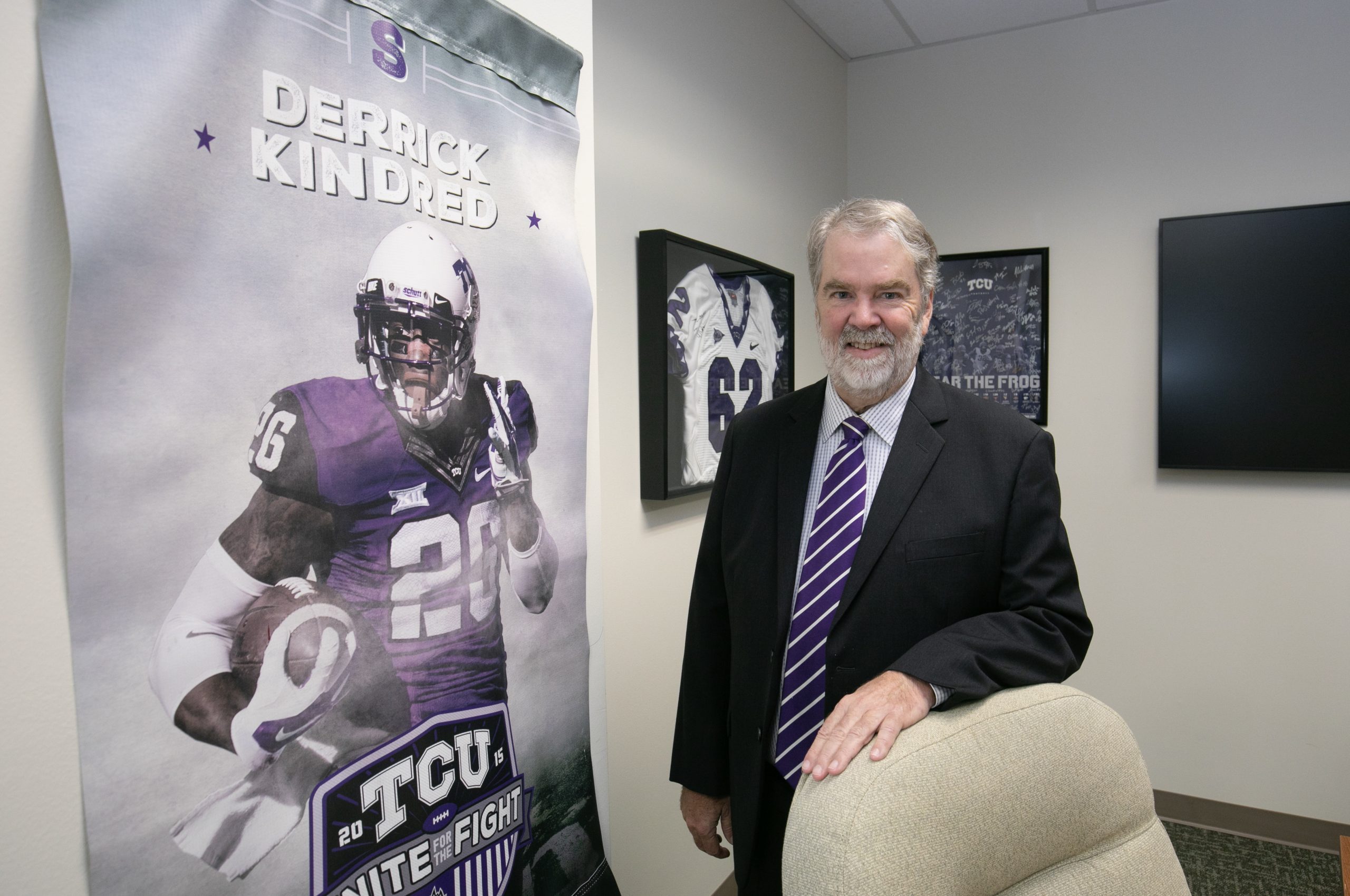
Judge Lance Baxter displays his TCU pride in his office, the same school spirit that led him to whisper “Go Frogs” when he first met Jennifer Edgeworth at a 2018 debate, years before they’d partner to create Collin County’s mental health court.
One man said his boss wouldn’t change his work hours. The man missed a medical appointment but promptly rescheduled it for an upcoming day.
“Thank you for being so forgiving and faithful with me,” he told the judges.
Violating the rules can get a person kicked out of the program.
“I have very good news,” another man said when it was his turn. “I got a job.”
Everyone applauded.
The encouragement continued when a newcomer sat down.
“We try to do it differently,” Edgeworth told the woman. “We’re at a roundtable because we want you to know and feel that we are all invested in wanting you to succeed. So, it’s not a typical courtroom setting where people are advocating against each other.”
Edgeworth and Baxter said they are glad to be part of a nationwide movement that, since 1990, has launched more than 4,000 diversion courts for veterans, juveniles, families, members of Native American tribes and people with substance use disorders.
Diversion courts aim to be more humane, Baxter said, and to cut incarceration costs. That includes the average of $175 per day in Texas that it costs to detain a person whose untreated mental illness or addiction can fuel their crimes and lead them to cycle in and out of jails and prisons.
“There’s been a social shift,” Baxter said of the rise in treatment courts. “There is much more of an interest in doing things differently.”
Nationwide, about 60 percent of diversion court participants completed program requirements in 2022, according to a 2025 National Treatment Court Resource Center report. Collin County’s achievements mirror that. To date, 42 of 60 people admitted to the program — 148 have applied — graduated. Of those who didn’t cross that finish line, some were discovered to have resided outside the county. Some didn’t pass drug tests. Tragically, one person died by suicide.
Nationwide, people in their 20s and 30s make up 57 percent of program enrollees; 73 percent are men.
“This work is not only about reducing recidivism. It’s about restoring hope.”
Judge Jennifer Edgeworth
As a testament to what’s possible, Edgeworth shows off a March 2025 mental health court graduation day photo of herself and a young man. They are standing side by side, smiling. He has an arm around her shoulder, she drapes one across his back. He’s wearing khaki pants, an Oxford button-down shirt, white sneakers, a fresh haircut.
When he arrived in mental health court in April 2024, Baxter said, “He wasn’t taking showers. He had a huge beard that was all over everywhere. Poor hygiene is a classic symptom of mental illness.”
“He was,” Edgeworth said, “very disheveled and very broken and very angry.”
He’d faced a misdemeanor charge for making a terroristic threat against a relative. He’d been downing a cocktail of 15 stimulant pills a day, triggering psychotic rages and getting him fired from jobs.
In mental health court, he followed the tailored plan. He took prescribed medicines for his diagnoses of bipolar disorder, major depression, anxiety and attention deficit hyperactivity disorder. He got steady enough to go back to work, first as a restaurant line cook. In January 2025, he went on the payroll as a director at a marketing firm.
He was moving toward his former self. He’d been a businessman and podcaster. Over the previous Christmas holiday season, he reconciled with his family.
“Our approach recognizes that participants are more than their cases,” Edgeworth said. “They are individuals navigating complex mental health needs who deserve compassion, understanding and the opportunity to rebuild their lives.
“This work is not only about reducing recidivism. It’s about restoring hope.”
WHEN YOUR COMPANY’S MOTTO IS “WE’RE IN BUSINESS TO SAVE OUR HOME PLANET,” sustainability isn’t just a goal, it is a core value. Patagonia, the American outdoor retailer, is as well-known and respected for its activism on environmental issues as it is for its durable, high-quality clothing and gear.
As head of environmental impact for Patagonia, Kim Drenner ’08 (MS ’10) leads initiatives to reduce pollution and carbon emissions and to strengthen environmental accountability and awareness. Her impact ranges from Patagonia’s own facilities to its global supply chain and ripples across the outdoor goods industry.
Drenner grew up in Arlington, Texas, in a family who loved the outdoors. She was awed by the high desert landscape of Taos, New Mexico, where her family frequently skied. During annual family trips to Hawaii, she explored the reefs and the rainforest.
Arriving at TCU in fall 2004 as a soccer recruit, Drenner played for the Horned Frogs and planned to major in journalism. But that changed after she took a course in contemporary issues in environmental science taught by Mike Slattery, professor, director of research in the Ralph Lowe Energy Institute and director of the Institute for Environmental Studies.

Kim Drenner helps shape efforts to reduce the environmental impact of apparel manufacturing industry-wide.
“Mike is such a charismatic, passionate individual and scientist, always so inspiring,” Drenner said. “He is always thinking creatively about how to get students engaged.”
The following summer, she joined Slattery’s study abroad course in Costa Rica, where she visited a remote research station in a cloud forest.
“It was so insightful to not only see the beauty in nature,” she said, “but to understand the issues the country was managing in transforming from a resource extraction-based economy [farming, logging] to an ecotourism-based model as a way to protect the landscape.”
That pivotal experience spurred her to major in environmental science — and to help write a grant that secured funding to maintain the research station for TCU students.
Drenner took an internship during her senior year as an environmental, occupational health and safety associate at Fort Worth’s Bell Helicopter.
“That was a great experience in understanding how a company manages their environmental footprint,” she said, “and how you get the people making the product, versus the executives, to care.”
Two opportunities enticed Drenner to stay at TCU for a master’s degree.
First, Slattery invited her to study abroad in England at the University of Oxford’s Environmental Change Institute. She heard lectures by world-renowned scientists and attended her first climate change protest, held at a self-sustaining village constructed by activists next to a proposed fossil energy project.
Second, she returned to the research station in Costa Rica. For her thesis research, she rose at sunrise each day to survey trees in the dense forest as part of her analysis of biodiversity. She evaluated whether a payment system for biodiversity could incentivize landowners to keep their forests intact instead of clearing them for industry.
“Kim was curious, an important trait for any student,” said Slattery, who served as one of her thesis advisers. “She was also hardworking and engaged. But if I had to sum up her traits in one word, it would be ‘resilience.’ She never once said, ‘Oh, I can’t do that.’ She just found a way.”
Drenner gravitated toward environmental compliance thanks in part to another TCU mentor: Becky Johnson ’95 MS, a professor of professional practice with a long career in environmental consulting. Johnson taught her about environmental management systems and how to address pollution from industry, which would become fixtures of Drenner’s career.
In 2012, Drenner took a job in Vancouver, British Columbia, joining the climate change and sustainability services team at EY, formerly known as Ernst & Young and one of the Big Four consulting firms.
Over four and a half years, she audited and advised large companies across Canada, working in industries including mining, oil and gas, government, finance and forestry. “I feel like I got to see more of Canada than a lot of Canadians,” she said, “always during the coldest time of year, too.”
“I asked, ‘Why are we talking about using carbon offsets when we’re still polluting halfway across the world in our supply chain?’ ”
Kim Drenner
She visited remote industrial facilities to see their manufacturing processes firsthand and evaluate their pollution management practices.
“The Big Four audit process is very rigorous,” she said, explaining that it requires quickly learning the technicalities of each industry enough to ask precise questions about the source, measurement and integrity of emissions data. “You have to be very open to digging in, asking a ton of questions and learning from everyone around you. I feel that has helped me as I’ve progressed in my career.”
As a longtime Patagonia customer — the quarter-zip R1 Air fleece is her favorite piece — Drenner was thrilled to join the company in 2018 as a supply chain environmental responsibility manager at its headquarters in Ventura, California.
“I felt like the position was written just for me,” she said. Her EY experience prepared her well for improving Patagonia’s process for auditing its vast supply chain. “Most people don’t realize we don’t own our supply chain,” Drenner said. “These are all completely separate businesses, and, in most cases, we are less than 5 percent of their total production.”
Patagonia’s supply chain includes dozens of suppliers worldwide. They are all vetted and audited for environmental impact.
In her first year, Drenner traveled the world, including to Morocco, Mexico, Spain and Portugal. One of her most memorable site visits was in South America, where she was excited to see that a supplier was using high-quality regenerative organic-certified cotton but alarmed to discover a potential spinning and dyeing vendor was discharging hazardous wastewater.
“It was so motivating to hear our owners say, ‘We won’t make this product until we can get the supply chain right,’ ” she said.
It took about five years to find an alternative supplier in the region that could meet Patagonia’s environmental standards.
“When you see suppliers whose values are aligned with ours, who go back and make the investment to get where we want them to be, that’s so impactful,” Drenner said. “It helps the industry, because we do so much groundwork that benefits all the other brands.”
On the Outdoor Industry Association’s Sustainability Advisory Council, Drenner has collaborated with peers from other brands, both large and small, on reducing environmental impact.
After serving as Patagonia’s head of supply chain environmental responsibility for two years, Drenner was promoted to head of environmental impact in 2022.
She now leads a global team that measures Patagonia’s environmental impact and implements programs to reduce that impact. Drenner served as an adviser on the Fashion Acts, legislation in New York and California aimed at increasing accountability in the fashion industry. She also partners with Patagonia’s product teams to source more sustainable materials and with the marketing team to ensure that all environmental claims are accurate and verifiable.
“We try to keep the company honest and truthful because this is an industry where there is a lot of greenwashing,” she said. “Greenwashing is saying your company is doing something sustainable when it isn’t.”
Drenner’s proudest achievement is a large-scale decarbonization effort to reduce emissions from the material manufacturers that account for some 90 percent of Patagonia’s carbon footprint. The company considered using carbon offsets, such as reforestation, to balance out emissions. “I asked, ‘Why are we talking about using carbon offsets when we’re still polluting halfway across the world in our supply chain?’ ” she said.
She worked with Patagonia’s executive team and finance department to create an internal impact fund to enable Patagonia’s decarbonization work, supporting suppliers by covering 100 percent of the costs of conducting energy and carbon audits, adopting renewable energy sources, and switching their boilers from coal to electric. Patagonia, in partnership with the Outdoor Industry Association, sponsored first-of-its-kind research to ensure electrification could work in the textile industry, then shared its findings with the public.

Drenner partners with the Outdoor Industry Association to share Patagonia’s research and best practices publicly, leveraging the company’s influence to push competitors toward stronger environmental standards.
“This is an incredibly complex challenge that most would expect to take years, but Kim developed and implemented a plan in under two years,” said Eric Cheng, a supply chain environmental impact program manager who has worked with Drenner throughout her tenure at Patagonia. “The project reflects Kim’s signature working style: thorough research, strategic planning and actionable solutions to address some of the most complicated environmental issues.”
Drenner and her team are propelling the company toward an ambitious goal of net zero emissions by 2040. She hopes other outdoors companies will continue to follow Patagonia’s lead on decarbonization and amplify the positive environmental impact for everyone’s home planet.
“Our voice, our influence in the industry is massive,” Drenner said. “People listen to us; we don’t take that for granted.”
This is the fourth in a series of visits with regional TCU alumni chapters and clubs.
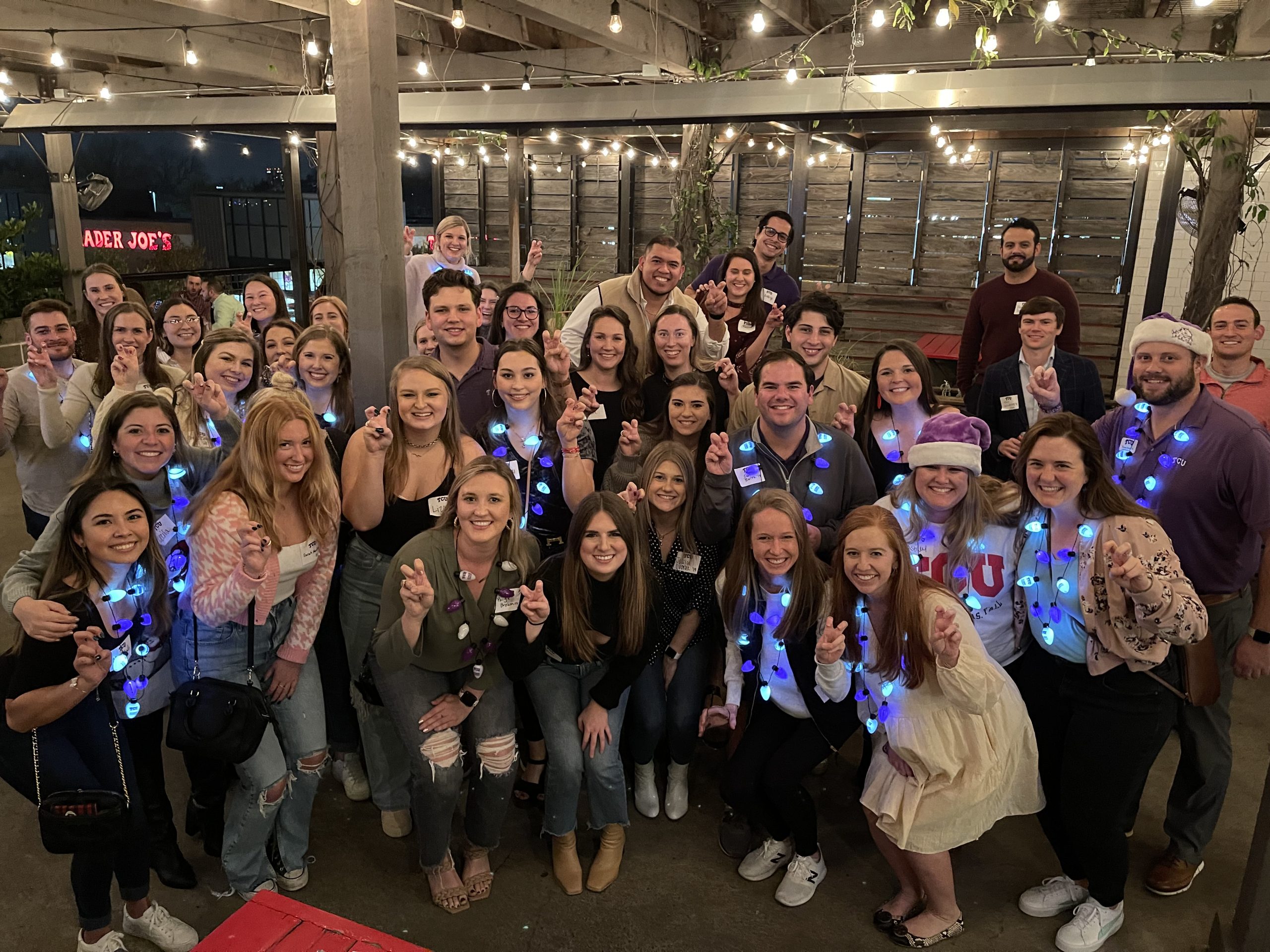
Dallas Chapter President Blair Jones ’14 said the group balances social outings, community service and game-watching parties. “It’s an approachable group,” Jones said, “that has a variety of unique ideas to get alumni together.”
Courtesy of TCU Alumni Association Dallas Chapter
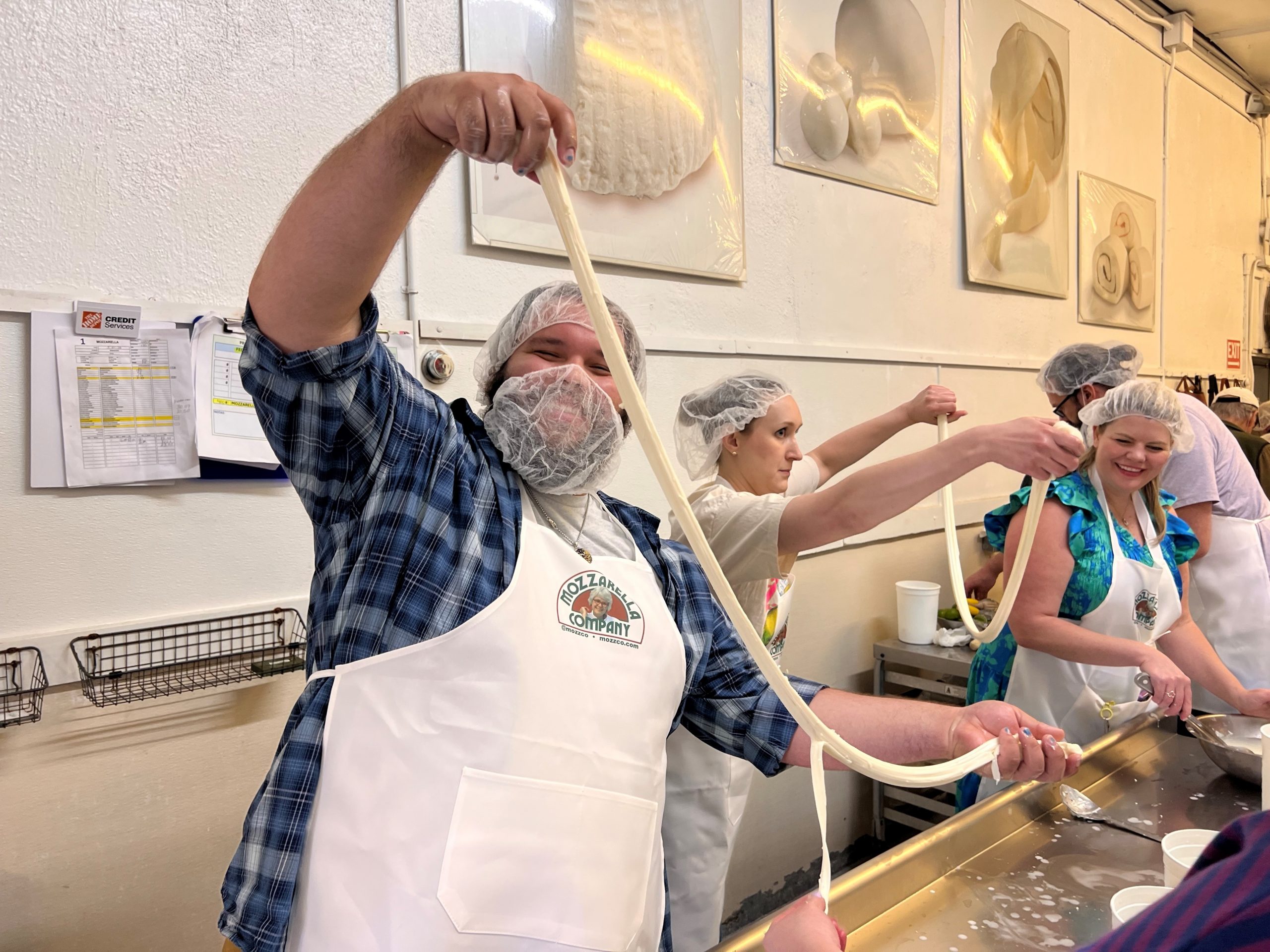
Alumni met at Dallas’ Mozzarella Company for a hands-on cheese-making class, crafting their own ricotta and fresh mozzarella.
Courtesy of TCU Alumni Association Dallas Chapter
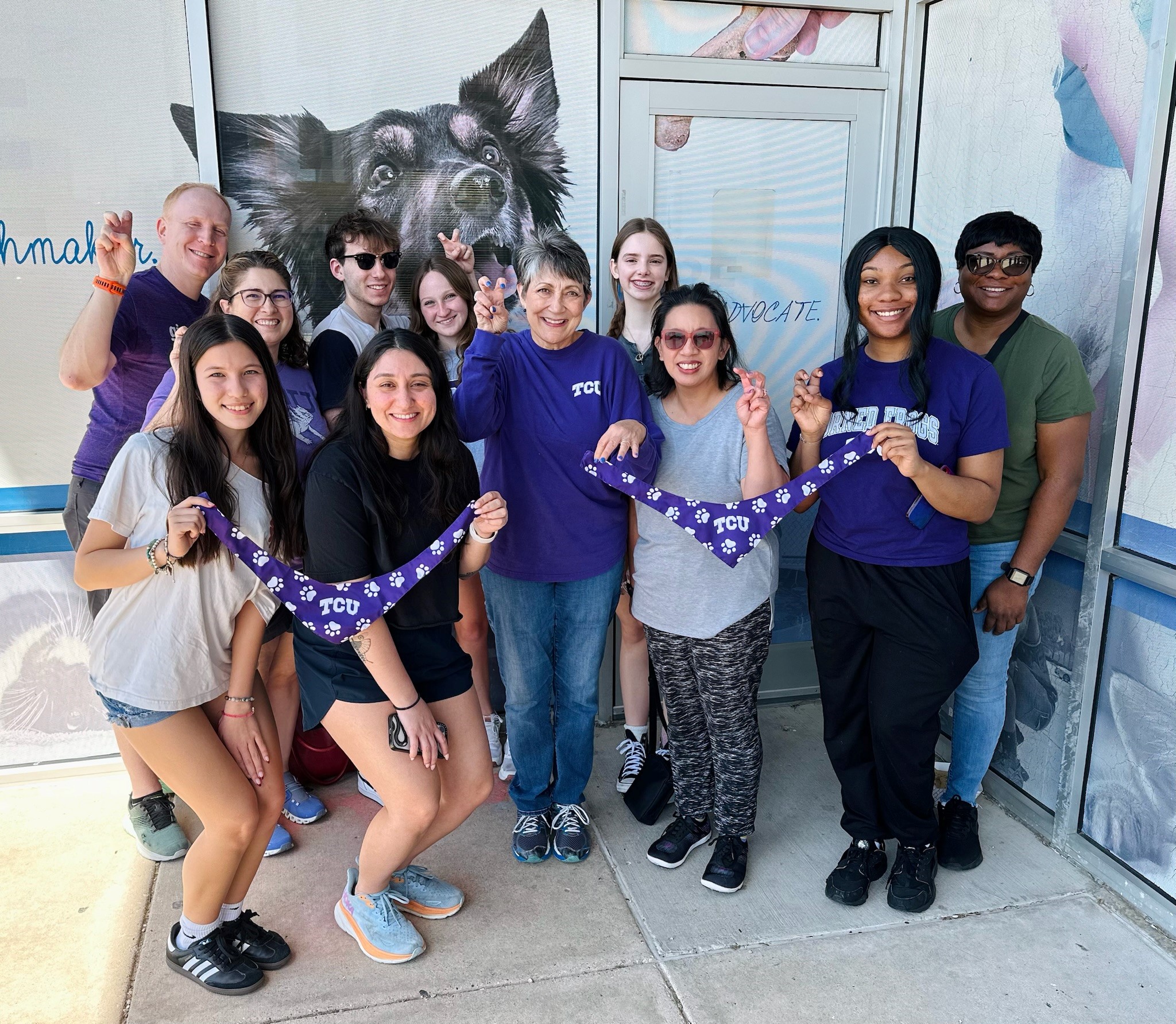
At Dallas Animal Services, alumni walked dogs, donated TCU bandanas and photographed pups for the shelter’s website to encourage adoptions.

Courtesy of TCU Alumni Association Dallas Chapter
Every December, alumni and their families mingle with SuperFrog Santa at the Dallas Arboretum and walk through the “12 Days of Christmas” exhibition.
Courtesy of TCU Alumni Association Dallas Chapter
Members of Dallas Young Alumni — a group for those who graduated in the last decade — join many chapter events and host happy hours of their own.
Dallas alumni host new-to-town Horned Frogs at the Texas Ale Project during the Nationwide Welcome Happy Hour, often with a visit from the Salsa Limón truck.
During football season, the Dallas chapter and Dallas Young Alumni get together for game-watching parties at the River Pig Saloon.
This is part two of our TCU Horned Frogs baseball preview series.
The TCU Horned Frogs enter the 2026 season with high expectations. A team boasting three reigning All-Big 12 players has a target on its back on the conference and national levels after reaching regionals last year for the 18th time in the last 21 postseasons. The Frogs are preseason favorites to win the conference in the 2026 Big 12 Baseball Preseason Poll conducted by league coaches, receiving 13 of 14 first-place votes.
One of the most important relationships in baseball is the chemistry between the middle infielders.
True freshman shortstop Lucas Franco told assembled media that, “expectations are a distraction.” He’ll have to find a way to manage them, as he was selected preseason Big 12 Freshman of the Year. The Katy, Texas, product attended Cinco Ranch High School and was the No. 5 prospect in the state of Texas according to Perfect Game. The 6-foot-3 left-handed hitting shortstop hit .413 his senior year with 13 extra-base hits. With last year’s shortstop Anthony Silva drafted to the Cleveland Guardians, there is a hole looking to be filled, and Franco has a chance to make an impact there immediately.
Second base is a different story. Cole Cramer, a graduate student from Arlington, Washington, is the only returning Horned Frog to play in and start in all 59 games last season. Last season, he hit .320 with 14 extra-base hits and drew the most walks on the team with 43. Cramer is one of the veteran leaders on this young roster.
When Franco was asked about how he had settled into being around the team in his first year, he said that Cramer, “was a guy that took me in and showed me the ways.”

Trever Baumler is among the young arms TCU will rely on to solidify its pitching staff this season. Courtesy of TCU Athletics
Pitching depth is critical in college baseball, and the Frogs will be tested after losing senior Louis Rodriguez to Tommy John surgery.
The No. 1 question mark for this Horned Frogs team? Pitching development. Tommy LaPour will be the Friday starter, but the Frogs have multiple talented young arms looking to build upon last season.
Sophomore Mason Brassfield looks to build on a productive freshman year where he provided 61 and two-thirds innings with a 4.09 ERA and a 25 percent strikeout rate. The crafty left-hander from Bakersfield, California, was named a Perfect Game Second Team All-American last season.
Another pitcher TCU will call upon to provide some length is sophomore Trever Baumler. Hailing from Urbandale, Iowa, he has a mid-90s fastball that he pairs with his breaking ball. His brother, Carter, was a fifth-round pick of the Baltimore Orioles in 2020.
The Frogs face a brutal early schedule that will test their credentials as a Big 12 and, potentially, a national contender. TCU plays No. 23 Vanderbilt, No. 7 Arkansas and Oklahoma on consecutive days (Feb. 13-15) at Arlington’s Globe Life Field in the Shriners Children’s College Showdown. Then comes a trip west to face No. 1 UCLA in Los Angeles the following weekend. Beginning the season with these opponents will ensure that Kirk Saarloos’ team is tested before starting Big 12 conference play.
The Horned Frogs, led by coach Saarloos, win the Big 12 Championship and advance to the College World Series for the first time since 2023. TCU has the roster to live up to expectations, and its gauntlet of a non-conference schedule will have them battle-tested for the postseason.
— Grant Harris
THANK YOU FOR YOUR TRUST, TCU.
As I step into the role of TCU’s 11th chancellor, I am deeply grateful for your confidence and for the privilege of leading this remarkable community.
My late father, Gary, was one of those rare people who put others first and made everyone around him feel more capable. His example of selfless service continues to shape how I lead. To invest in TCU is to embrace the responsibility of servant leadership, which means listening first, empowering others and leaning into courage and humility.
That approach strengthens not only our work but also our shared purpose, which is to prepare students not just for meaningful careers but for lives defined by integrity, leadership and service. Education is about more than what we know — it is about who we can become and the difference we can make.
The TCU of today and tomorrow is a place where purpose is honored, curiosity is celebrated and our founding tradition of investing in others carries forward. This community has invested in me more than anywhere else, and it is now my privilege to serve deeply alongside all of you.