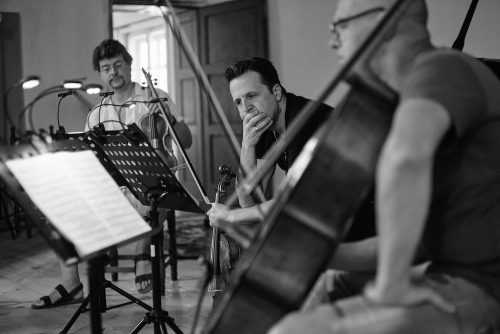
The Van Cliburn Concert Hall at TCU and its home, the TCU Music Center, have proven transformative for the School of Music, bringing students expansive rehearsal spaces, private practice rooms and a beautiful new venue. Construction crews spent more than 600 days building the TCU Music Center, which opened in fall 2020; the Van Cliburn Concert Hall hosted its first concerts in spring 2022 and will feature some 300 performances annually.
The concert hall’s design is all about the musical experience. Principal architect Michael Tingley said that a “ring of circulation space” separates the hall from rehearsal rooms; the space also has an acoustic isolation joint in the floor.
“These two design and construction details prevent any sound that may be occurring elsewhere in the building from sneaking into the concert hall,” Tingley said. Inside, the space envelops the audience in sound and style. “Oak creates a warm feeling to the room, like being inside a musical instrument.”
— Compiled by Heather Hughston and Laura Samuel Meyn
The danger comes from ransomware carrying silly monikers — NotPetya, WannaCry, AstraLocker and Xing Locker, among others. But the damage can be serious and costly. In January 2022, technology firm Accellion paid clients $8.1 million for a data breach caused by hackers. In 2017, NotPetya disabled Merck’s computers, costing the pharmaceutical firm an estimated $870 million, in large part because production of a vaccine against the human papillomavirus was halted. Hospital systems, a critical pipeline, a major shipping line, sheriff’s departments and countless corporations have all been shut down by internet attacks.
Institutions of higher learning haven’t been spared. In 2020, the University of California, San Francisco paid a $1.14 million ransom after hackers calling themselves the NetWalkers froze academic files.
A ransomware payment compounded by the Covid-19 pandemic led to the closing of a historically Black college in Illinois. Lincoln College wasn’t alone. The New York Times reported 1,043 U.S. schools, including 26 colleges and universities, were the victims of ransomware attacks in 2021. TCU has beefed up security against the growing threat. The campus employs state-of-the-art strategies to protect its computer network from frequent hacking attempts. Faculty members have won federal grants to craft online cybersecurity labs — now used by students on at least three continents. And the Neeley School of Business requires business information system majors to take a course on cybersecurity. Some get snapped up by firms in the burgeoning field.
Cybercrime is a threat to most facets of 21st-century life. Staying safe from computer-related harm requires everyone to be a sentinel and to use the internet with safety in mind. Careless choices in the cyberworld can lead to catastrophic consequences in the physical one.
Anatomy of a Cyberattack
TCU’s technological defense team keeps the digital infrastructure secure.
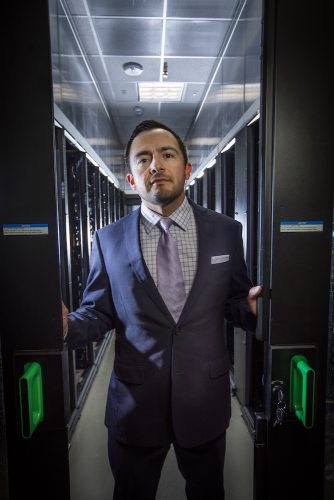
Aaron Muñoz ’04 (MBA ’16) makes one thing clear: In the chaotic world of internet attacks, even educational institutions like TCU are targets of opportunistic hackers.
Cybercriminals can be just about anywhere, said Muñoz, assistant director for IT security at the university. During a two-day period in March 2022, he said, “We witnessed 18,000 different computers trying to hack into TCU computers.”
Thousands of those attempts originated in the United States; hundreds more arrived from Brazil and Mexico.
Aaron Muñoz and colleagues in the information technology division repelled a hacker’s brute force attack on TCU’s computer servers in March.
Muñoz said he believed that someone, perhaps in Russia, had marshalled thousands of computers by infecting them with malware and launching them as an army of bots. The hijacked machines used stolen or compromised usernames and passwords to try to gain access to TCU’s network in a brute force attack.
But Muñoz and his colleagues in TCU’s information technology division had armed the university’s network with an account lockout mechanism. By limiting the number of incorrect password guesses that could be submitted in a stretch of time, assaults were slowed to the point that brute force attacks were computationally infeasible.
The hackers “didn’t overwhelm us. They were guessing passwords and didn’t get a single one,” Muñoz said. “Part of the reason for it is our password policy. We enforce what’s called a lockout. After five incorrect password [tries], your account will lock, and it’ll stay locked for five minutes.
“A guess every five minutes slows the attackers’ efforts down to a crawl,” Muñoz said, “as opposed to a million guesses per minute.”
Across campus, students, faculty and staff passed by, unaware of the drama playing out in an anonymous-looking ground-level office in the Sid W. Richardson Building.
Muñoz said the first hint of an attack came on the night of March 22, when he noticed that he was locked out of his own TCU email account. His account was unlocked in five minutes when the system automatically reset, he said. “I thought it was just an anomaly.”
But the next morning his office received more than 10 calls reporting account locks. “That grabbed our attention and started us asking questions and digging further,” Muñoz said. “What were they after? Was it just nuisance, or were they trying to get personal information?”
His team didn’t know how malicious the breach attempt was. “It can be any number of things. This was not a phishing attack, where they come in and use these email accounts to send more spam or phish other organizations to basically harvest more accounts.”
Capturing a tcu.edu email address gives legitimacy to a fake message. “Every organization is vulnerable to this,” Muñoz said. “So that’s one potential goal of an attack.”
Or the hackers’ intention could have been to access TCU systems by exploiting the victim’s mailbox and contacts.
More worrisome, Muñoz said, is the fact that a mailbox can be linked to a personal investment account. By accessing an email account, a bad actor could gain access to an investment or savings account and drain assets.
“It could be even more nefarious,” he said. Hackers could compromise an administrative account to gain more access to the network and potentially start planting malware. With a stolen password, a university’s network could be shut down until a ransom is paid.
Sometimes the perpetrator is right on campus.
A homegrown attack involving a single computer keyboard led TCU to upgrade security protocols. In February 2018, a student switched a professor’s keyboard with one that logged keystrokes, including the password login.
The student then signed in as the professor and changed his grade for the course. News reports said a surveillance camera caught the student in the act. The student was expelled, and criminal charges were filed. The episode prompted the use of multifactor authentication, like an automated text request to confirm one’s identity.
Muñoz and TCU’s IT security team monitor the university’s network in a basement office of the Sid Richardson Building. “If there is a breach,” he says, “we limit the damage.”
A major concern for TCU is a distributed denial of service attack — an attempt to overwhelm a server or network with a flood of traffic — the sort that happened in March when an armada of virus-infected computers launched a coordinated assault. The answer, Muñoz said, is multifactor authentication login requirements that bots can’t easily break through.
“A weak link is when somebody uses Password1 as the password, or GoFrogs22,” Muñoz said.
Most internet users have trouble remembering numerous passwords, so many people use the same word on several websites. This is a bad practice, Muñoz said, particularly if a hack of an online merchant yields enormous amounts of personal information and dumps passwords en masse on the dark web.
There have been cases where a victim of a phishing attack resets the password in an easily discoverable way — like changing the compromised GoFrogs22 password to GoFrogs23, Muñoz said.
“We discourage folks from using a certain password pattern,” he said. “If your accounts have been broken into, stop using [the password] anywhere.”
TCU has avoided crippling attacks despite breach attempts arriving at least twice a month, Muñoz said. He credited a commitment to cybersecurity from the university’s highest levels.
Searching for an apt metaphor, Muñoz first compared the campus to a castle, then decided on a big ship.
“You may have a hole in one area, [but] you have compartments within the ship that if one area gets flooded, they prevent others from getting flooded too,” he said. “And so, much the same way, we try to put layers of security in place, making it harder for hackers to get in.
“If there is a breach, we limit the damage.”
Training for Attacks
The Neeley School of Business prepares students to protect companies’ sensitive information.
Kyle Deer had pursued internships with security-conscious corporations and felt confident he could handle potential online threats. Then the TCU senior took a course on cybersecurity in business. Deer said that until then, he hadn’t grasped how vulnerable the information on his personal computer and smartphone really was.
“There’s a very good chance all of your information is already out there on the dark web. We learned how [easily] passwords can be broken,” the Marine Corps veteran said of learning from Layne Bradley ’80 MBA, instructor of supply chain management. “We went into some detail on one thing — the assumption that nothing bad is going to happen because no one’s gotten my stuff yet. The reality is that there is a very good chance it could happen.”
Deer and all of his fellow business information system majors at the TCU Neeley School of Business must take Bradley’s course, Fundamentals of Cybersecurity, to graduate.
The course led to a deep-dive self-examination for Deer, he told the class. He recounted convincing his dubious wife of the merits of changing passwords on their laptops, phones, bank accounts, various subscriptions and apps, then signing up for a $105 a year antivirus service for peace of mind.
When passwords are stolen, people can find their bank accounts drained or discover a home mortgage taken out in their name in some far-off state.
The stakes can transcend financial devastation.
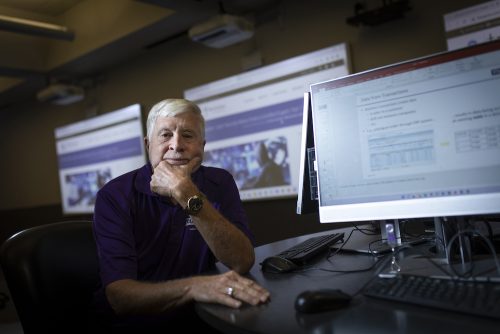
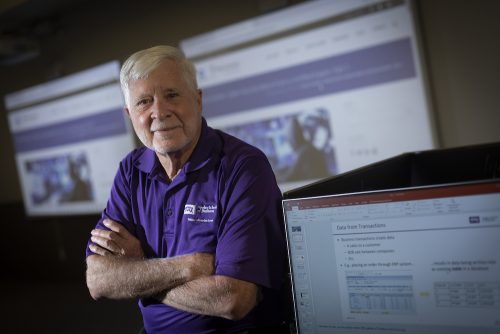
Layne Bradley developed the Fundamentals of Cybersecurity course that is now mandatory for business information system majors in the Neeley School of Business.
While doing research for a data analytics class, Deer came across a Wall Street Journal article about parents who sued an Alabama hospital, claiming their 9-month-old baby had died of inadequate care because its computers were paralyzed by ransomware.
In recent years, a string of high-profile ransomware attacks on hospitals, grocery chains and critical infrastructure has heightened interest in cybersecurity. Such attacks crippled the Colonial Pipeline, which reportedly paid $4.4 million to get operations running again, and the meat-packing giant JBS, which coughed up $11 million. The software firm Kaseya and some 1,500 clients were infected by the REvil/Sodinokibi virus, but Kaseya refused to pay the $70 million ransom, which was later reduced to $50 million before the Ukrainian hacker was arrested in neighboring Poland.
A 2019 IBM study estimated that the average data breach costs the target company $3.92 million, while “mega” breaches involving more than 50 million records were projected to run as much as $388 million. IBM’s X-Force Incident Response and Intelligence cited a White House assessment that NotPetya alone caused business disruption globally amounting to more than $10 billion in damages. Government Technology magazine quoted an IBM official as estimating that cybercriminals were costing the global economy $600 billion a year “with no signs of slowing down.”
As many established software companies, consulting firms and cybersecurity startups have learned, there are profits to be made countering or repairing ransomware attacks. Investors handed more than $12.2 billion to cybersecurity startups during the first half of 2021, The New York Times reported.
And the boom means job opportunities. In 2021, the U.S. Bureau of Labor Statistics projected job growth in information security to increase 31 percent by 2029, with increased demand in the public and private sectors.
Six years ago, members of Neeley’s Business Information Systems advisory board saw the looming trend and suggested adding cybersecurity to the curriculum, said Jeff Stratman, professor and chair of information systems and supply chain management.
One of the holes in the information systems program was cybersecurity education, Stratman said.
Bradley answered the call and developed a cybersecurity course for business information systems majors.
“Our expectation was that students were going to jump on it, but enrollment in the initial class was underwhelming,” Stratman said. “So we went back to our advisory board and said, ‘Look, are we pushing on a string here? There doesn’t seem to be demand for this kind of thing.’
“But they convinced us that the students didn’t appreciate the opportunity and that we needed to educate them in the skills they would need to be successful in the business world.”
Faculty heeded the advisory board’s advice and decided to make the course a requirement. Bradley brought in a number of guest speakers who, aside from discussing the breadth of the problem, told of ample job opportunities in the field.
Layne Bradley’s students develop cybersecurity policies as a capstone project.
Matthew Bowman ’22 said another Neeley course taught by Bradley, Securing Company Data, reset his job goals. “Before this class, I was familiar with the word cybersecurity but not with the details of what it really was. This course gave me a very well-rounded education into this field and helped drive my interest and desire to start my career in cybersecurity. If it were not for this course, I am not sure I would have decided to make the career choice that I did.”
The cybersecurity knowledge paid off when he was preparing for interviews with corporate recruiters, said Bowman, who in July joined Ernst & Young as a cybersecurity consultant.
Deer and a classmate, Nolan Dearborn ’22, demonstrated what business information systems majors could do in the cybersecurity field with their final project in Fundamentals of Cybersecurity. For the capstone project, they created an internet policies and procedures manual for a local defense contractor.
In the manual, they proposed a company policy that was tough on slackers. At a minimum, failure to comply with cybersecurity protocols would result in disciplinary counseling by a supervisor. Subsequent infractions, or any action posing a significant risk to the company, might result in termination as well as possible legal consequences.
Detailed in the proposed policy are the sort of emails that cannot be opened. Prohibitions exist to forbid sharing proprietary business information on instant messaging platforms other than the company’s secure internal system.
The student project also mandated cybersecurity training for new employees, along with subsequent check-ins by supervisors.
Then the pair described the procedure for off-boarding departing employees to protect sensitive company data. All of the used laptops and smart devices would be examined for evidence of proprietary files having been downloaded or exported. The company would also deactivate all of the departed employees’ accounts, preventing entry to company web portals and applications.
“The vast majority of the time the breaches really aren’t a technical problem. They’re a human process problem.” Kelly Slaughter
Deer and Dearborn also addressed data breaches: If the leak was a result of a weak password, punitive measures would be taken against the irresponsible employee. If the company was attacked by malware, a specialist team would conduct a cybersecurity audit through a third-party vendor, change outdated systems and identify vulnerabilities. Should data be stolen, bank accounts would be frozen and all logins changed, and a cybersecurity consultant would be brought in to assess the damage.
Neeley is not training technical experts in cybersecurity, said Kelly Slaughter, associate professor of professional practice in information systems and supply chain management.
“Everyone thinks of cybersecurity as being a very technical issue and therefore [requiring] technical solutions,” Slaughter said, “but the vast majority of the time the breaches really aren’t a technical problem. They’re a human process problem.”
Slaughter cited the 2016 hack of the Democratic National Committee’s servers. While depicted as a technically sophisticated attack, the breach was actually quite rudimentary. A hacker sent an email to Hillary Clinton’s campaign chairman, John Podesta (and to 107 other email addresses), saying that his password had been stolen and he should change it by clicking on a link. He did so, giving the hacker access to the servers.
“What’s really neat about the cyber-security field is that you can make a career in it,” Slaughter said. “It’s going to be around for 20 years. It’s going to be around 30 years. It’s going to be around 40 years.”
Internet Defense 101
Liran Ma and Curby Alexander are making cybersecurity education free and accessible to all.
Liran Ma was at a Cub Scout outing when he saw a familiar face, another dad who was also a TCU faculty member. While the Scouts learned about fishing, Ma opened up about a dilemma he was facing in trying to spread the message about phishing.
Ma, professor of computer science, had been working with colleagues at the University of Washington and Georgia State University to develop online labs to teach best practices in cybersecurity. They were having scant luck landing funding to develop these innovative labs, which would teach college students how to counter computer/network-related attacks and other digital lapses.
The other father was Curby Alexander, an associate professor of professional practice in the College of Education. “It’s a funny story because I’m not in computer science,” Alexander said, “but I’m very techy because my PhD is in instructional technology.”
Ma confided that his group had gone through two unsuccessful tries for federal grant funding. The National Science Foundation kept responding with feedback saying the proposal needed a stronger plan for assessing student learning outcomes. Ma asked if Alexander would review his application and offer input.
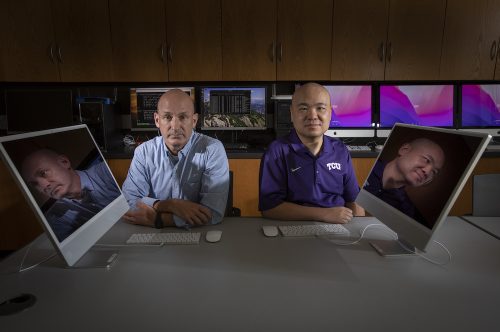
Curby Alexander, left, and Liran Ma have collaborated to develop a website to teach cybersecurity skills. Behind them are computers not connected to the TCU network, some of which are set up as attackers and some as victims to give students hands-on experience in dealing with cyberattacks.
Alexander said Ma and his partners, Zhipeng Cai, an associate professor at Georgia State University, and Wei Cheng, an associate professor at the University of Washington, Tacoma, needed to include a clear educational objective. Funders wanted measurements for assessing learning gains in order to understand what students would take away from the lab exercises.
“The next thing you know, Ma said, ‘We’re going to put you as a [co-principal investigator] on the project,’ ” Alexander said.
A few months later, during summer 2018, the foundation funded the $250,000 proposal.
“It was serendipitous the way I got involved,” Alexander said, “because I have no background in computer science or cyber, but I have a lot of background in measuring student learning gains.”
In spring 2019, the four-party collaboration earned a second round of federal funding. A beta version of their project, Eureka Labs, is now online at eurekalabs.net. The web resource offers tutorials on how to stay safe on the internet. “Our goal is to provide learners and educators with free, easy-to-use and high quality security education materials,” the site says.
“I have no background in computer science or cyber, but I have a lot of background in measuring student learning gains.” Curby Alexander
So far, Ma and his collaborators have released 28 hands-on labs and tutorials, based on authentic scenarios, aimed at instilling cybersecurity concepts and principles. These real-world threats can infect computer networks, mobile phones and databases. Each exercise is ranked by level of difficulty — fundamental, advanced and challenging.
The lessons have catchy names to make them more appealing:
Bleeding Heart refers to the catastrophic Heartbleed computer bug, which is capable of scraping a server’s memory.
Zombie Apocalypse shows how a computer can be overwhelmed with internal message requests or pings, causing it to become inaccessible to normal traffic, also called a denial of service attack.
The Evil Twin attacks lesson refers to nearly identical but fake Wi-Fi access points that snare the unwary and capture whatever data passes through the imposter.
This POODLE Bites! describes an attack used to steal information, including passwords, from secure internet connections.
In WEP Cracking, the site details how Wi-Fi connections have weaknesses that can be exploited by nefarious hackers.
“This lab shows students the vulnerabilities, explains the concepts — why the attacks are possible and how you defend [against] them,” Ma said. “If you download the lab manuals you actually can see the steps of how [attacks] can be launched.”
The student is then shown how the hacking attempts can be circumvented.
Ma said tens of thousands of people have accessed the Eureka Labs website, including users in India, Japan, Germany, Britain and China, where 30 universities have used the tutorials.
Alexander’s evaluation results have demonstrated that the labs help the students learn. Students have indicated that they adequately grasped the security concepts, and also that they enjoyed the learning process. Some commented, “The labs are so much FUN.”
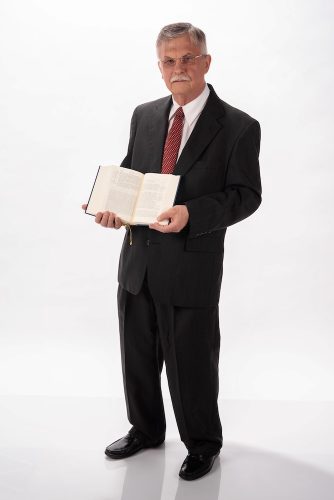
David Moessner, the A. A. Bradford Chair of Religion, is in his 11th year of teaching at TCU. His translation of the Gospel of Luke is in the New Revised Standard Version Updated Edition of the Bible. He is working on a book about ancient Greek narrative as it relates to the Gospels.
David Moessner has worked on an updated translation of the Gospel of Luke. “If a person like myself likes languages,” he says, “it’s kind of exciting.” Photo by Glen E. Ellman
The professor brings a broad view to TCU, having studied at Princeton, Oxford and Basel University. He teaches Jesus and the Gospels, as well as courses in biblical interpretation and Greek.
How did you become passionate about theology?
I grew up in a Christian family, and that was just a way of life. It was as a Lutheran I grew up, and junior high up through high school they had Saturday morning instruction; they don’t do that much anymore. By virtue of being in the church, I just got to read the Bible.
When I was an undergrad at Princeton University, I took a religion course my freshman year, and I really loved it. A lot of my beliefs were shaken or challenged, but it didn’t scare me away; it really made me want more.
I come from a family of physicians; my three brothers are physicians. So, I was supposed to be one, too. I did both pre-med and religion. I actually got into med school, but I didn’t go.
I went on in religion because I love to learn Greek and Hebrew; I love to read the original languages. I like ancient history. I love the fact that you had to study the history of Israel, and the Hebrew Bible, and all the Greek empires, different periods or phases of Greek ascendancy, pre-Hellenistic and Hellenistic and then the Roman Empire. So, it was a combination of history and ancient texts of Biblical material that I had gotten used to as a kid and in college.
How did you grapple with your religious views being challenged?
I took a course on the history of theology, from Schleiermacher to Tillich. And I would say that course and then the philosophy of religion course — those two courses really challenged me because they made me see new perspectives. And they made me then question what I really thought, what I really believed.
I dropped some of what I thought were sort of nonnegotiable views of things, like the inerrancy of the Bible, although I was more of an infallibilist.
I still have a very high view of Scripture, but I’m not stuck in some of those categories that keep one away from understanding what different cultures experience. And that’s, of course, especially important these days. How do people from different regions of the world and different cultural backgrounds understand some of the things we take for granted?
“A lot of my beliefs were shaken or challenged, but it didn’t scare me away; it really made me want more.” David Moessner
You know Hebrew as well as Greek; which other ancient languages have you learned and how do these relate to the study of theology?
Well, I took Syriac. And I took Aramaic. Some say Hebrew is a dialect of Aramaic; Aramaic and Hebrew are very close. The vocabulary is different — that’s where it gets tricky. The characters are the same. So, you think you know Hebrew, then you read an Aramaic word that looks like it’s the same, but it’s not necessarily.
Jesus would have been speaking primarily Aramaic; that was his mother tongue. And Hebrew, then, would be the language of the Scriptures. And the Gospels are written in Greek. If a person like myself likes languages, it’s kind of exciting.
Do you know any other modern languages?
I can speak German, especially when I’m there. I can read French, but I’m getting rusty in French, because I don’t read it as much as I should. I don’t know Spanish, which is my big problem. Wish I did. If I were young, I would learn Spanish for sure.
Now modern Greek is not the same as ancient Greek, or even the common Greek of the New Testament. But when I have been to Greece a couple times, there’s enough similarity that sometimes you can say, ‘Well, I know what that means.’ It’s the same text of characters, but it doesn’t mean the same as it used to mean. But that’s the nature of language, right? It’s constantly changing.
Do you have a favorite expression in any language?
I can give you a mantra that I think is my favorite because of the wisdom it contains: “To live is to love; to love is to know God.”
You were named a “premier scholar of the Lukan Writings” by the American Academy of Religion and Society of Biblical Literature in 2017. What drew you to the New Testament?
I had a course I took my freshman year, which was an introduction to the New Testament, and it was so good. It was a historical critical approach, which was basically new to me, but I really learned a lot. I was challenged in many ways, and I’ve changed views on many things. It made me more interested in studies of the New Testament.
St. Luke writing the Gospel. Miniature painting from Book of Hours, ca. 1510. Courtesy of the Library of Congress
And when I was at Oxford, I got to see how important the Old Testament was for Christian interpretation. And then, part of the Oxford degree was the patristic period, early church writers. In those writings, we’re taking the person who Christ is, figuring and configuring Christ with the holy Old Testament. So it became very clear to me that I had to really study both testaments just to get a better view.
You are an ordained Presbyterian minister; do you act as a minister?
I’ve never had a church of my own, but I’ve always been active in the church. So, my wife and I — she’s ordained as well — we participate in the First Presbyterian Church in Dallas, because my wife teaches at SMU. Good ole rival. And she’s a professor at the Perkins School of Theology. She’s in practical theology, pastoral theology, counseling.
As a parishioner, are you ever seen as intimidating to the minister because of your knowledge in the field?
Fortunately, I get to know the senior ministers or the main preacher, and we strike up friendships. We started at First Presbyterian in downtown Dallas. They have The Stewpot ministry, and so the church appealed to us.
The first minister that we had there was a former student of mine, when I was in Atlanta. So I had the liberty with him to critique his sermon some Sundays. And he always was very respectful. And also, he was a superb preacher. And so we really got along — no going at each other.
What is compelling to you about the King James version of the Bible?
That was a monumental translation by a group of British scholars who were pulled together by King James. It’s the same kind of English in Shakespeare, and even to this day, I love the Psalms. When I was a kid, some of them I memorized, because it’s fantastic language. And the translators had what we would call today inferior Greek and Hebrew manuscripts available.
So, when you read the King James, the language was hard to understand at certain points; some of the idioms were no longer idioms that we understood. And separate words were also sometimes changed. Furniture in that period did not mean table. It meant the human body, what we call members of the physical body.
Do you have a favorite verse that comes to mind when you think of the poetic language in the King James?
“The Lord is my shepherd; I shall not want.” What does “want” mean? Means I won’t lack for anything.
“He makes me lie down by green pastures. He leads me by the still waters. He restores my soul.”
“Even though I walk through the valley of the shadow of death, I will fear no evil.” Shadow of death?! Well, it makes sense from the Hebrew. It’s a dark place where death is all around. They could have said dark place of death, instead they said the shadow of death. It’s just that really fantastic English imagery.
Can you explain the significance of the New Revised Standard Version Bible released in 1989?
This is the only accepted English Bible by all Christian groups around the world. And one of the reasons for this is that it has what’s first called the Apocrypha by Jerome. Apocrypha means hidden text. It doesn’t mean bogus or untrue or mythical. When we say something’s apocryphal today, we mean it’s not true.
If you put all those books at the end, after the New Testament’s over, you make a clear statement: these are not really part of the Bible. As we know, Revelation is the end of the Bible, and it points to the end time and all that’s going on–imagery of the apocalypse and so forth.
“When you’ve studied the Bible all your life, even as a kid, you never think you’re going to be on a committee that would translate it, or re-translate it.” David Moessner
What this Bible did in the New Revised Standard Version is it put the so-called apocryphal material, the Deuterocanonical text, right in the middle, right after the last of the Hebrew Bible. So, in a way, it brought Catholics and Orthodox together in a new way; they never shared the same Bible before.
What is meaningful to you about helping to translate the revised update of the Bible?
It’s a thrill for me — thrill of my life, actually. Because when you’ve studied the Bible all your life, even as a kid, you never think you’re going to be on a committee that would translate it, or re-translate it. And so, I took it with a lot of seriousness and solemnity, but also with a lot of joy.
The working thesis is “As literal as possible, as free as necessary.”
There is no word-for-word translation; that destroys translation. Word-for-word is not translation; it’s a misunderstanding how language works. All language is idiomatic; you try to give it a literal rendering, it just sounds goofy or it doesn’t make sense at all.
What does the process of translating this work look like? Which revisions are noteworthy?
I was asked, using the Greek text, to make suggested changes to this translation of Luke.
I ended up making quite a few changes. But there are only two or three substantive changes that I thought were important. One of the changes that I thought was really important was not accepted. Jesus refers to himself according to the Gospel texts as the son of man. Well, I suggested that it be changed to son of humankind.
The Gospel of Luke contains some of the church’s most used material, according to Moessner. This includes the Three Parables of the Lost: the lost son (the Prodigal Son), the lost coin, and the lost sheep. Photo by Mi Carmo via Pexels
It’s not because Jesus is a male that he’s called son of man, it’s because he is representative of all humanity. And rather than say, son of humans, or son of humanity, son of humankind has more of a rhythm to it. And the word “kind” in English represents the word in the Greek translation of the Hebrew Bible in the Genesis story, “God created each according to their kind,” says NRSV and the King James. It was still rejected. It would upset too many people, probably.
The change that I was able to get through that I really liked is the opening of Luke’s Gospel. He says, “After investigating everything carefully.” That word in Greek was translated as investigate, but that’s not what the Greek word means. It came from a German rendering in the great lexicon or dictionary of New Testament and early Christian Greek.
[Luke] is one of those disciples who has been schooled in traditions and been trained in them from way back, that’s who he is. He’s not a historian who comes in and tries to write a new version based on history. [My translation] is going to be “as one who has grasped everything from the start”– that’s not exactly the way I said it but it’s close enough. That changes the whole relationship of Luke to the eyewitness tradition.
Much of the first two chapters of Luke are poems, Greek Old Testament meter and poetry. Well, I did that for the English.
Would you consider Luke’s to be one of the more important Gospels?
Oh, yeah. Of course, I’m biased. Luke has some of the most loved material in terms of the church’s use. The Good Samaritan parable, for example. The woman who keeps hounding the judge to get justice accomplished–that’s in Luke 17. You’ve got probably the most famous of all, the Prodigal Son, Luke 15. The Three Parables of the Lost. Only Luke has those three together; it ties the lost sheep with the lost coin with the lost son.
And of the three writers, he is the most eloquent. He wasn’t a top litterateur, in the sense of the classical Greek writers. He wasn’t a Plato, by any stretch, but he was very good. And of the New Testament writers, he has the best knowledge of Greek and the best writing in Greek.
Editor’s Note: The questions and answers have been edited for length and clarity.
Teenagers across the world are still soaking up Romeo and Juliet, whether in school or through Taylor Swift’s lyrics. Between the lines, each generation of high school students interprets William Shakespeare’s tale of star-crossed lovers through its own pop culture filters.
Shakespeare wrote Romeo and Juliet in 1592-93. The famous tragedy has been the subject of countless adaptations, including West Side Story and Shakespeare in Love.
Original or spinoff, the bard’s core messages rarely change. But what are young people learning about life through the play?
Ariane Balizet, professor of English, studies how Shakespearean adaptations in film, TV and fiction articulate ideas about girlhood. Balizet’s studies fit well with her other academic role as associate dean of faculty and diversity, equity and inclusion for the AddRan College of Liberal Arts.
In her 2019 book, Shakespeare and Girls’ Studies, Balizet analyzes recent retellings of Shakespeare’s tales to better understand the voice and role of young female characters and to study the emphasis Shakespeare places on their sexuality.
She said she hopes to understand what the bard’s work means for the teenage girls reading and watching today.
“Shakespeare is used to authorize a very limited version of what girlhood is,” she said.
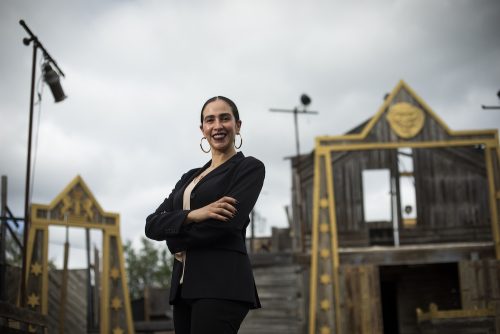
Ariane Balizet, on the stage of Hip Pocket Theatre in Fort Worth, says even modern adaptations of Shakespeare on TV and in movies present girls as subordinate. Photo by Rodger Mallison
Generation after generation, Shakespeare’s vision of ideal girlhood has persisted. Like Juliet and Hamlet’s Ophelia, girls in his stories are often thin, white, privileged, straight and cisgender, Balizet said. Thus, teaching Shakespeare as a gold standard of English-language literature has a downside.
“This thing that we call Shakespeare is actually a hurtful prism for understanding the lives of young people of marginalized genders,” Balizet said.
She studied adaptations produced between 1994 and 2018, a time when anxieties about teen pregnancies were heightened by pushes for abstinence-only sex education.
Fear that young women may face the “crisis of teen pregnancy,” Balizet said, appears in 10 Things I Hate About You, a re-imagining of Shakespeare’s Taming of the Shrew.
“Pregnancy is not just material evidence that a young woman has lost her virginity and thus her moral worth,” Balizet writes. “Pregnancy is the shameful, embodied punishment for the loss of purity.”
A portrait of a woman playing Ophelia created between 1880 and 1890. Courtesy of Library of Congress
The scene suggests that to be valued by men, girls must meet expectations of sexual purity, beauty, composure and romance, she said.
Balizet’s book fills “a new place for feminist work,” said Ann Christensen, department chair and professor of English at the University of Houston. “Her work crosses over and shows the relevance of Shakespeare in our culture.”
Balizet also considered the messages contained in depictions of fictional characters studying the playwright’s work.
Balizet said writers lean on Shakespeare as a mark of intellectualism to elevate their work. Just invoking his name or quoting his works in their scripts might draw a bit of the same renown, she said.
“There aren’t a lot of bookish girls in Shakespeare. There aren’t a lot of self-employed girls. There are a lot of dead girls in Shakespeare.” Ariane Balizet
“Shakespeare is the authority on culture. Shakespeare is the authority on romance,” Balizet said. “Shakespeare is the authority on tragedy or comedy or power and taking that cultural value and using it to authorize one version of girlhood.”
Reading his work is a rite of passage in the American education system. The Common Core State Standards for English Language Arts & Literacy lists Shakespeare, one of few authors called out by name, as a requirement.
Deciding whether Shakespeare is bad for girls was not Balizet’s goal, she writes. Rather, she wanted to demonstrate “how the construction of girlhood within and through Shakespearean adaptation has cultural meaning that is useful in advancing the rights of and opportunities for girls.”
But the playwright rarely presents healthy, accurate or inclusive representations of girls, Balizet said. “My study of Shakespeare in teen girl TV reveals persistent, troubling patterns of girls’ intellectual, physical and sexual subordination.”
“For some girls, reading Shakespeare is very painful,” she said. “There aren’t a lot of bookish girls in Shakespeare. There aren’t a lot of self-employed girls. There are a lot of dead girls in Shakespeare.”
A job search can result in sharing more than your résumé with potential employers. In spring 2021, the FBI put out a press release to warn the public that cybercriminals are using fake job listings to target personal and financial information.
We talked to Mike Caldwell, executive director of TCU’s Center for Career & Professional Development, for some insights into cyber security on the job hunt.
You mentioned seeing an increase in fake or misleading job posts in the last year. Why are job hunters being targeted?
I have seen it tick upward when the job market is really strong and when the job market is really challenging. When it’s challenging, people look for ways to take advantage of job seekers who maybe have not looked for a job in a while. And right now, when there are so many job postings, it’s hard to wade through what is a good opportunity and what isn’t, what’s a reputable website and what isn’t.
During the job search process, you’re going to be asked to provide and contribute personally identifiable information — your name, your address, your phone number. Once you are employed by an organization, they may ask you to show them a driver’s license, give your Social Security card.
Job seekers may feel a little more inclined to give up more information than they would normally because they may be without a job. And that’s what I think scammers are doing in most cases — they prey on that sense of urgency. I had a student at my past college who was offered a job and asked for their bank account information. The student thought that was the normal thing to do to get set up on payroll, and had money taken from their account.
Where can people look for a job safely?
No place is completely safe. But Handshake, because of the checks and balances, is probably going to be a little bit safer. Also LinkedIn, where you can verify connections with the organization, is a little bit safer.
If you’re an active TCU student, you have a Handshake account automatically; if you’re an alum, you can input your request for an alumni account. Underneath the single sign-on option for students, there’s an alumni button. In Handshake right now we have 17,000 postings in our system; I can’t imagine how many hundreds of thousands are on Indeed right now. A number of job posting platforms have systems where they’re able to determine whether the job was posted via a virtual private network. If the person is masking the IP [internet protocol] address, that can be a red flag.
Who is Handshake for?
Handshake is primarily serving that entry-level college market. That said, it is available for alumni at TCU; our services extend to alumni for life. A number of the jobs are alumni-focused, because some of them are graduate-level positions.
“LinkedIn is generally a good option. It goes hand in hand with the advice that we always give of trying to find someone with a company or organization that you’re interested in working with.” Mike Caldwell
The jobs that are pulled into the Horned Frogs Connect platform through our alumni office also come from Handshake. So, we’re able to help filter some of those jobs that maybe require one to three years of experience. You can even connect your Horned Frogs Connect account to your LinkedIn account.
LinkedIn is generally a good option. It goes hand in hand with the advice that we always give of trying to find someone with a company or organization that you’re interested in working with. Because then you can reach out to the person, who may be a TCU alum, and say, “Hey, I saw you had this marketing manager position open. Can you tell me a little bit more about that role? Do you know anything about that department? How’s your experience with that company or organization? Do you have any advice for someone who might be coming in and looking for that role?”
Framing it in that way helps not only verify the validity of the job posting, but it also gets your foot in the door in terms of connecting with people who are with the organization.
Does Handshake only have the job openings that companies ask to post to TCU?
It can be as local as the TCU Marketing & Communication office sharing a student worker position. It can be up a level — someone from here in the DFW area who’s posting only to TCU, SMU and a couple of the other schools in the area. And it can be national — Google, Amazon, Facebook — all of the Fortune 500 companies use Handshake. Some employers are posting to the entire Handshake network of hundreds of schools.
When on the job hunt, Mike Caldwell says to watch for red flags like an “employer” who contacts you from a blocked number. Photo courtesy of Unitonevector, iStock, Getty Images
Are there any sites that you would advise avoiding? What are some steps you can take to stay safe?
No, I think you can use them all in aggregate.
See if the posting is also posted on the company’s website. Verify that you are talking to the actual employer before providing any kind of bank account information. Verify that all the websites that are being shared with you are legitimate, that they are company websites, that it’s not a Google form that’s going somewhere else.
Something that we always share with students is if you get that out-of-the-blue email from some random person that says you’ve been offered a job or you’re invited to apply, that’s definitely something to watch out for. That’s one reason to keep a record of where you’ve applied — not only will that help you in your job search, it’ll also help keep you safe.
If the job is “We would like to hire you as a shipping coordinator; you will pick up packages, you will mail these packages” — be very cautious of that. It may seem like a legitimate job on the surface, but be extra wary of any position or job that asks you to ship, pick up or distribute packages or mail. It could be illegal, and then your name is tied to it.
In addition to recognizing red flags, how can people protect themselves?
I mentioned earlier keeping a log of jobs that you’ve applied to; that’s just a good networking practice as well. I applied on this date, this is the organization, these are my contacts with the organization, this is who I need to follow up with, this is the timeline. Make sure that you have an alert or notification set up on your phone or on the account that you’re using for your job search because you don’t want to miss an interview.
You can also set up alerts with almost every major employer where they notify you of open jobs, and sometimes you’ll get that information before it hits a job board.
If you suspect that a job is a scam, what action should you take?
If you’re using Handshake, flag it; if you’re using LinkedIn, Indeed, any of those systems — they all have a “report” option.
I strongly encourage TCU students to report anything to IT if it has come in through email. If it’s something that is serious, reach out to the TCU campus police as well, and they can investigate it. If you’re an alum, you can go to the Federal Trade Commission website and report it.
Editor’s Note: The questions and answers have been edited for length and clarity.
In 2007, Olga Samano was a 25-year-old single mother living in her parents’ house with her two children and her two sisters. Seven people shared a three-bedroom, one-bathroom Fort Worth home.
Samano said the thought, “I can’t do this anymore — I have to get my life together” looped in her mind.
She turned to Habitat for Humanity, a nonprofit homebuilding program that serves people in need of affordable housing.
Meanwhile at TCU, a group of juniors was settling into their roles with FrogHouse, a then 3-year-old formal partnership between TCU and Habitat for Humanity. Each FrogHouse team spent an academic year building a house for a family — from the first dollar to the last nail.
Student leaders for Samano’s home planned to raise $50,000 during the fall semester and build her a house 2 miles east of campus in the spring.
The project “was massively impactful,” said Eric Tabone ’08, the executive director of Samano’s project. “We would start fall semester with no money, and in a matter of six to eight months we’re giving a family a house.”
FrogHouse also gave students a dose of reality, Tabone said. “We got to see a side of what the real world actually looks like. Oftentimes we were within this bubble and didn’t see what it looked like on Berry [Street] 10 blocks away.”
When Habitat for Humanity told her she’d been approved for a home, “I literally started crying at work because I just knew that that was meant for me,” said Samano, who works in billing at John Peter Smith Health Network. “I was going to be able to have room for my kids and myself. It was just the most wonderful feeling ever.”
Raising Money and Walls
TCU’s relationship with Habitat for Humanity stretches back to the 1990s. Before FrogHouse, the university’s student chapter had offered alternative spring break excursions during which students helped build houses in places including Los Lunas, New Mexico, and Americus, Georgia.
Habitat for Humanity approved Samano for a home, and the student volunteers went to work on the lot 2 miles east of campus. TCU’s affiliation with Habitat for Humanity began in the 1990s. Courtesy of TCU Archives
In 2005, TCU staff members, seeking to improve the student experience, assigned a part of the university’s mission to each class: To educate individuals (first-years) to think and act as ethical leaders (sophomores) and responsible citizens (juniors) in the global community (seniors).
Juniors interpreted their responsible citizenship mantle as an opportunity to give back to Fort Worth, said Jared Cobb ’11 EdD, who led the class’s experience. Among them: One dance major went to an elementary school in a disadvantaged area to teach ballet during gym class.
The FrogHouse partnership, which started in 2005 and ended in 2010, involved hundreds of students and taught skills from raising money to wielding a hammer.
“I remember thinking, ‘Wow, this is special. This is really happening — here we go.’ ” Matt Owens
Matt Owens ’07 helped lead the inaugural FrogHouse project in 2005-06 as the fundraising director.
With other juniors, he wrote letters to the TCU community asking for donations. One of the first checks came from Marcia Schubert ’80, who had encouraged Owens to consider enrolling at TCU.
“I remember thinking, ‘Wow, this is special. This is really happening — here we go,’ ” said Owens, who put the experience to work in a fundraising job two years after graduation and now runs operations for a family foundation. “We began the process in earnest, knowing this is big: The success of the junior year project is squarely on us, and if it doesn’t get funded, it doesn’t get done.”
The students serving Samano decided on a letter-writing campaign as well. They also put collection jars around campus and hosted a Halloween costume contest.
Chris Volpe ’09, the director of fundraising for Samano’s home, asked students to skip one latte and donate that money to FrogHouse.
But the funding goal turned out to be a bigger mark than anticipated, Volpe said. “It was grueling. … It’s sink or swim — raise $50,000 or you’re not building a house.”
TCU’s administration kicked in the final $15,000, which allowed the building phase to begin in the 2008 spring semester.
Volunteers filled construction slots, usually on Fridays and Saturdays. Sometimes a fraternity, athletics or alumni group would fill the whole day’s volunteer schedule. Tabone said the project was good for “bringing people from the entire TCU network together.”
Tabone, who later founded BBE Languages, a Bogotá, Colombia-based communications training business, worked alongside Samano on construction days; Habitat requires its recipients to participate in the construction.
Samano said the TCU juniors, just a few years younger than she was, brought enthusiasm and energy to build days. “Especially on a Saturday early in the morning — you’re a college student — who wants to be at someone else’s house trying to help them build it? They chose to be here.”
Samano took a day off work to raise the first wall of her new house.
She started envisioning the future as she drove by the construction site at night. She tried to decipher the maze of framing on her Saturday volunteer days. Though afraid of heights, she worked on the roof, thinking, “I’m actually putting a roof over my head.”
At the ceremony to hand over the keys, Volpe and Tabone watched as Samano’s son, Brandon, and daughter, Natalie, with wide smiles and bright eyes, explored their new house.
Giving and Receiving
The FrogHouse team changed the future for Samano’s family, which later included twin girls. The TCU students emerged from the project changed as well.
“When I got to step back and see the done house and see the reaction of the family getting the house, I knew it was going to be life-changing,” Volpe said. “You don’t realize how it puts you on a different trajectory.”
In their junior year, TCU’s class of 2009 worked with Habitat for Humanity to help build Olga Samano’s house. Photo by Mark Graham
Volpe used examples of his FrogHouse victories and blunders in job interviews.
“A lot of the skills that I learned at FrogHouse really translated to what I’m doing now: presenting in front of people, teaching people, engaging a team,” he said. “It was such a valuable real-life experience of running a project. I see so many direct similarities in how I run projects now to how we did FrogHouse.”
The entrepreneurial fire ignited during Volpe’s junior year led to his later opening a coffee shop during a national recession and choosing a job at a risky startup company over an established organization. He is now a senior director at a software company.
For Samano, the new house was the beginning of a new life.
Sometimes after work she would pull into her driveway and sit in the car to gaze at her house. “Thank you, God. This is our home,” said Samano, who still lives in the house. With the help of some committed TCU students, “I was able to do this for my kids and give them a home of their own.”
Joy Bollinger ’02, artistic director of Bruce Wood Dance, choreographed Four Cello Suite for TCU’s School for Classical & Contemporary Dance during her spring 2022 residency. Featured were, from front to back, junior ballet and modern dance major Erin Banks and ballet majors Janet Nguyen ’22, Aubrie Rosenkoetter ’22 and senior Isabella Ginter.
Bollinger set the work, which she called “a simple statement on the elegance of sound and the intrinsic expression of movement,” to four dances from Bach’s “Cello Suite No. 2 in D Minor.” A collaboration with the School of Music, Four Cello Suite also featured four student cellists, each performing from one corner of the stage. “You’re not only reaching toward the goal of accomplishing the physical and emotional aspects of a dance, but you’re affected by the music in real time and adjusting accordingly,” she said. “I was very proud of the dancers.”
Rumen Cvetkov ’06 knew he could excel on the viola from an early age; he was drawn to its melancholic sound.
He grew up in one of Europe’s oldest cities and dazzles audiences by playing his treasured 18th-century viola. But Cvetkov has carved out a thoroughly modern career, one that has seen him perform and teach in nearly three dozen countries.
Music helped define the Cvetkov household. His mother, Mariana, was a classical pianist, and his father, Cvetan, left a legacy as a respected conductor and composer in their hometown of Plovdiv, Bulgaria.
Young Rumen picked up the violin after getting one from his parents for his fourth birthday. At age 8 and on the advice of his music school’s director, Cvetkov switched to the viola, a slightly larger instrument.
Cvetkov loved the instrument in part for its more melancholic sound. The violin and viola each have a G, D and A string. But whereas the violin’s fourth string is an E at the upper end of the scale, the viola has a C string at the lower end, making the viola’s sound a fifth lower on the scale than its smaller counterpart.“
From an early age, I was having this feeling that if I kept myself close to the instrument with practice, I could be really, really good,” Cvetkov said. “I dedicated myself completely to the viola from as early as 12.”
AMERICAS-BOUND
At 19, Cvetkov sidestepped Bulgaria’s compulsory two-year military service by heading to Mexico to perform with an orchestra. “I didn’t want to give up the time to play,” he said.
Accompanying him on the adventure was Desislava Marinova Cvetkova ’06, a violinist who would become his wife. The two, who met as children at their full-time music school in Bulgaria, wed in 2009.
The couple first learned of TCU while in Mexico. Cvetkov had a friend studying with Mikhail “Misha” Galaganov, professor of viola and division chair of strings at TCU.
“Rumen has always aspired to have a great career in music,” said Galaganov, who worked with Cvetkov on performance. “As a viola performer, he has excellent technique and an effective stage presence.”
“From an early age, I was having this feeling that if I kept myself close to the instrument with practice, I could be really, really good.” Rumen Cvetkov
“Rumen was a hardworking student who had a beautiful sound and was always trying to improve himself and reach the highest level of his potential,” said violinist Betina Pasteknik ’05, a classmate of Cvetkov’s who now performs in Austria’s Vienna Chamber Orchestra as well as in baroque ensembles throughout Europe. As undergraduates, Cvetkov and Pasteknik took to the stage together in chamber ensembles.
While at TCU from 2002 to 2006, Cvetkov and his future wife became enamored with the United States. He performed in festivals in Los Angeles every summer and traveled often to New York. In Texas, he loved everything from the heat to the squirrels.
“And the customer service!” he said. “It’s one of the most important things that America has and shouldn’t lose.” Though he was no great fan of the food (“I’m a food enthusiast, and I think Europe is better”), Cvetkov often found himself impressed with restaurant staffers during his time in Fort Worth.
The course load at TCU, leading to his degree in viola performance, sometimes made him chafe. “Being an undergraduate is really busy with lots of general classes, which I didn’t like a lot,” he said — he’d rather have spent that time on practice.
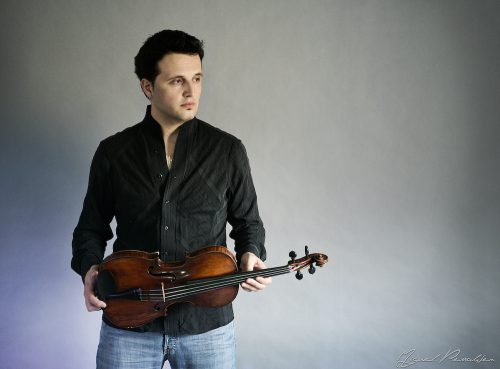
Rumen Cvetkov knew he could excel on the viola from an early age; he was drawn to its melancholic sound. Photo courtesy of Virtuoso Artists Management
Toward the end of his undergraduate years, he bought a rare viola, made by Simon Schodler around 1785, from Dallas Symphony Orchestra violist Pamela Askew. The instrument, which he said has “an extremely beautiful sound,” has a name: The Time.
“It was a fortune for me when I was a student, but I was lucky to be able to afford it,” said Cvetkov, who earned a full scholarship to TCU. “It has been with me for some of the most important times in my life. We have an amazing relationship.”
Recently, he acquired a rare viola made in Moscow in 1941, the year that the city was under siege by the Nazis during World War II. Timofey Podgorny (1873-1958), known as the Russian Stradivari, made the instrument, called The Poet. (The name of the Italian Stradivari family still reverberates in the music world, with the violins, violas and cellos they made in the 17th and 18th centuries coveted.)
Cvetkov also has a 100-year-old Italian viola.
“Each instrument is distinct and obviously different, just like people,” Cvetkov said. “I use them differently for different concerts, depending on the piece and depending on the place.”
GOING PRO
Soon after beginning graduate school in Chicago, Cvetkov accepted an offer to return to Europe to start his concert career. For the 2008-09 season, he performed as a viola soloist with the Magogo Kamerorkest de Nederlanden, a chamber orchestra in the Netherlands that recently disbanded.
Cvetkov is a regular soloist and section leader for Tonhalle-Orchester Zurich in Switzerland and the Barcelona Symphony Orchestra in Spain. Courtesy of Rumen Cvetkov
Cvetkov has played under some of the world’s most esteemed conductors, including Zubin Mehta, Bernard Haitink and Alan Gilbert. He has traveled to four continents to perform, in venues including New York’s Carnegie Hall, Walt Disney Concert Hall in Los Angeles, Germany’s Philharmonie Berlin and the Pallacio de Bellas Artes in Mexico City.
Los Angeles Weekly described Cvetkov’s sound as “full, vibrant, carefully balanced and infinitely variable.”
Although no longer performing full time with an orchestra because of his teaching load and his role in organizing festivals, Cvetkov is a regular soloist and section leader for Tonhalle-Orchester Zurich in Switzerland and Spain’s Barcelona Symphony Orchestra.
“In our music world, talent is not enough to be the best,” said wife Cvetkova, who is assistant concertmaster of southeast Spain’s Murcia Symphony Orchestra, for which Cvetkov was a soloist. “Apart from Rumen’s great talent, the strengths that make him such a wonderful musician are his devotion, hard work and constancy.”
In 2019, he released his first CD. Brahms Alliance showcases his love of the Romantic-era style, with his viola music accompanied by pianist Ludmil Angelov.
His follow-up CD debuted in July. Called Melodies, it features music for viola and piano. Included is Tchaikovsky’s “Pezzo Capriccioso,” which he describes as a challenge to play.
CONCERTS AND CLASSROOMS
Cvetkov founded the MurciArt Music Festival, in the south of Spain, in 2017 and recruited Placido Domingo as honorary maestro. As artistic director of the annual festival, most recently held in July 2020, Cvetkov oversaw the musicians’ preparation and performances.
Cvetkov, who speaks Bulgarian, English, Spanish, some Italian plus passable Russian, has also become an in-demand instructor.
In addition to his hectic performance schedule, he serves as a viola professor at the Academy of Music and Performing Arts, Fontys in Tilburg, the Netherlands, and at New Bulgarian University in Sofia, the capital city of his home country, where he and his family live.
“Teaching students is a really big obligation and a lot of responsibility,” Cvetkov said. “You have to know what to tell them. It’s a very delicate thing.”
“Rumen has always had a passion for performing. … He puts his soul and meaning into every music composition he performs.” Misha Galaganov
He often gives classes when he visits various institutions, as he did in April 2019 when he returned to TCU for the School of Music’s Guest Artist Recital.
“I did not tell my current students that Rumen was my former student before he came and played because I did not want to brag,” said Galaganov, who noted that Cvetkov spent about 30 minutes one-on-one with each of the students after hearing them play.
“Their progress was made quite visible even with this limited amount of time,” Galaganov said. “The suggestions he gave to each one of my students were suited to them individually. It was a proud-parent moment for me.”
Cvetkov hopes to return to TCU in 2023 and looks forward to visiting — and perhaps performing at — the Van Cliburn Concert Hall, which opened in April.
During the pandemic, Cvetkov spent more time at home with his family, which includes the couple’s two daughters, both budding violinists. Victoria, 8, performed in her first violin concert four years ago. Sofia, 6, followed in her father’s footsteps by also taking up the instrument at age 4. Though their parents offer them guidance and encouragement, the girls take outside lessons.
The children have also become exceptional audience members over the course of their young lives. Their father’s concert schedule, which can fill up a year in advance, sends them all around Europe. Spring and summer are Cvetkov’s busiest times as a performer.
“Rumen has always had a passion for performing,” Galaganov said. “Some people don’t want to do much with the music. They play the notes. But Rumen wants to do something, which makes him more pleasurable to listen to when he performs.
“He puts his soul and meaning into every music composition he performs.”
“It’s OK to take a left turn,” Amy Hoover ’83 said. “Sometimes you end up somewhere you didn’t expect.” Studying at TCU was one of a series of left turns — those unanticipated changes — that have defined Hoover’s life.
A native of central Florida, Hoover achieved a score on the PSAT that placed her among the top 1 percent of high school students nationwide. That earned her the designation of National Merit Scholar and the opportunity to attend her choice of universities on scholarship.
Hoover skipped her senior year of high school and because she was just 17, enrolled at the University of Central Florida, where her father was a professor, so she could live at home.
Sophomore year, Hoover used her scholarship to continue her education at TCU, which she said had the best outreach. “They seemed to really want me, and it was literally the best decision I ever made.”
Hoover originally thought she would pursue a career in music. Another left turn, she said, occurred as she registered for classes at TCU, a process that in 1980 took place in the gym.
“I love being outdoors, and I enjoy my niche in backcountry flying, but I also like the academics and being part of a university campus.” Amy Hoover
“There’s this really cute guy sitting at the table, and it says ‘geology,’ ” Hoover said. “I have no idea what geology is, but I’m going to talk to this cute guy!”
She did find love — with the science. “I am kind of a nerd, so majoring in geology was fascinating,” Hoover said. “I learned so much about our planet, how it formed, and not only about rocks but also ecosystems, chemistry, physics and how to be inquisitive about the natural world.”
Field trips to observe geological formations inspired her; Hoover said she enjoyed the process of hands-on learning in an outdoor environment. Jonathan Pershouse ’81 MS, the graduate student staffing the geology registration table, served as her geology lab instructor. To this day, she said, she remains friends with Pershouse and his wife, Laura Neely ’82 MS.
After graduating from TCU, Hoover continued her studies and earned a master’s in geology from Oregon State University in 1987. While she searched for a job in the field, she took a friend’s suggestion to become a white-water rafting guide on the Middle Fork of the Salmon River in Idaho.
Few navigable roads available in this preserved wilderness made air travel a necessity for Hoover and other guides. She found flying into the backcountry of Idaho on a small plane exciting.
“I get in this little airplane where they fly all the gear and guides in before they fly in the guests. I thought this was the most fun I’d ever had.”
Falling in love with aviation was another left turn, Hoover said. She funded her flight training by working as a river guide in Idaho in the summers and as a sea kayaking guide in Baja, Mexico, in the winters.
Hoover earned her private pilot’s license in 1989 and continued her aviation education to receive her instrument rating and commercial pilot license. She worked as a backcountry air charter pilot, flying in equipment to supply hunters and lodges in Idaho.
Teaching Others to Soar
A few years into her professional flying career, Hoover found a calling in helping others earn their wings. “I’ve always loved teaching,” she said. “I think I helped half the baseball team get through their classes at TCU.”
Hoover became a certified flight instructor in 1992 and taught private flying lessons for 13 years. In 1998, she took a position as the aviation program coordinator at Mount Hood Community College in Oregon and taught full time while working on a doctorate in education at Oregon State University. She earned her degree in 2005, which allowed her to teach aviation to university students and devote time to the science of aviation.
Today, Hoover is a professor at Central Washington University, a public university with a four-year program in aviation. Since embracing university life, she has contributed to academic and aviation publications. Together with R.K. “Dick” Williams, Hoover authored the textbook Mountain, Canyon and Backcountry Flying.
“I love being outdoors, and I enjoy my niche in backcountry flying,” she said, “but I also like the academics and being part of a university campus.”
Hoover works with student pilots and mentors new pilots through several industry groups. Photo courtesy of Central Washington University
With more than 3,000 hours of instructing time in the air and more than 15,000 hours of instruction time on the ground, Hoover specializes in teaching tailwheel aircraft flying.
Summers find her back in central Idaho, teaching private lessons in backcountry, mountain and canyon flying to a broad range of students. Such settings can be challenging even for otherwise experienced pilots because of the topography, weather systems, density altitudes and landing conditions unlike those in more developed areas of the U.S.
Among Hoover’s students have been an instructor at the U.S. Navy Fighter Weapons School (also known as Top Gun), astronauts and commercial pilots. The list includes Jeff Skiles, the first officer who served alongside Capt. Chesley “Sully” Sullenberger on US Airways Flight 1549 in 2009. Together, Sullenberger and Skiles followed emergency procedures to successfully land the jet on the Hudson River after a bird strike took out both of the plane’s engines.
Learning to follow emergency procedures is vital for any aviator, Hoover said. In 2014 in Idaho, where her love of aviation took off, she experienced first-hand how important such knowledge is in another left turn that threatened to end her story.
It hit me!
Flying her Citabria, a small, light aerobatic airplane, Hoover planned to meet several other pilot friends for breakfast in the backcountry. She gave her position over the radio as she flew through the uncontrolled airspace.
Also in the area that day was a Cessna Hawk XP; Hoover had flown with the pilot in his airplane on the same route the week before. The pilot reported over the radio that he had passed Hoover and was ahead and above her.
“I was confused when [the Cessna] made the call,” Hoover wrote in the account published in her book. The call indicated the Cessna was 3 or 4 miles ahead of her. “He was reporting the same altitude, so I should have seen him.”
While she scanned the area surrounding her aircraft, something caught her eye.
“I turned my head further to look and saw a white, high-wing aircraft fly under me; it appeared under my left wing, overtaking me from behind and below, and flew by very fast.”
“I heard a loud sound like someone pounding on sheet metal with a hammer, and felt my airplane being pushed up.” Amy Hoover
In the next moment, she saw the top of the fuselage and the left wing of the other aircraft.
“I heard a loud sound like someone pounding on sheet metal with a hammer, and felt my airplane being pushed up. The whole incident took only a few seconds, and it is hard to describe in words the level of shock I experienced; it was as if my brain could not comprehend what my eyes, ears and other senses were recording. … I gasped, and I heard myself say, ‘It hit me!’ ”
The engine of Hoover’s airplane stopped, as did her propeller, whose blades were bent. She wrote that the adrenaline pulsing through her body was an odd sensation. “And that is when all the training, practice, experience, study, preparation and luck over the previous 26 years of flying kicked in.”
Though she had never experienced a mid-air collision, Hoover wrote that she found her body automatically executing the emergency procedures she had taught others so many times before.
“Ironically, the focus of my research on concurrent task management was a key element; for several years, I had conducted experiments, designed and tested training courses, and published papers on single pilot task prioritization. All that paid off, because I had done a lot of mental preparation and deep thinking about the subject, as well as actual in-flight practice.”
Successfully piloting her plane to a controlled crash landing in the Idaho backcountry, Hoover then coordinated her own rescue by making radio communications to other pilots in the area while monitoring herself for signs of shock. Her Citabria was disabled but had remained upright.
“Pilots may anthropomorphize their airplanes in the same way sailors do their boats, but on that day, I knew that tough little airplane had done the job of keeping me alive.”
“Pilots may anthropomorphize their airplanes in the same way sailors do their boats, but on that day, I knew that tough little airplane had done the job of keeping me alive,” said Amy Hoover of her experience performing a controlled crash landing after her plane was hit by another. Photo courtesy of Ricardo Esquivel via Pexels
She documented her experience in voice recordings on her phone and took photos of her damaged Citabria while managing the physical and psychological toll the accident had taken on her body. Hoover wrote that she felt like her body “had just been run over by a truck,” but she had no bleeding or broken bones. While evaluating the wreckage and watching for planes overhead, she willed herself to stay focused and alert to guide rescuers to her location even while feeling the signs of shock. Hoover left the scene of the crash in a rescue helicopter.
The pilot of the Cessna also crashed but did not survive. The National Transportation Safety Board’s investigation concluded that the probable cause of the accident was “the failure of the overtaking airplane’s pilot to maintain visual contact and separation from the airplane being overtaken.” The findings lined up with Hoover’s voice recordings.
“The data shows what happened, but not why,” she wrote. “Ultimately, the only person who knows why is not here to tell us.”
Certified Flight Instructor of the Year
While Williams, Hoover’s co-author, had encouraged her to include the story in their textbook, Mountain, Canyon and Backcountry Flying, she was reluctant at first. She said that an email she received from one of her mountain flying students changed her mind. The student wrote, “About two weeks ago I was involved in an airplane crash, and if it wasn’t for you and what you taught me, I’m not sure if I would be sending you this email.”
Hoover’s dedication to aviation education and to the advancement of the field earned her the title of 2022 National Certified Flight Instructor of the Year, awarded by the Federal Aviation Administration and the General Aviation Awards Industry Board. Hoover was nominated for the award by her peers, a distinction that she said both touched and surprised her.
“I was a flight examiner who gave check rides to other instructors and so I have evaluated hundreds of instructors. She’s literally the top 1 percent in all that I’ve flown with,” said Robert “Bob” Vosburgh, a retired Air Force major whose 50-year aviation career includes Top Gun awards for his flying in the F-111, AT-38 and F-16. He also served as an aeronautical engineering professor at the U.S. Air Force Academy.
“She never touched the controls of the airplane until the last flight of the last day, when I asked her to show me something. She’s incredibly good, trusting and empowering.” Bob Vosburgh
Wanting to explore the backcountry of Idaho, Vosburgh purchased an Aviat Husky, a small, high-wing aircraft capable of landing on backcountry terrain, and asked Hoover to fit him into her busy schedule as a student in July 2017. They flew together for three days.
“She’s just an outstanding instructor. She never touched the controls of the airplane until the last flight of the last day, when I asked her to show me something. She’s incredibly good, trusting and empowering — and I’ve done a lot of instructing, mostly in fighter airplanes. Amy’s the best.” Vosburgh was among those who submitted letters recommending Hoover for Certified Flight Instructor of the Year.
In addition to working with experienced aviators, Hoover also mentors new pilots through several industry groups, including The Ninety-Nines: International Organization of Women Pilots, Women in Aviation International and the Air Line Pilots Association International Aviation Collegiate Education Club, among others.
“Her student evaluations of instruction receive high marks, and the comments on the evaluations speak to her enthusiasm, subject matter expertise and willingness to mentor her students,” wrote Teresa Ann Sloan, professor emerita with Central Washington University, in her recommendation of Hoover for the flight instructor award. “I have seen her go the extra mile to help students.”
Hoover explained that her teaching style is a lot like the way she leads — from behind. She cultivates a supportive environment that allows her students’ passion for aviation to take flight. “It’s more like, what’s your learning style? How do you learn best? How can I focus my teaching style to help you?
“My favorite part of teaching is being able to make those adjustments so that I can best help them to help themselves,” she said. “What brings me joy is when that lightbulb finally goes off, and they put it all together.”
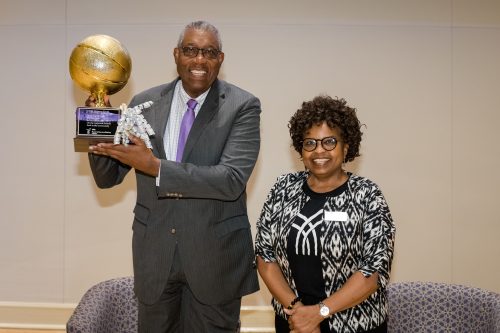
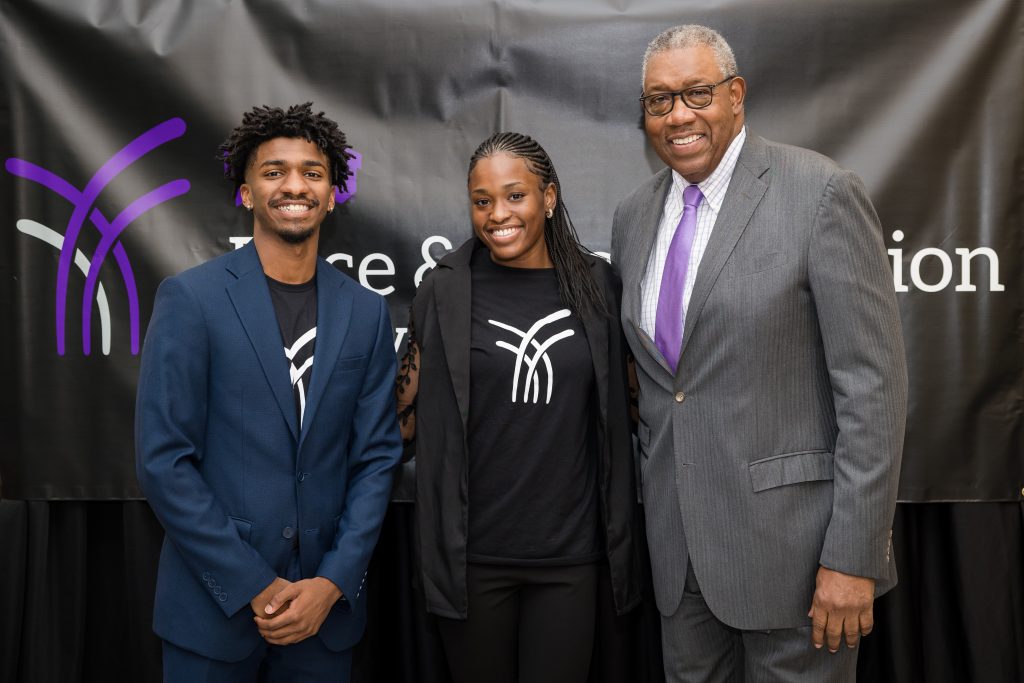
James Cash ’69 said his education and support system enabled his lifelong success. He was the first Black student athlete at TCU; later, he became the first Black professor at Harvard to attain tenure and a board member at major corporations including General Electric and WalMart. He also served on TCU’s Board of Trustees.
Cash spoke with Amiso George, professor of strategic communication and chair of TCU’s Race and Reconciliation Initiative, and Sylviane Greensword, postdoctoral fellow with the Race and Reconciliation Initiative, in a panel discussion Thursday at the Brown-Lupton University Auditorium. Friends and family filled the audience, including classmates and current students from I.M. Terrell High School.
The panel coincided with the unveiling of Cash’s statue outside the Ed and Rae Schollmeier Arena on Friday. The statue will be the first of a Black person on campus, George said to thunderous applause.
Breaking barriers at TCU
In 1964, Cash needed to choose which Southwest Conference school he would integrate. He said he wanted a place where he could feel comfortable and supported.
Because Garvin Isaacs was willing to break the color barrier in a Fort Worth gym in the 1960s, he and James Cash ended up playing together for TCU Basketball. They became lifelong friends, even participating on each other’s weddings.
One person was instrumental in his decision: Garvin Isaacs ’67, then a first-year guard on the TCU basketball team, who ignored segregation barriers at Cash’s local gym and became a lifelong friend. Having a trustworthy friend in Isaacs made TCU the best choice, Cash said.
Cash spoke highly of his time at TCU and said most people were welcoming. During his second day on campus, All-American defensive back Frank Horak ’67 sought Cash out and said, “I’m delighted that you are here.” Horak told Cash to find him if he experienced issues on campus.
But Cash did endure harmful language from white classmates who had never been exposed to a Black person.
When Cash first met with an academic counselor about majoring in mathematics, he was asked if he was certain because “you people aren’t good” at math.
After the same faculty member saw Cash shine in the classroom, he became one of Cash’s biggest advocates, making sure he received assignments while the team traveled. “He became what would be known today as an ally,” Cash said. “It taught me a lesson … there are many perceptions that can be really reversed once people are exposed.”
A change is gonna come
Cash connected stories of his TCU experience to the wider Civil Rights era. In March 1965, John Lewis led a march in Selma, Alabama, on what became known as Bloody Sunday. TCU awarded Cash an athletic scholarship in May 1965.
Nearly 60 years later, Cash said, the university’s commitment to inclusion remains “one of the reasons I hold this institution in such high regard.”
TCU unveiled a statue of Cash on Friday, November 11, 2022. The day before, he was given a basketball by Amiso George, professor of strategic communication and chair of TCU’s Race and Reconciliation Initiative.
Recent events have influenced Cash’s decisions to speak publicly about his life experience and accept honors from the institutions he has served. Before the death of George Floyd, Cash said, “Candidly, I wouldn’t have accepted” the statue from TCU.
“I thought [justice] was about doing the work,” he said.
Since June 2020, Cash has changed his mindset — being in the spotlight could promote positive representation and prevent history from repeating itself.
In April 2022, he attended the dedication of Harvard Business School’s Cash House, renamed in his honor.
Cash, who praised his education at I.M. Terrell High School, has devoted his resources to creating educational opportunities for underrepresented and marginalized students.
At Terrell, his teachers and classmates created a supportive environment where students reached for excellence. However, many underrepresented students post-desegregation have been placed in environments with few resources or expectations, he said. “They seem to have lost the ability to dream.”
As a business leader and entrepreneur, Cash has seized the opportunity to make a difference for young people, especially Black men.
Cash touted the “Baby College” program of the community nonprofit Harlem Children’s Zone, where he served as a board member for 10 years. The program educates caregivers about child development to promote healthy childhood stimulation. “It really affects their capacity to learn at later stages of life,” he said.
Inspiration also came closer to home: Cash wasn’t the only member of his family with a TCU degree. “My mother set the standard for pursing excellence,” he said.
In the 1950s, Black students could not enroll at TCU, but faculty in the College of Education led by Sandy Wall broke cultural barriers to teach courses off campus to as many as 60 Black people.
Juanita Cash, a Fort Worth schoolteacher, earned a master’s in education from TCU in the summer of 1965.
In 1987, Cash and his sister, Pamela, established the Juanita Cash Fellowship for Graduate Education with the TCU College of Education to help teachers from diverse backgrounds and educational settings pursue graduate degrees.
Current student athletes Darius Ford of the men’s basketball team and Tomi Taiwo of the women’s team also spoke with Cash and fielded questions from the audience.
Ford asked if TCU basketball would win the national championship with Cash on the roster. His answer? “I would absolutely say yes, but it would be because I’d be holding all you guys accountable.”
It takes a village
Cash’s family, classmates and teammates from I.M. Terrell received ovations and watched as Cash received an award from TCU’s Race and Reconciliation Initiative that praised him as “A leader on the court, in the classroom, on the boards and in the community.”
Earlier in his lifetime, they could not have stepped foot on campus. “It’s surreal,” Cash said.
He hopes people who see the statue connect with his experiences as a Black person, student athlete and alumnus who has worked to leave a meaningful, transformative legacy.
While structural racism persists, Cash said improvements give reason for hope. “We are in a much better place, even with all the challenges we can talk about, in 2022 than we were in 1969.”
Current TCU student athletes Darius Ford, left, of men’s basketball and Tomi Taiwo of the women’s team also interviewed Cash and fielded questions from the audience.