

Austin Dickson led relief efforts for the July 4 Guadalupe River flooding in Central Texas, raising money to help with rebuilding and recovery. The devastation in Louise Hays Park in Kerrville remains evident months after the flood.
Relief Fund Raises More Than $100 Million to Help Kerrville Area Recover From July 4 Floods
More than four months after historic floods devastated the Texas Hill Country, Austin Dickson ’03 was driving across the now-tranquil Guadalupe River on a sunlit November day, taking stock of the drastically altered landscape more than 30 feet below.
Louise Hays Park, located under a downtown bridge in Kerrville, Texas, was once a recreational centerpiece for this city of nearly 25,000, shaded by a canopy of towering trees and offering activities ranging from a fitness center to kayaking. Now, Dickson said, it resembled “the surface of the moon.”
July 4 floodwaters rose more than 35 feet to just under the bottom of the bridge, destroying scores of trees, many more than a century old, or leaving them bent toward the ground in a sobering testimonial of the flood’s enormous force. The 64-acre park, which includes hiking paths, picnic areas and recreational equipment, was largely destroyed. While some of its trails reopened in October, much of the park remains closed for renovation.
Dickson, a Waco, Texas, native, is at the center of the massive rebuilding effort as CEO of the Community Foundation of the Texas Hill Country.
Under Dickson’s leadership, the foundation has raised more than $100 million in donations that have been applied toward a variety of needs, from rehousing flood victims and restoring small businesses to providing health care to survivors. More than 700 families have received assistance through foundation grants distributed by nonprofits.
“The foundation is truly just moving mountains for our community,” said Mary Campana, executive director of Kerr County’s Habitat for Humanity, which was gifted a $3 million grant from the community foundation to help rebuild and repair homes.
She called Dickson “an unsung hero” of the Hill Country. “[The Community Foundation] hit the ground running,” she added, “and if they hadn’t, none of this would be happening.”
DARK DAYS
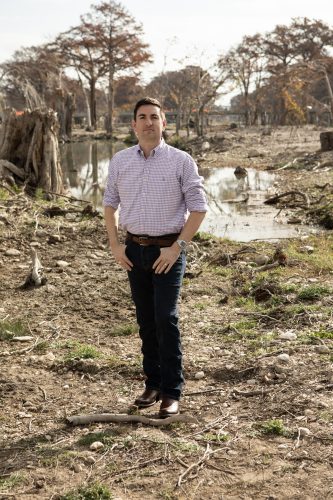
Austin Dickson, CEO of the Community Foundation of the Texas Hill Country, has led efforts to distribute more than $40 million in flood relief grants since the July 4 disaster.
More than 130 people in Kerr County and the surrounding Hill Country died in the July 4 flood, including 27 campers and counselors at Camp Mystic, a popular girls’ retreat near the Guadalupe River. Dickson knew at least four people who died in the flood, including Dick Eastland, Camp Mystic’s director.
Dickson, who has headed the Community Foundation for the Texas Hill Country since 2017, is headquartered in Kerrville’s Guthrie Building, a 138-year-old limestone structure that formerly housed a newspaper and the town’s city hall. It sits a block away from the Guadalupe River.
“One of my jobs is to connect needs in the community with passions that philanthropic people have,” he said. “I believe that my religion degree and my liberal arts education at TCU have given me the interpersonal skills in my career in general and particularly at this moment.”
Dickson and his family live on a hill away from the river. Their household also includes three dogs: Jake the black Labrador, Stanley the rat terrier and Indiana the Brittany.
They were home July 4, looking forward to enjoying the holiday weekend, before overnight torrential rains sent the Guadalupe out of its banks and turned Kerr County into a national disaster zone. At 9:48. a.m. July 4, alerted by a succession of text messages, Dickson called the foundation’s three other staff members to action and remotely created the Kerr County Flood Relief Fund to begin raising donations for what would become a full-scale rebuilding and recovery campaign.
“The rest of that day turned into a nightmare,” Dickson said, recalling an onslaught of “very dramatic and traumatic situations” that included scores of drowning deaths and missing people, in addition to high-water rescues that miraculously kept the toll from going even higher. “A lot of destruction happened that day,” he said, adding that “the full scale of how tragic this event was wasn’t immediately clear.”
ONGOING EFFORT
Dickson has often been the face of the recovery effort, appearing in news conferences, TV interviews and on social media. In August, he made a high-profile appearance at an “Applause for the Cause” benefit concert organized by musician Robert Earl Keen, a parent of two TCU alumnae, to generate donations for the Community Foundation of the Texas Hill Country.
Buc-ee’s founder and CEO Arch “Beaver” Aplin III, whose ubiquitous travel center chain sponsored the benefit, said in a statement that “we were all in” after learning that “100 percent of our commitment goes to the Community Foundation of the Texas Hill Country.”
The August concert at Whitewater Amphitheater in New Braunfels drew more than 5,000 people and raised over $3 million. Dickson went on stage to accept the proceeds from Keen and Aplin.
Although Kerrville and surrounding communities still face a long road to achieve full recovery, many of those on the receiving end of the relief fund say the future now seems considerably brighter in contrast to the dark hours they endured during the flood and its immediate aftermath.
Floodwaters forced Maria Martinez, her husband and their 2-year-old daughter to escape their mobile home in Center Point near Kerrville and flee to higher ground. The family — Maria was more than six months pregnant — then spent more than five hours under a wooden deer blind along with her parents and others escaping the rising waters.
Several bodies were found not far from their home. Nearby trees, basketball courts and park benches were washed away “like a bomb went off,” Martinez recalled.
After returning home, the family discovered that their residence had become uninhabitable due to mold. They stayed with her parents, who live next door, and then spent nearly two months in temporary housing provided by Airbnb through a grant from Dickson’s organization. The foundation’s $3 million grant to Habitat for Humanity is helping fund the renovation of the Martinez family’s home.
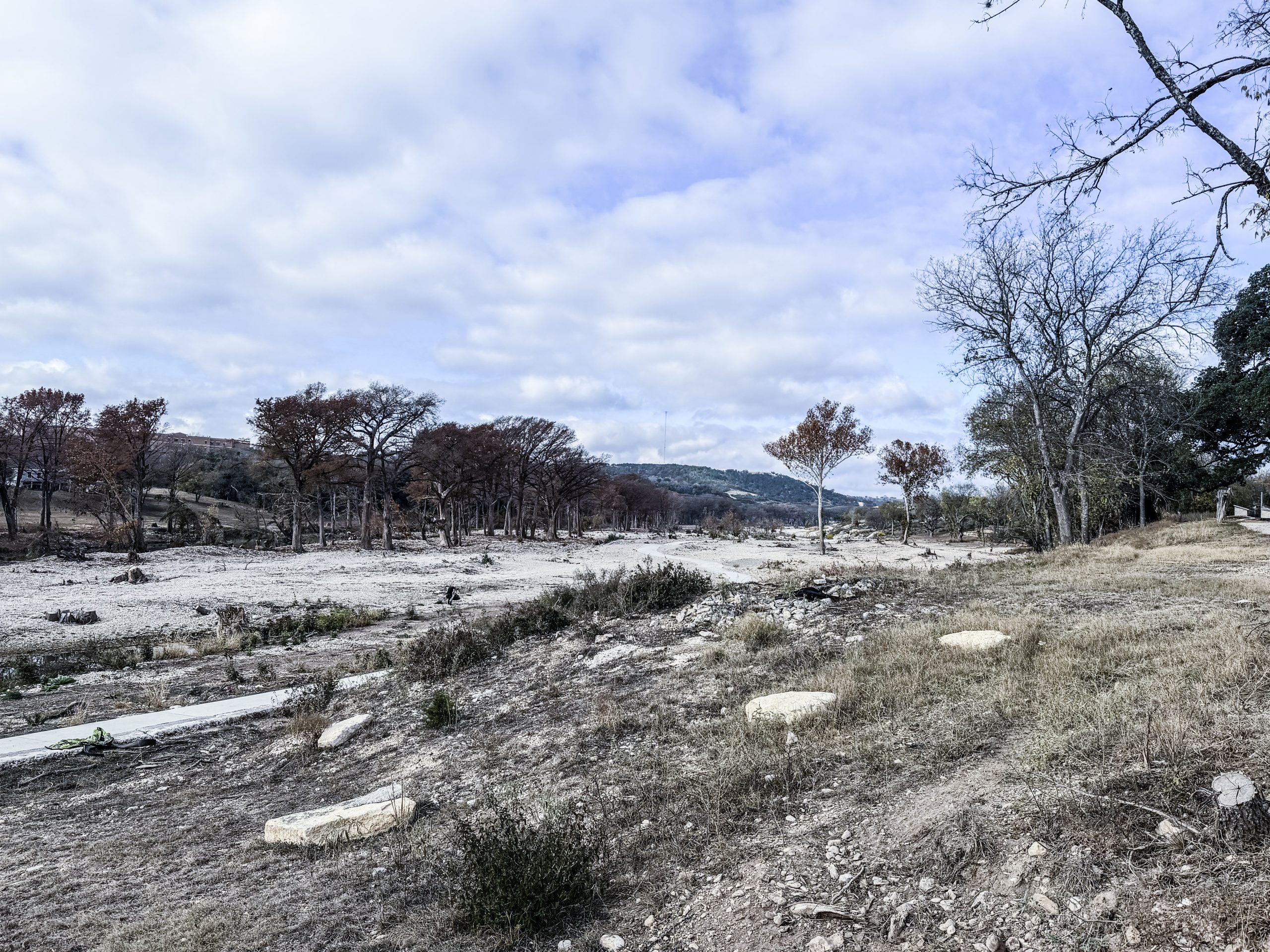
Floodwaters surged to within inches of the bottom of a downtown Kerrville bridge on July 4, more than 35 feet above the floor of Louise Hays Park, which once served as a recreational hub for the city of nearly 25,000.
“It was really sweet to see how many people … came afterward to try to put this place together,” said Martinez, who gave birth to a second daughter Oct. 13. “It was a tragic thing, but it was a beautiful thing.”
Kerrville’s nearly 60-year-old gathering place for seniors, the Dietert Center, was closed for nearly four months after a 6-inch-deep carpet of water swept across every corner of the 20,000-square-foot ground floor July 4. A $500,000 grant from the community foundation, along with funding from other sources, helped an army of volunteers restore the building so it could reopen in late October.
“Their gift was awesome,” Dieter Center executive director Brenda Thompson said. “We’ve been able to get this building back up and running.”
CHARACTER REVEALED
“I think in tragedy and times of great stress, our character is revealed.”
Austin Dickson
The Community Foundation of the Texas Hill Country was founded in 1982 to serve a 10-county region, funding more than 250 charitable nonprofits each year and providing scholarships to help students pursue higher education. On average, the foundation distributes approximately $6 million each year, according to its website, a fraction of the $40 million in grants that have been distributed under the Kerr County Flood Relief Fund.
The foundation has also helped ease the aftermath of other disasters during Dickson’s leadership, including the fatal shooting of 19 students and two teachers in 2022 at Robb Elementary in Uvalde, which is less than 100 miles southwest of Kerrville.
Dickson’s organization also helped fund the recovery from the Crabapple wildfire that burned nearly 10,000 acres near Fredericksburg in neighboring Gillespie County.
Philanthropy, religion and higher education have served as key elements of Dickson’s professional trajectory. After graduating from TCU, he earned master’s degrees in religion from the School of Divinity at the University of Edinburgh in Scotland and the Candler School of Theology at Emory University in Atlanta. He also holds a master’s degree in public policy from the Jimmy and Rosalynn Carter School of Public Policy at Georgia Tech.
Dickson lived in Atlanta for 13 years, leading several nonprofits and working for the Community Foundation for Greater Atlanta. Although he returned to Texas in 2017 to take his current position, he still teaches graduate courses at Emory.
Dickson believes his extensive educational background, including leadership programs at TCU, has fortified his ability to deal with the immense challenge presented by the Hill Country floods. “There’s a lot of grief left to process,” he said, “but for me personally, the moment has required leadership, it has required action, and that is what is propelling me forward right now … to be of service to my community in the recovery.”
“I think in tragedy and times of great stress,” he added, “our character is revealed.”
People who have watched Dickson’s ascent from his TCU days praise his commitment to the flood-ravaged Hill Country.
Darren Middleton, a professor in the honors college at Baylor University in Waco, was on the faculty at TCU for 24 years and recruited Dickson as his student assistant in the religion department. “He was a bright young man, very outward-going, very charismatic, never met a stranger.”
Lindy Segall ’74, a former PR executive who now lives in Fredericksburg, Texas, was a classmate of Dickson’s father, David Dickson ’74. He didn’t connect with the younger Dickson until decades later when they became acquainted through philanthropic activities several years ago.
“I came across the community foundation that Austin heads up and noticed in his bio sketch that he was a TCU grad,” Segall said. After the floods swept through Central Texas, Segall said he reached out to Dickson offering to help and quickly discovered that “the wheels were already turning” through the foundation’s newly created relief fund.
“They jumped in and took care of the people who were in dire straits,” said Segall, who has also worked to raise donations for the flood rescue. “What this young man has achieved since the devastating and deadly Guadalupe River Flood of July 4 is the stuff of Horned Frog legends.”
Your comments are welcome
1 Comment
Austin has been a great leader of the foundation, and our community is very blessed to have him and the foundation in place when we faced our darkest days. There is still a lot of rebuilding and healing to be done. Thank you TCU for sharing his story and of our community.
Rich Schneider, III ’02
Go Frogs!
Related reading:
Features
Shawn Lassiter Creates Sustainable Models That Help Communities Thrive
Through BRAVE/R Together, the TCU alumna works to advance education, health and economic growth.
Alumni
Pearce Edwards: How It Started … How It’s Going
From student journalist profiling his professors to published scholar joining their ranks, Pearce Edwards has come full circle at TCU.
Alumni
A Legacy of Joy
Tammy Krause’s Bags of Fun honor her daughter’s memory.