
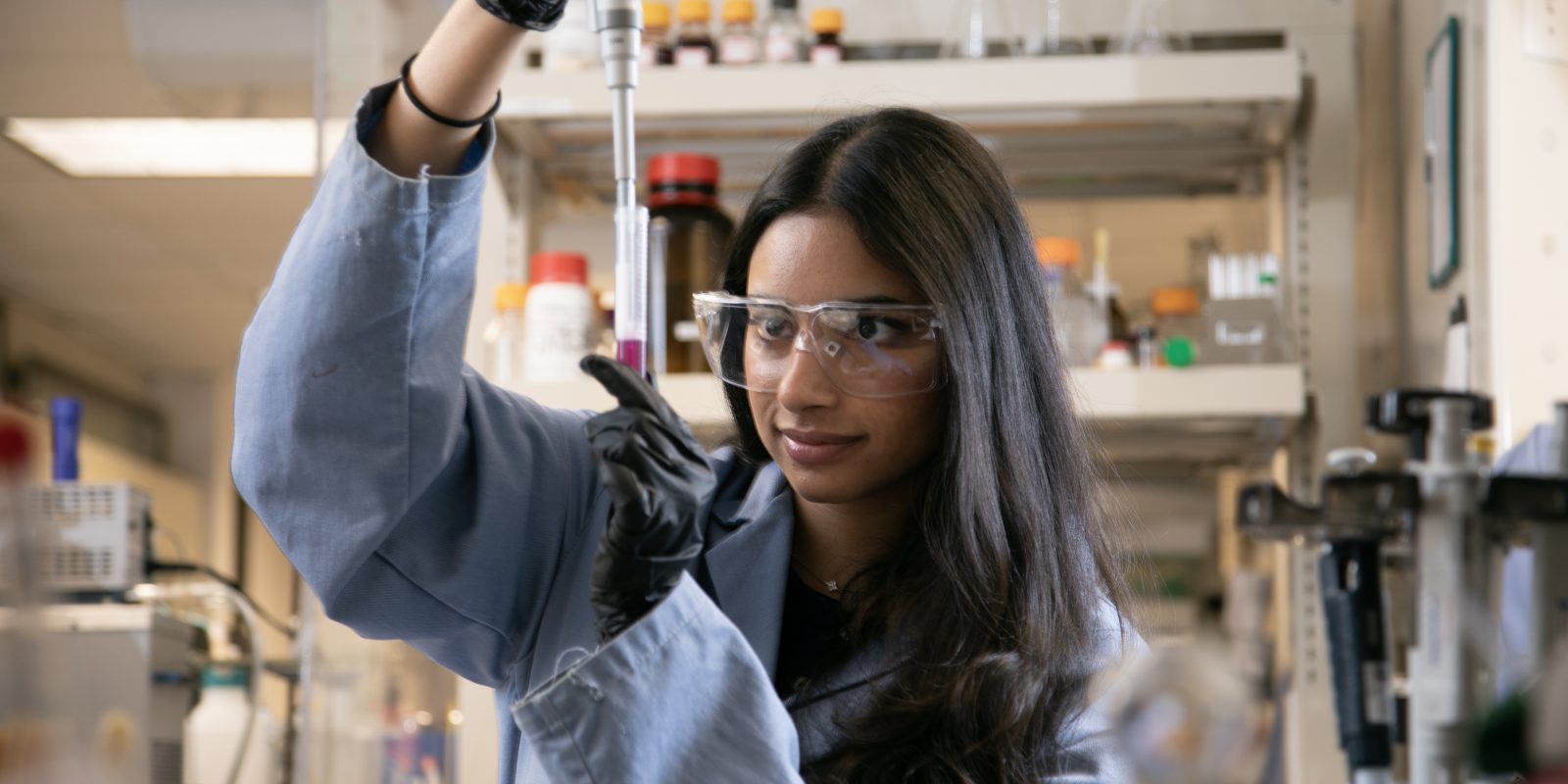
Biochemistry major Saba Anjum is researching ways to make antioxidant molecules more permeable so they can be used to target and treat neurodegenerative diseases such as Alzheimer’s and glaucoma.
Students Get Hands-On Experience With Projects Thanks to TCU Science & Engineering Research Center Grants
TCU’s Science & Engineering Research Center encourages the intellectual curiosity of undergraduate and graduate students by funding their individual research projects and pairing them with faculty mentors for guidance. Students learn by doing, from pitching a proposal and budget to creating a plan, conducting experiments, and analyzing and reporting data.
“It’s a process — the whole scientific enterprise that the student gets a chance to experience hands-on,” said Timothy Barth, professor and associate dean of graduate students in the Louise Dilworth Davis College of Science & Engineering.
The center’s student research grants have been funded by multiple sources since the program launched in 2006, beginning with the TCU Vision in Action Strategic Initiative Fund. Phil Hartman, emeritus dean of the college, gave the program a boost in 2012 through funds from the dean’s office. Individual donors have stepped in as well.
“Many benefactors, friends of TCU and alumni from the college decided that this was such an important endeavor that they began to give gifts to the college for the specific purpose of funding undergraduate research,” Barth said. “We have funded 176 proposals over the last two years. In terms of dollar value, over $250,000 in research.”
Strong proposals, Barth said, depend upon the student’s ability to communicate the importance of the research, sharing the impact it could potentially have on society. Three recent projects that secured funding address treatment for neurodegenerative diseases, food insecurity in Tarrant County and using wearable devices to detect health issues.
Treating Alzheimer’s and More
Saba Anjum, a senior biochemistry major, knew growing up that two of her uncles had glaucoma, a neurodegenerative disease that damages the optic nerve and can lead to blindness. “I initially felt hopeless because glaucoma has a strong genetic predisposition,” Anjum said. “But I was always a very curious child and a problem solver.”
Through her Science & Engineering Research Center grant, Anjum works under the guidance of Kayla Green, professor of chemistry. The Green Research Group holds several patents on antioxidant molecules it developed that aim to prevent or reduce the damage caused by oxidative stress in body cells, slowing down the progression of neurodegenerative diseases.
“We do know that our molecule is potentially a really good treatment for Alzheimer’s,” Anjum said.
But the current antioxidant molecules don’t permeate the blood-brain barrier. Anjum’s research aims to make the antioxidant molecules more permeable so they can be used to develop therapies that will target and treat neurodegenerative diseases.
Anjum’s funding goes toward the purchase of chemical synthesis supplies, including reagents and solvents used in developing a version of the antioxidant molecules that can better target the brain.
“Having research as a component of undergraduate education is an ideal scenario for students to apply what they have learned, make connections between data and gain confidence in their abilities,” Green said.
“Having research as a component of undergraduate education is an ideal scenario for students to apply what they have learned, make connections between data and gain confidence in their abilities.”
Kayla Green
Anjum traveled to San Diego to share her research at the American Chemical Society’s national meeting, presenting in the Division of Medicinal Chemistry.
Anjum said she plans to attend medical school and pursue an MD-PhD dual degree, aiming to become a physician scientist. She hopes to apply the knowledge she’s gaining through her research experience to someday develop a new treatment for glaucoma.
“The College of Science & Engineering not only helps us keep doing the amazing research that is happening in our labs,” Anjum said, “but it also encourages undergraduate students to keep pursuing important questions, seeking answers and addressing the challenges that we have in the scientific and medical communities today.”
Food Insecurity
As a dietetics graduate student, Josie Miller ’24 (MS ’25) worked on a team of researchers that wanted to learn why many Tarrant County adults who qualify for Meals on Wheels, a nonprofit that delivers meals to the elderly and people with disabilities, still experience food insecurity.
In addition to Miller, the research group included a nutritional science student and four nursing students; Gina Alexander, professor of nursing; Kyle Walker, professor and department chair of geography; and Gina Hill, professor and department chair of nutritional sciences, who served as Miller’s mentor. Two retired Tarrant County public health workers also helped the team by approaching potential study participants.

Graduate student Josie Miller researched food insecurity among older adults in Tarrant County who qualify for Meals on Wheels. Courtesy of Josie Miller
“Josie and a team of students interviewed older adults at three community sites deemed as high-priority neighborhoods based on U.S. Census Bureau public data,” Hill said. “Through these interviews we learned about … the barriers to having access to adequate food as an older adult, and what they knew about Meals on Wheels.”
Miller used her grant money to pay for an account on NVivo, a platform for qualitative data analysis, which she used to examine participant interviews that the team conducted. With NVivo, “I could be more involved in the research analysis part of the project,” Miller said. “You sift through the answers from everybody and find patterns and meanings.”
Miller’s research team came to multiple conclusions: The main reasons for food insecurity in older adults in Tarrant County are economic and health-related; some qualified individuals don’t use Meals on Wheels due to common misconceptions, such as the belief that clients must be older than 60 and U.S. citizens; and eligible participants prefer to learn about Meals on Wheels opportunities through word of mouth or partner organizations.
Despite the challenges, the team learned that Meals on Wheels has a positive reputation in the community.
Miller, who wrote a thesis about the research for departmental honors, presented her work at the Texas Academy of Nutrition and Dietetics’ annual conference and the Michael and Sally McCracken Annual Student Research Symposium.
AI-Assisted Diagnosis
Sujit Bhandari, a senior computer science major, is working to create an AI diagnostic model that can be integrated into wearable devices, such as the Apple Watch, Fitbit, Oura Ring and Whoop, to track health patterns and detect early signs of health issues like arrhythmia and sleep apnea.
Bhandari is working under the guidance of Robin Chataut, assistant professor of computer science, in his NextGen AI Research Lab, which conducts projects that sit at the intersection of artificial intelligence, large language models (artificial intelligence systems trained on text data) and cybersecurity.
Bhandari used his grant to purchase a variety of wearable devices and accompanying subscriptions, plus iCloud services to store the data. Physiological data such as heart rate, breathing patterns and blood oxygen levels can be recorded using the wearable devices.
Bhandari has collected some 50,000 data samples to train his AI model. He said the samples are a combination of “synthetic physiological data generated using large language models, AI systems capable of simulating realistic health signals, and real physiological data from publicly available medical datasets,” including one created by MIT and Beth Israel Hospital in Boston for studying cardiac arrhythmias.
Bhandari then created a hybrid dataset to train artificial neural networks used for displaying and analyzing visual data — and found a promising outcome.
“The model trained on both large language model-generated synthetic data and real physiological data actually performed better in terms of accuracy, reliability and adaptability compared to models trained only on real-world data,” Bhandari said. “This hybrid approach shows real potential to make AI-powered health monitoring more scalable, accessible and privacy-friendly, especially in resource-limited settings.”
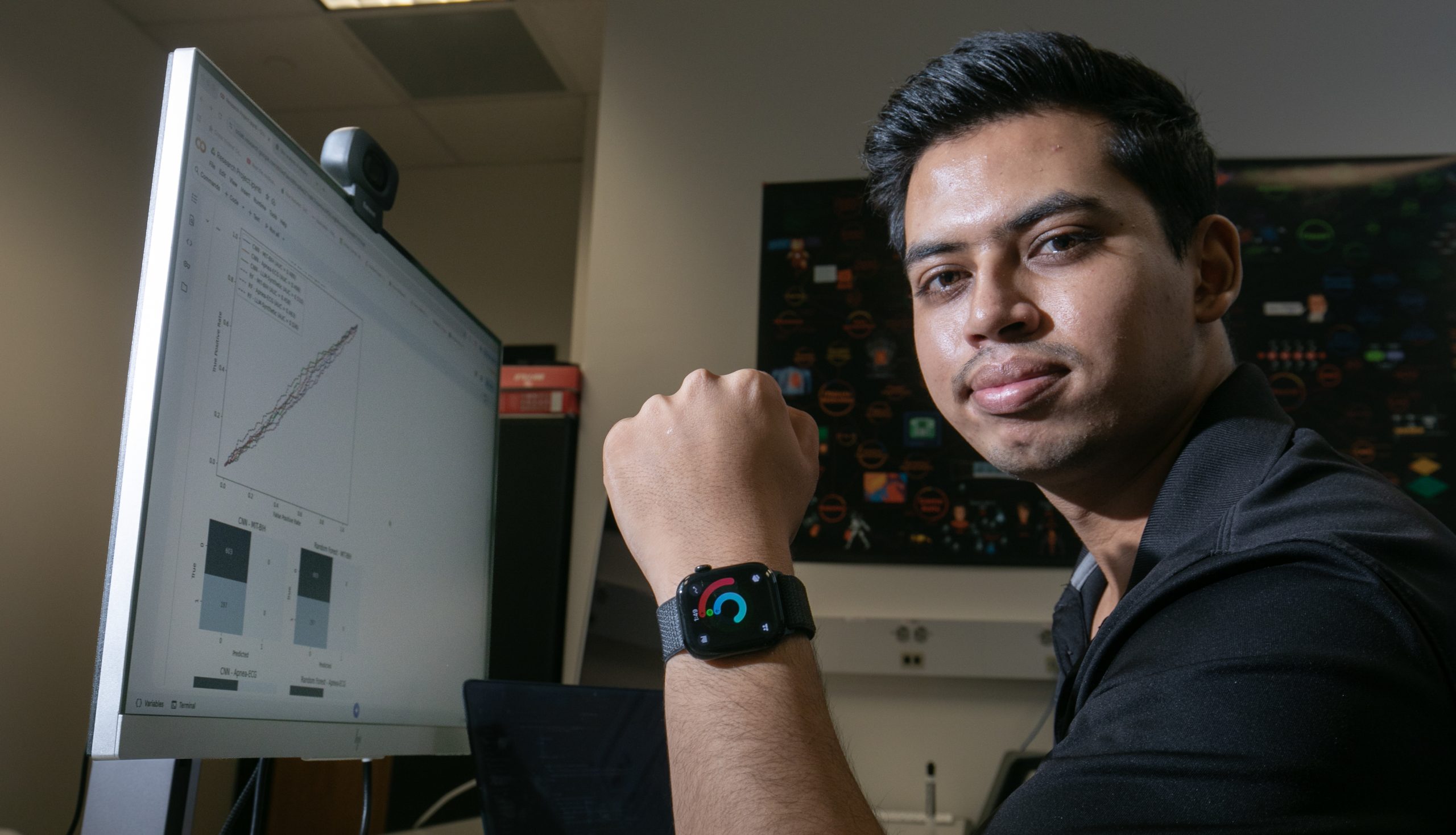
Sujit Bhandari is training an artificial intelligence model that uses data collected by wearable devices, such as the Apple Watch, to diagnose potential health issues. He hopes that pairing the AI tool with an app would help people seek medical attention for conditions like sleep apnea or arrhythmia.
Bhandari’s goal is to create a mobile app that can be used with wearable devices to accurately detect health issues. He is currently working to refine the model to improve performance.
“The wearable device would continuously collect data such as heart rate and sleep metrics. The AI would analyze these patterns in real time,” Chataut said. “If it detects irregularities like signs of arrhythmia or sleep apnea, it would notify the user, prompting them to seek medical attention.”
Student Research Symposium
Barth said that seeing the results of such research at the Michael and Sally McCracken Annual Student Research Symposium each spring is the most rewarding part of the process. About half of the projects at the poster presentation session are funded by the Science & Engineering Research Center.
Presenting at the symposium is another step in the scholarly research process, giving students experience sharing their work in a professional setting.
“Undergraduate research has been one of the longest historic traditions of the college,” Barth said. “We bring our undergraduate students into the faculty laboratories and give them a really special high-impact experience, working hand in hand with faculty on important issues facing society today.”
Your comments are welcome
Comments
Related reading:
Alumni
Angel Guyton: How It Started … How It’s Going
Hands-on research experiences at TCU helped Alcon scientist Angel Guyton chart her path toward a career in medical science.
Belonging in STEM: How the Pre-Health Professions Institute Shapes Young Scholars’ Futures
Through immersive experiences and relatable role models, students gain confidence to pursue careers in science, engineering, health care and beyond.
Research + Discovery
Prescriptions for Chronic Inequities
TCU researchers seek to close gaps in health care access and outcomes for underserved people.