
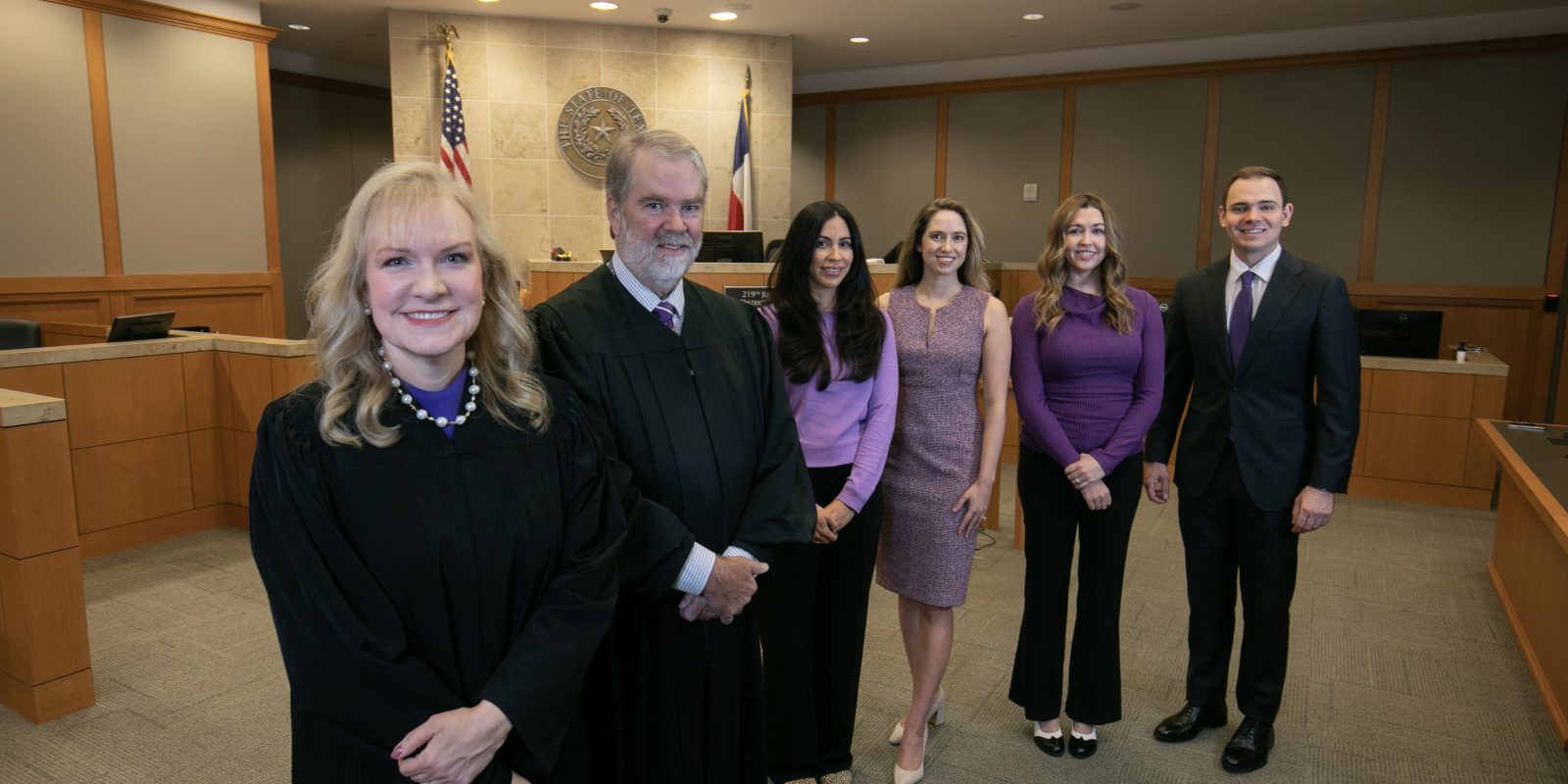
Jennifer Edgeworth and Lance Baxter co-founded the Collin County Adult Mental Health Court. Working with the TCU-educated judges are, from left, Michelle Garcia, Kailey Gillman, Janessa Reid and Rogan McDaniel.
TCU Alumni Judges Transform Lives Through Award-Winning Mental Health Court
For selling fentanyl to a person who overdosed and died, a convicted man was sentenced to 20 years in prison. When 219th District Court Judge Jennifer Edgeworth ’96 of Collin County, Texas, announced the punishment, she said, the man’s kin wept over the double tragedy.
Edgeworth handed down that hard sentence shortly before striding into another proceeding, this time with the Collin County Adult Mental Health Court, with very different outcomes.
If there is a happy place in the criminal justice system, for Edgeworth and Judge Lance Baxter ’83, who presides over the Collin County Court at Law No. 3, it’s the county’s adult mental health court. Co-founded by that duo three years ago, its results in keeping offenders with mental health disorders out of incarceration won the Judge Ruben G. Reyes Outstanding Specialty Court Team Award in 2025 from the Texas Association of Specialty Courts.
A DIFFERENT APPROACH
Baxter credits Edgeworth with persuading the local district attorney to partner in establishing Collin County’s first adult mental health court. Before meeting Edgeworth, Baxter had spent years lobbying for one. Edgeworth held more sway with the district attorney, Baxter said, because her court is a tier higher than his.
She demurred. Baxter’s years of making the case for the court, Edgeworth said, paid off. Mutually, they’d primed the district attorney to give the go-ahead.

219th District Court Judge Jennifer Edgeworth described the Collin County Adult Mental Health Court as “not a typical courtroom setting where people are advocating against each other.”
The judges met in 2018 when Baxter, already elected to the bench, moderated a candidates’ debate during Edgeworth’s first campaign for a district court judgeship.
“I leaned over and said, ‘Go Frogs,’ ” Baxter recalled, chuckling.
He and Edgeworth are paid to adjudicate cases in their regular courtrooms. But they also preside over the mental health court. Each month, they invest 14-20 hours holding sessions, reviewing files, meeting with staff and spreading the word about specialty courts to legal and mental health professionals and other groups.
In the special court, they function as law-minded jurists but also cheerleaders, job advisers and personal coaches.
“They are empathetic and approachable, cultivating a fair, person-centered environment where participants feel heard, respected and motivated to make meaningful changes. They’re perfect for the role they have,” said Janessa Reid, the court’s program coordinator. She added that their commitment to breaking the cycle of incarceration has shaped a program that prioritizes treatment over punishment and supports individuals in finding a sustainable path forward.
“We want to keep these individuals from cycling in and out of the criminal justice system,” Edgeworth said. “There is an opportunity to truly help them and see a lasting and positive change in their behavior and choices.”
Twice-monthly, roughly two-hour sessions at the mental health court let the judges dig deeper into the lives of people whose criminal charges they aim to ultimately wipe from the public record.
WHO GETS HELP
Court participants are diverted from a trial, potential conviction and incarceration after applying — sometimes at the suggestion or demand of defense attorneys, prosecutors or family — and being screened for the special program. Who gets accepted is determined on a case-by-case basis, with input from the district attorney’s office.
Participants’ criminal charges vary: felony assault against a hospital worker or loved one, misdemeanor theft, resisting arrest and more.
Ineligible for the program are those with current or prior charges or convictions for sex offenses or illegal drug manufacturing; those with pending charges or arrest warrants outside Collin County; or those on parole, probation or some other form of justice supervision.
The Collin County court’s current 14 enrollees and 42 graduates struggle with post-traumatic stress disorder, bipolar disorder, schizophrenia, depression, anxiety and other chronic mental illnesses. Participants include corporate executives, budding cosmetologists, cybersecurity students and stay-at-home moms. Among them have been a Sept. 11 first responder at New York City’s twin towers and a guy getting by on what he earns mowing yards.
Some who have been accepted into the program, which takes nine months to two years to complete, were suffering their first psychotic break when they were arrested. Sometimes, their arrests uncovered their lack of access to medical care or a lack of adherence to or understanding of an existing mental health prognosis and care plan.
One participant sought emergency medical care after his first major psychotic episode. Thinking he no longer needed it, he’d stopped taking the medicine prescribed for him. Months later, after another episode resulted in a run-in with law enforcement, he learned that he’d likely have to take medicine for the rest of his life.
“It’s a great opportunity for people to get the help they need,” said Reid, former director of community integration of the Denton County MHMR Center. “It allows us to approach each situation from a trauma-informed perspective — not to judge, but to create a safe space where participants can share what happened and explore how we can best help them.”
“In the past, individuals in similar situations would typically go through the traditional process and be placed on standard probation,” said Michelle Garcia, the mental health court’s probation officer. “It was difficult to watch that happen to someone experiencing their first offense during a mental health crisis, only to leave the system with a criminal record. That record follows them into the community, creating barriers to employment, housing, education and even basic stability. Through this program, individuals receive a meaningful second chance — one that supports recovery rather than punishment.”
ONE DAY IN COURT
On a fall Thursday, a teacher, a corporate sales manager, a restaurant server and an oil change tech were among the 16 people updating the judges on how they were faring. The youngest was 18, the oldest in her 50s.
From chairs usually reserved for a courtroom trial audience, they waited to be called by name to sit casually at a conference table. Baxter and Edgeworth sat across from them. The judges and individuals discussed mundane and serious issues. There were new puppies, new tattoos, a newly discovered lavender essential oil’s relaxing effect. There was a just-ended romance where things had turned toxic.
The judges made comments and asked questions. Was everyone adhering to their individualized, mandatory treatment plan of regular meetings with case managers and probation officers? Were they avoiding alcohol, cannabis products and illegal drugs? Had they passed random drug tests and attended behavioral support groups?
Were folks taking antipsychotics, antidepressants and other medicines only as prescribed, not misusing them? Who among them had kept or missed an appointment with the psychiatrist?

Judge Lance Baxter displays his TCU pride in his office, the same school spirit that led him to whisper “Go Frogs” when he first met Jennifer Edgeworth at a 2018 debate, years before they’d partner to create Collin County’s mental health court.
One man said his boss wouldn’t change his work hours. The man missed a medical appointment but promptly rescheduled it for an upcoming day.
“Thank you for being so forgiving and faithful with me,” he told the judges.
Violating the rules can get a person kicked out of the program.
“I have very good news,” another man said when it was his turn. “I got a job.”
Everyone applauded.
The encouragement continued when a newcomer sat down.
“We try to do it differently,” Edgeworth told the woman. “We’re at a roundtable because we want you to know and feel that we are all invested in wanting you to succeed. So, it’s not a typical courtroom setting where people are advocating against each other.”
PART OF A MOVEMENT
Edgeworth and Baxter said they are glad to be part of a nationwide movement that, since 1990, has launched more than 4,000 diversion courts for veterans, juveniles, families, members of Native American tribes and people with substance use disorders.
Diversion courts aim to be more humane, Baxter said, and to cut incarceration costs. That includes the average of $175 per day in Texas that it costs to detain a person whose untreated mental illness or addiction can fuel their crimes and lead them to cycle in and out of jails and prisons.
“There’s been a social shift,” Baxter said of the rise in treatment courts. “There is much more of an interest in doing things differently.”
Nationwide, about 60 percent of diversion court participants completed program requirements in 2022, according to a 2025 National Treatment Court Resource Center report. Collin County’s achievements mirror that. To date, 42 of 60 people admitted to the program — 148 have applied — graduated. Of those who didn’t cross that finish line, some were discovered to have resided outside the county. Some didn’t pass drug tests. Tragically, one person died by suicide.
Nationwide, people in their 20s and 30s make up 57 percent of program enrollees; 73 percent are men.
A SUCCESS STORY
“This work is not only about reducing recidivism. It’s about restoring hope.”
Judge Jennifer Edgeworth
As a testament to what’s possible, Edgeworth shows off a March 2025 mental health court graduation day photo of herself and a young man. They are standing side by side, smiling. He has an arm around her shoulder, she drapes one across his back. He’s wearing khaki pants, an Oxford button-down shirt, white sneakers, a fresh haircut.
When he arrived in mental health court in April 2024, Baxter said, “He wasn’t taking showers. He had a huge beard that was all over everywhere. Poor hygiene is a classic symptom of mental illness.”
“He was,” Edgeworth said, “very disheveled and very broken and very angry.”
He’d faced a misdemeanor charge for making a terroristic threat against a relative. He’d been downing a cocktail of 15 stimulant pills a day, triggering psychotic rages and getting him fired from jobs.
In mental health court, he followed the tailored plan. He took prescribed medicines for his diagnoses of bipolar disorder, major depression, anxiety and attention deficit hyperactivity disorder. He got steady enough to go back to work, first as a restaurant line cook. In January 2025, he went on the payroll as a director at a marketing firm.
He was moving toward his former self. He’d been a businessman and podcaster. Over the previous Christmas holiday season, he reconciled with his family.
“Our approach recognizes that participants are more than their cases,” Edgeworth said. “They are individuals navigating complex mental health needs who deserve compassion, understanding and the opportunity to rebuild their lives.
“This work is not only about reducing recidivism. It’s about restoring hope.”
Your comments are welcome
Comments
Related reading:
Features, Research + Discovery
Alessa Juarez Finds Responding to Mental Health Crises Requires Collaboration
De-escalating situations and improving services need an empathetic team approach.
Features, Research + Discovery
Health Care MBA Gives Students Opportunity to Improve Public Policy
Business students learn the art of convincing and influencing stakeholders for the common good.
Features
How Mindfulness Meditation Will Change Your Brain
Richard Davidson also found that contemplative practice enhances well-being.