
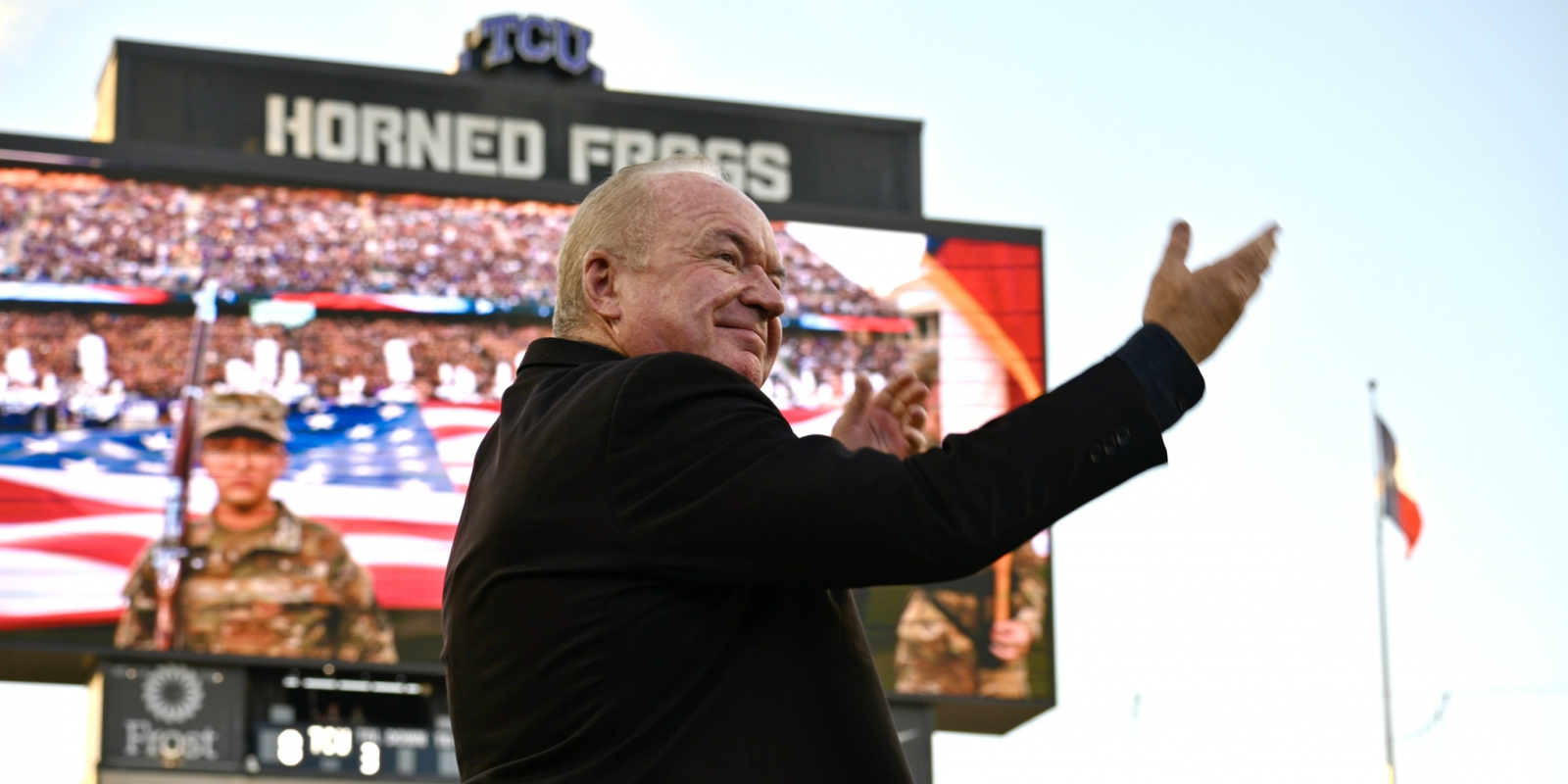
From TCU’s stadium to concert halls worldwide, Bobby Francis marks 25 years of building the university’s band program. Photo by Breelyn Francis
Director of Bands Bobby Francis Brings New Music and Opportunities to the TCU Wind Symphony
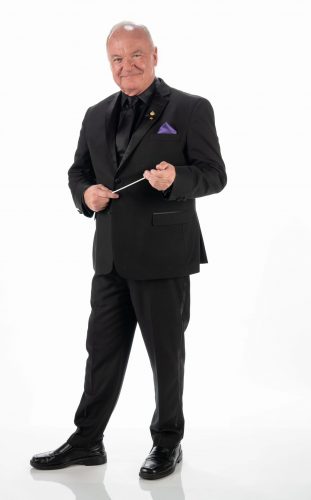
The former clarinet and saxophone player guest-conducts the nation’s top military bands and serves as chairman of the board for the American Bandmasters Association. Photo by Glen E. Ellman
Twenty-five years into his tenure, Bobby R. Francis, director of bands and professor of conducting, continues to embrace new challenges. Just as his term leading the American Bandmasters Association as president ended, Francis hosted the 2025 College Band Directors National Association conference at TCU. The prestigious event drew band directors, conductors and composers from around the nation to share in four musical days at the Van Cliburn Concert Hall, where the TCU Wind Symphony premiered four works.
When did you know that you wanted to make music your career?
I think very young, like a lot of people. I had a junior high band director — it was a kind of retirement job for him, which meant that he liked to go have a cigarette in the teachers’ lounge sometimes — and he would have me come teach the beginner classes as an eighth grader. And I was more than happy to get out of history to come do beginning woodwinds.
You were part of the Texas All-State Band in high school as a clarinet player. What led you to expand to also playing saxophone as an undergraduate at East Texas State University?
I wanted to make some money playing because I was really poor, and so I learned to play saxophone. I played sax in the jazz band all through college and then ended up getting hired by the Mal Fitch Orchestra. It was a society big band in Dallas — one of the most popular ones. Johnny Mathis came to town, we played a show; Gladys Knight and the Pips and groups like that. And then I ended up playing at Six Flags on my clarinet in the summers.
After you earned your degree in music education, you worked with the high school marching band in Richardson for one year. What was next for you?
I went back to my old high school, Trinity High School in Euless, as the assistant director. I thought I’d want to be a woodwind professor, so I started a master’s degree in woodwind performance at North Texas. I did that concurrently with teaching and playing gigs, getting back at 3 in the morning from Tulsa and getting up for 7 a.m. marching rehearsal. After five years, I got a call in the early summer from Ray Lichtenwalter, who was the director of bands at the University of Texas at Arlington, and he said, “Do you want to be the marching band director at UTA? It’s a one-year appointment, but you’ll have to have a master’s completed by the end of that first year.” So I ended up completing it at East Texas State because they were able to accommodate me with some summer classes and evening classes.
After six years conducting the marching band at UTA, you served as director of bands at East Texas State for six years. When you arrived at TCU in 2000, what were your goals for the band program?
It was an opportunity to build something. I do recall talking about a vision for the next 20 years, and it was basically build up every component of a solid band program. The thing that was here was Curt Wilson’s jazz program — that was groundbreaking. So I wanted to take that to the Wind Symphony, build that up to a very highly respected position, and to the marching band, of course, which is the most visible. All the concerts I’ve played with the Wind Symphony — it wouldn’t be as big a crowd as one football game.
Outside of musical skills, what makes for a successful member of an ensemble?
Common courtesy to their colleagues and respect for each other — I think that’s a big part of the whole culture of the ensemble and the band program at TCU. I really feel like now they’re very supportive, they respect each other, and that means in the rehearsal environment. If you’re talking because you want to talk in a rehearsal, you’re disrespecting your colleagues. If you’re not prepared when you come to rehearsal, you’re disrespecting your colleagues. So I think that beyond the musical requirements and demands, those two things are probably most important.
I think it starts with the band faculty and how we treat each other, how we treat the students. I grew up in an old-school yelling, throwing, berating kind of atmosphere — the band director you were scared to death of. I went back and taught at a school that still taught that way and I had to play that game for a couple years, and I realized this is not me, this is not healthy and this is not what I’m going to do. You can correct someone without making them feel small.
Anytime we have people on campus — I mean composers or guests for any reason — if they interact with our students, they are always very complimentary about how respectful they are, how smart they are and how much they really enjoy just getting to know the students.
How do you choose repertoire that keeps musicians interested and challenged?
It’s a balancing act of something old, something new, something borrowed, something blue. I’m trying to do a better balancing act. I tend to err on the contemporary side of things, but we do revisit the masterworks for the wind band. We just recently played “Hammersmith” by Gustav Holst, with a grad student conducting.
I think bottom line is if it has musical purpose, emotional purpose, and you get something out of listening and playing the music on a very deep level, it’s challenging at some level — it’s got to have all these factors in order for it to be something that is a meaningful experience. I don’t want to waste students’ time playing something that’s not going to have an emotional result for them, or for the audience or for myself for that matter.
Your latest recording project was released by Mark Records in May 2025; what can you share about it?
I wrote a grant proposal to record composers that have come from TCU — students who went through this program. And so we ended up with seven or eight composers, and they’re highly successful, like Kevin Day ’19. Harrison Collins ’24 is going to be a star, and then there’s Quinn Mason; we premiered his sixth symphony. So we recorded works of those composers.
Kevin Day’s trumpet concerto, called “Pyrotechnics,” we premiered it at the Texas Music Educators Association conference in San Antonio in 2020, right before Covid hit. We were going to have a recording project of it with Jens Lindemann, world-famous trumpet soloist, that spring. Of course, that didn’t happen. So we decided to make that one of the focal points for this recording project.
What does a conductor do, outside of the obvious?
The ultimate responsibility for a conductor is to represent the composer’s intent and to be a steward of the music and bring it to the audience in a meaningful way and, in the process, to the students performing the music. People ask if I practice my conducting and I really don’t anymore. I practice studying scores and hearing the sounds in my head — audiation.
When you’re on the podium or you’re rehearsing the ensemble, you’ve got to be able to hear what you want it to sound like — have that picture in your brain — and perceive what you’re actually getting, compare it to what you need it to be and then prescribe solutions to get it there. It could be technical, it could be musical, it could be expressive, and that’s the whole process of rehearsal.
I’m not an expert on every instrument by any stretch, but you’ve got to know the most common problems. So if you don’t know on flute on high F above the staff that you need to put the ring finger down to lower the pitch, it’s going to be sharp all the time, and your band’s going to sound bad.
What makes a conductor successful in communicating with musicians?
Elizabeth Green in the book called The Modern Conductor calls it impulse of will. The impulse of will is something you really can’t teach — the ability to bring people together, to make them do something in a certain way, musically, just through your presence. It’s not only arm and hand technique, it’s your face, it’s your posture, it’s everything. It’s just, “Come on!”
It’s all about trust. If you come across as fake or contrived or rehearsed, like “I’m just doing this because I stood in the mirror and I thought this is what looks good,” they see through that in a heartbeat. It’s got to be sincerity coming and going, back and forth.
What are some of the most important things you teach student conductors?
My backyard’s got, in spring, a million birds. So I record the sound and use an app called Merlin that tells you what bird’s making noise. I play the sound to the class — count how many different sounds you hear, and guess where they’re located, how close to our recorder is it. And then they listen to it again. They’re honing their listening skills and listening at a deeper level than they would normally. That’s what you’re doing when you rehearse the ensemble — the instruments are the birds. And then I play the Merlin thing and it actually shows chirp, chirp, chirp — wren. And then they know, oh, I only heard four different sounds, and there are actually nine. So they listen again.
I can’t tell them enough how important it is to study on their instrument and get better on their instrument, because musicianship is musicianship and that’s the best way to learn to express a phrase, to shape music, to know where the music’s going. If you don’t do that on your own as a performer, it’s really difficult.
How do you handle it when things don’t go as expected during a performance?
It happens all the time. Maybe somebody comes in early or late or something — do I go with the person that’s playing the solo, or do we keep the ensemble together? And you have to bring them back together sometimes. The better rehearsed they are, the less often that happens, of course.
There’s this old saying about as soon as you get on the podium, you kind of lose half your brain just because of the nerves. When you get on the podium, you’re hearing all this coming at you. You’re running through those filters in your brain, and you have to be able to respond accordingly and go with the flow.
You have guest-conducted youth wind orchestras and other student groups all over the world, from the Sydney Opera House to Pearl Harbor. Tell us about some of those experiences.
Sydney Opera House was a group of Texas kids — we brought college and high school and adults together, rehearsed a few days, flew to Australia and performed a couple of times. Same thing with Pearl Harbor. We did Fourth of July at Normandy Beach, which was very cool, very emotional.
Guest-conducting honor bands — part of that’s recruiting. A lot of the kids we have here in the program I once taught in an honor band when they were in high school. We have a real strong contingency from the Chicago area, lots from California and then a lot of Texas kids.
You’re on the podium for four hours on a Friday night and eight hours on a Saturday and a concert that night. As I get older I’ll do less of that, but it’s amazing to hear Day 1 the first note, and then 24 or 36 hours later, put on a really good concert.
“I’m not going to stop giving students these kinds of opportunities because I know how important it is to them, and they will remember that performance forever.”
Bobby Francis
You recently concluded your term serving as president of the American Bandmasters Association, which included running the annual convention. What was the significance of serving in that role?
It’s an honorary organization that requires a very extensive, successful career before you’re even considered to be a member. This year, for example, I think there were 13 nominees — this is in the entire country and Canada — and six of them got in, just to be members. That happened in 2003 for me. I have been a member ever since and somebody nominated me to be an officer, and I got voted in as president. First, vice president, then president-elect and then president; it’s a five-year cycle of leadership with the organization. I’m now chairman of the board, and I’ll have another year after this one.
I think in Texas there are probably somewhere around 18 ABA members, and we have one of the largest contingencies and the most band directors in the country. Just being invited to be a member — I made the old joke, “I used to have great respect for this organization till you had me as a member.” So that just stunned me. And then to be president of that group is just something I would never have imagined.
What’s it like to guest-conduct some of the nation’s top military bands?
Those are invited performances for me to conduct, like Hindemith’s Symphony, last movement, with The President’s Own Marine Band a couple of years ago. Last year, I conducted the Pershing’s Own Army Band — it’s part of being an American Bandmasters Association president. The outgoing president conducts the national anthems for the U.S. and Canada at the beginning of a concert.
If you’re with the President’s Own or Pershing’s Own, you give the downbeat, and they sound wonderful. These are people that could be playing in the Chicago Symphony or the New York Philharmonic, but they prefer and audition for and were admitted to the President’s Own, for example. So that becomes a matter of what do I bring to them musically that might be different than what they’re used to?
How do opportunities to interact at major conferences impact music students?
As I told the Wind Symphony the other day, bragging about how well they did at the College Band Directors National Association conference, not only performing but helping to run the show, “I think the worth of your degree went up based on what you just did, because everybody was knocked out.”
We’re looking to hopefully perform at the Texas Music Educators Association conference in San Antonio next year, possibly combined with our choir. I’m not going to stop giving students these kinds of opportunities because I know how important it is to them, and they will remember that performance forever.
Editor’s Note: The questions and answers have been edited for length and clarity.
Your comments are welcome
Comments
Related reading:
Research + Discovery
Germán Gutiérrez Believes in the Power of Music
The director of orchestras at TCU says music is a way for people to work together and put aside political differences.
Features
Our Marching Band, the Pride of TCU
In its 111th year, the band still practices hard, relies on teamwork and performs with passion.
Campus News: Alma Matters
Van Cliburn Concert Hall Design Takes Center Stage
Explore the adjustable acoustics at the Van Cliburn Concert Hall in this interactive graphic.