
Getting Down to Business
Professor and entrepreneur Michael Sherrod helps students and faculty innovate, turning their passions into reality.

“The risk of losing your job in a corporate environment is exactly the same as starting a small business: 50 percent over four years. So there’s no more advantage to going to work and getting a paycheck than there is trying to do your own thing,” says Michael Sherrod, William M. Dickey Entrepreneur in Residence at the Neeley School of Business. Photo by Glen E. Ellman
Getting Down to Business
Professor and entrepreneur Michael Sherrod helps students and faculty innovate, turning their passions into reality.
Michael Sherrod ’10 EMBA, the William M. Dickey Entrepreneur in Residence at the Neeley School of Business, has founded or held senior management roles at dozens of companies, including AOL Local and Ancestry.com.
His diverse professional experiences inform his teaching across campus, including graduate-level classes in the business analytics, business administration and liberal arts programs, and serving as a faculty member in the BNSF Neeley Leadership Program, which trains business students to become industry leaders. Sherrod also directs TCU’s Innovative Teachers Guild, where non-business professors learn to use entrepreneurial thinking and experiential learning in their classrooms.
What brought you to TCU, and what keeps you here?
I had just finished being the first publisher of the Texas Tribune down in Austin. I came back to Fort Worth, and I thought it was about time to retire. I got a call from a former EMBA professor that I had in 2010 who told me that TCU was looking for an entrepreneur in residence. I thought, “Well, that sounds interesting.”
Normally speaking, those are one-year gigs — you write a book, you teach a class. When I got there for the interview, they said, “We’d like for you to stay as long as you like.” I thought it’d last for a few years, but it’ll be 14 years that I’ve been there, and what made me stay was the incredibly wonderful students and the people who work there.
It was a revelation to me when I taught my first semester-long class. That was way harder than I thought it was going to be — putting together all the content for a whole semester and making sure it’s not too much and not too little, sort of a Goldilocks situation. You want to make it just right. My wife — she’s a PhD and she taught in the nursing school for 20 years — she helped me understand how to do that, which was invaluable.
Once I taught that first semester, I was hooked. I just loved it. Teaching was something I found to be just totally engaging, impactful, a lot of fun and really, really interesting. I learned from the students I think as much as I taught them, and the students at TCU have changed dramatically since I started in 2011. They’re very engaged and wanting to get in there and grind away. What people say about Gen Z I just don’t see. I see a lot of engaged students with a fantastic work ethic. I have been at TCU longer than I have ever been at any other workplace and it’s because I love it.
What do you want students to take away from your courses?
In corporate entrepreneurship, I want them to learn big concepts around how to manage people because one of the things that happens to our students when they graduate is they very quickly become managers. The reason 75 percent of people quit their jobs in the Great Resignation was because of their immediate supervisor, so what I’m trying to get them to understand is how corporate cultures work and how they can leverage that for their own success.
It’s my firm belief that in the 21st century, every single student at TCU at some point will have to be an entrepreneur. There’s just too much volatility in corporations. No one has a 30-year career anymore. So they’re going to have many, many different kinds of jobs. And they need to be flexible. They need to be continuously learning. They need to be adaptable.
Most importantly, they need to understand basic technology that’s coming into the world. If people are doing those things and you don’t understand them, you can’t effectively manage them because you don’t know enough. They could say, “This project is going to take six months,” when, in reality, it should take six weeks, and if you don’t know that you’re not going to do well in your job. So that’s really what I’m trying to get across to them — the things they need to understand to be successful.
What do you want to learn from students?
Mostly what I want to learn from students is what are they thinking right now? What is it that they are interested in? It changes — in the time I’ve been there, students went from kind of being, “Yeah, I’m just going to be a corporate cog and I want a job,” to being very activist in their approach. Now, “I don’t just want a job. I want a job that meets my standards, that allows me to be who I am, my authentic self.” And I love seeing that.
What do you find rewarding about working with students?
Just getting to know them is rewarding. Most of them are just a hoot. I really like to get to know them a little bit and understand not only where they’re coming from but, more importantly, where they want to go. One of the very first questions I ask in all of my classes is, “Why did you take this class? How does this fit into your overall goals for your career?”
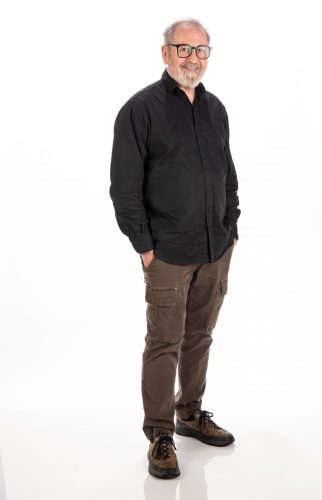
Michael Sherrod challenges students and faculty to embrace uncertainty, think entrepreneurially and create a human-centered future. Photo by Glen E. Ellman
You’ve received several teaching awards, including a 2024 Poets&Quants Best Undergraduate Business Professor nod. What does it mean to receive those honors?
I love the fact that Poets&Quants recognized me as one of their top professors. I got the TCU Graduate Teaching award a few years back, and even before that, I got an Innovative Curriculum Award. Those things mean a lot to me, and I’m very proud of them. But really, when I get a note from a student or a student sees me in the hall and says, “I had your course last semester. I really enjoyed it. I miss being in that class,” that’s what really makes me feel like I’m doing something impactful.
What can you share about your current projects?
The thing I’m most interested in advancing right now is the Innovative Teachers Guild. I want to change that up a little bit, so that instead of just talking about and mentoring them on entrepreneurial thinking and experiential learning, they have to produce a business or a course or a module that’s going to help their students right now and post-graduation. The curriculum around that is what I’m working on right now because I think that could be something that not only we could use here at TCU, but we could export to other universities to help their professors get more engaged.
What does innovation mean to you?
Innovation, to me, means understanding what it takes to create the future. And the reason this is so important to me is because I believe that if all of us aren’t working to create a human-centered future, we won’t have one. We’ll have a machine-centered future, and that is not good for humanity.
The digital landscape has changed a lot in the past 10 to 15 years. What are the challenges of keeping up?
Man, you’ve got to work at that. If you want to keep up with what’s happening right now, you have to spend a good amount of time every day going through all of the sites that you trust, looking for new things, scouring the net for new information. What’s the newest thing in AI? What’s happening in blockchain? What’s going on in crypto, what’s happening in cyber security?
Every day, something new comes out, some new capability. Just last week, agents could do one thing at a time. This week, they can do 50 simultaneously because of Manus, a Chinese AI that can do 50 simultaneous activities as an agent. That is a game-changer.
I encourage everyone to take all the free courses that are out there on AI, because you are going to have an AI assistant. It doesn’t matter what your age is or what your job is, you need to be learning AI because it’s going to become part and parcel of your life faster than you think.
Which big lesson have you learned in your career, and how have you passed that on to your students?
I think the most important lesson that I can give them is if you’ve got a really great idea that you’ve been working on for a long time and you present that idea to management and they say no, you have a choice to make. You either stay and you go on and do your job, or you take that idea and you leave and you create something new with it.
So they’re going to have that moment in their career, maybe a couple of times, where they have to decide, “Is this the time for me to go do this, or am I going to stay inside the corporation?” And the difficulty in that decision is that corporations are no longer safe. The risk of losing your job in a corporate environment is exactly the same as starting a small business: 50 percent over four years. So there’s no more advantage to going to work and getting a paycheck than there is trying to do your own thing.
“Once I taught that first semester, I was hooked. I just loved it. Teaching was something I found to be just totally engaging, impactful, a lot of fun and really, really interesting.”
Michael Sherrod
You manage Black Dove Press and Blue Pigeon Press, both small book publishing companies. What kind of books do you publish and what are you reading right now?
I publish poetry books, fantasy novels, interesting biographical sketches. I do some experimental publishing, like I published a book of QR codes that every month changed to a new book at midnight at the end of the month. I’ll publish anything that interests me.
I’m reading a book by Kurt Vonnegut right now, an old one, Breakfast of Champions, which is one of my favorite books. I’m actually rereading it for about the 15th time. I’m a big science fiction reader, and my favorite books right now are The Murderbots Diaries. They are hilarious.
I always have at least one print book and one digital book that I’m reading. I read about 120 books a year. That’s one of the ways I keep up with what’s going on in the world. This is weird, but I’m a huge fan of Norwegian and Japanese detective novels — Chinese, too. They are really interesting, different and the whole north part of Europe has really dark detectives.
Is there a professional achievement that you’re most proud of?
Starting my first company, Sherrod Publishing, Inc. That and Digital City [a company Sherrod co-founded that provided the first digitized city guide]. The reason I’m proud of Digital City is because when we started that company no one had ever really worked for a website before, so finding people to work there was very difficult. And not only that, but the salaries we had to pay were tiny.
So I found people who had just gotten out of mental institutions, that had cocaine problems, that were afraid to drive. My editor was 6-foot-7, weighed 450 pounds and wore a purple suit every day. So it was an unusual group of people. But what I’m proudest of is that group of people, they all had problems in their background and they were determined in this new industry to remake themselves. We made more money and we had eight times the users of any other Digital City because these people were brilliant.
I’m proud of my first company [Sherrod Publishing, Inc., which began as a magazine publishing company] because it actually worked when I didn’t know anything. I was lucky, lucky, lucky, but I was able to take that luck and make it work. Digital City was my other favorite because it created such opportunity for these people. Most of the people who were on the original team at Digital City have all gone on to do great things and are part of my network still to this day.
Editor’s Note: The questions and answers have been edited for length and clarity.
Your comments are welcome
Comments
Related reading:
Features
AI in the Classroom
TCU professors are navigating students through the brave new world of artificial intelligence.
Research + Discovery
Startups with a Story
TCU business faculty are shaping entrepreneurship by showing how values and authentic storytelling help new ventures draw investors.
Features
Venture Capitalism 101
MBA students connect investors and startups in a Neeley program.