

TCU criminal justice professors are helping local police officers learn to be better leaders. From left, Johnny Nhan, Ronald Burns and Kendra Bowen.
From Mental Health Crisis to Better Policing: TCU’s Evidence-Based Training Model
TCU scholars are redefining police leadership training.
THERE WAS A TIME WHEN police officers were generally regarded as unassailable heroes, rarely questioned and largely left to oversee their own conduct by a trusting public that stepped aside when officers arrived. Many children dreamed of carrying a badge when they grew up.
Today, officers operate under the public’s watchful, skeptical eye, with smartphones often livestreaming tense situations. The balance between authority and accountability is finer than ever. Ask children now if they want to be a police officer, and they may shudder at the responsibility.
In this transformed landscape, successful policing demands a new breed of leadership — one that balances accountability with support for rank-and-file officers and enforces the law while building genuine community trust.
“Police leaders set the tone for whether they have an antagonistic or friendly relationship with the community they serve,” said Johnny Nhan, associate dean of graduate studies and professor of criminal justice. “Today, there are liability and public perception issues, and leaders are tasked with very difficult decisions.”
Nhan and fellow TCU criminal justice professors Kendra Bowen and Ronald Burns are creating groundbreaking programs that blend research with training to help law enforcement evolve for modern realities.
Their work addresses one of policing’s most complex issues: how officers respond to people in mental health crises. A 2024 Journal of Qualitative Criminal Justice & Criminology paper by Bowen, Nhan and Alessa Juarez, who started the research as a TCU graduate student, examined collaborations between North Texas law enforcement and mental health service providers.
Despite efforts to improve outcomes, miscommunication and differing approaches to addressing emergencies have often hampered effectiveness, sometimes with tragic outcomes. In 2015, Dallas police fatally shot a man with schizophrenia who was holding a screwdriver, even though his mother had warned 911 dispatchers about his mental health condition.
The study proposed solutions, such as joint training between police and mental health professionals, while emphasizing the critical role of police leaders in fostering openness and collaboration.
“Academics and law enforcement have traditionally been in silos,” Bowen said. “But through research and collaboration, there are opportunities to identify best practices that result in strong leadership and successful policing.”
BREAKING THE MOLD
Research insights uncovered by TCU faculty flow into the university’s classrooms, where North Texas police officers learn to apply evidence-based strategies that are reshaping law enforcement.
A 2017 request from Neil Noakes, Fort Worth’s police chief at the time, was the genesis of the police leadership training program. He approached TCU — known for its nationally ranked master’s program in criminology and criminal justice — about such a program. There, he connected with Nhan, whose textbook Issues and Controversies in Policing Today (Rowman & Littlefield) has been adopted in classes nationwide.
They set out to create a program addressing what police at all levels describe as a lack of meaningful leadership training. The result was Leadership, Executive & Administrative Development (LEAD), a graduate-level certificate program for sergeants and higher-ranking officers.
Rather than replicate conventional leadership training — large conference rooms filled with dozens of attendees — they limited the program’s class size to fewer than 10 people to encourage discussion and collaboration. The small classes allow for unique experiences; one cohort met with David Brown, then-Dallas police chief, to discuss his decision-making during the 2016 sniper-attack killings of five police officers.
The curriculum tackles communication, management, interviewing for leadership roles, media interaction, policy development and stakeholder engagement.
Since launching in 2018, LEAD has seen impressive results: About 75 percent of its 46 graduates have earned promotions.
“A goal of leadership training is teaching students to think bigger,” said Bowen, the graduate program director. “It is very easy to get caught up in the day-to-day duties without thinking about the bigger picture: what needs to improve and how to improve it.”
Lake Worth, Texas, Police Chief J.T. Manoushagian, a 2019 LEAD graduate, said that the program’s lessons translated into the creation of an emergency communications center. He and the city’s 911 communications manager, also a LEAD graduate, spearheaded the consolidation of three emergency-call operations into a single regional dispatch center that now handles more than 150,000 calls a year.
During LEAD, “I learned not just what to think, but how to think,” Manoushagian said. “I learned to look at the services we’re expected to provide and identify ways we could do so more effectively and more efficiently.”
BEHIND THE BLUE LINE
The program’s instructors are sharing the framework as a model for law enforcement leadership education nationwide. In 2019, they published an article in the Law Enforcement Executive Forum highlighting the training’s unique structure.
New insights have emerged from the relationships TCU has built with police departments — connections that unlock research opportunities typically inaccessible to academics.
“One of the hardest things for academics to do is cold call a police department and try to access data, whether that is statistical data or talking to officers, because they are generally mistrustful,” Nhan said. “Because of the relationships we are able to build with police leaders, we can call a police chief and ask if it is possible to do some research on this or that, and they usually agree because of the trust we have established.”
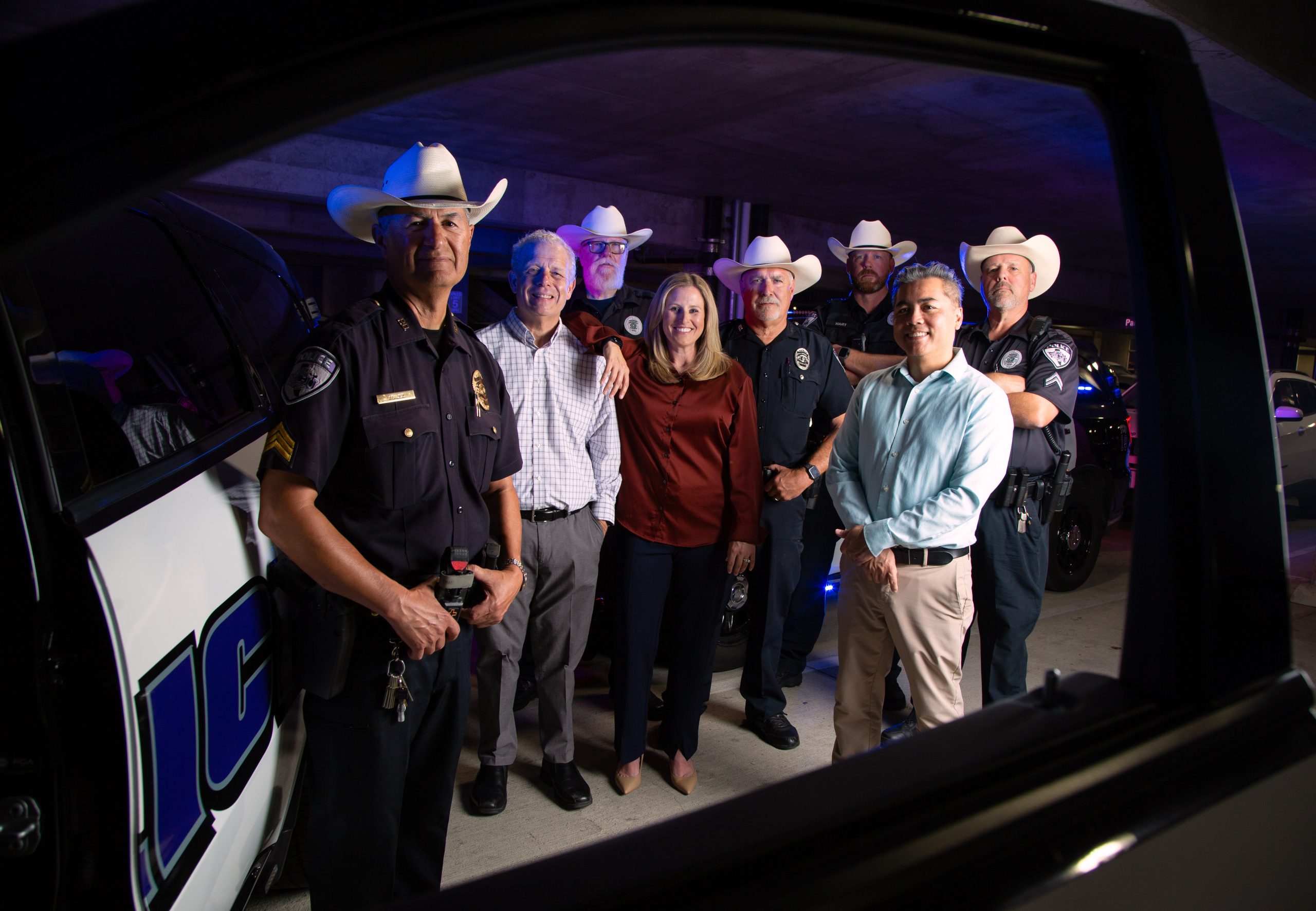
TCU criminal justice professors are helping TCU police officers learn to be better leaders. From left, Sgt. Eric Abilez, Ronald Burns, Cpl. Bryan Levy, Kendra Bowen, Cpl. Gary Jeandron, Officer Trey Hart, Johnny Nhan and Cpl. John Spann.
A police officers association in North Texas approached Nhan with concerns about the psychological toll of long-term injuries that aren’t considered critical. While officers who are shot receive extensive support, those who slip on ice and require back surgery often struggle in isolation for months or years with minimal assistance.
“This is not something that exists in the research literature; the academic world did not know this was a problem,” Nhan said. “Now we’ve started a research project where I’m talking to police officers about their experiences after these under-the-radar injuries.”
The findings suggest that “long-term police injury is compounded by police reluctance to seek professional psychological help and a dysfunctional insurance and medical system,” Nhan said. “Being out long term can have devastating effects on mental health that can lead to feelings of abandonment, isolation and loss of purpose and passion for police work.”
The research partnerships continue expanding. The emergency call center Manoushagian established offers rich data for studies. This spring, Bowen and Juarez will collaborate with the center to examine topics including artificial intelligence’s effectiveness in analyzing and improving emergency call handling, plus the correlation between citizen satisfaction with emergency responses and 911 center employee satisfaction.
FROM ROOKIE TO READY
“We needed to be thinking about helping officers interested in leadership … get on that trajectory earlier.”
Kendra Bowen
As the LEAD program evolved, participants suggested a need to help frontline officers develop a leadership mindset early in their careers. Nhan said new officers tend to arrive on the force eager to hit the streets and make arrests, but supervisors are focused on big-picture issues.
“We needed to be thinking about helping officers interested in leadership … get on that trajectory earlier,” Bowen said.
This insight sparked the creation of Transformational Learning, an intensive one-week course funded by a research grant from TCU’s Office of Sponsored Projects. Two Fort Worth police officers, Tiffany Bunton and Latricia Lovings, helped design the curriculum.
The program spans police leadership theory and decision-making to wellness and communication. Officers engage with command staff, explore leadership pathways and receive career guidance. Thirty-five officers in the first two cohorts have completed the course.
“We don’t try to tell the students that we know everything there is to know about policing,” Burns said. “But when a topic comes up and there is research around it that we are familiar with, we can share that evidence as part of the discussion.”
Bowen, Burns and Nhan are completing a study to submit for publication that will examine the officers’ views on leadership training and the role of civilians in teaching leadership to police. Findings suggest that the lack of formal, practical leadership training opportunities leaves many officers unprepared for supervisor roles even years into their careers and that participants appreciate an academic facilitator.
“Our research offers much to the limited body of work examining leadership training and serves as a model for others to replicate or build upon,” Burns said. “Ultimately, our research is an added benefit of the training and, at the very least, adds another piece to the puzzle as we try to determine the most effective means to train tomorrow’s law enforcement leaders.”
Your comments are welcome
Comments
Related reading:
Alumni, Features
Crowdsourcing Can Lead to Solving Crimes with Police
Johnny Nhan analyzed how citizens banded together on platforms like Reddit to find the Boston Marathon bombers.
Alumni, Features
Justice for All
Judge Zuberi Williams cultivates connections and empathy.
Alumni
On Call for Justice
Anthony White’s passion for justice drives his police work, victim advocacy and teaching.