
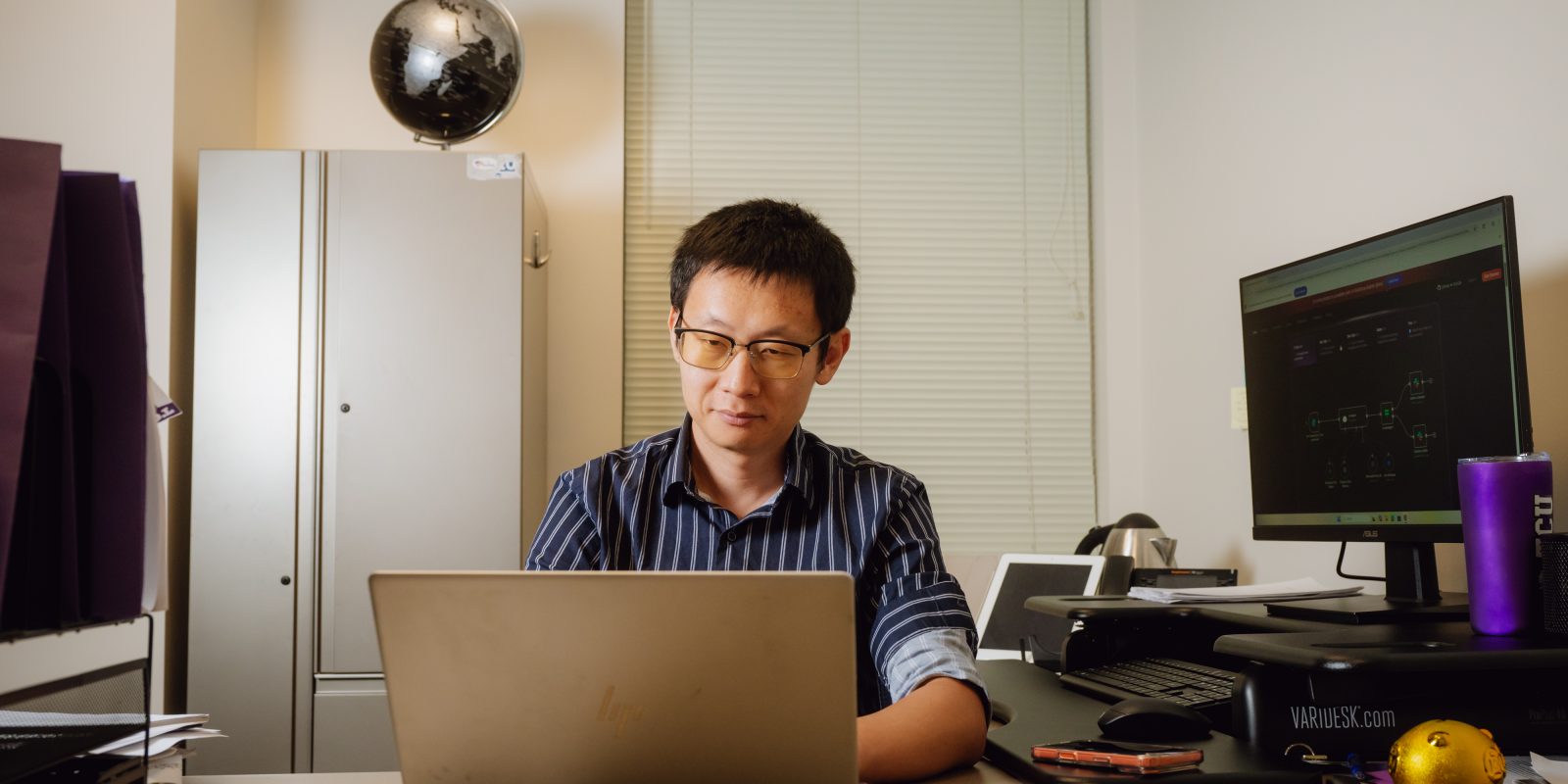
Xiaolu Zhou co-leads AddRan’s AI research cluster, seeking external grants to integrate the technology responsibly across liberal arts disciplines from literature to history.
AI in Academia
Xiaolu Zhou is working to bring TCU classrooms into the future.
Type a question into Xiaolu Zhou’s “AI Globe” and watch the world spin. The digital sphere rotates on screen, continents blurring past until it settles on a precise location — maybe the Yunnan-Guizhou Plateau in southwest China, maybe a sprawling European urban center where particulate matter clouds the air.
The program responds in real time, layering geographical data over the query, turning curiosity into discovery. Zhou is developing the AI Globe as one of several tools that use artificial intelligence to update and respond to a student’s inputs. In the program, users can input queries related to a geographical question, and the program will rotate a digital globe to pinpoint the area directly related to the query while providing relevant information.
Through this tool, Zhou seeks to spark his students’ interest in geography by giving them the means to pursue the subjects that interest them the most.
Zhou, an associate professor of geography in TCU’s AddRan College of Liberal Arts, has been utilizing AI to support his research for years. His studies seek to identify meaningful patterns in massive datasets using advanced AI techniques. The applications include environmental monitoring and analysis of rental housing markets.
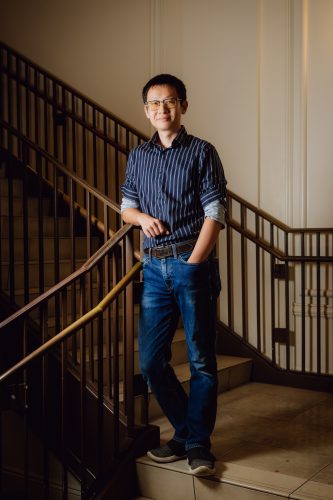
Xiaolu Zhou presented at AddRan’s Distinguished Faculty Lecture Series last March, discussing AI’s potential to empower professors in developing interactive teaching tools tailored to individual student needs.
“AI can assist me in gathering and organizing information,” Zhou said. “It serves as an analytical assistant that integrates data from different sources, examines it in depth and helps uncover meaningful insights.
Having experienced the benefits of harnessing the power of machine-learning models, Zhou believes AI can also be utilized as a critical tool for classroom learning.
Zhou “and I both agree that AI is useful and that we have to address its presence in the world and on our campus and in our classrooms,” said Muriel Cormican, associate dean of undergraduate students and professor of German. But a critical examination of AI must also be part of the discussion surrounding the technology, she added.
When Dean Sonja Watson announced the establishment of interdisciplinary research clusters in TCU’s AddRan College of Liberal Arts, Cormican proposed a cluster on AI. She and Zhou now co-lead it, working to determine the best way to foster interdisciplinary collaboration, seek funding opportunities and integrate AI in teaching and research.
“Zhou has an outstanding record of research in AI technology,” said Sonja Watson, dean of AddRan. “And I believe he does an amazing job of collaborating with others to solve problems.”
BRINGING AI TO THE CLASSROOM
Last March, Zhou hosted a presentation at AddRan’s Distinguished Faculty Lecture Series about artificial intelligence and its potential use in the 21st-century classroom. AI, he believes, can empower professors to develop new and interactive teaching tools that can be tailored to meet the needs of each individual student.
He believes professors can utilize AI to assist with various aspects of course design. Zhou has used it in his classroom to familiarize his students with a variety of specialized AI tools, from workflow automation programs such as n8n, to media creation platforms like Google Flow.
“By exposing students to multiple tools,” Zhou said, “I aim to develop both their technical fluency and their ability to select the right tool for the task.”
Professors can also utilize the processing power of AI to challenge students with projects that help them learn its capabilities, he said. Zhou has designed a curriculum for his AI & LLM Concepts and Applications class, where students utilize the technology throughout the semester to build webpages, design and execute automated workflow programs, and produce images, videos and other creative outputs.
“These assignments,” Zhou said, “help students explore different capabilities of AI and how to integrate them into practical application.”
THE LIMITATIONS OF AI
Despite its potential benefits, Zhou also reminds students that artificial intelligence is not a miracle cure-all. It is a tool. Like any tool, it can be mishandled. And sometimes, it can even break.
Although AI technology has advanced in recent years, it can still be susceptible to fallacies. One such fallacy, Zhou said, is referred to as the hallucination problem.
“Sometimes,” he said, “when AI is asked a question it doesn’t have a clear or factual answer for, it may still generate a response — one that sounds confident but isn’t necessarily supported by evidence or accurate information.”
When using AI, he said, people must be hypervigilant about fake, skewed or biased outputs.
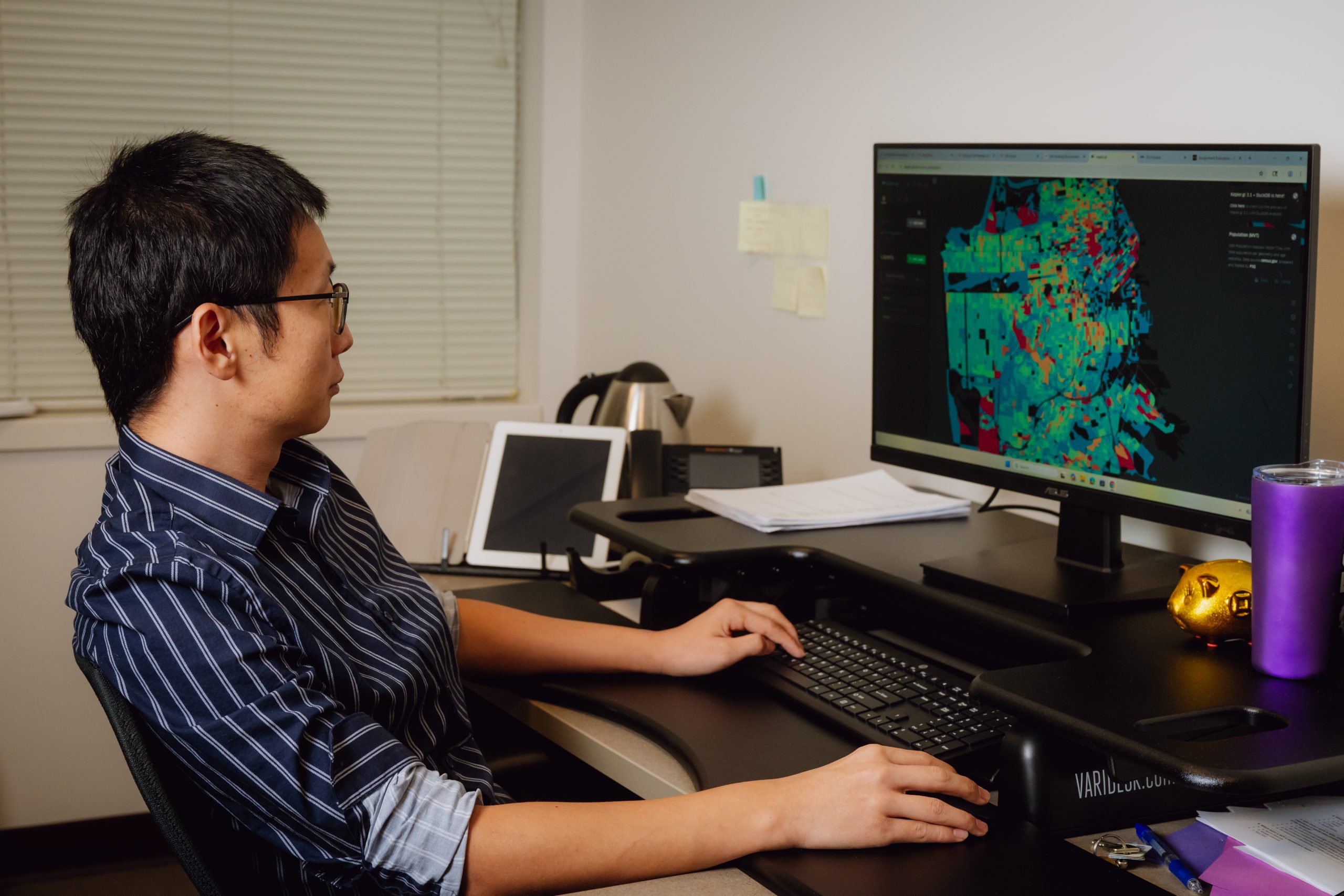
Xiaolu Zhou studies a map showing population and age statistics for the San Francisco area at his office workstation in Scharbauer Hall.
“We have a tendency to think that AI is more objective than human beings,” Cormican said. “But it is important for students and all of us to understand that there is an algorithmic bias built into all of these programs. They reflect the bias and limitations of those who create them and the data they are trained on.”
Algorithmic bias refers to the tendency of certain machine learning programs to unfairly favor one group of people over another. It is already a real-life problem that affects academia, as Stanford scholars have found that AI detectors tasked with determining whether students used technology to write their essays are heavily biased against non-native English speakers.
RESEARCH CLUSTERS
As the technology continues to develop, Zhou is invested in introducing AI to TCU as an intentional learning tool. He and other professors will identify areas for growth and then apply for external grants.
“We plan to work with faculty in the AddRan College to explore how AI can be effectively and responsibly integrated into the study of disciplines in the liberal arts, for instance, literature and history,” Zhou said.
For example, AI could be used to analyze themes in books and plays and generate multiple interpretations, allowing students to engage in deeper critical discussions about the text. In a history classroom, AI could create interactive timelines that allow students to explore the complexities of historical causality, such as how a famine might have impacted the politics of a region, and how history might have unfolded differently if that famine had never occurred.
In the process, AI may make mistakes or overlook details, but those moments can teach students to think critically, verify information and collaborate with AI to refine insights, Zhou said, adding that as the technology becomes more integrated across disciplines, developing the ability to work effectively with it will be an essential skill in nearly every field of study.
“While we have not yet finalized specific project themes,” Zhou said, “Our approach will be to work closely with faculty across disciplines to identify promising areas for collaboration.”
Your comments are welcome
Comments
Related reading:
Research + Discovery
How AI Deepfakes and Bias Threaten Elections, Health Care and Public Trust
TCU researchers expose how artificial intelligence is spreading political misinformation, worsening medical disparities and eroding confidence in institutions.
Research + Discovery
AI² CENTER AT TCU
The university has built AI infrastructure the way it once built libraries — as a foundation for the next century of research. The new AI² Center enables TCU to operate this technology securely and ethically from campus.
Research + Discovery
AI on Fashion’s Cutting Edge
Instructor Leslie Browning-Samoni weaves AI into her merchandising curriculum.