
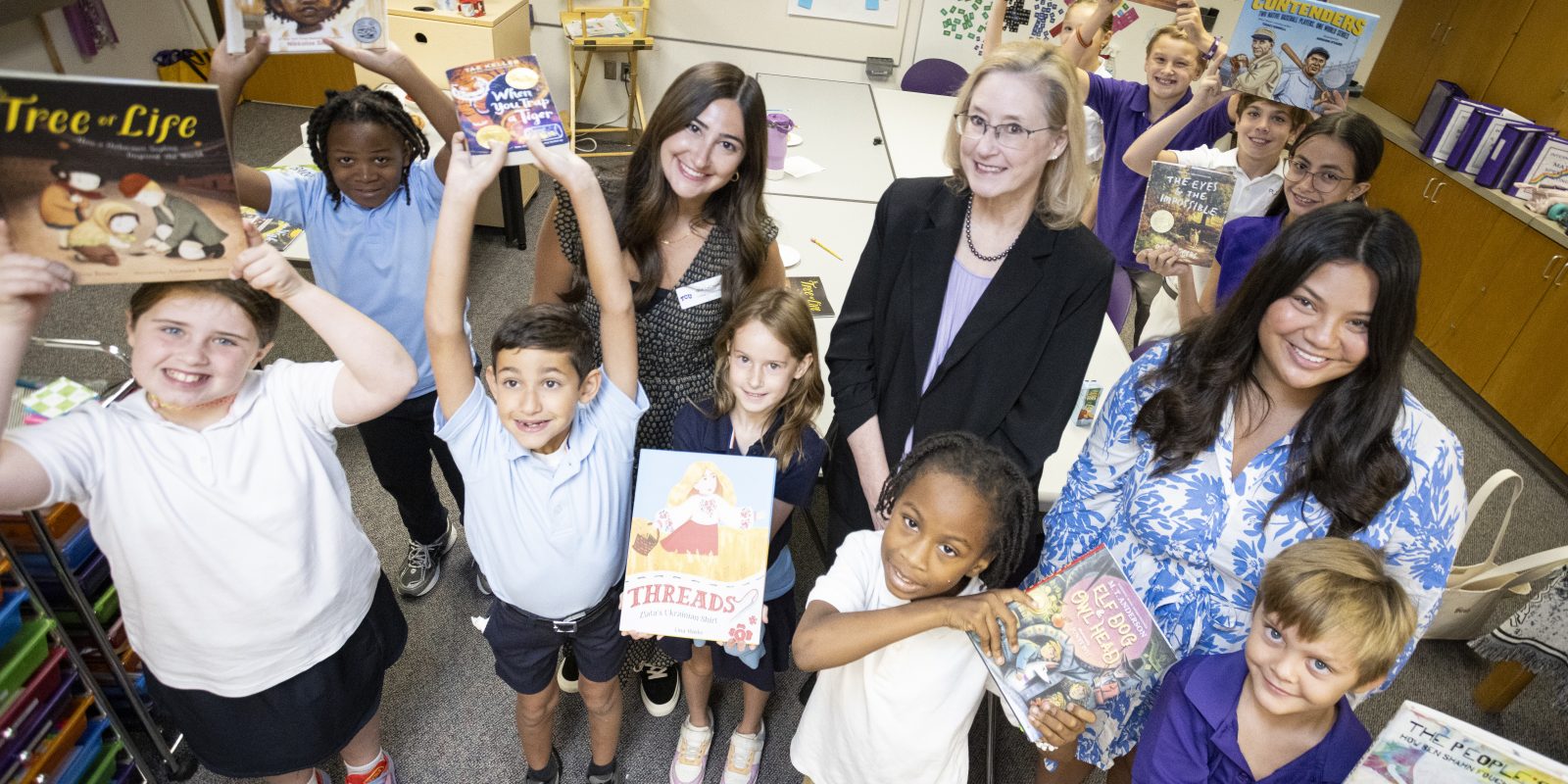
Jan Lacina, senior associate dean for research, graduate studies and strategic partnerships in TCU's College of Education, with students from the Starpoint Critical Literacy Book Club, which she launched in 2023 to foster a love of literature in children with learning difficulties. Photo by Ralph Lauer
Starpoint School Book Club Fosters a Love of Reading in Children With Learning Difficulties
Jan Lacina launched a book club for children with dyslexia that fosters empathy and confidence while training graduate students in research.
ON A WEDNESDAY MORNING AT 7:30, eight students arrive early for book club at Starpoint, a TCU laboratory school serving elementary-age children with learning difficulties. Doughnut holes and fruit await them — a signal that this gathering is social.
Today’s picture book, How Do You Spell Unfair? by Carole Boston Weatherford, tells the true story of MacNolia Cox, an eighth grader who in 1936 became the first Black student to win the Akron, Ohio, spelling bee, earning her a spot at the National Spelling Bee in Washington, D.C.
Gina LeCause, a TCU master’s student in language and literacy, guides the group through MacNolia’s journey, pausing frequently to draw out deeper thinking. How might MacNolia be feeling as she endures the indignities of segregation during her travels, including at the spelling bee banquet, where she and her mother sit at a card table, separated from the other families?
The children respond quickly: sad, mad, separate.
MacNolia perseveres, finishing in the Top 5. When LeCause asks about the character’s traits, voices chime in: determined, brave.
“I’m sure you guys have faced some obstacles,” LeCause tells the students, “and you can be like MacNolia.”
The story ends, but the club wants more.
Maggie Nguyen, another language and literacy master’s student, tells them they’ll soon vote on a new chapter book to read. As the session wraps up, one boy protests: “It’s already over?”
BUILDING A BOOK CLUB
Jan Lacina, senior associate dean for research, graduate studies and strategic partnerships in TCU’s College of Education, launched the Starpoint Critical Literacy Book Club in fall 2023. She sought funding to support two master’s students, along with breakfast and books for Starpoint students. Two families responded with donations that brought the vision to life, including stipends for master’s students for two years. The club fosters a love of literature rather than teaching reading.
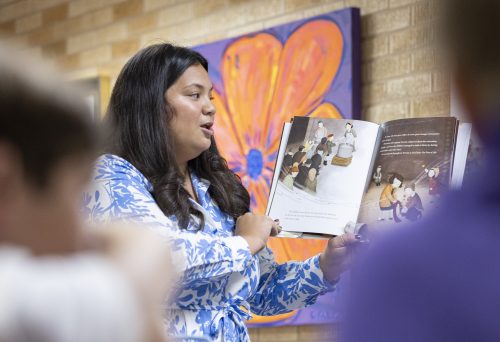
Language and literacy master’s student Margaret Nguyen reads to Starpoint students, pausing frequently to ask deeper questions that build empathy and comprehension in children with learning difficulties. Photo by Ralph Lauer
“Our focus each year is to explore award-winning, beautifully written children’s books that captivate children and nurture a lifelong love of reading,” Lacina said, adding that the book club gives her the opportunity to mentor graduate students as they connect research to practice.
Lacina has since won awards from the International Literacy Association and the Association of Literacy Educators and Researchers for her work at Starpoint.
“Book clubs are not anything new,” Lacina said. “But what is novel is having a book club in a school for children who are being served for dyslexia.”
Patricia Crawford, a professor at the University of Pittsburgh and editor-in-chief of the Early Childhood Education Journal, sees the significance: “So many times in schools, when we have these innovative programs for readers, we grab the readers who … are already excelling in reading. Meanwhile, the kids who might struggle a bit with reading, or have some type of disability related to reading, often are kind of cordoned off into instruction that does not invite their voices to be heard.”
The club’s format adapts to students’ needs, breaking up read-aloud time with activities that get children moving and interacting.
Reading transforms lives, Lacina believes — particularly when children see themselves reflected in stories, validating their experiences, and when they glimpse others’ perspectives, building empathy and understanding. This year’s selections focus on upstanders: people who intervene when they witness unfair treatment.
“As educators, it is our job to build their confidence in learning how to read, but just as important, we need to guide children to make ethical decisions in life. We want them to go out into the world and be outstanding human beings.”
Jan Lacina
The club doubles as a research opportunity. Each year, with permission from Starpoint students and their parents, Lacina records book club discussions.
Parents complete surveys and children answer questions at the start and end of the school year.
Graduate students review the recordings, coding student responses in transcripts and identifying patterns. As the Bezos Family Foundation Endowed Chair in Early Childhood Education, Lacina has funding to guide graduate students through the full research cycle — collecting and analyzing data, writing papers and making presentations at conferences.
“I teach them what to do and how to do it,” Lacina said, “and how we have to keep important records and the importance of being confidential with our transcriptions.”
Over two years, she and her graduate students have published three journal articles about the book club, with more research underway.
“I came to TCU because I was interested in being a teacher-scholar,” Lacina said. “This project is an example of teacher scholarship.”
RESEARCH AND FINDINGS
Through multiple studies, Lacina and her graduate students have discovered that book club participation fosters children’s empathy, strengthens their comprehension and confidence as readers and enhances their social-emotional skills.
Their first article, published in Literacy Today in 2024, details how they organized the book club.
Lacina, who started her career as an English as a second language teacher, partnered with then-master’s students Maddie Baldikoski and Avery Penman to select award-winning children’s literature featuring refugee or immigrant protagonists. The hero archetype dominated these selections — characters who face problems and overcome them through perseverance.
The team examined how such books support students’ development as empathetic readers. Their article outlines engagement strategies, from using daily questions to focus learning to incorporating student choice in book selection.
The same team published a study in The Language and Literacy Spectrum in 2025, exploring how understanding peritextual features — elements outside the main text such as book covers, summaries and author bios — builds reader confidence.
After introducing these features during book club, Lacina and the graduate students posed questions: How does the book cover help you make predictions about the story? And how does the summary help you before you read the book?
The findings? Conversations about book features heightened students’ awareness of how to approach reading, boosting confidence and comprehension.
In a study published in The Reading Professor in June 2025, Lacina demonstrates how special education students can improve reading comprehension and peer relationships through book club participation.
Using transcripts of book club sessions and parent surveys, Lacina tracked students’ progress. By year’s end, they offered more elaborate answers to discussion questions, described characters’ emotions with greater nuance and showed increased enthusiasm for reading.
“When students recognize character emotions in a text,” Lacina writes, “they develop important social emotional skills such as empathy, conflict management, social awareness and more.”
FROM STUDENT TO TEACHER
Graduate students helping lead the Starpoint book club meet weekly with Lacina to reflect while planning future sessions.
One focus is reading aloud with expression. They also learn when to pause for questions and how to draw responses from all students, not just the quick responders.
“I think that’s especially important at a school like Starpoint, but important in any school, that we just aren’t providing interaction with the child who always has a quick response,” Lacina said. “We give an opportunity for children who may be shy, who may be anxious — we give them the space that they can have the time to feel comfortable to respond.”
For Deja Muñoz, now a first-grade teacher in the Eagle Mountain-Saginaw Independent School District, the experience left a lasting mark. The funding that supported her book club work made her TCU education possible while building her research and teaching skills.
“Instead of just asking a yes-no type question,” Muñoz said, “what could I ask that would make students think deeper?”

Photo by Ralph Lauer
She also learned to approach difficult literary topics in age-appropriate ways. Muñoz was among the 10 or more TCU graduate students each year who, through the Holocaust Museum Houston’s Warren Fellowship, receive funds to attend a six-day institute on teaching about the Holocaust. All Texas public school K-12 teachers cover the topic during Holocaust Remembrance Week, usually observed in late January.
Muñoz collaborated with Lacina, fellow graduate students Amanda Slowey and Tiffany Nakamura, and Wendy Warren, chief learning and interpretation officer at the museum, on a chapter about Holocaust education for Children’s Literature to Read Our World: Text Selection and Strategies for Critical Reflection. It will be published by Routledge in March 2026.
The book, edited by Lacina, encourages teachers to use diverse children’s literature to guide students’ understanding of the world. Each chapter features different experts on literature reflecting African American, Indigenous or Asian experiences, among others.
Lacina’s family history inspired her latest research. During the 18th-century expulsion of Acadians by Great Britain, her ancestors were deported from Canada and resettled in Louisiana. Her Cajun grandfather, she said, was spanked by his Louisiana teacher for speaking a French dialect.
With her graduate students, Lacina is examining how Acadian protagonists appear in children’s literature and how educators can use these texts to engage children with marginalized histories.
CHAPTER BOOKS, LIFE LESSONS
Back at Starpoint School, the book club has chosen its next chapter book: The Eyes and the Impossible, a 2024 Newbery Medal winner by Dave Eggers.
Lacina said that The Eyes and the Impossible captivates children of all ages with its humor and cast of animal characters. The narrator is Johannes, a stray dog (though he prefers “free dog”) whose job is watching over a seaside park with his animal helpers. Along the way, Johannes confronts ethical dilemmas.
“The story is about having freedom and being yourself. For children — and for children at Starpoint School, in particular — they need to know it is OK to be themselves,” Lacina said. “As educators, it is our job to build their confidence in learning how to read, but just as important, we need to guide children to make ethical decisions in life. We want them to go out into the world and be outstanding human beings.”
Your comments are welcome
Comments
Related reading:
Research + Discovery
Beyond Parties: How Greek Life Is Training the Next Generation of Leaders
From building schools in Nepal to serving under-resourced communities, fraternities and sororities are embracing their civic origins.
Research + Discovery
How AI Deepfakes and Bias Threaten Elections, Health Care and Public Trust
TCU researchers expose how artificial intelligence is spreading political misinformation, worsening medical disparities and eroding confidence in institutions.
Research + Discovery
Jessica Zeller’s Student-Centered Approach is Transforming Ballet Education
A new book explores how traditional ballet teaching causes harm and envisions a student-centered revolution through humanizing pedagogies.