
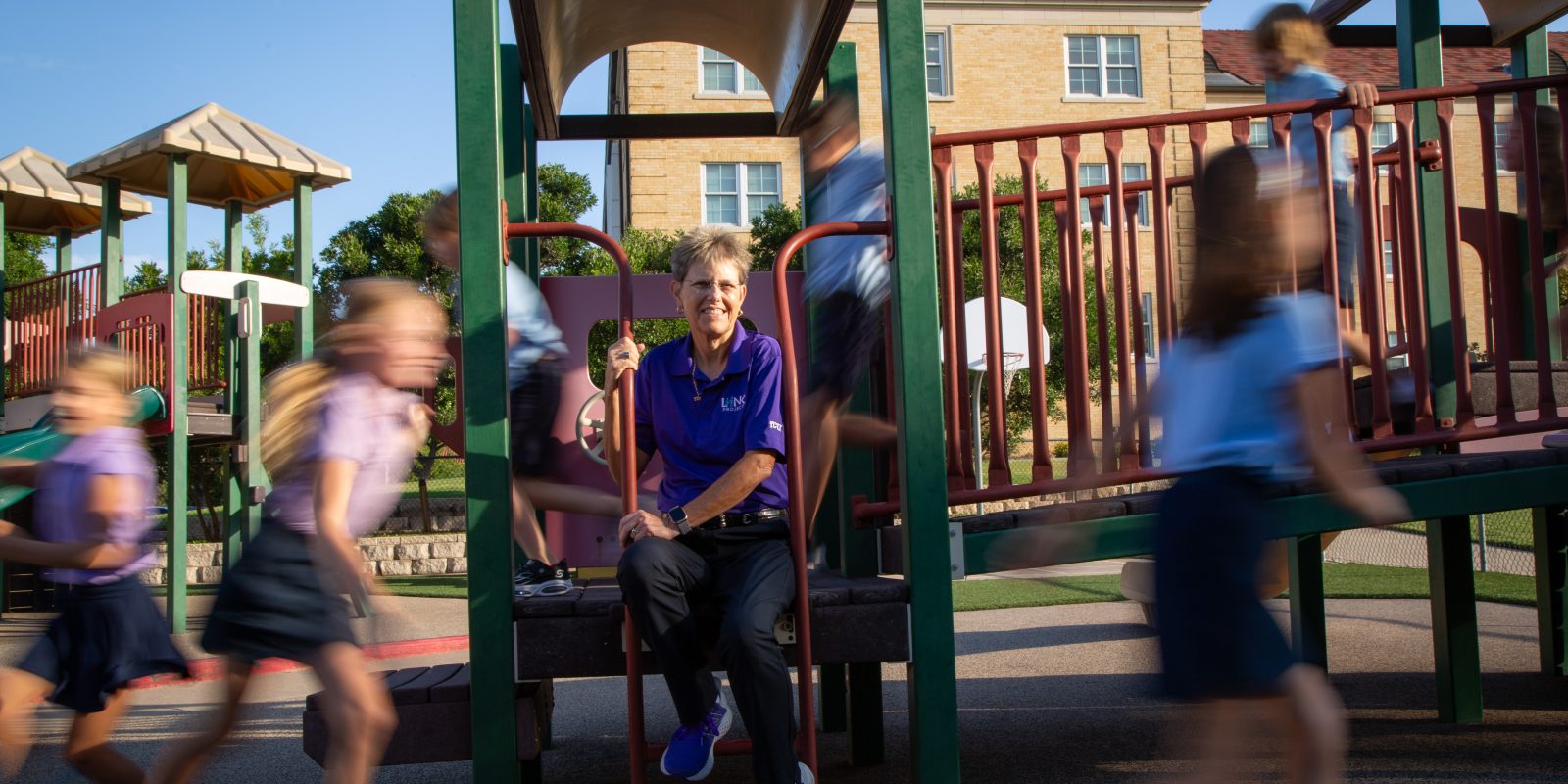
Finland's outdoor education model inspired Debbie Rhea to create a similar approach for American schools.
TCU Professor Debbie Rhea’s LiiNK Project Promotes Outdoor Play in Schools
A kinesiology professor’s passion project shows how free play outdoors improves classroom outcomes for children.
AS A LIFELONG ATHLETE, DEBBIE RHEA intuitively grasped that movement can be medicine when it comes to healing fractured attention spans and fostering well-being. Rhea’s research into children’s brains and bodies as a professor of kinesiology compelled her in 2012 to create the LiiNK Project®, which stands for Let’s inspire innovation ’N Kids.
Geared to students in kindergarten through 12th grade, the program promotes four outdoor breaks consisting of 15-minute blocks of unstructured activity per school day, plus one 15-minute daily character lesson. It’s a straightforward antidote to the ills facing Gen Z and Generation Alpha, including anxiety, obesity and attention-deficit/hyperactivity disorder.
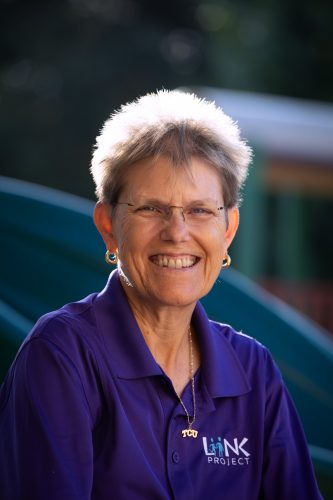
A founding member of the Global Recess Alliance, Debbie Rhea continues working with school districts nationwide to expand her programming.
“It’s all very doable, and the dividends are enormous,” Rhea said, noting that since 2015, some 60,000 students in Texas, Oklahoma and Michigan have participated in LiiNK. “All of the data we’ve collected and continue to collect demonstrate what we knew already: that children’s brains work better inside the classroom when they’re given regular, unstructured time outdoors.”
In November 2024, Rhea launched the Right Moves podcast through TCU’s LiiNK Center for Healthy Play, which partners with school districts around the country to implement principles of her project. The podcast allows Rhea to showcase experts and best practices in the field of children’s health.
“The big words in public education right now are instructional time, which is something everyone worries about. But giving our students an opportunity to have their free choice of activity outside the classroom means they come back inside ready to learn,” said Stephanie DuBose, who has taught third and fifth grades at Koennecke Elementary in Seguin, Texas. “You just don’t see the afternoon lag as bad when you follow LiiNK.”
Rhea’s book Wrong Turns, Right Moves in Education, published in 2019, details the inspiration for her life’s work. This one-time English and P.E. teacher, who worked at two public high schools in Texas as well as a junior high, returned to academia in the 1990s. She earned an MEd and EdD in sport psychology and pedagogy at the University of Houston.
Her curiosity about best practices in the classroom didn’t end with her formal education. In 2012, she traveled to Finland to learn more about its education system. “Global test scores showed theirs were the highest, so I went over to see what was going on from a physical education perspective,” she said. “The Finns always rank high on those lists of the happiest people in the world, too.”
It turned out that Finnish children spend significant portions of the school day outdoors despite the often frigid temperatures. Rhea returned to North Texas determined to translate this for American youth, teachers, administrators and parents.
Rhea launched a pilot program in 2014 with Trinity Valley School, a private pre-K through 12th grade school in Fort Worth, as well as with Starpoint, a laboratory school on the TCU campus for children ages 6 to 11 with learning differences. The data revealed almost immediately that children’s health and learning outcomes improved when they received four outdoor breaks per day while in school.
“P.E. and recess have traditionally been viewed as a break for teachers and not an important piece of the school day,” said Rhea, also a founding member of the Global Recess Alliance, a nonprofit that advocates nationwide for the importance of outdoor play. But data gathered through the LiiNK Project with help from TCU students shows “that creativity, socialization and concentration were improved, while bullying decreased in children and adolescents when they had this outdoor time built into their day.”
Teachers’ and administrators’ concerns about bullying led Rhea to also incorporate Positive Action®. The existing curriculum consists of a 15-minute daily character lesson designed to promote social-emotional development. Rhea and her team gravitated to the curriculum, which is used around the country, because of its emphasis on storytelling to convey healthy human interactions and relationships.
For schools with a student population that has generally experienced higher levels of trauma, Rhea and her team added a third component to the LiiNK Project: Trust-Based Relational Intervention®, developed at TCU’s Karyn Purvis Institute of Child Development.
“The TCU-born program has been very helpful in creating the empathy environment on the playground,” Rhea said, “by giving teachers the tools to help kids when they escalate or become very low in their energy levels.”
“All of the data we’ve collected and continue to collect demonstrate what we knew already: that children’s brains work better inside the classroom when they’re given regular, unstructured time outdoors.”
Debbie Rhea
Students aren’t expected to run laps or engage in intense physical activity during their multiple daily recesses. The point of Rhea’s program is providing space for students to choose. During one recess, a group of friends might pretend to roast marshmallows around a campfire. On an outdoor break after lunch, the same group might shoot hoops.
DuBose said the teacher training she received through Rhea’s program seven years ago influenced her approach to her own “homework.”
“I started putting a timer on the work I take home so I’ll only work on it 30 to 45 minutes before I go outside to do something,” she said. “Something so simple can be transformative.”
Rhea, meanwhile, continues working with school districts and administrators to promote her programming.
“We’re proud of how many students we’ve helped,” Rhea said, “but we want to touch the lives of every kid in America.”
Your comments are welcome
Comments
Related reading:
Research + Discovery
Advocating for Youth
New major provides experience helping children in settings outside the classroom.
Features
AI in the Classroom
TCU professors are navigating students through the brave new world of artificial intelligence.
Belonging in STEM: How the Pre-Health Professions Institute Shapes Young Scholars’ Futures
Through immersive experiences and relatable role models, students gain confidence to pursue careers in science, engineering, health care and beyond.