TCU’s Science & Engineering Research Center encourages the intellectual curiosity of undergraduate and graduate students by funding their individual research projects and pairing them with faculty mentors for guidance. Students learn by doing, from pitching a proposal and budget to creating a plan, conducting experiments, and analyzing and reporting data.
“It’s a process — the whole scientific enterprise that the student gets a chance to experience hands-on,” said Timothy Barth, professor and associate dean of graduate students in the Louise Dilworth Davis College of Science & Engineering.
The center’s student research grants have been funded by multiple sources since the program launched in 2006, beginning with the TCU Vision in Action Strategic Initiative Fund. Phil Hartman, emeritus dean of the college, gave the program a boost in 2012 through funds from the dean’s office. Individual donors have stepped in as well.
“Many benefactors, friends of TCU and alumni from the college decided that this was such an important endeavor that they began to give gifts to the college for the specific purpose of funding undergraduate research,” Barth said. “We have funded 176 proposals over the last two years. In terms of dollar value, over $250,000 in research.”
Strong proposals, Barth said, depend upon the student’s ability to communicate the importance of the research, sharing the impact it could potentially have on society. Three recent projects that secured funding address treatment for neurodegenerative diseases, food insecurity in Tarrant County and using wearable devices to detect health issues.
Treating Alzheimer’s and More
Saba Anjum, a senior biochemistry major, knew growing up that two of her uncles had glaucoma, a neurodegenerative disease that damages the optic nerve and can lead to blindness. “I initially felt hopeless because glaucoma has a strong genetic predisposition,” Anjum said. “But I was always a very curious child and a problem solver.”
Through her Science & Engineering Research Center grant, Anjum works under the guidance of Kayla Green, professor of chemistry. The Green Research Group holds several patents on antioxidant molecules it developed that aim to prevent or reduce the damage caused by oxidative stress in body cells, slowing down the progression of neurodegenerative diseases.
“We do know that our molecule is potentially a really good treatment for Alzheimer’s,” Anjum said.
But the current antioxidant molecules don’t permeate the blood-brain barrier. Anjum’s research aims to make the antioxidant molecules more permeable so they can be used to develop therapies that will target and treat neurodegenerative diseases.
Anjum’s funding goes toward the purchase of chemical synthesis supplies, including reagents and solvents used in developing a version of the antioxidant molecules that can better target the brain.
“Having research as a component of undergraduate education is an ideal scenario for students to apply what they have learned, make connections between data and gain confidence in their abilities,” Green said.
“Having research as a component of undergraduate education is an ideal scenario for students to apply what they have learned, make connections between data and gain confidence in their abilities.” Kayla Green
Anjum traveled to San Diego to share her research at the American Chemical Society’s national meeting, presenting in the Division of Medicinal Chemistry.
Anjum said she plans to attend medical school and pursue an MD-PhD dual degree, aiming to become a physician scientist. She hopes to apply the knowledge she’s gaining through her research experience to someday develop a new treatment for glaucoma.
“The College of Science & Engineering not only helps us keep doing the amazing research that is happening in our labs,” Anjum said, “but it also encourages undergraduate students to keep pursuing important questions, seeking answers and addressing the challenges that we have in the scientific and medical communities today.”
Food Insecurity
As a dietetics graduate student, Josie Miller ’24 (MS ’25) worked on a team of researchers that wanted to learn why many Tarrant County adults who qualify for Meals on Wheels, a nonprofit that delivers meals to the elderly and people with disabilities, still experience food insecurity.
In addition to Miller, the research group included a nutritional science student and four nursing students; Gina Alexander, professor of nursing; Kyle Walker, professor and department chair of geography; and Gina Hill, professor and department chair of nutritional sciences, who served as Miller’s mentor. Two retired Tarrant County public health workers also helped the team by approaching potential study participants.
Graduate student Josie Miller researched food insecurity among older adults in Tarrant County who qualify for Meals on Wheels. Courtesy of Josie Miller
“Josie and a team of students interviewed older adults at three community sites deemed as high-priority neighborhoods based on U.S. Census Bureau public data,” Hill said. “Through these interviews we learned about … the barriers to having access to adequate food as an older adult, and what they knew about Meals on Wheels.”
Miller used her grant money to pay for an account on NVivo, a platform for qualitative data analysis, which she used to examine participant interviews that the team conducted. With NVivo, “I could be more involved in the research analysis part of the project,” Miller said. “You sift through the answers from everybody and find patterns and meanings.”
Miller’s research team came to multiple conclusions: The main reasons for food insecurity in older adults in Tarrant County are economic and health-related; some qualified individuals don’t use Meals on Wheels due to common misconceptions, such as the belief that clients must be older than 60 and U.S. citizens; and eligible participants prefer to learn about Meals on Wheels opportunities through word of mouth or partner organizations.
Despite the challenges, the team learned that Meals on Wheels has a positive reputation in the community.
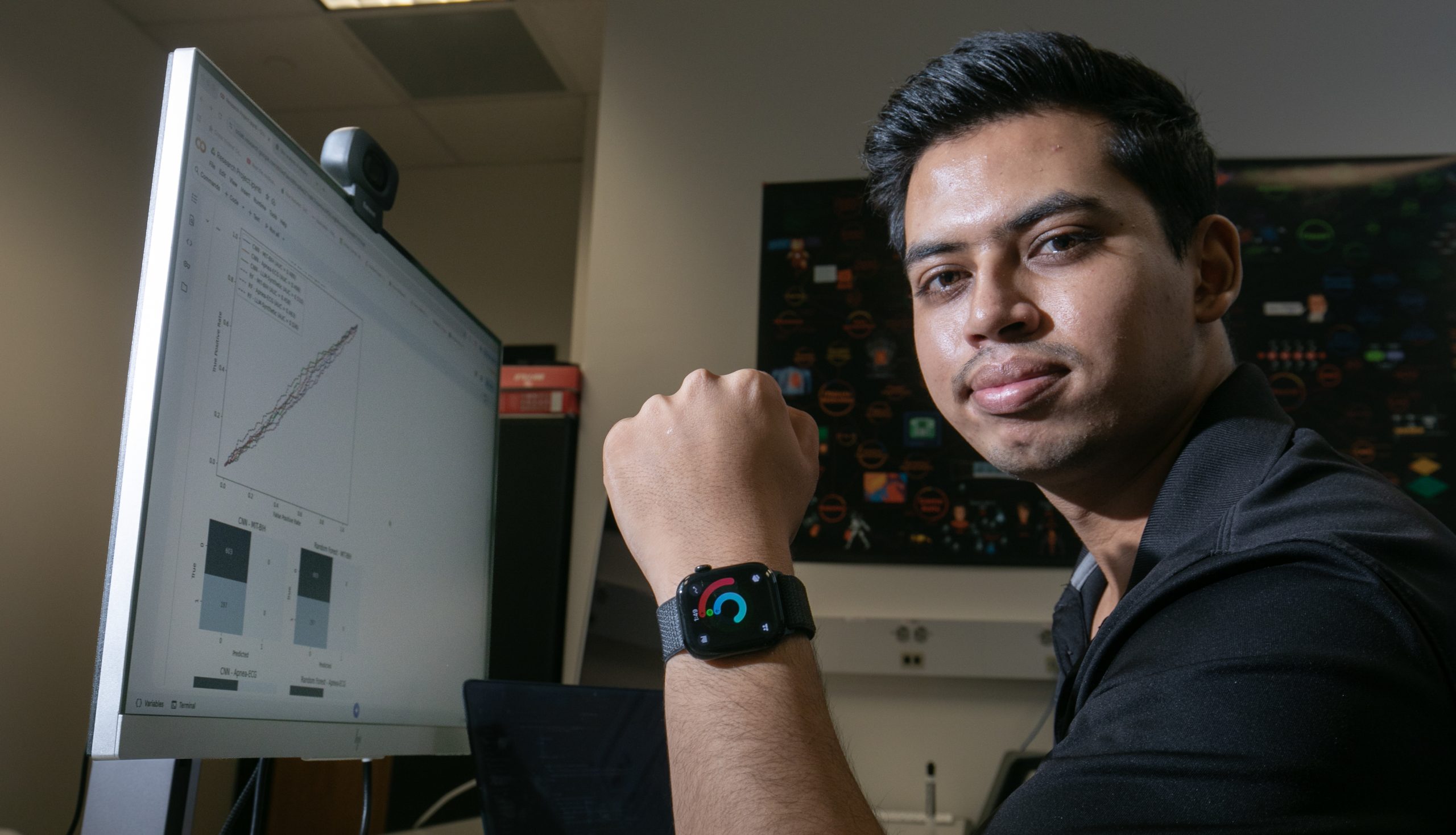
Sujit Bhandari, a senior computer science major, is working to create an AI diagnostic model that can be integrated into wearable devices, such as the Apple Watch, Fitbit, Oura Ring and Whoop, to track health patterns and detect early signs of health issues like arrhythmia and sleep apnea.
Bhandari is working under the guidance of Robin Chataut, assistant professor of computer science, in his NextGen AI Research Lab, which conducts projects that sit at the intersection of artificial intelligence, large language models (artificial intelligence systems trained on text data) and cybersecurity.
Bhandari used his grant to purchase a variety of wearable devices and accompanying subscriptions, plus iCloud services to store the data. Physiological data such as heart rate, breathing patterns and blood oxygen levels can be recorded using the wearable devices.
Bhandari has collected some 50,000 data samples to train his AI model. He said the samples are a combination of “synthetic physiological data generated using large language models, AI systems capable of simulating realistic health signals, and real physiological data from publicly available medical datasets,” including one created by MIT and Beth Israel Hospital in Boston for studying cardiac arrhythmias.
Bhandari then created a hybrid dataset to train artificial neural networks used for displaying and analyzing visual data — and found a promising outcome.
“The model trained on both large language model-generated synthetic data and real physiological data actually performed better in terms of accuracy, reliability and adaptability compared to models trained only on real-world data,” Bhandari said. “This hybrid approach shows real potential to make AI-powered health monitoring more scalable, accessible and privacy-friendly, especially in resource-limited settings.”
Sujit Bhandari is training an artificial intelligence model that uses data collected by wearable devices, such as the Apple Watch, to diagnose potential health issues. He hopes that pairing the AI tool with an app would help people seek medical attention for conditions like sleep apnea or arrhythmia.
Bhandari’s goal is to create a mobile app that can be used with wearable devices to accurately detect health issues. He is currently working to refine the model to improve performance.
“The wearable device would continuously collect data such as heart rate and sleep metrics. The AI would analyze these patterns in real time,” Chataut said. “If it detects irregularities like signs of arrhythmia or sleep apnea, it would notify the user, prompting them to seek medical attention.”
Student Research Symposium
Barth said that seeing the results of such research at the Michael and Sally McCracken Annual Student Research Symposium each spring is the most rewarding part of the process. About half of the projects at the poster presentation session are funded by the Science & Engineering Research Center.
Presenting at the symposium is another step in the scholarly research process, giving students experience sharing their work in a professional setting.
“Undergraduate research has been one of the longest historic traditions of the college,” Barth said. “We bring our undergraduate students into the faculty laboratories and give them a really special high-impact experience, working hand in hand with faculty on important issues facing society today.”
Richard Selcer ’80 PhD may be the most important Texas historian you’ve never heard of.Selcer has written more than a dozen books that dig deeply into the region’s past, from Texas frontier history to notable Fort Worth characters.
Over the last half-century, hehas also achieved an impressive, peripatetic career in education, and treasured every moment.
“My motto may have been, ‘have degree, will travel,’”Selcer said. “I followed the opportunities where they led me. I learned something everywhere I taught and tried to contribute meaningfully at every educational post Iheld.”
Teaching, Near and Far
Richard Selcer earned a star on the Texas Trail of Fame in 2024 for his contributions to regional history.
Selcer’s early teaching posts include serving as a history professor at Jarvis Christian College in Hawking, Texas, which is among the nation’s historically Black colleges and universities. Selcer next headed the history department at Yankton College in South Dakota, and served as the academic dean of the all-women’sCottey College in Nevada, Missouri.
Though an American historian, Selcertaught critical thinking, philosophy and international relations in Vienna, Austria;Kyiv, Ukraine;Bratislava, Slovak Republic;and Pravetz, Bulgaria; over the course of two decades. Meanwhile, he also taught as an adjunct history professor in the U.S.
“I split my time teaching in the States with lecturing abroad. It continually informs my perspective,” Selcer said. “My academic stints stateside have been varied and also uniquely rewarding.”
Hiseducational endeavorshave been characterized by spontaneity and pluck.Selcer once took a group of students from Austin College to Williamsburg, Virginia, to study colonial history, and wound up chaperoning them to the inauguration of President Richard Nixon. He also led a dozen undergraduates overseas to study the great capitals of Eastern Europe in person — Vienna, Budapest and Prague.
“Seeing a lot of the world gives you multiple perspectives and broadens your understanding,” Selcersaid. “It’s rewarding personally and professionally, and it adds depth to what one has to offer in front of any classroom.”
Since 2018, Selcer hastaught popular music history classesfor TCU’s Silver Frogs, a continuing education program for adults over 50.
“I have about nine or 10 different courses focused on different types and eras of music—with audio-video accompaniment,” Selcer said. “They always fill up.”
“He had the credentials to do the typical, big university stuff,” said Tim Taylor’73,one of Selcer’s childhood friends. “But he’s always been focused on the Fort Worth locale. He could have gone a lot of places for his postgraduate work, but he decided to return home and complete it at TCU. And, from the beginning, he took a very focused approach rather than using broader strokes of the brush.”
Think Globally, Write Locally
Selcer’s first book, Hell’s Half Acre, published by the TCU Press in 1991, delves into the bawdy truth behind Fort Worth’s late 19th-century red-light district, a favorite haunt of Butch Cassidy, Wyatt Earp, Doc Holiday, Bat Masterson and otherWild West figures.
At publication, a Capital Times reviewer wrote, “Selcer successfully separates fact from fiction, myth from reality. …Hell’s Half Acre is far more than just local history. It is a gripping microcosm of the American past, warts and all.”
Selcer leads walking tours of downtown Fort Worth and the Stockyards to share the city’s lesser-known stories.
More than 30 years later, Hell’s Half Acreremains TCU Press’ all-time bestseller. Dan Williams, director of TCU Press and an honors professor of humanities, said it’srare fora book to remain in print for multiple decades — and rarer still for one to remaina steady seller.
“TCU Press has happily reprinted copies multiple times. My colleagues and I are proud of the book and its author,” Williams said. “Combining a historian’s skill and a writer’s craft, Rick tells the engaging story of Fort Worth’s early days, when the railroad attracted a colorful array of saloons, gambling hallsand bordellos. … I still recommend the book to anyone interested in early Fort Worth and/or the Wild West.”
Selcerhasn’t just focused on “warts” or obscure Lone Star history. For the last four decades, he has also traversed military history inbooks including Lee vs. Pickett: Two Divided by War (1998) and Civil War America (2006).
In 2015, Selcerpublished A History of Fort Worth in Black & White: 165 Years of African-American Life. Ronald Goodwin, arespected scholar at Prairie View A&M University,lauded it in The Western Historical Quarterly, calling it “masterfully” written.
“His examination of Jim Crow detailed the tenuous relationship between the city’s Black and white communities. The reader will immediately‘feel’ the cultural tensions between the two and gain a surprising glimpse into a seldom-seen aspect of Black life that is too often ignored by outsiders,” Goodwin wrote. “The use of city directories, census data and personal letters reinforce the commitment by Fort Worth’s Black community to achieve social and political equality, often at great personal challenges.”
In Service to History
Selcer’s books are complemented by work that’s etched in bronze. He served on the Tarrant County Historical Commission from 2006 to 2023and worked on the narratives of several monuments around the city, including a marker commemorating Cowtown’s first Black policeman, Hagar Tucker, and a marker and statue for the last chief of the Comanche Nation, Quanah Parker.
“Look at what he’s been able to do, what he’s written about,” said Clara Holmes, who served with Selcer on the commission. “He’s really the go-to person for any history in Tarrant County.”
In 2023, Selcer returned, again, to TCU Press, with Fort Worth, Texas, That’s My Town! A Young People’s History. The book—the first children’s history of Cowtown since 1967—received a Will Rogers Medallion Award for “Best Non-fiction Illustrated for Young Readers.”
Selcer’s cumulative contributions to regional history earned him a star on the Texas Trail of Fame,located in the Fort Worth Stockyards National Historic District, in 2024.
“There are a million stories out there,” says Richard Selcer, whose “Hell’s Half Acre” remains TCU Press’s all-time bestseller more than 30 years after publication.
“What he’s done, no one else has done,” Holmes said. “He continues to go where others fear to tread, even when he knows he’ll take some licks. He cares, and people respect him.”
Selcer is currently doing research for More Fort Worth Stories,a follow-up to his 2021 spotlight on noteworthy Cowtown residents and visitors.
“I try to find ground that hasn’t been plowed,” Selcer said. “There are a million stories out there. I was very fortunate to stumble upon some that let people know a little bit more about where they live.”
HAL LORING ROACH SR. ’61, the first director of TCU’s Frog Club, charted many victories as he navigated the changing times of student athletics, especially college football. He took a fan base hampered by struggling seasons on the field and built it into a loyal following, win or lose.
Soon after becoming chief fundraiser for TCU sports and scholarships in 1992, he dealt not only with the Horned Frogs’ football results but also with angry fans when athletic departments began linking donations to season seat locations.
He wouldurgecallers to think first about the young athletes, not the play calls. Sometimes, offering a free drink ticket or cheeseburger lightened the mood.
“For him to do what he did, for as long as he did, speaks volumes, because for a long time he was selling when there was nothing to sell,” said John Denton ’85, retired associate athletics director. “It didn’t matter how big or ‘small’ you were, Hal knew your name, from major donor to the benchwarmer.
“TCU fans should say a prayer of thanks for Hal Roach and the job he did for TCU. It wasn’t easy.”
Roach died Oct. 17. He was 86.
Survivors include his wife, Rebecca Roach ’81; son Hal Roach Jr. ’87 and his wife, Marjana Roach ’88 (MS ’90); and brother, C.D. Roach ’72.
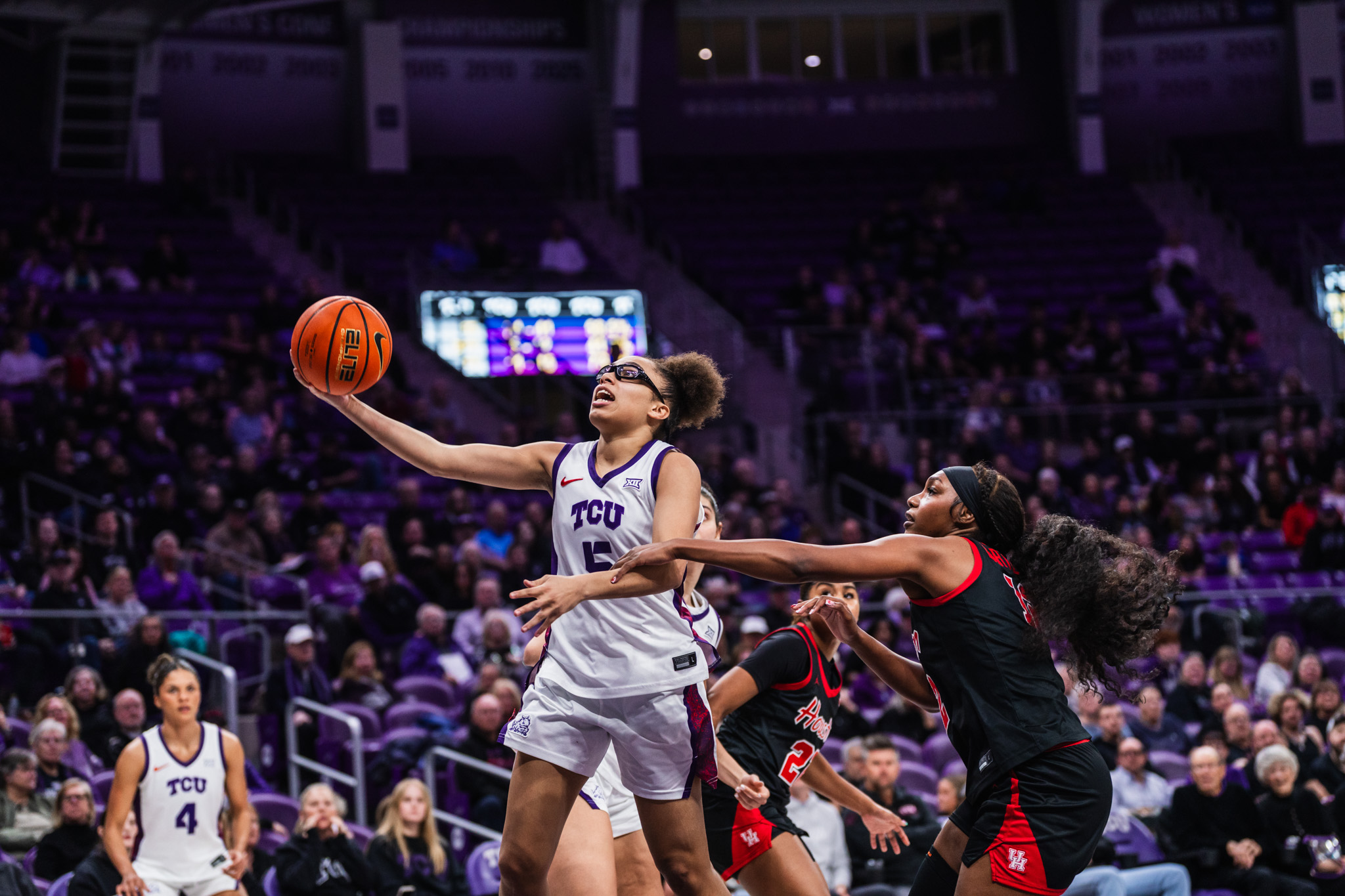
TCU shook off a bitter loss to 18th-ranked Texas Tech byoverwhelming Houston 90-45 Wednesday night in a return to Schollmaier Arena. The 45-point spread represents TCU’s largest margin of victory over a Big 12 opponent since joining the conference in 2012.
“Their size, it’s just incredible,” Houston head coach Matthew Mitchell said of TCU’s defense, a unit that led the NCAA in field goal percentage defense (.328) coming into the game. “I thought our players really tried hard to get the ball in the basket a couple of times tonight, and just their sheer length and size are a problem.”
Six-foot-seven senior center Kennedy Basham spearheaded that disruption, leading the team with three blocks and pulling down four rebounds in 11 minutes played. First-year guard Clara Bielefeld added a pair of blocks along with three points and six reboundsin18 minutes off the bench.
With 167 assists, Olivia Miles is only 38 away from breaking now-Chicago Sky guard Hailey Van Lith’s single-season program record, set in 2024-25. Courtesy of TCU Athletics
The “Big Three” of Olivia Miles, Marta Suárez and Donovyn Hunter combinedfor 64 points on 24 of 33 shooting.Miles paced the Frogs in scoring for the 11th time in 13 contests. Suárezlogged her second double-double in as many outings with 24 points and a team-high 10 boards.
“It was a tough loss,” Miles said of the Texas Tech defeat, a 62-60 final. “But there are blessings and lessons in losses in life. …We took what we learned from that game and kept positive energy. Luckily, everyone wants to get better here, and no one’s sulking and moping around, so we just got back to work.”
Wednesday night’s stifling defensive showing extended the No. 14 Horned Frogs’ home winning streak to 39 games, giving them the nation’s longest active run ahead of No. 4 Texas. The stretch began 711 days earlier with a victory over these same Houston Cougars on Feb. 24, 2024.
“The talent that has come to Fort Worth is some of the best talent in college basketball,” said head coach Mark Campbell, who pointed to an initial group of players as catalysts for the program.“The ‘Underfrogs,’ that was just a resilient, gritty group, very similar to what Houston has right now. They rolled up their sleeves and battled and fought, and they’re the group that got this party started.They’re the group that laid the foundation.”
A Big Trip Up to Boulder
Tied for tops in the Big 12 standings with a 9-2 league record, the Frogs hit the road Sunday to face a Colorado team with postseason aspirations of its own.
The Buffaloesare fighting for their fourth NCAA Tournament berth in five seasons.
Senior guard Jade Masogayo and her 11.5 points per game remain from a Colorado group that last year posted a 9-9 conference mark.
Junior guard Desiree Wooten, a North Texas transfer and Dallas native, leads Colorado with 12.1 points per game and has reached double figures in six straight Big 12 contests.
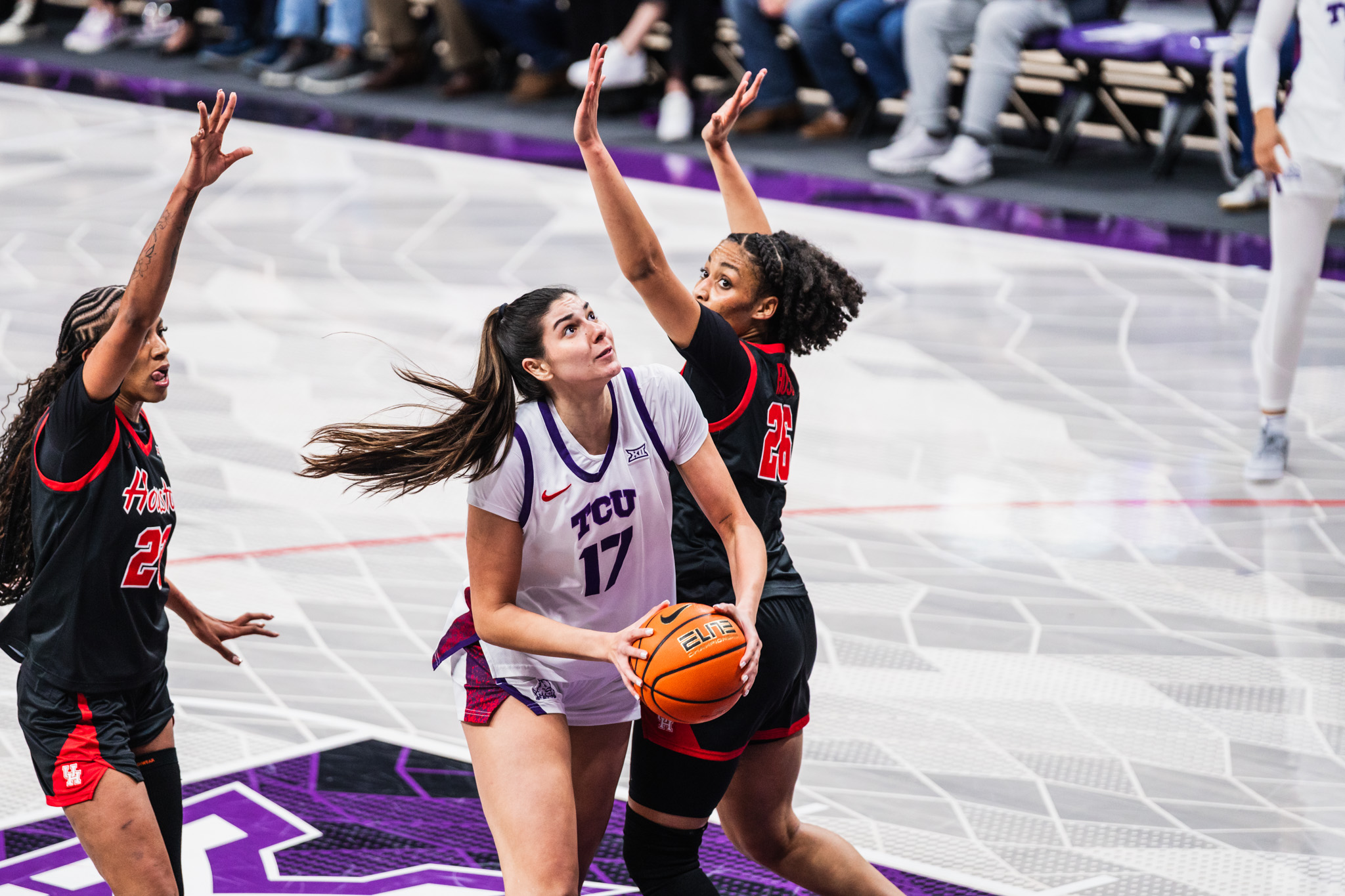
Sophomore center Clara Silva has started all 24 games for the Horned Frogs this season, averaging 10 points, 7.8 rebounds and 1.9 blocks per contest. Her paint presence could be crucial as 14th-ranked TCU prepares for a pair of remaining regular-season matchups with rival Baylor. Courtesy of TCU Athletics
A Heavyweight Battle With the Bears
TCU will travel to Waco next Thursday evening for a nationally televised showdown against Baylor, which sits tied atop the Big 12 standings alongside the Frogs.
The 2024-25 conference runners-up boast legitimate size in the paint. Forwards Kiersten Johnson, Kyla Abraham and Bella Fontleroy each average at least 1.5 blocks per game, forming one of the conference’s most formidable front courts.
This year’s 20-4 squad has only lost to top-20 opponents, most recently a 70-60 road defeat to surging West Virginia — a team that visits Schollmaier Arena on Feb. 15.
Campbell issued a rallying cry to the TCU faithful as the postseason comes into focus.
“We’ve got three home games left against three of the best teams in the Big 12,” said Campbell of remaining home matchups against the No. 20 Mountaineers, Iowa State on Feb. 22 and 15th-ranked Baylor to close the regular season on March 1. “So we need Fort Worth to show out.… We need the student body to come out these last three games, and let’s keep the longest home winning streak in college basketball rolling.”
This is the first of a multi-part series previewing the TCU Horned Frogs baseball team.
Major media outlets agree that TCU has the talent for another deep postseason run. The Frogs rank in the preseason top 12 in polls from reputable outlets including D1 Baseball, Perfect Game and Baseball America. TCU is ranked in the preseason top 25 for the 17th consecutive season. The optimism is an extension of roster continuity from last year’s squad that went 39-20 but was eliminated in the NCAA Corvallis Regional.
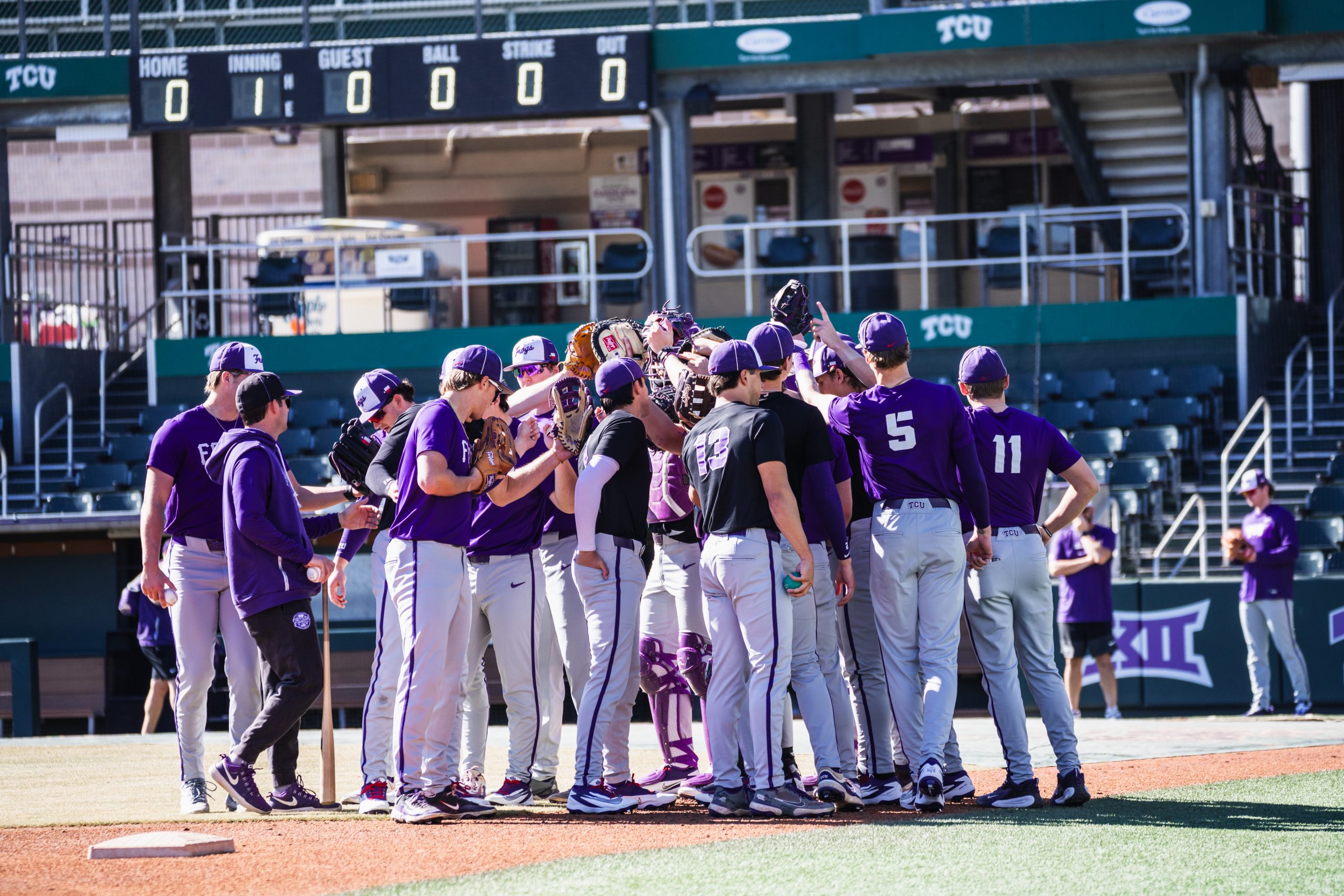
TCU returns much of its squad from last season, including a trio of potential first-round MLB draft picks. Courtesy of TCU Athletics
Feeling a Little Drafty
The Frogs roster features legitimate major league talent with three 2026 MLB Pipeline Top 100 draft prospects: outfielder Sawyer Strosnider (No. 10), outfielder Chase Brunson (No. 44) and ace pitcher Tommy LaPour (No. 62).
Wichita State transfer Tommy LaPour assembled an 8-3 record and a 3.09 ERA over 16 starts in his Horned Frogs debut last season. Courtesy of TCU Athletics
Brock, Texas, product Strosnider, the Big 12 Freshman of the Year last season, is one of the best all-around athletes in the country. He has a pretty, left-handed swing and hit for a .350 average with a .420 on-base percentage. The 20-year-old slugged .650 and hit 13 doubles, 11 homers and led the nation with a school-record 10 triples while pacing the team in hits (77) and runs batted in (51).
Brunson is an all-around player who provides both a consistent bat and great defense in center field. The 6-foot-3 San Clemente, Calif., native was named to the All-Big 12 Second Team last season after slashing .317/.395/.554 with 12 dingers. Brunson started the 2025 season with a 43-game on-base streak. He is expected to be the centerfielder again this season after starting 58 games last year.
LaPour, the big 6-foot-4, 230-pound right-hander, was a true workhorse for the team last season after transferring from Wichita State. LaPour has a big fastball that lives at 95-98 miles per hour and can get all the way up to 101. He also has a slider and changeup that can be used when he gets ahead in the count. The Kansas City-area native started 16 games in 2025 and threw 90.1 innings to the tune of a 3.09 ERA. He struck out 88 hitters while only walking 27. This earned him first-team All-Big 12 honors last year.
Sophomore Studs
Noah Franco is a talented player who has the ability to hit and pitch. The two-way pitcher and outfielder hit .313 with a .548 slugging percentage as a freshman and mashed 11 homers. He also has the arm to provide some innings on the mound, as he threw 12 innings, striking out 18 on the year. Perfect Game gave him first-team Freshman All-American honors last season.
Nolan Traeger is a left-handed-hitting catcher who started 43 games as a true freshman, hitting .327 with a .429 on-base percentage. He is a very good framer behind the plate and has a strong arm that threw out nine would-be base stealers last season. He was named second-team All-Big 12 in 2025.
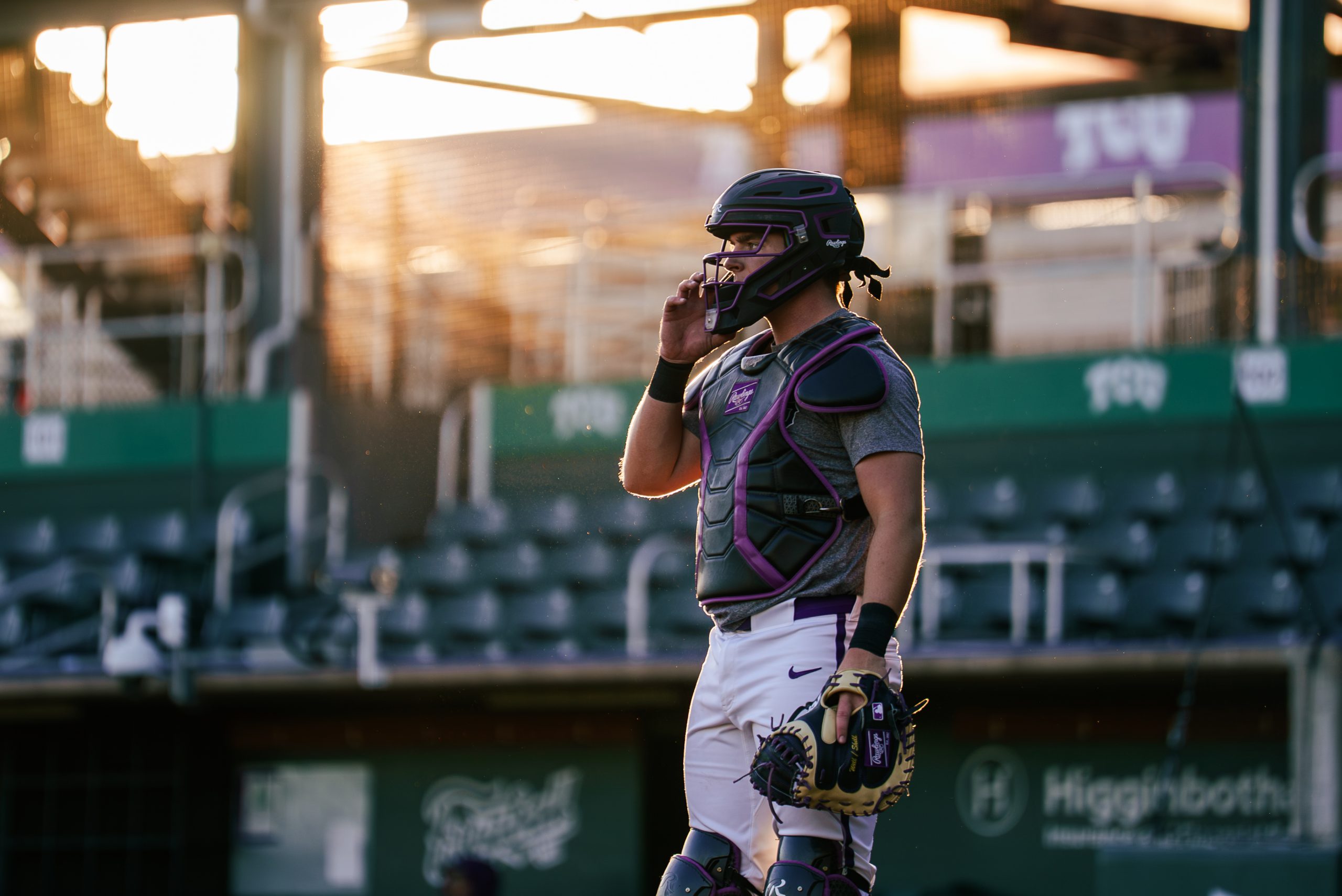
Sophomore catcher Nolan Traeger is among the four returning Horned Frogs who were listed as freshman All-Americans by Perfect Game a season ago. Courtesy of TCU Athletics
Comings and Goings
The two biggest losses for TCU in the transfer portal were first baseman and catcher Karson Bowen, who went to Florida, and right-handed pitcher Kole Klecker, to Arizona State. The Frogs responded to these losses by bringing in first baseman Rob Liddington (Incarnate Word), infielder Kyuss Gargett (Kentucky), and pitchers Ethan Thomas (Hawaii) and Tanner Sagouspe (Cal Poly).
Liddington is a left-handed hitter who can plug in place of Bowen at first. The senior hit .359 and swatted 15 homers for Incarnate Word last season.
Gargett is an athletic infielder who can play multiple positions. He has experience in big moments, making 5 starts and 12 appearances in the College World Series.
Thomas is a 6-foot-5 230-pound right-handed pitcher with a fastball that gets up to 94 and a couple of off-speed pitches. He spent his last two seasons at Hawaii and made 18 appearances with 37 strikeouts and three saves for the Rainbow Warriors in 2025.
Sagouspe is a right-hander out of Cal Poly who finished his 2025 campaign with 40 innings pitched over 25 appearances registering an ERA of 3.60 with 50 punchouts. His over-the-top delivery brings in a fastball in the low 90s, and he features a hammer curveball.
When PEARCE EDWARDS ’13 was an undergraduate, he so admired the work ofRalph Carter,Piper Professor of political science, that he wrote a profile of Carter for TCU 360. In fall 2025, when Edwards returned to TCU to join the faculty as an assistant professor of political science, other one-time faculty mentors — includingMichael Strausz, professor and department chair, andEric Cox, associate professor — became colleagues.
“It’s an honor, really. These are tremendous faculty; they’re great teachers, great scholars,” Edwards said. “TCU set the example for me.”
Pearce Edwards took his academic talents to Atlanta’s Emory University for graduate school after honing his organizational skills in the Chancellor’s Leadership Program and Model United Nations as a TCU student. Courtesy of Pearce Edwards
As aTCU student, Edwards cultivated leadership and organizational skills through the Chancellor’s Leadership Program and Model United Nations that would serve him well. He completed a stint with Teach for America before beginning graduate school at Emory University in Atlanta, where he earned a master’s and doctorate in political science.
At Emory, Edwards developed a focus on repression and resistance in authoritarian regimes, particularly in Latin America.
Edwards went on to a postdoctoral fellowship in Pennsylvania and then took a tenure-track faculty position in Louisiana, where he taught for two years.
As a new professor atTCU, Edwards already appreciates how students engage in hispolitical science classes. He’s also a prolific researcher, with more than a dozen publications in peer-reviewed journals in the last four years.
“I’ve always cared about translating my research into the classroom,” he said, and “into interactions with students.”
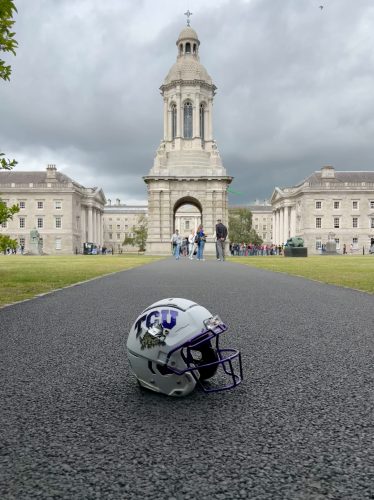
Horned Frogs heading to Dublin for the Aer Lingus College Football Classic this August can explore the Irish capital through its signature culinary combinations. From coastal haunts to historic quarters, these spots are worth the detour.
1837 Bar & Brasserie at Guinness Storehouse
Signature Dish & Recommended Drink Irish oysters paired with Guinness Original Stout
Why the Pairing Works This duo, dating to 1837, marries the sea-kissed sweetness of the oysters with Guinness’s roasted malt notes and creamy texture. The stout’s slight bitterness cuts through the oysters’ richness while its creamy carbonation cleanses the palate between bites.
While You’re There Tour the seven-story Guinness Storehouse to trace the operation’s journey from Arthur Guinness’s humble four-acre site, leased on New Year’s Eve 1759 for just £45 annually, to what became the world’s largest brewery by 1880. Cap your visit at the top-floor Gravity Bar, where sweeping windows frame panoramic views from the Dublin Mountains to Howth Head.
Johnnie Fox’s Pub
Signature Dish & Recommended Drink Irish lamb stew with a Mattie’s Mule
Why the Pairing Works This hearty dish finds its foil in a lively Irish twist on the Moscow Mule. The cocktail’s bright acidity and spicy zing lighten the savory stew and awaken the taste buds. Mint garnish adds herbaceous freshness that complements the stew’s root vegetables.
While You’re There Catch the Hooley Show, Johnnie Fox’s traditional music and dance performance that brings Irish culture to life in an intimate setting. The venue itself, founded in 1798 and perched in Glencullen, calls itself Ireland’s highest pub.
Why the Pairing Works This showstopping spread of crab claws, prawns, mussels, oysters, smoked salmon and crab aioli finds a classic match in Champagne. The wine’s bubbles and crispness elevate the indulgence of each element, while mineral notes enhance the seafood’s natural saltiness.
While You’re There Grab Beshoffs’ famous beer-battered cod and chips to go, then head to Howth Adventures for a boat tour with views of Howth Head and Ireland’s Eye, and chances to spot seals and puffins.
FIRE Steakhouse Restaurant & Bar Dublin
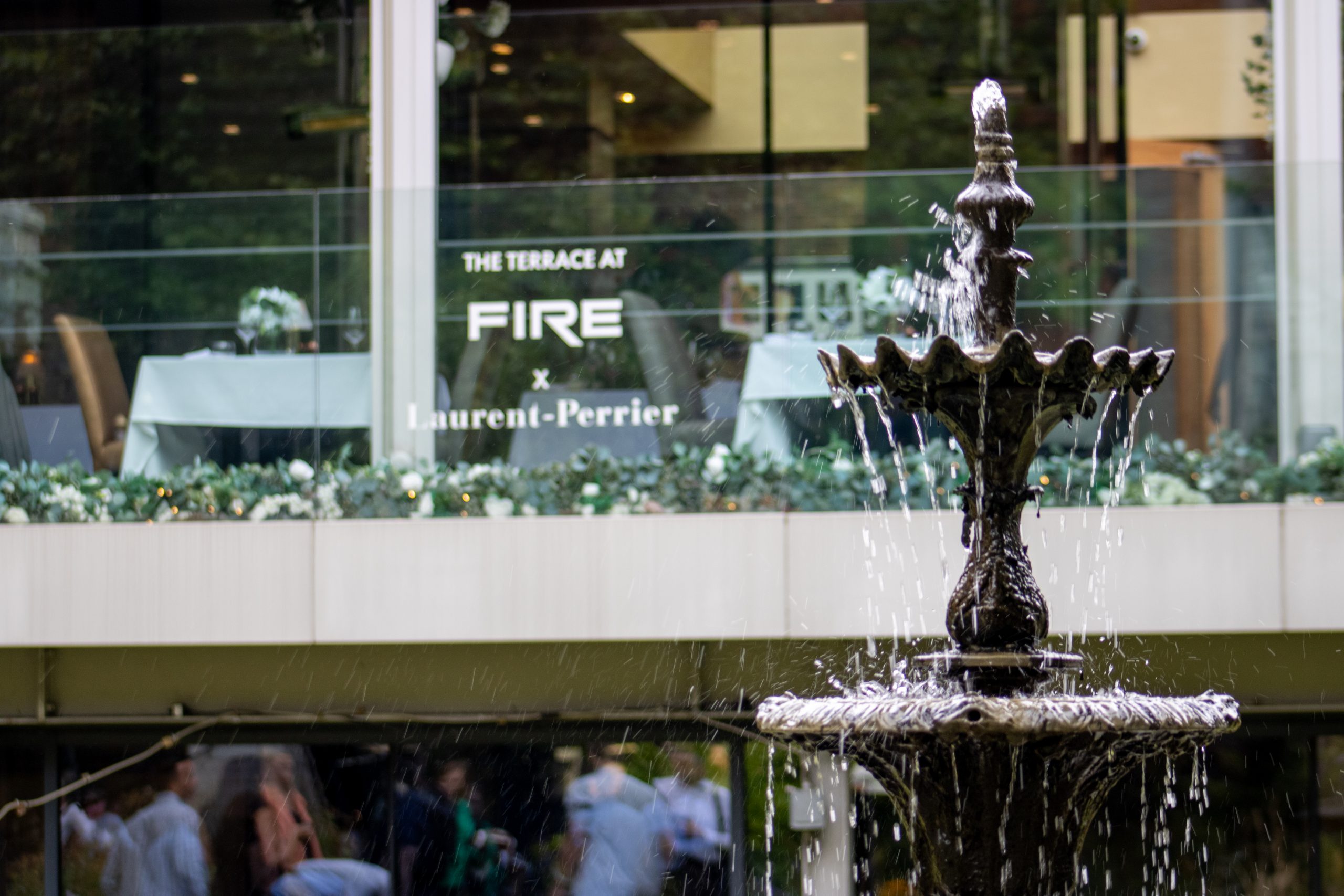
Signature Dish & Recommended Drink Ciaran’s whiskey-infused steak paired with a smoked old-fashioned
Why the Pairing Works The strip loin soaks in spirits for 24 hours before spending 30-plus days in the dry ager. Midway through aging, the beef gets a balsamic treatment, which adds sweetness and reinforces those whiskey notes. The tableside-smoked old-fashioned, made with Dublin’s Own whiskey, mirrors the steak’s complex flavors.
While You’re There FIRE Steakhouseis in the historic Mansion House on Dawson Street, the residence of Dublin’s lord mayor and site of the first sitting of DáilÉireann, Ireland’s parliament, in 1919. After dinner, walk a couple of blocks to Kehoes, an 1803 pub where mahogany partitions and original Victorian fixtures preserve its 19th-century character.
B Bar at Clayton Hotel Burlington Road
Signature Dish & Recommended Drink Irish sirloin steak paired with Chateau Puynard “The Steps” Bordeaux
Why the Pairing Works Aged for about 15 months in French oak barrels, the Merlot-Cabernet Sauvignon blend offers rich dark fruit aromas. According to Executive Chef Finbarr Higgins, the Irish beef has a mild character that complements the wine’s earthy depth without overpowering it. “It’s all about terroir,” Higgins said. “Our land is perfection for beef, and Bordeaux wines are getting the right terroir to match the meats.”
While You’re There As an official partner of the Aer Lingus Classic, Clayton Hotels welcome visiting teams and their fans. Fuel up for game day at the sprawling breakfast buffet, featuring Irish staples such as Galway sausages, scrambled eggs, hash browns, bacon, and a selection of fresh fruits and artisan cheeses.
Afterward, take a short ride to the National Botanic Gardens, where nearly 50 acres of Victorian-era glasshouses and themed gardens offer a peaceful escape in the Glasnevin neighborhood.
With a waving One Shade Greener flag in hand and music filling the air, TCUsenior Mark Sayegh hypes up volunteers from a small canoe floating on the Worth Hills Pond, turning a simple campus cleanup into a celebration of community and environmental action. That same passion has allowed him to grow a nonprofit spanning several chapters and mobilize others toward change.
Sayegh’s green thumb was instilled at an early age as he watched his dad garden. Later, during his sophomore year at Westlake High School in Austin, Texas, during the Covid pandemic, he and a friend noticed their local parks struggling with litter as more people gathered for socially distanced picnics. The two organized cleanup efforts, launching the initial infrastructure of what would become One Shade Greener.
By April 2023, Sayegh officially founded it as a TCU student organization after learning that parts of Fort Worth have some of the lowest life expectancy rates in Texas, an issue largely tied to food insecurity. The organization now aims to foster a cleaner, healthier environment by building and maintaining community gardens and organizing regular litter cleanups throughout the city.
“I really wanted to connect TCU students with the broader Fort Worth community,” Sayegh said.“And I realized that this passion of mine, this organization, gave me a rare opportunity to do so.”
“I never thought it would come this far,” Sayegh said. “It was two people. … I never thought it would grow into this.”
Growing the Movement
After a decorated kicking career at Austin Westlake, Sayegh joined TCU’s football team but had to retire following a spine injury during his first spring on campus.
Back home in the capital city for summer break, Sayegh refocused that energy, using his recovery time to strategize about how to grow One Shade Greener. He organized weekly community cleanups every Sunday, using Instagram to raise awareness. The events drew not only his friends but also volunteersfrom across the area.
As attendance at the cleanup events grew, Sayegh leaned on fellow members to help coordinate activities during his surgery and recovery. Soon, those same members asked if the initiative could be brought to their own schools and college campuses. Sayegh quickly began developing ways to expand One Shade Greener to suit the needs of each community.
Whether planting trees, cleaning lakes or maintaining gardens, the goal is to advance the organization’s mission of creating healthier spaces and environments.
“Mark shows that the people you lead are capable of making the right choices; they just need parameters,” said Michael Rizzo, a friend who has worked with Sayeghthrough OneShadeGreener and Honors College programs since the pair’s first year on campus.
In 2023, One Shade Greener expanded to five chapters beyond TCU: Sayegh’s alma mater, Westlake High School; Texas Tech University; Stephen F. Austin State University; Baylor University; and Brentwood Academy in Brentwood, Tennessee. Chapters at Texas State and the University of Arkansas followed in summer 2025, and the organization plans to keep growing.
To keep chapters connected to him and to each other, Sayegh ensures the OneShadeGreener Instagram account remains active, reposting content from other chapters’ accounts and sharing updates on cleanup efforts with the TCU chapter during meetings.“I try to show everyone that we’re all working toward one mission,” he said.
Sayegh recalls his proudest initiative as the organization’s first garden, planted at Fort Worth’s Lily B. Clayton Elementary School, just seven minutes from TCU’s campus.
“I think the way that we’re embedded in the community is the thing that sets us apart the most,”he said.
One Shade Greener’s community gardens provide fresh produce to Fort Worth families while teaching students about sustainability and food security.
Within a few weeks, the TCU chapter restored the school’s gardens, which were disheveled and rarely used. The group followed up with monthly gardening lessons for the kids, using pamphlets and potato-themed activities — such as creating their own “Mr. Potato Man” — to show the vegetable’s versatility and spark excitement about the project.
For Thanksgiving, the garden’s vegetables and herbs were harvested and packed into goodie bags for the children to take home.
“They were so proud that they were able to give their parents something that they grew,” Sayegh said,adding that they asked, “Can we start this at home? Can we have an onion garden at home?”
Campus Connections
Sayegh, who was named TCU’s Outstanding Senior in the fall, describes himself as an outgoing person who thrives on meeting and collaborating with new people. As a Chancellor’s Scholar, a member of the John V. Roach Honors College and president of the Chemistry Club, he is deeply involved in campus life and knows how common it is for TCU students to need service hours for their own organizational requirements. Many of his volunteers are part of Greek life on campus.
For each event that attracts a significant number of participants, Sayegh’s goal is to encourage at least five to 10 attendees to become regular volunteers. From bringing donuts to waving a large One Shade Greener flag and blasting music from a speaker, he works to make every cleanup enjoyable.
Over the years, OneShadeGreener has collaborated with about 40 organizations on campus. TCU’s Student Government Association approached Sayegh last year to launch a recycling initiative on campus, and he spoke at SGA meetings to encourage more participation.
“Mark leads by example. He’s a servant leader who genuinely cares, not just about sustainability but about people,” said Charity Ketu, former student body vice president, who has known Sayegh since living in the same dorm their firstyear on campus.“His impact has been felt both through environmental efforts and in the lives of those around him on campus.”
Sayegh attributes much of his journey to the opportunities offered to him at TCU. Being a Chancellor’s Scholar not only made attending the university possible but also inspired his commitment to giving back to the community that shaped him.
“It makes me so grateful to be at TCU, and I’m trying to make an impact with everything I do and do something with every second of my time because I know that there are people believing in me, and I want to make them proud,” he said. “I want to give back.”
One Shade at a Time
While One Shade Greener has already played a meaningful role on TCU’s campus and in the Fort Worth community, Sayegh sees its greatest potential still ahead.
As he prepares for medical school to pursue a career in ophthalmology, he plans to continue integrating OneShadeGreener into his work by combining gardening with access to healthy food as a form of promoting overall wellness.
“I really want to put more of my time into the gardening aspect and tie it in with health,” Sayegh said. “I think as a future physician, I’ll be able to do this more, working with local clinics and connecting families that don’t have access to healthy food. It could be a separate avenue for health rather than just prescribing medication.”
While he looks ahead, Sayegh also reflects on the experience of leading One Shade Greener and the lessons it has taught him about service, and the impact even small actions can have.
Sayegh said no effort is too minor, whether it’s picking up one piece of trash or cleaning one garden at a time. “We want to make the world one shade greener — not a lot of shades at once, just one shade at a time.”
Many will recall that comedian Bob Hope ended his performances with his signature song, “Thanks for the Memories.”We asked TCU retirees to recall some of their fondest TCU memories or, as we Horned Frogs sing, “Mem’ries Sweet.”
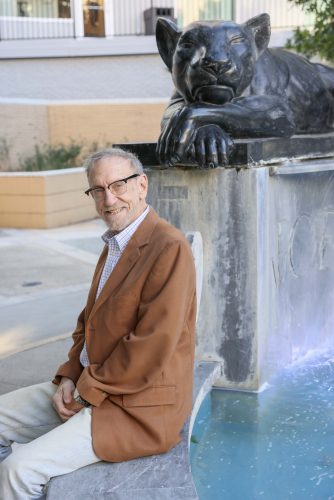
Richard Leo Enos helped elevate TCU’s Honors Program to an Honors College with its own dean through his work co-chairing a university commission subgroup.
I have a habit that is so unconscious and automatic that I have never reflected upon it . . . until a few days ago. Whenever my TCU Magazine arrives in my mailbox, I always stop whatever plans I have and flip through the pages. I especially look at the activities of the alumni/ae section to catch up on the students I once taught, as well as the featured stories of that issue. This time, however, I stopped and asked myself a question, “Has there ever been a feature on TCU retirees?”
I couldn’t recall one, at least immediately, and that somehow seemed wrong to me. We have a variety of features on our alumni/ae, events, and achievements of individuals. We occasionally do have a special feature on professors, such as the wonderful essay on the TCU Piper Professors, but nothing about the hundreds of retirees—faculty and staff—who contributed so much to shape our identity and contribute to the nationally recognized university that we enjoy today.
These retirees are not only our “Elder Frogs” but sadly our “Silent Frogs.” So I thought that it was time to give voice to our TCU retirees. I asked some of our retirees to recall some of their fondest memories of TCU. I hope that you will enjoy their comments. As you read these comments, you will be struck—as I was—at how each of these comments, written independently and with no real directives, recalled their fondest moments with students a central feature!
Emeritus Piper Professor (State of Texas). He retired as a Professor of Rhetoric from the Department of English in 2019.
Honors at TCU: From Program to College
Richard Leo Enos Emeritus Piper Professor, English
One of the exciting discoveries that I made when I arrived at TCU from Carnegie Mellon University in 1995 was our long-standing Honors Program. For decades, the TCU Honors Program had been an important resource that served the university well by providing exceptional students with the opportunity to learn at a level that few experience as undergraduates.
I immediately asked to be included in the activities of the Honors Program and witnessed firsthand the dedication of the faculty and staff.
When I arrived, TCU’s academic reputation was rising to even higher national prominence, and we were all looking for ways to showcase our university. That opportunity came a few years later when then Chancellor Michael Ferrari created a large task force called The Commission on the Future of TCU.This was a university-wide initiative comprising multiple subgroups.Each subgroup was co-directed by a faculty member and a member of the Board of Trustees, with committee members composed of TCU faculty, staff, alumni/ae and friends.
I was fortunate enough to co-chair the AddRan subgroup with Trustee Deedie Potter Rose ’63. After months of work, our subgroup presented recommendations aimed at enhancing the opportunities and merits of TCU,which would benefit our students.
One of our most important recommendations was that TCU Honors move from the status of a program to a College with its own dean.Inherent in this recommendation, of course, was a major increase in facilities, faculty and resources.We wanted this Honors College to be inclusive, drawing students and faculty from across the university and giving them the opportunity not only to realize and demonstrate their talents, but also to provide a more detailed organizational structure that would make such efforts inherent in the Honors College mission.
At about that time, we were also working on a university committee to compose TCU’s mission and vision statements.We firmly believed that reconceptualizing the Honors Program as the Honors College would not only demonstrateour commitment to thenew TCU mission but also help lead us toward our vision of being an internationally recognized model of higher education.
I am proud to say that the efforts of so many helped make the dream of an Honors College come true.
Sally L. Fortenberry
Emeritus Piper Professor (State of Texas). She retired as a Professor and Department Chair of Fashion Merchandising in 2024.
Reflecting on Past Engagements Sustains the Future
Sally L. Fortenberry Emeritus Piper Professor, Fashion Merchandising
When asked to write about my fondest memories at TCU, I was challenged to come up with only one drawn from the 35 years I worked here.I thought first about all the many students I have taught and advised and gotten to know over this time.I reflected on several major trips I took with students and how those memories are still some of my fondest.
Every 2 years for the past 32 years, I attended the Phi Upsilon Omicron National Honor Society Conference with members of the TCU chapter as its advisor.Some of the most memorable conferences involved traveling with students to Buffalo, New York, and getting to visit Niagara Falls; to Boise, Idaho, and getting an up-close look at the blue football field; to Menomonee, Wisconsin, and Savannah, Georgia, where we had the chance to explore both cities’ history and the beautiful surroundings; and a trip to Bowling Green, Kentucky, where we toured the Corvette museum.
A trip to Puebla, Mexico, with one of our department honors students to visit the University of the Americas and a local apparel manufacturing facility is another of my favorite memories, especially considering neither of us spoke much Spanish.
When connecting with students outside the classroom, the bonds of friendship are established, and once they graduate, staying in touch is easier and allows for opportunities to create more memories. I have attended weddings, baby showers, new business openings and new product launches of former students, and I cherish each activity and appreciate the chance to stay connected to these alumni/ae who are now friends.
I would also be remiss not to mention the fond memories I have of the many faculty and staff members I worked with at TCU and got to know as individuals, not just work colleagues. It is primarily because of the people I worked with, across departments and colleges, on university committees, and within the Faculty Senate, that kept me at TCU for 35 years.I truly enjoyed getting to know these individuals in all these capacities, and without the opportunity to collaborate across departments, colleges and disciplines, my experience at TCU would not have been the same.
Picking up the phone and calling someone who could assist, or walking down the hall or across campus to brainstorm ideas on projects, brought me to campus each day. Out of these interactions at work grew a network of friends who could call on each other when needed. One such example is when engineering faculty found themselves housed in the Annie Richardson Bass Building until their new building was completed.All the Engineering faculty were new to TCU, so the faculty of nutritional sciences, fashion merchandising and interior design made a point to include them in our monthly potluck lunches, holiday celebrations as well as our impromptu gatherings in the Bass Living Room.Lifelong friendships resulted from these work-related engagements, and many of us continue to get together even after retirement.
Phil Hartman
Retired in 2021 after 40 years in the biology department, through which he served as head of the Pre-Health Professions Program for 22 years and as Dean of the College of Science & Engineering for 9 years. He coauthored the second edition of Walking TCU: A Historic Perspective.
These are a Few of My Favorite Things
(with apologies to Rodgers and Hammerstein)
Phil Hartman Emeritus Dean of the Louise Dilworth Davis College of Science & Engineering and Professor of Biology
In my 40 years at TCU and going on three-plus years of retirement, I’ve accumulated a host of fond memories. Most center around people I admire and respect, whether they be students, faculty or staff. Rather than limiting this essay to my single fondest memory,I’ve taken the liberty of listing my top 13, in no particular order.
Before the list, though, a quick anecdote: Shortly before my WalkingTCU book, coauthored with Joan Swaim ’56 (MA ’68), was published, I was asked to name my favorite place on campus. Rather than the expected—someplace like Frog Fountain or Amon Carter—my interviewer was initially perplexed by my response of “the fifth floor of Winton Scott.” Why, she asked? “Because that’s where I had my most cherished moments interacting with students, faculty and staff.”
Sitting in a Michigan basement with my son Jonathan Hartman ’06watching the Rose Bowl win.
Playing basketball with the guys on the grounds crew. I’m proud to call them my friends and was honored when they attended my retirement fete in the TCU Music Center.
Research trips to Japan to visit my collaborator and dear friend Nao Ishii. What an amazing country!
LONG Travels (e.g., Orlando) with pre-health students in university vehicles to biennial pre-health professions honor society conventions.
Along with Susan Weeks ’09 DNP, playing a role in the beginnings of the Anne Burnett Marion School of Medicine at TCU, including the initial“top-secret” negotiations with the University of North Texas Health Science Center.
For 22 years, teaching, advising, mock interviewing and writing letters of recommendation for applicants to medical school. It was challenging at times, but also intensely rewarding to work with committed faculty and staff in mentoring stellar students.
Watching our younger son Jonathan cross the stage in 2006 with his diploma and then giving him a huge hug.So proud of him!
Mentoring students in my research lab…helping them experience the thrill, but also the frustrations, of doing science.
Revising and expanding Walking TCU: A Historic Perspective, which kept me busy during my first year of retirement.
Turning students onto the beauty of genetics.
Walking across campus and encountering students as well as faculty and staff I treasured as both colleagues and friends.
Although not a fond memory, taking intense pride in the faculty and staff as they worked heroically during the Covid/sustainability/optimization era of distance learning and budget cuts.
Entertaining students, faculty and staff in our home, thanks largely to the planning and execution efforts of Mary Beth, the “Deanette” and my best friend!
As a retiree, rehabbing abandoned bikes and donating them to two agencies to be gifted to either homeless individuals or immigrants. I’m up to 60 bikes now over the past 14 months (a shout out to Tom and George, my two favorite TCU Police Officers, for supplying most of the bikes!!).
As Julie Andrews so beautifully sang in the Rodgers/Hammerstein classic: “When the dog bites; When the bee stings; When I’m feeling sad; I simply remember my favorite things and then I don’t feel so bad.”And thusly, “These are a few of my favorite things,” or rather some of my fondest memories of TCU.
Don B. Mills ’72 MDiV
Administrator and faculty member at TCU for 52 years.He retired as Emeritus Vice Chancellor for Student Affairs and Distinguished Professor of Higher Education in 2021.
Thoughts on TCU
Don B. Mills Emeritus Vice Chancellor for Student Affairs
What memories stand out to me after 52 years working at TCU?I could certainly tell a lot of stories about things that happened. I could share tales about the many thousands of students I met or the alumni who have helped to shape the university.No doubt the campus has undergone physical changes from a relatively nondescript site to a dynamic and beautiful location.The reach of TCU’s influence has expanded from being regional to being national, even international.
Memories are extremely personal.We remember things because they have somehow left an imprint that may dim over time, but they do not disappear.What is important to one person may only be incidental to another. We remember events that may be amusing, sad, joyful, heartbreaking, embarrassing or life-changing.We may remember single events or a procession of events that lead to an understanding of the character of the people and the institution that they build.It is that procession of events that I would like to focus on because I believe it illuminates what provided the energy that provided the unique culture that is TCU.
I initially came to Fort Worth to earn a degree from Brite Divinity School. After a year, I accepted a position in student affairs at TCU.I soon learned some important elements of our culture.There was a sense that TCU’s success depended on everyone, not just leadership but also the students, faculty, staff and alumni/ae.Because success depended on everyone, there was a general acknowledgement that those who were part of the history of TCU provided a foundation, and it was up to contemporary members of the university community to carry our legacy forward. That also meant that everyone rooted for each other’s success and, by doing so, recognizedthat it assured success for TCU.
Did this mean that people always agreed?Of course not.Students were, and are, always pushing for more autonomy.Faculty voices were, and are, seeking more involvement in governance. Money is never plentiful enough, and disagreements about the highest priorities were expected and accepted.The key, however, for me was the sense that all were working together for a common goal.
The reality of a connected campus did not need a formal designation.Fraternities and sororities, residence halls, honor societies, student government and other student organizations organize the student body.Schools, departments, divisions and administrative functions organize a university.In some institutions, that organization determines a person’s place in the university.At TCU the organization is a starting place to find connections everywhere.
So what are my memories? What made me want to spend a career in one place?It was the culture.It is people such as our faculty who make an effort to ensure student success.It is the hall director who encourages a student to have the courage to step into a leadership role.It is the leadership of the university that understands the greatness of the university lies in the character of people who inhabit the physical campus, not the physical campus itself. Excellence in a university stems fromthe connections between its members,rather than from designated programs. The connections have defined TCU for decades. That is who we are. Those are my most significant and fondest memories.
Richard Sybesma ’91 MLA
TCU Swimming Coach for 38 years, 1979-2017.Coach Sybesma is the longest-tenured head coach in any sport in TCU’s history. Among the many accolades Coach Sybesma receivedare coaching in the Olympics, winning 5 “Coach of the Year” honors and several conference championships.
My Fondest Memories: Remembering Swimming and Diving Practice on 9/11, 2001, and One Very Young, Very Special Hero
Richard Sybesma Emeritus Head Coach, Swimming Photo by Sharon Ellman
On September 11, 2001, the team met at the Forest Park outdoor 50-meter pool at 2:30 for a normal practice. Most athletes were not sure what had happened with the day’s events, as they had been in class. We gathered to discuss what we knew, and I instructed them to go home, check on any relatives in New York or other cities, call their parents, fill their cars with gas, and if further terrorist activities occurred, to meet at the TCU pool.
I felt we needed a team plan,something to focus on in case anything else might happen to our country and knowing that the building of TCU indoor pool was also a fallout shelter built in the ’70s. The team would be safe, have plenty of water to drink, and we could be together to form a plan.Fortunately, we did not need to meet, but that day, we came together as a team in case of further problems. We added the NYDC with an American Flag logo to our swimming suits and team poster supporting all the victims and heroes of this tragedy. It was a huge team-bonding experience, with everyone knowing that a plan was in place to keep our team safe.
In the years following 9/11, we have always talked about this plan in case of other attacks on America and providing for the safety of our team. As a nation, we must continually remind our young people of this tragic day in American history. I hope none of us ever forgetsand we can share with others the loss, sadness, heroism, solidarity and commitment our nation had that day.
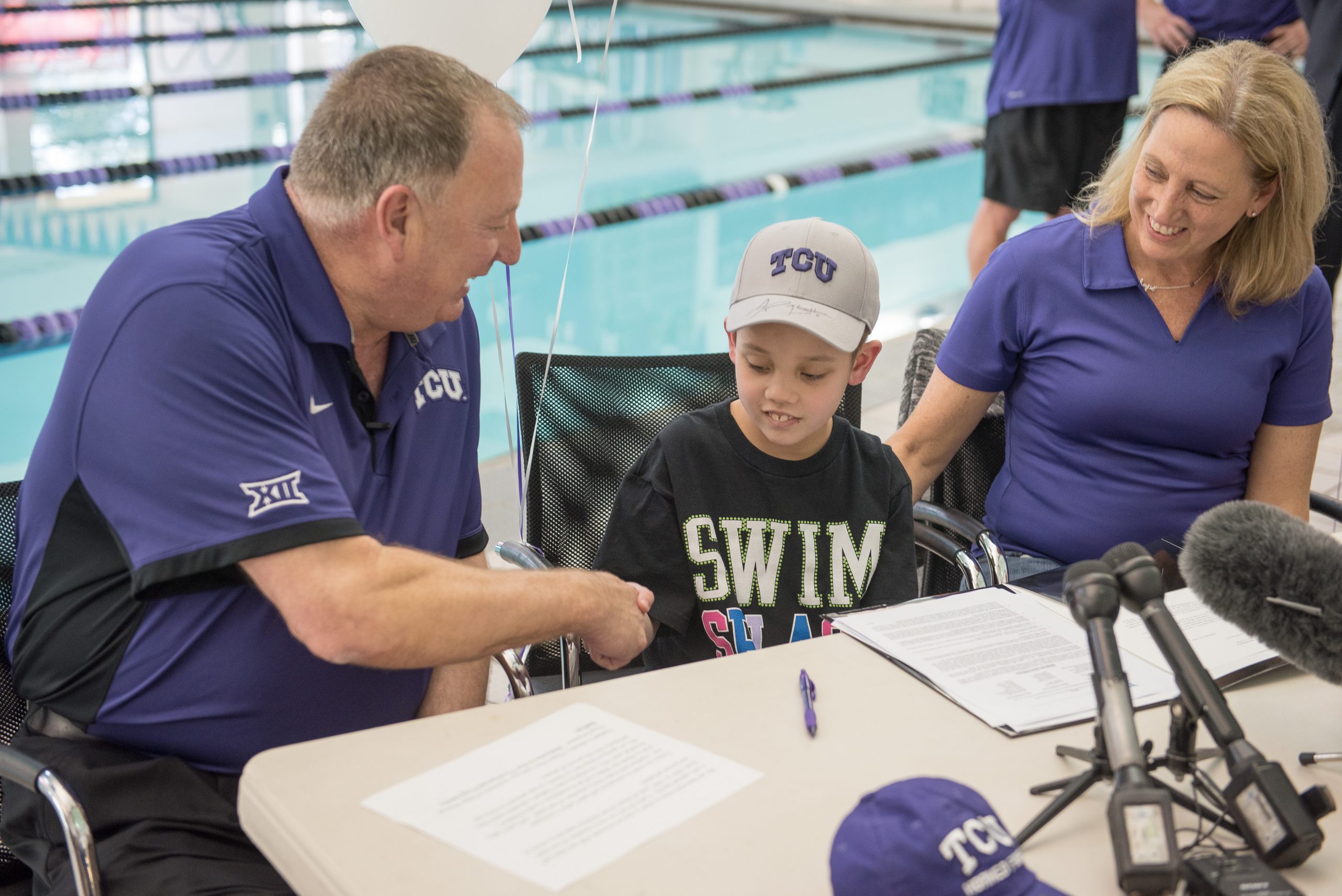
On an individual and personal level, one of my proudest and most poignant memories was having Nathan Lin, at the time an 8-year-old who was suffering from an aggressive brain tumor, sign a Letter of Intent to become a member of our team. In fact, despite all of the honors and distinctions that I have been fortunate enough to receive—including my coaching at the Olympics, NCAA national and conference championships—I consider this experience with Nathan to be my proudest moment! This was made possible not only by our team but also by Make-A-Wish and other very caring groups and individuals.
Watching the team cheer Nathan as he swam in our pool was a moment I shall never forget. Nathan’s motherCathy Boyd Lin ’89 swam for us (1985-1989), and she wrote me a powerful letter saying how much it meant for the family.Having Nathan embraced by our team showed me how much we benefit from our students, past, present and future!
From left, coach Richard Sybesma, Nathan Lin and Nathan’s mother, swimming letterwinner Cathy Boyd Lin, at a 2016 event in which the 8-year-old was signed as a member of the TCU swim team. The signing was part of Lin’s Make-A-Wish Foundation dream come true. Photo by Glen E. Ellman
I would like to end by quoting Cathy’s own words of appreciation for our Horned Frog Swimming Team: “Many of you came to Nathan’s funeral, and I am so very grateful for that loving show of support for your littlest teammate. To have the TCU Swimming/Diving coaches as pallbearers at Nathan’s funeral was quite an honor. I am certain Nathan was so proud to have them escort him to his final resting place.”
As Cathy went on to tell me in her letter, our experience had a profound impact on her, her husband Jeff and the entirefamily, and I will add to the team and to me as a coach: “This brings me to my next point—whether you realize it or not, these people you swim every day and share so much of your life with right now are far more than just your teammates—they truly are your family. And as a TCU athlete, you are part of an even bigger family that will be with you long after you graduate.”
Mary L. Volcansek
Emerita Professor of Political Science. She also served as Dean of the AddRan College of Liberal Arts from 2000 to 2007 and retired from TCU in 2018.
Mem’ries Sweet, 2000-2018
Mary L. Volcansek Emerita Professor, Political Science and Dean of the AddRan College of Liberal Arts
TCU, “mem’ries sweet?” A cascade of delicious thoughts flow over me—the 2011 Rose Bowl game, skydiving with the Army Golden Knights, TCU moot court competitions, a who’s who of outstanding speakers and many people and events.
But, primarily, students fill my thoughts. I naturally use the metric of students to measure what tastes the sweetest, endures the longest, and ranks the highest. My successes are reflected in the accomplishments of my students, and many who passed through my classrooms over my 48-year career have achieved laudable attainments. A number particularly stand out when I think about those I taught and advised at TCU, not only by their later life’s work, but also by the seeds already germinating at TCU.
A notable example of such student accomplishments is a young woman, a communications major who presented herself in my office to ask about taking my Judicial Politics course the following term.I described the course and mentioned that required readings included excerpts from Franz Kafka’s The Trial, to which she responded, “Why just excerpts and not the whole book?” You can readily see why she impressed me.
She enrolled in the course and was an avid student, obviously having read all of the assignments and ready with insightful comments and questions.One day—this was in the years immediately following 9/11 and the U.S. expeditions into Afghanistan and Iraq, when few Americans knew much about Muslims—I walked into class and was struck to see her sitting with her laptop open, but wearing a full burka or at least a full-length robe and hijab. She explained that she was writing a story about how people reacted to women dressed in prescribed conservative Islamic attire and was dressed this way for the full day.She displayed no embarrassment or discomfort and proceeded to ply me with her usual questions and to offer ready laughs at appropriate times.
I knew that Christina Ruffini ’07 interned one summer with CBS and heard from her once or twice after graduation when she was a CBS producer.For reasons I can’t recall, I started following her on X when it was still Twitter and was delighted to see that she obviously was part of the press corps that accompanied then-Secretary of State Mike Pompeo.
Time passed, I deleted my Twitter account and thought no more about it.One Sunday, I happened to turn to CBS Evening News.A stunningly attractive, poised, confident, knowledgeable and articulate young woman was reporting on the major foreign policy issue of the day.Yes, my “make me read all of The Trial” and hijab-attired student was explaining U.S. foreign relations to the nation. My pride could not be contained.I tracked down an email address and sent a “you-probably-don’t-remember-me-but” email via CBS to compliment her performance.As any good Horned Frog would, she promptly responded and said that she remembered me and my course well.
THAT is a memory sweet and one that warms the heart of a retired professor.A recent Google search revealed that her accomplishments as a journalist far exceed the single CBS episode that I saw. My happiest and most meaningful memories from TCU are of my students, and my pride derives from how they have used their TCU educations to become “ethical leaders . . . in a global world.”
In this series, TCU Magazine visits with alumni in the food and beverage industry. Send recommendations to tcumagazine@tcu.edu.
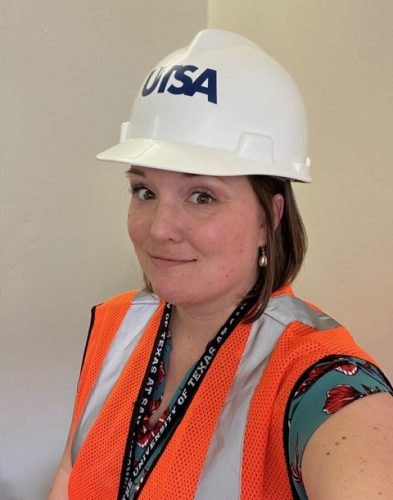
Stephanie LokenEdgett ’05isthe director for university dining and retail services at UT San Antonio, where she oversees contracts forthe dining hall, which serves more than 2,000 meals a day, 21 retail food locations ranging from Chick-fil-A to Freebirds, more than half a dozen markets and 150 vending machines.Edgett, who recently completed her master’s in higher education administration, also helps steer remodeling projects and new concepts for campus, such as the addition of The Den by Denny’s, popular with students for its all-day breakfast.
What drew you to a food-related career?
Friends would have Hamburger Helper for dinner or Pop-Tarts in the morning, and then my dad is makingpot roast on a Sunday night or chicken marsala on a Tuesday. We just always ate good food. I started getting into baking from home ec in high school. Originally, I wanted to be a pastry chef after I finished my food management degree, but then I decided to go a different route.
Class of 2005 alumna Stephanie Loken Edgett wears many hats as director for university dining and retail services at UT San Antonio. Courtesy of Stephanie Loken Edgett | Jose Barrera
I’m just really proud of having gone through that program at TCU. It’s a small but mighty program.There was a class I took, Quantity Foods, and it was cooking on a large scale, likeif you were in a hospital or retirement home or hotel. And I just remember thinking this equipment is so cool, to be able to make this much soup.
How did TCU shape the way you approach your work?
I lived on campus all four years. A lot of my friends are still from Colby Hall, and we would call each other at 5:30, 6 o’clock,and we would walk to the dining hall. There’d be five, six, 10 of us at any given time. To me, it was the community-building, that sense of belonging.
When we’re looking at designing a space or renovating a space, we’re trying to think, “What would be a good fit? What’s going to connect the students?” If you were to ask anyone from the early 2000s [at TCU] what their order at Deco Deli was, they would tell you. I want to pass that on to the students here.
Where on campus have you been able to foster that kind of community?
We opened a coffee shop near our bookstore, and we modeled it loosely on Friends. So instead of Central Perk, it’s Union Perk. We put in a little cat window cling, like Smelly Cat from Friends. We have a fountain on campus, so we used that fountain as artwork, like the fountain from the Friends theme song. We put a guitar in there so people could play when they are sitting on the couch. You watch students talking in line, sitting at the tables, sitting on the couch, just chit-chatting with friends — the excitement they have for it is really the most fun with a lot of these projects.
“You watch students talking in line, sitting at the tables, sitting on the couch, just chit-chatting with friends — the excitement they have for it is really the most fun with a lot of these projects.” Stephanie Loken Edgett
What elseare you working on?
The strategic planning for our area: What are the innovations and enhancements?Food-delivery robots are a big thing. Whether or not our campus can have those — that’s something that I need to look at. Our campus isn’t flat, and we don’t have a lot of ways to get from one area to the other without going around.
Right now, we’re looking at renovating our downtown campus’ food area. They’re planning to move about 8,000 students through a couple of programs to be down on that campus permanently. Our plan is to completely renovate that space and have it open for August 2027.
What’s your favorite on-campus meal?
We have a station in our dining hall that is Tex-Mex, and one of the staff members will make posole. When the posole comes through, I’m always in line for it. Our allergen-free station tends to be one of my favorite stations as well, because the woman that makes that menu does a really good job of creating really nice, flavorful dishes.
Editor’s Note: The questions and answers have been edited for length and clarity.