Menu

Author Archives: Caroline Collier

  1. Cameron Norrie’s Smashing Success

    Leave a Comment

    On Oct. 17, 2021, as a strong wind swirled, Cameron Norrie took center court in Indian Wells for the finals of the BNP Paribas Open. The 6-foot-2 lefthander was hardly the favorite in the Southern California desert in a tournament delayed seven months by the Covid-19 pandemic.

    But Norrie had spent the unexpected time off at his family’s home in New Zealand, running the equivalent of a 10K in hilly Auckland almost every day for two months.

    He was in the best shape of his life for Indian Wells, which tennis fans consider the fifth major. In terms of prestige, the competition is nearly on par with the four grand slams: the Australian Open, the French Open, Wimbledon and the U.S. Open.

    Heading into the competition, Norrie was ranked No. 26 in the world.

    He blazed through the tournament, defeating five opponents before the final round, where he was considered the underdog against Nikoloz Basilashvili, a power hitter from Tbilisi, Georgia.

    Norrie started the match strong with his solid groundstrokes and trademark accuracy, but after a 3-1 lead, Basilashvili roared back, winning 10 of the next 11 points. For the first time during the tournament, Norrie dropped the opening set.
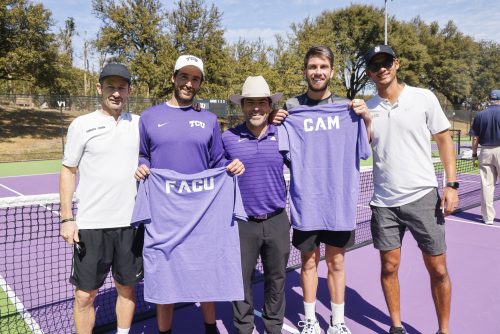
    TCU vs Michigan men’s tennis in Fort Worth, Texas on March 2, 2022. (Photo by/Sharon Ellman)

    Devin Bowen, Facundo “Facu” Lugones, David Roditi, Cameron Norrie, Derek Siddiqui. Courtesy of TCU Athletics | Photo by Sharon Ellman

    What Norrie did next was exactly what his coaches at TCU had come to expect. The then-26-year-old fought back with a forehand renowned for its topspin, which makes it hard to return. His serve likewise showed no mercy.

    Norrie blasted shots at key points to take the second set 6-4, forcing a third. Norrie found his rhythm, impervious to the wind and the pressure.

    After an hour and 49 minutes on the court, Norrie dominated the third set, taking it 6-1 to capture what was then the biggest win of his career.

    In an on-court interview following the win, Norrie said, “I can’t really believe it. If you’d have told me I’d have won before the tournament started I wouldn’t have believed you.”

    Linda Lawrence Cappel ’80 watched it all from the stands. She runs the pro shop by TCU’s outdoor courts and became something of a surrogate mother to Norrie after he arrived on campus in August 2014.

    “Cameron has this kind of drive that doesn’t waver,” she said. “It’s hard to explain his magic.”

    David Roditi ’96, TCU’s head men’s tennis coach, and Devin Bowen ’94, assistant coach, said they had an inkling Norrie might have the chops to go pro a few months after the future No. 1 Briton arrived in Fort Worth.

    “He was determined, he could suffer, he could take a lot physically, could play all day, and he had another level of competitiveness altogether,” said Bowen, who like Roditi enjoyed success on the professional circuit before returning to his alma mater to coach.

    “Cameron Norrie is a proper killer,” Bowen said.

    “He really is,” Roditi agreed.

    ?????????????????????????????????????????TCU Cameron Norrie, in a 2017 match against TAMU. Courtesy of TCU Athletics

    In 2017 Cameron Norrie became the first player in TCU program history to finish the season ranked No. 1 in the Oracle/ITA singles poll. Courtesy of TCU Athletics

    Stateside

    Norrie’s tennis journey began with his mother hitting balls to him in the driveway when he was 6. His microbiologist parents, Helen and David Norrie, both played squash in college and encouraged their son’s athletic pursuits, which included rugby, soccer and cricket.

    Norrie debuted on the junior level in international tennis tournaments at age 13, though that year — 2009 — he lost in the first round of every tournament. At 15, he finished as runner-up in the New Zealand 18 & Under Indoor Championships. When he was 16, he won two junior international titles.

    The Norrie family decided Cameron should move to the U.K. to train at the Lawn Tennis Association’s National Tennis Centre in southwest London. Starting in 2013, he lived with a host family and competed in junior Grand Slams at Roland Garros (home of the French Open) as well as at Wimbledon and the U.S. Open. He began representing Britain rather than New Zealand, a move that enabled him to qualify for more funding in the U.K. Training elite tennis players, who need coaching and trainers as well as mental fitness and nutritional support, is an expensive undertaking.

    At 15, Norrie and a coach traveled around Europe for five months. Though he rose to No. 10 in the junior international rankings, he began to consider competing at the collegiate level. He talked to the head coach at the University of Michigan, where a fellow junior tennis player from New Zealand was on the roster.

    But in the summer of 2014, the Michigan coach was fired. Norrie scoured the U.S. for different options.
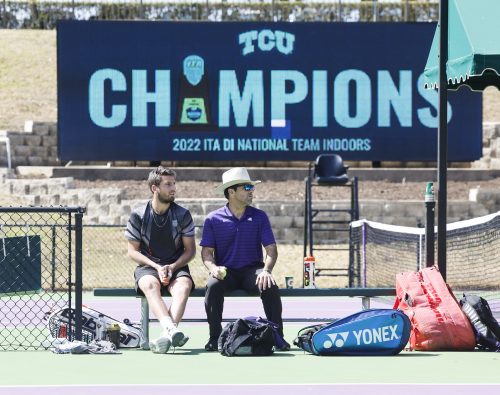
    TCU vs Michigan men’s tennis in Fort Worth, Texas on March 2, 2022. (Photo by/Sharon Ellman)

    Cameron Norrie, left, flourished at TCU under the direction of Coach David Roditi. Courtesy of TCU Athletics | Photo by Sharon Ellman

    Norrie visited TCU, said the campus was “wonderful” and Roditi “amazing.” He signed to TCU a week before the start of the semester.

    In September 2014, Roditi announced that Bowen would return to TCU as assistant coach, a move that Norrie describes as making an indelible mark on his game.

    “Devin has made a huge impact on my life and my career particularly in terms of work ethic,” said Norrie, who tried to lure Bowen to go on tour with him in 2017.

    “The combination of both those guys is amazing,” Norrie said, describing Roditi and Bowen as perfect complements to each other.

    “It was very special to be part of the TCU community and to have Devin and David lead me through making a lot of mistakes my freshman year and learning from them and then being able to use TCU as a base even now,” Norrie said. “I couldn’t have asked for two better coaches.”

    Norrie flourished on the purple courts.

    In the fall of his first year, he won the singles and doubles titles at the USTA/ITA Texas Regional Championships. He finished the 2014-15 season ranked 25th in the nation and garnered All-America honors in singles.
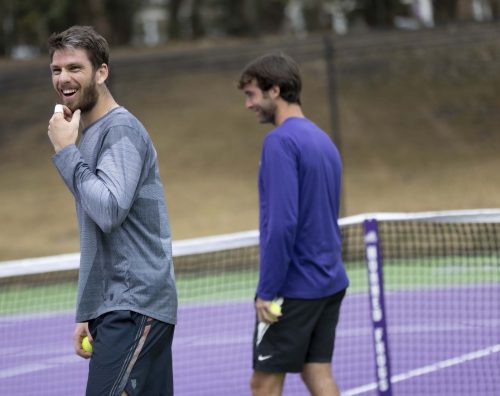
    TCU alum, Cameron Norrie, practices on the TCU courts on campus March 4, 2022. When Cam is in Fort Worth he always stays with his Texas “mom” Linda Cappel ’80 who works at the TCU Tennis Shop. Her black lab, Zoe, is also a big fan of Cameron.

    Cameron Norrie asked his former teammate Facundo “Facu” Lugones, right, to be his coach. Lugones, was named ATP’s 2021 Coach of the Year. Photo by Jill Johnson

    As a sophomore, he earned an at-large bid to the NCAA singles championships, becoming the first TCU men’s tennis player to advance to the singles final four.

    By the time he was a junior, he’d risen to No. 1 in the national singles rankings. In the spring of 2017, he went undefeated in Big 12 play, notching a perfect 10-0 record in both singles and doubles.

    “Cam Norrie is a good example of what college tennis can do for a player,” said Timothy Russell, CEO of the Intercollegiate Tennis Association. “In college they have a full team of people around them, not only coaches but trainers and nutritionists and mental fitness people.”

    Norrie made another key contact at TCU in Facundo “Facu” Lugones ’16, who had been a high-ranking singles player in his native Argentina. Upon going pro following his junior year, Norrie asked his former teammate to be his coach.

    “Cam has achieved so much, and a lot of that has to do with his time at TCU,” said Lugones, who in December was named Coach of the Year 2021 at the American Tennis Professionals Awards.

    Forever Frog

    Norrie said he loved his TCU years — tennis and more. As a first-year student, he lived in Moncrief Hall, a source of fond memories and enduring friendships. He studied sociology and business while practicing, which NCAA rules limits to 20 hours a week, and competing all over the country.
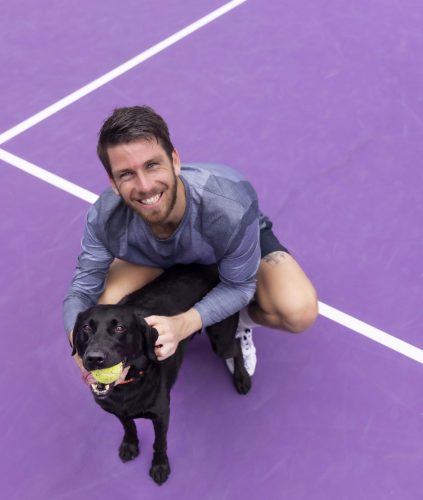
    TCU alum, Cameron Norrie, practices on the TCU courts on campus March 4, 2022. When Cam is in Fort Worth he always stays with his Texas “mom” Linda Cappel ’80 who works at the TCU Tennis Shop. Her black lab, Zoe, is also a big fan of Cameron.

    Cameron Norrie returns to Fort Worth to visit his favorite dog, Zoe. Photo by Jill Johnson

    He forged a special bond with Zoe, the black lab Cappel and her husband, Joe, a Fort Worth physician, adopted as a puppy not long after Norrie started school.

    “I was in love with the dog and as a result became very close with Linda, who is an unbelievable person,” Norrie said.

    Cappel serves as a team mother of sorts, often hosting functions at her Fort Worth home. (In March, Norrie requested Dr. Cappel’s signature fried ribs at an informal gathering of friends.)

    “The day we brought Zoe home, I think we were having a team dinner or team meeting or something at the house, and there was Cameron on the floor with her,” Cappel said. “She’s 8 now and they are still like that, just loving each other.”

    When Norrie turned pro, Roditi asked the couple if he could use their house as a home base. Professional tennis is almost never lucrative early on, and players have high expenses, including travel to tournaments and staff salaries. Renting an apartment doesn’t make sense for someone traveling 42 weeks a year.

    Norrie moved his stuff into the Cappels’ spare bedroom.

    “People say, ‘But wait, Linda, he’s making millions of dollars now,’ ” Cappel said. “But I tell them that he’s sticking around because he loves our dog and our pool and this city.”

    Less than a year after leaving TCU, Norrie broke into the top 100 players in the world.

    He kept climbing.

    In early July 2021, Norrie faced Federer at Wimbledon. Then ranked No. 34 in the world, Norrie fought back from losses in the first two sets to take the third, 7-5. Despite the support of the British crowd for one of their own, Federer pulled out the win 6-4 in the fourth.
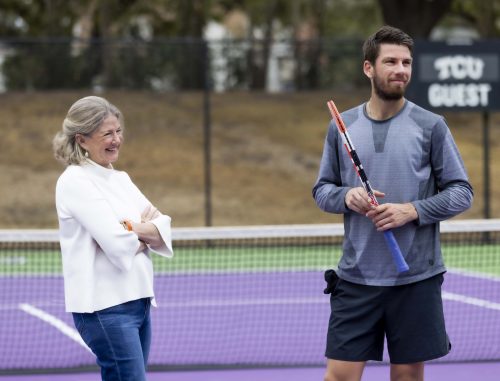
    TCU alum, Cameron Norrie, practices on the TCU courts on campus March 4, 2022. When Cam is in Fort Worth he always stays with his Texas “mom” Linda Cappel ’80 who works at the TCU Tennis Shop. Her black lab, Zoe, is also a big fan of Cameron.

    When Cameron Norrie is in Fort Worth he always stays with his Texas “mom” Linda Cappel who runs the TCU Tennis Pro Shop. Photo by Jill Johnson

    Afterward, the Swiss legend told reporters that he was “super relieved” by the outcome, describing the match as “a tough battle with Cam.”

    A little less than four months later, Norrie would become an ATP Masters 1000 champion with his victory at Indian Wells. He was the first British man to claim the title.

    New Heights

    Norrie enjoyed a smashing start to the 2022 season, defeating Reilly Opelka in late February to win Florida’s Delray Beach Open. A week later, he came in second at the Mexican Open in Acapulco, losing to Nadal in the finals.

    In April, he had landed in the No. 10 slot among the best players in the world.

    In late May, he defeated Slovakian Alex Molcan to win his second tour title of 2022 in Lyon, France. The victory was his first on a clay court.

    In July, Norrie broke new career ground — and gained an international fanbase — by advancing to the semifinals at Wimbledon. The Duke and Duchess of Cambridge cheered him on from the stands and tweeted their admiration for his skills on the grass courts.

    Roditi said his former athlete’s ascent feels gratifying but so, too, does his continued ties to the TCU tennis program. The head coach keeps in regular touch with Norrie, who asks him about the current crop of players and watches the matches on TV when he can.

    “It’s exciting for the players now to get to see him out on the court hitting,” said Roditi, who noted that he and the trainers welcome all tennis alumni back to TCU to practice and work out at the gym.

    Standing on the purple courts after a training session, Norrie summed it up like this:

    “Without TCU, I don’t know where I’d be.”
  2. Insights Into Introverts

    Leave a Comment

    An ideal workday for Ma’lisa Yost is a balance of team meetings, chats with co-workers and quiet time to write and think on her own. 

    “I like to engage with small groups or one-on-one with people,” she said. “I don’t mind being in a big group, but I might not say anything.” Later on, Yost might email someone “and give them feedback, if I think they’re open to it.”

    Yost, the assistant director of advancement communications at TCU, said she often feels her best conversations are in small groups or with just one other person, allowing her to tune into and engage with her colleagues. 

    For Gorland Mar, director of graphic design at TCU, an ideal day includes meetings where he can listen to his colleagues’ needs and feedback or gather input from his teammates on projects — and also spending some time alone to put his creative skills to good use.

    “That’s how I prefer to work, to really get in my own physical space where there’s just nobody around,” he said. “Not to say that I can’t handle interruptions, but I feel I create best when I’m in my space.”

    Personifying Personalities

    Albert Einstein was one well-known introvert. Elon Musk is another. Warren Buffett, Bill Gates, Meryl Streep and J.K. Rowling, all masters of their respective fields, are introverts. Even tireless leaders can be introverts; consider Eleanor Roosevelt or Barack Obama.

    Carl Jung introduced the terms introversion and extroversion into psychology in his book Psychologische Typen (Rascher, 1921). Jung defined introversion as “inwardly directed psychic energy.” Extroverts, he theorized, prefer to engage with the outside world of objects, sensory perception and action, while introverts focus on the internal world of reflection and are thoughtful and insightful.

    Cathy Cox, graduate director and associate professor of psychology, cautioned against labels that define individuals as one or the other. She said that personalities exist along a wide continuum. 

    In the 21st century, Cox said, psychology turns to the Big Five, a tool used to delineate five traits of personality, one of them being extroversion. OCEAN, an acronym for these five dimensions of personality measurement, encompasses openness to experience, conscientiousness, extroversion, agreeableness and neuroticism. An individual’s unique personality also can be characterized by subtraits within each of those dimensions.

    “Introverts are usually shy, quiet, focused inward, reserved,” Cox said. On the other hand, a personality that tends toward being “loud, outgoing, sociable and the life of the party” describes someone who leans toward extroversion. 

    Energy Balance

    The main difference between introversion and extroversion is “really about how you respond to stimulation,” Cox said. “We put ourselves in a zone of stimulation that works for us.”

    For some people, the best thinking is done in a quiet atmosphere. Others find clarity in a room full of people and action.

    “I get my energy being alone or with someone I’m really comfortable with,” Yost said. “I’m in an office with three other people who are also writers, and everyone is very considerate of the others because we all have similar personalities.” 

    “Stimulation comes in all forms — social stimulation, but also lights, noise and so on. … Many people believe that introversion is about being antisocial. That’s a misperception: Introverts are just differently social.”
    Susan Cain

    Yost said that as an introvert, she fights a stigma. “Introversion can have a negative connotation, but it doesn’t mean you don’t have friends or that you can’t be outgoing,” she said. “It just means you get your energy from within instead of interacting with other people.”

    A preference for less stimulating, less active environments is a hallmark of someone who ranks high in introversion, said Susan Cain, author of Quiet: The Power of Introverts in a World That Can’t Stop Talking (Crown, 2012). “That’s where they feel most alive and most energized,” she wrote in an email. “In contrast, extroverts crave more stimulation to feel at their best. 

    “Stimulation comes in all forms — social stimulation, but also lights, noise and so on,” she wrote, “so an introvert is more likely to enjoy a quiet glass of wine with a close friend than a loud, raucous party full of strangers. Many people believe that introversion is about being antisocial. That’s a misperception: Introverts are just differently social.”

    Cain’s revelations about the quieter personality type have gone viral; her TED Talk on the power of introverts has been viewed more than 30 million times.

    While people whose personalities lean toward introversion work in every field, they are often attracted to careers in which they can do tasks independently, Cain wrote. Graphic design, engineering, accounting, photography, research, writing and information technology are among fields that offer the kind of stimulation best suited for someone who prefers to think and create alone.

    Genetic Disposition

    “I was drawn toward visual things like graphics and illustrations, including comic books,” Mar said of his childhood. “A lot of it was imagination and role-playing. We could get some friends together and start dialoguing, making up an episode of some TV show or something. But I also enjoyed just sitting down and starting to draw something.” 

    Yost said her immediate family members are also introverts. “We’re all readers, and everybody in my family enjoys being alone. They still want interaction with people, but they’re comfortable being by themselves,” she said. “Growing up, my mom always put value in entertaining yourself, in not needing a lot of attention or assistance in making yourself happy. But I also think I was born this way.”

    Genetics do play a part, Cox said, though the surrounding environment works to shape and mold people as well. “Evidence shows that around 30 to 50 percent of our personality is genetically based, with some traits being more heritable than others,” she said, citing the work of Harvard University psychological researcher Jerome Kagan on behavioral inhibition in children.

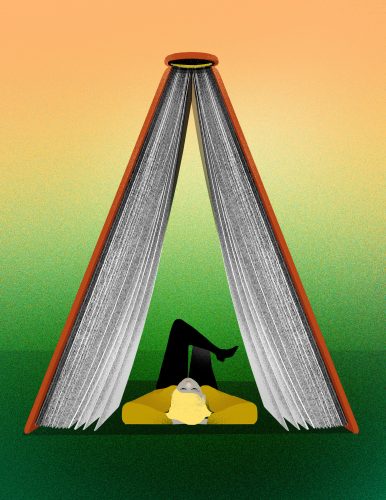
    An Illustration of a person laying on the ground with legs crossed. A large book acts as a tent to seclude the person.

    Illustration by Brian Stauffer

    Kagan and his colleagues observed toddlers’ reactions to a variety of stimulants, including encounters with unfamiliar toys, interactions with female strangers, exposure to a large, odd-looking robot and separation from their mothers. 

    Subsequent studies reassessed these children, exposing them to novel situations. At 6 years old, children who had exhibited behavioral inhibitions as toddlers showed greater physiological responses, including salivary cortisol levels, muscle tension, heart rate and pupillary dilation, than those of children who had been categorized as uninhibited when presented with new stimuli.

    Researchers concluded that the threshold for activation of the endocrine system might be lower for inhibited children than for uninhibited children, creating different physiologic responses. These reactions may help explain why some people gravitate toward calmer environments.

    “The research shows that we have a predisposition to act a certain way. We’re either shy and quiet or we’re outgoing and sociable and need that chaos,” Cox said. Someone who rates highly on introversion, for example, might have a satisfactory level of stimulation by working alone in an art studio, while someone who ranks highly on extroversion might experience that same level of satisfaction from the stimulation of a loud group event. The physiological responses are similar while the stimuli can be wildly different.

    Workplace Dynamics

    People whose preferred level of stimulus aligns with a more introverted style can find themselves in an uphill battle in a Western culture of personality. In school or in the workplace, for example, outgoing, gregarious, quick-witted personalities can be seen as more competent than people who focus on quietly listening in group settings and pausing to think and make decisions. 

    “Some argue it’s a Western ideal, one that is not as prevalent in collectivist cultures,” Cox said.

    “Extroverts tend to tackle assignments quickly. They seize the day; they just do it. They make fast decisions and are comfortable multitasking and risk-taking. The downside is that their decisions can be rash; they sometimes leap before they look,” Cain wrote. Introverts, on the other hand, work more slowly and deliberately, focusing on one task at a time.

    “To sit and think and go through something carefully … it’s kind of hard to separate my personality traits from my introversion,” Yost said. For example, she prefers to gather all the information required before beginning to write a document, researching the topic at hand before creating her position. “I’ll try to hit all the different resources and not leave anything unturned, which takes time.” 

    Her introversion draws Yost’s colleagues to her when they need proofreading because “they know I’m meticulous,” she said. Former co-workers “gave me a T-shirt that said, ‘Does anal retentive have a hyphen in it?’ ”

    “The introvert on your team is picking up details and thinking quietly, going to a deeper level of analysis than an extroverted individual, who may be doing something more superficial.”
    Cathy Cox

    Putting Personalities to Work

    Cox said optimal work teams contain a balance of introverts and extroverts. “The introvert on your team is picking up details and thinking quietly, going to a deeper level of analysis than an extroverted individual, who may be doing something more superficial.” 

    Introverts tend to think more independently and are less swayed by others’ perspectives, she said. “To get a full gamut of perspectives, you want an integration of the two.”

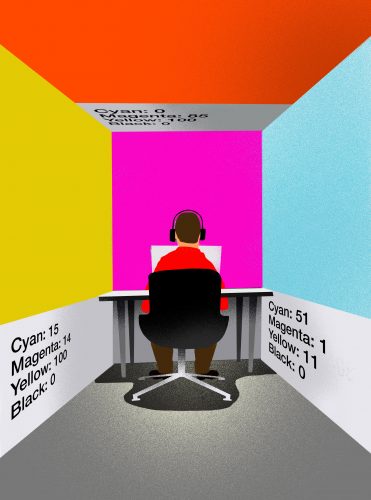
    An illustration of a person sitting at a desk with headphones on. Pantone color blocks over the walls around them.

    Illustration by Brian Stauffer

    Mar said he is a “sit back and see” person who is able to fill a variety of roles on a team based on what he observes is needed. He also emphasized the role that listening plays in group dynamics. “Listening is the key to communication, and that’s what graphic design is about: communication. The better listener you are, the better communicator you’ll be.”

    Introverts like to think before they speak, Cain wrote. “Sometimes they feel frustrated by meetings happening very quickly and in what can feel to them an unconsidered way. Extroverts, on the other hand, can feel understandably frustrated when introverts are taking so much time to think things through that they don’t share their ideas.”

    People who don’t speak up often in meetings can be misunderstood as disinterested or disengaged. “The truth is that large meetings are often not the best way to get the best of introverts’ brains,” Cain wrote, citing a study from the Kellogg School of Management that found in a typical meeting of six to eight people, three people do 70 percent of the talking. 

    “This is a very worrisome statistic for anyone who wants to make sure that the best ideas and decisions are coming to the fore. We need to rethink how we run our meetings — and how often we hold them.”

    Cox said leaders should not force an agenda that may not be in a teammate’s comfort zone. “We know that introverted people don’t want to be the center of attention, nor do they want to be put on the spot to make a speech,” she said. Seek them out individually for their feedback and give them the time they need. “They’re gathering facts and putting an argument together. … Give them time to process the information; it benefits them and their personality type.” 

    Neither introverts nor extroverts exist in a vacuum, Cain wrote. Working together, introverts and extroverts can benefit from each other’s strengths in a sort of yin and yang approach to collaboration. One example is that of Steve Wozniak and Steve Jobs. Noted introvert Wozniak, the engineer and computer programmer who invented the Apple computer, collaborated with Jobs, a gifted public speaker with extroverted tendencies, to create Apple Inc. to pioneer incredible technology and bring it to market. 

    Appropriate levels of workplace stimulation are important for everyone, Cox said. Yost has served in several roles during two different tenures at TCU, her current stint a 20-year-plus term. Mar is going on 30 years of service to the university. 

    “The numbers speak for themselves,” Mar said in describing his satisfaction with his role. “I think that says something not just about me but about the environment, too, and how I feel I’ve been valued here. I’m very grateful and very thankful.” 


    In Quiet, Susan Cain finds that we dramatically undervalue introverts and shows how much we lose in doing so. (Crown)

    In Quiet, Susan Cain finds that we dramatically undervalue introverts and shows how much we lose in doing so. (Crown, 2012)

    Creating an Introvert-Friendly Workplace

    Susan Cain, author of Quiet: The Power of Introverts in a World That Can’t Stop Talking, shared advice for creating an inclusive workplace for people whose personalities tend toward introversion:

    Apportion work time appropriately. “Introverts thrive with more quiet time, while extroverts need more participatory time.”

    Consider accolades. “When rewarding people for a job well done, think about their personality style: An introvert may not relish a big dinner with the team. Instead, give them a day off to spend time as they please.”

    Plan your space. “Make sure to give people private office space or, if you use an open office plan, to include nooks and crannies throughout the office where people can be by themselves.”

    Mix up your processes. “When it comes to idea generation, use a hybrid process in which people do a significant part of their creative work on their own — and then come together to share what they’ve come up with. We all work and think better this way — extroverts included!”

    — Rachel Hedstrom


    Introvert or Extrovert?

    In the workplace, recognizing and honoring introverts’ and extroverts’ differences can help personalities work together with greater understanding.


    Introvert

    Extrovert

    Preference for solitude
    Outgoing
    Observe first and act later
    High energy
    Think better by themselves
    Talkative
    Draw energy from reflection
    Draw energy from other people
    Calm
    Enthusiastic
    Seek calm environments
    Seek new experiences

    — Amanda Vasquez 

  3. Chancellor: TCU Invests in Health Care Innovation

    Leave a Comment

    This TCU Magazine is filled with stories illustrating medical innovation — many about Horned Frogs working together to advance medical science. Our cover story features former professional boxer and Fort Worth native Paulie Ayala. He teamed with faculty at the Harris College of Nursing & Health Sciences to help Parkinson’s patients fight the good fight and combat the progression of the disease. Students are also participating in this research to prove how exercise translates into real hope for the Parkinson’s population.

    These are significant times for the TCU School of Medicine. Early in the pandemic, the school sought FDA approval to test a drug that might halt severe Covid infections. The school’s academic chair of internal medicine, Mohanakrishnan Sathyamoorthy (“Dr. Mo”), enlisted transplant physician Dr. Stevan Gonzalez and medical school dean Dr. Stuart D. Flynn in the Fort Worth Clinical Sciences Working Group. Within the year, they received approval to conduct trials to help save people from the cytokine storms that turn Covid deadly. Like many other initiatives at TCU, the project also presents research opportunities for our medical students. Click to read the story.

    Construction will begin this year on a four-story, approximately 100,000-square-foot building at the northeast corner of South Henderson and West Rosedale streets. The building will be the academic hub for 240 medical students and hundreds of faculty and staff.

    Construction will begin this year on a four-story, approximately 100,000-square-foot building at the northeast corner of South Henderson and West Rosedale streets. The building will be the academic hub for 240 medical students and hundreds of faculty and staff. Courtesy of TCU Marketing & Communication

    Our medical school will continue to positively impact the Fort Worth area, and soon this presence will become a physical one. TCU’s new medical campus will be in the heart of the city’s medical district — an exciting development in the history of the University. TCU’s strategic campus expansion will enhance both the success of our students and the health of our community.

    The TCU School of Medicine has already inspired so many, including Arnie Gachman ’64, who along with his great wife, Harriette, has made supporting the school a passion project. The grandson of Ukrainian immigrants, Arnie exudes spirit and generosity; take a glimpse into his life story here.

    Our medical school’s mission is to transform health care by creating Empathetic Scholars®. As our world becomes smarter, it is important that we also seek ways to be kinder. Please read about the work of AddRan professor Jeannine Gailey here. Her research encourages people to respect human dignity and look beyond body types.

    As each page of this TCU Magazine illustrates, the efforts of talented and passionate Horned Frogs make a profound difference in people’s lives.

    I think the world would agree. Lead On, and Go Frogs!