
Horned Frogs Abroad: Jack Diehl in Dublin
A TCU senior gets a close look at European politics while studying in Ireland.
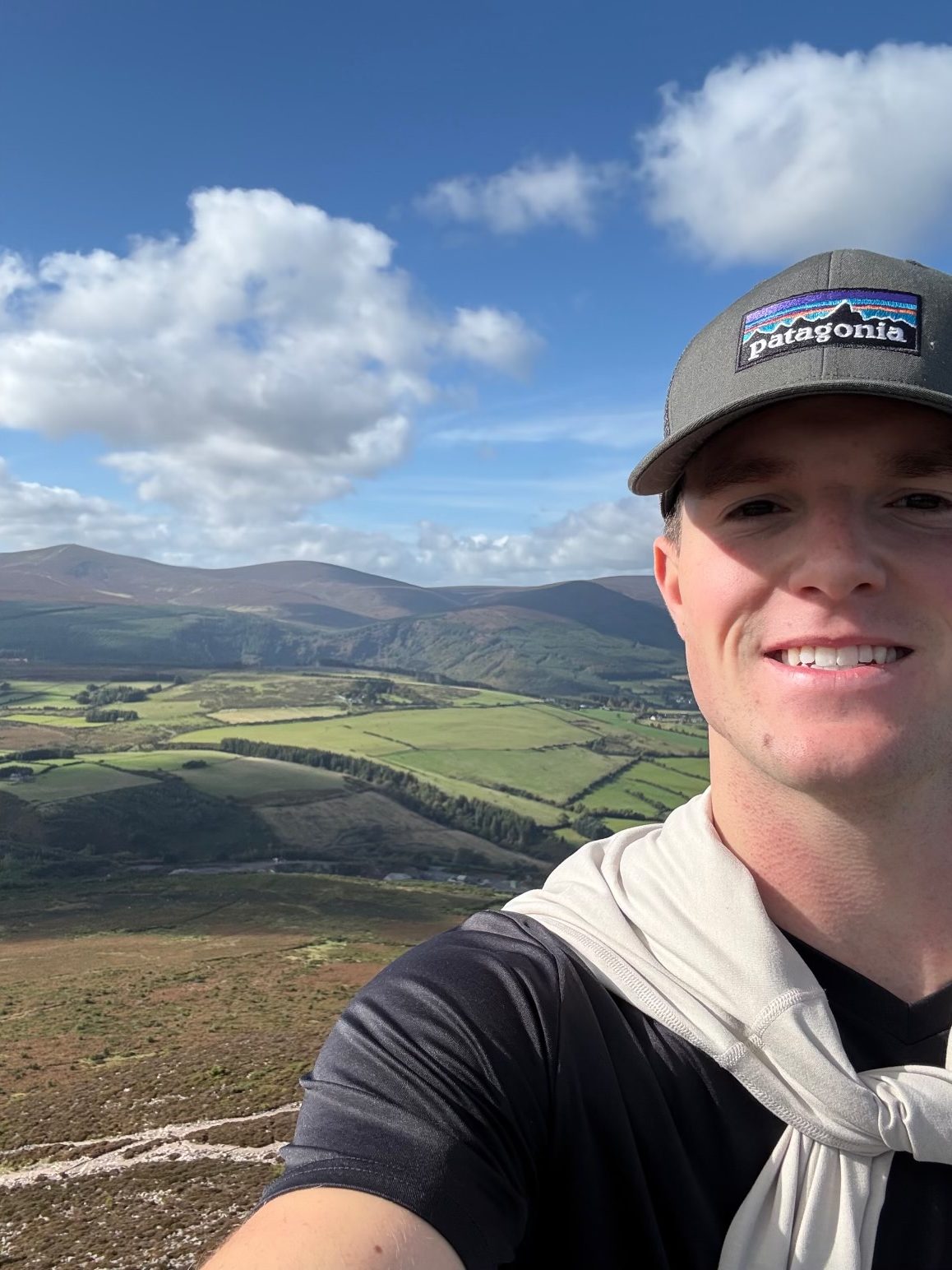
“There’s so much more to Ireland than Dublin,” says Jack Diehl, a political science major who has traveled to Cork, Galway, Wicklow and Bray. Courtesy of Jack Diehl
Horned Frogs Abroad: Jack Diehl in Dublin
A TCU senior gets a close look at European politics while studying in Ireland.
In this series, TCU Magazine visits with students who are studying abroad. Send recommendations to tcumagazine@tcu.edu.
Jack Diehl, a senior political science major from Anoka, Minnesota, is spending the semester studying at University College Dublin in Ireland. His coursework focuses on European politics and international relations, with classes including Northern Ireland Politics, European Union Foreign Policy and International Money and Banking. Diehl arrived in Dublin in late August, shortly before the Horned Frogs faced North Carolina there in the Aer Lingus College Football Classic.
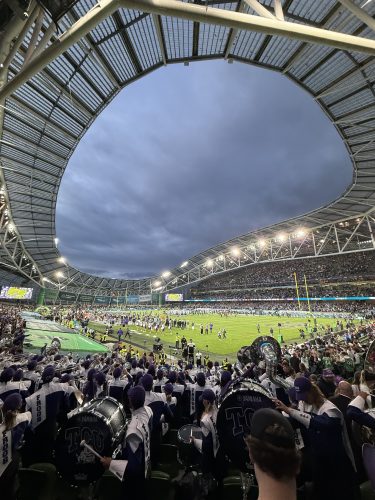
Diehl arrived in Dublin shortly before TCU faced North Carolina at Aviva Stadium in the 2026 Aer Lingus College Football Classic. Courtesy of Jack Diehl
What specifically made you interested in Dublin for your study abroad?
I was looking mainly at the colleges themselves and access to the rest of Europe. I stumbled upon Dublin, and I’m at University College Dublin, which is in the top 100 in the world. I had also never been to Ireland, so it seemed like a cool country to explore. The culture was interesting to me and still is.
How did your political science background influence your decision to study in Ireland?
Ireland is a member of the European Union, and I wanted to learn more about the EU as an actor. There’s a lot of interesting political history with Ireland and Northern Ireland specifically. The politics are super divided for societal reasons, religion especially. It is a dynamic that you don’t necessarily see in the United States. I’ve also been able to take classes that treat economics from a totally different perspective as a part of the EU. I’m taking an international money and banking class, which feels more international here since I’m not just hearing things that I’ve already heard about the United States.
How do your classes in Ireland compare to your political science courses at TCU?
They are completely different, and that was probably the biggest shock of coming and doing school here. I only have five total class meetings a week for four different classes. Most of them are one meeting a week for two hours. In one of my classes, 100% of the grade rides on a test at the end. In another, 95% of the grade rides on the final. You do the majority of the studying on your own, and it is very reading-heavy. I also have two classes that are organized in eight-person table groups. We spend half the class listening to a lecture and the second half discussing with our group or working on group projects.
Have you had any opportunities to study Irish politics, history or government firsthand?
I’m taking a Northern Ireland politics class, which is hyper-specific to a small part of the U.K. that shares the island with the Republic of Ireland. There are still political tensions there. The professor said she had people come up to her after the first lecture saying she was wrong and should lose her job for saying “Northern Ireland” to begin with, since some people don’t acknowledge it as a different country. They will just refer to it as the north of Ireland. I’ve also been taking an EU foreign policy class, which is very applicable while being in a member state of the EU. It means a lot to the people who live here, and I’m surrounded by them. I get to see a perspective of somebody who is within the jurisdiction of the EU.
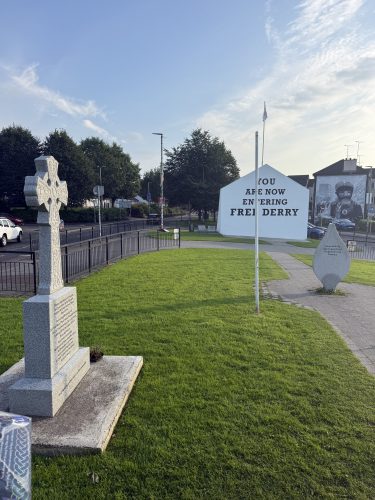
Murals mark the city’s history of conflict at Free Derry Corner in Derry, also known as Londonderry. Courtesy of Jack Diehl
Have you visited any historical landmarks or politically significant sites? What did you learn from those experiences?
Right when I got here, I traveled as much as I could around Ireland, because my parents had rented a car. We went to Northern Ireland and saw Belfast and Derry, also known as Londonderry. That’s also very divisive. If you call it Londonderry, many people will get upset. We saw the murals and the streets where car bombings and protests happened. I could see the long-lasting ramifications of areas where there was conflict.
Have you traveled anywhere outside of Dublin? Where have you gone, and what stood out to you in those places?
I’ve done a bunch of travel. I’ve been to Cork, which is on the southwest coast of the island. I’ve been to Galway, which is on the west coast, twice. I’ve also traveled to a couple of small towns called Wicklow and Bray. These quieter towns are less tourist-trapped than bustling cities, and it’s been fun to engage with and observe the locals there. The Irish are all super friendly, especially the older people. They’ll have a conversation with you in a grocery store over absolutely nothing.
What advice would you give another student considering studying abroad in Dublin?
Do it. Ireland is extremely underrated. When you think of Ireland, you think of Dublin, Guinness, pubs — all the standard Irish things. But there’s so much more to Ireland than Dublin. It’s also very easy to travel around. You can take a bus to pretty much anywhere or take the train and go see a city that’s completely different. The hiking is beautiful. The nature is amazing. The temperature’s phenomenal, and the people are really great. Be down for doing anything, because you’re gonna have these random experiences that you’ll never have again.
Editor’s Note: The questions and answers have been edited for length and clarity.
Your comments are welcome
Comments
Related reading:
Horned Frogs Abroad: Kierstyn Wright in Buenos Aires
A TCU student finds the Argentine capital to be an underrated study abroad spot.
Features
Infographic: Minors
A wide variety of minors gives TCU students the chance to add depth to their majors or dive into new areas.
Features
Government of the People
Democracy demands the participation of its citizens.