

TCU's research culture is designed to move fast while staying student-centered and impact-focused. Illustration by Keshia | Adobe Stock
Startup Speed, Academic Soul
Reuben F. Burch V is crafting a research culture at TCU that moves fast, stays student-centered and delivers real-world impact.
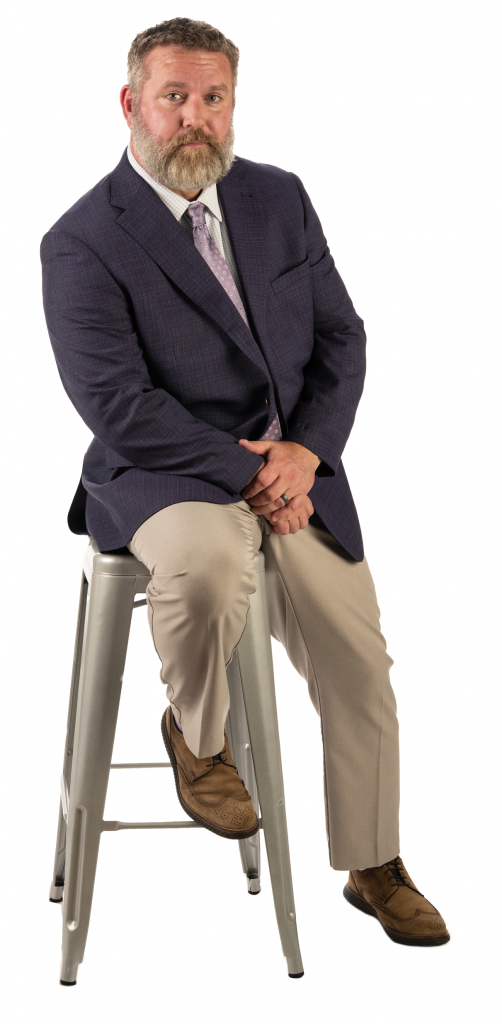
Reuben Burch aims to create a research culture at TCU that’s fast, student-centered and solves real-world problems: “Without the students, we lose our purpose for why we’re here doing what we do.” Photo by Glen E. Ellman
REUBEN F. BURCH V joined TCU in 2025 as vice provost for research, stepping into a pivotal leadership role just as the university finds its rhythm on a national stage and begins tuning up for R1 status, the highest research classification in American higher education.
A computer engineer and an industrial engineer by training, he brings a distinctive blend of academic, industry, political and entrepreneurial experience.
Burch learned the engineering ropes at Mississippi State University, where he was a member of the football team. His career path then zigzagged from virtual reality hardware and software design and U.S. Navy weapons and radar training development to NASA satellite geospacial data management, financial systems software architecture, breakthrough solutions for logistics giants and wearable tech startups.
He returned to his alma mater as an engineering professor, founding the Athlete Engineering Institute, a first-of-its-kind center that unites engineers, athletes, strength coaches, athletic trainers and business leaders to safely push the boundaries of human performance.
That institute, which began as a modest pilot project, grew into a $46 million research enterprise. It produced patents (including smart socks), peer-reviewed publications and deep partnerships with the U.S. military, national sports leagues including the NFL and global manufacturers.
Most recently, he served as associate vice president for research at Mississippi State.
At the center of Burch’s plan for TCU is a conviction that research should move the needle by solving real problems, improving lives and bringing students into the process from Day 1.
“Without the students, we lose our purpose for why we’re here doing what we do,” he said. That belief is already shaping his early efforts, from expanding support for doctoral students and postdocs to widening the on-ramp for undergraduates to join the research journey.
His vision is a research culture that’s outward facing and collaborative. He talks about research moving at two speeds: the long arc of faculty-led discovery and the faster tempo of team-based work that responds to real-time questions from industry, national agencies or community partners.
“He has terrific ideas for process improvements and streamlining our operations and is a great communicator and advocate for our faculty and staff,” said Floyd L. Wormley Jr., TCU’s provost and vice chancellor for academic affairs. “I am extremely optimistic and excited to work alongside him.”
Burch’s leadership style favors clarity, trust and direction. “It’s easier for people to be bought in,” he said, “if they know where we’re going.”
He plans to be an empowering presence, not a commander. “A true research office is a service center,” he said. “Faculty need support and resources to pursue their vision, not someone micromanaging their work.”
Burch wants the university’s research culture to reflect its ethos: personal connection, creative thinking and a shared commitment to the greater good.
“We’re not re-creating old models,” he said. “We’re building something new, with process optimization and human care at the core.”
Burch discussed his vision for a 21st-century R1 university with Endeavors. Here are excerpts from that conversation.
How do you envision TCU achieving R1 distinction?
A modern, sustainable R1 is multimodal, operating at two speeds. Most academic research falls in the fundamental category — it takes time to develop world-changing ideas. But funding increasingly comes from diverse sources beyond national agencies, and even federal agencies now seek more urgent results, similar to private and industry funding.
Faculty need to keep generating big ideas, but we need people to help execute those ideas with greater speed, almost like a startup.
We’re creating an office of research development to identify who aligns best with proposal calls, alert them to the opportunity and then provide resources, templates and advice.
While TCU moves toward R1 status, what are the most impactful next steps to grow research funding?
Many opportunities don’t require money; it’s a mindset and cultural shift. We need to help people connect with existing resources. There are immediate opportunities for almost everyone on campus. We just need people to know about them.
We can’t focus solely on national agency proposals. We can partner with private industry and local, state and national political figures. Bigger funding often comes from relationships: If you’ve demonstrated good work, people want to fund you and see what you do with it. Well-respected researchers can become extremely well-funded while writing fewer proposals.
What’s the difference between research and development?
Coming from industry, R&D were synonymous. In academia, a faculty member explained after I’d first moved to higher education: “What you did for 14 years was development. Here at an R1 university, you’ll do research.” Research identifies paths to end results; development gets you there. Both are important sides of the same coin and what national funding agencies are expecting.
TCU already leads significant development work that may lack research components. Likewise, some researchers bring ideas far forward without building final products. There’s leadership training value in understanding where you fit in that pipeline, and all skills are needed.
What role will artificial intelligence play in this vision?
We need to focus on four areas while governing AI direction: First, AI use in classrooms. Faculty must help determine boundaries. Research shows people who are overly reliant on AI experience cognitive decline within six months, with prefrontal cortex changes affecting creative thought.
Second, faculty who use AI in research, and third, faculty who research AI. These are completely different things. Lastly, ethics in AI is a natural fit for the skills at TCU. How to use AI is one discussion and how you should use AI is another.
We can distinguish ourselves by demonstrating that we recognize these four areas’ importance and involving faculty in governing resource use.
How will the Burnett School of Medicine at TCU factor into interdisciplinary research?
The medical school is a catalyst. Every college can partner with it. Being new, they’re open to partnerships.
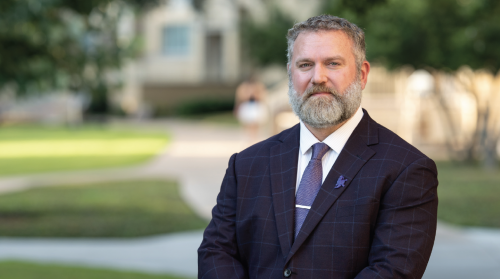
Reuben Burch joined TCU in 2025 as vice provost for research after building a $46 million research institute at Mississippi State University.
Tell us about the Athlete Engineering Institute at Mississippi State.
Initially a merger between engineering and sports teams, combining engineers who build solutions with kinesiologists who understand human body problems, we added textiles, fashion design, sociology, marketing and communication scholars. Textiles were critical; inventing sensors took six months but putting them in fabric took five years.
The institute blended human factors, human performance, technology and data science. We supported not just sports athletes, but industrial, tactical and at-risk athletes. Starting with $2,500, we reached $46 million over eight years, producing about 100 papers and 50 patents.
You hold 49 patents, all of which were awarded while you were at Mississippi state. Which are you most proud of?
My first because you always remember your first patent. We helped FedEx design its current-generation courier Power Pad (a mobile device drivers use to log package delivery information in real time), creating the next generation device, a potential wearable to replace it for truly hands-free operation.
Another was my first developed with students — essentially a smart sock capturing motion at foot and ankle joints, which strength coaches identified as most important for training and sports activities.
What’s your philosophy on academic-industry collaboration?
Having been on the industry side when academics reached out, I know industry needs to understand how academia works and vice versa. There’s a real person behind every project who expects value from partnerships, and this is an important truth for any faculty or student wanting to work with industry.
We can start by asking industry to help design class projects at no cost, building relationships while understanding their culture. We can communicate our desire to partner, be a good steward of our resources, and ask for consideration when opportunities arise.
What’s the role of arts, humanities and creative scholarship in your research vision?
While some people may think of mostly STEM topics for proposals, other disciplines add the human element. Communication, business, fashion design, marketing and branding make engineering inventions usable by humans. Sometimes people forget that STEM people are creative, and creative people do research. History is the biggest predictor of the future, and a strong background in reading and language is the platform upon which STEM disciplines are built.
Editor’s Note: The questions and answers have been edited for length and clarity.
Your comments are welcome
Comments
Related reading:
Features
As TCU Provost, Floyd Wormley Jr. Leads with Heart, Humor and Hard-Won Wisdom
The academic leader brings clarity, conviction and a scientist’s curiosity shaped by years spent balancing lab work, mentoring and a growing call to serve in higher education.
Features, Research + Discovery
TCU’s Graduate Students Explore New Topics Through Research
These students are improving the world by reaching beyond the boundaries of knowledge.
Research + Discovery
How AI Deepfakes and Bias Threaten Elections, Health Care and Public Trust
TCU researchers expose how artificial intelligence is spreading political misinformation, worsening medical disparities and eroding confidence in institutions.