
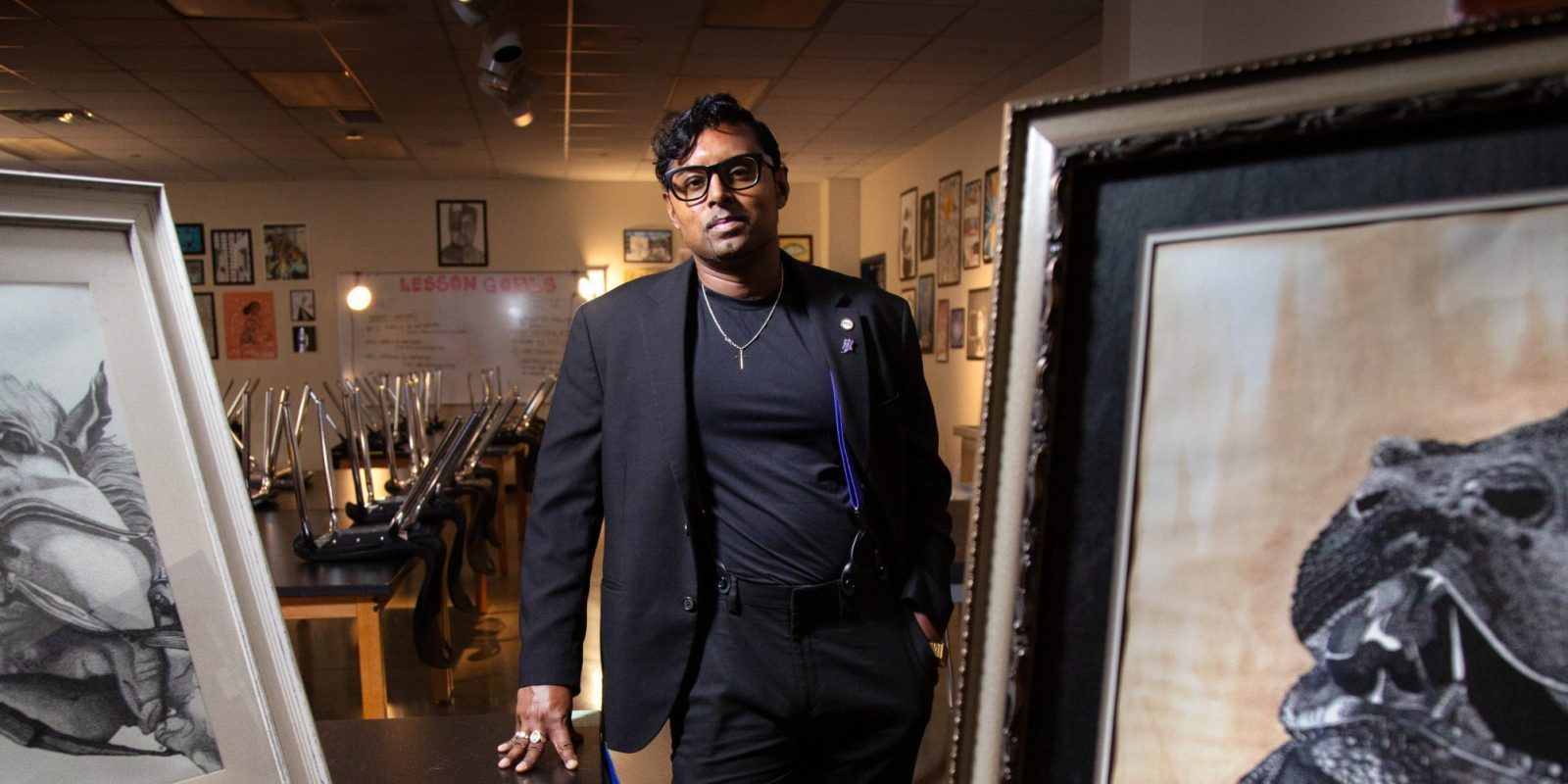
As an Advanced Placement art teacher at Fort Worth’s Boswell High School, Dhananjaya “DJ” Perera takes risks and urges his students to do the same, exposing them to traditional and new media forms. Photo by Joyce Marshall
DJ Perera Leads Students on the Digital Frontier Where Art Meets AI
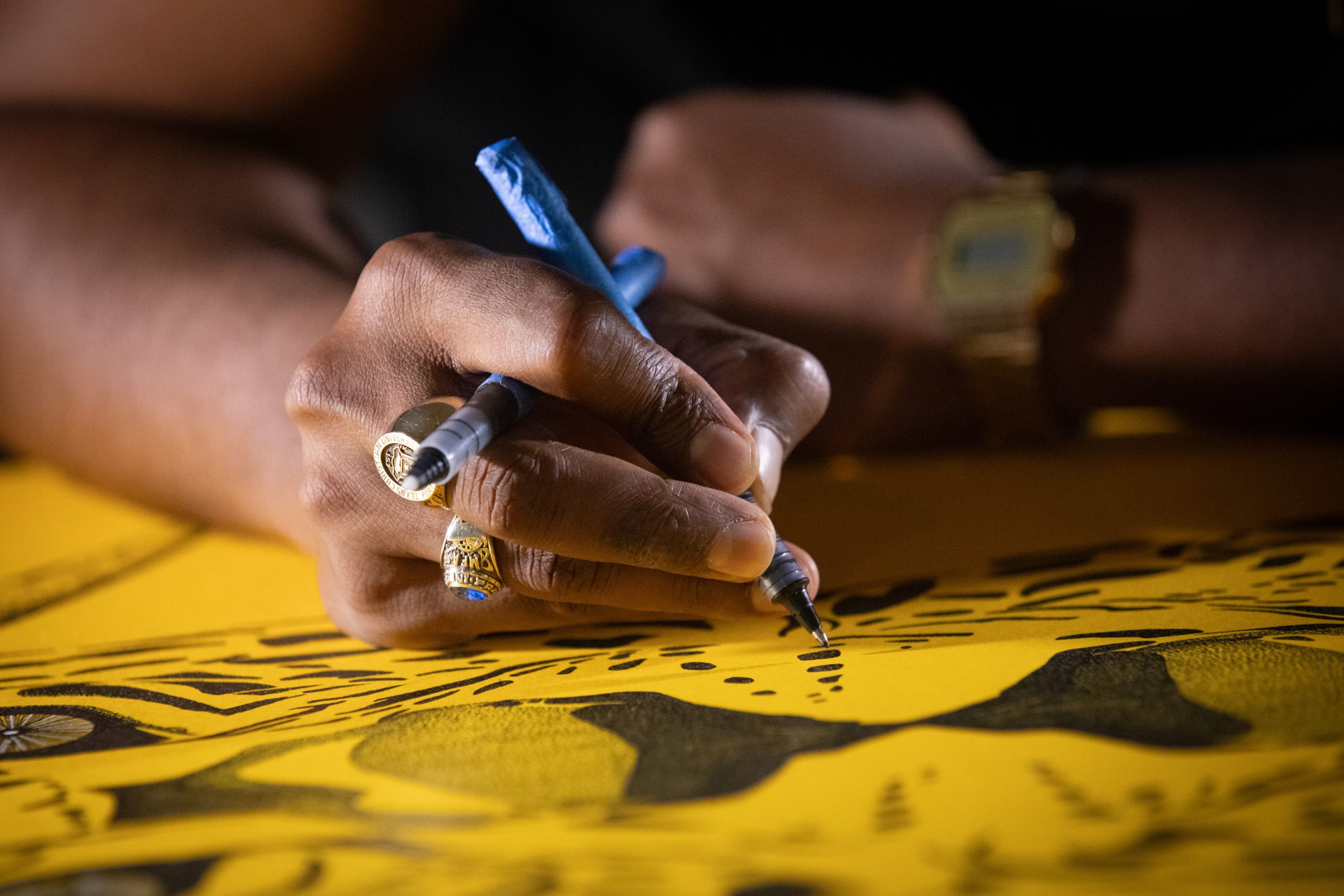
At first glance, the portrait of a white horned frog on black paper is striking. But look more closely, and a sea of white ink dots and hidden text emerges, making the work truly awe-inspiring. Created by artist Dhananjaya “DJ” Perera ’10, “140 Hours,” displayed in TCU’s Moudy North building, is a deliberate inversion of the more common black ink on white paper.
He created the piece, named for the 140 painstaking hours it took to complete, for TCU — at the request of Amy Tully, the Teresa Ann Carter King dean of the College of Fine Arts.
In addition to being an artist, Perera is an educator, mentor and founder of a program for young artists, which led him to curate Fort Worth’s first youth art and AI exhibition. Across each of these roles, he has pushed creative boundaries and encouraged others to do the same.
“For me, that’s the whole point,” he said. “Is what you’re doing unique? Is it going to stimulate dialogue?”
“For me, that’s the whole point. Is what you’re doing unique? Is it going to stimulate dialogue?”
Dhananjaya “DJ” Perera
JOURNEY TO TCU
Born and raised in Qatar but of Sri Lankan descent, Perera chose a path that he said is rarely encouraged in South Asian culture — pursuing fine arts over STEM.
His journey to TCU started with a Google search. Perera said that his mother was drawn to the word “Christian” in the university’s name — and that earning an American degree, for students having grown up outside the United States, carries prestige and is a source of pride. His path to TCU seemed predestined.
Perera became the first Sri Lankan to earn a Bachelor of Fine Arts in studio art at TCU, as well as the first to receive a Master of Fine Arts in painting and drawing from Pratt Institute in New York.
A moment of “divine intervention,” Perera said, came when he invited the Sri Lankan ambassador to his graduate thesis show. The connection led Perera to briefly serve as a national adviser to the United Nations, covering sessions of the General Assembly and Security Council and preparing reports on matters relevant to the Sri Lankan government.
“These experiences are networking lessons that no one can teach you,” Perera said. “It starts with education. It starts with how you project yourself, how you communicate.”
ART IN THE DIGITAL AGE
“140 Hours” is the second work of Perera’s to be displayed at TCU. In 2021, after an interview on NPR boosted his career, Perera donated “117 Hours” — a similarly detailed depiction of a peacock — to the Mary Couts Burnett Library in gratitude for the role TCU had played in his successful artistic journey.
Both pieces are part of Perera’s ongoing 19-part series — a number inspired by the year 2019, when the project began — that explores the tension between artificial intelligence and human intelligence. Through painstakingly rendered depictions of wildlife, Perera challenges viewers to reflect on the patience and dedication behind human-made art in an increasingly digital age.
While grounded in traditional techniques like stippling, Perera also embraces emerging media and encourages the next generation of artists to do the same.
He founded the New Arts Media New Arts Learning program, better known as NAMNAL, which connects high school students with tools like augmented reality, laser engraving, projection mapping and artificial intelligence.
The program collaborated with institutions including TCU’s College of Fine Arts, the University of Texas at Dallas’ Harry W. Bass Jr. School of Arts, Humanities and Technology and the University of Texas at Dallas’ ArtSciLab, which shared their new media technology. The students’ work culminated in Fort Worth’s first art and AI exhibition featuring young artists, hosted by the Pool Near Southside Artspace in 2025.
DJ Perera’s intricate pen-and-ink drawings, two of which are part of TCU’s permanent collection, explore the tension between artificial and human intelligence. Photo by Joyce Marshall
With Perera’s guidance and passion, students don’t just build exceptional résumé entries — they become engaged in Fort Worth’s art ecosystem while being part of art history.
“I’m trying to collect and preserve these artworks from teenagers,” Perera said. “They’re younger than me, but their artworks are, dare I say, more valuable than mine because this goes beyond anything we’ve seen before.”
So far, Perera said, the NAMNAL program has helped students earn acceptance letters to Pratt Institute, the School of the Art Institute of Chicago and the Rhode Island School of Design.
“DJ is a very student-centered educator,” Tully said. “I think what stands out to me most is his commitment to exposing his students to both traditional and nontraditional forms of art and being curious to experiment with new media and AI, which are changing as quickly as we can learn about them.”
LEADING BY EXAMPLE
In his role as an Advanced Placement art teacher at Fort Worth’s Boswell High School, Perera brings a hands-on, culturally immersive approach to the classroom. He encourages students to look beyond the screen by offering extra credit for attending art exhibitions, helping them build cultural awareness through real-world experiences.
His teaching philosophy emphasizes STEAM (science, technology, engineering, art and mathematics) education as well as entrepreneurship and practical application. That same mindset led him to co-found Bos Gentlemen, a character-building initiative for boys at Boswell that Perera said instills the values of “charity, community, civility and courtesy.”
Students in the program participate in leadership events, meet with local executives and civic leaders — such as Fort Worth Mayor Mattie Parker and council member Michael Crain — and donate out of their own pockets to charitable causes. At the end of the program, juniors and seniors attend a formal dinner, and seniors receive two-piece suits to mark their growth and professionalism.
“It follows this principle of: ‘OK, you have done for the community — now the community will do for you,’ ” Perera said.
Gaining recognition for his role with Bos Gentlemen led Perera to join TCU’s JPMorgan Chase Inclusive Excellence Mentoring Program. While the program is focused on business and professional development, Perera brings a unique perspective, emphasizing the importance of soft skills like communication, community engagement, intuition, innovation and personal presentation.
Lisa Whitin, a junior business information systems major, connected with Perera through the program.
“What makes Mr. Perera an exceptional mentor is his ability to listen and tailor his advice to each issue or lack of understanding I had in each situation,” Whitin said. “He doesn’t offer generic tips; he invests in understanding your specific journey.”
Perera reflected on a few values that have helped him succeed.
Be willing to take risks. Wisdom comes from experiences, and experiences come from you being willing to take risks. You have to milk every opportunity and not waste time.
Put effort into being successful. I say this to my mentees, and to both my students at the secondary level and at the tertiary level: Erase all false senses of entitlement and actually get out of your community, learn something from people that are different from you. How will you learn from those experiences?
Do not feed ignorance. This country, this society — they thrive on sensationalism. Where is the reality? There is a world that is going on elsewhere, and you have to edify yourself to contextualize everything; TCU allowed me to do that from the very beginning.
Time waits on no one. Time is of the essence. What are you going to do with time and are you going to choose to waste it?
Edited for length and clarity.
Your comments are welcome
Comments
Related reading:
Features
Art Is Everywhere
TCU’s campus features works from its 1,200-piece permanent collection. We turn the spotlight on a few of them.
Alumni, Features
Impact Through Art
Creator and curator Christopher Blay’s work centers on the Black experience.
Features
Crystal Bridges exhibition gives Alejo Benedetti a chance to work with Annie Leibovitz
The 2023-24 exhibit, which included 20 new works, marked the legendary photographer’s first museum commission.