
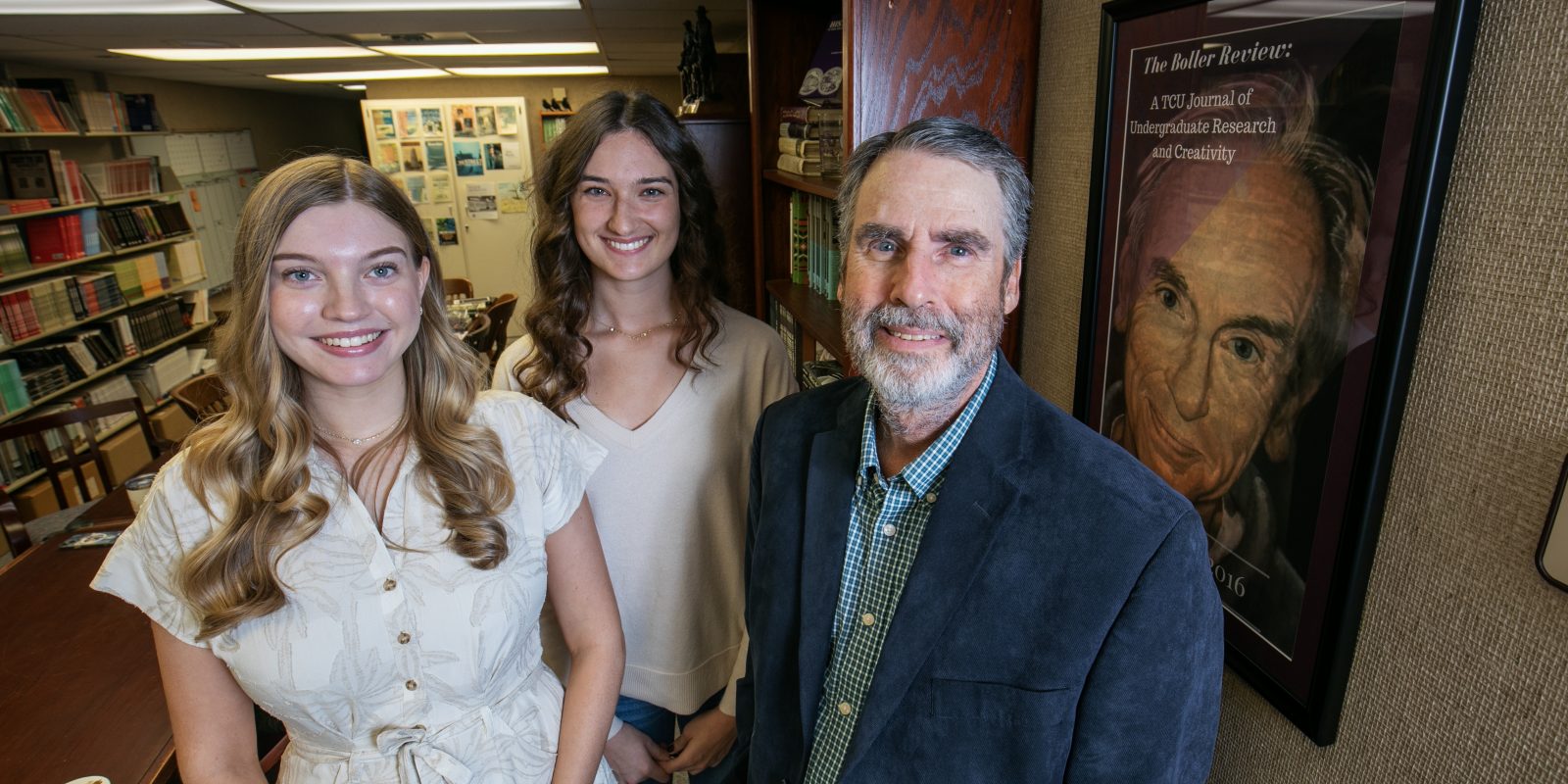
Former Boller Review editor Lexie Woodall, current editor Trinity Sloan and TCU Press director Dan Williams have expanded the journal's reach through a cover design contest and social media presence. Photo by Rodger Mallison
The Boller Review Showcases Undergraduate Research at TCU
For nearly a decade, TCU’s student-run research journal has published undergraduates studying everything from termite-inspired HVAC systems to vocabulary development in deaf children.
When Isabel Van Vleet began conducting research as a TCU speech-language pathology undergraduate, she didn’t expect it would lead to becoming a published author.
Van Vleet spent two years researching under the guidance of Emily Lund, a professor in the Davies School of Communication Sciences and Disorders. They explored how 4- to 7-year-olds connect words with concepts — known as lexical-semantic organization — comparing children with typical hearing to those who are deaf or hard of hearing.
Children who are deaf or hard of hearing develop their vocabularies more slowly, Van Vleet said, “but there wasn’t a ton of research on how and why it goes slower.”
Through summer camps conducted by Lund, the researchers found a clue: Children who are deaf or hard of hearing sometimes connect a word (like “dog”) in more thematic ways (“furry,” “tail”) while their peers with typical hearing connect the same word in categorical ways (“animal,” “pet”). The way a child organizes vocabulary can predict later language success.
As a senior, Van Vleet wrote up the study as her undergraduate thesis and presented it at the Harris College of Nursing & Health Sciences’ annual spring research fair in 2024. The Harris College nominated Van Vleet’s project for publication in The Boller Review, TCU’s undergraduate research journal; her article was published in volume 8.
“It was the first time where I was like, ‘Wait, I made something that will make an impact on health sciences and then more specifically speech pathology,’ ” Van Vleet said.
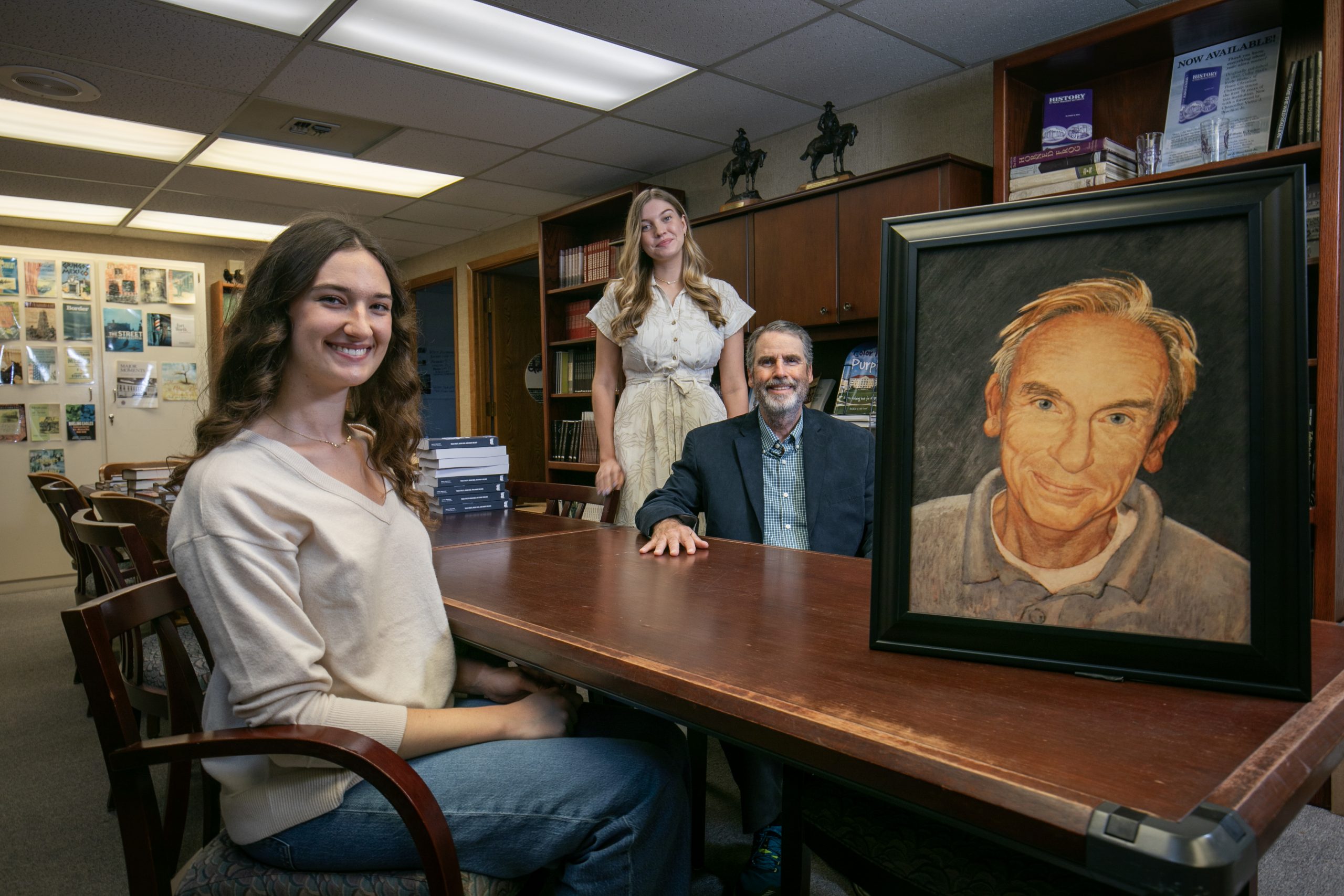
Paul F. Boller Jr., TCU’s inaugural Lyndon B. Johnson Chair of United States History, established the Boller Competition in 1982 and left a portion of his estate to TCU Press upon his death in 2014, funding the undergraduate research journal that bears his name. Photo by Rodger Mallison
A LEGACY OF RESEARCH
For nearly a decade, The Boller Review has provided students like Van Vleet the opportunity to publish and share their research. Named after the late Paul Boller, professor emeritus of history, the review is published online annually through TCU Press.
Boller, TCU’s inaugural Lyndon B. Johnson Chair of United States History, arrived on campus in 1976. Six years later, he established the ongoing Boller Competition, an undergraduate research competition conducted through the John V. Roach Honors College, in memory of his parents. He also published a memoir and a book of essays through TCU Press.
When Boller left a portion of his estate to the TCU Press upon his death in 2014, Dan Williams, honors professor of humanities and director of the press since 2010, proposed using the funding to create an academic journal, led by student editors, as a showcase for “the university’s best undergraduate research and creativity.”
Each spring, colleges nominate two outstanding projects for publication. A team of student editors then collects materials from nominees and lightly edits — a collaborative process that helps undergraduate researchers and editors see themselves as part of a scholarly community. The review’s first volume, published in 2016, featured 16 undergraduate research projects.
Volume 8, in which Van Vleet’s project appeared, also included research on building a sustainable HVAC system using the design of a Macrotermes natalensis termite mound, a study on the effect brand activism has on political polarization, and an institutional and historical look at microcredit as a culmination in economic theory.
Comments from faculty mentors accompany every project, highlighting a student’s growth as a researcher or sharing the impact their work could have on the field. Many projects also include a video interview with the student author.
“Not enough students and not enough professors really emphasize it’s not just the learning, but it’s reflecting back on the relevance of what you learned,” Williams said. “That’s an important part of The Boller Review.”
EVOLUTION OF THE REVIEW

Lexie Woodall created a cover design contest in 2023 to publicize The Boller Review and increase student involvement in the undergraduate research journal. Photo by Rodger Mallison
In 2023, Lexie Woodall, then serving as editor-in-chief of The Boller Review, came up with the idea for a cover design contest to help publicize the journal and increase student involvement. Woodall worked with Jan Ballard, senior instructor of design, to offer the contest through a design class.
Trinity Sloan, a senior writing and strategic communication double major who served as associate editor for volume 8 and is the current editor-in-chief, launched the review’s Instagram account, where she promotes journal content using clips from author interviews.
As the review’s 10th anniversary nears, its impact can be felt both on and off campus. Sarah Horning, one of The Boller Review’s first student editors, is now an instructor in the department of English and languages at Tarleton State University and the university’s dual enrollment program. She incorporates the review into her curriculum as an example of how student writing and research can affect others.
“There’s just a lot of opportunity for doubt to seep in for students. Like, ‘Why does this matter? Why is this important?’ ” Horning said. “And I’ve used The Boller Review as an example in my teaching often … because the work has real-world impacts and has real outcomes.”
Van Vleet, now a student in TCU’s speech-language pathology master’s program, has continued to work on her research project by coding previously gathered data and adding it to the existing data set. Her goal is to publish the entire study in a peer-reviewed journal.
After graduation, Van Vleet plans to pursue a clinical career as a speech-language pathologist.
“I feel like I never would have had opportunities to explore sharing research with others and then the opportunity to eventually get published without doing The Boller Review.”
Your comments are welcome
Comments
Related reading:
Features
Marcela Fuentes achieves a dream with successful release of ‘Malas’
Educator and author Marcela Fuentes spent more than a decade writing “Malas” before its 2024 publication.
Features
Catherine O’Connor finds acclaim with debut novel “Dust Covered Lies”
The landscape architect and TCU Press author picked up fiction writing in her mid-50s.