Menu

Author Archives: tcumagazine

  1. Q&A – Schieffer College dean Kris Bunton

    Leave a Comment

    In April, TCU appointed Kristie “Kris” Bunton dean of the Bob Schieffer College of Communication. She joined TCU in July, having been associate dean of the College of Arts and Sciences at the University of St. Thomas in St. Paul, Minn., where she founded the Communication and Journalism Department and its national award-winning online student news organization.


    What attracted you to TCU?

    I came to TCU because it’s a mission-driven private university preparing graduates to become morally responsible leaders who will serve the common good and because it insists that faculty be both teachers and scholars.

    After six months, what’s your assessment of the state of the college?

    Our college is poised for excellence. We are passionate about working with students. We want to excel. And we are ready for new directions.

    You’ve used the words “integrity, civility and tenacity” to describe core values of the college. Why those three words? How do they encompass what the college stands for?

    Those values derive from our namesake. For years, Bob Schieffer tenaciously asked hard questions of world leaders and key newsmakers. When he retired from “Face the Nation” last year, we heard politicians and newsmakers praise his civil manner in the divisive world of Washington and network journalism. Unlike Dan Rather and Brian Williams, Bob Schieffer was never yanked from the anchor’s chair for ethical mistakes. He produced fair and open-minded reporting on topics important to citizens. Those three ethical values – tenacity, civility and integrity – should be the hallmark of every student and professor in our college.​

    What’s ahead for the college?

    Our college must become indispensable inside TCU and nationally prominent outside it. To do that, we will ensure all our academic programs are equally rigorous and current, and we need to cultivate a vibrant presence outside the walls of our building, so we’ll be doing more community-based learning and outreach. We also must work to diversify the student and faculty populations in our college. And in light of TCU’s new medical school, we’ll attempt to build expertise in health-oriented communication.

    The journalism field continues to evolve rapidly, and some j-schools are seeing fluctuations in enrollment. Where do you see the future of journalism education?

    Actually, journalism education isn’t the only discipline in our college that faces rapid change. Think about how differently interpersonal and organizational communication, advertising, film, public relations and video production are all practiced today. For example, families celebrate holidays using Skype, while viewers watch sports highlights and TV series on mobile phones. That means our whole college has to be nimble as practices change. We have to constantly sprint with our students to stay abreast of change, but we also have to remember we’re training students to run a marathon. I don’t just want us to prepare students for their first jobs; I want us to help students learn how to learn and think critically for the rest of their lives. So teaching them to be good critical thinkers who are curious and persistent is as important as teaching them the latest video editing software.

    What kind of encouragement have you received from Bob Schieffer?

    I’m honored to call Bob my friend. His visits are special times for our students, with whom he always poses patiently for photos. He and I have had great fun visiting classes together. We think we’re a pretty good team on ethics and journalism.

    Ethics is your teaching and research area. What drew you to that subject?

    In my childhood, the radio’s morning agriculture and weather reports, the daily newspaper and my grandmother’s weekly column were sacred rituals. I fell in love with journalism through these channels, so my career choice was a no-brainer. But I quickly became more intrigued by the ethical questions raised by journalism than by being a journalist myself, not least because I felt unprepared to navigate ethical waters. I pursued graduate degrees so I could help fledgling journalists do better than I had in balancing ethical obligations for telling the truth, protecting privacy, debunking stereotypes and preventing harm. I’m glad to continue that work each spring by teaching a media ethics seminar.

    You are co-author of a book on the ethics of reality television. That genre is often not associated with principled thinking, and there’s not an abundance of scholarship on it. What might surprise people about your research?

    Some actions are unequivocally unethical. Plagiarism by journalists, for instance, is always stealing, and therefore not interesting to study. The media ethics questions I study are usually more complex than they first appear. It’s easy to dismiss reality TV as unethical. But I’ve found both ethical harms and goods in almost every form of mediated communication, including reality TV. It’s worth studying popular media entertainment because it constantly reflects, and sometimes challenges, our culture’s values and norms. Reality TV, for instance, should get some credit for presenting a wider array of diverse people than other entertainment forms have.

    How would you like to see students dig into ethical topics in the Schieffer College?

    The faculty own the curriculum, so they’ll ultimately decide what’s appropriate. However, I’ve encouraged them to consider a capstone ethics course that would join students from across our college for a unifying intellectual experience at the end of the bachelor’s degree. Training in ethical analysis reminds students of the fundamental purpose of communication: telling the human story in truthful, responsible ways. Who doesn’t want to teach and study that? Sign me up!
  2. TCU Swimming signs 8-year-old fighting tumor

    2 Comments

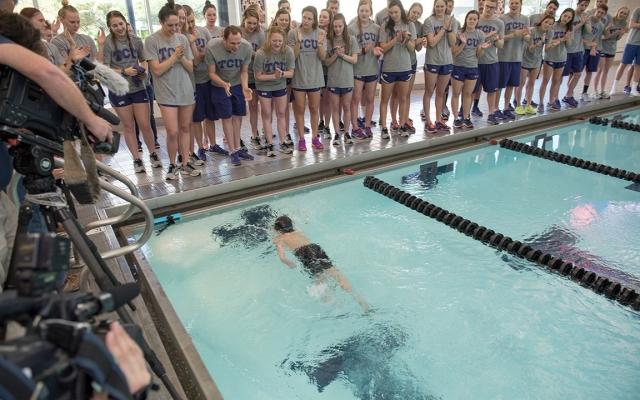
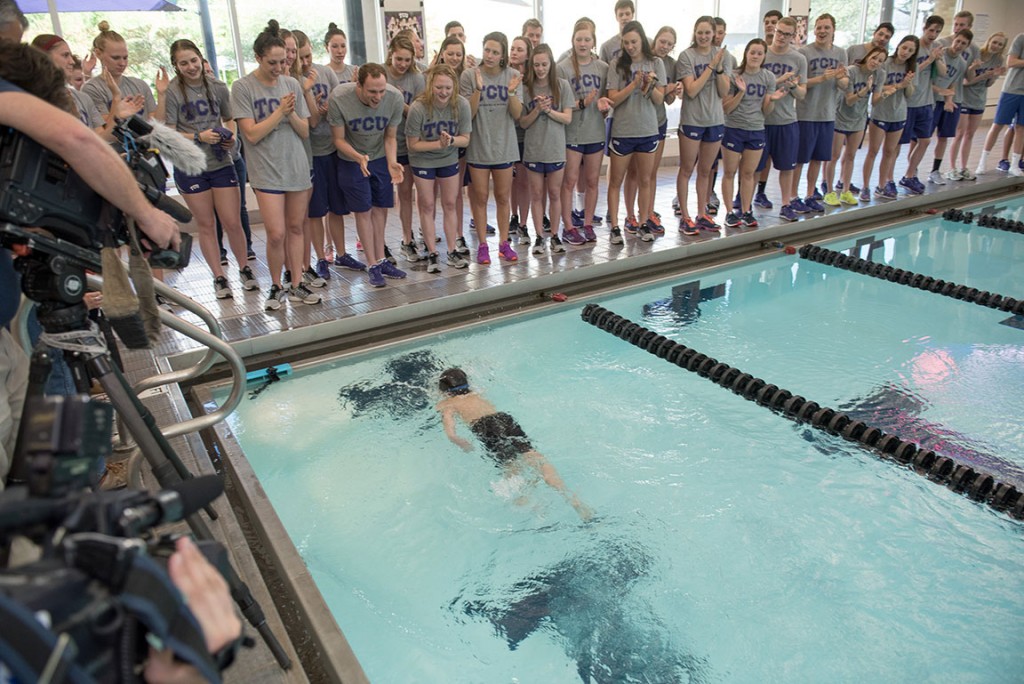
    Eight-year-old Nathan Lin couldn’t hear the TCU Swimming & Diving team cheering and, clapping and chanting his name until he pulled himself out of the water.

    It was his first lap as an official member of the squad.

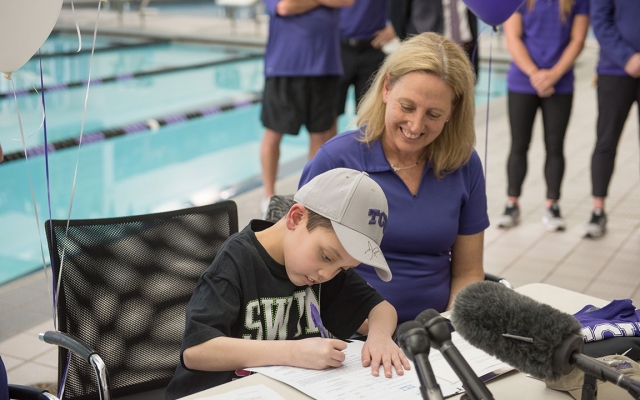
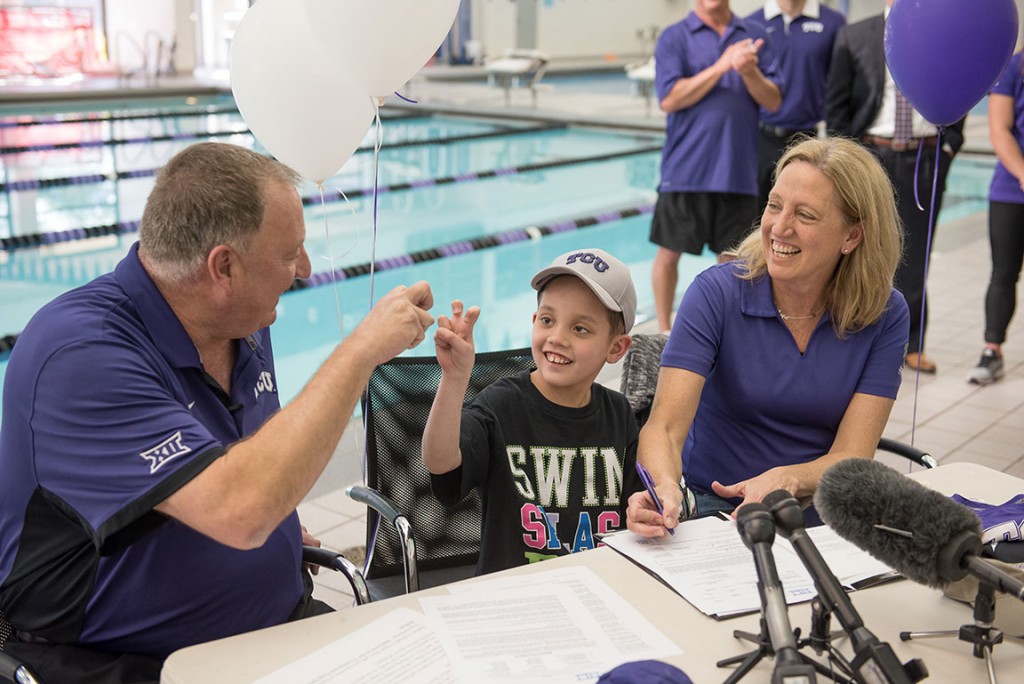
    On Wednesday, Lin signed a ceremonial national letter of intent at the University Recreation Center natatorium as part of his Make-A-Wish Foundation dream.

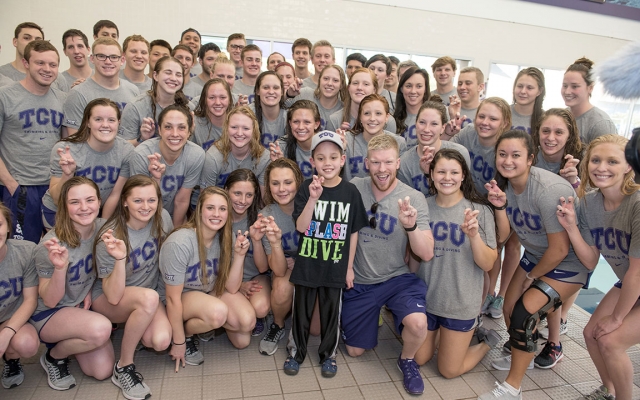
    The day included slapping high-fives, making frog hand signs, receiving a TCU shirt with his name on it and leading the team in cheers.

    Lin could summarize it all in one word: “Awesome.”

    Nathan4Lin is the son of former TCU swimmer Cathy Boyd Lin ’89, who learned last July that her youngest child had a brain tumor.
    Her former coach Richard Sybesma, who has guided the men’s and women’s programs since 1978, heard of what the Lin family was facing and reached out to them as Nathan began chemotherapy treatments.

    “One thing Cathy mentioned to me was how important the power of prayer was to them. They could feel that,” said Sybesma, who remembered his former swimmer as a hard worker, NCAA Championships participant and one-time school relay record holder. “That was a special thing to be able to tell the team. Pray for the family.”

    Led by Sybesma, TCU surrounded the Lins. In November, Nathan met his favorite Horned Frog football player Trevone Boykin, coach Gary Patterson and the team in November. In January, the 8-year-old, who attends Fort Worth All Saints’ Episcopal School half days, talked hoops with men’s basketball players Chauncey Collins and Malique Trent.

    “Nathan’s been a big TCU fan all his life,” his mother said yesterday after the signing. “He loves anything to do with TCU.”

    But with his mom a swimming letterman and his love of getting in the pool, Nathan was especially thrilled to join the H2O Frogs.

    Nathan5“Wait ’til I’m in college,” he told reporters.

    The team was honored to have him join their ranks and include them in his special signing ceremony, said butterfly and freestyle swimmer Cameron Rattray, a senior from Bridgewater, N.J.

    “We got to see the strength and determination he has as he’s battling,” said Rattray, a pre-med major who wants to pursue a career in pediatric oncology. “I think we lose sight of what’s important in life, which is health and family. So it means a lot to us to open the circle of our team family to Nathan. It makes us step back and think how blessed we are to be here.”

    Sybesma said he’s glad the team is appreciating lessons out of the pool as squad members embrace their newest teammate.

    “Our team, they learned a lot today — about life, about family, about teamwork. To see Nathan swim the length of the pool with the team cheering — special.”

    On the Web:
    TCU360 coverage
    NBC 5 coverage
    Fox 4 coverage
    Fort Worth Star-Telegram coverage

  3. Habitat inventions at Fort Worth Zoo

    Leave a Comment

    The Australian red kangaroo is noted for its intelligence and inquisitive nature. Whether in its native outback or at the Fort Worth Zoo, the curious marsupial is smart enough to know that it’s often too blazing hot to forage for food in the midday sun.

    Its natural instinct is to stretch out and relax until dinnertime.

    “For a zoo patron, that’s not very interesting,” said junior environmental science major Kat Findley of Colbert, Ga. “The kangaroo habitat is nice and large, and we wondered how the kangaroos might move around more, especially closer to the viewing area.”

    But the reddish-brown mammal with long, pointed ears and a squared-off muzzle does scavenge before dusk occasionally — if it can find enough shade, Findley learned along with fellow environmental science major Patrick Ryan and ceramics major Sydney Williams.

    Could they build a device that would rouse the roos’ natural instincts?

    Kat Finley TCU, Patrick Ryan TCU, Sydney Williams TCU

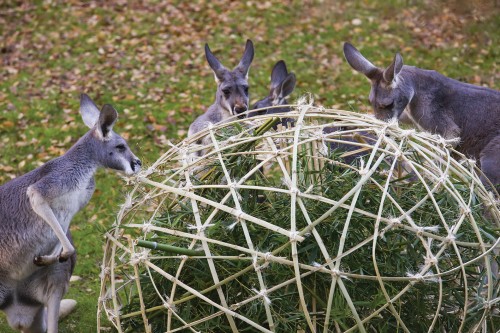
    The foraging simulator is a big hit with the zoo’s red kangaroos.

    That challenge was part of a new interdisciplinary course called Zoo Enrichment, developed in the fall by faculty members in two TCU colleges. Cameron Schoepp, associate professor of art, and Victoria (Tory) Bennett, assistant professor in the School of Geology, Energy & the Environment, designed and taught the class, dividing 15 graduate and undergraduate students into teams of three to study and observe species behavior before devising an object or structure to coax out instinctive behaviors and boost activity in the habitat.

    Biology and environmental science students led the research effort, while art majors, ranging from painting to sculpture to art education, guided the concepting and design. By the midpoint of the semester, each team had to create a model of its idea and present it to zoo administration and animal caregivers for approval. 

    Placing diversions in animal exhibits is a familiar enrichment tactic at the Fort Worth Zoo, said Jenny Elston, curator of conservation and behavior. Past efforts have included balls and toys or hiding food and treats in ice.

    The TCU student teams were asked to build on that.

    At a zoo site visit, the red kangaroo team noted bamboo decor around the marsupial exhibit. Yet the Australian mammal doesn’t eat bamboo, instead preferring underbrush and other bushes.

    But it gave the group an idea. “Bamboo is flexible and strong, so we thought it might be a good material to work with. It also has a natural color that fit the habitat,” said Williams.

    It’s also lightweight. The team thought a foraging structure should be portable, and they settled on a curved shape.

    The class is a great segue into the real world, solving issues and improving habitats.
    Tory Bennett

    Eventually, their concept became a sphere with string tying together bamboo rods. Inside the shell, keepers could hide leafy plants, brush and other goodies for the kangaroos to rip away and munch on with their sharp teeth.

    While marsupials’ hindquarters are stronger, their front paws are dexterous enough to reach and pull limbs, Ryan said.

    “We didn’t see that behavior at the zoo, but we learned that during our research,” he said. “We were curious to see if we could draw out that natural behavior.”

    In December at the project reveal, the team’s hunch proved correct, as the kangaroos picked at an afternoon snack with both front paws.

    “We worried that they might try to eat the string tied to the bamboo, but they went straight for the brush,” Findley said.


    In a way, the projects are similar to public art, said Schoepp, who came up with the idea for the course when a friend’s daughter asked if he made toys for elephants in his art studio.

    “In art, we always talk about audience,” he said. “In this case, it’s partly the animals, partly the zookeepers, partly the public. All three had to be addressed in this challenge.”

    Paul gunter tcu, mallory melton tcu, Fort Worth zoo rhino

    Students Paul Gunter and Mallory Melton designed the new rhino toy.

    After that, student teams had several logistical details to sort. “Then there’s the problem-solving aspect,” Schoepp said. “What materials can hold up to an orangutan or bear or rhino? What shape and size is safe for a river otter? These are difficult questions.”

    Observing the scrapped tree trunks in the rhino yard, the African black rhino team initially sought to construct a rubbing post to help the 2,000-pounders brush their massive sides and backs.

    The challenge was to build a device that wouldn’t be destroyed.
    Paul Gunter

    rhino habitat ideas, zoo improvement, african black rhino

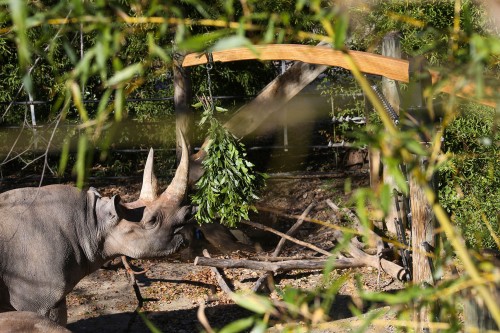
    An African black rhino forages at its new browse feeder.

    But they also soon noticed limited natural feeding options with the few trees around already picked over, so they switched to a plan to stimulate food browsing.

    “They’re natural browsers, so we wanted to simulate the activity of ripping tree branches and eating fruit,” said Beau Hartweg, a science education graduate student.

    The team devised a feeder arm using Marine-grade plywood and a curved metal jig with a steel cap and shock absorber, which is weatherproof and should handle the wear and tear of the African beast, said Paul Gunter, an art education major.

    “The challenge was to build a device that wouldn’t be destroyed,” Gunter said. “This should last them a long time.”

    The shock absorber is designed to mimic the natural give rhinos would encounter with a tree branch, said environmental science major Mallory Melton, who traveled to Africa in the summer and worked with endangered white rhinos.

    Rhinos also used their horns to dislodge fruit, which the browser feeder supports.

    Best of all, zookeepers can load the device with branches on a daily schedule, leaving the tree population unaffected.

    “Our goal was to tie the information the zoo is already providing to activity we could stimulate,” said Hartweg. “It’s very satisfying to see the rhinos take to the feeder right away and display the behaviors described on the exhibit markers.”

    For Bennett’s science students dreaming of a career in wildlife ecology, Zoo Enrichment was good preparation, she said.

    “The class is a great segue into the real world, solving issues and improving habitats,” Bennett said.


    Of all the exhibits at the Fort Worth Zoo, the habitat for the Sumatran orangutan is most unlike its natural world — a rainforest.

    That’s what Martin McQueen, Barrett Ray and Kayce Denkhaus initially intended, imagining a pump system that would draw water from the primates’ water source and simulate frequent precipitation.

    But the scope soon grew too large and complex, and zookeepers pushed for an alternate concept. From its research, the team had imagined a secondary element to the rainforest — a tree stump that collects water, becoming a drinking source.

    handsome orangutan, TCU students change the world, orangutan habitat

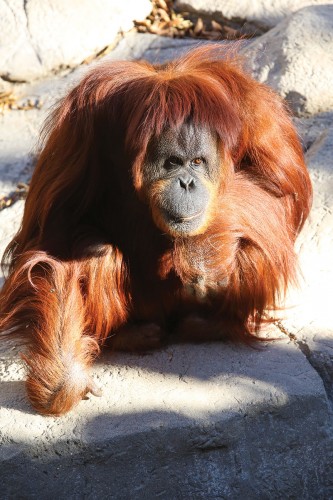
    A wise Sumatran orangutan contemplates his new drinking hole.

    In the wild, oragutans spend 95 percent of their time in the trees. While avoiding predators, they find tree holes and dip their arms inside to get their long body hair wet. Then they slurp off the water.

    “We saw a video of this activity, and we wondered if they could perform that behavior in the zoo,” said Barrett Ray, a speech pathology major.

    To build it, the team used part of an actual tree trunk to shape a clay and metal shell, which they later covered with epoxy and plaster and eventually painted.

    “It was a long process to make, and it was the first time we’d used the materials,” said Kayce Denkhaus, an art studies major.

    Materials such as bolts, scrap metal and epoxy became a commodity, and teams wouldn’t have finished the projects without donations and generous pricing from vendors, Schoepp said.

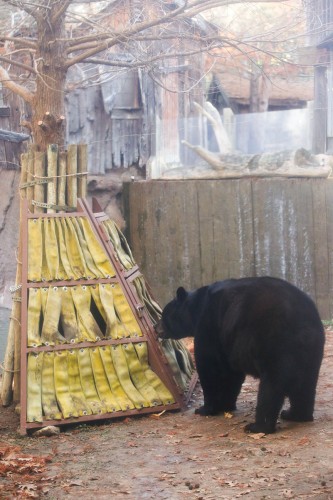
    The American black bear team used donated fire hose from Fort Worth Fire Department Unit No. 21 to construct a pyramid-shaped foraging structure. The North American river otter group incorporated Plexiglass and Styrofoam, plus leftover piping from an old HVAC system.

    “Being resourceful was part of the challenge and made us appreciate how our enrichment object came together,” said Andria Beal, a biology graduate student.

    On the day after the December project reveal, Fort Worth Zoo officials posted a video on social media of scenes of the animals interacting with the structures.

    “The TCU students did a marvelous job. Their creativity and ingenuity were very impressive,” Elston said.

    Mixing art and science students was mutually beneficial, said Anastasia King, an art sculpture major, who worked on the bear team.

    “The art majors learned research and data collection techniques. The environmental science majors worked on design for the first time — concepting, material use, construction. Both brought critical thinking and problem-solving skills to the table,” she said.

    Just before the Christmas break, McQueen received an email from wildlife ecology professor Bennett. It contained a link to a video of the team’s orangutan pulling a hairy limb out of the tree hole — something the primate hadn’t done at the end-of-semester presentation.

    “It made my day. It made my semester,” McQueen said. “This thing we made — our Plan B — was being used. It worked! We made their home better, hopefully for a long time.”

    FWFD donations, black bear zoo habitat ideas, Corry Shaffer TCU, Colby Plott TCU, Anastasia King TCU

    Students used fire hose donated by the Fort Worth Fire Department for this pyramid feeder for the zoo’s black bear.

  4. Guarding the Super Bowl trophy

    Leave a Comment


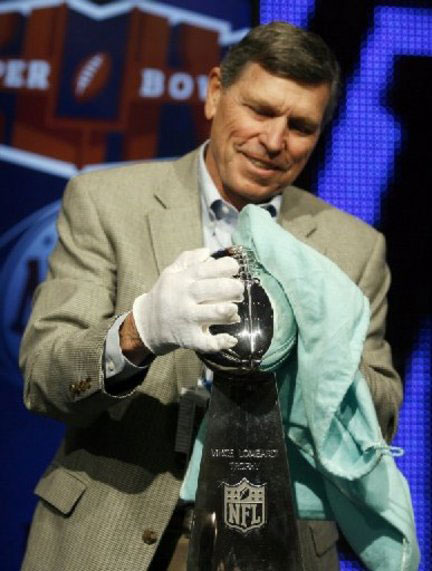
    Every year, millions of people watching the NFL’s Super Bowl catch a glimpse of Ben Nix ’63. But what viewers really see what’s he’s holding — the shiny Lombardi Trophy that goes to the big game’s winner.

    A former Dallas Cowboys security officer and FBI agent, Nix has worked for the NFL since 1981. Each year, his job is to coordinate the travel and protection of the league’s ultimate prize.

    BenNixNFL-Lombardi-TrophyThe trophy, made by Tiffany’s, weighs 7 pounds and costs about $50,000. It’s made of sterling silver. Unlike the Stanley Cup in hockey, the Lombardi Trophy is made anew each year. The winning team keeps it forever rather than giving it back at the start of the ensuing season.
    Starting the week of the Super Bowl, Nix goes wherever the trophy goes, transporting and guarding it at numerous appearances at the site of the big game each year. Photos are OK, but no one touches it without white gloves, until it’s time to hand it to the league commissioner at the trophy presentation.

    “The most difficult part is to keep the hands off it until the team gets it,” he said. “It smudges up pretty easily and so we try to keep that from happening.”

    Nix, a former TCU football player, gets busy at the fourth quarter winds down.

    “About four minutes left in the game, [I] bring it out to the field and eventually hand it to the presenter who takes it down to the winning team,” he said.

    And when that final minute runs off the clock and the handoff is made, Nix exhales.

    “There’s always a sense of relief,” he said. “There’s no question about that. Yeah, a big sense of relief.”

  5. 1994 grad’s film takes on poverty, gang life

    Leave a Comment

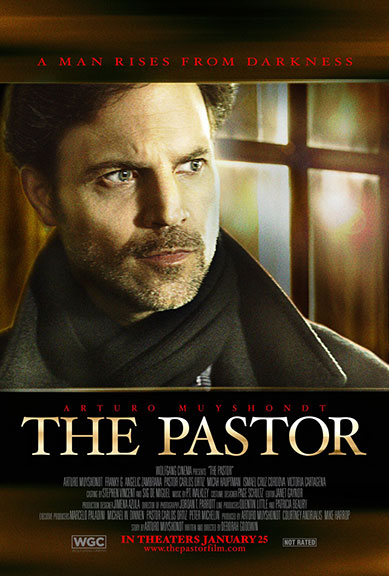
    Arturo1Today is a big day for actor and film producer Arturo Muyshondt ’94. His new film “The Pastor” debuts at 400 theaters nationwide, including two in Fort Worth — Ridgmar 13 and Hulen Movie Tavern — and four in Dallas.

    The film is billed as “a gritty, strong-messaged, gang thriller,” and it has personal meaning for Muyshondt, who grew up amid a violent civil war in El Salvador. He also conducted much of his research for the film in United States cities with gang activity and jails in the U.S. and Central America.

    The movie draws from his own life. Muyshondt plays the title character who is a former gang leader in Brooklyn who survives a knife attack in prison and then discovers his faith in God while in solitary confinement. Upon his release, he becomes a pastor, finding his true purpose, and seeks to serve underprivileged youth of the community to steer them away from the gang life he once led.

    Turf wars ignite between two prominent gangs, and the new-found pastor finds himself and his growing community targets. Will he maintain his faith or turn back to the cold-blooded killer he once was.

    “The film and my character have taken a life of its own as they relate to my personal story,” said Muyshondt, who also wrote and produced the film.

    He’s also a global spokesman. Earlier this month, the United Nations invited him to speak at its conference on Poverty, Inequality and Social Violence. Afterward, he showed the film to audiences in his native El Salvador.

    Muyshondt’s interest in acting and filmmaking dates back as far as 12 years old, when he created short films in El Salvador.

    But it wasn’t until 2003 when he really tried his hand at acting after a successful but tiring career as an investment banker in Miami, where he worked for Dresdner Bank AG, a German financial conglomerate. After advising governments, banks and corporations in Latin America and structuring investment products for wealthy clients, he wanted something new and began acting training at Coconut Grove Playhouse.

    By 2007, he launched his own production company WolfGang Cinema and went to Los Angeles to intensify his new career at The Joanne Baron Studio. His goal: Establish himself as a leading Hispanic producer in Hollywood.

    Today, Muyshondt has turned WGC into a cross-cultural enterprise, producing films that focus on a multicultural audience.

  6. 5 thoughts on TCU-Oregon

    2 Comments

    1. Character revealed

    bowlcheer3

    TCU celebrates its most unlikely victory in program history. The 31-point rally was the largest in 120 seasons of Horned Frog football. (Photography by Glen E. Ellman)

    A year ago, the Horned Frogs ferociously demolished Ole Miss in the Peach Bowl, raising eyebrows and commanding respect. TCU was a program that should have been in the College Football Playoff and played like a team fueled by frustration and anger. The Frogs rightfully gained a No. 3 ranking in the final Associated Press poll. A year later, TCU garnered national attention again at the Valero Alamo Bowl, but this time in a different way. The news of quarterback Trevone Boykin’s arrest and suspension cast a pall over the game locally and nationally. Murmurs around the Alamo City on New Year’s Eve lamented that the Frogs’ first appearance in South Texas in decades was tainted. What had been billed as one of the bowl season’s best matchups now appeared to be a mismatch. To their credit, the TCU faithful turned out in force, filling up 70 to 80 percent of the Alamodome, but they were quieted when the Frogs woefully sleepwalked through the first half, trailing by five scores. But that deficit and all that baggage made the team’s historic comeback even more remarkable. With a Saturday night primetime TV slot, the game was every bit the national stage as this season’s New Year’s Six bowls and the team’s game in Atlanta last year. For the program to exhibit such strength of will, such never-say-die heart, the players and coaches sent a tremendous message about the stuff Horned Frogs are made of. Amid all the injuries and high expectations, it was a season of not-quitting. Coach Gary Patterson and the players may have shown more character in 2015 than the Rose Bowl and Peach Bowl years. The Alamo Bowl game was just the last moment of an entire year of intestinal fortitude.

    2. Bram the torpedoes!

    bowlbramflip1

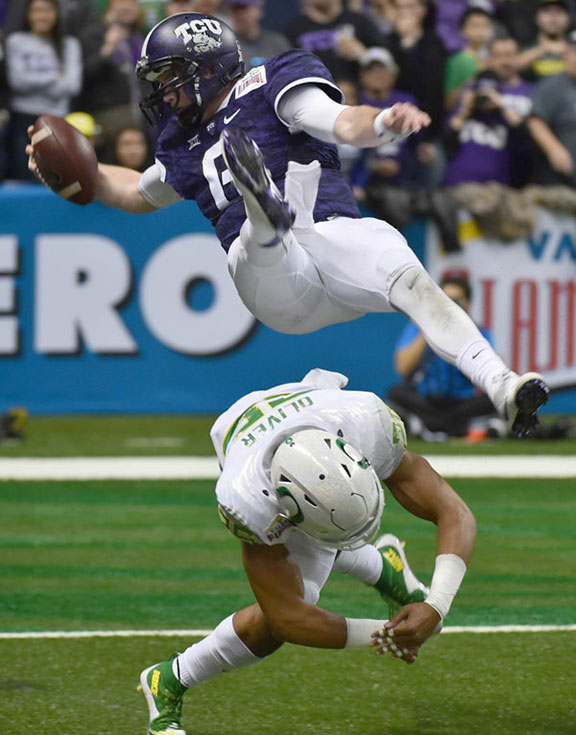
    Bram Kohlhausen dives for the end zone in the second half during the Horned Frogs’ rally. Kohlhausen was named the Offensive MVP of the 2016 Valero Alamo Bowl. (Photography by Glen E. Ellman)

    The central character in all these storybook doings was second-string quarterback Bram Kohlhausen, who incredibly made his first career start in his final game in college. How he got to that point is part of the story. The fifth-year senior walked on at TCU in 2014 after two seasons at Houston and a year at Los Angeles Harbor College. In 2015, he played mop-up duty against Stephen F. Austin, one snap against Texas Tech and a series against Texas. Kohlhausen’s father Bill, who passed away in early November, last saw his son play in TCU’s 50-7 win over the Longhorns. A week after his father died, Kohlhausen replaced an injured Boykin in a home game against Kansas, but he and the Frog offense struggled. Third-string Foster Sawyer moved ahead of him on the depth chart. But after Sawyer stumbled in the first half at Oklahoma, Kohlhausen rallied the Frogs in the fourth quarter to nearly pull a massive upset of the Sooners. With Boykin back against Baylor, Kohlhausen returned to role as backup. That lasted until about 63 hours before kickoff in San Antonio, where Kohlhausen had one practice and a walk-through to prepare as the starter. At halftime in the Alamo Bowl, the sentiment on social media and in the press box was that TCU would give Sawyer a chance to give the team a spark. While Coach Patterson changed his wardrobe in the locker room, he stuck with the fifth-year senior. All Kohlhausen did in the second half and overtimes was throw for 255 yards and two touchdowns and rush for another two scores. His daring runs added first downs or scores at five key moments of the game, including a Boykin-esque flip near the goal line and the final touchdown of triple overtime. The game’s Most Valuable Player was the hero, and in the press conference after, he gave credit to Boykin for inspiring his fearless performance, even acknowledging that he had TB scribbled on his wrist tape. By Monday, Kohlhausen had interviews with The Dan Patrick Show, SportsCenter, Fort Worth Star-Telegram, FoxSports.com and NBC Radio. All of them well-deserved! Also hard-earned: Kohlhausen will be on scholarship for the spring semester — his last at TCU.

    3. More than a slogan

    After the game, Coach Patterson admitted that the bowl win and the whole season wasn’t easy, but it was clearly memorable, more so than other higher-profile years. He acknowledged the fact that, through attrition, the Frogs had played 30 freshmen or redshirt freshmen, most in his 15 seasons as head coach. Others have noticed too. Before the game, commentator Mack Brown agreed that Patterson’s best coaching job was in 2015, not the years that ended in the Fiesta or Rose or Peach bowls. This year included the two biggest rallies in program history – from down 18 at Kansas State in October and down 31 to Oregon at the Alamodome. Beside Boykin, TCU played without starting center Joey Hunt and left guard Jamelle Naff. Those were the latest in a string of injuries and adversity that defined the campaign. Still, the Frogs gutted their way to 11 wins. Contrast that with the way Oregon fell apart without its quarterback Vernon Adams, Jr. and center Matt Hegarty, who missed the second half. “Next man up” is a nice slogan. But not every program can truly pull it off. The Frogs surely did.

    bowldefense

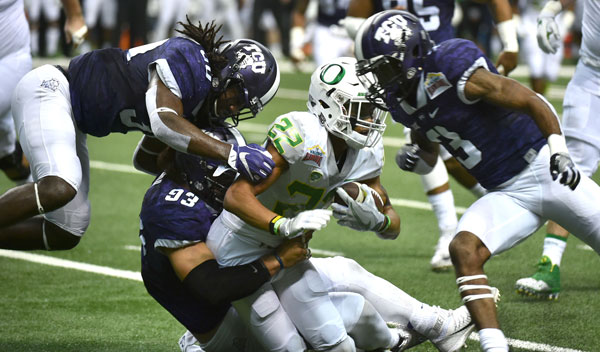
    The TCU defense held Oregon to 18 yards on 18 plays in the third and fourth quarters. (Photography by Glen E. Ellman)

    4. Second-half shutdowns

    The TCU defense held Oregon to 18 yards on 18 plays in the third and fourth quarters while the Frog offense got the team back in the game. Most importantly, the Frogs kept the Ducks off the scoreboard in the second half. The shutout continued a trend of TCU clamping down on foes after half time. The Horned Frogs yielded only 69 total points in the second half and overtimes of its last nine games. Since the Homecoming game against Texas, the Frogs basically have allowed only a touchdown per game after intermission against six bowl teams, four of them with nine wins or more. Changing from black to purple shirts at halftime was a funny sidebar (especially from the ultra-superstitious Patterson), but it took a lot more than new clothes to tighten up the defense. With four sacks of the Ducks, the defense also kept alive a streak of 30 games with a sack. That’s the second-longest active stretch behind Ohio State’s 35 in a row. And most of those Frogs return in 2016.

    5. Climbing the polls

    After all the heroics and celebrations, where does this leave TCU? Next week, the Frogs will surely find themselves in the Top 10 of the final Associated Press ranking. The No. 11 Frogs could jump several spots to No. 7 or 8. Teams ahead of them that lost: No. 10 North Carolina, No. 9 Florida State, No. 8 Notre Dame and No. 6 Iowa. That would give Patterson’s program its sixth finish in the AP Top 10 since 2008. Remarkable! What might we see in 2016? The Frogs say good-bye to tailback Aaron Green, wide receivers Josh Doctson and Kolby Listenbee, quarterback Trevone Boykin, offensive tackle Halapoulivaati Vaitai, center Joey Hunt, offensive guards Jamelle Naff and Brady Foltz, defensive ends Mike Tuaua and Lamar Lathan, defensive tackle Davion Pierson, safety Derrick Kindred, place kicker Jaden Oberkrom and punter Ethan Perry. That’s considerable talent and leadership walking out the door. But the youngsters who played in 2015 amid all those injuries will provide good depth for the Frogs in 2016 and beyond. Also consider that the Frogs will welcome back the injured from the sideline: wide receivers Deante Gray and Ty Slanina, cornerback Ranthony Texada, linebacker Sammy Douglas, safety Kenny Iloka and defensive end James McFarland. TCU will have to find a new quarterback and rebuild its offensive line, but there’s a lot of skill returning. And we know all about their heart.

    bowlhappyGP

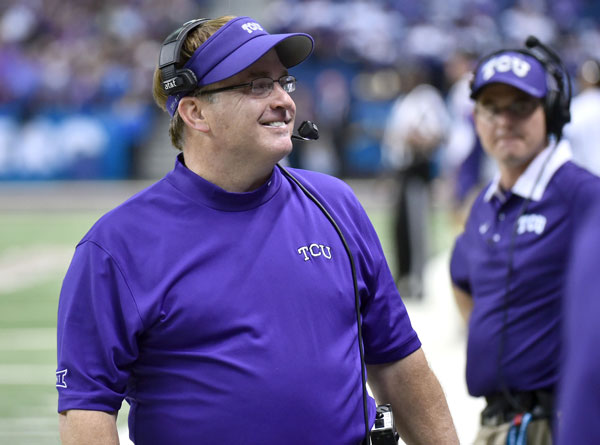
    “Black wasn’t working,” TCU head coach Gary Patterson told ESPN at halftime. The famously superstitious coach changed from a black mock turtleneck and visor to a purple shirt and visor for the second half. The Frogs rallied from a 31-0 deficit. (Photography by Glen E. Ellman)

    5 stats that stood out

    1. TCU was the first team to rally from a 31-point deficit in 1,464 NCAA games. The comeback matched the largest in bowl history (2006 Insight Bowl Texas Tech vs. Minnesota) and second-largest in any Football Bowl Subdivision game. According to ESPN Stats & Information, the Frogs’ chance of winning fell to 0.9 percent early in the third quarter. In the second half, the Frogs six possessions resulted in field goal, touchdown, touchdown, field goal, touchdown, field goal. They never punted, never turned the ball over, never lost the ball on downs. They did convert all three fourth-down attempts. Two went for touchdowns.

    2. Quarterback Bram Kohlhausen started off slowly, completing just nine of 19 pass attempts for 91 yards and an interception. In the second half and overtimes, Kohlhausen was 19-of-26 for 255 yards and two touchdowns. That was more passing yards after halftime than Trevone Boykin ever had in his career. Kohlhausen was especially clutch when it mattered most. On third and fourth downs, he completed 6-of-7 for 90 yards and a touchdown.

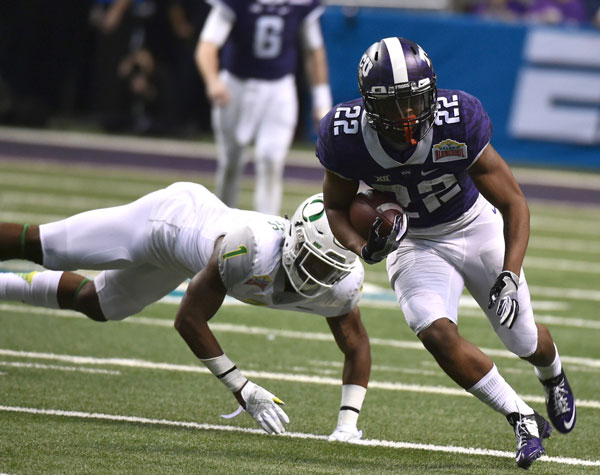
    3. TCU set a series of school bowl records: total offense (545 yards), passing offense (371 yards), passing attempts (47), completions (28), points scored (47) and plays (94). The Frogs also saved the Las Vegas sportsbooks millions. Reportedly, a deluge of bets on Oregon came in over the last two days before the game. The Frogs’ rally wrecked a huge payout.

    4. Running back Aaron Green, a San Antonio native, rushed for 101 yards to finish the year with 1,272 yards, most in a season by a Horned Frog running back since LaDainian Tomlinson led the NCAA with 2,158 yards in 2000. Green’s 2,427 career total – in just three seasons in Fort Worth – fell just outside the Top 10 of all Frog rushers, but he will be recorded in the history books as one of the greatest ballcarriers in TCU history.

    5. TCU achieved the 11-win plateau for the eighth time in the last 11 seasons and ninth time overall in 15 seasons under Gary Patterson. Prior to the Patterson era, TCU had only two seasons (1935 and 1938) of 11 victories or more in a year.

    bowlaaron

    Senior tailback Aaron Green, a San Antonio native, rushed for 101 yards on 25 carries in the 2016 Valero Alamo Bowl. (Photography by Glen E. Ellman)

    5 tweets (plus one more) that told the tale

  7. 5 thoughts on TCU-Baylor

    Leave a Comment

    1. Elemental Football

    Memories from Saturday’s sweet, sweet victory over Baylor will be of the unbridled joy we all felt at the end of the second overtime. A favorable outcome can easily erase the pure misery of standing outside for four hours in the worst imaginable weather, not to mention the 45-minute lightning delay. Dealing with the elements is part of being a football fan, though. Adapting to the conditions is the job of the staff and players, and the Frogs stepped up to the task. The offense pitched as mistake-free of a game as was possible, and the defense focused in to take advantage of every weather-related Baylor miscue. Defensive end Josh Carraway’s scoop-and-score was a testament to laser vision and follow-through effort, and in retrospect, perhaps the most important play of the night.

    2. Pick Police

    The main difference between the 2014 squad and this one was not the injuries, but the turnover differential. While the Chris Hackett-led ball hawks of 2014 snagged interceptions all the way through to Atlanta and the Peach Bowl, the current Frogs have been too busy adapting to new lineups to remember that they can be receivers, too. Until the last game of the season, of course. Freshman Julius Lewis grabbed what would have been the prettiest interception of the college football season had an unrelated penalty not negated his effort. Nick “Pick” Orr took an errant pass away from Baylor receiver Ishmael Zamora in what will hopefully be a preview of his 2016 heroics.

    3. Going Steady

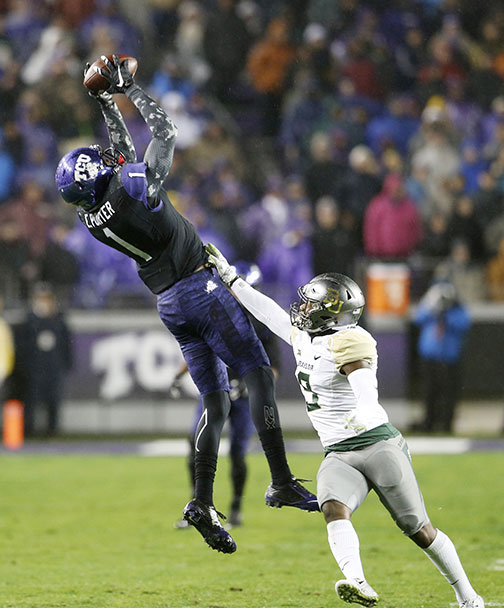
    Given the nasty, wet conditions, ball security was at a premium. Punts were the flavor du jour, and first downs were not, as receivers on both sides had a tough time holding onto passes with numb fingers. With the continual changes of possession and close score for the duration, punt returner KaVontae Turpin needed to hold onto every kick sailing in his direction — cold hands be darned. Not only did Turp perform this crucial task with the grace of a senior, not a true freshman, but the team also relied on his steady hands to grab the touchdown pass that put the Frogs ahead for good.

    4. The Patterson Magic

    Yeah, we expect defensive genius from Gary Patterson on a yearly basis, and he delivers time and time again. Getting the 2015 Frogs up to snuff in the most explosive offensive conference in college football was going to be a tall task after the never-ending string of injuries. TCU played 30 redshirt and true freshmen this season, good for second in the NCAA. Could Patterson get the youngsters to play his brand of smashmouth defense? Why yes. By the end of the season, the Frogs launched as good of a defensive effort as they ever had by taking both Oklahoma’s and Baylor’s high-flying ambitions to the woodshed. Patterson AND the fresh-faced Frog defenders deserve legendary status for the grit they showed this season

    5. Poetic Justice

    No position involved more drama in 2015 than the linebacker corps. From attrition and injury to true freshmen and untimely ejection, no one knew how the defense would perform up the middle on any given week. Shame this happened at TCU, whose veteran LBs earned the program the moniker “Linebacker U.” But with challenge comes opportunity, and Ty Summers stepped up with an epic performance, garnering a Patterson-era record 23 tackles on the night. In light of all of the positional drama, Summers’ fateful stop on the game’s final play (with the help of Julius Lewis) put an exclamation point on the linebackers’ achievements of 2015 and the possibilities ahead.

    DefenseBU

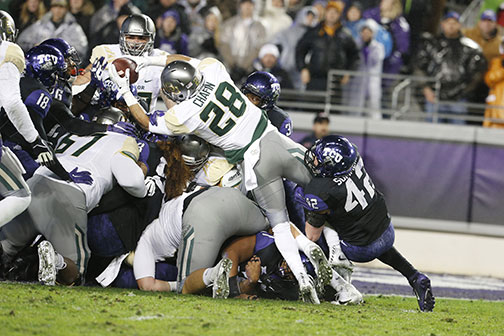
    The TCU defense stopped Baylor running back Devin Chafin on fourth down in the second overtime to secure a 28-21 victory. (Photo by Sharon Ellman)

    5 stats that stood out

    1. TCU reached the 10-win plateau for the 10th time in 15 seasons with Gary Patterson as head coach. The Frogs have won double-digit games in season for the sixth time in the last eight years. Prior to Patterson’s arrival in Fort Worth in 1998, TCU had just four seasons of 10 wins or better.

    2. The Frog defense was outstanding on a rainy night. Baylor was held to a season-low 21 points, which was fewest for the Bears since 2013, and just 62 yards passing, lowest since the 2002 season. Baylor went 17 consecutive possessions without scoring a point, its longest streak under Art Briles. TCU also held the Bears for three straight quarters without scoring a point, the longest streak since 2009.

    3. TCU quarterback Trevone Boykin’s 14-yard completion to Jarrison Stewart was his first completion of the game and broke Andy Dalton’s program record of 812. Boykin now has 830. The first-quarter touchdown was TCU’s 25th straight game with a score in the opening frame, a Big 12 record and tied for the nation’s longest stretch since 1996. On the ground, Boykin scored his career-high ninth rushing touchdown of the season and 27th of his career, ranking seventh in TCU history.

    4. Freshman linebacker Ty Summers had a team-high 23 tackles, which were the most ever in the Patterson era, as well as the most by any Big 12 defender since 2000. Pretty good for a guy making his fourth career start. The 23 stops were sixth-most in TCU history and most since Scott Taft recorded 30 tackles versus UTEP in 1997. Fellow freshman Travin Howard had a career high 19 stops and senior defensive tackle Davion Pierson, in his final home game, had a career-high 13 tackles, including 3 1/2 for loss, with a sack and fumble recovery.

    5. Baylor and TCU held each other to less than four yards per play on the game. Each offense entered the game averaging more than seven yards per play. Baylor entered the game averaging 7.93 yards per play, which led the Big 12, but was held to only 3.5 yards per play. (TCU ranked second in the conference with 7.15 yards per play, but was limited to 3.8 yards per play in the nasty conditions.

    PorterBU

    Sophomore wide receiver Emmanuel Porter led the Horned Frogs with three catches for 48 yards. (Photo by Sharon Ellman)

    5 tweets (plus one more) that told the tale

  8. TCU-Baylor for the 111th time

    Leave a Comment

    BaylorShove4

    Happy Thanksgiving Weekend!

    I hope all of you have a great holiday and enjoy all your family traditions, whatever they may be. This holiday is all about family and food. And it wouldn’t be complete without some football with one of our Big 12 family … and feud.

    Baylor-TCU is a game that’s been long-anticipated, sort of like Grandma Denton’s sweet potatoes … with melted marshmallows.

    The campuses are only 83 miles apart. These two are each other’s closest neighbors on Big 12 Lane. And the shared fence has taken a beating of late. It’s a rivalry that’s complete — from the guy in the last row to the players and all the way down to the head coaches. It’s thorough and thick, and it’s amazing that it’s taken this long.

    Sure, Baylor and TCU played 110 times all through the early years and throughout the history of the SWC, but it never had the heat that it has now. In the old days, the Bears view of the Brazos was ruined on a regular basis by the hated Aggies, and TCU couldn’t stand SMU, a mere 30 miles east.

    TCU and Baylor will play for the 111th time tonight, and it’s one of the most played series in college football. If the SWC hadn’t broken apart, this would be one of the top three series in college football in terms of total games played.

    It’s hard to imagine these two teams going at it more than once a year, but when these two schools were located in Waco, multiple meetings were commonplace: They played twice in 1901, three times in 1902, twice in 1904, three times in 1905, three times in 1907, three times in 1908, three times in 1909 and twice in 1910. The Frogs and Bears lost 10 games when didn’t play each other after 1995 until 2006.

    The flames on this rivalry really got fanned in 2010 when Andy Dalton and the Rose Bowl-bound Frogs (from the MWC) welcomed RGIII and his Superman cape into Amon G. Carter Stadium. TCU led 35-3 at the half and dismantled Baylor in grand fashion, 45-10. That made it three straight TCU wins over Baylor and the folks in Waco didn’t like it. The next fall, when Casey Pachall and the Frogs rolled into Waco, Art and RGIII and big pass plays were waiting. While the Frogs had a chance to win it at the end, this shootout victory by Baylor leveled the table. Since the Frogs entered the Big 12 in 2012, it’s been a year-round tussle in worthy of neighborhood attention.

    Even though TCU has lost two games and Baylor has lost one, there’s still a lot on the line, especially bragging rights and who gets to have fun with billboards in I-35 and team photos for the next year. It’s the day after Thanksgiving, Black Friday, and these two teams are shopping for weaknesses to exploit and good gets that no coupon can bring. The store opens at 6:30 p.m. Don’t be late for these door busters!

    • Quarterbacks – Who will they be?   Not exactly the scenario that everyone from Lee Corso to Dave Campbell anticipated at the beginning of the year. Trevone Boykin is hobbled but available and Baylor has no Seth Russell and no Jarrett Stidham. Chris Johnson has moved back to quarterback from wide receiver to fill in and he did a nice job vs. Oklahoma State. And he’s big.
    • Running Backs – I like this matchup between Shock Linwood and TCU’s Aaron Green. Two of the more productive backs in the Big 12. These backs both bring the BALANCE to their respective offenses.
    • Defenses – The Frogs have had problems defending deep passes and Baylor has had problems stopping the run. How each group has healed up since last week’s battles will be key here.
    • Kicking Game – TCU has the best field goal kicker in TCU history in Jaden Oberkrom, and he’s almost done as a Frog. Watch and appreciate him. He may be the difference in this one. And don’t forget the return game … it may be Turpin-Time!

    It’s a Purple Out game at The Carter, so lay off the tryptophan and get amped up for this one.

    Kick ‘Em High!

  9. 2016 football schedule released

    1 Comment
    TCU Football’s 2016 schedule will feature seven home games — six against Power 5 opponents — and 10 games in the state of Texas.
    The Big 12 Conference released its conference schedule this afternoon, giving the Horned Frogs their first look at next season’s slate, which includes home matchups against potential Top 25 teams Arkansas, Oklahoma, Oklahoma State.
    The Frogs will open 2016 with three straight home games for the first time since 1993, hosting non-conference foes South Dakota State and Arkansas before facing off against Big 12 mate Iowa State. The games are part of seven contests to be played at Amon G. Carter Stadium. It’s just the second time in school history for the Frogs to have seven home games. In 2014, TCU went 7-0 in Fort Worth, including three victories over ranked opponents.
    Also like 2014, the 2016 Frogs will play outside of Texas just twice in the regular season — on Oct. 8 at Kansas and Oct. 22 at West Virginia.
    The Frogs open the 2016 campaign Sept. 3 versus South Dakota State. A Sept. 10 home game versus Arkansas is part of a 13-year run in which TCU will have at least one non-conference game against a Power 5 opponent. Then the Frogs open Big 12 Conference play against Iowa State on Sept. 17. The following week, the Frogs hit the road against long-time rival SMU.
    TCU will also host Oklahoma (Oct. 1), Texas Tech (Oct. 29), Oklahoma State (Nov. 19) and Kansas State (Dec. 3). In addition to Kansas and West Virginia, the Frogs will travel to Baylor (Nov. 5) and Texas (Nov. 24), which will be played on Thanksgiving night.
    2016 TCU Football Schedule
    Sept. 3 – South Dakota State
    Sept. 10 – Arkansas
    Sept. 17 – Iowa State*
    Sept. 24 – at SMU
    Oct. 1 – Oklahoma*
    Oct. 8 – at Kansas*
    Oct. 22 – at West Virginia*
    Oct. 29 – Texas Tech*
    Nov. 5 – at Baylor*
    Nov. 19 – Oklahoma State*
    Nov. 24 – at Texas*
    Dec. 3 – Kansas State*
    *Big 12 game
  10. 5 thoughts on TCU-Oklahoma

    Leave a Comment

    1. Nothing Keeps a Good Frog Down

    From hopping conferences to impressing biased pollsters, the ascent of TCU football has been a tale of overcoming obstacles. This season, the Frogs have faced astounding adversity in losing 18 starters and a corresponding 88 starts to injury. But like teams past, nothing breaks the spirit of these student-athletes. Even down a Heisman candidate quarterback, a record-rewriting wide receiver and a veteran center, the guys clawed to a narrow loss versus a Top 10 team in a hostile environment. TCU football has come too far to claim a moral victory, but we fans can acknowledge the gutsy effort and be proud nonetheless.

    2. Let’s Talk about Character

    Imagine being the quintessential team player for the entirety of your college career — doing what is asked of you and cheering on your teammates without the benefit of experiencing much in-game action. Then, when the starter goes down, and your time to shine finally arrives, you lose your father the very same week. Impossible to imagine, unless you’re Bram Kohlhausen, who just lived through this unthinkable scenario. For him to come in late in the game and lead the offense capably and bravely to within an inch or two of an epic victory speaks volumes about who this young man is. The football program’s success has been built not by the select superstars, but by guys like Kohlhausen who embody what we call the Frog Factor.

    3. The Defense We Know and Love

    Watching defensive end Josh Carraway chase Oklahoma quarterback Baker Mayfield through the backfield in the first quarter showed that the legendary and much-feared TCU defense had returned. Riding high off of a big win against Baylor, Oklahoma likely did not expect to be hunted down by an elite unit all night, but that’s what happened. Despite being on the field for almost two-thirds of the game, which would have broken most college defenses, the now-redeemed Frogs played their best game so far this year. Hopefully the progression will culminate on Friday for the showdown we’ve been awaiting for more than a year.

    4. Enough is Enough

    TCU has been dealing with the injury bug for the duration of the season, and we’re almost numb to seeing yet another Frog being helped off of the field. Now athletes across the Big 12 seemed to be falling like flies. No one wanted Baker Mayfield to leave the game, and we winced watching OU’s star running back Samaje Perine hold his knee and walk off hobbled. For Friday’s showdown, Baylor may be relying on third-string quarterback Chris Johnson and without the services of many key players. The only thing we want to see more than a sweet Horned Frog win on Friday is an injury-free evening — for both teams.

    5. What kerfuffle?

    After the game, posts erupted on social media outlets defending Coach Patterson for the unsuccessful two-point attempt on the Frogs’ final offensive play. Posts on fansites expressed dismay at the criticism, and twitter users reminded people that Coach P has some unforgettable wins through late two-point conversions in recent history. Others took to Facebook to express appreciation for the coaching staff’s being the greatest in TCU football history. Glad to see how proudly you bleed purple, folks, but why the rabid defense? I’m sure a straggler or two complained in the heat of the moment, but the majority of Saturday’s Internet material was positive and supportive … as usual.

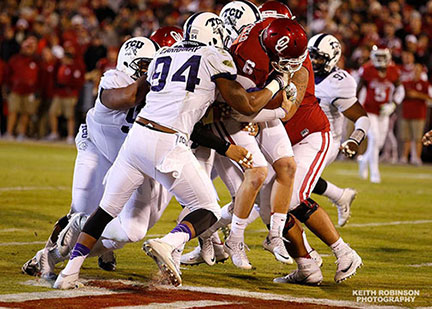
    defenseOU2

    The TCU defense tied a season high with four sacks. Defensive end Josh Carraway led the way with 2 1/2 sacks. (Photo by Keith Robinson ’82)

    5 stats that stood out

    1. With 127 yards on 24 carries and a touchdown, running back Aaron Green had another monster game when the injury-riddled Horned Frogs needed him. Green now has 1,100 yards on the season and is the first TCU player to top 1,000 yards in five years. It was the fifth time this season he’s gone over the century mark in a game and the ninth time in his career. He needs eight yards in the next two games to have the most rushing yards in a season since LaDainian Tomlinson’s 2,158 in 2000. Green’s touchdown was his 10th of the year and 19th of his career.

    2. The TCU offense kept its streak of scoring a first-quarter touchdown alive with a 37-yard scoring toss from Foster Sawyer to Kolby Listenbee. The Frogs have now scored in the opening quarter in 24 straight contests — a Big 12 Conference record and the NCAA’s second-longest streak since 1996.

    3. Place kicker Jaden Oberkrom hit on his 75th career field goal with a 43-yarder in the fourth quarter. The kick equaled the Big 12 Conference record, shared by Oklahoma’s Michael Hunnicutt (2011-14), and extended Oberkrom’s TCU mark.

    4. Entering Saturday’s game, TCU was the only Oklahoma opponent to hold a winning record against the Sooners in Norman. The Frogs fell to 4-4 all time on the Oklahoma campus. The game also drew the third-largest crowd in Oklahoma history with 85,821 in the stands. Five of TCU’s six road games this season (Minnesota, Kansas State, Iowa State, Oklahoma State, Oklahoma) have resulted in attendance totals ranking in the top six in the home team’s stadium history.

    5. The TCU defense’s four sacks tied a season high set against Stephen F. Austin. The Frogs have had at least one sack in a school-record 28 consecutive games, which is tied for the fourth-longest in the nation. TCU got big games from safety Derrick Kindred, who had his second interception of the season and eighth of his career, and defensive end Josh Carraway, who equaled a career high with 2 ½ sacks. Carraway has a team-high seven sacks on the year.

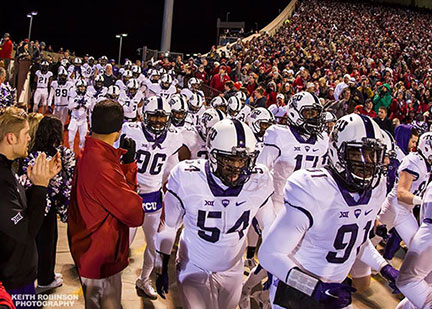
    teamOU2

    The TCU Horned Frogs entered the game as the only Oklahoma foe to sport a winning record in Norman. TCU fell to 4-4 all time on the Oklahoma campus. (Photo by Keith Robinson ’82)

    5 tweets that told the tale