Menu

Author Archives: Corey Smith

  1. Government of the People

    Leave a Comment

    THE NUMBERS TELL A TROUBLING STORY. Despite unprecedented access to information and digital tools for political engagement, fewer Americans are showing up at the polls. About 154 million Americans voted in the 2024 presidential election, representing 63 percent of eligible voters — down from a turnout of a little over 65 percent four years earlier.

    Among voters ages 18-29, only 47 percent cast ballots, falling from 50 percent in 2020.

    As the United States prepares to celebrate its semiquincentennial, the 250th anniversary of the Declaration of Independence, on July 4, 2026, this decline raises questions about the health of American democracy. What does meaningful civic participation look like in an age of social media, viral videos and artificial intelligence? And how can a democratic system survive when its citizens increasingly retreat from the public square?

    The stakes couldn’t be higher. “Democracy requires voting, elections and participation … and requires that the person with the most votes wins the elections and takes power,” said Keith Gåddie, the Hoffman Chair of the American Ideal and a professor of political science, who describes that sequence as the “minimum conditions for democracy.”

    But minimum conditions aren’t enough for a democracy to thrive.

    “We need to be able to constructively disagree with each other, which is something few are modeling at the moment, but maybe that can change.”
    Keith Gåddie

    The Great Disconnection

    The roots of America’s civic disengagement run deep. Political scientists point to Robert Putnam’s groundbreaking research in 2000’s Bowling Alone: The Collapse and Revival of American Community (Simon & Schuster), which shows how changing American behaviors since the 1960s, such as sharp declines in group activities like bowling leagues, mirror a growing detachment from the democratic process.

    “When Americans had more relationship with our community members, it was good for participatory democracy because there was more trust involved,” said Joanne Connor Green, who retired as a political science professor this year. “The system functioned better when people were more engaged.”

    This erosion of social connections has created a paradox: Americans have more ways than ever to express political opinions, yet they feel increasingly powerless to create change. Social media amplifies voices but often confines users to spaces where they hear only similar viewpoints. Online activism can feel satisfying in the moment but may not translate to the sustained engagement that democracy requires.

    “You also have to have healthy conversations to have a healthy democracy,” added Gåddie, who has spent decades consulting for political candidates on both the left and the right. “We need to be able to constructively disagree with each other, which is something few are modeling at the moment, but maybe that can change.”

    A Laboratory for Democracy

    Some educators are working to bridge this gap by treating their classrooms as workshops for democratic engagement. Rachael Houston, an assistant professor of political science, spurs her students to think about their civic obligations. In her Constitutional Law: Rights & Liberties class, undergraduates read more than 55 Supreme Court rulings while scrutinizing and discussing ways in which the decisions by the nine justices expand or limit Americans’ civil liberties.

    “We talk a lot about free speech, which is absolutely foundational to participatory democracy,” Houston said. “We also focus on voting rights and the barriers to voting. A lot of my students said they didn’t know there was a polling station [on campus in the Brown-Lupton University Union] until I’d told them about it.”

    Houston encourages dissenting views in her classroom, something she said enhances the group’s collective learning. Students disagree on all manner of contentious topics — which spurs precisely the kind of civil discourse that democracy demands.

    “Newer generations seem to have more trouble talking about tough issues than older generations have had, and this is one place where I think social media can actually be helpful,” Houston said. “Students can find and also form communities based on their interests and beliefs.”

    Photograph of political science professors, from left, Keith Gåddie, Rachael Houston, Michael Strausz and Sam Arnold, standing in business casual attire in front of a large brick government building.

    Political science professors, from left, Keith Gåddie, Rachael Houston, Sam Arnold and Michael Strausz focus on citizens’ rights and obligations in a democracy, from voting, to participating in civil discourse, to fulfilling jury duty. Photo by Rodger Mallison

    Houston admits that social media can silo students in certain beliefs, thereby serving as an echo chamber. But sites such as Instagram and TikTok can also help introduce students to causes and ideas. As a practical matter, Houston observed students in fall 2024 hosting live sessions on social media to help their fellow Horned Frogs register to vote.

    The challenge, Houston said, is helping students navigate both the opportunities and the pitfalls of digital engagement. “If you took that away, these students would feel more isolated about the democratic process,” she said, “but I also feel the need to teach students how to navigate the negativity that inevitably comes with almost anything online.”

    Beyond the Ballot Box

    Real democratic participation extends far beyond election cycles. Emilio Duran ’24 discovered this during his work as a policy analyst for Sergio Muñoz Jr., a Democrat who represents South Texas’ District 36 in the Texas House of Representatives. During the state legislative session last spring, Duran focused his research on issues such as taxes, gambling and sports. His findings, which included information gathered from speaking with constituents and stakeholders, helped his boss form positions on those issues.

    “I never put much thought into the fact that we’d have so many late nights with debating and amending going on down on the floor until 2 or 3 in the morning,” said Duran, who recently enrolled at St. Mary’s University School of Law in San Antonio.

    The experience gave him an appreciation for public passions on contentious issues like school vouchers, which dominated the Legislature’s 2025 regular session. In the late spring, lawmakers voted to allocate $1 billion in taxpayer funds to help parents pay for private school tuition and homeschooling expenses for children from kindergarten through 12th grade.

    “I heard from a lot of people voicing their frustration over vouchers,” he said. “I like to think democracy is alive and well and there are a lot of elected representatives out there truly doing what’s best for the country.”

    Retail Politics in the Digital Age

    State Sen. Lois Kolkhorst ’88 embodies what she calls “retail politics,” the constant interaction with the 1 million Central Texans she represents in Senate District 18. A video of her pointed questioning of a spokesman for the American Heart Association over the group’s opposition to a bill (SB 379) that stopped food stamps from covering soda and candy went viral in March 2025.

    “In my office, we do retail politics, which means I’m constantly out there interacting with and getting input from the people I represent,” said Kolkhorst, a Republican who first began serving in the Texas House of Representatives in 2001.

    Social media increasingly plays a role in her communication with constituents, but she’s learned to navigate its complexities. “I do read the comments on Facebook and X and respond to as many as I can, to make sure that I’m hearing from people, but sometimes the silent majority isn’t calling or posting because they agree with a bill,” she said. “One of the hardest things I do is to be able to decipher the noise and figure out what the majority of people really want and to then determine if that aligns with the values of my constituents.”

    “I like to think democracy is alive and well and there are a lot of elected representatives out there truly doing what’s best for the country.”
    Emilio Duran

    Kolkhorst said she most appreciates constituents who make the trip to the state Capitol to speak in person. “What I love most about the Texas Legislature is the accessibility: You sign up in an electronic kiosk at the Capitol and get 2 or 3 minutes to speak, or longer if someone asks you a question.

    “That is participatory democracy in action,” she said. “I have changed my vote or introduced amendments based on testimony I’ve heard. And my best bills have come from my constituents.”

    The Quality Question

    Not everyone believes that maximizing the number of voters should be democracy’s primary goal. Sam Arnold, an associate professor of political science who specializes in philosophy, argues that the quality of civic engagement matters more than quantity.

    Sidebar titled “Service That Matters” by Lisa Martin, outlining the importance of jury duty with input from political science professor Sam Arnold and other experts. A red-striped star appears in the upper-right corner.

    “It’s hard to make good decisions as a group unless people participate,” Arnold said. But he ponders whether all participation is equally valuable.

    “The older you are, the more you know, so maybe it’s good that younger voters don’t traditionally show up as much,” he said. “If the point is to make the world a better and more just place, there are lots of ways to do that that have nothing to do with politics, like volunteering.

    “You could even argue,” Arnold said, “that a really good car mechanic does more good for the world than 10,000 voters.”

    His perspective challenges the conventional wisdom that democracy benefits from maximum participation. Jason Brennan, Arnold’s co-author of the book Questioning Beneficence: Four Philosophers on Effective Altruism and Doing Good (Routledge) and a professor at Georgetown University’s McDonough School of Business, takes this argument even further, questioning whether voters who are misinformed or lack information should head to the polls at all.

    Brennan offers a classroom metaphor to illustrate the problem: If a professor told students they wouldn’t receive individual grades, but instead would all get the same grade based on the class average, “you’d probably expect that people would fail not because they’re stupid but because they have really bad incentives to study.” Those who do study hard “will bear all the cost of studying but barely move the meter in terms of a grade.”

    Similarly, Brennan argues, citizens who carefully research issues and candidates see their votes count exactly the same as those who vote based purely on party lines or name recognition. This creates what economists call a “rational ignorance” problem: Individuals have little incentive to become well-informed because their single vote is unlikely to change the outcome.

    “I have a friend at Rutgers University who actually advocates eliminating voting and having lotteries where you randomly select a certain number of people, and they get the power to vote,” Brennan said. “By having it be a smaller number of people, you give them an incentive to think very carefully because now their vote really matters.”

    Lessons From Abroad

    International comparisons offer insights into different approaches to democratic engagement. Michael Strausz, chair and professor of political science and an expert on Japanese politics, notes that political engagement there remains higher than in America, something he attributes partly to Japan’s compressed election cycles.

    Unlike the U.S., with its perpetual campaign season, Japanese politicians in parliamentary elections have only three weeks to campaign. Also, “In Japan, traditional media is still more powerful and respected for expertise,” Strausz said. “Here in the U.S., there is less respect for the mainstream media and for academic knowledge.”

    This media skepticism has contributed to what Gåddie, who coauthored Democracy’s Meanings: How the Public Understands Democracy and Why It Matters (University of Michigan Press), identifies as a broader crisis of institutional trust. “People are increasingly going to alternative media and the digital environment for their political content,” Gåddie said, “but it’s harder and harder to fact-check because there is so much information out there.”

    The solution, he argues, isn’t to retreat from information entirely but to develop better filters.

    “We do need, from time to time, gatekeepers who actually think deeper and look with great care at things and then curate. In a way, we all need a sommelier at times, someone we have confidence in to give us recommendations.”

    Photograph of TCU leaders Titus Fagan, right, and Reagan Stephens, dressed in formal business attire as they stand smiling beside the John F. Kennedy Tribute Memorial in Fort Worth, Texas.

    Titus Fagan, vice president of TCU’s Student Government Association, and Reagan Stephens, president, ran positive campaigns that made effective use of social media to reach student voters. “In the midst of a lot of things that could divide us, I want students to feel seen and heard,” Fagan said. Photo by Rodger Mallison

    The Next-Generation Experiment

    Despite the challenges democracy faces, some TCU students remain committed to working toward bettering our country. Reagan Stephens, a senior political science major and president of TCU’s Student Government Association, refuses to accept that politics must be divisive.

    “Politics used to be a topic you avoided at the dinner table, but now it is a tool people can use to build off each other and learn different values,” Stephens said. “I don’t think it’s unusual for my generation to want to participate in the political process, considering we have easy access to information at our fingertips.”

    She and student government vice president Titus Fagan both ran positive campaigns focused on ideas rather than attacks, suggesting that civil discourse remains possible even in polarized times.

    “My slogan was ‘Your Voice, Our Vision,’ ” said Fagan, a junior accounting major. “In the midst of a lot of things that could divide us, I want students to feel seen and heard and to connect with them on a really foundational level.”

    Stephens built a “REAL Results” campaign for the presidency, promising to address student concerns she heard in informal listening sessions. Solutions for those concerns include a service commitment that would offset parking fines and requiring tuition transparency from university administrators. She said she will apply these consensus-building skills after graduation, when she plans to attend law school with the goal of returning to her home state of Nevada to become an attorney specializing in water rights.

    Both students effectively used social media to reach their peers without falling into the negativity that often characterizes online political discourse. “While I was able to reach a wide range of students through tabling and walking around campus,” Stephens said, “my Instagram had over 300,000 impressions during my two weeks of campaigning.”

    Their success suggests that the problem isn’t technology itself but how Americans use it.

    “There’s a lot wrong,” said Jim Riddlesperger, a political science professor who retired at the end of the spring semester after 42 years at TCU, “but you cannot be around 18-year-olds and not feel optimistic because each new generation gives us hope for a healthier political system.

    “Discourse is the fodder of democracy,” Riddlesperger added, and perhaps that discourse is evolving rather than disappearing.

    Path to Action

    After feeling discouraged by the revelations of disconnection in Bowling Alone, Green collaborated with Daniel Shea of Colby College in Maine and Christopher E. Smith of Michigan State University.

    Photograph of Greg Cox, inaugural executive director of Texas Christian University’s Office of Government Relations, standing on the right side of the sidebar titled “In the Room Where It Happens.” Cox is wearing a dark blue sports jacket, light dress shirt, and khakis. The sidebar details Cox’s background in public service and law, his role advocating for TCU in local, state, and federal education policy discussions, his efforts supporting the Anne Burnett Marion School of Medicine, TCU’s goal of achieving R1 research status, and his involvement in higher education and college athletics policy reform.

    First published in 2006, Living Democracy (Pearson College Division) offers concrete ways for college students to engage in politics and civic life.

    “The whole idea was to show students that democracy isn’t this abstract thing,” Green said. “As a professor, you do touch a large number of young people ages 18-21, which is a pivotal time in their life to get them to think about what it means to be a good citizen.”

    Green encourages her students to identify an area of passion — say, the environment, childhood hunger or affordable housing — then immerse themselves in understanding the issue beyond headlines or snippets on social media. The next step centers on action through advocacy, such as calling or meeting with local legislators or joining or even creating community organizations that will educate voters.

    “Internet participation or couch activism can serve as a mechanism to get people interested in politics and then to mobilize them enough to perhaps vote,” Green said, “but it can also give people a false sense of being engaged. You have to do the work.”

    That might look like volunteering to become a poll worker or canvassing a neighborhood for a like-minded political candidate. Eco-minded teens and adults can organize a public park cleanup event or a recycling drive.

    For her part, Kolkhorst encourages young people to get involved in campaigns or other aspects of government, something that may start with testifying about a bill or emailing anyone from a U.S. senator to a city council member about an issue.

    “In America, we have constitutional rights that allow us to express our opinions and be involved in our government,” she said. “It’s not perfect, but I think it’s the best system in the world.”

  2. Catherine O’Connor finds acclaim with debut novel “Dust Covered Lies”

    1 Comment

    When author Catherine O’Connor won two 2025 Spur Awards from the Western Writers of America for her debut novel, Dust Covered Lies, Dan Williams, director of TCU Press, may have been more thrilled than the author.

    “The Spur Awards are like the Emmys of Western writing, and we’re a small academic publisher competing for these awards with the likes of the Big Five in New York City,” Williams said, referring to Hachette Book Group, HarperCollins, Macmillan Publishers, Penguin Random House and Simon & Schuster.

    For more than 70 years, Western Writers of America has recognized distinguished fiction and nonfiction about the American West with the Spur Awards. Notable past winners include Taylor Sheridan for Wind River and Hell or High Water and David Grann for Killers of the Flower Moon.

    “My colleagues and I are ecstatic for Catherine,” Williams said, “and also happy for Patrick Dearen, another TCU Press author, whose novel The Big Dry was named a finalist for a Spur.”

    Competing against 50 other titles in the category of Best Western Traditional Novel, O’Connor “won easily,” said R.G. Yoho, Spur Awards chair.

    “The judges score all entries and end up with a top five list, which they then submit to me,” said Yoho, who is also a novelist. “I’m beginning my fourth year as Spur Awards chair, and I’ve never seen anyone win a major category so decisively, let alone a first-time author.”

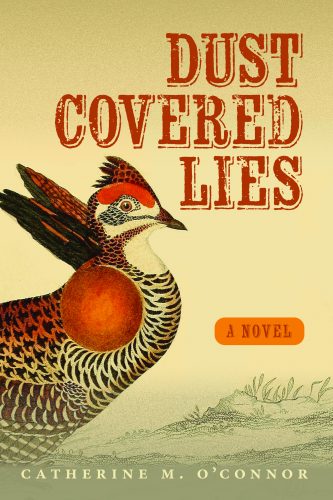
    Cover of "Dust Covered Lies" by Catherine O’Connor: a sandy-beige background with a stylized brown-and-orange bird standing above a faint horizon sketch of dusty plains. The title ‘DUST COVERED LIES’ is in large rust-colored serif letters at the top, and the author’s name appears in lighter serif text along the bottom.

    Landscape architect and author Catherine O’Connor began fiction writing in her mid-50s and quickly rose to prominence with her celebrated debut Western novel. Courtesy of TCU Press

    Debut novels across five categories of Western fiction are considered for Best First Western Novel, and O’Connor’s high scores rendered Dust Covered Lies the hands-down winner.

    The novel follows Frances “Frannie” Abbott, an orphaned teenager and champion markswoman who immigrates to Texas from England. Traveling with her autistic and artistically gifted younger brother, Juan Esteban, Frannie sets out on a hunting expedition along the Colorado River. When a murder occurs and Juan Esteban’s life is threatened, Frannie must lie to protect him. The pair then flee to the Texas Panhandle.

    O’Connor admitted she didn’t initially view her novel as exactly Western. The native Austinite chose Texas as the setting, but O’Connor said she “just thought of the novel as American.”

    The story toggles between two distinct regions of Texas and two indelible periods of America’s history — the 1870s, in the aftermath of the Civil War, and the 1930s, at the height of the Dust Bowl. O’Connor’s creative process drew from meticulous research to lend credibility to her characters’ experiences and as an antidote to writer’s block.

    “I found that when I got stuck, I could always go back to the research,” she said. “I’d go back and find something new, some inspiration for plotting or character development.”

    O’Connor surveyed the evolution of Texas landscapes, variations in regional ecology and shifting demographics over the last century and a half. But animating Frannie, Juan Esteban and other characters with irresistible dynamism required a tighter focus on the granular.

    “I studied detailed drawings of the sort of passenger ships that might have carried an immigrant like Frannie from Liverpool, England, to Galveston. I read firsthand descriptions of what Galveston was like during that time. I needed to know what it must have felt like to travel in steerage and where European immigrants to coastal Texas were coming from.”

    In a 1993 essay, the late David Foster Wallace notes that “fiction writers as a species tend to be oglers” and “born watchers.” O’Connor is no exception. Her immense faculties of observation have been cultivated over decades by a childhood steeped in visual art, undergraduate studies in American literature, a seven-year stint in advertising and training at Harvard as a landscape architect.

    “When I was growing up, we had a lot of books around the house; they were mostly art books,” O’Connor said. Her father collected paintings by naturalist and ornithologist John James Audubon, displaying them in the family’s home.

    As an undergraduate at Duke University, O’Connor fell in love with American literature despite being a self-described “slow reader.” She was drawn to the visual and spatial details and the unfolding stories within distinctly American contexts. After earning a bachelor’s degree in English in 1983, she moved to New York City to begin a career in advertising.

    “It was fun,” she said, but “I was looking for something other than a profession, something that was going to provide an avenue for creative expression.”

    O’Connor moved to Boston in 1990 to pursue a master’s degree in landscape architecture from Harvard. Her training there refined her capacity for ogling.

    “Memorably, one exercise involved going out and finding a place and returning to that same place weekly for six months,” she said. “Any time of day, we were told to sit there and observe and either draw or write, whatever. The idea was to build on our observational skills.”

    This exercise allowed O’Connor to watch a particular place — a landscape — change over time on micro and macro levels, an experience easily transferable to writing an absorbing, character-driven novel.

    “I don’t exactly know how to articulate it, but in the same way Henry James could use houses to delineate character, Catherine is able to use landscape to illustrate character,” said Betsy Tschurr, a childhood friend of O’Connor and eager beta reader of early drafts. “I think she sees the natural world and the cultivated world and their relationship to each other in a way other people can’t.”

    From the first page, the narration captures Frannie’s view of her natural surroundings, “living on these dusty panhandle plains in a bump-in-the-road town called Leilo” where “few trees manage to survive, just the weed species that ranchers and farmers hate, like mesquite and hackberry, and even those look like they’ve been beaten with a stick.”

    Catherine O’Connor’s career as a landscape architect helped hone her ability to write detailed descriptions of places in her novel, including the dust-filled streets of West Texas in the 1930s. Public Domain | NOAA, George E. Marsh Album, Historic C&GS Collection

    The author said writing fiction is an extension of her work as a landscape architect. “It’s just another medium of expression for me.”

    She is interested in places and people who “have an edge to them” and circumstances that demand the hard-earned grit Frannie demonstrates to build a life amid ostensibly barren surroundings and long odds.

    O’Connor needed the same grit to navigate the publishing world. She shopped Dust Covered Lies for more than a year, seeking representation by a literary agent and enduring repeated rejections.

    “TCU Press was the first publisher to give me a sense that this might actually happen. My editor said, ‘This is not ready for publication yet.’ In the word yet was this hope because no one had ever said that.”

    Kathy Walton, the editor who worked with O’Connor on Dust Covered Lies shortly before retiring from TCU Press, said the manuscript she received was well-written and required only “some tightening up at the sentence level here and there and clarifying a character’s motivation in a couple of places.”

    The novel’s predominant themes, including survival and human resiliency, are inextricably bound with the spirit of the American West. But the story’s emotional core is its commitment to hope, a quality O’Connor views as fundamentally Christian and quintessentially American.

    “I don’t like to write 100 percent devastation,” O’Connor said. “There has to be hope. There’s always some reason to hope; there’s always a desire for some measure of hope and joy, even in complicated situations.”

  3. Playing With Heart

    1 Comment

    When Ryan Williams ’18 received an email in late 2024 advising her to keep her calendar clear for a possible opportunity to train with the U.S. Women’s National Team — essentially a tryout for the most decorated team in global women’s soccer — she initially thought someone was playing a joke on her.

    Establishing herself as a professional soccer player had been a bit of a bumpy ride for the former TCU star. After being selected with the 40th and final pick in the National Women’s Soccer League draft in 2018, Williams barely played during her first three years as a defender for the North Carolina Courage. Part of that was due to injuries and the complications that came with the Covid-19 pandemic, but Williams grew so frustrated by her lack of playing time that, at one point, she considered exploring other options and debated whether staying in one place was best for her career.

    “I struggled with my identity and my value and my self-worth,” Williams said of dealing with her injuries. “It was so hard because our team was so good, and I was sitting out watching practice from the side. I felt so disconnected.”

    Williams responded by working even harder in team training sessions and on her own or with another teammate or two. She paid attention when coaches told her areas to work on, whether getting physically stronger or working on passes to teammates that could lead to goals.

    Eventually, her efforts paid off with more playing time, initially as a reserve and then as a full-time starter in the 2023 and 2024 seasons. Williams quickly became a fan favorite, using her speed and skills to shut down opposing players and ingraining herself as part of the Courage’s offensive attack.

    Her strong play continued in 2025: In a match in April, Williams scored the first goal of her National Women’s Soccer League career and had the assist on the winning goal in extra time as the Courage earned a 3-2 victory over the Kansas City Current, which was undefeated coming into the game.

    Williams was named one of the league’s best players following the 2024 season and landed on the league’s monthly honor roll for the first two months of the 2025 season. Following that initial contact from the U.S. Women’s National Team in late 2024, she received an invitation in early 2025 to train with them.

    Nathan Thackeray, a longtime assistant coach for the Courage who was named interim head coach this season, said Williams initially needed to raise the level of her game to earn playing time. “She had to learn how to become a professional,” he said. “She had to watch and see how they did things.”

    With those lessons learned, Williams has become a steady presence in the Courage’s starting lineup. “She’s resilient,” Thackeray said. “She’s hard to run by, she’s hard to get past. She’s ultra-competitive.”

    Williams said she fell back on what had worked for her as a youth soccer player and, later, during her years at TCU. “I just want to go out every day and get better.”

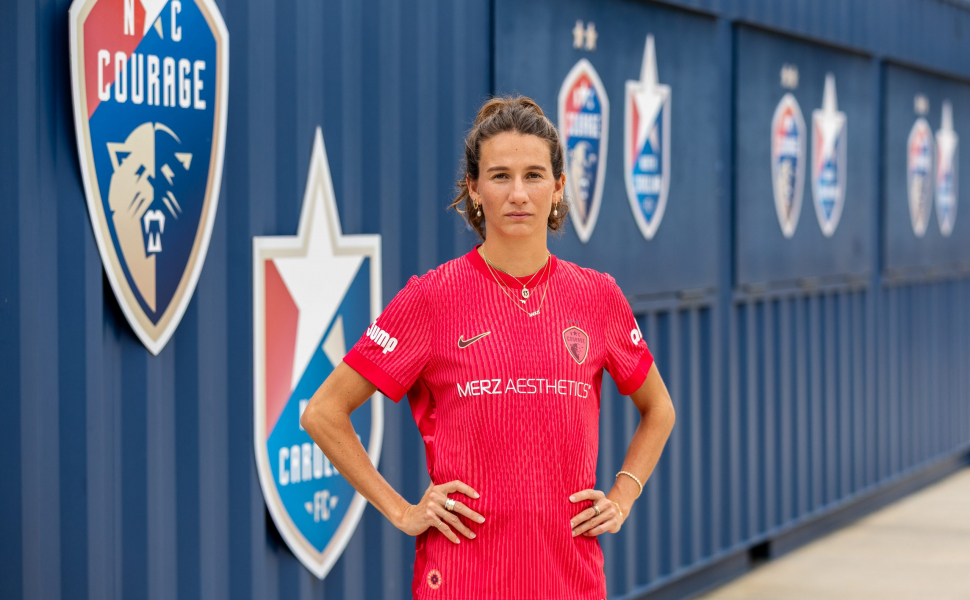
    Photograph of TCU alumna and professional soccer player Ryan Williams standing with her hands on her hips in front of a navy blue wall decorated with North Carolina Courage emblems, wearing a red Courage uniform.
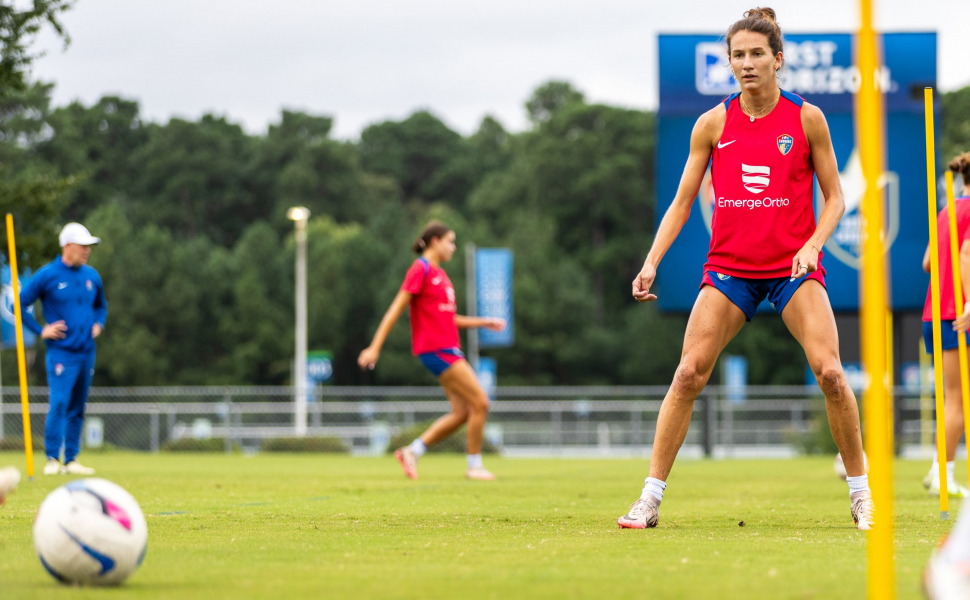
    Photograph of TCU alumna and professional soccer player Ryan Williams, wearing a red practice jersey and blue shorts, watching a soccer ball in motion. Teammates, coaches and trees are visible in the background.
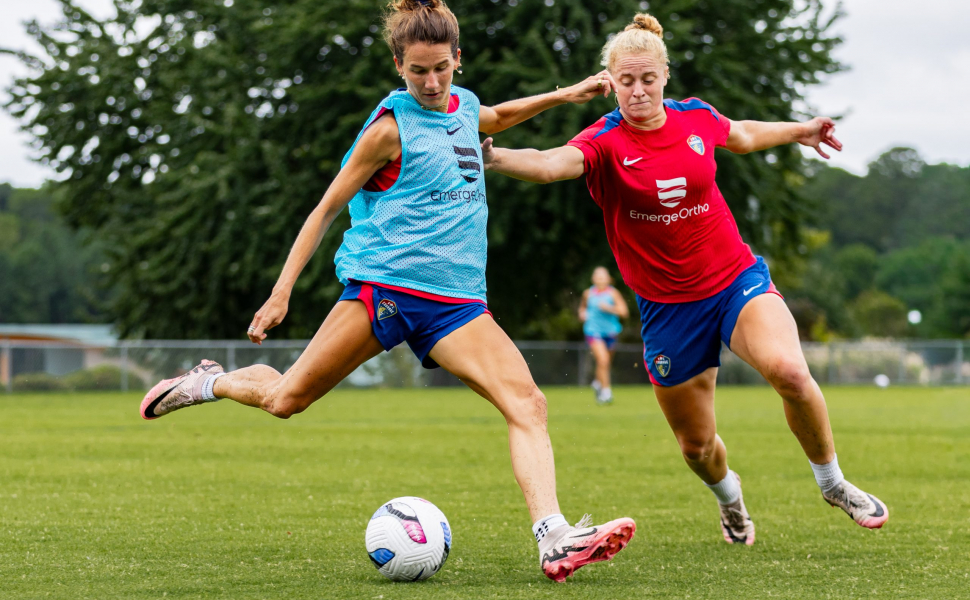
    Photograph of TCU alumna and professional soccer player Ryan Williams, wearing a light blue practice pinnie and blue shorts, preparing to kick a mostly white soccer ball while a teammate in a red uniform and blue shorts chases from the side.


    Ready to Run

    Growing up in a suburb of Denver, Williams was part of a soccer family. Her dad played on a semiprofessional team as a young man and coached his children when they played. Weekends would start with a quick stop at a bagel shop, then on to the soccer fields for games. “It just turned into our family thing,” Williams said.

    Unlike many children who play at the top levels of youth soccer, Williams spent little time thinking about playing in college or dreaming of playing for the national team. She even quit playing club soccer her first year of high school — a critical time to start getting the attention of college coaches — to run cross-country instead.

    “I don’t like to look too far ahead,” Williams said. “I just kind of like to see what I feel like at the moment and go with that.”

    Williams returned to soccer the following year; she had missed the sport and the camaraderie of being part of a team. And if she was going to run — speed and stamina are among her strengths — Williams decided she would rather do it with a ball at her feet or chasing down a player from the other team.

    It was late in the college recruiting process when Williams decided she wanted to play after high school. Williams has ties to Texas — she was born in Houston, and her older sister studied nursing and ran cross-country at TCU. She signed with TCU’s soccer team as a recruited walk-on but was good enough to play for the Horned Frogs in the first game of her first season.

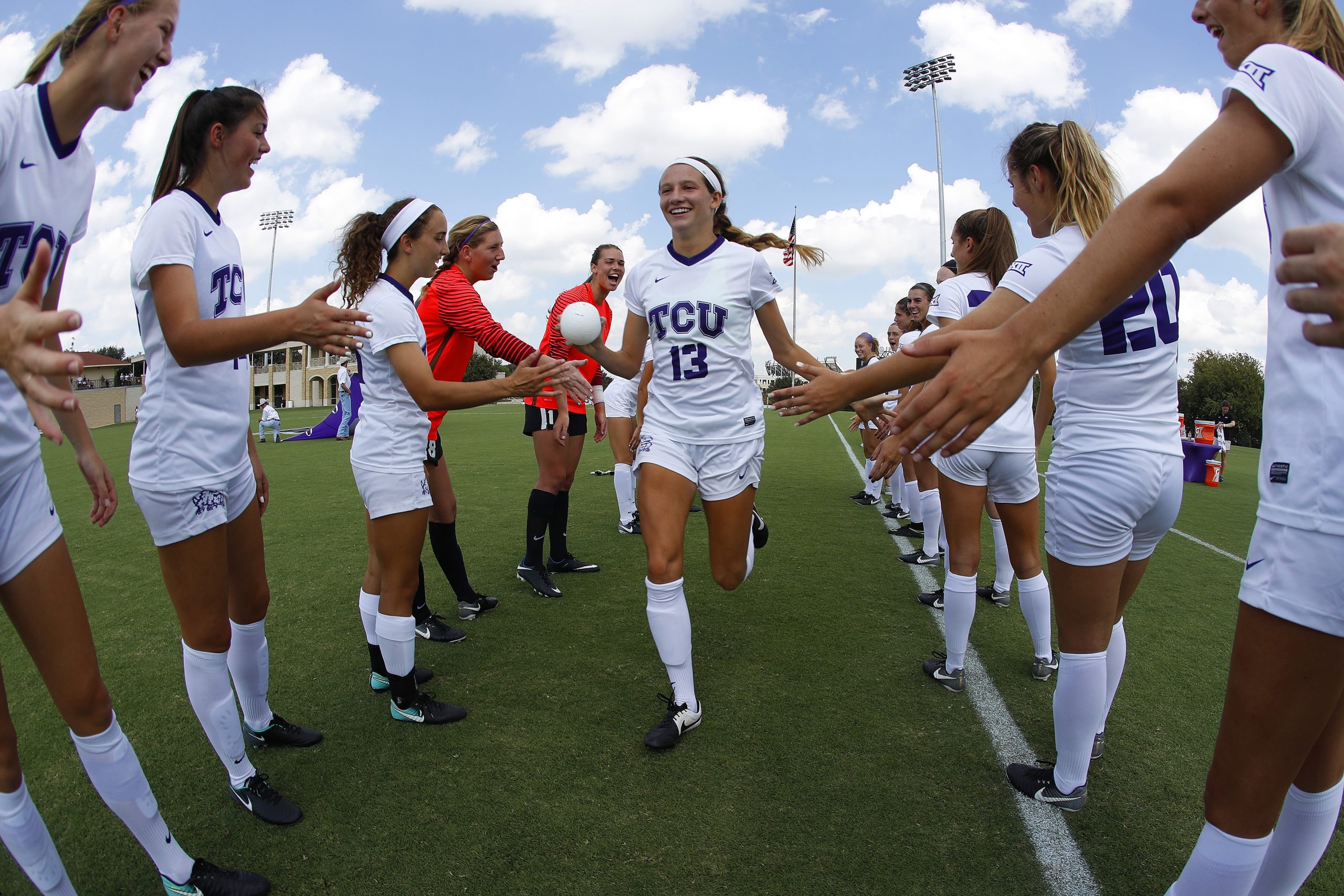
    Photograph of soccer player Ryan Williams as a TCU student-athlete, running through a tunnel of teammates on the field before a Horned Frog soccer game on a slightly cloudy day.

    Ryan Williams, a three-time Academic All-Big 12 honoree and one-time all-conference first teamer, was selected by the North Carolina Courage in the fourth round of the 2017 NWSL Draft. Photo by Sharon Ellman

    Williams enjoyed her time at TCU, and it showed in her success on the field. She played in all but one game during her four years in Fort Worth and was named to the all-conference team her senior year. But again, Williams gave little thought to what was next until her college career was almost over. “I was just so present,” she said, “which I’m thankful for because it allowed me to enjoy my time there.”

    As she worked to complete a bachelor’s in general studies, Williams realized she wasn’t ready to stop playing. She asked Eric Bell, head coach, and Ryan Higginbotham, associate head coach, if they could help her figure out a path to play professionally. They suggested that in addition to training with the team, she train individually with them to stay sharp and continue to improve. “She was beating down our doors all the time to do extra stuff,” Bell said. “Her work ethic was fantastic.”

    My Own Favorite Player

    Williams said she was excited and nervous when she arrived for her first preseason training with the Courage. The team was loaded with big-name players like Lynn Williams (now Biyendolo), Sam Mewis, Abby Dahlkemper and Crystal Dunn, all of whom had or would play for the national team. The Courage won the National Women’s Soccer League championship during the first two years Ryan Williams was with the team. “The practices were so intense,” she said. “The girls were so talented, and I was just trying to keep up.”

    Kaleigh Kurtz, also a defender, joined the team the same year as Williams. It didn’t take long for her to recognize Williams’ focus and determination to get better. “She was ready and willing to go above and beyond,” Kurtz said.

    Another teammate, Meredith Speck, said Williams refused to make excuses for her initial lack of playing time. “She saw it as a positive opportunity and a way to grow,” said Speck, a midfielder who is the longest-tenured member of the Courage. “She was surrounded by a really great team … and it’s hard to complain when your team is winning every game. You look at the person who’s playing in front of you and say, ‘What can I learn from them?’ ”

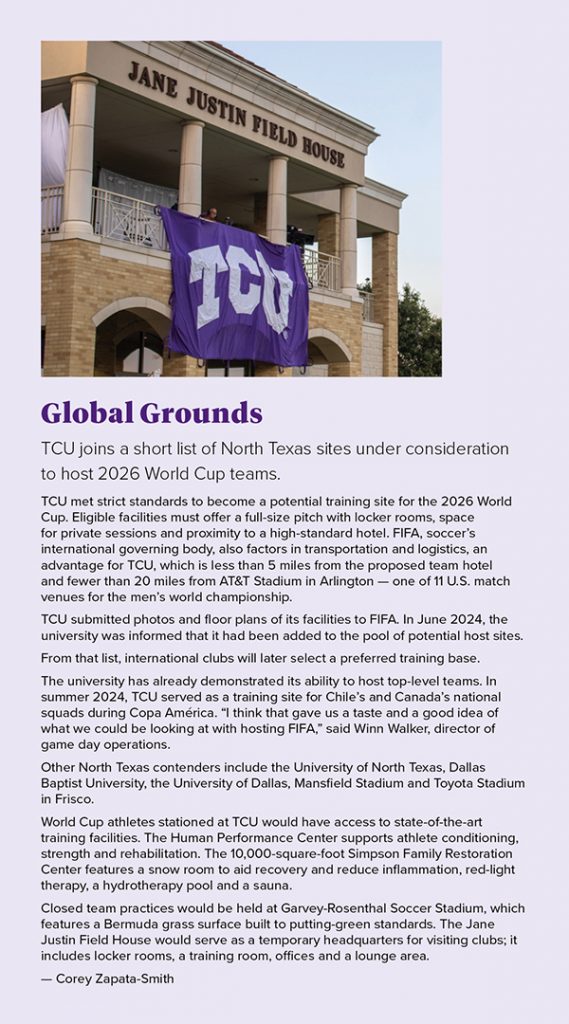
    Sidebar graphic with a light purple background and purple and black text titled “Global Grounds,” explaining the selection process for 2026 FIFA World Cup team base camps and the requirements TCU met to be included as a prospective site. A photograph at the top shows a purple TCU flag with a white arched “TCU” logo hanging from a guard rail at the Jane Justin Field House.

    Now that Williams is a mainstay for the Courage, she still puts in the extra work and is known among teammates for her relentless effort during training sessions and games. When the team did an exhausting series of runs at the end of a preseason practice earlier this year, Williams led the way while some players lagged behind, gasping for breath.

    Kurtz, who typically plays alongside Williams on the defensive line, values her speed, communication and work ethic during games. “If someone gets past me, then [Williams’] name is getting screamed,” Kurtz said. “She’s the safety valve.”

    While Williams trained with the national team for a week in January, she did not get called up when the team played a series of games in February. Still, she relished putting on the national team training gear and having the opportunity to test herself against a new group of players and get guidance from a new set of coaches. “That was a really cool moment for me,” she said.

    Williams still gets excited about putting on the Courage training gear, walking onto the field to play and sticking around after the games to sign autographs for fans. When asked to sum up her journey in professional soccer, Williams took a few moments to consider the question.

    “A word that sticks out to me is ‘patience,’ ” she said. “With that is a lot of resilience and determination. Even in moments when I was down or wasn’t feeling like I was getting anywhere, I still had this belief in myself, deep in me, that I would be the starting [defensive] right back for the Courage.

    “I want to be my own favorite player,” she said. “My favorite player is someone that works so hard and, even if they make a mistake, they quickly react and they get it back. It sounds cheesy, but I always want to be someone that people look at and say, ‘Oh, she plays with a lot of heart.’ ”

  4. Olivia Miles Eyes a National Title in Her Fifth and Final College Campaign at TCU

    Leave a Comment

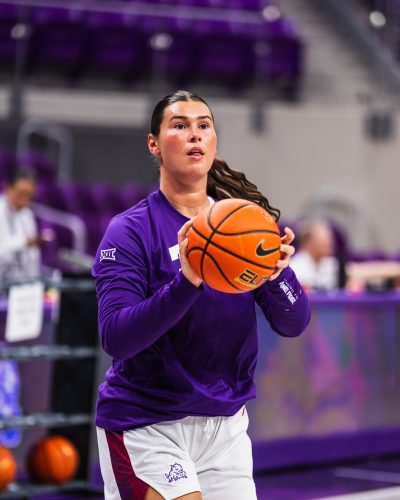
    Olivia Miles, whose Notre Dame team lost to TCU in last March’s Sweet 16, has arrived in Fort Worth with a résumé few in college basketball can match — and the resilience of a star who missed the entire 2023-24 season recovering from a torn ACL.

    The three-time All-ACC first-team honoree announced her transfer to TCU live on the Emmy-winning Inside the NBA, flanked by college and WNBA great Candace Parker and Lakers legend Shaquille O’Neal, who presented her with a white TCU jersey stitched with the number 5.

    “Coach Mark Campbell is one of the greatest in the game,” Miles said of her decision to attend graduate school at TCU. “He has a very direct plan for me and for our team.”

    Miles is the second all-conference guard signed by Campbell in as many offseasons, following the 2024 arrival of Hailey Van Lith, who became Big 12 Player of the Year and the No. 11 pick in the spring’s WNBA Draft.

    Miles may be even more highly sought should she enter the WNBA in 2026; ESPN projects the 22-year-old as the No. 2 pick after a senior season at Notre Dame in which she averaged a career-high 15.4 points and hit better than 40 percent from the three-point line.

    Fresh off a gold medal from July’s FIBA AmeriCup final win over Brazil, Miles adds electricity to a Frogs backcourt that also features Donovyn Hunter and Taylor Bigby, the lone returning starters from a roster that last season carried TCU women’s basketball to its first Elite Eight.

    What excites you most about joining TCU’s program?

    I’d say the growing fan base. Coach Mark Campbell has come in and really rejuvenated the energy: the stadium, this team, the program, the school. I’m excited to meet the fans and to play with such amazing girls. We love each other. We’re excited to have fun this year.

    You have a bachelor’s degree in political science and a master’s in nonprofit administration from Notre Dame. What made you pursue that combination? 

    I love studying politics and human behavior. That’s definitely something I was drawn to. 

    And the master’s program — a dream of mine is to start my own nonprofit. So I wanted to be more prepared for that in the future and understand the basics.

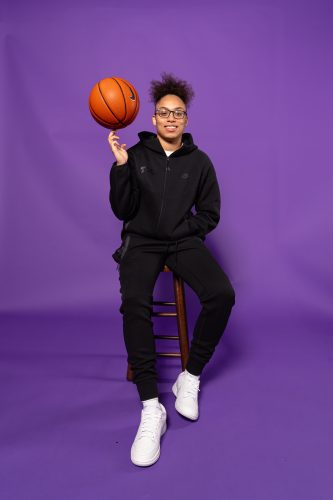
    Photograph of Olivia Miles sitting on a stool against an all-purple backdrop, spinning a basketball on her right hand. She wears an all-black zip-up hoodie, black sweatpants and white sneakers, smiling toward the camera.

    Olivia Miles steered Notre Dame to the Sweet 16 last season in what was its 30th NCAA Tournament appearance. Courtesy of TCU Athletics | Zach Campbell

    What would be the focus of your nonprofit? 

    It’d definitely be a foundation helping kids in sports. 

    I’ve always been passionate about providing kids gear, helping them get funded to go on trips. I’ve had a lot of AAU teammates who couldn’t make tournaments because they couldn’t afford travel, hotels, whatever it may be. So I want to help kids with that kind of stuff. 

    What academic achievement from Notre Dame are you most proud of? 

    I won the Kay Yow Scholar Athlete of the Year Award in the ACC. That was a pretty cool achievement. It was definitely a testament to my academic hard work.  

    How would you say being a student-athlete has shaped your academic discipline?  

    You have to be committed. You have to put in extra time, show up on time and respect your peers. Whether that’s in group work, in the classroom, I know how to work in teams.  

    I know how to communicate effectively because of basketball. I get my work in on time because I know I have to show up on time. The habits you build on the court definitely translate off the court. 

    What’s your number one piece of advice for an incoming first-year student-athlete? 

    Enjoy the ride. It goes really fastI’m in my fifth year already, and I can’t believe it. Don’t be afraid to open up, and don’t be afraid to ask for help. 

    It’s really hard with practice, games and schoolwork. So lean on each other and on your good friends. 

    What would you say makes this team’s chemistry unique?  

    We don’t care who throws the ball in the hoop. It’s about who gets the best shot and when. 

    We’re willing to defend, to run and push in transition, to spread the floor. It’s going to be a lot of fun. 

    How would you describe your playing style?

    Pretty creative. I play the game with a free-flowing spirit and joy, and I never take anything too seriously. I love trying new things, stuff other people don’t usually even think of. That’s what makes it fun for me.

    What are your individual goals for this year? And what are the team’s goals?

    My individual goal is to be a pro every day, to be as consistent as I can. That will translate to my teammates and rub off onto everyone else. To show up every day, be the best teammate and leader I can — that leads to team success.

    Obviously we’re going for a championship; everyone is. But it’s the little details in between that separate you. So I think our team goals are to find those differentiators that set us apart.

    Has being in the WNBA been a dream of yours since you were a little kid?

    No, I wouldn’t say it was a dream early on. I came from a family that didn’t really know basketball. 

    My dad was an immigrant from Jamaica, and he played soccer. So I grew up playing soccer. We didn’t know what the WNBA was. We didn’t know who Maya Moore or Lisa Leslie were until I got much older. 

    Was there a key turning point when you pivoted from soccer to basketball? 

    I played soccer all up until senior year of high school. I knew in college it would have to be one or the other. 

    If I could play soccer right now, I would. It was just the fact that there’s more opportunity for me in basketball. I’m a lot better at it, I’ve dedicated more time to it and it’s indoors, which is nice. 

    Have you ever thought about how that soccer skill set made you a better basketball player, at least footwork-wise? 

    Absolutely. Even my passing. 

    Soccer is all about windows and gaps and leading people to spaces. I see basketball the same way. And the footwork definitely translates into being able to move around the court at high speeds and see the floor at a high level. 

    How do you define leadership on the court?

    I think I’m still trying to figure it out myself. Leadership is the willingness to be vulnerable and to have people follow you. It’s scary. You’re always in the spotlight, always taking the criticism. You’re expected to drag your team out of a 10-point deficit, to turn the tide.

    It’s a lot of responsibility. But in my opinion, it’s about being vulnerable and letting people see that vulnerability from you so they feel empowered themselves.

    What was it like representing Team USA again and coming home with a second International Basketball Federation gold medal? 

    It was amazing. 

    It’s always a blessing being able to represent your country. It’s fun being around elite players and competing against them.  

    We were just down in playing against Brazil with Kamilla Cardoso and Damiris Dantas, who are both WNBA players. It was weird, we had 19-year-olds trying to guard them. But it was a good experience. And we won the gold. 

    Was there a moment that stood out from that experience? 

    Winning the gold, I think it meant a lot more.  

    It meant a lot more just because when I played U16 six years ago, we were killing teams by, like, 100. The competition wasn’t as good. It wasn’t as fun. But this time, we felt the grind. We had to get over adversity and beat a really good team. That made it so much more meaningful. 

    “Leadership is the willingness to be vulnerable and to have people follow you.”
    Olivia Miles

    How have you grown as a person since starting college?  

    I’ve definitely gotten a lot more selfish with my time. I think I often didn’t use it as well, whether that’s recovery, sleep or eating right.  

    Now — and this is why I’m doing the liberal arts program, for the flexibility — I can be more intentional with my time. If I want to sit on the couch and rest, I can. Or I can get an extra workout in. I can use my time in ways that best serve me. 

    What’s something that fans might not know or expect about you?  

    I’m a major cat person.  

    I have one cat, though. I don’t have, like, 86 cats. I’m not a cat lady, but I am a major cat person. I love cats.  

    How did you get your cat down here from South Bend?  

    I flew him. First class. Yeahhe’s spoiled.  

    Has there ever been a moment throughout your college career where you doubted yourself, and how did you overcome it? 

    Absolutely. This is very vulnerable of me: I doubt myself every day. I doubt if I can get on the line and do a sprint every day. There are little doubts in your mind that you always have as a player. I’ve gotten really good at redirecting those thoughts into something positive.

    You’re always going to question yourself. That’s the point of the challenge. As I’ve grown, I’ve learned how to lift myself up, especially through adversity and with my knee injury. That’s helped a lot.

    Have you had a chance to explore Fort Worth? Any favorite spots so far? 

     I live downtown, so I’ve seen a lot of cool restaurants and spots.   

    I’ve been to Sundance Square. I haven’t been to the Stockyards yet. I’ve been to Clearfork. There are some pretty cool spots down here. The river’s nice, too. 

    How do you balance NIL opportunities with staying focused on basketball and school? 

    Luckily my agent handles most of it, but it does get overwhelming. 

    Last weekend I was in Miami for an Unrivaled NIL deal. That stuff gets tiring. You have to travel in the middle of workouts, then you’re on a plane, and it kills your joints. It’s a lot. 

    You have to manage your partnerships. But ultimately, you’re grateful for the opportunities. 

    What do you envision your life looking like five years from now? 

    Hopefully in the league, with enough money saved to take care of myself and my family. 

    don’t want to play forever. I want to get a few good years in and live a good life. Maybe start my nonprofit and help people around the world — and then just chill. 

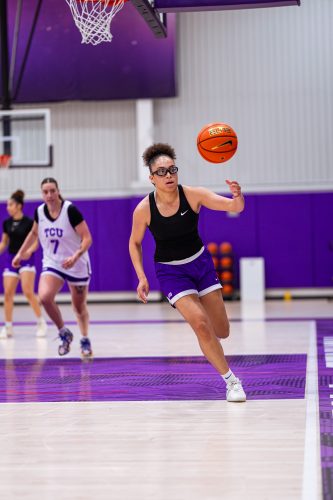
    TCU basketball player Olivia Miles corrals a loose ball and turns upcourt during a summer 2025 practice. Two teammates, including Marta Suárez, appear in the background.

    Olivia Miles brings elite court vision, playmaking and three-point shooting to an experienced TCU roster. Courtesy of TCU Athletics | Zach Campbell

    Can you walk me through your pregame routine from the time you arrive at the arena? 

    I usually get there for my shooter, about five to six hours before the game, and get shots up. Then we watch film and eat a pregame meal. 

    I’ll head back home — that’s my time to center myself, do my mind work, my hair, get ready, listen to music. Then I head back to the gym, have a snack, get taped up. About two hours before the game, I’ll stretch, do more mental prep, get on the court, do team warmups and then it’s game time. 

    It’s really a selfish day for me, preparing my mind for such a taxing, emotional game and being able to deliver a win for our team. 

    Who on the team is the funniest and why? 

    Taliyah Parker, because her spirit is just so childlike in the best way possible. That’s not any offense there, she’s just pure. She makes everyone laugh, whether it’s her jokes or facial expressions. Definitely T. 

    Who’s someone, athlete or otherwise, you’d love to meet? And why?  

    Stephen Curry. I think that’s self-explanatory. He’s just a GOAT in our game. I was going to say Maya Moore, but I’ve met her. Probably Sue Bird, but I’ve talked to her, too. So definitely Steph. 

    What advice would you give to your younger self before you ever picked up a basketball?  

    I would tell her: Don’t let anyone steal your joy.

    You’re the only one who can take your joy away. Don’t give your power to other people. Be confident in who you are and enjoy the ride.


    Editor’s Note: The questions and answers have been edited for length and clarity.

  5. Frog Finder

    Leave a Comment

    Mandy Castro, dean of admission, is proud of TCU’s holistic review of applications, which goes beyond test scores to forge an individual and empathetic understanding of each student through written and video submissions. Castro took the helm of TCU’s office of admission in 2024, following her seven-year tenure as director of admission. Today she leads a staff of 36, most of whom help in the effort to review more than 20,000 applications every year, selecting each incoming class of Horned Frogs.

    You went to the University of Oklahoma; how did that experience and the degrees you earned lead you to a career in university admission?  

    When I was a student at Oklahoma, I took the opportunity to study abroad; I got degrees in psychology and Spanish. When I graduated, I moved abroad and lived in Spain for about four and a half years. I came back to the United States and started working in human resources; a job opened at the University of Oklahoma in the office of admissions it was really interesting because it paralleled what I had been doing in human resources, which was recruiting.

    I pursued a masters degree in organizational dynamics with an emphasis in technical project management. I think the part of the psychology degree that I liked the most was data getting to share all of the data inquiries, looking through the puzzle pieces and helping to move the needle drew me in and kept me interested in admission.

    What is your favorite part of working in admission?

    I find that working with young people is really life-giving the students keep us young. And getting to be on the forefront of what is changing in the world and helping set future students, then future employees, up for their next step is a really cool space to occupy.

    Admissions is fun. There are folks who are hardwired to carry students through four years of their lives; the admission office typically isnt that place but were the connectors to those people who make student experiences at TCU so wonderful. 

    What is the biggest change youve seen at TCU since you arrived 

    We hit the pandemic while I was here, so the reset, the faculty teaching online, the campus opening, us coming back in person and then evolving into the TCU of today has been really interesting and fun.  

    I love that we are at a school that gives us a voice. Our new Chancellor has a vision that is going to help us grow, and I think that while we grow and change and maintain the essence of TCU, were in a new space and thats exciting. We have a growth plan that the board passed, so the expectation is to grow about 3 percent a year for the next 10 years. 

    What does a typical day look like for you during peak application season?

    Ill speak from the counselor perspective. My days can be filled with meetings and every day, we host about a hundred people on the tours, where the guides show them the campus and tell stories. Counselors meet them after theyve seen the campus and answer any additional questions that they have. Applications are due Nov. 1, and we render decisions somewhere in early to mid-December. So the six weeks between Nov. 1 and when we get the application decisions out are intense. We process upward of 10,000 applications during that time. Most of our free time is spent with doors closed and reading applications that are upward of 12 to 13 pages each. Each student deserves to be able to tell their story and not just be a set of data points. They have experiences in life that they’ll bring with them, and we’re just trying to identify those who we think would thrive at TCU.

    Why is it important for you to read applications alongside your staff?

    I think that if you get into upper administration at any level, you can lose sight of who you’re actually serving. It’s important for us to keep our pulse on who the students are, what their changing needs are and how we can serve them as a community. For example, we needed more campus resources in the area of mental health — that came after the pandemic. We understand when we read applications everybodys lived experiences and help partner them with the resources on campus.  

    How is the TCU selection process unique?

    The holistic review is unique simply because youre looking for the students who would thrive on your institutions campus. If we can find a student whose ability matches our resources, we can help ensure their success. Our holistic review process also allows students to add a freedom of expression piece to their application. That can be a piece of writing, poetry, a visual depiction of something thats interesting to them, etcetera. Some students have a part of their lived experience that has been ongoing all through high school that they’re not going to carry on in college, and they can show it to us through video or another platform. And thats often exciting to see when we read an application.

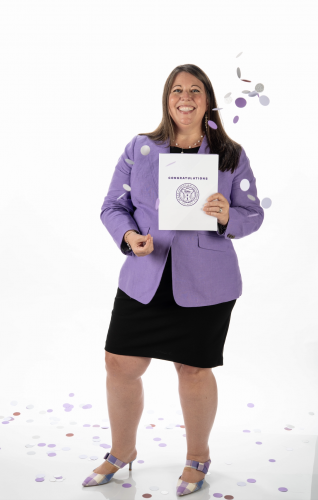
    Studio portrait of TCU Dean of Admission Mandy Castro, wearing a purple sports jacket and black dress, holding an acceptance letter with a purple “Congratulations” heading and seal.

    Mandy Castro sees herself and her team as “brand ambassadors” for TCU’s colleges, majors and the city of Fort Worth. Photo by Glen E. Ellman

    What stands out the most to you when reviewing a student’s application?  

    It depends on the student. If you’re looking for somebody who presents as an artist, you’re going to look for those components. If you’re looking for a student who’s going into business, is there a piece that aligns with business?  

    I’ll tell one little story. A student was a first-generation applicant whose essay was about his family celebrating his graduation from high school, and he’s going to be the first in his family to attend college. Then I opened his freedom of expression, which was a video clip, and it was a guy in workout attire, grunting through a deadlift, and he splices the video to him saying, “I’m so glad you watched that, because what I showed you was my one rep max of a deadlift. When I started high school, I was overweight and I started to work out with an older kid and he pushed me to continue with it.”

    So, in a short 30-second clip, I was able to see something that did not surface in the application and that set this student apart. I saw somebody who had worked really hard for their academic achievement, who was being celebrated and supported by their family, and also somebody who had had a transformational experience in high school that would lend me to believe that they could transition to college and succeed. 

    Which qualities make for great Horned Frogs?

    Our students are so diverse. I think that the students are academically astute; they’re ready for the challenge. They need to be able to hit the ground running and succeed in our rigorous curriculum. I think that intellectual inquiry just in the sense of, “I want to know more, I want to figure it out,” digging into the puzzle pieces and asking questions, aligns with who our students typically are. I think that when they look at the long term, TCU isn’t the destination; TCU is a stop that fortifies them on their path to what’s next.

    With TCU’s admission process becoming more competitive, which challenges does your team face?  

    The hardest part of admission is saying no; we get into the business so we can admit students. We have some very popular programs that are nationally recognized, and students are very interested in these. We’re trying to differentiate between students with a similar academic profile and figuring out who we can take and who we can’t. That’s why we have readers and multiple layers of review and evaluation so that we can find the most well-rounded class of students for each of our degree programs.

    What does being selective do for the university?

    It really elevates your peer set. Being selective allows us to choose the students who we can best support and help thrive in the most appropriate ways — those who can come and do research on our campus, who can graduate with a degree with pride and give back to our institution and our communities. Were really taking the whole mission, vision and values of TCU into consideration. And if we see ethical leaders and responsible citizens and potential world-changers, those are great, aligned students with us; when you can choose those students to be a part of your community, then they thrive here. 

    What do you think TCU’s most significant selling point is to potential students?

    TCU is safe and we care. We commissioned a study right before the pandemic, and we discovered that TCU had some very distinct characteristics that students found in us. We are people who are ambitious; we are goal-oriented. But the undergirding of all of that was this deep level of care where students could try and fail and then try and succeed in a place that wasnt going to write you off when you didnt do it right the first time, but a place where you could iterate and become better.

    “I find that working with young people is really life-giving — the students keep us young.”
    Mandy Castro

    What is something people might not know about your job?

    There’s much more data that goes into it than you would imagine. We don’t simply meet with students and tell them how wonderful TCU is and then they enroll — we have to be brand ambassadors for every college, every major, the institution as a whole, the city of Fort Worth, the state of Texas and the United States in general. So when we find students for TCU, it’s a multifaceted process that involves lots of different layers. During the evaluation and consideration, a student’s application is read upward of five to seven times before a decision is rendered. A lot of times people think, Im just filling this fluff out so that I can turn it in and nobodys actually going to lay eyes on it. Its exactly the opposite. 

    How do you stay inspired and motivated in your role?

    The changing environment of college keeps us on our toes. We’re fortunate to work in a place that has an academic cycle. We do different things at different times of the year, which is exciting to me. During one period, I’m preparing people to get ready to hit the road; during another period, we’re traveling; next, we’re reading applications; then we’re hosting lots of families on campus for events and programs. And all of those things are engaging in their own ways, so that keeps you motivated for what’s to come. The puzzle-solver in me likes to take what could be improved upon and tweak it moving forward to see if we can do a little bit better each time.

    Editor’s Note: The questions and answers have been edited for length and clarity.

  6. Handling With Care

    4 Comments

    Lisa Havens ’84 is a nurse, veteran, attorney and chief risk officer for one of the largest health care systems in the United States a system that cares for more Texans than any other.

    Her journey was born from a setback.

    As a high school sophomore, Havens applied to a nurse’s aide program at a joint vocational high school in her hometown of Springfield, Ohio. The program offered students the opportunity to learn a trade during their final two years of high school, and Havens was eager to pursue a career as a nurse’s aide. 

    She was rejected and surprised. In junior high, Havens had worked as an aide for an elderly neighbor who was bedridden, providing care at night so that the woman’s husband could sleep. At church, Havens assisted a woman with diabetes in administering insulin injections. 

    Havens’ high school guidance counselor suggested college instead. “No one in my family had ever gone to college,” Havens said, “and I didn’t really know the path to that.” The counselor enrolled Havens in classes that would prepare her academically and taught her how to fill out college applications.  

    She worked multiple jobs to earn money for college, one of which included serving as a nurse’s aide in a nursing home and exploring her passion for providing care: “I fell in love with clinical care,” she said, “and with the patients there. 

    Havens applied to TCU to be close to her brother, who had moved to Fort Worth. She was accepted, and the scholarship she was awarded made it financially possible for her to attend. Boarding the first flight she had ever taken, Havens moved to Fort Worth at age 17, unsure of what was next but eager to find out. 

    Clinical Care Calling

    Although Havens first considered becoming a school guidance counselor to assist other students the way her counselor had helped her, nursing continued to call to her. 

    Declaring nursing as her major, Havens dove into her classes, where she remembers feeling supported by the professors and by fellow students. TCU, she said, taught her to strive for excellence and prepared her well to provide clinical care “especially learning how to look at the whole person, not just the ailment.” 

    Among the important lessons she learned at TCU, Havens said, was the framework for clinical safety in nursing the Five Rights of Medication Administration. Ensuring the right patient is receiving the right drug in the right dose, through the right pathway and at the right time is a critical checklist for nurses. 

    Havens considered becoming a school guidance counselor to help others the way her counselor helped her, but nursing continued to call.

    Caring for the caregiver was another lesson Havens learned first at TCU. 

    “One of my nursing professors told us that if we needed a day for our own mental health, to take it, no questions asked,” Havens said. “She and my other professors stressed that we needed to take care of ourselves in order to care for patients. It was very forward-thinking. This powerful life lesson is something I carry with me today.” 

    Havens worked as a health care assistant at John Peter Smith Hospital in Fort Worth while a student at TCU and as a nurse at several Veterans Administration Medical Centers after graduation.  

    Caring for veterans and listening to their stories of service inspired Havens to join the U.S. Air Force Reserves; she also took inspiration from her father, who served in the U.S. Army. She served for six years, working in a clinical role one weekend each month and participating in additional clinical training two weeks each year. 

    “The VA was very supportive of continuing education and also of supporting the country through military service,” she said. “Most of the nurses on my unit had master’s degrees and continued to provide bedside care.” 

    Managing Risk, Finding Reward

    Earning her master’s degree in nursing from the University of Texas at Arlington in 1989 allowed Havens to sharpen her skills and explore new interests.  

    She went on to become a cardiovascular clinical nurse specialist at Methodist Dallas Medical Center; in that role, Havens deepened her interest in health care safety and began to proactively manage risk for herself and others.  

    “I had some exposure to risk and safety as a bedside nurse,” she said, “but as a clinical nurse specialist, I helped write the policies and do the audits to ultimately help nurses provide and patients have the safest care possible.” 

    Havens joined her hospital’s peer review program, a process used to assess nursing care, qualifications and the validity of any complaints. Reviews may be triggered by a patient care incident or initiated by a nurse who believes an assignment could violate the Nursing Practice Act. 

    On that team, Havens assisted with investigations and partnered with hospital leadership and attorneys on next steps. Through the experience, she found a new side of health care that interested heradvocating for nurses from a legal perspective. 

    “I felt like nurses and other health care providers needed an advocate. We can’t always control the outcome,” Havens said. “How do you explain that, protect the patient and write education that allows us to learn from things that happen to make us better?” 

    Havens decided to pursue her interest in risk, compliance and the legalities of health care by earning a juris doctor degree. She attended Baylor Law School with the goal of staying in the field of health care upon graduation and found that the skill set she had honed as a nurse readied her for the rigors of law school.

    “Analyzing issues and problems was great preparation for law school, which was a lot of logical problems and analysis,” Havens said. “I enjoyed figuring out the pieces of the puzzle and how they fit together.”

    After graduating in 1993 and clerking for the Texas Supreme Court for a year, Havens began practicing as an attorney, working on cases involving health care law. She joined a well-regarded firm that specialized in the field and served as a trial attorney.

    Photograph of Lisa Havens — TCU alumna, nurse, veteran, attorney and chief risk officer at Baylor Scott & White Health — standing in a hospital hallway with her hands crossed in front of her.

    As a U.S. Air Force Reserve nurse, Lisa Havens combined military discipline with clinical care — shaping a unique perspective she brings to health system leadership today.

    One of the firm’s clients was the system formerly known as Scott & White, which provided health care in Central Texas, operating a network of clinics and hospitals. After serving as outside counsel for the health care system, Havens was recruited for a position inside Scott & White as the system’s director of risk management and assistant general counsel.

    It was an amazing opportunity to come in-house and continue to partner with outside counsel as an organization that wanted to do the right thing. I always felt 100 percent supported in doing that next right thing,” Havens said. “That culture and support is why I went thereand why I have stayed.”

    Scott & White merged with Baylor Healthcare System in 2013, creating the largest not-for-profit health care system in Texas. In a series of promotions, Havens advanced to vice president of risk management, senior vice president of risk management, chief risk officer and then deputy general counsel.

    “Her path sounds unique to other people, of course, but Lisa has used the same core principle whether she’s a nurse, whether she’s military, whether she’s an attorney,” said Jennifer Salim Richards ’08, principal and founder of Richards Law, who has provided legal counsel to Baylor Scott & White since 2016. “She’s always about love, service, integrity first. She’s just worn different hats to perform that service.” 

    Today, Havens serves as chief legal officer for Baylor Scott & White Health, managing a team of 279 employees and outside counsel. She leads the legal, risk, compliance and internal audit functions, as well as government affairs and community investment. In her role, Havens also serves as legal adviser to the Baylor Scott & White board of directors and as a member of the system’s senior leadership team, reporting directly to the CEO, Peter McCanna. 

    Grounded in Integrity and Truth

    Throughout Havens’ diverse career in health care, one unwavering focus has remained at the heart of every role: doing what is right for the patient.

    One of the core things for me is always going back to our ‘why.’ We are here to provide care and comfort to patients,” Havens said. “I’m interested in helping caregivers stay focused on making it about patients and their families. How do we come together to provide that compassionate care? How do we do that and maintain resiliency? How do we listen to our providers, understand and support them so we can continue to provide excellent health care?” 

    “Lisa always starts with the premise that she’s going to do what’s best for the patient and what’s best for the mission,” Richards said. “As outside counsel, it’s such a gift to work with that mentality. You just have to bring her the answer grounded in integrity and truth.” 

    “One of the core things for me is always going back to our ‘why.’ We are here to provide care and comfort to patients.”
    Lisa Havens

    Havens reflects on her well-rounded career as being a gift in the form of a series of opportunities placed before her to learn and to grow as a professional and as a person. She points to her time at TCU as an example of how, with the right support, a person can reach their potential. 

    “I have extreme gratitude to TCU for taking in a 17-year-old who didn’t know anything,” Havens said, “and then guiding me, shaping me and preparing me for a life and a future after TCU. 

  7. Three Things to Watch in TCU’s Top-20 Tilt with NC State

    Leave a Comment

    No. 17 TCU Women’s Basketball closed its season-opening homestand on Wednesday night, dominating Tennessee State 122–39 after earlier decisive wins over Sam Houston and North Carolina A&T.  

    The most recent result was not only impressive but historic. The Horned Frogs’ 83-point margin of victory is the largest in TCU men’s or women’s basketball history, and the 122 points mark the program’s second-highest total against a Division I opponent in nearly five decades. 

    “In transition, this team is explosive,” head coach Mark Campbell said to open Wednesday’s postgame press conference. “If we can defend and rebound, there are just so many playmakers running around the court and so many skilled players. It’s been three games in a row now where the ball is zinging all over the place.”

    The Frogs were efficient and balanced during the midweek rout, going 17-for-27 (63 percent) from beyond the arc. No team in the country shot better than 39 percent from three over the course of 2024–25. Guard Maddie Scherr sank all six of her three-point attempts and finished with a game-high 22 points — her most since Dec. 21, 2023 — after missing all of last season with injury. 

    You’re just starting to see what Maddie’s able to do. She’s always been one of the best guards in college basketball,” Campbell said, noting that the now graduate student Scherr was a McDonald’s All-American coming out of Kentucky’s Ryle High School. 

    Forward Natalie Mazurek, who averaged four minutes per game last season (and never exceeded four points during her first 16 games as a Horned Frog), knocked down three three-pointers Wednesday — all within the final five and a half minutes of regulation — bringing the home crowd roaring to its feet each time. 

    “Special shout out for Nat, who works her tail off every day, competes every day, has been a huge part of our program the last two years,” Campbell said, “so really cool for her to get some minutes and be able to stick shots. 

    Contributions off the bench will be key if the Frogs are to capture what would be an impressive road win over No. 10 NC State on Sunday afternoon. 

    Photograph of a TCU women’s basketball player seen from a low rear angle, sitting with arms resting on folding chairs on either side during pregame introductions. A purple-lit jumbotron hangs overhead in a red-lit arena.

    Fresh off a record-setting blowout, the Frogs set their sights on a tough road test against No. 10 NC State. Courtesy of TCU Athletics

    The Wolfpack, a Final Four team two seasons ago, fell to the Frogs last year at Schollmaier Arena in a 76-73 thriller that vaulted TCU into the AP Top 25, setting the stage for an all-time year. 

    With Sunday’s rematch in Raleigh all but promising to challenge the Frogs in new ways, here are three things to watch as TCU looks to build on a stellar start. 

    Will off-court chemistry continue to show?

    The Horned Frogs aren’t just among the nation’s top 10 in scoring this season — they also rank fourth in assists, averaging 24.7 per game. The team has had a different leading scorer in each of its three wins.

    We all get along so well. We hang out outside of basketball,” Mazurek said. “We enjoy spending time with each other, and I feel like that plays a part on the court.”

    Photograph of TCU forward Natalie Mazurek preparing to shoot a basketball during a pregame warmup at Schollmaier Arena in Fort Worth, Texas, November 2025 NCAA basketball game.

    Natalie Mazurek knocked down three of the four shots she took from three-point range Wednesday night against Tennessee State. Courtesy of TCU Athletics

    “You see us on the court, vibing and just having fun, laughing with each other,” echoed Olivia Miles after posting her first double-double of the season Wednesday. “That’s what it’s all about at the end of the day. It’s bigger than basketball. These girls and these relationships last forever. We just aren’t afraid to be ourselves.” 

    NC State will be without guard Saniya Rivers, a two-time All-ACC defender who was the No. 8 overall pick in April’s WNBA draft by the Connecticut Sun. The Wolfpack haven’t been known for elite team defense under Texas native Wes Moore — in his 13 years as head coach, they’ve never ranked in the top 25 in scoring defense. But they do bring offensive firepower, with four players averaging double figures, including junior guard Zoe Brooks and junior forward Khamil Pierre, who each average a double-double through three games. 

    Will early top-15 showdowns for NC State factor in?

    The Wolfpack handled Maine on Tuesday night, 66-47, in their first contest of the season at James T. Valvano Arena — the storied venue named for the famous late coach.

    NC State’s other two early-season matchups, against No. 12 Tennessee and No. 8 USC, were both decided by a single possession.

    They’re not going to be nervous,” Campbell said. “That program has been at such a high level for years. And so they’ve played in tons of big games. They’re going to be well prepared.”

    TCU enters Sunday with three days’ rest and holds a trio of wins by 39-plus points. The Frogs don’t face another top-25 opponent until Jan. 7, when they visit No. 20 Oklahoma State.

    How will the Frogs fare in the paint? 

    TCU’s first loss last season, an 85-52 defeat to South Carolina at Dickies Arena in December, was largely decided in the paint. The Frogs were outrebounded 36-26 overall and 8-6 on the offensive glass. 

    Looking ahead to Sunday, NC State’s Pierre — a 6-foot-2 transfer from Vanderbilt — has been a beast on the boards early in the season, stacking up 14, 18 and 10 rebounds over the Wolfpack’s first three games. 

    The Frogs’ bigs have stepped up as well. Senior center Kennedy Basham recorded six blocks against North Carolina A&T on Nov. 6, tied for the second most of her career, while fellow transfer and sophomore center Clara Silva leads the team with 8.7 rebounds per game. 

    How TCU’s frontcourt matches up with Pierre and NC State’s size and athleticism in the paint could be a decisive factor on Sunday. 

    When the Frogs return to Schollmaier for a 6:30 p.m. tip against Tarleton State next Thursday, they’ll be aiming to extend their program record to 28 consecutive home victories.

    — Corey Zapata-Smith

  8. Giddyup Gang

    Leave a Comment

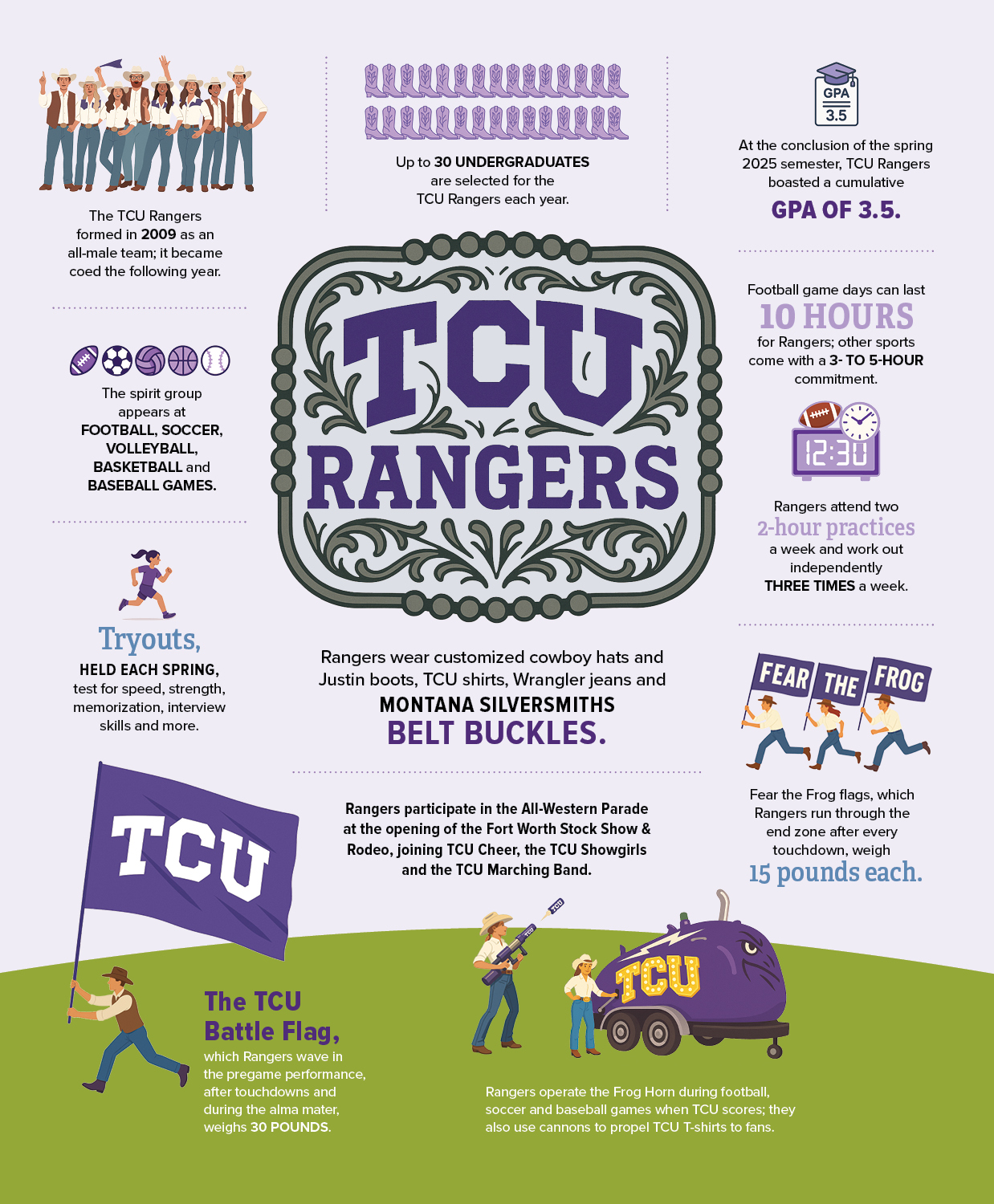
    The TCU Rangers, a coed spirit team that celebrates Western culture, does more than run flags across the field at Amon G. Carter Stadium. The team appears in a variety of campus and community events to create an “atmosphere where everyone feels a part of the family,” said Jason Lesikar ’02 (RM ’03), Rangers coordinator.

    Infographic showing various statistics and factoids about the TCU Rangers spirit team.

  9. From the Chancellor

    Leave a Comment

    AT TEXAS CHRISTIAN UNIVERSITY, research and creative activity are more than academic pursuits. They are catalysts for solving humanity’s most pressing challenges and preparing our students to be the pioneers of a rapidly evolving world.

    Under the leadership of Provost and Vice Chancellor for Academic Affairs Floyd L. Wormley Jr. and Vice Provost for Research Reuben F. Burch V, we are advancing toward Carnegie R1 research university status while preserving our cherished teacher-scholar model.

    Why is this important? Research excellence empowers students to think critically, analyze complex data and communicate insights, and draws world-class faculty who bring cutting-edge discoveries into the classroom. It amplifies our tradition of mentorship, where faculty guide students through authentic discovery and foster intergenerational relationships that last far beyond graduation.

    TCU’s commitment to excellence is yielding groundbreaking work across campus. For example: Political science faculty are reframing how we measure the quality of civic participation, our Center for Neurodegenerative Disease is developing treatments for Parkinson’s disease, and communication studies faculty are uncovering how strategic songwriting builds and connects global communities.

    Together, we are breaking new intellectual ground every day and shaping the innovators and thought leaders our world needs most.

    Lead On and Go Frogs!

  10. The Element of Time

    Leave a Comment

    From knowing about job openings the moment they post to following up promptly after an interview, being strategic about timing can make the difference between missing out on an opportunity and being hired. Mike Caldwell, executive director of TCU’s Center for Career & Professional Development, shared insights on how to stay a step ahead in the job search.

    How can I improve my timing as a job applicant?

    Organizations that you really want to work with — sign up for their email alerts, set up a profile, get job announcements sent to you so that you don’t miss the timing of new jobs. Government jobs will open in a window; it will open for 48 hours, and then it will close. Prioritize the jobs that you know have been posted recently. Some of my colleagues are hearing from employers that, because of the rise of AI bots applying to jobs on behalf of people, employers are capping the number of applicants.

    What do successful candidates do after turning in their applications?

    Find out if you have a contact within the organization — maybe it’s a TCU alum — and let that person know that you’ve applied; that can help you stand out as a candidate. You’re reaching out to find some insights about the company or the organization, asking if your contact has any additional advice. If the position has a closing date, pay attention to that as well. If it closed and you haven’t heard anything back, prioritize your new applications to other roles. You might hear back still, but maybe that means you weren’t selected in the first round.

    After an interview, how soon should you send a thank-you note?

    Immediately — that day. You could be the first interviewee; you could be the last interviewee. It shows that you’re conscious of time and that you’re motivated to follow up in a timely manner. It can really help set you apart. It used to be handwritten letters; if you’re interviewing on-site, a lot of applicants hand a thank-you note to the person at the front desk as they’re going out the door. That way, you’re still making that handwritten, personalized connection.

    If you don’t have that opportunity, follow up with an email; you might want to write a draft, save it, have it ready to go.

    If the timing isn’t right at a company that you want to work for, how can you forge a relationship for when the timing might be better?

    Not giving up, being persistent but not overly aggressive — just demonstrating your interest can really go a long way. If you miss out on an opportunity, you might be frustrated. But there might have been a better candidate in that circumstance; the next job, you might be the best candidate for that role. If you receive the rejection notice, thank them for their time. It really goes a long way if someone reaches out and says, “Thanks for letting me know. If there’s an opportunity in the future, I’d still love to work at your organization.”

     — As told to Laura Samuel Meyn


    Editor’s Note: The questions and answers have been edited for length and clarity.

    Send your career questions to tcumagazine@tcu.edu. For more information about careers, visit careers.tcu.edu.