ESPN Analytics gave TCU a 3.8 percent chance of beating West Virginialast Wednesday night after Mountaineer guard Jordan Harrison sank a 15-foot jumper with 11 seconds left.
Down 49-46, junior guard Donovyn Hunter stepped to the free throw line and made both attempts, pulling the Frogs within one with three seconds remaining. TCU immediately fouled Harrison, who had made all seven of her free-throwattempts to that point. But she clanked the first on this trip, leaving the door open.
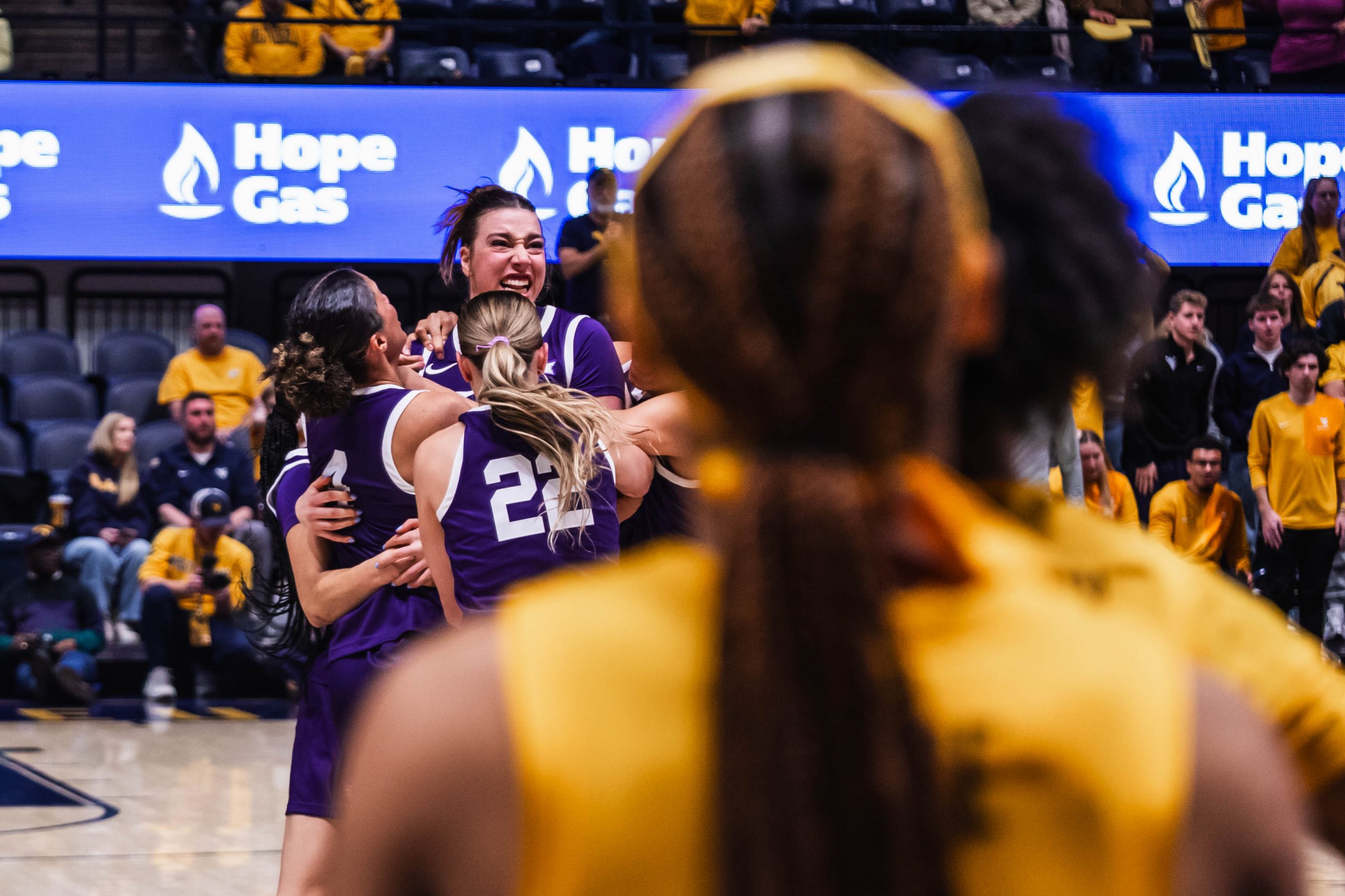
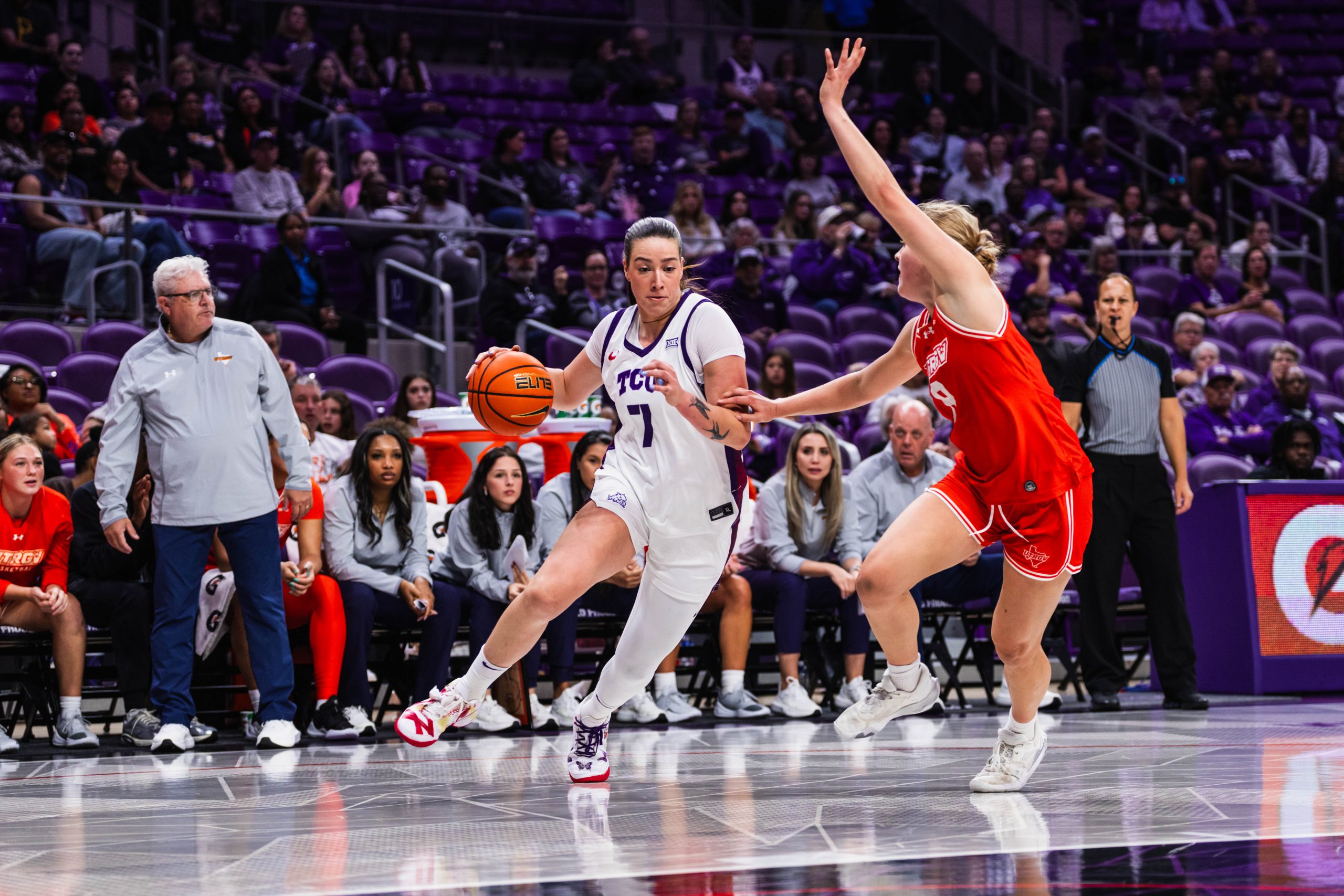
On the final possession, stretch forward Marta Suárez received a bouncing sideline inbound pass from Hunter, briefly facing up her defender before launching a three-pointer from the top of the arc. Two, one. The shot sailed high through the air, catching the left side of the rim and twirling through the nylon as the backboard’s LED lights illuminated red.
Teammates swarmed Suárez at midcourt as the No. 10 Horned Frogs escaped with their fifth Big 12 victory, improving to 17-1 on the season.
Marta Suárez’s buzzer-beating three-pointer lifted the Horned Frogs to a 51-50 road victory over West Virginia on Jan. 14. Courtesy of TCU Athletics
Suárez, who has enjoyed a career season but was 3-for-18 shooting for the game and 0-for-5 from three-point range prior to the winner, showed no hesitation in the crucial moment.
“It’s just the work that I put in. I know I’m a shooter. I’ve done that before,” the graduate transfer said in the postgame press conference. “And then, honestly, just my teammates, you know. We’ve had a great trip, and just coming out and knowing that I have a chance to get a win for them, and knowing how much it means for everybody, kind of just pushes me forward.”
TCU coach Mark Campbell echoed that resilience: “We just grinded and stayed in a fight, defended like crazy for 40 minutes. That gave us a chance and an opportunity to steal the game.”
The Wildcats Come to Town
The dramatic finish keeps TCU in a two-way tie for second in the conference standings with a dozen Big 12 contests remaining in the regular season. Saturday brings to Schollmaier Arena the Arizona Wildcats, whose 75-72 win over BYU on Jan. 6 stands as the squad’s only Big 12 victory to date.
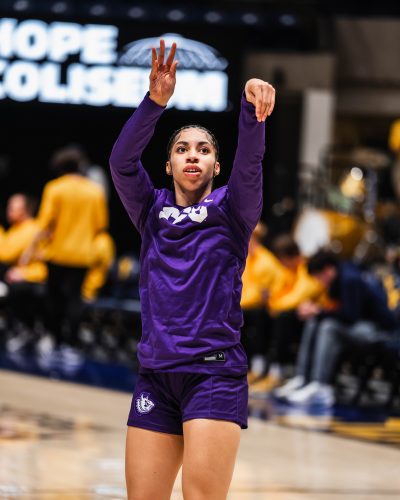
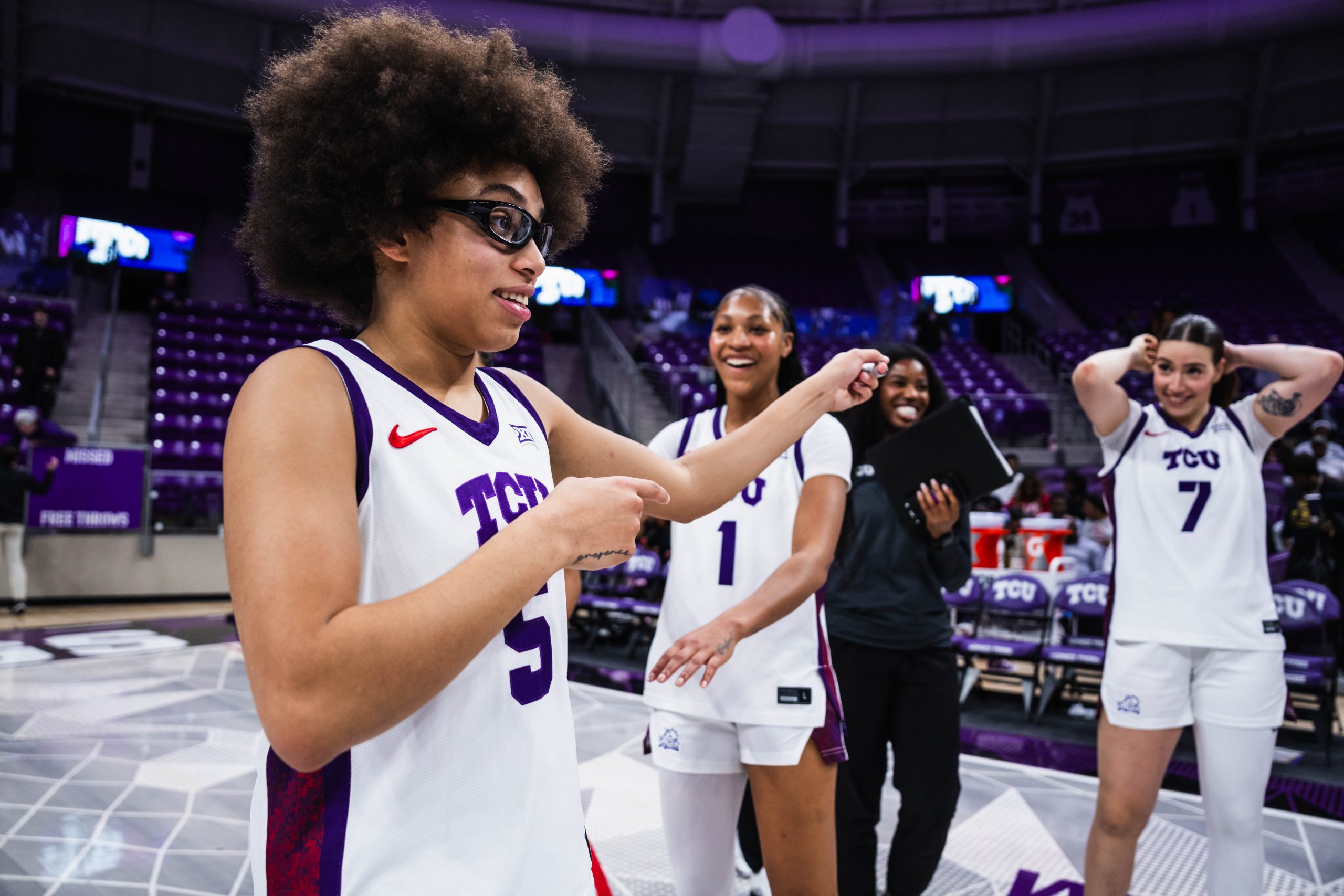
Veteran guard Veronica Sheffey logged a season-high 17 minutes during TCU’s Jan. 14 win at West Virginia. Courtesy of TCU Athletics
Arizona’s Adia Barnes era is no more. The now-SMU coach’s Tucson tenure saw seven consecutive winning seasons, peaking with a trip to the National Championship in 2021. Under first-year head coach Becky Burke, who led Buffalo to a WNIT championship last year in her third season with the Bulls, the Wildcats have dropped four of their last five.
Arizona will be without its leading scorer. Senior guard Mickayla Perdue suffered a recent wrist injury and is out indefinitely. The Cleveland State transfer was averaging a team-best 17.1 points per game. In her absence last Saturday, the Wildcats managed just 55 points in a loss to UCF at home.
They’ll still have senior guard Noelani Cornfield, who ranks fourth in the Big 12 with 119 total assists and is Arizona’s primary playmaker. Her 7.4 assists per game are more than triple that of any other Wildcat.
Next Up: Buckeyes, Then Unbeaten Red Raiders
Two days later, TCU faces perhaps its greatest test of the season at the Coretta Scott King Classic. The Horned Frogs travel to Newark, New Jersey, to meet No. 14 Ohio State on Martin Luther King Jr. Day, with tipoff set for 11 a.m. CT on FOX as part of a doubleheader at the Prudential Center.
The Buckeyes bring a five-game winning streak into the matchup, including an 89-76 dismantling of No. 12 Maryland last Sunday. Sophomore guard Jaloni Cambridge poured in 28 points over 40 minutes in that victory, narrowly missing a triple-double with nine rebounds and eight assists.
Then on Feb. 1, the Frogs face still-undefeated and 17th-ranked Texas Tech, which at 19-0 is off to its best start in program history. Having cracked the AP top 25 for the first time in 14 years, the Lady Raiders appear poised to snap a 12-year NCAA Tournament drought.
Tech guards Bailey Maupin and Snudda Collins are both shooting better than 35 percent from three while averaging 15.4 and 14.3 points per game, respectively. Meanwhile, 6-foot-2 junior Jalynn Bristow averages 7.1 boards and 2.1 blocks per game, placing her second in the category among Big 12 players.
The showdown in Lubbock will be the lone regular-season meeting between the teams and very likely pivotal in determining who tops the standings heading into the conference tournament in March.
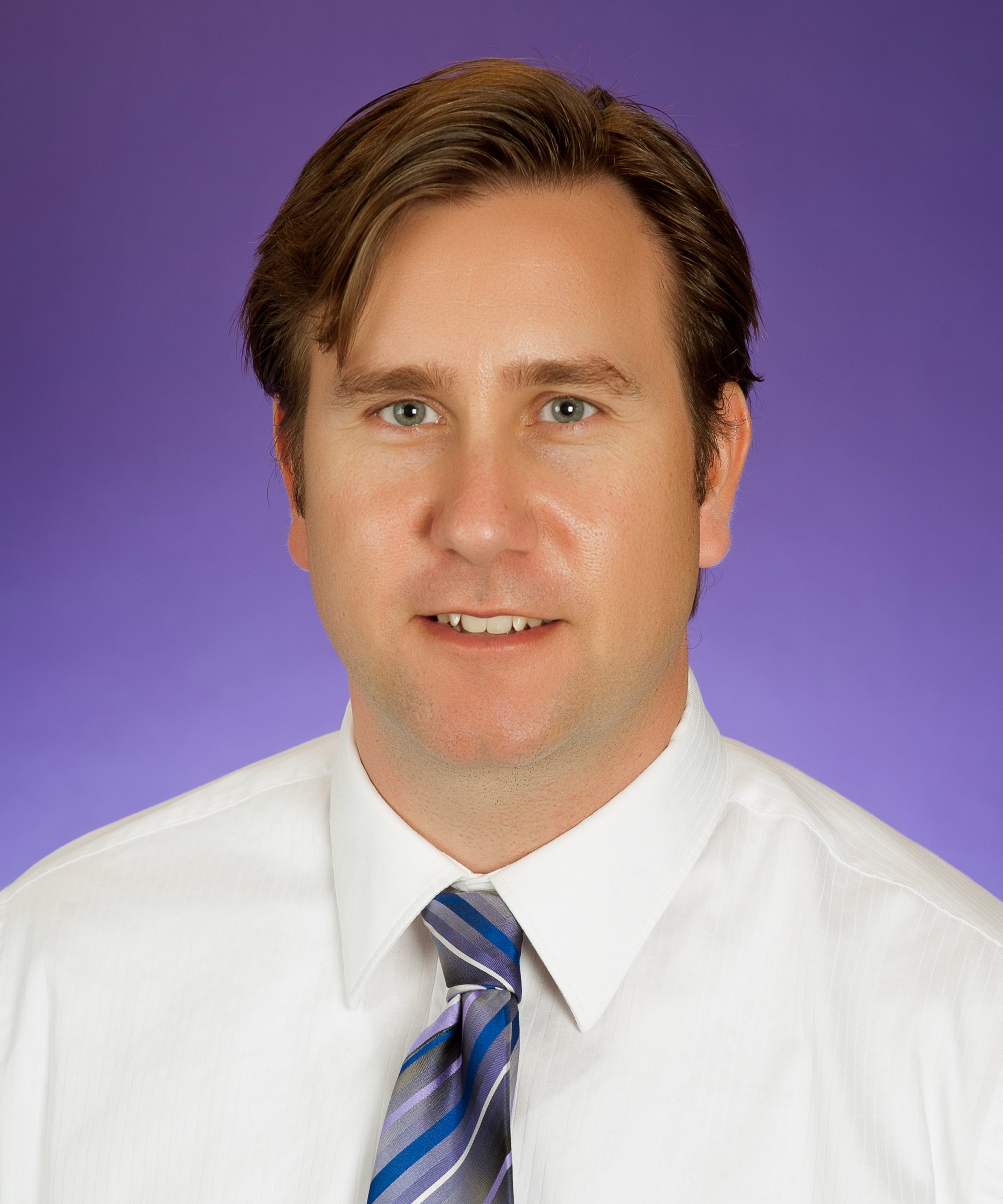
Christopher R. Watts, PhD, the Marilyn and Morgan Davies Dean of TCU’sHarris College of Nursing & Health Sciences, whose groundbreaking research on Parkinson’s disease and tireless advocacy for community health transformed countless lives, died earlier this week.
A nationally recognized expert in voice disorders and speech-language pathology, Watts spent nearly two decades at TCU building programs, mentoring students and translating cutting-edge research into tangible help for peopleliving with neurodegenerative diseases. His leadership elevated Harris College’s reputation while never losing sight of his central mission: serving people.
“We are dedicated to supporting the health and well-being of our communities,” Watts said on behalf of Harris faculty in 2023. “We aim to enhance global health through education, scholarship and innovation, and we prepare professionals to change the world for the greater good.”
He devoted his career to that vision — and built Harris College around it.
A Scholar Who Served
Watts joined TCU in 2008 as director and chair of the Davies School of Communication Sciences & Disorders, bringing with him a doctorate from the University of South Alabama and a passion for helping people with communication impairments. Under his direction, the Davies School flourished: Undergraduate enrollment grew by 60 percent, and graduate enrollment increased by 70 percent. He guided a major renovation of the school’s facilities, expanded clinical services and substantially increased graduate financial aid.
Under Christopher Watts’ direction, the Davies School of Communication Sciences & Disorders thrived, with undergraduate and graduate enrollment increasing substantially. Photo by Scott Murdock
After serving as assistant dean for strategic initiatives from 2015 to 2018, where he led development of Harris College’s vision, mission and strategic plan, Watts was named dean in 2019. His leadership philosophy was straightforward: get faculty into the community to help real people.
Watts ensured the successful implementation of Harris College’s first PhD program, which is in health sciences and is “graduating researchers with the interdisciplinary knowledge and skills so desperately needed to enhance global health,” said Susan Mace Weeks, executive vice provost and Watts’ predecessor as dean of Harris College.
“Most of the research done by our faculty is applied research,” Watts told TCU Magazine. “Our faculty are going out into the community to help real patients, which aligns with our vision for transforming health care.”
The Parkinson’s Mission
Watts’ most enduring legacy may be his work addressing Parkinson’s disease —a calling that united his expertise in voice and swallowing disorders with a deep commitment to improving quality of life for patients and families.
His research, which started with a Parkinson’s-related dissertation, was prolific: more than 80 peer-reviewed publications examining how the disease affects speech, voice, and swallowing over three decades of study.
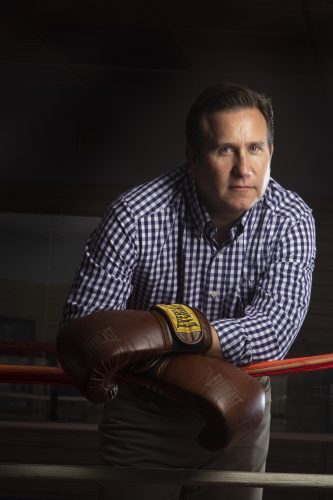
Christopher Watts partnered with boxer Paulie Ayala on Punching Out Parkinson’s, a program that showed boxing significantly improves respiratory strength in patients. Photo by Joyce Marshall
“Chris Watts was a visionary leader who understood that great research serves real people,” said Floyd L. Wormley Jr., TCU’s provost and vice chancellor for academic affairs. “His work illustrated the power of scientific inquiry combined with deep compassion for patients and their families. As TCU advances our research mission, Chris set the standard for what it means to pursue excellence while staying grounded in community impact. He built bridges between the laboratory and people’s lives; we will miss him dearly but his influence will shape our work for years to come.”
Watts never let research remain in academic journals. In 2016, he created Endeavor Parkinsonology, a Fort Worth initiative connecting newly diagnosed patients with evidence-based exercise programs, support groups and educational resources.He saw a critical void: “So many people have received a Parkinson’s diagnosis and been given a prescription for dopamine and told to come back in six months. And they’re like,‘What do I do now?’ ”
Watts also established the Tarrant County Parkinson’s Group, which met several times a year at TCU, bringing together patients, caregivers, faculty and students to discuss treatments and share support.
Recognizing that exercise could help combat symptoms, Watts collaborated withformer world champion boxer Paulie Ayalato establish Punching Out Parkinson’s, an innovative boxing-based exercise program. He published a 2023study showing that non-contact boxing increased respiratory muscle strength by 60 percent or more in men with Parkinson’s after a year of biweekly resistance training.
In 2024, he co-founded TCU’s Center for Neurodegenerative Disease with Michelle Kimzey, associate professor of nursing, establishing Fort Worth as a hub for Parkinson’s and dementia research, education and support.
The center’s creation was catalyzed by a $1 million gift from the Zoota family, whose late patriarch Murray Zoota lived with Parkinson’s. The donation funded the Eleanor & Murray Zoota Endowed Professorship and launched the Zoota Family Leaders in Parkinson’s Disease Speaker Series in 2023, bringing global experts to Fort Worth.
“The world is aging, and the United States is aging, and dementia and Parkinson’s disease are significant problems of aging,” Watts said. “And guess what? TCU is doing something about it.”
Building Connections, Changing Lives
Throughout his tenure at TCU, Watts emphasized that Harris College’s strength came from its deep community roots.
“For decades, our world-class faculty has conducted research in the community for the benefit of the community,” he said. “Our long and strong connections with Fort Worth and Tarrant County are leading to better health outcomes.”
“Chris Watts exemplified TCU’s deepest commitments — to education that transforms, to research that serves our community and to leadership grounded in genuine care for others,” said TCU Chancellor Daniel W. Pullin. “He didn’t just study how to improve lives, he devoted himself to doing it, bringing hope and help to patients and families facing Parkinson’s disease. His legacy will continue through the students he mentored and the community he brought together in common purpose. The TCU community and Annie and I extend our sincere condolences and will keep his family and friends in our prayers.”
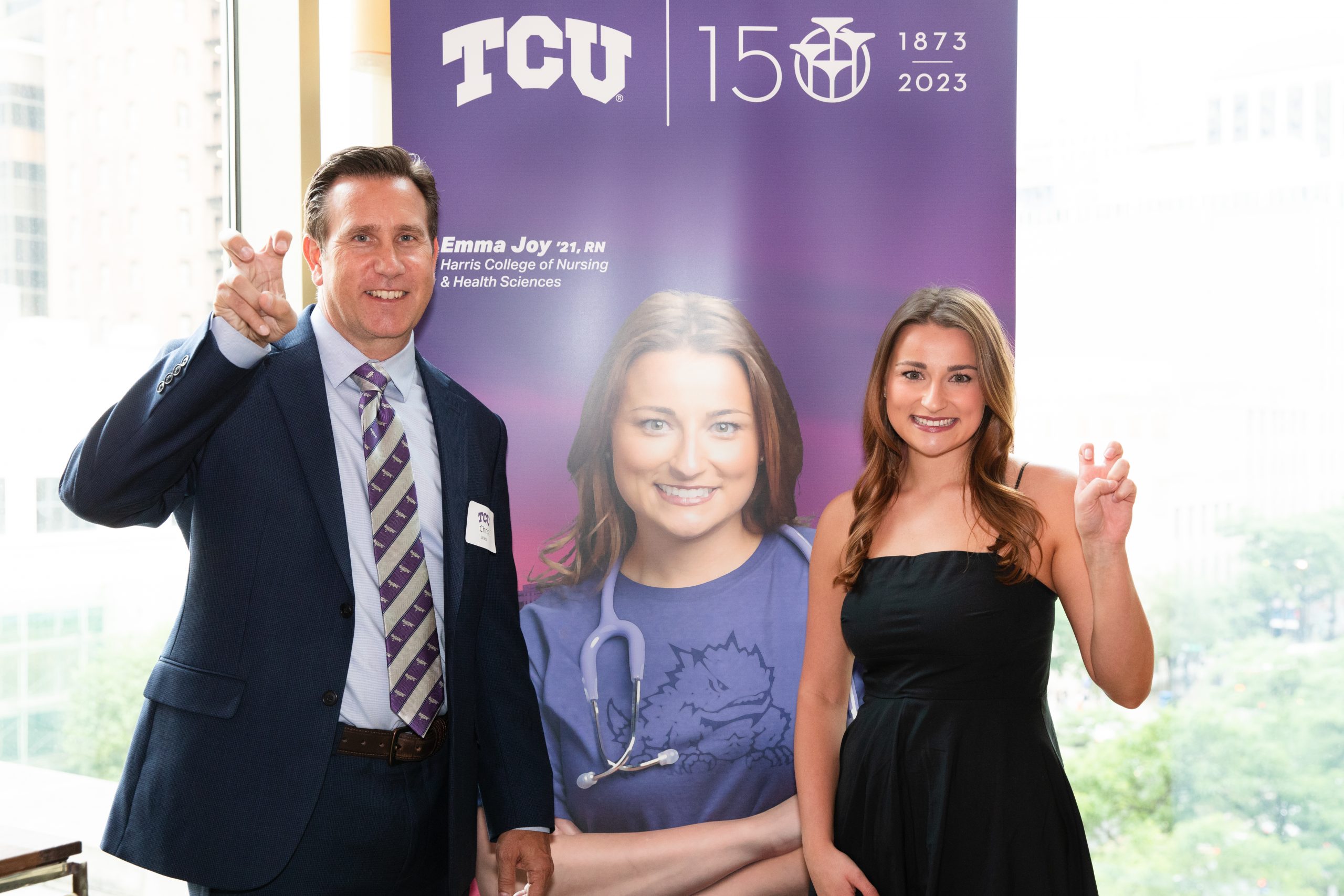
Christopher Watts celebrated student achievements throughout his career, including at the 2023 installation of TCU’s 150th anniversary mural in Chicago featuring Harris College graduates. Photo by Amy Peterson
As dean, Watts secured more than $17.75 million in gifts and commitments, including major endowments for distinguished chairs, student scholarships and the Center for Neurodegenerative Disease. He envisioned the center eventually funding pilot research projects focused on Parkinson’s disease and dementia, bringing faculty and community together to solve problems.
Watts was elected Fellow of the American Speech-Language-Hearing Association in 2015 and received TCU’s Wassenich Award for Mentoring in 2012.
“TCU lost someone truly great this week,” said TCU Trustee Marilyn Davies. “His time at TCU and on earth was too short, but his vision and ideas elevated TCU and all of the Harris College programs. The college and our students are nationally recognized in large part due to his work and the dedication of his team over his 17 years at TCU. This is also a personal loss for me and my family — he was a friend and has been an inspiration to us.”
Christopher R. Watts is survived by his wife, Deborah Watts; daughters Lindsey Watts ’21 and Emily Watts ’22; and the countless students, faculty, patients and families whose lives he touched through his research, teaching and unwavering commitment to improving health in the community.
Christopher Watts’ funeral is scheduled for Monday, January 19, at 10:00 am at Bluebonnet Hills Funeral Home, 5725 Colleyville Blvd, Colleyville, Texas 76034.
The family is requesting that people wear purple or royal blue in his honor.
In lieu of flowers, the family is requesting that donations be made to Punching Out Parkinson’s.
In this new series, TCU Magazine visits with alumni in the food and beverage industry. Send recommendations to tcumagazine@tcu.edu.
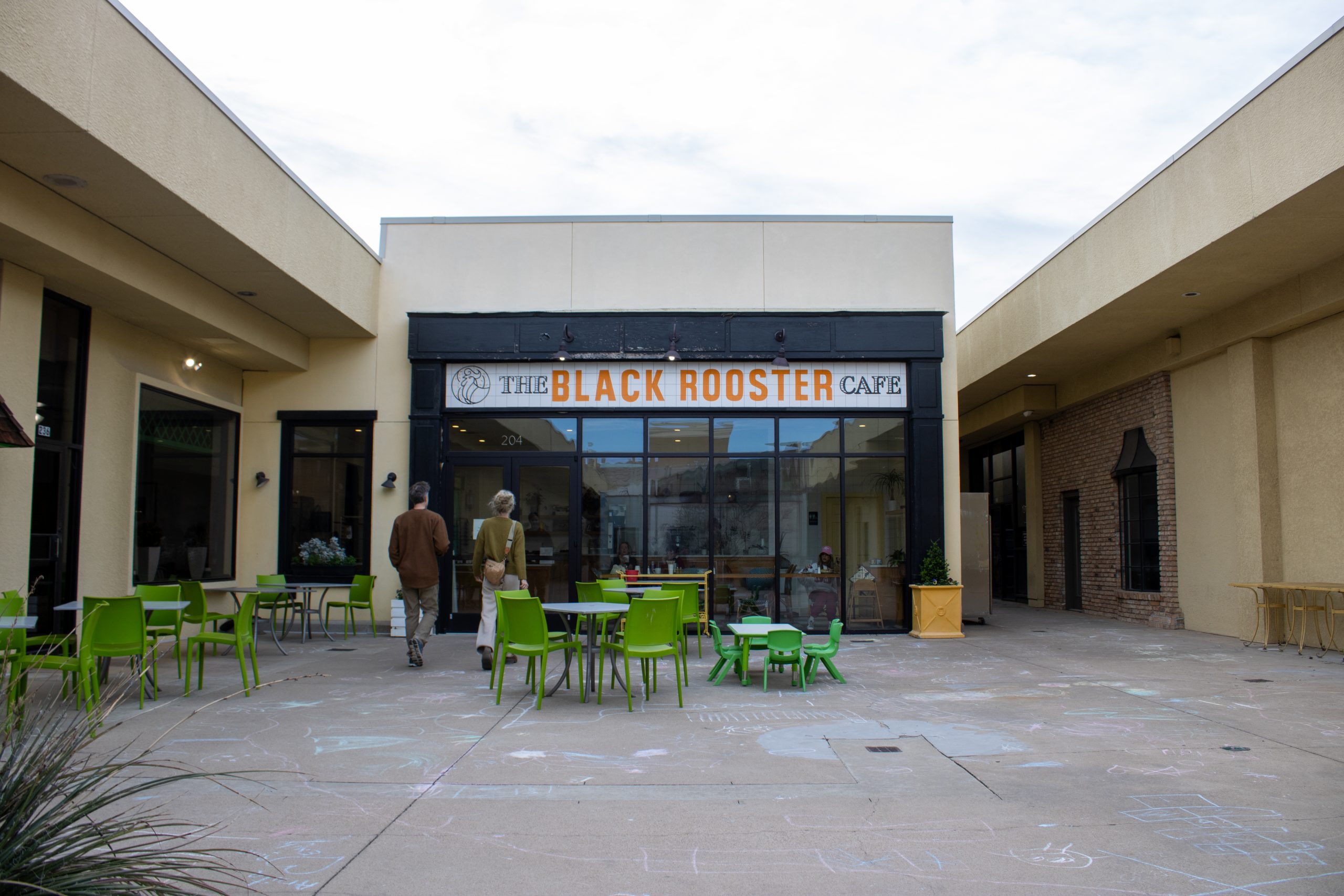
Imran “Immy” Khan’13 MBA and his wife, Lauren,purchased The Lunch Box, known for its classic chicken salad, while he was in graduate school at TCU. In 2014, they addedThe Black Rooster Bakery, known for itsartisanal pastries, to their portfolio. They later moved the bakery from Forest Park Boulevardto a new space by The Lunch Box, tucked into a courtyardoff Camp Bowie Boulevard in Fort Worth. Today, the businesses operate side by side, offering dine-in, takeout and a brisk catering business that delivers to schools, churchesand businesses across Tarrant County.
What drew you to the restaurant business?
I grew up with three older siblings and we always had large gatherings around food and just enjoyed the camaraderie, whether at home or going out to a restaurant as a group. Being able to provide that experience to others was something that was attractive to me. The Lunch Box is a business that had been running successfully for a very long time, and like a lot of things in life, timing is everything. When I was getting my MBA at the Neeley School, the owner of The Lunch Box was looking to sell. We were able to acquire the restaurant for a dollar amount that was far lower than trying to start a new idea that would require a lot of build-out costs and other development and research costs.
How did your MBA from TCU help you as an entrepreneur?
It gave me the confidence to be able to understand all the facets that go into operating a business and to be able to make high-level decisions. The ability to move into an entrepreneurial project — whether it was signing a long-term lease for hundreds of thousands of dollars, negotiating contracts with vendors, hiring, being able to interact with employees of all different levels of experience — TCU just gave me that extra level of skill and personal development to enter into the business world and thrive in that tough environment.
The Lunch Box has been open for more than 50 years, and The Black Rooster Bakery has been operating for 15 years. What have you kept the same, and what have you changed?
We’ve tried to keep the core products the exact same — same recipes, same ingredients — regardless of the cost increases that have come along over the years, so we can maintain that consistency. Every decision we make is driven by feedback from our customers. In The Lunch Box, we’veadded the Napa Valley salad and the TCU Turkey sandwich that has been very popular for our catering customers as well. And in The Black Rooster, we took our basic croissant recipe and expanded into the various flavor options — meat-filled, fruit-filled, chocolate-filled.
The Black Rooster Bakery operates adjacent to The Lunch Box in a courtyard off Camp Bowie Boulevard in southwest Fort Worth. Photo by Corey Zapata-Smith
What do you think has made The Lunch Box successful for so many decades?
I think it’skeeping things simple, not chasing the latest fadand treating people the right way —both customers and employees.
Do you have a regular order?
I don’t — I try to sample all of our food. Our chicken salad is our most popular seller at The Lunch Box and with the plain croissant from The Black Rooster, that is really a great combination. My son, who’s now 18 months old, that’s his favorite thing to eat for lunch — he’s happy with chicken salad and a butterycroissant.
Editor’s Note: The questions and answers have been edited for length and clarity.
A contested close-range attempt from Arkansas-Pine Bluff’s Jailah Pelly grazed off the rim. Olivia Miles leaped from the low block and pulled down the rebound with her right hand. Miles started up the floor. A whistle blew. Timeout.
In exhaustion and exaltation, the two-time All-American bent over at midcourt, pulling her jersey over her face, as the home crowd rose to its feet.
By the 3:27 mark of the fourth quarter in Tuesday night’s 109-54 blowout of Arkansas-Pine Bluff, Miles had compiled 25 points, 11 assists and 10 rebounds to secure her third straight triple-double and the ninth of her collegiate career, tying her for third all-time in NCAA history. Only four-time All-WNBA guard Sabrina Ionescu and two-time AP Player of the Year Caitlin Clark have recorded more.
Already subbed out and applauding from the bench was graduate forward Marta Suárez, who on the same night posted 20 points, 10 assists and 10 rebounds for her first career triple-double. The pair made NCAA history: never before had two teammates both achieved the feat in the same game against a Division I opponent.
Olivia Miles, left, and Marta Suárez, right, became the first teammates in NCAA history to record triple-doubles in the same game against a Division I opponent during a Dec. 16 win against Arkansas-Pine Bluff. Courtesy of TCU Athletics
“This stuff doesn’t happen,” head coach Mark Campbell said after the game. “This is not normal. But I’m loving it.”
For Miles, the accomplishment was secondary to simply staying on the court. After multiple injury-plagued seasons at Notre Dame, the graduate transfer has found a new appreciation for being on the floor.
“I’m satisfied because I’m healthy at the end of every game,” Miles said. “It doesn’t matter if I have zero points or 25 points. Being hurt has taught me to value each possession, each game, and if I make it through 40 minutes healthy, it’s a win for me. These things are just bonuses.”
Those bonuses are piling up at the perfect time. But Miles and Suárez aren’t the only ones thriving. Production across the roster, along with the on-and off-the-court chemistry, just a dozen games in, has been impressive. For Suárez, sharing the historic night with Miles made the moment even sweeter.
“To be able to do it with her makes it so much more special,” Suárez said. “She’s just such a good teammate and such a good friend. I love her to death.”
With Saturday’s Big 12 opener against Kansas State looming, the Horned Frogs seem to have found their stride, if they ever lost it at all. The win over Arkansas-Pine Bluff counted for ninth-ranked TCU’s 25th in 26 games dating back to early February of last season.
The loss that immediately preceded that dominant stretch? Kansas State.
What will we see against the Wildcats?
One of only two Big 12 opponents to defeat TCU across the Frogs’ 21 regular-season and conference tournament contests in 2024-25, Kansas State has stumbled out of the starting blocks in 2025-26.
With last year’s second-leading scorer Serena Sundell on to the WNBA and 2024-25 All-Big 12 forward Temira Poindexter having graduated, the Wildcats sit only a game over .500 at 7-6, with non-Power 4 losses to South Dakota, South Dakota State, Green Bay and San Diego State. Even still, Campbell warns against taking unranked K-State lightly. The Wildcats were able to rally from a fourth-quarter deficit to down No. 14 Ole Miss, 61-60, on Dec. 7, a result that stands as the Rebels’ lone defeat of the season.
“Coach [Jeff] Mittie’s an elite college basketball coach,” Campbell said of the former longtime TCU head coach. “He maximizes his group every year. This year, they changed their style of play a little bit. Obviously, they had Ayoka Lee over the last couple of years, and she was one of the most dominant centers in college basketball. And so, he’s been in the league a long time. He knows the Big 12. He is gonna have his group locked in and ready to go.”
TCU should have reinforcements coming into the conference opener. Campbell said the team expects to have graduate guard Maddie Scherr back in the lineup Saturday after she sat out Tuesday night’s win. Kennedy Basham’s status remains up in the air after the senior center hurt her left ankle in the second half. She ended the game on the bench, an ice pack wrapped around it.
“My guess is she tweaked it and she’ll be fine,” Campbell said.
Should Basham be limited or unable to go, expect an expanded role for graduate forward Natalie Mazurek, who played a season-high 11 minutes against the Golden Lions on Tuesday.
Donovyn Hunter has hit at least one three-pointer in each of TCU’s 12 games this season, reaching double figures in all but two contests. Courtesy of TCU Athletics
Elsewhere for the Horned Frogs, keep an eye on junior guard Donovyn Hunter, who is playing efficient basketball to spark a career season to date. The Oregon native’s nightly averages of 14 points, 3.5 rebounds and 1.8 steals are all personal bests, as are her 52.4 percent field-goal rate, 41.4 percent mark from three-point range and 77.8 percent rate from the free-throw line.
First tip Saturday is set for 4 p.m. at Schollmaier Arena.
“It is a great opportunity, December 20, to come pack the Scholl,” Campbell said, “and make sure this team and this group has a great crowd to get the Big 12 season started. I know Fort Worth will show out, they have. But let’s get this party started this Saturday.”
Before he became a five-time Louisiana state champion at St. Thomas More Catholic High School in Lafayette, Louisiana, and long before the Las Vegas Raiders came calling, Jack Bech was a soccer kid.
He was about 5 years old at the time, just starting to play. His mother, Michelle Bech, remembers sitting on the side of the field at one of his early games, watching her youngest child chase the ball with boundless energy.
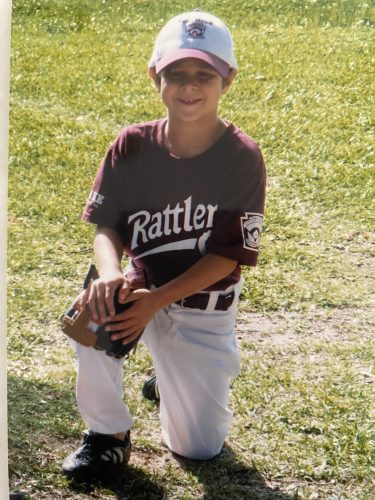
From the soccer pitch to the Little League baseball diamond, Jack Bech dominated youth sports growing up in Lafayette, La. Courtesy of the Bech family
“I will never, ever, ever forget,” she said. “He was driving the ball down the middle of the field. … All of a sudden, he leaves the ball and starts running towards me at an angle. I’m wondering, ‘What is he doing?’
“He’s running off the field towards me. He jumped in my lap, planted a big ol’ kiss on my lips, gave me a big hug and told me how much he loved me. Then he jumped off my lap, ran onto the field, took the ball away from whoever else was slowly trying to get it down the field and triumphantly scored the goal, detour and all.”
That moment, Michelle said, still sums him up: a mix of tenderness and tenacity, affection and fire. Even then, his athleticism stood out, but so did his instinct to connect. “He’s always been so full of love, so full of joy,” she said. “And really, ultimately, he has been the rock of our family.”
Football in the Blood
Two of Jack’s uncles played football at LSU, and uncleBrett Bech was a New Orleans Saints receiver in the late ’90s. Jackgrew up attending LSU football games and playing the sport with his older brother, Tiger, from the moment he could run.
Tiger, nearly six years his senior,often roped Jack into pickup football games in the yard, where an alley of live oaks framed the makeshift playing field. Wearing nothing but a diaper, Jack would run into the fray, taking hits from older kids and often coming inside with tears streaking his face. No matter how many times Jack was knocked down, he always returned for more.
Those early battles with Tiger and the neighborhood boys taught toughness. Jack still carries a straight scar down the back of his head from the staples he needed after splitting his scalp during a wrestling match with Tiger.
Lance Strother, director of adult ministry and outreach and longtime wide receivers coach at St. Thomas More, met the Bech brothers while Tiger was a student there.
Though the Bech brothers never took the varsity field together, younger brother Jack, right, followed in his elder brother Tiger’s footsteps as one of the most dynamic receivers in St. Thomas More High School history. Courtesy of the Bech family
Tiger mentored his younger brother directly. The two argued from time to time, as siblings do, Strother said, “But they loved each other like best friends, too.”
“Tiger was not passive in coaching up Jack and telling Jack what he’s capable of,” Strother continued. “So Jack heard from his own mind and heart, and he heard from his older brother, who he looked up to, ‘Hey, you’regonna play in the NFL. Nobody can stop you.’ ”
Jack grew into a varsity regular by his sophomore season of high school.
“He and Tiger were both uniquely strong in the weight room,” Strother said. In his final two seasons at St. Thomas More, Jack hauled in 150 passes for 2,827 yards and 34 touchdowns. He contributed to three Louisiana state titles in basketball and two more in football, winning MVP of that championship game his senior year.
Attention from recruiters, anywhere from Louisiana Tech to Vanderbilt, trickled in.
He held out hope for an LSU offer.
“He knew that something great was coming from somewhere, whether it was LSU or another school,” said Michelle, who, like her husband, Martin, is a graduate of the university.
A week before Halloween 2020, then LSU head coach Ed Orgeron and his staff extended Jack an official offer.
Bayou Bengal Becomes a Fort Worth Frog
Jack had done what generations of Louisiana kids dreamed of by pulling on the purple and gold. But the story didn’t end there.
He spent two seasons with the Tigers, appearing in 25 games and starting 11. As a first-year target under offensive coordinator Jake Peetz, now of the Seattle Seahawks, he earned significant playing time and led the team with 43 catches.
His sophomore season, under new head coach Brian Kelly, Jack’s role diminished amid injuries and scheme changes.
Jack Bech announced his decision to transfer to TCU in December 2022. In 2024, he became just the fifth Horned Frog to surpass 1,000 receiving yards in a season. Courtesy of TCU Athletics | Amanda Transou
“He just called us up one day and said, ‘Hey, mom and dad. I’ve decided to leave LSU,’ ” Michelle remembers Jack saying after the season, “ ‘And I really want to go to TCU.’ ”
Jack said headapted the vision he’d had since childhood: to play big-time college football and one day reach the NFL. “That’s one of your dreams, being able to play at Death Valley. Being able to go there was a true blessing and gift,” he said. “My mom always said that God put me there to live out one of my dreams but eventually had a greater plan for me to be somewhere else. And that plan was to bring me to TCU.”
Jack had visited TCU as a high schooler.“He liked the energy of the coaches and the school,” Michelle said. “He loved that it was a faith-based college.”
TCU offered Jack around the same time LSU did and made his original short list. When it came time for a change, the Frogs were a natural fit.
“It took a lot of courage to do what he did, to leave a place that knew him so well, that loved him,” Michelle said of Jack’s decision to transfer. “He always bets on himself, no matter what anyone else says.”
Soon, Jack was loading up his truck with belongings and his dog, Zion, and pulling out of the family’s driveway for the six-hour drive to Fort Worth.
Heart of the Team
Jack’s easygoing nature helped him settle quickly in Fort Worth.
Luke Lingard, a senior linebacker and son of two Horned Frog alums, got to know Jack as his roommate on team road trips during the 2023 season.
“He would make time for anybody,” Lingard said. “He could talk to anybody, it didn’t matter who it was: equipment guy, trainers.”
Though injuries hampered Jack’s 2023 season, Lingard saw the work behind the scenes and knew what was coming.
“People didn’t really understand how good he was,” Lingard said, “but I kind of always knew because of how he attacked every day.”
Jack would routinely stay after practice, Lingard said, to catch a “freakish amount” of machine-tossed balls. Back at the house (the two roomed together full-time during the 2024-25 school year) Jack refused to miss his nightly stretch routine. “Nothing could get in the way,” Lingard said.
In 2024, Jack became only the fifth TCU player to top 1,000 yards receiving, joining Josh Doctson ’15, Quentin Johnston, Jalen Reagor and Reggie Harrell ’04.
“It was one of the best decisions I’ve ever made in my whole life,” Bech said of his decision to transfer to TCU. “It taught me how to become comfortable being uncomfortable, going out in a new place, not knowing anybody, going and having to make new friends … so many people who are my best friends and who are going to be my best friends for the rest of my life. Sometimes you gotta do hard stuff to get to where you’re going.”
No. 7
Bech and fellow NFL prospect Savion Williams ’24, now a Green Bay Packer, sat out the New Mexico Bowl following their senior season, a game the Frogs won against Louisiana to finish 9-4.
Less than a week later, the Bech family’s new year turned tragically dark. On the morning of January 1, 2025, Tiger was killed in a truck attack on New Orleans’ Bourbon Street that left 14 people dead and dozens more injured. His close friend and former Princeton teammate, Ryan Quigley, survived but sustained serious injuries. In the aftermath, one report suggested Tiger might have pushed a young woman out of the truck’s path, a possibility a paramedic later said aligned with what they observed at the scene.
In the days that followed, the Lafayette community rallied around the Bech family.
The Mass of Christian Burial, held the following week at the Cathedral of St. John the Evangelist in Lafayette, reflected the immense affection that family, friends and community members held for Tiger. The pews and side aisles overflowed with mourners, and an additional space was set up with televisions for those unable to fit inside.
During the service, Tiger’s love for life and for those around him was on full display.
“I imagine the church is this full because a lot of people feel the same way about this guy,” said Reverend Andrew Schumacher, before noting that Tiger called his grandmother twice on New Year’s Eve, mere hours before the attack. “Do you know how many grandchildren are calling their grandmothers on New Year’s Eve? … Tiger was. Because he loved big.”
The Bech siblings, from left: Tiger, Ginnie, Jack and Sophie. Courtesy of the Bech family
When Tiger’s siblings took the pulpit together, they began by honoring every life lost that day.
“Tiger is each one of you,” his sister Ginnie said. “He’s the love that y’all have shown our family.”
“These last few days, I have seen some of you who may be shy and reserved, meeting new friends and laughing endlessly in corners of my home,” sister Sophie said. “I have seen some of you swarming us and picking up every last piece that you can think of. I have seen and heard new facets of Tiger I did not know existed. I realized Tiger has orchestrated all of this from heaven. He has brought us all together.”
Finally, Jack stepped to the microphone. He opened his remarks with a series of questions: “If Tiger was your best friend, please stand up. If anyone in this room has ever had somebody try to crack them up and bring forth so much laughter every single time you saw them, please stand up. If anyone in this room has ever had someone do something kind for them and lifted them up in a time of need, please stand up. If anyone in this room has ever had someone reach out and check on them, someone they hadn’t seen or heard from in years, please stand up. If anyone in this room has ever had someone stand up for them or protect them, please stand up. If anyone in this room has ever known someone who electrified a room with their presence and unrivaled enthusiasm for life, please stand up. If anyone in this room has ever had a moment in their life when someone made you feel like you were the most important person on Earth, please stand up.
“I just asked seven questions, and everyone in this church is standing up. This is the perfection and completion of the No. 7, which is God’s number.”
A Catch for Tiger
In the weeks that followed, football became both refuge and reminder. Arriving in Mobile, Alabama, for the Reese’s (now Panini) Senior Bowl, Jack wore the same No. 7 his brother once wore.
With precisely seven seconds remaining in the fourth quarter, his team trailing and facing fourth-and-goal, Bech slipped through traffic near the goal line and hauled in a short pass from Memphis quarterback Seth Henigan. The catch sealed a 22-19 win for the American squad, a walk-off finish that felt scripted for the moment.
“Of course he performed in that game and it ended magically, and he won the MVP,” said Jack’s father, Martin. “What more can you say? It was just a very special event for him and our family.”
Standing on the field amidst cameras and postgame commotion, Bech pointed skyward.
“Man, it’s simple, my brother has some wings on me. He gave them to me and he let that all take place,” Jack told NFL Network’s Tom Pelissero. “Our lord and savior Jesus Christ, Tiger, nothing else but them. They’re the reason I did what I did today.”
Triple Sevens
About three months after the Senior Bowl, Strother led what he called “the single most distracted worship session I’ve ever led,” deep in the mountains of Puerto Rico. His phone buzzed relentlessly.Friends and neighbors were messaging nonstop about the NFL Draft, and about Jack Bech.
Back in Lafayette, a different gathering was underway: a prayer service for Tiger in a chapel on St. Thomas More’s campus, just before the draft party in the school’s new athletic building. Lingard attended, as did former TCU wide receiver JP Richardson, now with the Chicago Bears.
“Nobody was more deserving for something like that than Jack,” Lingard said of his friend being drafted.
Michelle reflected on the moment. “Jack wanted to start that night off in remembrance of Tiger and praying for him. … And that’s exactly what we did.”
After the service, the congregation moved across the parking lot for the draft party. High school coaches, friends from TCU and family gathered around tables heavy with Lebanese and Greek food, Jack’s favorites.
“We would have never guessed it would be Las Vegas,” Michelle said, recalling their surprise when Raiders general manager John Spytek and head coach Pete Carroll called with the news in Round 2.
“Jack and Tiger both wore No. 7 in high school. Tiger was No. 7 at Princeton,” she continued. “And so when we realized the symbol for Las Vegas was ‘777’ Jackpot, we were like, ‘Oh my, it was always going to be Vegas.’ ”
That night, the world saw what Jack and his family have always known: Beautiful things can happen, even after the worst of times.
Grinding for Greatness
As Jack nears the end of his rookie campaign with Las Vegas, he continues to emulate the habits of those who have found success at the highest level of the sport, including his teammate and four-time Pro Bowl edge rusher Maxx Crosby. The work is already starting to show up on Sundays. Jack has appeared in all 14 games of the Raiders’ games to date, catching 18 of 24 targets for 181 yards and posting a season-best performance against Denver on Dec. 7, when he hauled in all six passes thrown his way.
While adapting to learning the X, Z and A receiver positions — “It’s like reading Greek,” Martin Bech said of the average NFL playbook — Jack is leaning on the same work ethic that helped him reach the NFL.
“Not only does he get there early and stay late,” Martin said, “He also reads his iPad at night and continues to learn and make sure he knows the plays inside and out. … Because if you’re in the wrong spot, that can mean an interception. It could mean literally losing the game.”
Jack Bech brings the relentless work ethic that earned him an NFL spot to his rookie season with the Raiders. Courtesy of the Las Vegas Raiders
Beyond the technical grind, there’s a legacy Jack carries that drives him every day.
“Every person who had ever encountered Tiger, from Connecticut to Princeton to New York, all knew that he had a brother named Jack Bech who played football at LSU and TCU, and he was going to the league,” Michelle said.
Jack said Tiger, along with the rest of his family, have always been his greatest supporters, and that his big brother believed in him from the very beginning, seeing potential in Jack that he hadn’t yet recognized in himself.
“I think he’d say, ‘Keep going,’ ” Jack said of the advice his 5-year-old self would give him today. “Keep trusting in God, keep your faith first and your family right there,” Jack said. “I want to glorify the lord and glorify my brother through everything I do. This has been my dream since I was a baby. So, to be able to live this out, I couldn’t be more thankful and grateful for the opportunity.”
In this new series, TCU Magazine visits with alumni in the food and beverage industry. Send recommendations to tcumagazine@tcu.edu.
Katie Becker ’02, founder of Tasty Good Toffeein Lincoln, Nebraska, built her business from a beloved family recipe. Shortly after graduating from TCU, she learned how to make toffeefrom her grandmother, who was happy that Becker wanted to keep their family tradition alive. For a decade,Becker made toffeefor the holidays and other special occasions, sharing it with family, friends and coworkers. Their growing enthusiasm pushed her to start selling toffeeat craft shows, where she repeatedly sold out. Becker officially launched Tasty Good Toffeein late 2013; today, she offers multiple flavors and ships nationwide. Visit tastygoodtoffee.com.
What is mostimportant in the process of makingtoffee?
It is really good butter, pure cane sugar and a couple of other secret ingredients, and you just boil it within an inch of its life. It’sjust good basic ingredients and patience and trying not to burn yourself.I’m always so honored when people spend their hard-earned money to buy it, and even more impressed when they believe in it enough that they want to give it to somebody they love.
What are some of your favorite flavor combinations?
The most popular are Grandma’s original — Milk Chocolate Pecan Toffee— and then my personal favorite,Dark Chocolate Sea Salt.We have White Chocolate Pecan; we found out that lovers of Harry Potter feel it tastes like the butterbeer you buy at Universal Studios’ Harry Potter World, so that has a secret little fan base. Churro is a very popular flavor. We have some spicy toffees with ghost pepper dust, and that really came from a joke with a co-worker who grows his own hot peppers, dehydrates them, grinds them up and puts his pepper dust on everything.
What strategies have been most effective in growing your customer base?
I do a lot of in-person events,and I give out samples. It’sreally fun on my side of the toffeetable to see people take a sample and then watch their face light up in joy and recognition. Lots of people will say it reminds them of their own grandma at Christmastime. It’sfun to see people get excited once it hits their taste buds —that’s what fuels me to keep going.
Katie Becker’s toffee flavors include her grandmother’s original milk chocolate pecan and her personal favorite, dark chocolate sea salt. Courtesy of Christy Waybright Photography
How did your advertising degree from TCU impact your career path?
I did spend time working in advertising agencies and marketing firms and in-house agencies. And when I look back,all of the experiences I had from TCU — the classes I took, the internships, the study abroad in London —every step led me here. I take a little of everything I learned in what I do as a business owner. Always continue learning, always continue networkingbecause you never know what steps might lead you to something you never knew was on your path.
What advice do you have for somebody who has a dream of starting their own business?
If it’s something that you’re passionate about, if you can’t stop thinking about it and if you’re excited to wake up in the morning and get started on it, then you know you’re onto something. I’ve tried a couple of other things that definitely weren’t a fit. Toffeeis still the thing — ifI have to miss a major commitment or wake up at 4a.m. to make toffeeor drive eight hours to an event to do toffee—I’m still really excited about the overall process of it.
Editor’s Note: The questions and answers have been edited for length and clarity.
No. 8 TCU has already entered the record books this season, with last Thursday’s 80-32 toppling of Tarleton Staterepresenting a program-best 28th consecutive home win. Three days later, head coach Mark Campbell earned his 100th career victory in a 93-57 rout of the University of Texas Rio Grande Valley in the 19th Maggie Dixon Classic.
The win over UTRGV included a second straight double-double from leading scorer Marta Suárez, the current Big 12 Player of the Week. Her latest outing marked a third straight 20-point game for the graduate forward, who opened the stretch with a season-high 26 on 10-of-18 shooting in a 69-59 road win over then 10th-ranked NC State two Sundays ago.
Graduate guard Olivia Miles, meanwhile, is delivering one no-look dime after the next in averaging what would be a career-best 7.5 assists and 18.3 points per game for the two-time All-American.
Off to their third 6-0 start in as many years under Campbell, the Horned Frogs now shift focus to the Cancún Challenge — an early-season tournament held at the Hard Rock Hotel Riviera Maya near Cancún, Mexico. On Thanksgiving night, the Frogs will face Richmond, which entered the season as an AP top-25 team, followed by UAB the next evening.
“And so we’ve got two games in two days,” Campbell said at Sunday’s postgame press conference. “The other thing I really like about it: it kind of gets you ready for the Big 12 Tournament, where you’ve got to play a game and then turn around in 24 hours, you’ve got to lace them up and do it again.”
Marta Suárez is averaging a career-high 19 points per game as the Frogs near the end of November. Courtesy of TCU Athletics
Six games into the campaign and with more than half its roster newcomers, the Frogs have a chance to keep building camaraderie on and off the floor during the excursion, Campbell added.
After its trip to the Yucatán Peninsula, TCU returns home for four more nonconference games — against Incarnate Word, UTEP, Jacksonville and Arkansas-Pine Bluff — before opening conference play against Kansas State on Dec. 20, in the friendly confines of Schollmaier Arena.
Scouting the Spiders
Outside of a Nov. 7 matchup against No. 4 Texas, the Spiders have rolled to double-digit wins in each of their other five contests, including on the road against 2025 NCAA Tournament teams William & Mary and Columbia.
Richmond even led the Longhorns through a quarter — in Austin, no less — but went scoreless for the first four minutes of the second and saw Texas pull away after halftime.
Even still, the Spiders showcase a dangerous veteran roster with forward Maggie Doogan at the center of it. The 6-foot-2 senior is coming off an Atlantic 10 Player of the Year campaign and is logging 36.2 minutes per game, 17th in the country in the early going, while averaging 23.2 points, which ranks top 10 nationally.
Senior guard Rachel Ullstrom also returns from a Spiders squad that last year earned its first-ever NCAA Tournament win over ninth-seeded Georgia Tech. Ullstrom, the 2023-24 Atlantic 10 Sixth Woman of the Year and an all-conference player last season, ranks second on the team to Doogan in points (13.2) as well as rebounds (5.2).
The question is whether the Spiders can rise to — and maintain — TCU’s level of play. The Frogs have rattled off seven regular-season wins over ranked teams since the start of the 2024-25 campaign. Richmond is looking for its first victory over a ranked opponent in 19 years.
How About the Blazers?
Next up is a UAB squad built very differently — smaller and without a senior atop or particularly near the top of the scoring column. The Blazers’ offense, energized by sophomore Eleecia Carter, junior Cali Smallwood and first-year Sofia Munoz at 15.6, 14.2 and 11 points per game, respectively, is largely guard-driven.
The Blazers are also an excellent free-throw shooting team, knocking down 85.4 percent of their attempts from the line this season, second in the American Conference to only Rice’s 86 percent. Carter forces the issue herself much of the time, reaching the stripe 5.2 times per game, more than twice the rate of any other UAB player this season, and she’s knocked down 90.2 percent of her free throws for her career, to boot.
UAB can take the ball away, with Munoz, Carter and senior forward Monae’ Duffy combining for 5.2 steals per game for head coach Randy Norton, who’s in his 13th year at the helm and 213-162 for his career. But with three losses already on the season, two being by double-digits and the third against Division II program West Alabama, the Blazers will be prohibitive Black Friday underdogs.
When Radwa Mohamed ’25 was in high school, she was determined to become a physician assistant. As the daughter of immigrant parents unfamiliar with the U.S. education system, she often felt she was navigating the admissions process alone. That changed when she joined a mentorship program that introduced her to TCU’s Pre-Health Professions Institute.
“I never really had a role model to guide me through the college application process,” said Mohamed, who majored in biology as an undergraduate and has now applied to physician assistant programs. “I always felt like I had to figure out everything on my own, so being in this program exposed me to so many opportunities and resources.”
Her story is one of many shaped by the Pre-Health Professions Institute’s STEM mentoring and outreach programs, several initiatives designed to give middle and high school students, especially those from underrepresented communities, exposure to careers in scienceand health care with a goal of building excitement for college and ultimately pursuing a career in STEM.
Peer Power
Two factors drive Matt Chumchal’s work: addressing the physician shortage in Texas and nationwide and helping students succeed through mentorship — goals that are closely linked but distinct. The professor of biology and director of TCU’s Pre-Health Professions Institute channeled that energy into expanding access through the STEM mentoring programs.
To strengthen the initiative, he forged partnerships across TCU. Together, the Pre-Health Professions Institute, the Anne Burnett Marion School of Medicine at Texas Christian University and the Andrews Institute for Research in Mathematics & Science Education form a collaborative effort. The Joint Admission Medical Program, a pipeline created by the state Legislature in 2001 to make medical school more accessible to low-income Texans, provides some funding. Each fulfills a distinct role, united by a mission to help middle and high school students explore STEM and health care careers.
The results speak for themselves: Undergraduates who work with the Pre-Health Professions Institute to apply to professional schools are accepted at a rate more than double the national average, typically ranging from 80 percent to 90 percent each year.
On the ground, the initiative relies on mentors from both TCU’s undergraduate programs and its medical school, who are trained through the Pre-Health Professions Institute to connect with middle and high school students by giving presentations and working directly with them. Faculty present for the sessions are “flies on the wall,” Chumchal said.
“It doesn’t matter that we’re experts on something,” Ric Bonnell, assistant professor at the Burnett School of Medicine, said in a 2024 video highlighting the program. “Us interacting and trying to teach and communicate with high school kids is never going to be as good as [learning from] their near peers, who are college or medical students, who were sitting where they’re sitting just a few years ago.”
The Andrews Institute pitches in with logistics support and oversees research into the mentoring and outreach programs to “assess the attitudes and the perceived success of the program through the eyes of the mentors — and through the mentees,” said Molly Weinburgh, Piper Professor and the institute’s director.
Paving the Way
Kayla Thomas ’22 founded a mentoring program she dubbed Molding Melanin Magic after realizing how much she could have benefited from a mentor herself. To bring her vision to life, she applied in 2019 for an Experiential Projects to Impact the Community (EPIC) grant, a Pre-Health Professions Institute initiative that provides funds to support student-led projects.
“I thought if I had a mentor that was close in age to me, that looked like me, that was able to explain the ins and outs of some things that I didn’t understand while applying to college, it could have helped my transition and helped me to be prepared.” Kayla Thomas
“I thought if I had a mentor that was close in age to me, that looked like me, that was able to explain the ins and outs of some things that I didn’t understand while applying to college, it could have helped my transition and helped me to be prepared,” said Thomas, who earned degrees in biology and child development at TCU and is now progressing toward a medical degree at William Carey University College of Osteopathic Medicine.
Although Thomas’ goal was to create a safe and empowering space for minority students pursuing STEM degrees, she says, the program is open to all students.It initially paired high school women mentees with undergraduate women mentors. It has since expanded to serve middle schoolers interested in science, medicine and related fields, connecting students at Thomas’ high school alma mater, Texas Academy of Biomedical Sciences, as well as W.A. Meacham Middle School.
Mentor sessions bring learning to life with guest speakers and practical experiences. Laura Luque, interim STEM scholar program coordinator and senior instructor in TCU’s College of Science & Engineering, shared her journey to becoming a biology professor. A physician assistant visited to teach students practical skills such as using a stethoscope and taking blood pressure.
“I think just doing [activities] like that, constantly showing up, constantly being there to listen … it’s been a really helpful part of the mentorship program,” said Rudaina Fattul, a senior biology major and president of mentors in Thomas’ program.
Fattulwitnessed success firsthand with an eighth-grade student named Aliun. Having initially planned to enroll in a community college, she participated in the program and instead chose a science-focused high school as the next step in her academic journey. Later, she entered an art competition. “The prompt for the art competition was ‘draw your happy place,’ and she drew herself at TCU,” Fattul said.
Earlier this year, Weinburgh’s research team developed online surveys to evaluate Thomas’ program. The results, published in the National Association of Advisors for the Health Professions’ journal The Advisor in June 2025, highlight several factors behind the program’s success. Consistency and opportunities for off-task conversation — mentee-initiated questions unrelated to the lesson — proved valuable. Near-peer mentoring, which matches students with mentors of similar backgrounds and interests who are close in age, was also shown to be effective.
Weinburgh, who is also Andrews Chair of Mathematics and ScienceEducation, said future studies will explore whether such mentoring efforts help address the limited pipeline of future physicians. Thirty-three of Texas’ 254 counties do not have a single physician, according to KERA. The Association of American Medical Colleges, meanwhile, estimates a shortage of approximately 124,000 physicians across the U.S. by 2034.
Building Belonging
Building on Thomas’ efforts, the Pre-Health Professions Institute expanded mentoring and outreach opportunities, gaining momentum in 2019. Thomas’ program “really provided a great model that we could learn from and replicate in other environments,” Chumchal said.
TCU Pre-Health Ambassadors speak to Paschal High Schools students about pursuing a pre-health track in college. Photo by Sarah Jung
The Burnett School of Medicine partnered with the institute in 2023 to create the Mini Med School summer program, a free, week-long camp featuring interactive learning on the TCU campus. Students got hands-on experience with dissections and suture practice on banana peels, explored HoloLens simulations and participated in one-on-one mentoring sessions. “We’re helping them understand what a physician does,” Chumchal said.
The institute also hosts several STEM outreach programs. These include TCU Fridays, in which pre-health students give presentations at local high schools; the TCU Pre-Health Kickoff, highlighting student organizations; and an “Envision your Future in College” event with campus tours and vision boards. The medical school, with some financial support from the institute, hosts Burnett at the BLUU, a come-and-go event with interactive clinical demonstrations, and a seminar on the dangers of smoking and vaping.
“We try to expose them to hands-on things to get them excited about STEM careers and medicine,” Chumchal said. “I think a big goal is just helping them feel a sense of belonging. That they belong in STEM, they belong in medicine, they belong in college.”
Reflecting their success in engaging students and fostering a sense of belonging in STEM and medicine, in spring 2025, Chumchal accepted the Recognition for Innovation in Outreach award on behalf of the institute. The award was presented by the Texas Health Education Service (TXHES) at the Texas Association of Advisors for the Health Professions Conference. TXHES leads statewide efforts to strengthen and streamline the pathways into the health professions.
Looking ahead, Chumchal said he hopes the STEM Mentoring and Outreach Programs will continue to grow, blending intensive events with after-school activities, reaching schools with larger student groups and developing more high-impact, research-based programs — ensuring that even more students feel there is a place for them in STEM, in medicine and in college.
Passengers on the Mid-Riverina Express train woke to shouts for help, began Elizabeth Meyer, a TCU student acting as the plaintiff’s attorney.
“They would find that fellow passenger Avery Bancroft was dying on the floor of his cabin,” Meyer told the court. “They were shocked, they were horrified, they were panicked. All except for one: the defendant, Taylor Hopson — Avery Bancroft’s own daughter.”
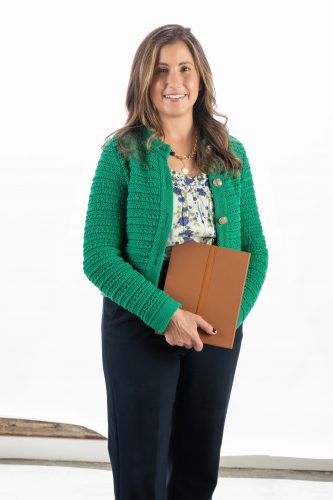
Meyer, a senior political science major from Shorewood, Minnesota, argued that Hopson killed her father during a family vacation, rendering her ineligible to receive millions in inheritance.
Michele Meitl, associate professor of criminology & criminal justice. Photo by Glen E. Ellman
Meyer was clear and confident in the role. But this wasn’t a real courtroom — and she wasn’t a real lawyer. She, along with the other attorneys and witnesses in the room, had not passed the bar exam or even attended law school.
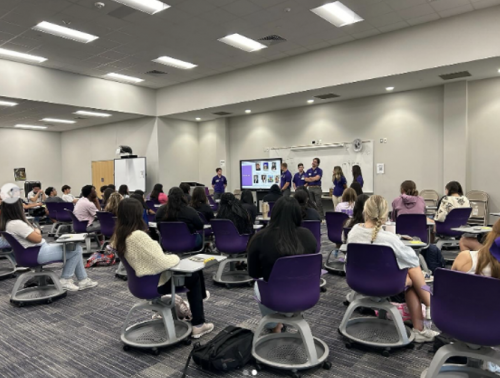
Instead, students from TCU were competing against the University of Oklahoma in one of four trials the Horned Frogs would argue in the American Mock Trial Association’s Opening Round Championship Series.
Each year, university mock trial groups prepare to present both sides of a fictional court case, then face off against opposing schools in a staged courtroom.
Last season, Meyer and the other members of TCU Mock Trial’s A team bested several national contenders when it advanced from regionals to the national competition for the first time.
The feat was even more impressive considering the program’s youth: It was founded in 2021. Students who have participated report that they’ve walked away with connections, friendships and skills — and for some, an early start to a career in law.
Building the Program
TCU Mock Trial founder Walter Flanagin ’24 said competing for his high school’s team shaped his career goals. When he arrived at TCU, where he majored in history, he planned to join the university team — only to learn no such program existed.
Flanagin resolved to start a group. He asked Michele Meitl, an associate professor of criminology & criminal justice, to advise the team and began recruiting fellow students.
Most members lacked mock trial experience, so Flanagin taught his teammates the basics, including the rules of evidence, courtroom procedure and how to write an opening statement.
“It’s hard to build a winning program,” he said, “but I wanted to build [a] program that keeps giving opportunities to future students.”
Training for the Future
“YOU GET A BUNCH OF EXPERIENCE [WITH] PUBLIC SPEAKING, ORGANIZING, WORKING WITH TEAMS, LEADING AND EVERY SINGLE POSSIBLE SKILL THAT YOU CAN THINK OF THAT WOULD BE GOOD IN LIFE.” Cole O’Brien
Charlotte Gegare, a sophomore strategic communication major, said that becoming a lawyer is more than choosing a profession — it’s personal.
“My biological mother was not the best role model in my life, and she wasn’t the best person to me and my two younger brothers when we were growing up,” Gegare said. “I felt that more could have been done to protect me.”
As a lawyer, she said, she hopes to advocate for people in need. “I know that there are children currently that are struggling with way worse than I ever went through. And if I can be a part of their journey and be the person sitting in their corner and standing on their side … in whatever way I can do that, I want to.”
For many students, the learning is already translating into results. “One of the judges, who’s a current law student, quipped that we understand the rules of evidence better than they do,” said Michael Shehata, a junior political science and psychology major from Keller, Texas.
Flanagin, now a second-year law student at Georgetown University, said the skills he learned in mock trial translated well to law school.
“We’ve been talking about the same sort of burdens of proof and stuff that you would learn on the mock trial team,” he said. “A lot of the background knowledge, just knowing how court systems work, helps you understand the cases you’ll read, especially first semester in law school.”
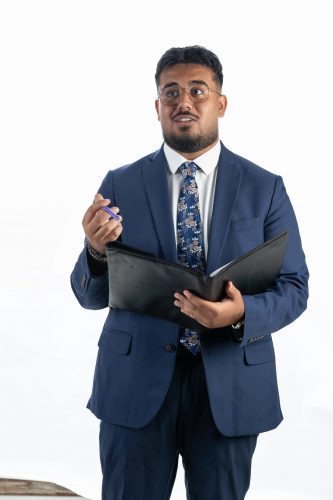
In the trial against OU, Cole O’Brien, a senior criminal justice major from Fort Worth, took the role of a plaintiff’s attorney in Shahid v. Hopson. His faux client, Shannon Shahid, Bancroft’s other daughter and Hopson’s half-sibling, alleged Hopson killed Bancroft and therefore could not inherit his estate.
Shehata played a photojournalist and witness. From the stand, he recounted the scene of the crime to O’Brien.
“I saw Mr. Avery Bancroft unconscious on the floor … so I grabbed my camera. And while I was doing that, I heard someone crying over my left shoulder.”
“Do you know who that person was?”
“Yeah, it was Taylor Hopson.”
“What did you do?”
“I panned my camera over, and I wanted to capture that moment as well, but as soon as Taylor Hopson saw my camera, they stopped crying — almost like they never really were.”
Winning as a Team
Most TCU Mock Trial team members are interested in law careers, Meitl said, but students from all majors can and do join.
Members come from degree programs including English, political science, anthropology and business.
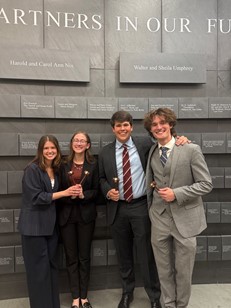
Team members were honored at the 2025 American Mock Trial Association’s Opening Round Championship Series. Courtesy of TCU Mock Trial
“I think the interdisciplinary part of mock trial is fantastic,” Meitl said. “They have different interests, which can, I think, be good for students who sometimes get a bit siloed in their own major.”
Gegare, from Menomonee Falls, Wisconsin, said her strategic communication studies and mock trial experience feed off each other.
“Being able to analyze material and break it down professionally and clearly, and then be able to present that material persuasively — I believe that these are key skills in law, but also that tie into my major,” she said, “and I have gained a lot of confidence within both of those areas.”
Meitl said the program provides transferable skills, including the ability to adapt, think critically and learn from failure.
“You get a bunch of experience [with] public speaking, organizing, working with teams, leading and every single possible skill that you can think of that would be good in life,” O’Brien said.
Meitl said the students’ closing arguments consistently impress her. “You have to adapt to what’s going on in the trial,” she said. “Students don’t usually have that written out and memorized. They have to think on their feet.”
The students’ growth comes from preparation, she said, but also from learning to work as a team.
In O’Brien’s first year on the team, he served as captain during a competition in Waco, Texas. At first, “there was a moment of disjunct whenever all of us weren’t exactly comfortable,” he said. “There were some people that were so new at communicating everything.”
The team took a brief break between rounds.
“We all had a moment of, ‘Let’s talk about what’s going on. Let’s get in the right mindset,’ ” O’Brien said. “After we had our little conversation, we really jelled together in a way that I wasn’t expecting.”
Michael Shehata, political science and psychology major. Photo by Glen E. Ellman
The team bounced back and performed well in the second half of the trial.
Meitl earned the 2025 Deans’ Award for Teaching for her work advising the program. “It’s a tremendous amount of time and work,” she said, “but I do it because of the impact I see on these students.”
Eventually, TCU aims to make the national championship, Meitl said. “The sky’s the limit for this group.”
In the mock courtroom, the students also bring boundless creativity.
In closing remarks in the Hopson case, O’Brien reminded jurors of three key facts: Bancroft had too much potassium in his system. Hopson had access to potassium. And Bancroft had planned to change his will.
“We hold the burden to prove to you by preponderance of the evidence, just meaning more likely than not — a grain of sand on one side of the scale just makes it slightly more heavy — that Miss Hopson was a culpable actor.”
Unlike in real courtrooms, mock trial doesn’t end with a dramatic verdict. Instead of issuing legal rulings, competition judges tally scores for the mock lawyers. Thus, Hopson’s inheritance dissolved into the fiction it was, but the Mock Frogs walked away with something more valuable: poise, perspective and the experience of succeeding — in court and in life.
Floyd Wormley Jr. grew up in Biloxi, Mississippi, in a household held together by his single mother. In a military town where most young people’s tickets out came with boots and dog tags, Wormley assumed his future would march in that same straight line.
Then came a simple question from a friend’s parent that changed everything: Have you ever thought about college?
Assisted by a scholarship and intrinsic willpower, Wormley enrolled at Tulane University in New Orleans, where his pre-med plans soon met the real nature of his intellectual passion. One biology class in, he was hooked. “Cellular and molecular biology,” he said with the ease of someone who has uttered the words thousands of times. “My major had a fancy name.”
He was the first in his family to graduate from college.
“There were days I thought about transferring,” he admitted of his early days at Tulane, when he sometimes felt like a poor kid in a rich world. “But I stayed because I didn’t want it to look like I quit.”
He also stayed because he had met his future wife, Zina, in his sophomore year. “We are both very firm in our faith,” she said, “and we believe that people are where they’re supposed to be.”
Wormley would go on to earn graduate degrees in microbiology and immunology from Louisiana State University Medical Center and complete a postdoctoral fellowship at Duke University. He built a formidable research résumé by specializing in immune system responses to persistent fungal infections.
During his PhD studies, “to make ends meet, he was working nights at Charity Hospital,” said Wormley’s mentor, Paul Fidel, a professor in the department of oral and craniofacial biology at the LSU Health Sciences Center in New Orleans. “Night-day, night-day, getting in the lab early, getting a few hours of sleep. … He never complained, absolutely never complained.”
As provost, Floyd Wormley Jr. aims to help faculty and students grow and serve the community. “Everything we do should improve our faculty, our students, our community — and TCU’s reputation.” Courtesy of TCU Marketing | Geno Loro
Wormley’s first tenure-track professorial role was at the University of Texas at San Antonio. He was the colleague who kept saying yes to service roles, eventually becoming an associate dean of research at UTSA and later overseeing graduate education. He said he loved being a science professor and fell into academic leadership almost by accident. “It was my opportunity to influence things for the better for my colleagues.”
Fidel said his protégé’s scientific backbone informed his administrative leadership. “His way of dealing with problems comes from those critical thinking skills. He’s able to look at a lot of different scenarios and then go down different paths until it closes off and moves to the next path.”
When TCU called in 2019, offering the chance to lead research and graduate studies, it checked all the right boxes: mission and values alignment, a research agenda on the rise and location, as Fort Worth is Zina Wormley’s hometown.
As associate provost, Floyd Wormley helped steer TCU into a new and ambitious research route, expanded support for graduate students and strengthened infrastructure for online programs. He accomplished it all with humor, grace and relational know-how, Zina Wormley said. “He has a really great way of letting people feel seen and heard, and he is always quick to listen.”
He described TCU as a place where people aren’t just committed to the work — they’re committed to one another. “The attention paid to making sure faculty, staff and students know they’re valued? That’s something you don’t see everywhere,” he said. “We shouldn’t take it for granted.”
Wormley, a Baptist church member who occasionally delivers sermons, brings both analytical rigor and pastoral care to academic leadership. He applies the same methodical preparation to campus matters that he once brought to scientific research.
“HIS WAY OF DEALING WITH PROBLEMS COMES FROM THOSE CRITICAL THINKING SKILLS. HE’S ABLE TO LOOK AT A LOT OF DIFFERENT SCENARIOS AND THEN GO DOWN DIFFERENT PATHS UNTIL IT CLOSES OFF AND MOVES TO THE NEXT PATH.” Paul Fidel
That scientific thinking extends to his view of education itself. Information alone isn’t enough for students, he believes; they need to apply it. “Learning the mechanics of throwing a pitch and being able to throw a pitch that gets across the plate in the strike zone are two very different things,” he said. “Our job at TCU is to ensure that when our students leave, they can throw fastballs that hit the strike zone every time.”
Off campus, he’s a father to two teenagers who mock his occasional “struggle meals” — microwave nachos and fried Spam. (Don’t listen to them, Zina Wormley said. Her husband is a talented chef who has won awards for his gumbo, and his coconut cake is a holiday favorite.)
Beyond the kitchen, Wormley’s children enjoy lives that are very different from his at their age. And that, he said, is the point.
“We do what we do so that we can make a generational change in the lives of our students,” he said. “Education made a generational change for me, and I want to pass that forward.”
When the job is hard, he thinks about commencement. About the student who gets into medical school. The one who lands a job, opens a business, returns with a story of transformation. “That’s the why,” he said. “It’s bigger than us. And I want everybody to see that it’s bigger than us.”
Wormley sat down with TCU Magazine for a candid conversation. What follows are highlights from that exchange.
As TCU’s chief academic officer, what do you see as your most important responsibility?
We must ensure academic excellence in every dimension — the classroom, the field, the theatre, the studio. That means giving faculty and staff the resources to create the best possible environment for students. We are not a massive state institution with tens of thousands of students and a mandate to be everything to everyone. Whatever we do, we must do exceptionally well.
TCU’s LEAD ON: Values in Action strategic plan emphasizes growing as a prominent center for research and creativity. As provost, what are your immediate priorities to advance TCU’s research agenda?
The first step was hiring an outstanding vice provost for research — and I believe we achieved that in Dr. Reuben F. Burch V. Next, we assess the aspirations of our students and the needs of Dallas-Fort Worth to decide where to focus. STEM fields are critical, but so are our strengths in theatre, art and music. We will invest in these areas and partner with corporations and community organizations — not simply to fill jobs, but to produce leaders who set the standard in their fields.
Leading with both analytical rigor and pastoral care, Floyd Wormley Jr. advances TCU’s mission to deliver excellence across teaching, research and student experience, including the university’s push toward Carnegie R1 status. Photo by Rodger Mallison
En route to TCU’s goal of becoming a Carnegie R1 university, the top tier for research, what specific milestones do you envision in the next three to five years?
Our plan calls for increasing research expenditures by at least 10 percent each year — and I emphasize “at least.” We are expanding doctoral programs and providing greater support for graduate students. That requires stronger infrastructure in our research and graduate studies offices. Priority areas include AI, engineering, data science and computation, along with upgraded facilities for the fine arts. Every discipline will see our commitment to excellence, even if not all at the same time.
Beyond traditional metrics like funding or new buildings, how will you measure the success of TCU’s expanding research enterprise?
Student outcomes are central. Are our students getting higher-paying jobs? Are they admitted to professional and graduate schools at higher rates? Are undergraduates publishing with faculty? Is the curriculum enriched by our scholarship? Citations and publications matter, but so does involving students and serving the community. Everything we do should improve our faculty, our students, our community — and TCU’s reputation.
TCU prides itself on its teacher-scholar model. How do you define a “teacher-scholar” today, and why does this model work here?
I emphasize a capital “T” and a capital “S.” Our faculty stay at the forefront of their fields, publish in their areas of expertise and bring that knowledge back to the classroom. We don’t have researchers who are detached from teaching or teachers disconnected from scholarship. It’s a two-way corridor — scholarship informs teaching, teaching shapes scholarship — and both are stronger for it.
What resources and support will be available to help faculty grow as both exceptional educators and impactful scholars?
We are creating an Office of Faculty Success to support professional development for faculty at every career stage. Our Office of Research and Creative Activity will focus on scholarly growth, and we will strengthen mentoring for junior faculty. Expect more workshops on pedagogy, teaching methods and research skills. We will be intentional about helping faculty excel in both teaching and scholarship.
What is the Innovation Network, and how will it engage students?
Led by our chief innovation and strategy officer, Tom Wavering, the Innovation Network will be a distributed system rather than a single hub. Students will connect with innovators and companies, access makerspaces and work on real-world projects through programs like our real estate and entrepreneurship centers. The aim is to bring the community into our campus — and our students into the community.
What role does technology play in helping faculty and students engage in transformative research and discovery?
Employers expect graduates to arrive with strong technological skills. We will invest in the infrastructure to meet that demand and train our campus community to use it well. AI and machine learning have applications across disciplines, from liberal arts to business to the arts, and we will be deliberate in weaving them into the curriculum.
Any predictions for what research and creative activity will look like in five years, once AI is more integrated?
It’s hard to predict because the technology changes so quickly. That’s why we must be thoughtful about how we use it. We want our faculty, staff and students to embrace AI, but also to know how not to misuse it and to use it humanely. That responsibility is part of our mission as a university.
How will TCU’s research efforts impact Fort Worth and North Texas?
We will partner with local industries on AI and aerospace and continue our leadership in the cultural community. On the biomedical side, we will help address shortages of nurses, physicians, occupational therapists and other health professionals. Our medical school, nursing programs and new health sciences initiatives are designed to meet this region’s most urgent needs.
Editor’s Note: The questions and answers have been edited for length and clarity.