As soon as Thomas Sumner ’67 (MBA ’68) set foot on the TCU campus as a student, he started making lifelong ties with his fellow Horned Frogs. Forging lasting relationships was a hallmark of the former TCU Trustee, who died Feb. 14.
When his family moved to Fort Worth from Longview, Texas, during his high school senior year, he arranged to graduate with his old hometown class. He kept friendships from elementary school and beyond throughout his life.
While at TCU, Sumner caught the eye of a young woman who was dating his fraternity brother. “He loved to dance, loved the parties, and he was good-looking, so why wouldn’t I notice him?” said Marilyn DeMoss Sumner ’68. But it was after they graduated, when they bumped into each other while Christmas shopping, that love blossomed. By that time, he had his MBA, and she was teaching.
And then: “We started dating, and almost immediately he was called up for the Air Force Reserve,” she said. Fortunately, he got assigned to Carswell Air Force Base in Fort Worth, and the couple married in 1971.
Sumner joined Arthur Andersen & Co. and moved to Houston, gaining the experience in banking, finance, real estate, homebuilding and property management that shaped him as an entrepreneur. He later formed Allpoints Surveying, a successful venture serving Texas real estate markets and beyond.
All the while, he never stopped backing TCU.
“His volunteer leadership role on the Board of Trustees and National Alumni Board were especially meaningful to him, and to us, thanks to his wise counsel,” said Don Whelan, vice chancellor for university advancement.
Marilyn Sumner said that over time she and her husband supported more changes at TCU. “Tom especially liked the direction the School of Business was going. He thought it was very applicable to the market in today’s world.”
In this series, TCU Magazine visits with alumni in the food and beverage industry. Send recommendations to tcumagazine@tcu.edu.
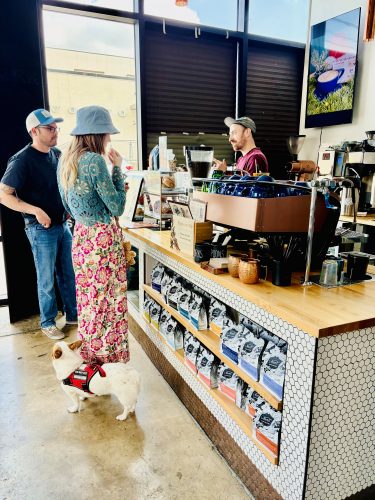
Roots Coffeehouse is dedicated to creating bold flavors and a cozy community space. Courtesy of Charlsye Lewis
Charlsye Lewis ’04 (MLA ’07) and Marcus Brunt ’98 (MLA ’00) co-foundedBoulevard of Greensin 2018. The vegan eatery in Fort Worth servesorganic bowls, cold-pressed juices, smoothies and more. The couplealso now ownRoots Coffeehouse, a community-centered cafe with locations in Fort Worth and North Richland Hills.When they met in the TCU Horned Frog Marching Band, Lewis and Bruntalready shared an interesta healthy lifestyle.Today, they strive through their businesses to make it easy for customers to enjoy nutrient-dense, high-quality food.Their motivation, Brunt said, began as more of a mission than a business: “We believed that something like this should exist in Fort Worth.”
You started Metro Animals, a doggy daycare, boarding and grooming business, more than 20 years ago. What inspired you to expand to the food business and openBoulevard of Greens?
Lewis: We saw it as something that we felt we really needed to do to protect and prolong our parents’ health. My mom was dealing with some liver issues. She wasn’t a drinker, but she still ended up with some liver problems. Eating very healthy, whole, fresh food is very helpful when you have chronic illnesses. We wanted her to be able to come in any day of the week and just eat whatever she wanted on our menu for free.
What are the challenges that come with creating a plant-based menu with healthful ingredients?
Lewis:I’m in contact with vendors and we have discussions about where things come from and how it’s processed. Ourspices — we don’t want them irradiated, we want organic wherever possible. We’rereally intentional about what we bring in.
Brunt:We use a cold-pressed juicer.Most places use something called high-pressure pasteurization, which pasteurizes it and makes it available to stay on the shelf for a really long time, but it also cankill some of the things in it, so not as many micronutrients are left.So we do cold pressing — we don’t heat up anything, we don’t destroy anything in the juice — but that means our shelf life is extremely short.So we just have to keep rotating those in to make sure they’re always fresh.
What are some of the biggest hits on your Boulevard of Greens and Roots menus?
Lewis:We have a grain bowl called the Pomona bowl and people are just stunned with the flavors. We have a house-made red pepper miso dressing that goes on top of the sweet potatoes in that bowl. We have a lot of superfoods like mushrooms and cucumber relish and quinoa. And you can get avocado and tofu — just so many good-for-you ingredients.
Brunt:At Roots, we have our staff come up with the seasonal menus.We have our baby root lavender matcha right now, and our maple sunrise Americano — those are really good. And we have our mood-changer tea that if you squeeze lemon in, it turns from purple to blue. Our big hits are the lavender honey latte or vanilla latte.
What is your personal favorite menu item?
Lewis:The first thing I reach for when I walk in the door at Boulevard of Greens is our immunity shot. It has a really potent blend of apple, cayenne, fresh ginger and a touch of maple syrup. It’s an experience taking that.
Brunt:For me, it would be the Pomona that we talked about earlier —that’s the go-to. And then our Broadway smoothie, which tastes like a chocolate shake, but it doesn’t have any sugar in it. We add extra cacao, so it’s extra chocolatey. At Roots, it’s any of the pour-overs — tasting black coffee the way it should taste.
Roots Coffeehouse offers a variety of seasonal beverages. Courtesy of Charlsye Lewis
How does Roots Coffeehouse foster community?
Brunt: Our motto is coffee, comfort, community. We have the community bookshelvesand we’ve got community tables that people can reserve, especially at our North Richland Hills location.People reserve it for Bible studies. There are game nights. There are groups of moms that will get together up there. We have a giant felt chessboard on the wall that people can play, and we have games out there as well. You’ll see families, you’ll see students.
Editor’s Note: The questions and answers have been edited for length and clarity.
Lance Davis, the No. 2 overall prospect in the state of Arkansas coming out of high school, set the state’s high school ERA record with a 0.14 in his senior year. He spent his first college season redshirting at the University of Arkansas and dealt with a foot injury during his time as a Razorback that kept him off the mound in 2025.
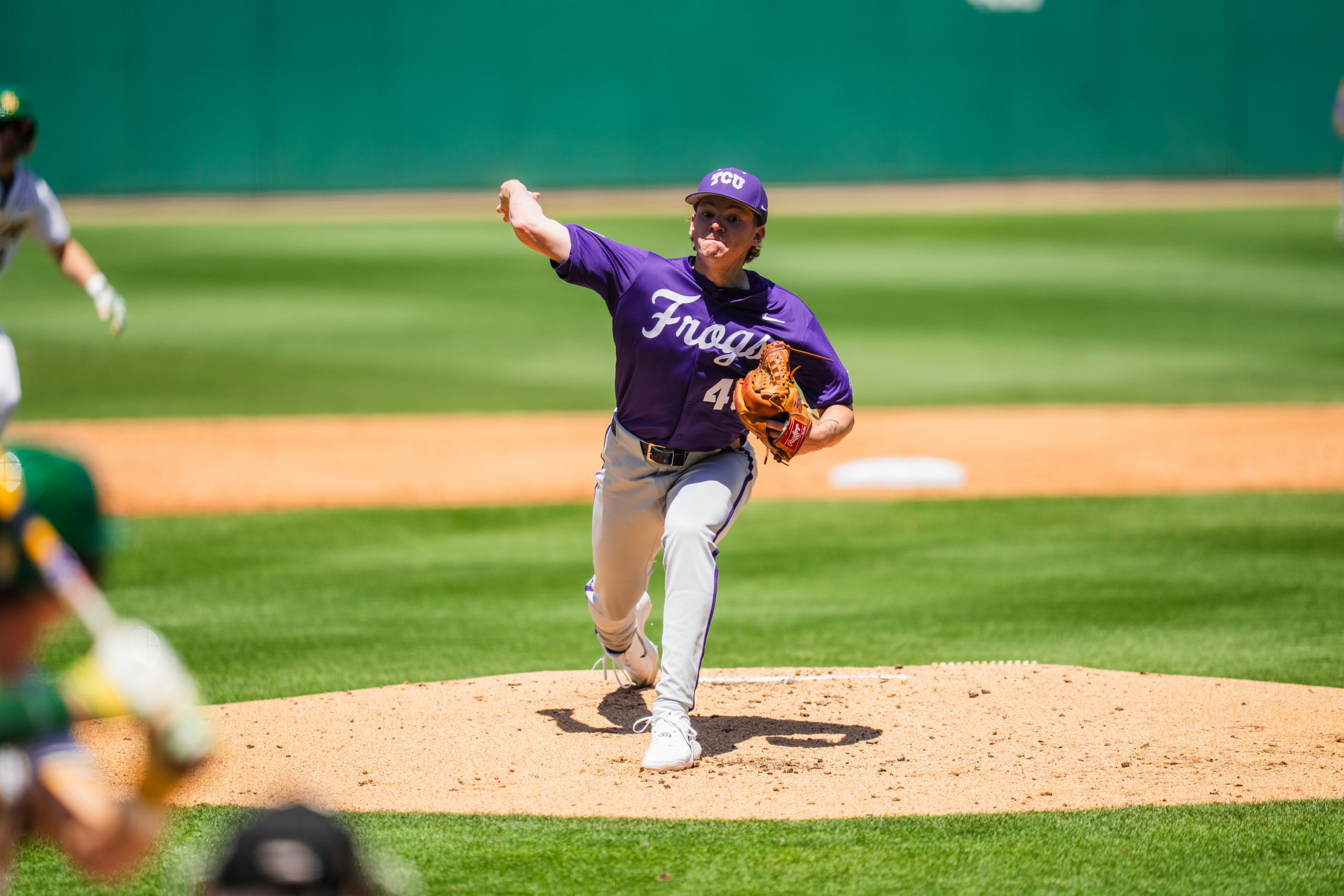
Since transferring to TCU in 2025, Davis has been a mainstay in the Horned Frogs’ rotation, making starts since February. The 6-foot-4 right-hander has a 3-3 record this season across 49 innings pitched with an ERA of 5.14. Davis has shown sharp command, with 32 strikeouts against 12 walks.
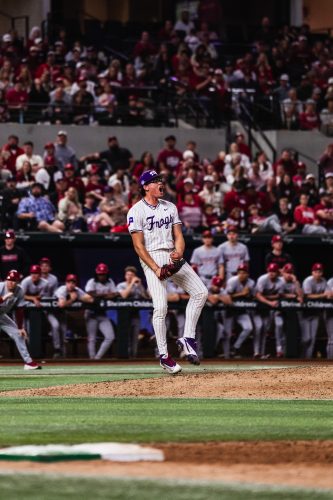
Redshirt freshman Lance Davis has found his footing this season, delivering seven-inning shutouts against Big 12 opponents UCF (March 21) and Arizona (April 11). Courtesy of TCU Athletics
Lately, Davis has been shining. The Frogs have picked up the win in his last five outings, dating back to March 21 against the University of Central Florida. In his last three starts, he is 2-0, throwing 20.2 innings, with a 2.61 ERA. His best game of the season was against Arizona on April 11, when he threw seven shutout innings with seven strikeouts, allowing just four hits and one walk.
Davis will try to build upon this momentum when he faces Houston on Saturday, April 25. The Frogs entered this series on a three-game winning streak and are facing a struggling Cougars team that has just three wins in its last 10 games.
TCU Magazinespoke with Davis about his road to TCU and what lies ahead.
What was your experience playing baseball growing up?
I grew up in northeast Arkansas, in a small town, but a big baseball town. So that’s the thing we did growing up. It’s about an hour away from Memphis, so we would drive across the river and play some really good competition.
Did any of your family members play baseball?
No, actually. My parents were both basketball players, so it was sort of weird for them for me to be interested in baseball, but I hated basketball, so I picked up baseball and ran with it.
What does it feel like being able to get on the mound again?
It’s been awesome. You’ve got to get used to it again a little bit, but now that we’re halfway through the season, it’s about finding your footing and feeling a little better each week.
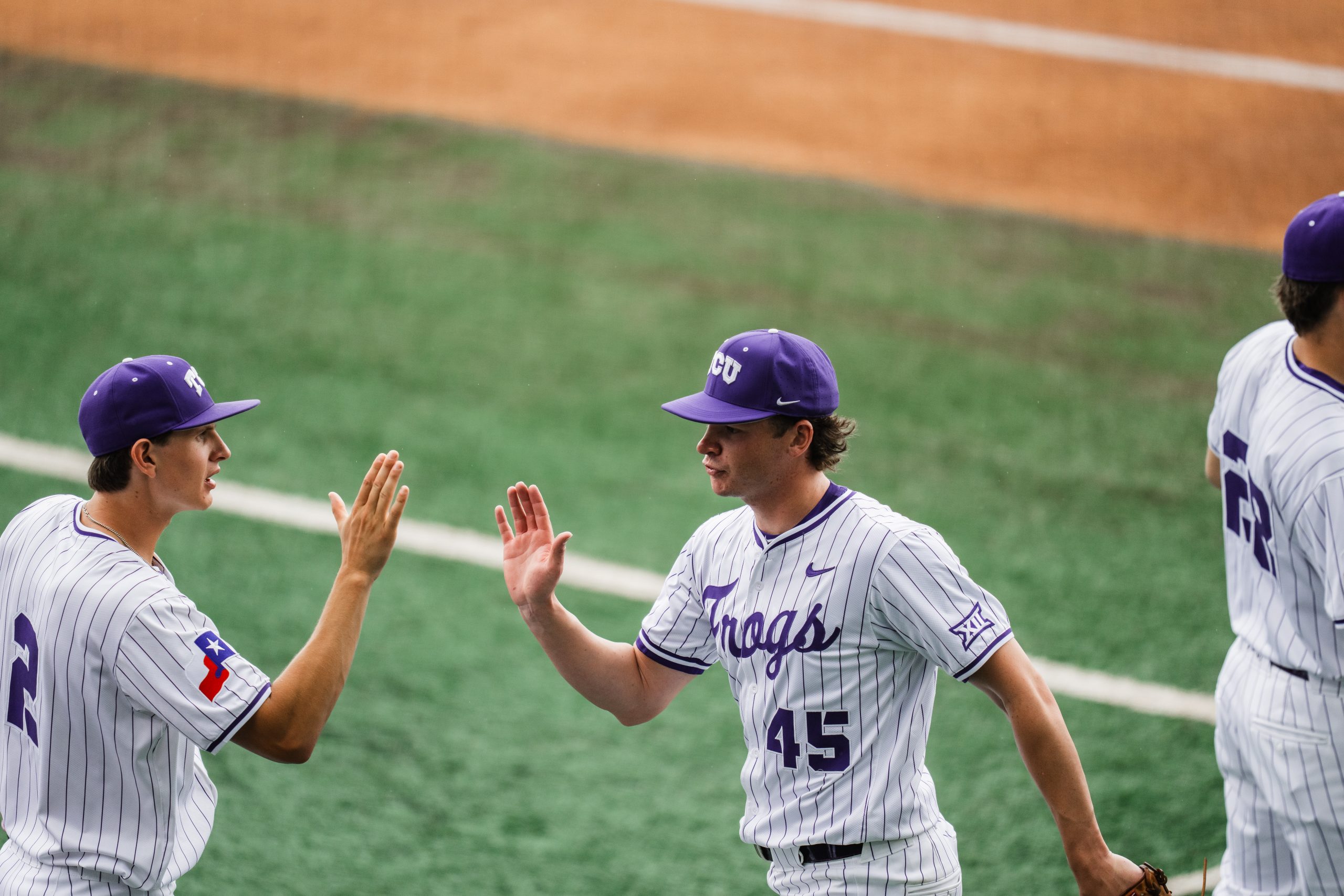
Lance Davis, center, was named to the SEC First-Year Academic Honor Roll at Arkansas. Now a criminal justice major at TCU, he has said becoming a lawyer is “sort of a dream” of his. Courtesy of TCU Athletics
What has been your favorite aspect of TCU Baseball so far?
The culture built by the guys before us — and what we’ve continued to build — is unmatched. There’s a great strength program, a great coaching staff that all mix together to have a successful program.
Do you feel that you’re more comfortable on the mound as of late?
Yeah, I think each week the goal is to get better, and I think so farI’ve done that. The goal moving forward is to keep improving.
What are your future plans?
I’m a criminal justice major, but I’ll see where baseball takes me and then hopefully get my degree here. That’d be special to me to come back and finish it at TCU. But I think for me, I’ve always wanted to be a lawyer, so that is sort of a dream of mine also.
Editor’s Note: The questions and answers have been edited for length and clarity.
Beckett Kitaendoesn’t believe in waiting for the perfect moment to launch a business. “It’s never going to be a perfect time,” he said. “If I fail, now’sa good time to fail. I’m in college. I’ll learn a lot.It’skind of a win-win.”
That conviction led the senior finance and real estate major to co-found Buffs, a high-protein snack brand built around a product that didn’t previously exist on grocery store shelves: a beef puff made from grass-fed meat, free of seed oils and designed to deliver protein in a more satisfying way than traditional bars or jerky.
“Buffswants to deliver protein — high-quality protein — in the most enjoyable way possible,” Kitaen said, “so that people are consuming this as a daily thing, rather than just a task or a chore.”
From Health Scare to Startup
Kitaen grew up in Orange County, California, where staying active was part of everyday life. But Buffs began not with athletics, but with migraines.
After childhood headaches returned in early college, he immersed himself in nutrition research, experimenting with whole foods and cleaner eating.
As he adjusted his diet, he noticed a gap in the snack aisle. Many protein products were filled with preservatives, artificial flavors and seed oils. He wanted something simpler and better.
He was interested in what he calls “high-quality animal-based protein” — food that fuels recovery, hormones and brain power, not just muscle gain.
The result was Buffs.
Kitaen had long imagined himself as an entrepreneur. Growing up, his father ran his own business. “As a kid, I thought that’s just how you made money,” he said. “You graduate college and start your own company.”
At TCU’s Neeley School of BusinessKitaen sought courses built for founders, including an NIL entrepreneurship class with Antonio Banos, an instructor and associate director of the Institute for Entrepreneurship and Innovation, and a sales foundations course with Ken Corbit, assistant professor of professional practice and assistant chair of marketing. The latter helped Kitaen structure an investor pitch for Buffs.
Corbit remembers Kitaen as focused and intentional.
“Beckett stood out almost immediately,” Corbit said. “He treated the material as if it mattered for his life, not just his grade.”
Kitaen and Buffs co-founder George Zhou, a student at the University of Southern California, also pitched the idea in TCU’s CREATE competition, which provides mentorship and enough seed money to launch an entrepreneurial venture.The duo won funding that has helped move Buffs forward.
Buffs is moving from concept to production as Kitaen and his team prepare to scale the snack startup.
Much of Kitaen’s education has happened outside the classroom, at industry conferences and through mentors in the consumer-packaged goods world. Early investors have largely been industry professionals who took a chance on two college founders still refining their product.
Buffsremains pre-launch. The recipe perfected in a kitchen setting must now be scaled for commercial production, a process that requires capital, equipment and patience. In the meantime, the founders test demand through samples, pop-ups and pre-launch ads that drive potential customers to a waitlist.
“You never want to launch without product-market fit,” Kitaen said. “We’re trying to understand who our niche is — the people who are going to be obsessed with it.”
Grit, Growth and What’s Next
Balancing a startup with a full academic load hasn’t been simple. For Buffs,no one assigns deadlines. No one checks progress.
“If you want to learn how to go get things done, start your own company,” Kitaen said. “It builds grit. It builds discipline. No one’s pushing you — you’re the one pushing the needle.”
Feedback from classmates and faculty has helped sustain momentum. When people taste Buffs and immediately ask where they can buy it, the doubts quiet.
Long term, Kitaen envisions Buffs as a trusted name in animal-based snacking, with regional retail placement growing into national distribution. Whether this company becomes his lifelong venture or simply the first of many, one thing is clear: Entrepreneurship isn’t a phase.
“Even if this fails,” he said, “I’m starting another company.”
For now, he continues to balance classes, product development and big ambitions. The timing may not be perfect. But for Beckett Kitaen, that’s beside the point.
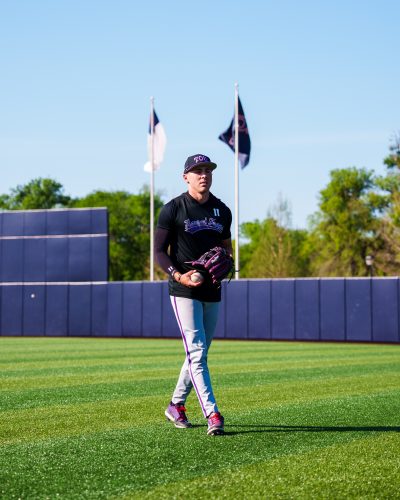
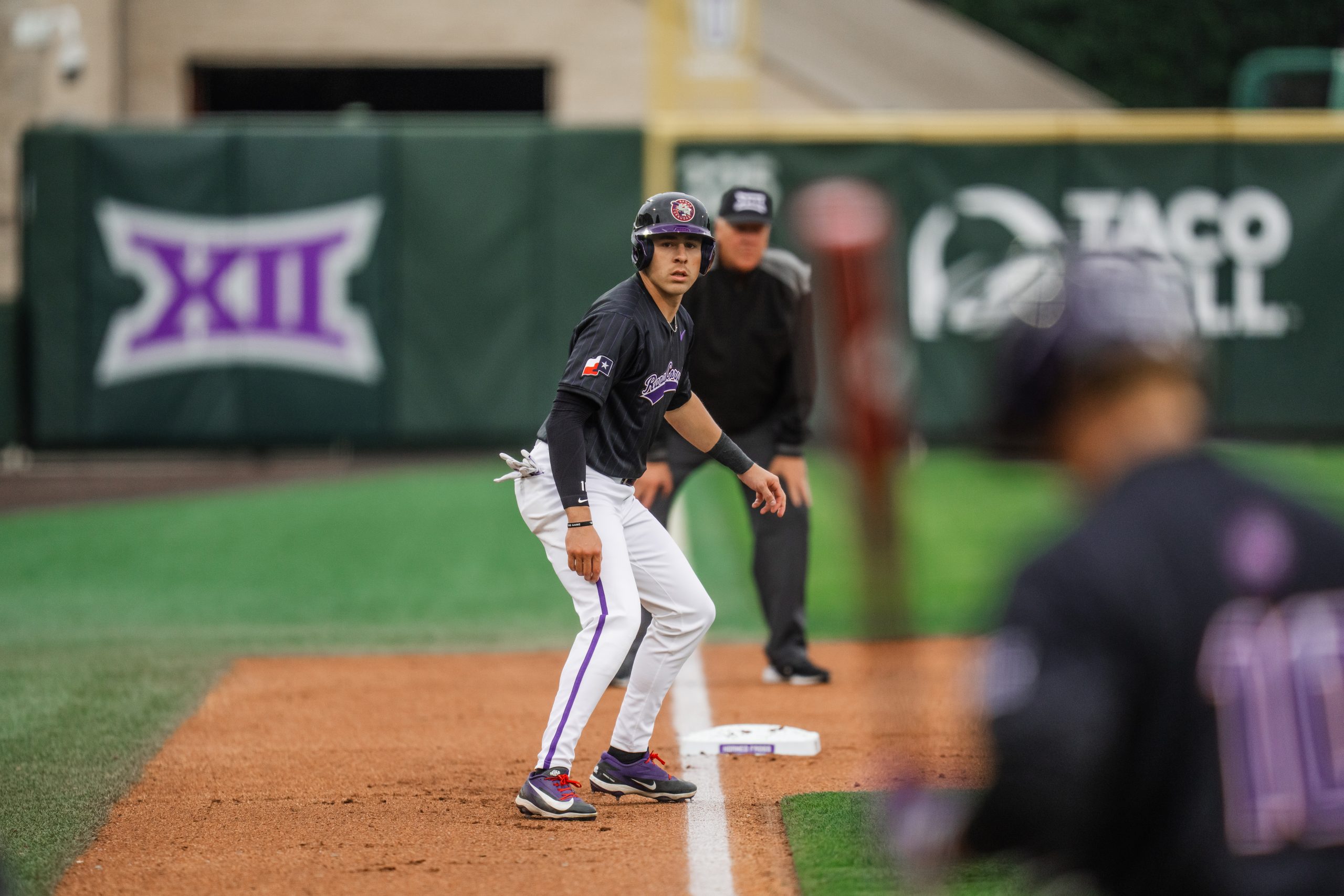
Junior Colton Griffin has become a steady lineup presence for the Horned Frogs by embracing his utility role. Courtesy of TCU Athletics
A multi-sport athlete from Spring, Texas, Colton Griffin was first-team All-State in baseball at Klein Collins High School, batting .480.Healso starred in football, where he played safety. Now, in his second season in a TCU Baseball uniform, the junior utilityman is displaying his versatilityonce again.
After transferring from Stephen F. Austin before the 2025 season, Griffin started 29 games in his first year with TCU — all on the infield dirt, mostly at third base. He hit .266 in his first year with the Frogs with nine extra-base hits.
This season, Griffin has shifted to the outfield and excelled defensively, maintaining a perfect fielding percentage and 55 putouts. So far this season, he is hitting .268 and is a perfect 8-for-8 on stolen base attempts.
TCU Magazinetalked with Griffin about what he has learned as a Horned Frog.
What was your experience playing baseball growing up?
I’ve been around the game my whole life. My dad was my high school coach, and we were together all the time, practicing in the cage and everything. That shaped my values as a person. The discipline I have and the competitive nature of being around the game my whole life have really shaped the person that I am today.
Last season, you bounced around the infield quite a bit; now you’ve solidified yourself in the outfield. What does that say about your versatility defensively?
Anywhere I play, it’s just for the team to find a way to win. Whatever the best position is for me to go out there and help the team succeed is where I want to be. It helps me as a person to be versatile and show that I can play every position and be an athlete.
What has the transition been like for you coming from Stephen F. Austin to TCU?
TCU is definitely a bigger school with way better competition playing in the Big 12. It’s been a grind. I think I’m getting more comfortable here. The coaching staff and our academic adviser have been awesome in helping me be in a position to succeed.
What is something that you have learned in your second year here at TCU?
The biggest thing is how to lead people. Not saying I’m one of the main leaders, but you know, playing every pitch, playing every game, and going about things the right way and having the right attitude in every situation.
Colton Griffin has 26 hits this year, already surpassing his 2025 total with upward of a month remaining in the regular season. Courtesy of TCU Athletics.
What is your favorite thing to do when you have free time?
An ideal Saturday for me would probably be sitting on the couch with my roommates playing “MLB The Show,” or some other video game.
What are your future plans?
If baseball doesn’t work out, I think I have set myself up pretty well. I’m in the Neeley School of Business as a marketing major, so I’d like to do something along the sales and marketing side of things. Just making a connection with somebody and finding a good spot that interests me and I can invest in in the future.
Editor’s Note: The questions and answers have been edited for length and clarity.
TCU came into the 2026 season with high outside expectations, ranking in D1Baseball’s national Top 10 before play began in mid-February. Two months later, the Horned Frogs carry a 20-12 record and a 7-5 mark in the Big 12, still in the midst of the race but looking to find the form that made them unanimous coaches’ favorites to win the conference.
Strong at Home, Searching on the Road
Head coach Kirk Saarloos’ team opened up the year on a high note at the Shriners Children’s College Showdown in Arlington, Texas, going 2-1 and beating No. 7 Arkansas and No. 23 Vanderbilt. The following weekend, the Frogs took a trip to Los Angeles to face the No. 1 UCLA Bruins and No. 1 MLB Draft Prospect Roch Cholowsky and got swept in a three-game series. Since that point, TCU has gone 18-7 and dropped out of the Top 25.
“At some point, we’ll start putting together good baseball. I don’t know who we are,” Saarloos said after the Frogs lost two out of three at Arizona State in March. “When we don’t pitch, we hit, and when we pitch, we don’t hit. That’s a bad recipe.”
TCU has, indeed, picked it up since that midseason swoon, winning seven of its last nine heading into a weekend series against Arizona at Lupton Stadium, where the Frogs have thrived all year, going 13-3. It’s been a different story away from Fort Worth, where TCU is 5-7 on the road and 2-2 in neutral site games.
Missing Pieces
The Frogs have won seven of 10 games since Noah Franco’s return from injury, picking up wins in each of his last four appearances. Courtesy of TCU Athletics
Health has been an issue for the Frogs all season, with two of the team’s stars missing significant time.
Junior pitcher and MLB Draft prospect Tommy LaPour has only made one start this year, coming on Opening Day. The Frogs have missed his presence on the mound; he provided them 90.1 innings last season, posting a 3.09 ERA. Getting LaPour back on the bump would be a massive boost for a Horned Frog squad pursuing a second College World Series berth since 2023.
The other expected starter to suffer an early-season injury, sophomore Noah Franco, returned on March 22. Franco is a two-way player who provides big power potential, both on the mound and in the batter’s box. Franco hit 11 home runs last year and tops out at 97 miles per hour as a southpaw. The Downey, Calif., native has done well coming out of the bullpen since his return, conceding no runs and allowing only three base runners over his past four and a third innings pitched against Texas Tech, Lamar and Kansas State.
Sagouspe Shines Amid Pitching Struggles
Senior Tanner Sagouspe has been a bright spot for a pitching staff ranking 11th out of 14 Big 12 teams with a 6.18 club ERA. The Cal Poly transfer sports a 1.77 ERA across 20 and a third innings in nine appearances.
Sophomores Nate Stern and Zack James have also contributed stability out of the bullpen. Stern has logged 17 innings across 11 bullpen appearances, striking out 21 batters with a 3.18 ERA. James is 4-0 in his nine appearances, making two starts. His season ERA sits at 3.52 across 30 and two-thirds innings; on April 5, he fanned five batters and conceded just five hits and a walk across eight innings in a 4-0 shutout of Kansas State.
Draft Prospects Living Up to the Hype
Sophomore outfielder Sawyer Strosnider ranks No. 10 on MLB Pipeline’s Top 100 Draft Prospect list. So far this season, he’s delivered, batting .304 with 10 home runs (he hit 11 all of last season). He also has six doubles, three triples and nine stolen bases, which ties him for the team lead with junior outfielder Chase Brunson.
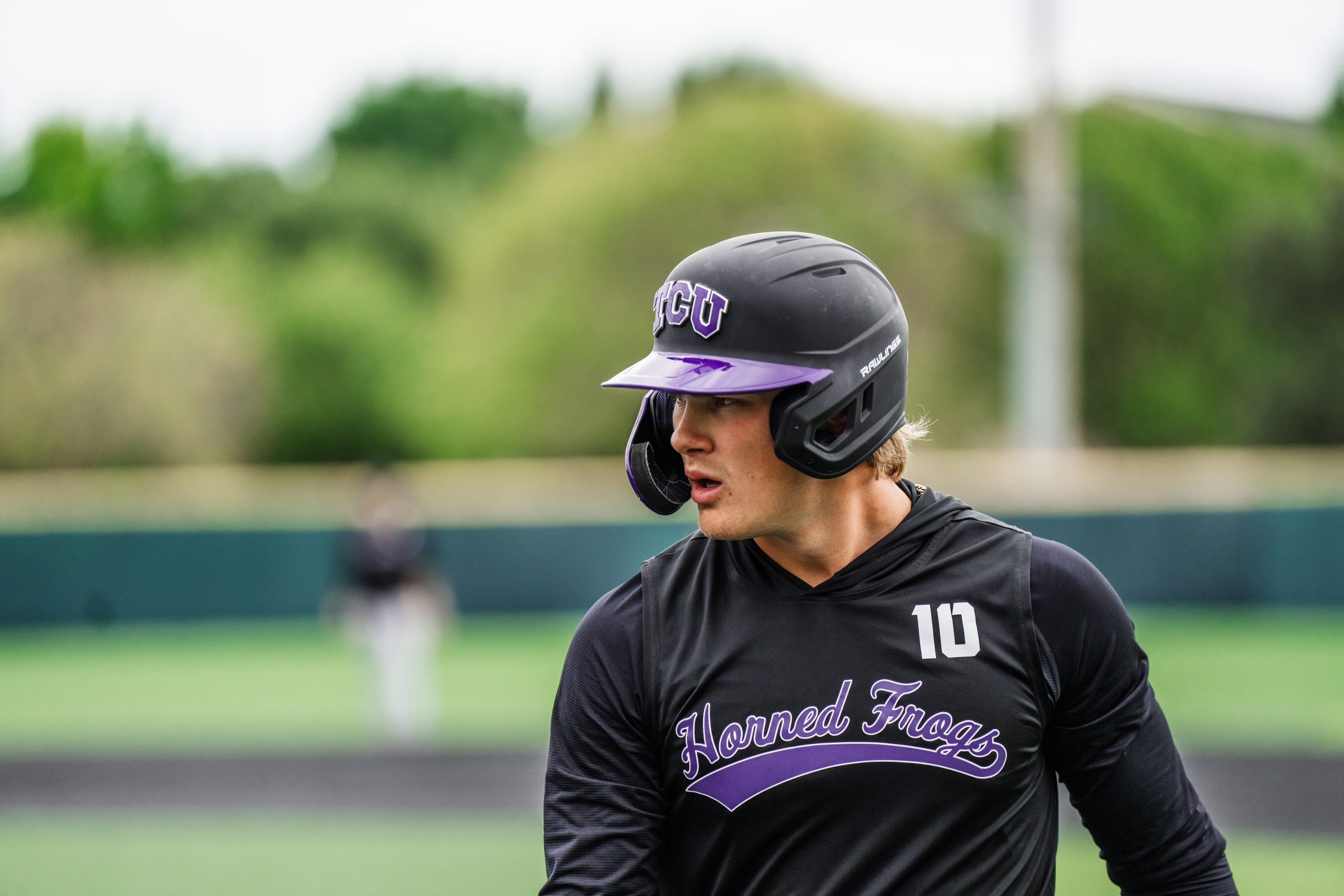
Sawyer Strosnider leads the team with 10 home runs, 41 RBI, 41 runs scored and 32 walks, continuing to show why he projects as a first-round MLB Draft prospect. Courtesy of TCU Athletics
Strosnider told assembled media in March that he is “starting to get more comfortable” manning the outfield alongside Brunson, a fellow MLB prospect. The two often rotate between playing center and right field. “Brunson’s an amazing outfielder, too,” Strosnider said. “It’s a good problem to have, having two good players who can play centerfield.”
Brunson, whose 32 RBI place him second on the club behind Strosnider’s 41, is batting .283 with an on-base percentage of .458 and 13 extra-base hits.
Bell, Cramer Leading the Charge at the Plate
Junior infielder Jack Bell earned a place on the NCAA Baseball Lineup of the Weekfor his performances against Dallas Baptist and Texas Tech in late March, during which he hit .588 with three home runs, adding a double and seven RBI. Bell is hitting .317 on the year with an on-base plus slugging percentage (OPS) of 1.019, good for second on the team.
Another key to the Frogs’ recent success has been graduate infielder Cole Cramer heating up at the plate at the right time. Over the last nine games, Cramer has 20 hits, including three home runs and three doubles.
Frogs Still Standing in a Bunched Big 12
Coming off a five-game winning streak highlighted by a series sweep of rival Texas Tech at Lupton Stadium between March 27 and 29, TCU managed to take two out of three games on the road against Kansas State this past weekend, before suffering a 4-1loss at Abilene Christian on Tuesday.
Chase Brunson and the Horned Frogs still have plenty to play for, sitting tied for fourth in a highly competitive Big 12 with several key road series ahead. Courtesy of TCU Athletics
While the season hasn’t gone entirely according to plan, the Frogs still find themselves in the thick of the Big 12 race, currently tied for fourth place. The league is fairly balanced from top to bottom, with five teams being either tied with or within a game of TCU.
The Frogs’ remaining road conference series come against three teams currently bunched with them in the standings: West Virginia (third), Baylor (tied for fourth) and Oklahoma State (seventh).
In this series, TCU Magazine visits with alumni in the food and beverage industry. Send recommendations to tcumagazine@tcu.edu.
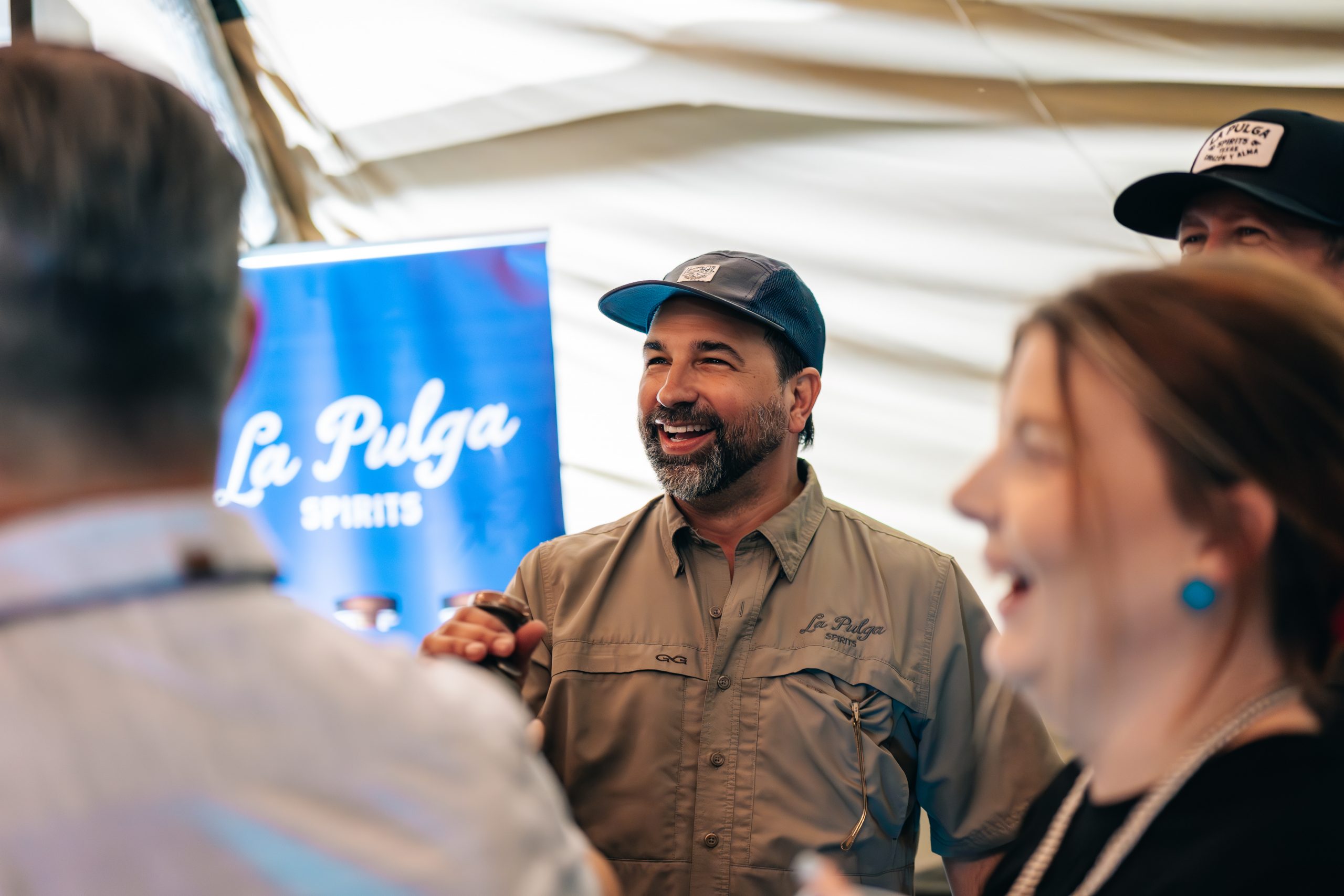
A decade ago, whenAndrew de la Torre ’01 was running La Perla, a cocktail bar and restaurant in downtown Fort Worth, he fielded visits from tequila brand ambassadors selling underwhelming examples of the Mexican spirit. In 2023, together with Sarah Castillo and Stephen Slaughter, de la Torre launched La Pulga Spirits, a line of additive-free tequila, mezcal and sotol with ingredients sourced directly from Mexico. La Pulga translates to “the flea,” a nod to another de la Torre project — Pequeño Mexico flea market, of which he is the longtime managing partner, on Fort Worth’s Northside. La Pulga Spiritsis centered on two core missions: bringing people together and representing Mexican culture. Now expanding across the U.S., the brand has released two special-edition Horned Frog-themed tequila bottles.
La Pulga Spirits released its second limited-edition TCU tequila bottle in 2025. Courtesy of La Pulga Spirits
You studied advertising and public relations at TCU. Which lessons did you take intoprofessional life?
What my college experience there taught me is that I could do anything if I set my mind to it — no matter what it is, just put my head down, work hard. Also just being exposed to people from different parts of the world that have wide-ranging talents.
In addition to La Perla, you owned and operatedEmbargo, a Cuban-themed nightclub. What inspired you to get into the food and drink industry?
My grandfather, he’s from Torreon, Mexico, and he put my dad and siblings through college flipping burgers. I’d grown up going to his restaurant, called Charlie Burgers after him. I am comfortable in those environments because it’s about service and hospitality and interacting with people. What truly inspired me to do my own thing — my mom had brought a coffee table book from Cuba, and I was just looking through this book and I was like, man, Fort Worth could use like a place like this, just drenched in color, full of heart and soul.
What did you learn about tequila during that time?
La Perla specialized in tequila and ceviche. All these reps and salespeople and even owners of these brands were coming through and trying to sell us on spirits that they had no idea about. They didn’t know what region of Mexico, they didn’t know what the NOM [Norma Oficial Mexicana, a number that indicatesthe distillery] was. Sarah Castillo and I realized that there was a gap of people doing really high-quality, additive-free, celebrity-free tequila. She and I both are of Mexican descent, so we wanted to do something that was representative of what tequila and Mexican spirits are. We knew if we put that quality and heart and soul in the bottle, everything else would kind of take care of itself.
The biggest part is doing a traditional style tequila that’s just got agave, yeast and water — nothing else. It’svery clean. All of our spirits are winning awards. Hats off to our distiller — 1068 is our distilling partner. They have a very high standard for quality and they do not cut corners and that really shows. When you drink La Pulga, it is smooth;the flavors of the actual agave, they sing.
Pequeño Mexico, the Fort Worth Northside flea market de la Torre manages, inspired La Pulga’s name. Courtesy of La Pulga Spirits
What are some of your favorite moments from running La Pulga?
I waited tables at Joe T’s to help put myself through TCU. Giving Lanny Paul Lancarte, one of the owners there, one of the first bottles because it has his initials on the top, LP — that was a good moment for us. Also, when people send pictures from other partsof the world, especially on a military base, in a random bar in Rhode Island or Connecticut or Tennessee or Oklahoma, those are all really cool moments.
In addition to running La Pulga and Pequeño Mexico, you also work in sales and development for Empire Roofing. How do you recharge?
I’m a workaholic. Traveling with my family is my sweet spot. And watching Judge Judy. I also love people-watching. My wife is my backbone; she’s tremendously supportive of everything I do. She definitely is the biggest reason I can work this much. Spending time with her and my three kids, traveling anywhere, is how I relax and decompress.
Editor’s Note: The questions and answers have been edited for length and clarity.
When former TCU athletic director Jeremiah Donati hired Mark Campbell away from Sacramento State in the spring of 2023, he handed over the keys to a program that had won three Big 12 games over the previous two seasons. On Monday night at the Golden 1 Center, in the very city where Campbell’s head coaching career began, those two men will be in the arena on opposite sides: Donati, now the athletic director at South Carolina, and Campbell, 40 minutes from his program’s first Final Four.
Now comes the clearest measure yet of how far TCU has come. Third-seeded TCU (32-5) faces No. 1 South Carolina (34-3), with the Big 12’s first women’s Final Four berth since 2019 on the line. The last time these programs met, in December 2024 at Dickies Arena, the Gamecocks turned a 21-point halftime lead into a 33-point win — the most lopsided defeat of the Campbell era.
TCU has gone 57-8 since that night, won two conference titles and built the case, brick by brick, that it won’t happen like that again. Campbell said the past year has sharpened his understanding of what it takes to challenge the sport’s blue bloods. “This is what they do every single year.”
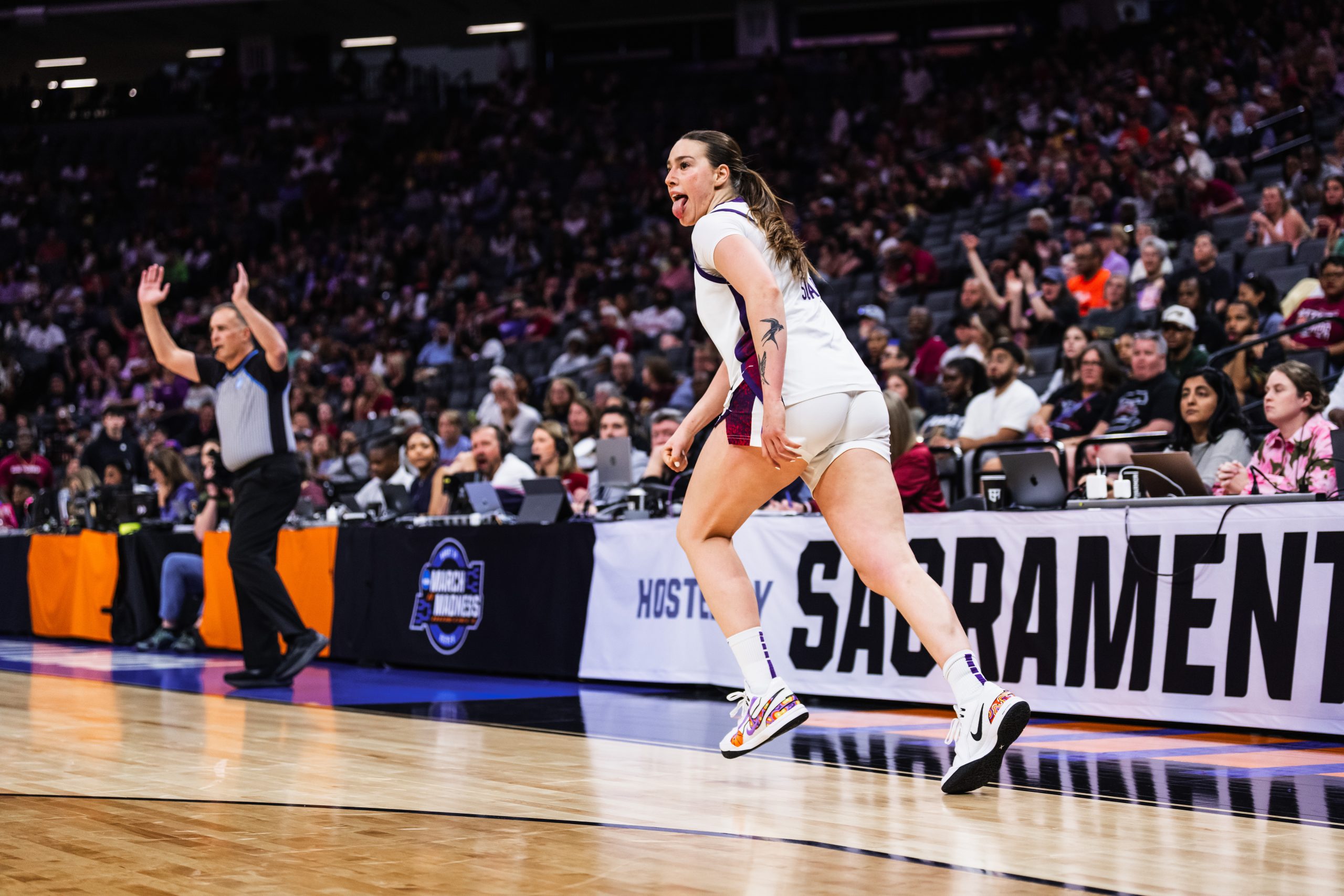
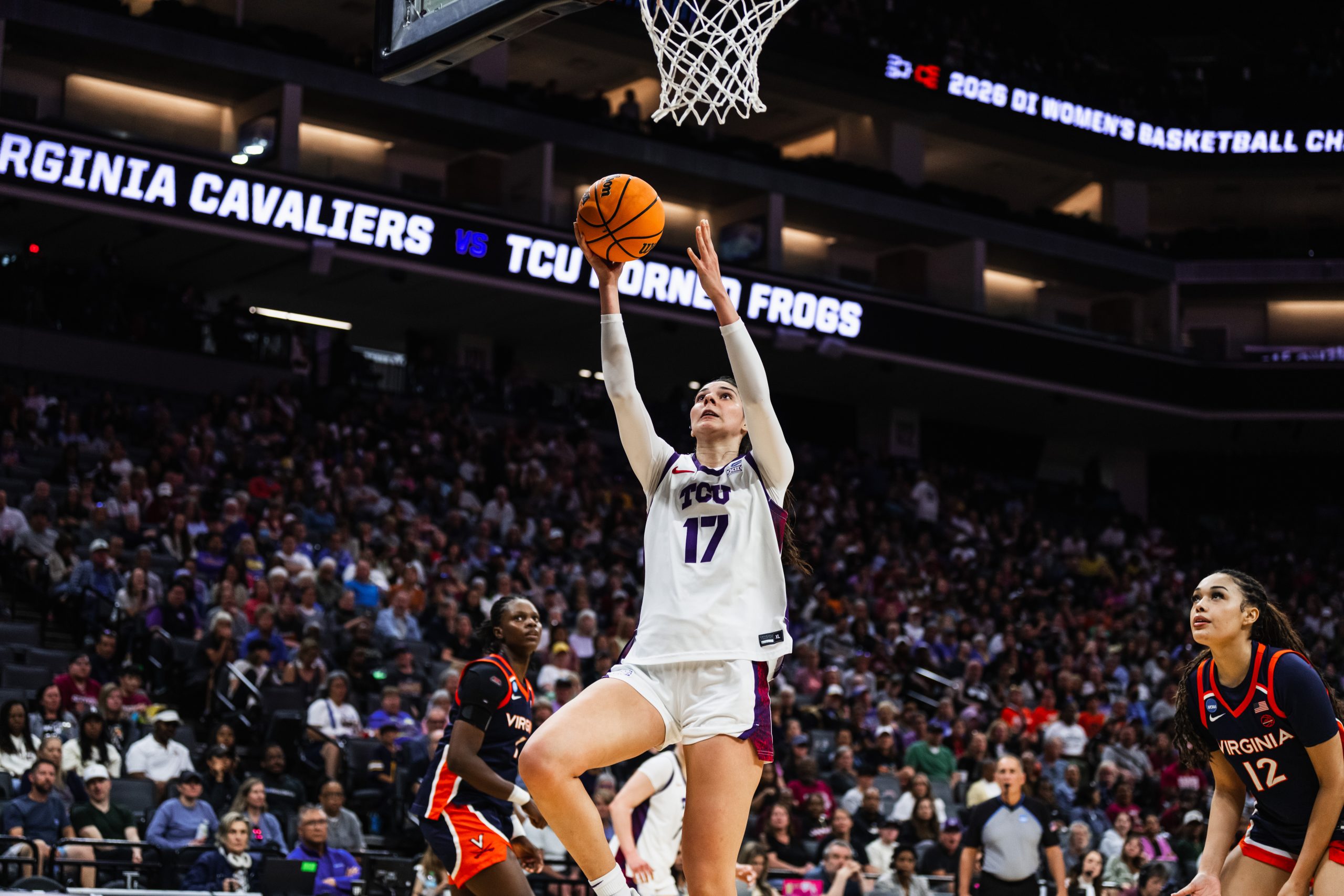
Stretch forward Marta Suárez posted a career-high 33 points to lead TCU past No. 10-seeded Virginia in Saturday’s Sweet 16 clash. The graduate student leads the Horned Frogs in scoring over the past 12 games. Courtesy of TCU Athletics
What TCU brings to Monday’s game is a roster built around one of the most dynamic players in the tournament. Graduate guard Olivia Miles, averaging 19.3 points, 12 rebounds and 10 assists through three rounds, is one of only three players in NCAA history to record multiple triple-doubles in NCAA Tournament play.
She notched her 900th career assist in Saturday’s win over Virginia, reached 246 assists on the season to break her own single-season record and entered Monday needing just one more win to give TCU its first Elite Eight victory. Campbell’s sense of wonder at her gifts has not dimmed. “Male or female,” he said. “There’s like half a dozen people in the world that have her vision, that can process it that quickly, that can throw a one-handed bounce pass to the opposite corner, off the dribble, on a laser, and then do it with her left hand.”
“I feel like I’ve blossomed as a scorer,” Miles told reporters Sunday, crediting teammates who space the floor and post players who free her with screens. “It’s allowed me to read different situations and be aggressive.”
Miles may spend much of the night tracking Raven Johnson, the Gamecocks’ only active returning starter from the teams’ 2024 matchup. Johnson is the engine of a South Carolina offense that pairs three veteran guards — Campbell called the trio “as good as anybody in college basketball” — with post players who can punish you at the rim or step out to 17 feet. “They have five players on any given night,” Campbell said, “that can really, really hurt you.”
Raven Johnson’s Gamecock backcourt mates Ta’NiyaLatson and Tessa Johnson each average scoring totals in double figures, while sophomore forward and second-team All-American Joyce Edwards goes for 19.6 points and 6.5 rebounds per game.
Graduate forward Marta Suárez, who set TCU’s tournament records for points (33) and made field goals in a single game against Virginia, will need to be one of the primary answers. Suárez has led TCU in scoring over the past dozen games, and she and Miles scored or assisted on all 79 Horned Frog points in the Sweet 16. “I think she’s just, it’s a different talent,” Suárez said of Miles, the player who makes everyone around her better. Miles returned the sentiment: “She’s enabled me to go out there and play the best version of me.”
Sophomore center Clara Silva is peaking in March, posting 37 points, 27 rebounds and nine blocks across three NCAA Tournament games. Courtesy of TCU Athletics
Key, too, will be junior guard Donovyn Hunter and senior guard Taylor Bigby, veterans who have averaged close to 40 minutes per game in the tournament, with Bigby compiling a career-high 27 points in the opening round.
Campbell will also need sophomore center Clara Silva, who’s averaged better than 12 points and nine rebounds for the tournament, to hold her own inside against one of the deepest frontcourts in the country. “Rebounding against South Carolina, you have to be able to battle them on the boards,” he said. “Their post players are some of the best posts in college basketball.”
“The Nest” is what they call the gym at Sacramento State. Mark Campbell, then a first-time head coach, spent two seasons there learning what it takes to build something special. On Saturday night at 6:30 p.m. CT, Campbell and his TCU Horned Frogs return to California’s capital for the second weekend of the NCAA Tournament, this time with more at stake.
The “full circle moment” Campbell describes in returning to Sacramento is more spiral than loop. The program Campbell inherited at TCU in 2023 had managed 24 wins over the previous three seasons. The team that touched down in California on Wednesday carries a 31-5 record and the ambitions of a program that has now posted back-to-back 30-win seasons, a distinction shared with only a handful of programs nationally, almost all of which are still playing. TCU has reached the Sweet 16 for the second consecutive year, and just the second time in program history.
Mark Campbell left Sacramento as Big Sky Coach of the Year. He returns three years later with a 31-5 Horned Frogs team and an Elite Eight ticket on the line. Courtesy of TCU Athletics
Standing between TCU and another Elite Eight berth is No. 10 seed Virginia, one of the most improbable Sweet 16 participants of all time. The Cavaliers entered the tournament through the First Four, then won three games in five days — a 57-55 play-in victory over Arizona State, followed by an overtime win over No. 7 seed Georgia and a shocking double-overtime takedown of Iowa — before moving on. TCU’s sophomore center Clara Silva caught the film session and came away with respect. “I think they have really good guards,” she said. “We watched the game yesterday against Iowa. They fight and fight until the end.”
Campbell isn’t selling the Cavaliers short, either. “Virginia’s an elite basketball team that’s playing really good, and they have a star at their point guard position. She’s, right now, playing as well as anybody in the country.” That star, Kymora Johnson, has averaged 24.3 points per game across the Cavaliers’ three tournament outings. She presents a challenge, but not a profile the Frogs find unfamiliar. “Olivia Miles will get you ready to play an elite playmaking guard,” Campbell said of his team getting reps against the three-time All-American every practice for the past seven months.
Miles has been extraordinary. The Big 12 Player of the Year has accumulated a combined 30 points, 26 rebounds and 22 assists across TCU’s first two tournament wins, a statistical run that has little precedent in NCAA Tournament history. She enters Saturday needing just two points to reach 700 for the season. In the Big Dance, she is a different player: Through eight career tournament appearances, she has averaged 8.3 assists and more than seven rebounds per game alongside her scoring.
But what makes this TCU team genuinely dangerous is that it doesn’t require Miles to shoulder the load single-handedly.
Silva’s development is the season’s quietest revelation. Campbell called Sunday’s overtime survival against Washington the best game of her career; she hit the go-ahead basket twice on her way to 16 points and eight boards, adding a pair of blocks. “I’m really thankful that I get to be part of this journey,” said the Kentucky transfer, who last year helped the Wildcats reach the tournament’s second round.
Taylor Bigby is among the eight seniors and graduate students on the Horned Frogs’ roster. The 6-foot-1 guard has scored 42 points over the past pair of outings, her most over a two-game stretch all season. Courtesy of TCU Athletics
Senior guard Taylor Bigby has been equally transformed. Shooting better than 55 percent from three-point range across 11 career tournament games, she erupted for a program-record 27 in the opening round against UC San Diego and added 15 against Washington. She is not interested in tempering expectations. “I feel like my confidence has grown a lot, and it’s at a high right now,” she said. “I don’t plan on coming down.”
For Bigby, the stakes need no inflation. “It means a lot, and I mean, at the end of the day, too, like, it’s also my last year. … The goal is to always be dancing in March, so to still be dancing is a blessing, and I’m just super excited, and I’m proud of my team.”
Campbell has shaped this roster into a group that refuses to lose close games. They trailed by eight at halftime against Washington, fell behind Big 12 heavyweights Iowa State and West Virginia in the final quarter during the regular season and found a way through. “There’s been a lot of close games that we had to grind out and find a way to win,” he said. “This team, they’re gritty, they’re tough, they’re a bunch of old vets.”
The Horned Frogs hold opponents to 33.4 percent from the floor — best among all Division I programs — and their frontcourt size, anchored by the Silva-Kennedy Basham duo, makes them uniquely difficult to attack at the rim.
At the Golden 1 Center on Saturday night, Bigby, Basham and a senior-laden Frogs squad will try to keep dancing.
Near the end of 45 grueling minutes, Washington’s freshman forward Brynn McGaughy corralled the inbound pass, pivoted on her left foot while surveying her options, then found her team’s top scorer, junior guard Sayvia Sellers, at the arc.
Sellers had an open lookfor a three. She caught, set and fired. One last breath. The ball bounced off the back rim and high into the air.
It hung there for a moment, then came down, tipped away by TCU’s Clara Silva as the final decimals faded from the clock.
What followed was more collective exhale than celebration.
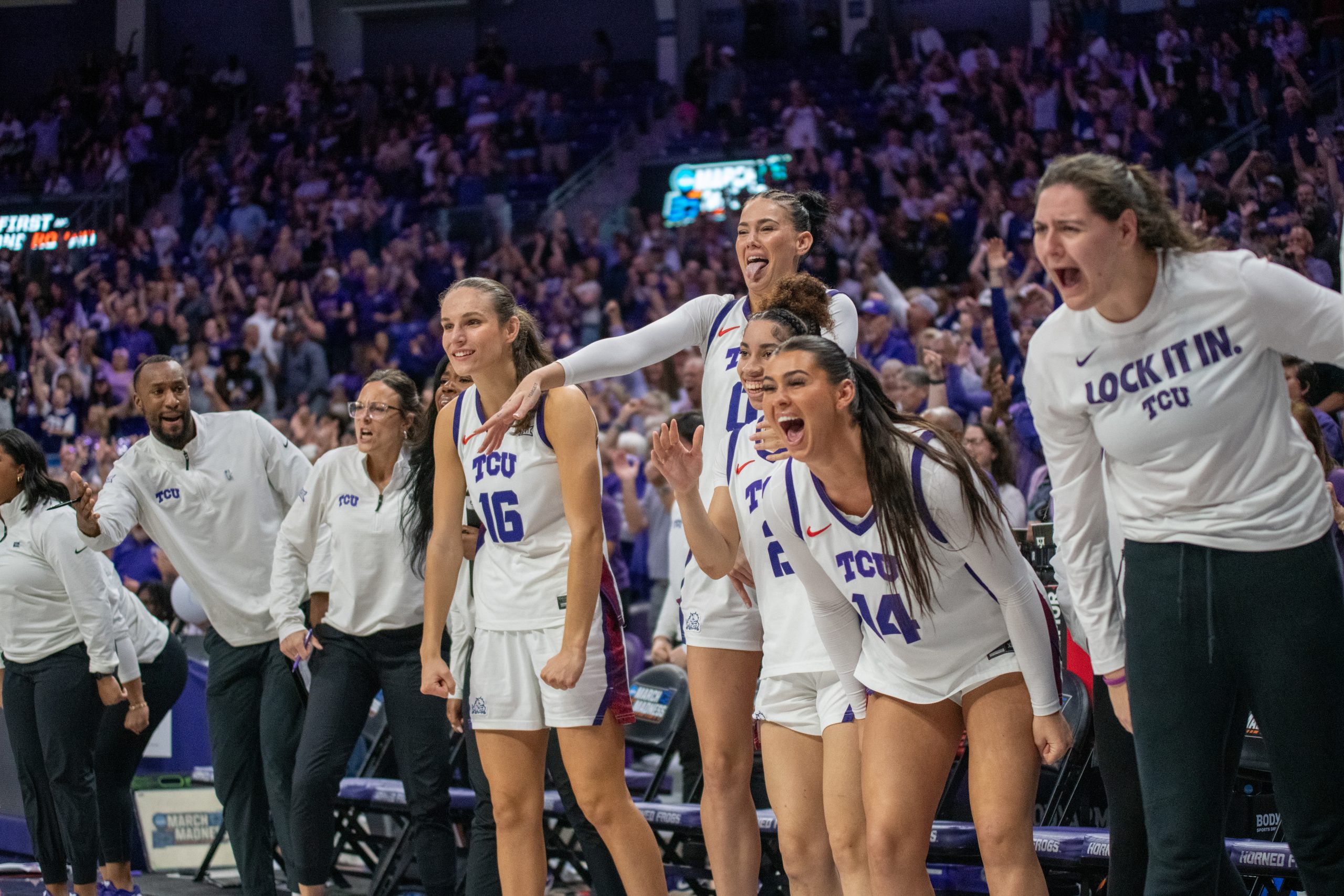
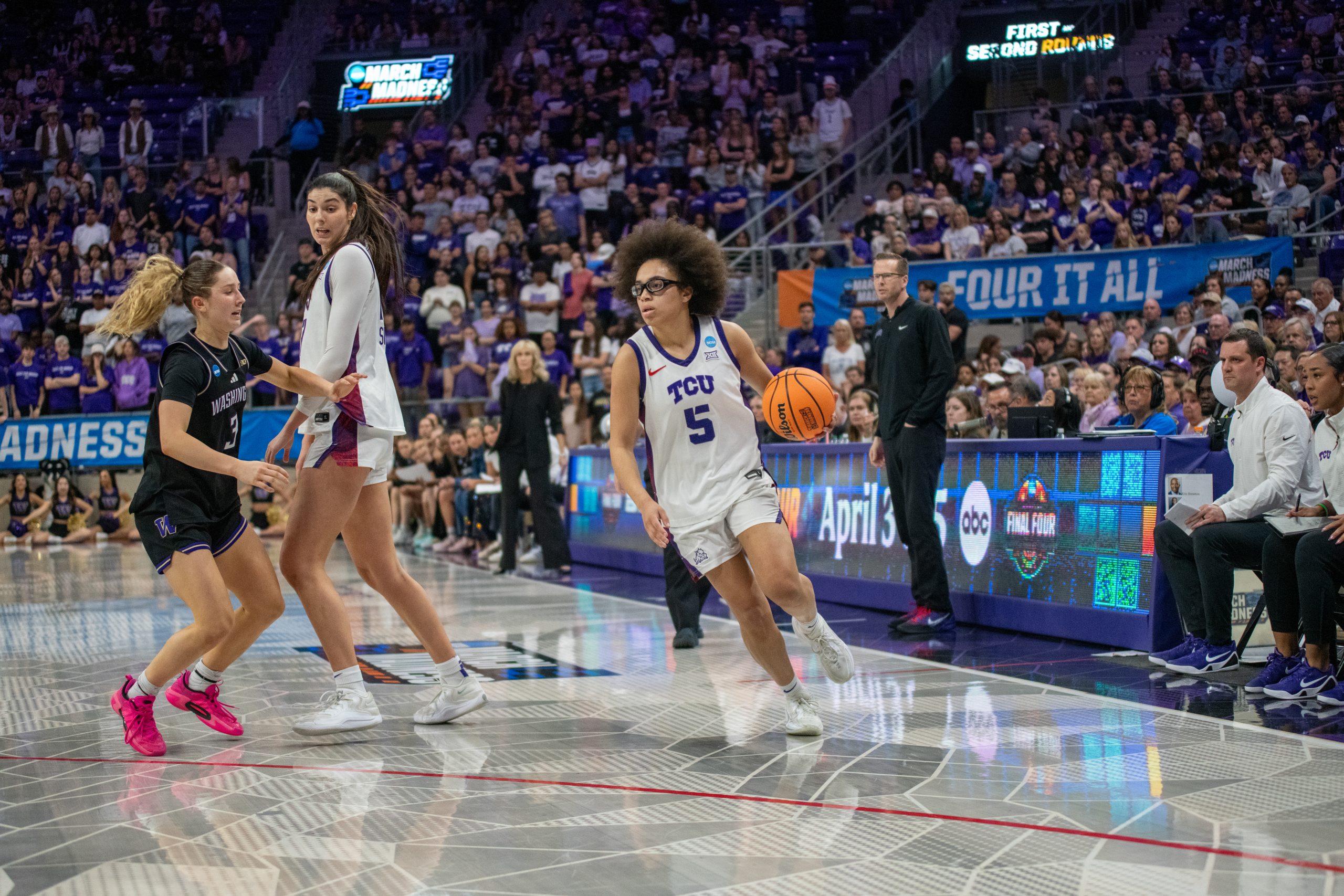
The Horned Frogs rallied from a 27-19 halftime deficit to defeat six-seeded Washington in overtime Sunday, advancing to the program’s second Sweet 16 in as many seasons. Photo by Percise Windom
Trailing by eight at halftime and shooting 26 percent from the field, the Horned Frogs clawed back one possession at a time, briefly pushing ahead in the fourth quarter and finally breaking loose with a 7-0 overtime-opening run en route to punching their ticket to the Sweet 16.
“That was just a gritty, resilient game,” head coach Mark Campbell said. “We were down the whole time. They just stayed in the fight.”
The night belonged to Silva. The sophomore center finished with 16 points, eight rebounds and a pair of blocks, anchoring a defense that held Washington to 35 percent shooting for the game.
TCU’s All-American guard Olivia Miles, who went 2-of-11 from the field in the first half, was a different player after the break, when she was 7-of-13.
At halftime, Miles had already steadied her teammates before Campbell said a word. “I just was telling them, ‘They’re not gonna give it to us. This is what March is about.’ ”
When play resumed, Miles attacked the paint, created opportunities for others and finished just short of a triple-double with 18 points, 10 rebounds and game-high eight assists.
TCU’s Taylor Bigby, a senior guard who spent much of the night chasing the Huskies’ Avery Howell through screens, hit the shot that may have won it — a three-pointer early in overtime that pushed the lead to five and took the air out of Washington’s rally. “I took it really personal going into the second half,” Bigby said of her defensive assignment “I knew that’s what my team needed in order for us to win.”
TCU forward Marta Suárez, playing with four fouls for most of the second half, said she refused to play tentatively. “It was a very tight game.”
Newly named Big 12 Player of the Year Olivia Miles finished just two assists shy of a second consecutive triple-double during Sunday’s comeback win over Washington. Photo by Percise Windom
Miles said the win was far from easy. “I was crashing out multiple times. I was angry, I was feeling all the emotions because I didn’t want to go home. I didn’t want to let my team down.”
As she walked toward the handshake line after the final buzzer sounded, Miles blew kisses and flashed heart hands to the Schollmaier crowd. For Bigby, who, like Miles,played her final collegiate game in Fort Worth, the moment was special. “It’s a blessing,” she said. “My teammates, my coaches, I wouldn’t be here without them and the confidence they instill in me. There’s no other way to go out with my last games here at the Scholl. It’s definitely gonna be something I remember.”
Now TCU heads to California’s capital, where the 31-5 Horned Frogs will face No. 2 seed Iowa or No. 10-seeded Virginia on Thursday or Friday at the Golden 1 Center, in the city where Campbell spent two seasons leading Sacramento State. “To take a program that’s 1-17 and get back to the Sweet 16,” Campbell said of the turnaround from a one-win Big 12 season in 2022-23, “it’s happened two times in the history of our school. And that was last year and this year. … I’m thankful we get another 40 minutes together. We get another week together.”