In this series, TCU Magazine visits with alumni in the food and beverage industry. Send recommendations to tcumagazine@tcu.edu.
Austin Perrotti ’17 closed the deal to buy back Perrotti’s Pizza in September 2025, returning the business to its namesake family after an eight-year hiatus. His father, Richard Perrotti Jr., and grandfather, Richard Perrotti Sr., founded the pizzeria in 1986, building the menu around family recipes that trace back to Austin’s great-grandmother in Italy. Today, three Perrotti’s locations operate across Fort Worth, the flagship tucked under TCU’s Molly Reid Hall student apartments on Greene Avenue.Austin, now owner and CEO, came up through the restaurant industry — from server to a consulting role — and was working in insurance sales when the chance to buy back Perrotti’s arose. He left that career to take over the family business. He is the third generation to run Perrotti’s. The fourth generation already runs around the shop.
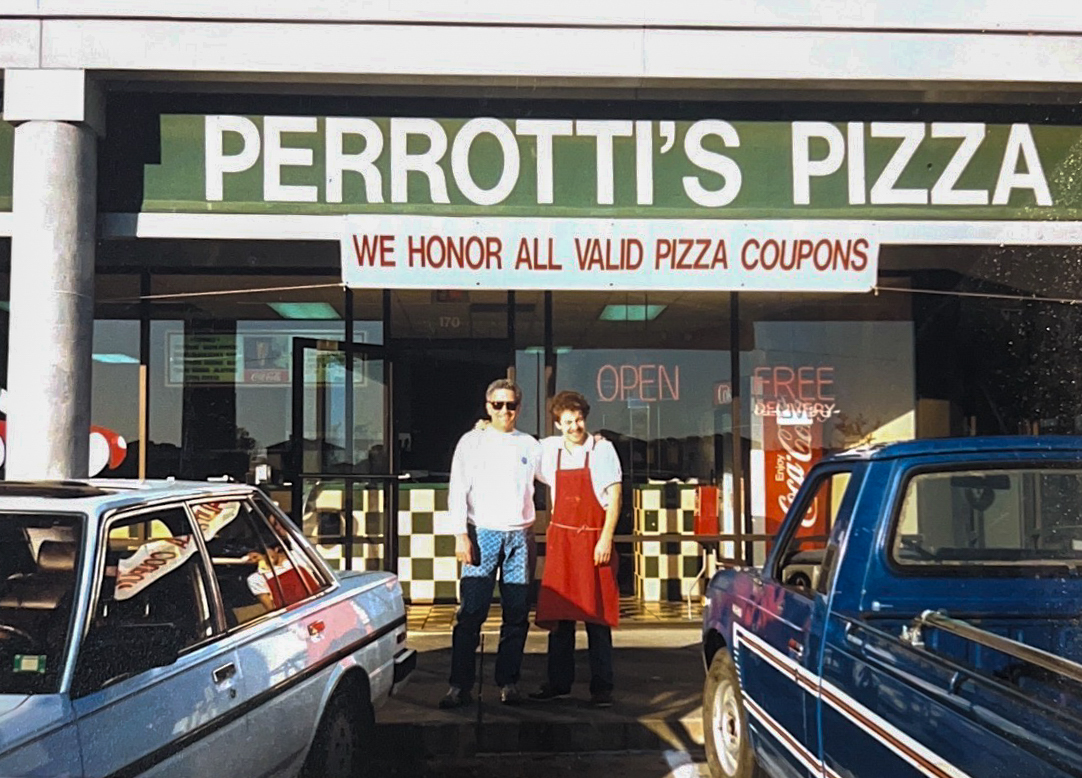
Richard Perrotti Jr., right, beside his father, Richard Perrotti Sr., at a former Perrotti’s Pizza location in Fort Worth. The two founded the pizzeria in 1986 on recipes brought from Italy. Courtesy of Austin Perrotti
What does Perrotti’s Pizza mean to the community?
You can’t think of Fort Worth without Perrotti’s Pizza, and I can’t imagine Perrotti’s Pizza without Fort Worth. As Fort Worth has grown and has become a very metropolitan city, some locals worry about losing that small-town feel. And I think one of the things that really brings a small-town feel to a metropolitan city is those family-run businesses. As I have gotten older, I have slowly started to see that decline. A lot of people have sold them, they’vegiven way to corporations or they just have gone out of business with the times being tough.
If you want a slice of the city and you want a slice of what it means to be a Fort Worthian, come to Perrotti’s Pizza. You get so much more than a slice of pizza: You get history, you get family, you see the same faces over and over again.
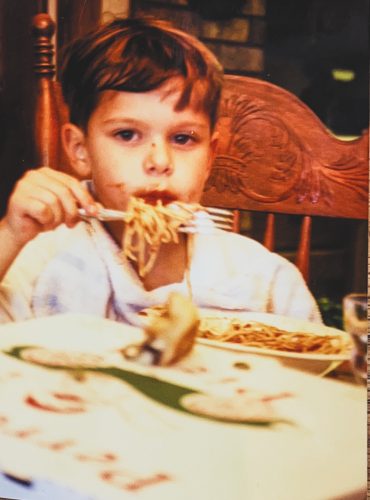
Austin Perrotti grew up on Perrotti’s Pizza, both as a consumer and helping out around the restaurant as a kid. Courtesy of Austin Perrotti
Did you grow up working at Perrotti’s?
When you own a family business, there’s no such thing as child labor laws. We would spend our weekends up here. Sometimes it was work, sometimes it was fun, but it gave us a chance to fall in love with and learn the product. Most kids, they’re out flying kites, hanging with friends, and we certainly did that. But there would be times where we’d come up here and my dad would say, “Okay, you’re in charge of the dough.” And so,I’d have to help him make the dough balls, or I’d cut a pizza and hand it to somebody, little things like that.
What’s the story behind the Perrotti’s logo?
The logo is actually a combination of my father and grandfather.
Back in the day — this would have been in the late ’80s, early ’90s — there was a guy who came in who just loved the pizza, and he was an artist. He would get his pizza box, and he would just kind of scribble and draw on it. And one day he was kind of looking up at my dad and my grandfather, and they came by and they go, “What is this?” He goes, “Oh, I created this little guy.”
How does the Perrotti family fit into the business today?
I’m a third-generation Perrotti’s owner, and this little guy here on my phone — that’s my son — one day he’ll be a fourth-generation Perrotti’s owner. My brothers Nick and Andrew work here, too, and now all of us have boys of our own. The fourth Perrotti brother is at the Sycamore School Road location.
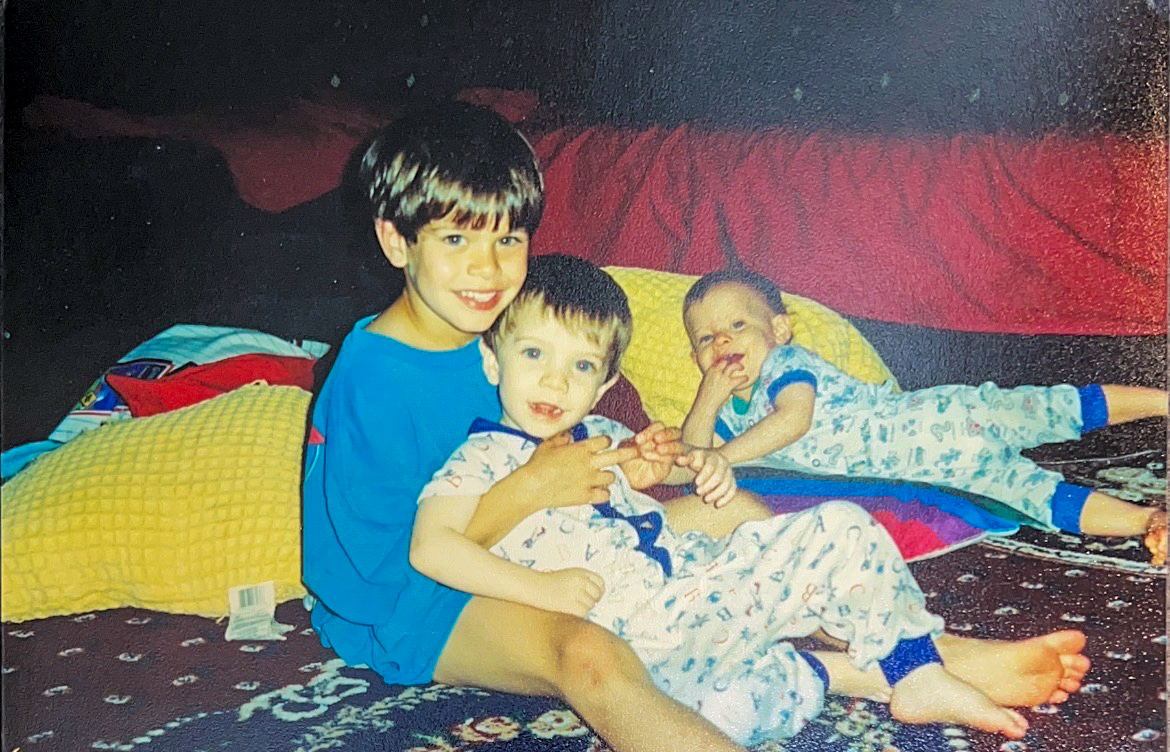
From left, brothers Austin, Nick and Drew Perrotti. Today, Austin serves as owner and CEO, Nick as general manager of the restaurant’s TCU location and Drew works back of house. Courtesy of Austin Perrotti
What do you order when you walk into your own restaurant?
You know, it really depends on the mood. I’d say our pan pizza, our boneless wings or the White Sicilian — that’sprobably what I get the most. The White Sicilian (mozzarella and garlic butter on a crisp golden crust) is what I grew up on as a kid, so that, for me, has a bit of nostalgia to it.
Editor’s Note: The questions and answers have been edited for length and clarity.
As an American living in Spain, Jennifer Ellis Murray ’14, loves the experience of going to food markets a few times a week, getting to know the vendors and learning how to eat in season in a country where not everything is available year-round.
Murray, who had studied abroad in Spain through the College of Education and returned as a student teacher, moved to Barcelona after graduation, where she taught fifth grade at an international school for eight years.
The extra time at home during the Covid-19 lockdown gave Murray the opportunity to start making grazing boards, which she learned about online, including through blogs based in the United States and the United Kingdom, where she said the trend caught on earlier than in Spain.
She remembered joking to her husband, “Wouldn’t it be so funny if one day I just stopped teaching and then had a company that was wine and cheese, and we just made food all day and did tastings and events?”
After the country opened up and she returned to teaching, the couple entertained small groups of friends at home, serving Murray’s grazing boards. She continued finessing her approach through trial and error — like learning not to put pickles near blueberries because the juice of the former ruins the taste of the latter.
Murray’s musing about pivoting to a culinary career slowly became a reality. While still teaching, she rented a commercial kitchen in Barcelona, where she hosted grazing board workshops and fulfilled catering orders, working early mornings, evenings and weekends. Eventually, she left her teaching job to devote herself to the new business.
Today, The Board Barcelona has a bricks and mortar shop and a long client list, catering private and corporate events in the Catalonian city.
Jennifer Ellis Murray taught fifth grade in Barcelona for eight years before leaving to run The Board Barcelona, which caters private and corporate events in the Catalonian city. Courtesy of Juno House
Murray teaches classes quarterly at the shop, where she demonstrates to students how to create a balanced and nuanced grazing board. Her tips include slicing and arranging cheeses in interesting and various ways, pairing ingredients that taste good together and strategically placing elements in contrasting colors to move the eye around the board.
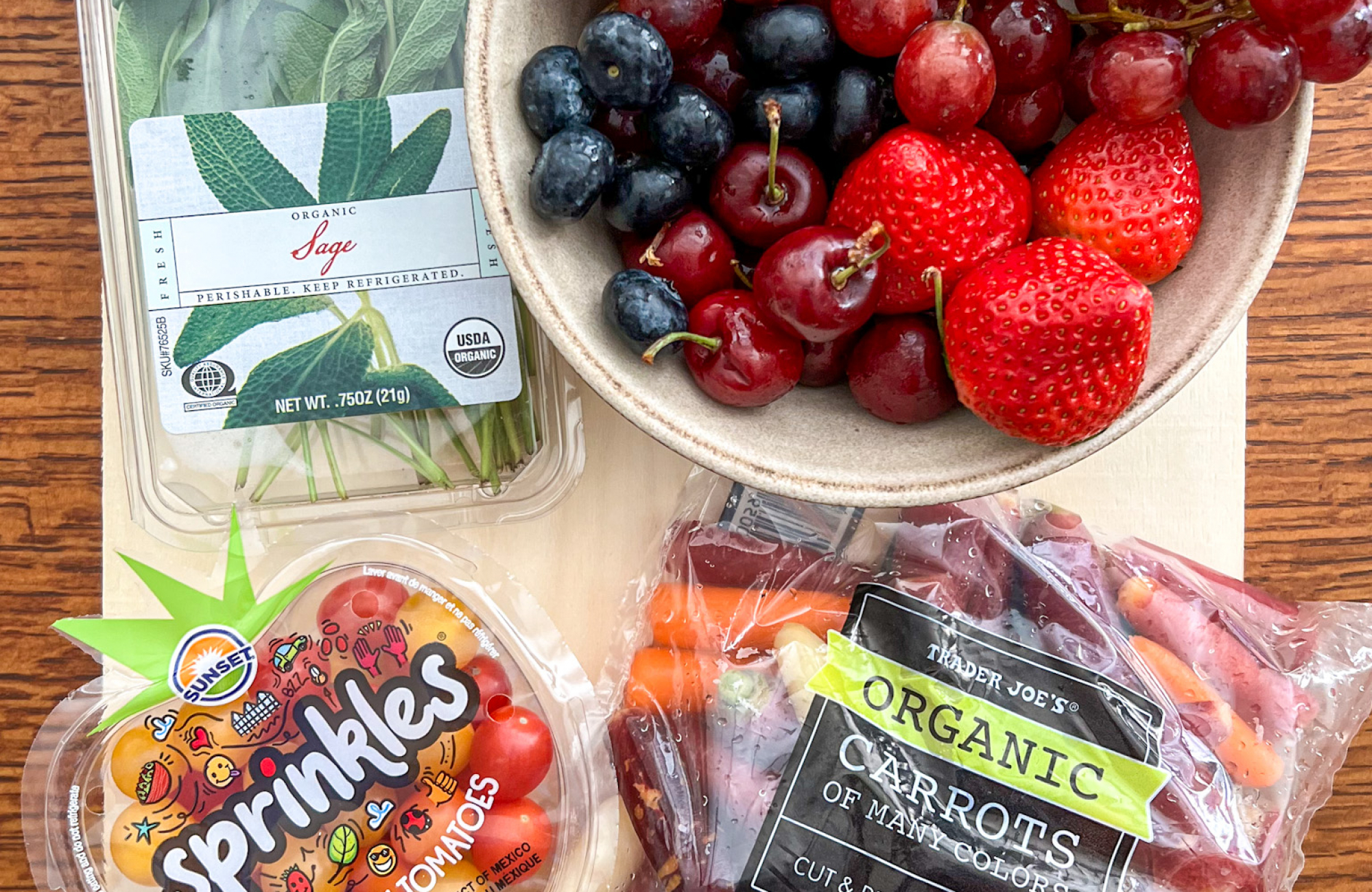
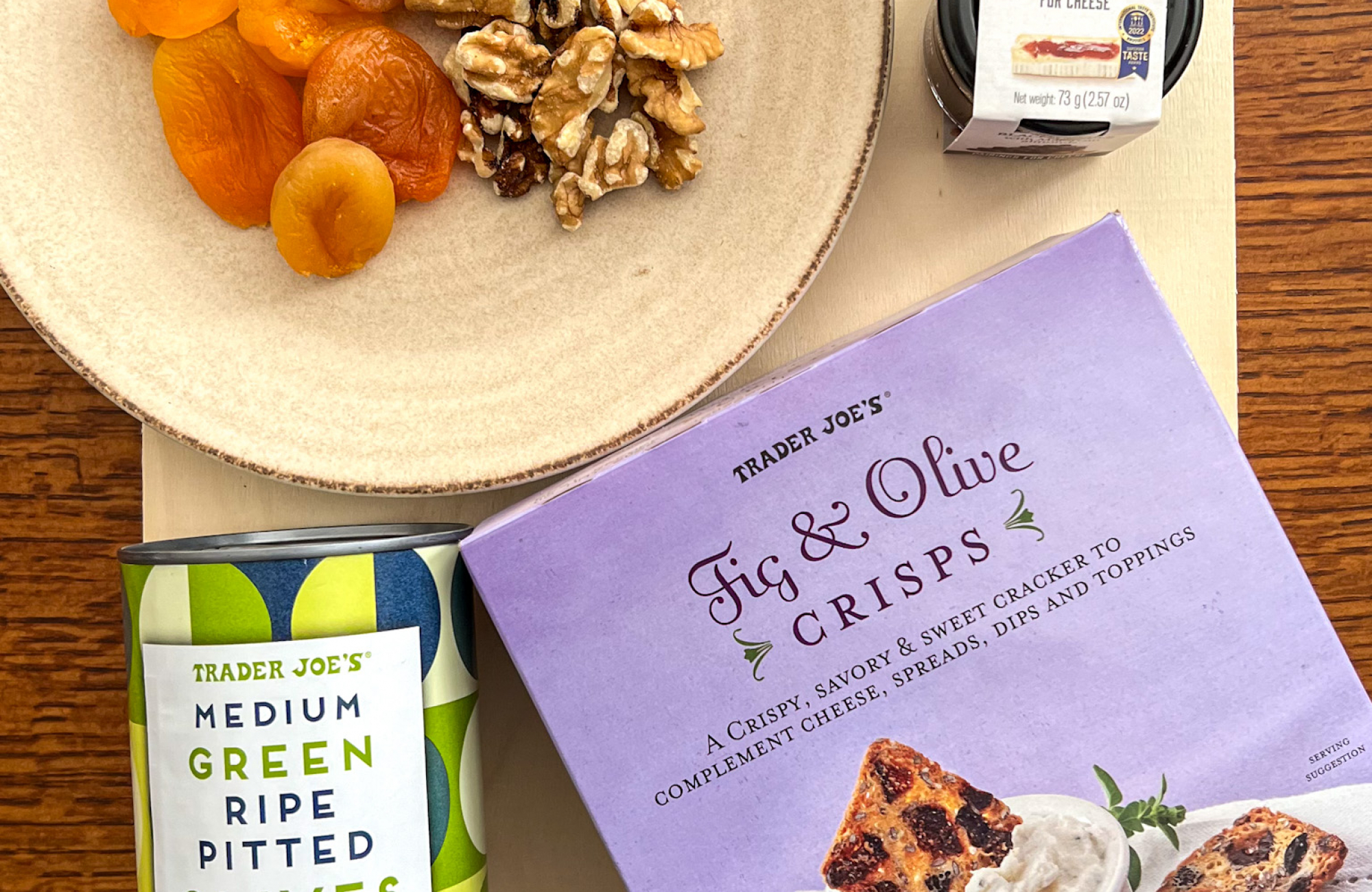
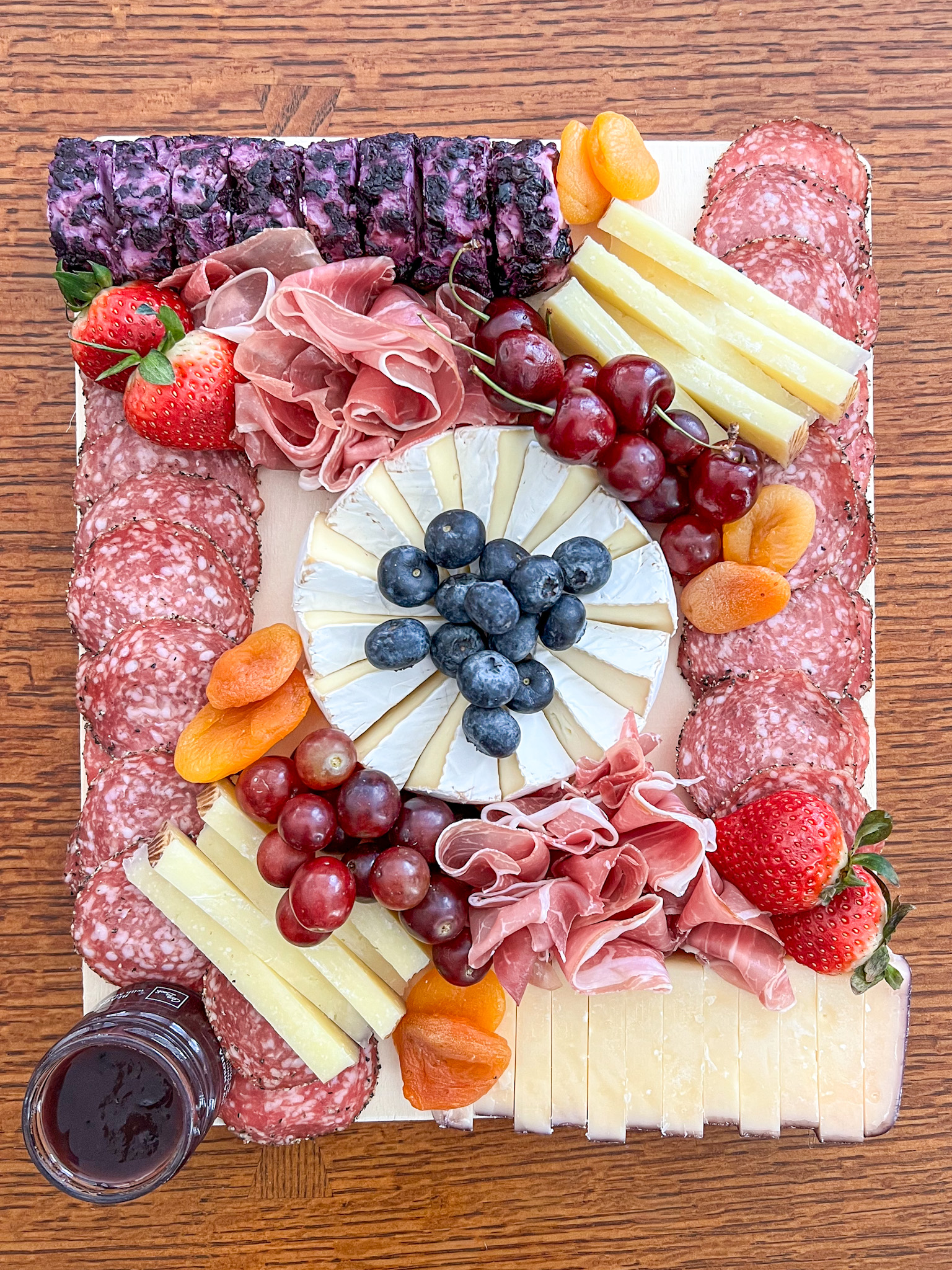
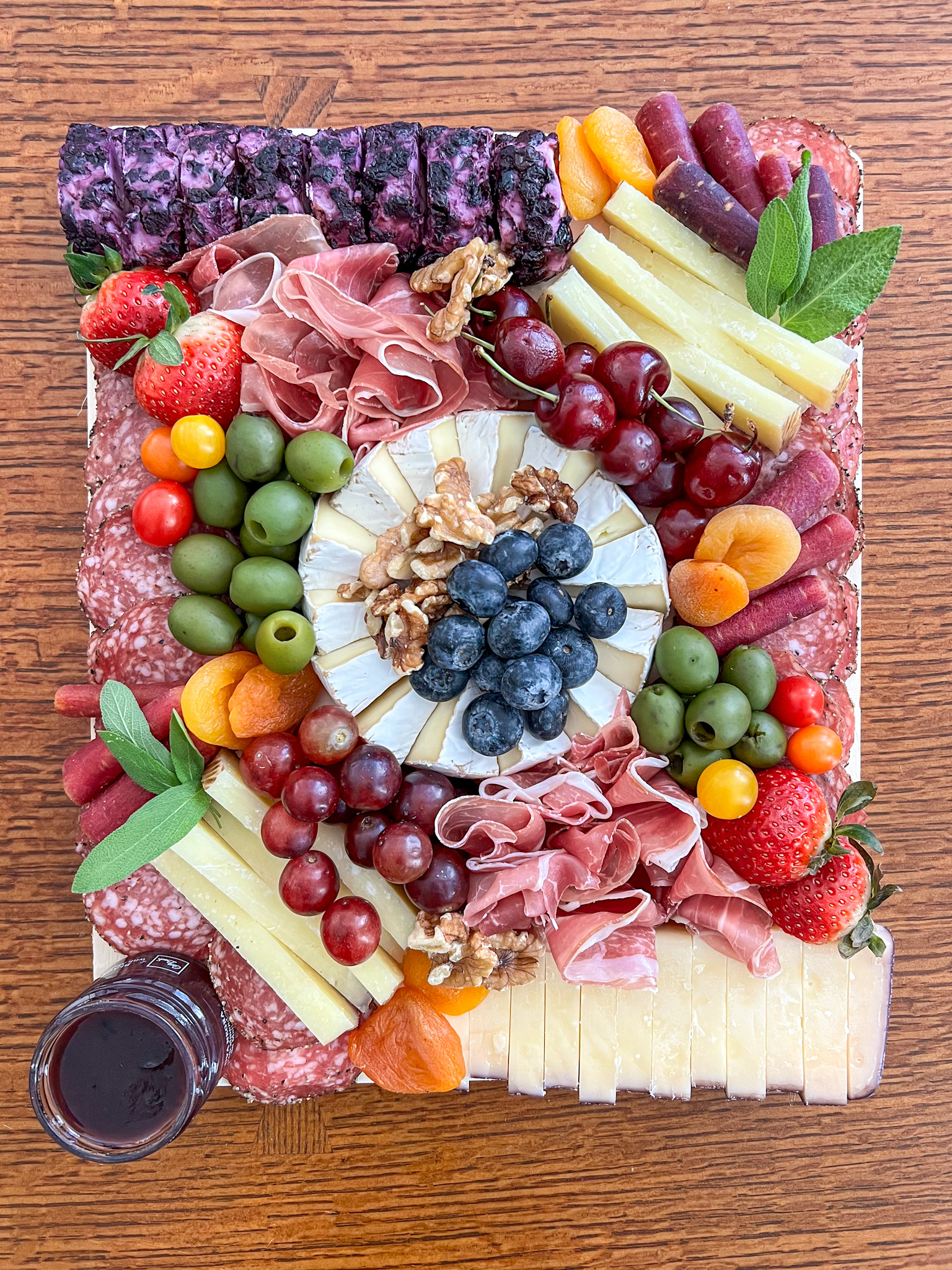
During a recent visit to Texas, Murray created a grazing board especially for her fellow Horned Frogs, using ingredients available from American markets — including cheeses made from cow’s, sheep’s and goat’s milk for variety in flavor and texture — and incorporating several purple ingredients.
Murray said to think like an artist while building a grazing board. “Step back frequently and look at the board as if it were a painting, always aiming for balance and symmetry,” she said. “The most important thing is combining flavors and textures that your guests will enjoy.”
— Laura Samuel Meyn
TCU-Themed Grazing Board
This board serves 4 to 6 people as a heavy appetizer or 7 to 9 people as a light appetizer. A rule of thumb is to include 2 to 3 ounces of cheese and 2 to 3 ounces of charcuterie per guest. It’s better to slightly overestimate quantities; you can replenish the board throughout the party.For a vegetarian version, omit the charcuterie and add more fresh fruit orcheese.
Serves 4 to 9
Cheese:
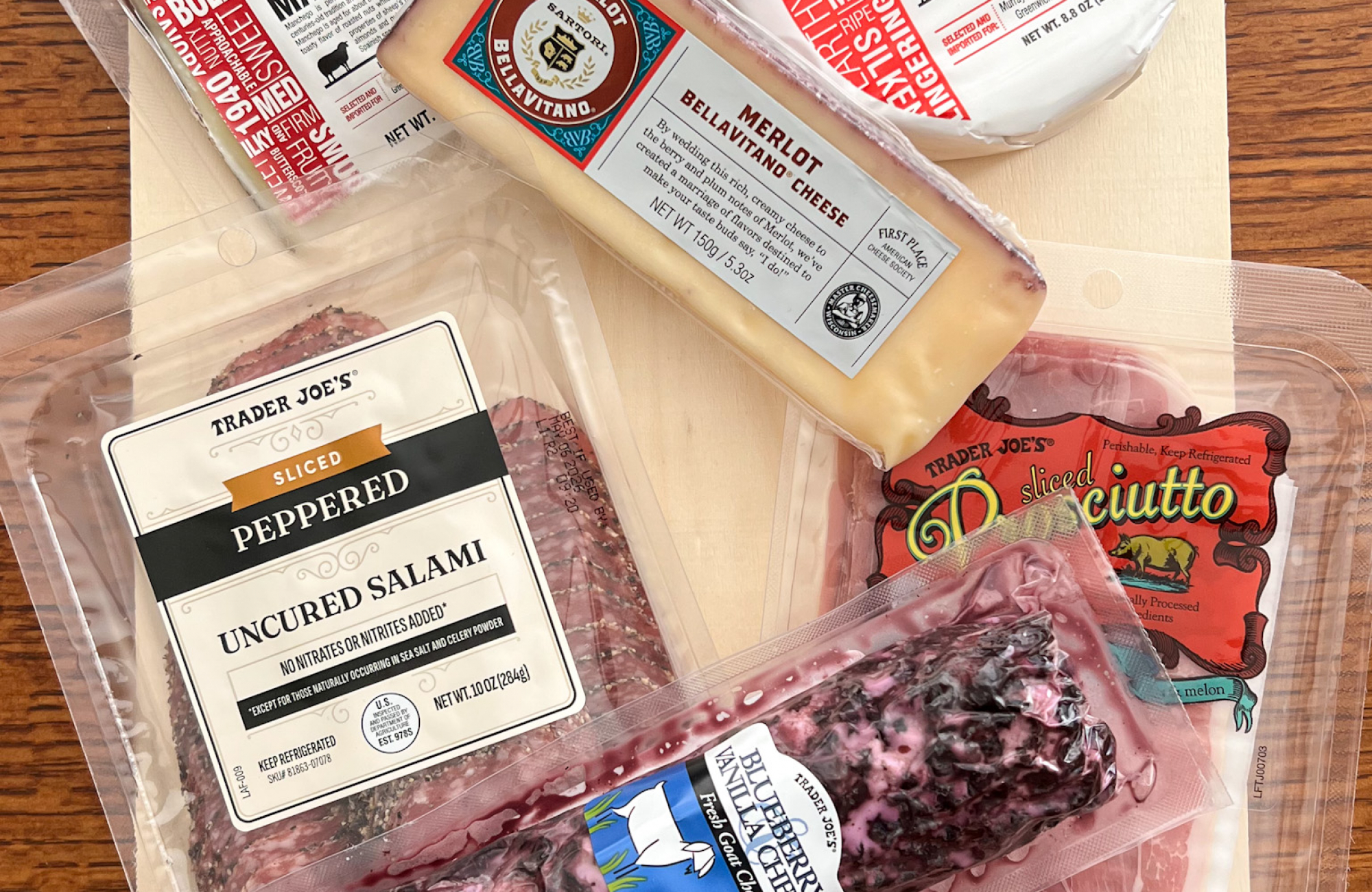
1 8-ounce wheel of brie
5 ounces young manchego
5 to 6 ounces red wine-infused cheese
8 ounces blueberry chèvre
Charcuterie:
10 ounces sliced salami or similar cured meats
4 ounces prosciutto or Spanish jamón
Fresh fruit:
Blueberries
Strawberries
Dark cherries
Red/purple seedless grapes
Additional items:
Grape-based jam
Dried apricots
Purple carrots
Green olives
Cherry tomatoes
Walnuts
Fresh sage (for garnish)
Crackers
Step 1:Take out all ingredients, leaving cheeses and meats off to the side so they can come closer to room temperature (meat is easier to fold when it is not too cold). Wash fresh fruit and set it aside to dry completely.
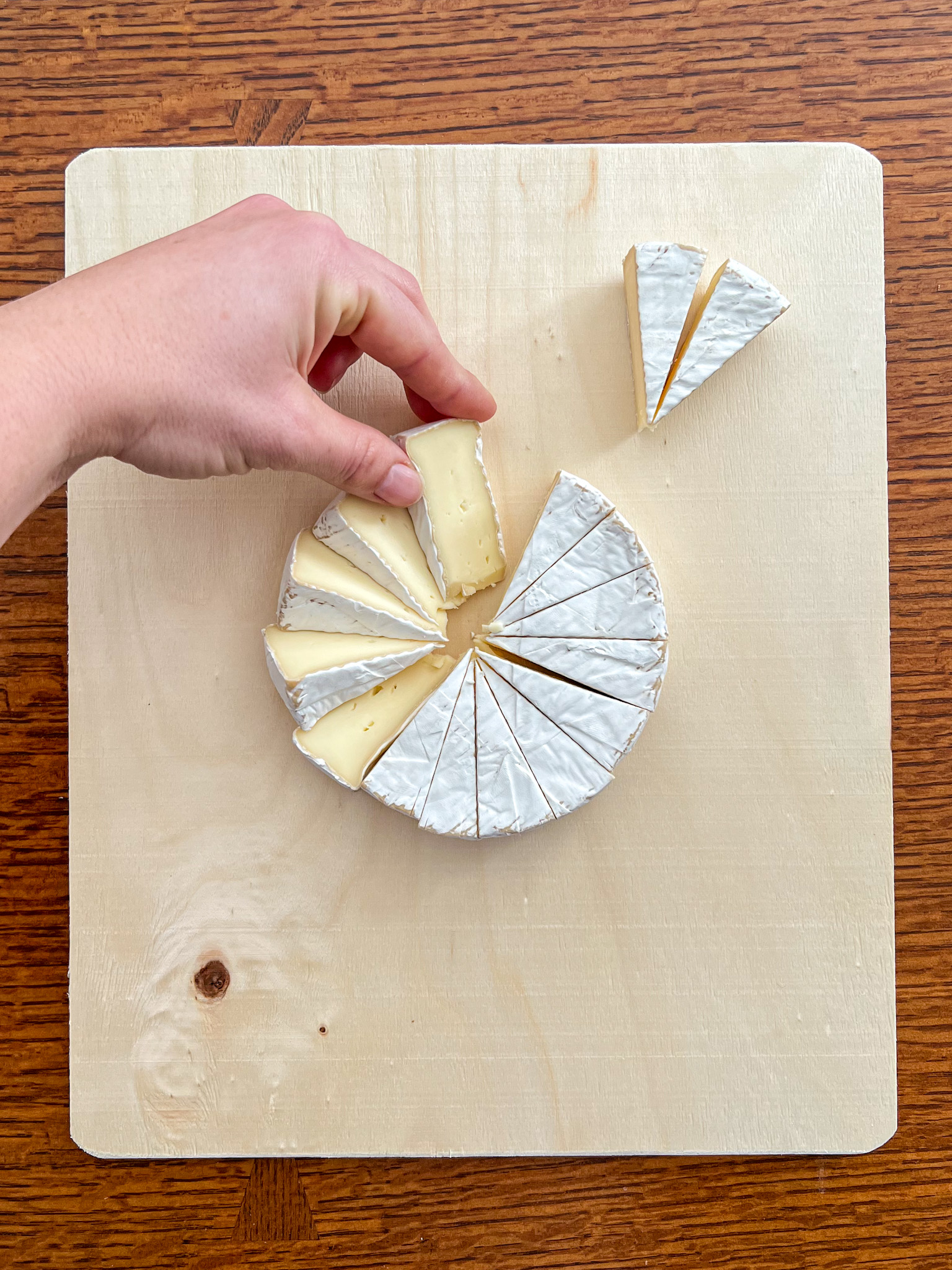
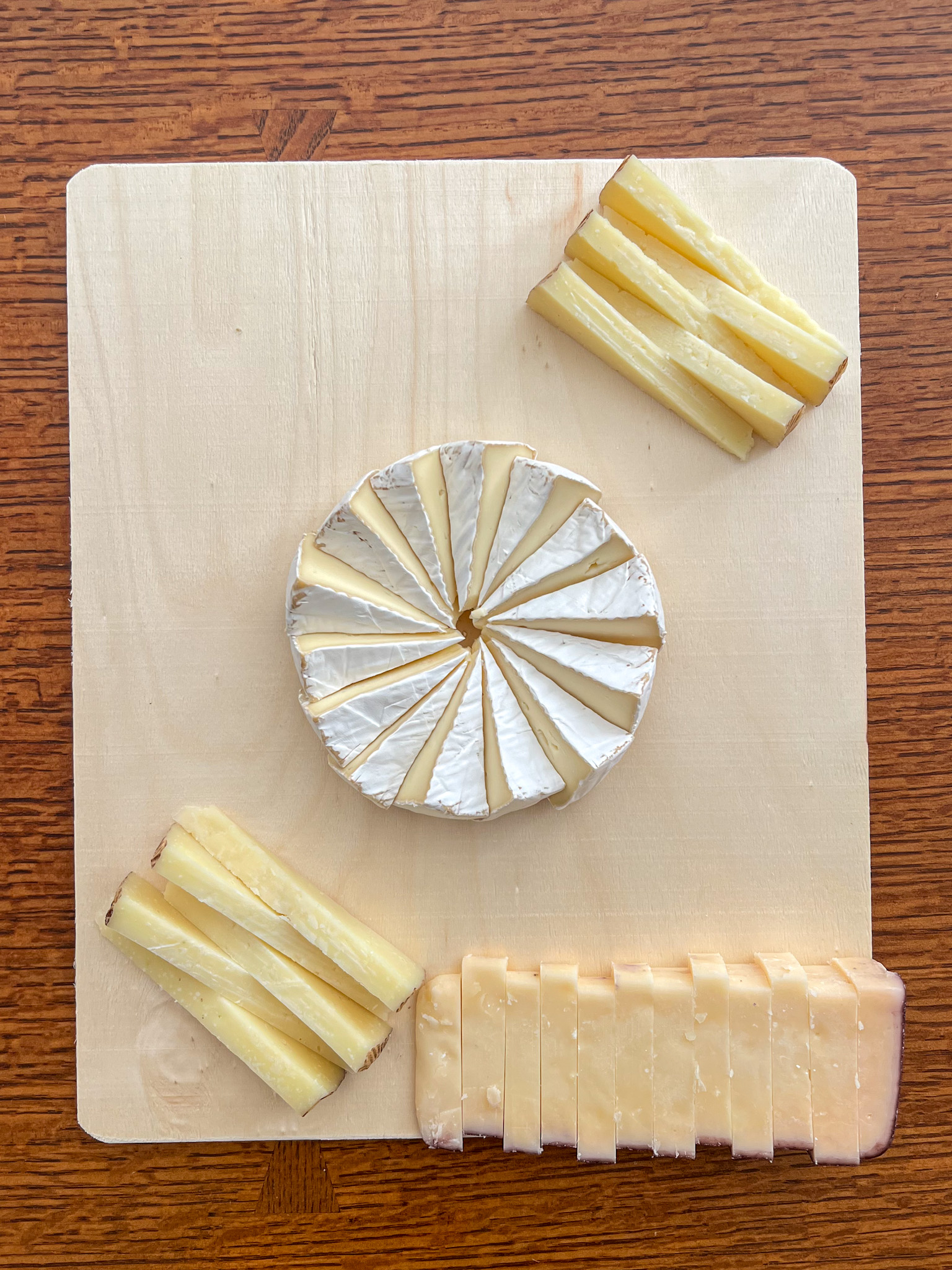
Step 2:Place brie in the center of your board and cut into small triangles.
Step 3:To make styling easier, remove a couple of slices of brie from the wheel. Twist-turn each pieceindividually to create pinwheel effect, stacking the final piece on top of the first.
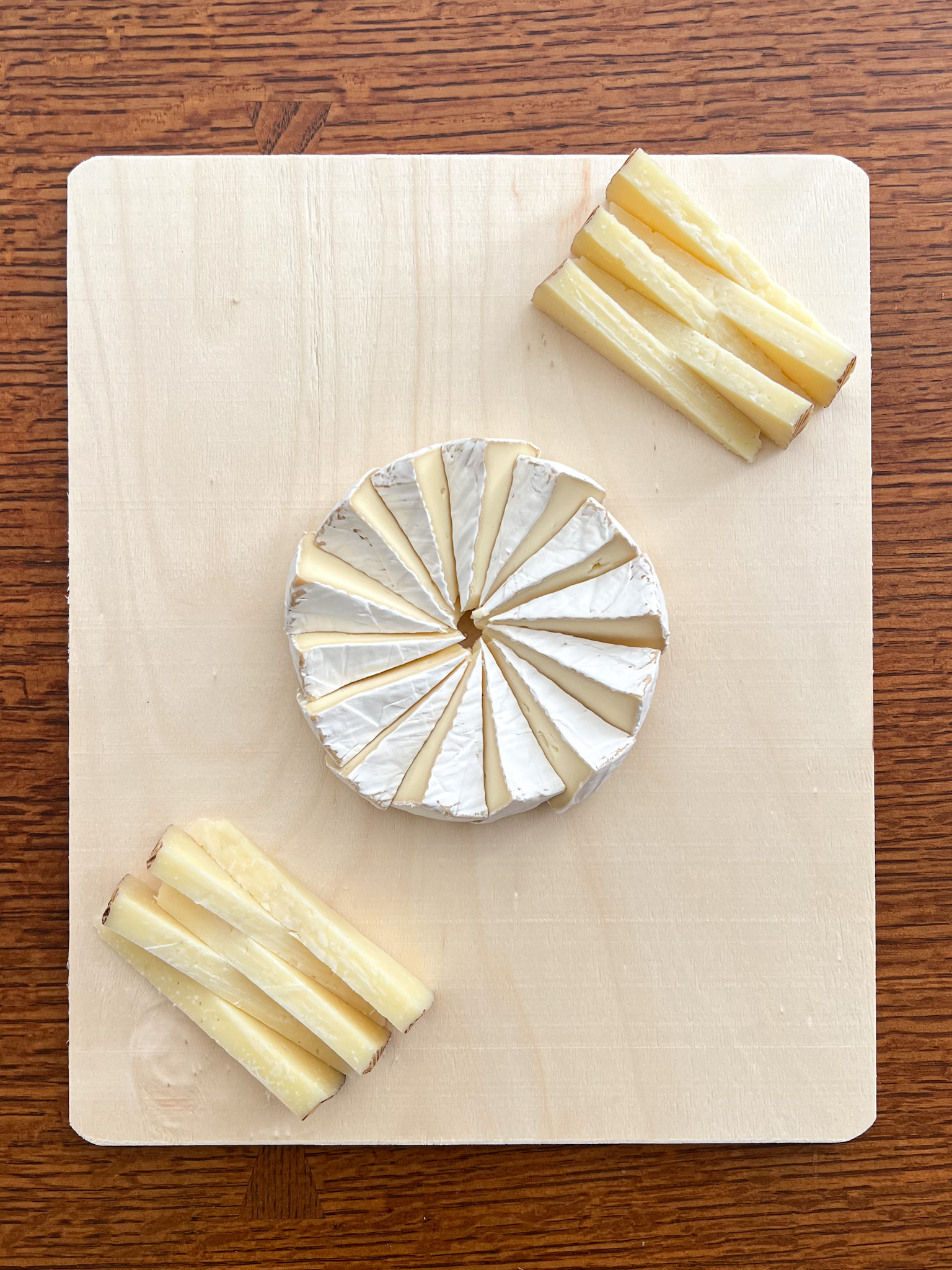
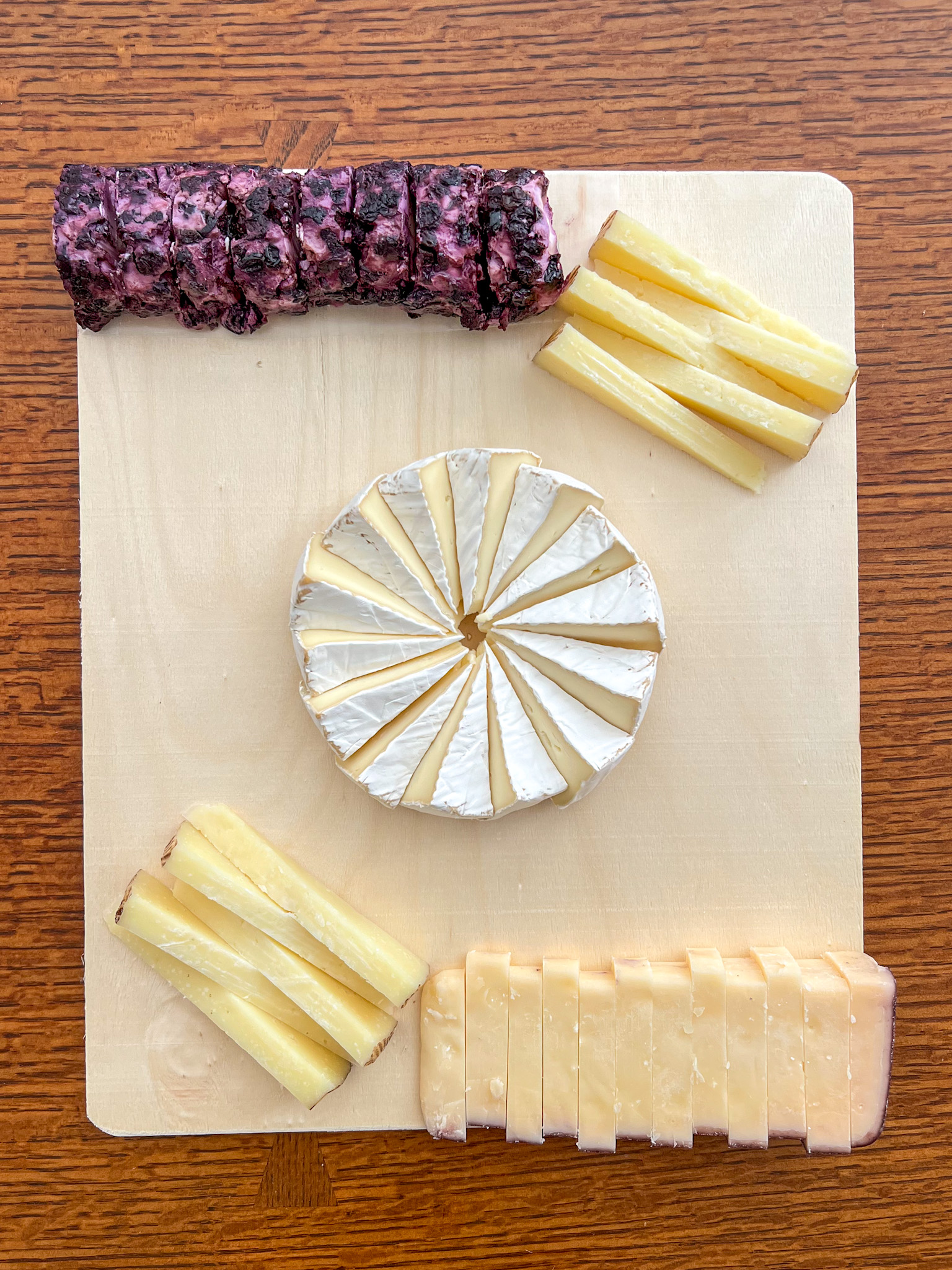
Step 4:Cut manchego cheese into triangles. Arrange them, rinds out, in a crisscross formation on the board, leaving space between brie and manchego for additional items and reserving room in the corners for meats.
Step 5:Slice red wine-infused cheese. Place in one corner of the board, slightly pushing and pulling slices to create a subtle 3D effect. Although the rind is not edible, it can be left on for color.
Step 6:Add blueberry chèvrein the corner opposite the wine-infused cheese, placing small piece of wax paper underneath (this cheese is very juicy and may stain wooden boards).Leave cheese whole or slice into medallions.
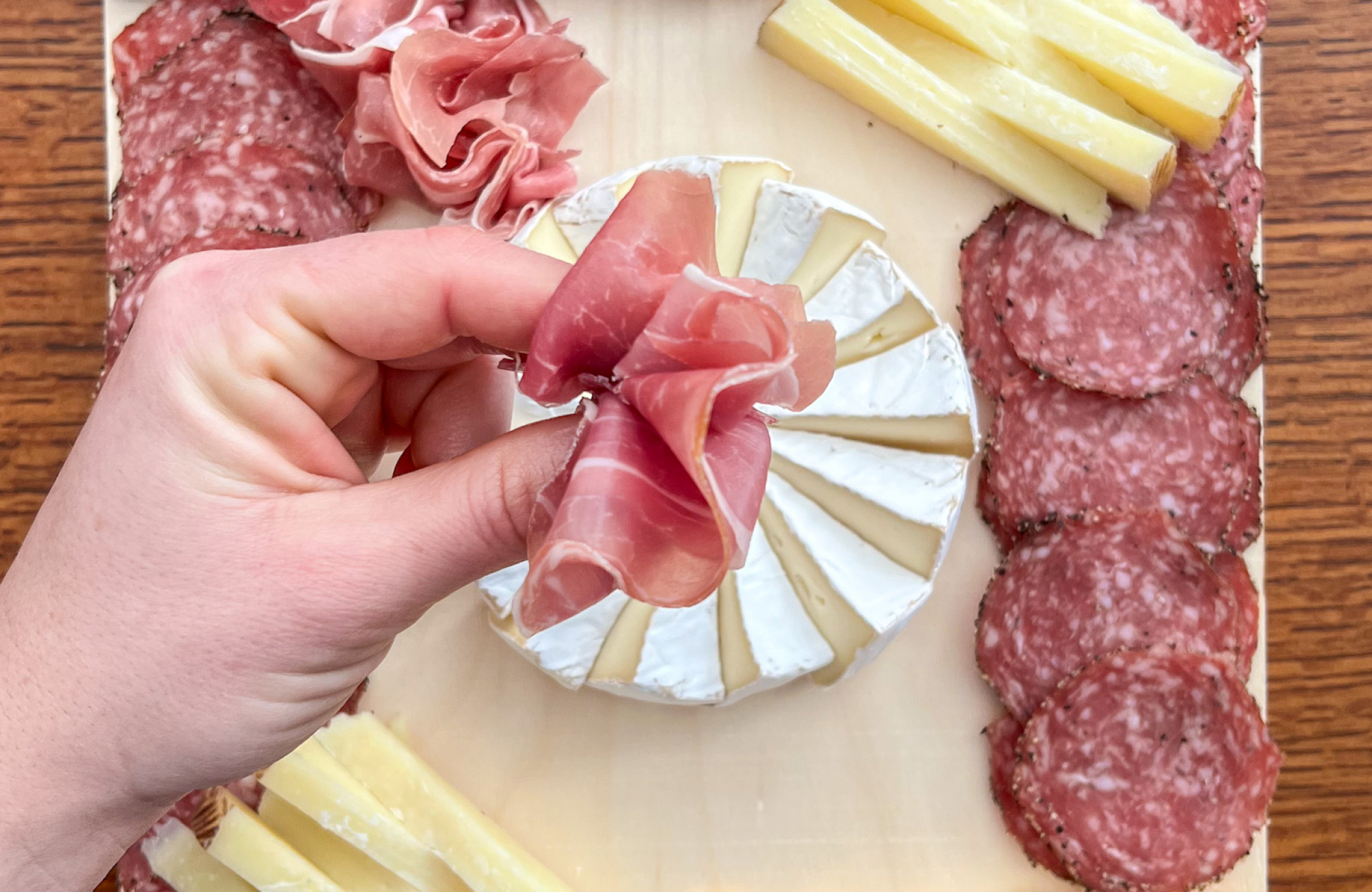
Step 7:Open salami and prosciutto, wearing gloves if desired. Start with salami, overlapping each slice along the long edges of the board, repeating to create a three-layer wall that helps keep other items in place. If needed, gently lift manchego cheese and slide somesalami underneath to help build height or fill gaps.
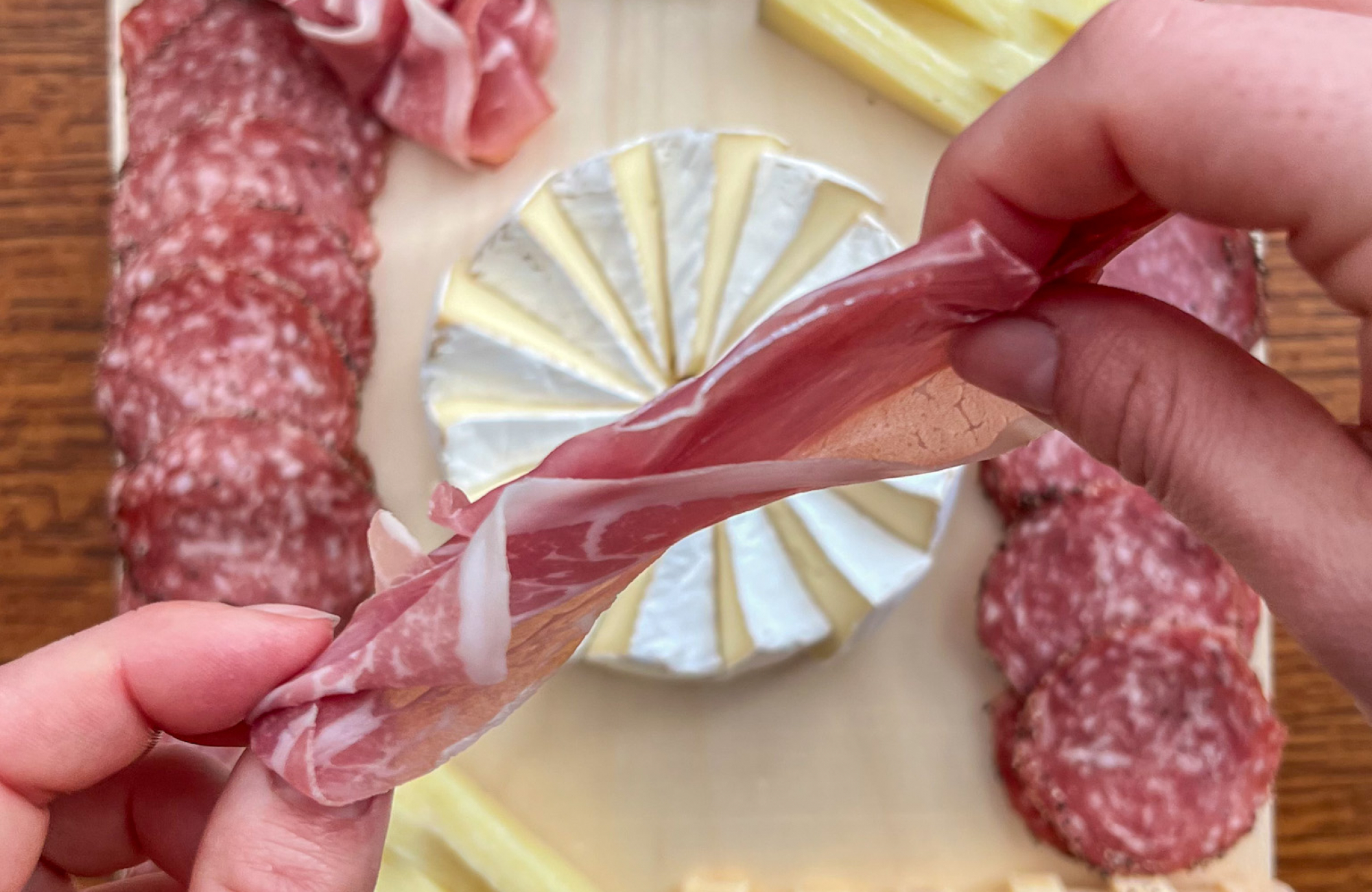
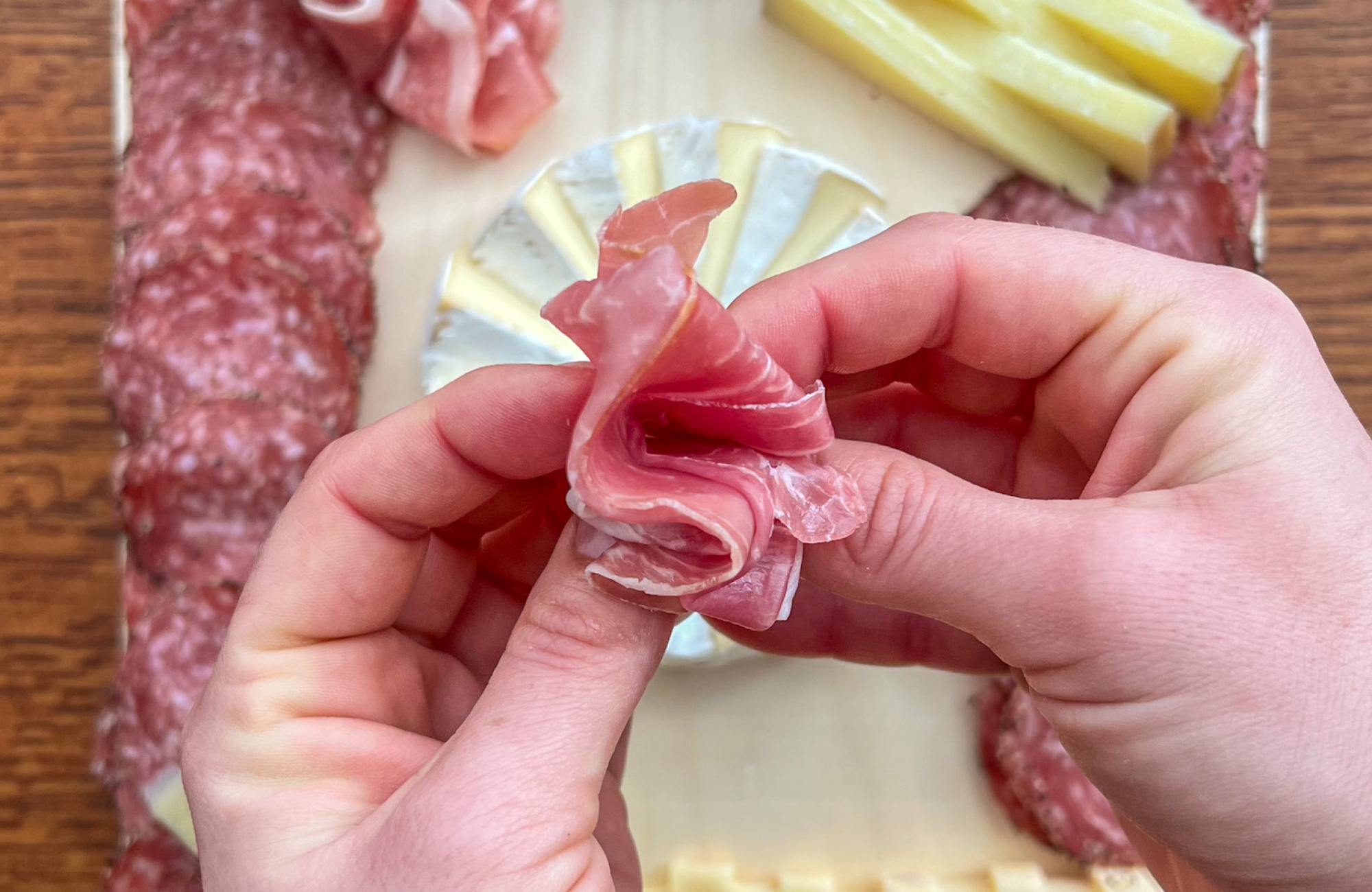
Step 8:Peel apart prosciutto pieces. Fold each slice lengthwise and gently pinch ends together to create a fan shape. Place between brie and corner cheeses.
Step 9:Keeping balance and symmetry in mind, place blueberries on top of brie and arrange strawberries and cherries around the board. Add jar of jam.Add grapes opposite the cherries and add dried apricots in pairs.
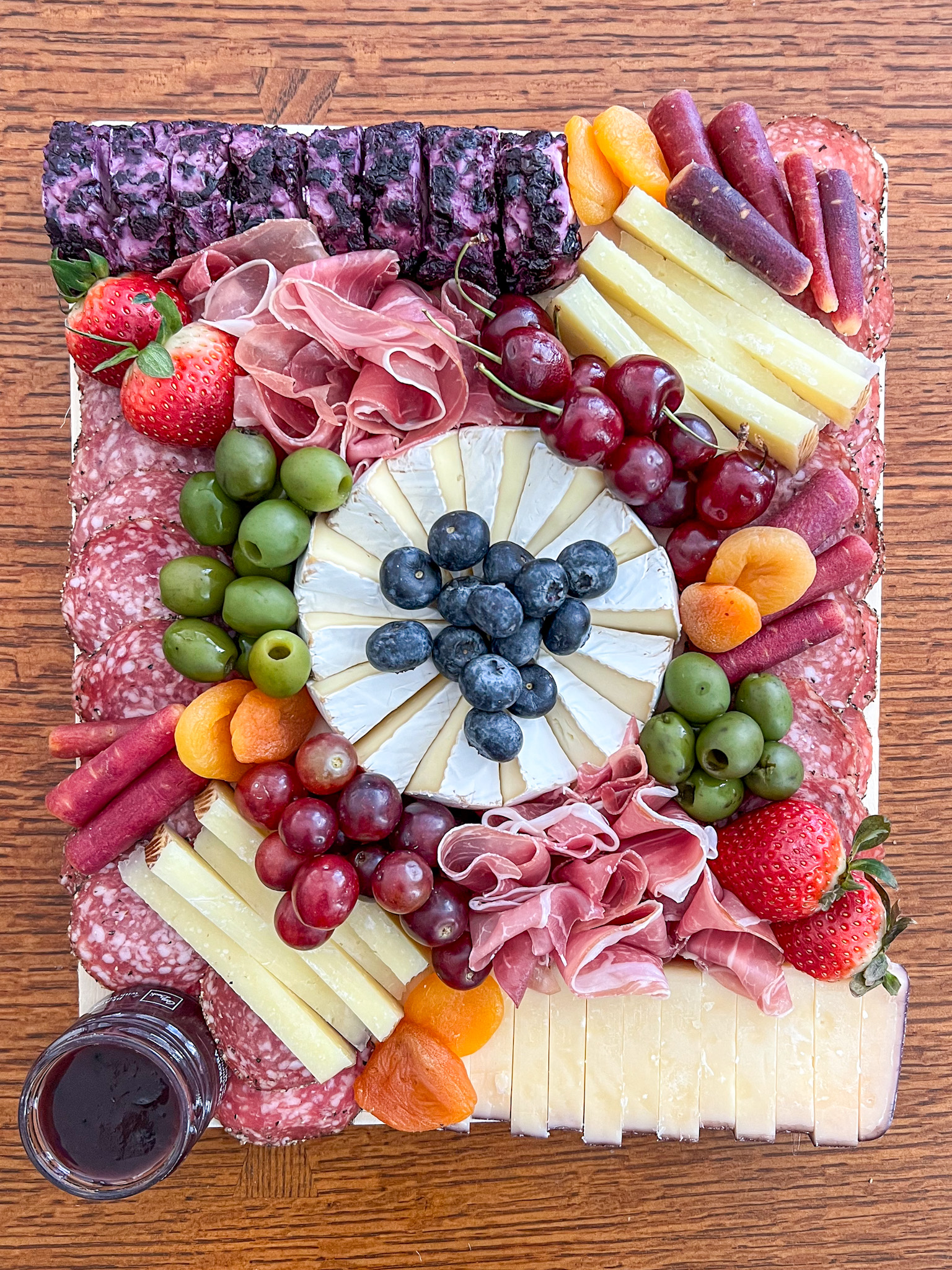
Step 10:Fill in any remaining gaps with purple carrots and bright green olives.
Step 11:Complete board with any extras you enjoy, like cherry tomatoes, walnuts and fresh sage. Serve with crackers.
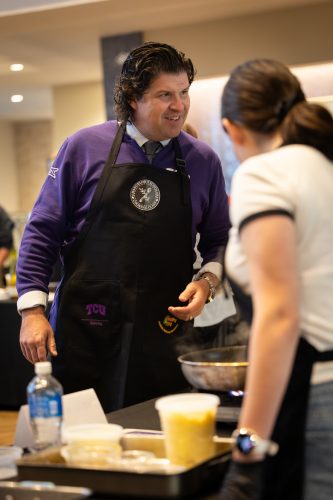
Conversation and taste-tests were on the menu when Chancellor Daniel W. Pullin joined Chancellor’s Scholars for a cooking class. TCU Marketing & Communication
Every August, before the first class meets, our newest students sit down with faculty and staff for the Frogs First Family Dinner. Before a single syllabus changes hands, we gather around a table, and that tells students something essential about TCU: Community here is not incidental. It is the point.
Food has always been how communities say youbelong here. This issue of TCU Magazine celebrates the alumni, students, faculty and staff who built their lives around nourishing others — from the NFL alum-turned-barbecue pitmaster to the vegan chef who reversed his own diabetes through intentional food choices.
Sharing with others is one way we turn values into action. Our students volunteer in the Food Recovery Network to collect unserved food from our dining halls and deliver it to neighbors in need across Fort Worth.
The roots run deep: History professor Rebecca Sharpless reveals how wheat quietly underwrote North Texas culture and civic life for more than a century. Food, it turns out, has always shaped who we are.
Fort Worth and TCU set a generous table, and I am grateful every day for the chance to pull up a chair.
For most of us, the words “comfort food” conjure a specific dish. Maybe it’s a savory childhood staple like mac and cheese, as perfect for bingeing over a breakup as it is occupying pride of place at the Thanksgiving table. Perhaps yours has its roots in heritage: Grandma’s Bolognese sauce, straight from northern Italy, or a family recipe for maja blanca, a popular Filipino dessert pudding of coconut milk, corn kernels and toasted coconut flakes. If comfort foods share a theme, it’s that these dishes fill the heart as well as the belly — as these Horned Frog foodies readily attest.
WHO: June Naylor Harris ’79
KNOWN FOR: Award-winning journalist and cookbook author
COMFORT FOOD: Beef Bourguignon
Food, travel and Fort Worth are among the big loves of June Naylor Harris, as, of course, is her husband. Former TCU football MVP and NFL veteran Marshall Harris ’79 is a well-known studio artist venerated for creating the Flying T logo.
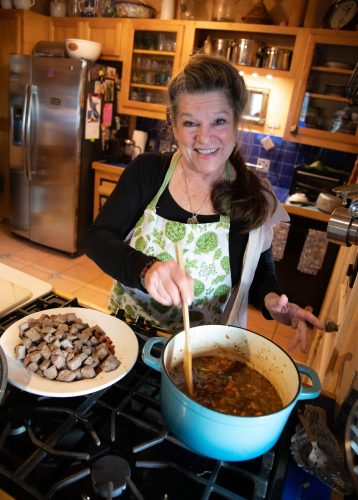
June Naylor Harris ’79 prepares beef bourguignon. The longtime journalist and author began cooking at a young age, inspired by her parents.
For her part, Harris started tinkering in the kitchen at a young age, inspired by her parents, whom she describes as motivated culinary explorers. In adulthood, she first encountered beef bourguignon via Julia Child; it proved a winning way to make good use of her Dutch oven. The classic French stew has become the go-to dish when she and Marshall celebrate something just for the two of them.
“There’s nothing fancy about chicken and dumplings or pot roast, but if it’s your favorite thing to eat, you want it for your birthday, right?” she said.
On New Year’s Eve or Valentine’s Day at her home in the city’s cultural district, a few miles north of the university, the sixth-generation Texan and Fort Worth Star-Telegram alumna might prepare beef bourguignon, often with an assist from Marshall.
It’s “easier to make than you’d expect, though you do have to be patient,” she said, promising that flambéing the veggies is a thrilling payoff. “There are few pots of goodness more satisfying in winter, especially if enjoyed with a nice bottle of red Burgundy alongside.”
During her three decades at the Star-Telegram, two of them as a food columnist and critic, Harris took cooking classes whenever she could, even in locales as far-flung as Thailand and Ireland. “Cooking for me is so therapeutic and so satisfying,” she said. Her cookbooks include The Texas Cowboy Kitchen (Andrews McMeel), co-authored with Grady Spears; Big Ranch, Big City (Ten Speed Press), co-authored with Lou Lambert; and The Texas Tailgate Cookbook (Great Texas Line Press), which she wrote with her husband mere months before the pandemic.
French stew, she said, tends to be especially versatile, and over the years she’s experimented and modified the recipe. Her preferred way to enjoy her favorite comfort food, she said, “is ladled over toasted planks of fresh French baguette, while Marshall’s is with egg noodles — but it’s every bit as good with mashed buttery potatoes or roasted new potatoes, too.”
The couple might serve beef bourguignon with petite green peas or a butter lettuce salad, lightly dressed in classic French vinaigrette.
When not at home preparing delightful meals or traveling the world, Harris has been at work for several years on a biography of Ruth Carter Stevenson, who shepherded the creation of the Amon Carter Museum to house her father’s collection of Western art. Harris’ beloved grandfather, a Star-Telegram editor, worked in the office adjacent to publisher Amon Carter’s — one of several family connections to the newspaper.
“My dad’s sister worked at the museum as a librarian when it opened in 1961,” Harris said, “so it felt like coming home.”
WHO: David Hawthorne ’07 (MLA ’08)
KNOWN FOR: NFL linebacker, food trucks and catering
COMFORT FOOD:Pulled Pork Sandwiches
When most Horned Frogs think of David Hawthorne, they picture him blitzing or tackling for TCU, the Seattle Seahawks or the New Orleans Saints (he played four seasons for each of his teams). A more current image of Hawthorne is that of a hospitality guru who has fed his award-winning barbecue to the likes of Dak Prescott, CeeDee Lamb and Taylor Swift.
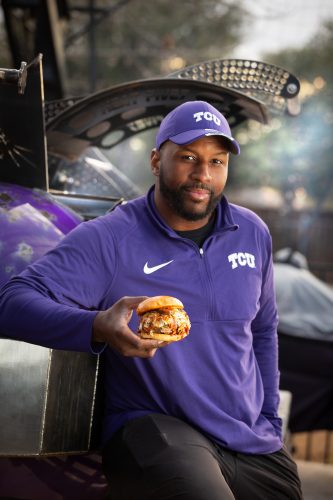
David Hawthorne presents a pulled pork sandwich beside a smoker he designed. The former NFL linebacker co-founded the North Texas barbecue catering company Not Just Q.
Barbecue is rooted in nostalgia for Hawthorne. His father was a pitmaster known as Mr. BBQ in their hometown of Corsicana, Texas. At TCU, Hawthorne blew away his roommates, teammates and future bride, Katy Buchanan ’07, with his culinary prowess, proving himself a bona fide MVP in the kitchen and at the grill. He has mastered all meats, but when it comes to comfort food, his favorite might just be a pulled pork sandwich, a recipe he tinkered with and perfected.
“I cooked even more when I was in the NFL,” Hawthorne said. “It was fun to be able to create those big holiday meals and magic for my teammates.”
He credits his wife, and her roots in Myanmar, with deepening his appreciation for Southeast Asian flavors and food, something that living in the Pacific Northwest reinforced. The Seahawk nutritionist’s emphasis on clean eating — and the NFL’s $500-per-pound daily fine for being overweight — reinforced discipline around food and performance, he added.
Upon becoming a Saint, Hawthorne sought to learn everything about Cajun and Creole flavors from chefs and friends in the Big Easy. “Gumbo, etouffee, catfish,” he said. “We had access to great food and cuisine.”
He’d long expected food to become his next chapter when he retired from the game in 2017. He partnered with chef Eric Hansen to co-found Not Just Q, a catering company in Dallas-Fort Worth that specializes in barbecue — everything from succulent ribs and melt-in-your-mouth brisket to sausage and that peerless pulled pork.
“While rooted in traditional barbecue, we pride ourselves on pushing the envelope to create a truly unique dining experience,” he said. His food trucks make coveted stops at certain TCU and Cowboys games.
“If you’re in this area, you better know how to cook a brisket, but I’m a pork person,” Hawthorne said. His beloved pulled pork sandwich starts with a toasted brioche bun. The meat comes mixed with a savory Texas red barbecue sauce. He tops that with a Latin-style coleslaw with a vinegar base rather than a mayo base, which truly makes the pork pop. Then there’s the Carolina Gold mustard-based barbecue sauce on top, plus a few pickle slices.
“This is a sandwich with a lot of character,” said Hawthorne, who has a stake in several restaurant groups. He also cofounded a technology company called Greta that helps meat markets, grocery stores, liquor stores and specialty stores streamline inventory and operations.
“Our pulled pork sandwich is definitely something you don’t expect to get from a food truck,” he said. “But once I get people to try it, they’re hooked.”
WHO: Lanny Lancarte II ’11
KNOWN FOR: Owner, Righteous Foods, and great-grandson of Joe T. Garcia’s founder
COMFORT FOOD: Enchilada Dinner at Joe. T. Garcia’s
“I think all comfort foods are driven by warm childhood memories — a combination of experiences as well as the food itself,” said Lanny Lancarte II, who literally grew up at Fort Worth’s most iconic restaurant: the legendary Joe T. Garcia’s.
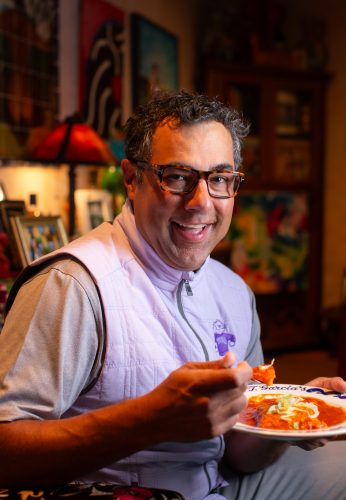
Lanny Lancarte II ’11 enjoys an enchilada plate in his father’s office at Joe T. Garcia’s, the iconic Fort Worth restaurant founded by his family. The fourth-generation restaurateur now owns the health-focused Righteous Foods.
At Joe T.’s, which has a small menu for such an outsized operation, Lancarte had a standard order: the cheese enchiladas. They remain his comfort food to this day.
That whole category of cooking harkens to family for Lancarte. “My great-grandmother was still alive when I started working [at Joe T. Garcia’s] in the early ’80s,” he said. “She had the mentality that if you’re old enough to walk, you’re old enough to work, so I was probably 6 or 7 when I started working there, doing things like washing dishes.” By the time he was in high school, he was managing substantial sections of the restaurant.
“I couldn’t go to Friday night football games because I had to work. … That was just in our family’s DNA,” he said. “Everything was about hospitality and being in the restaurant business.”
While at TCU in the mid-’90s, he did a semester abroad at the university’s one-time sister school, Universidad de las Americas Puebla. “I really started getting interested in the food side of things in the restaurant business, and my time in Mexico accelerated that,” he said. Lancarte decided to leave TCU a few credits short of graduating to pursue a program at the Culinary Institute of America in Hyde Park, New York. (He came back to campus in 2011 to finish his coursework.)
In 2005, Lancarte returned home from the East Coast to open Lanny’s Alta Cocina Mexicana on West Seventh Street in Fort Worth. Despite its success, he opted to reconceptualize the restaurant in 2014 into a more mindful dining experience. The fare at Righteous Foods emphasizes healthful ingredients including organic eggs, halal cart chicken (marinated chicken, rice and two types of sauce) and grass-fed bison.
He admits the enchilada plate at Joe T. Garcia’s is a bit of a cheat meal, but it was a dish that his great-grandmother created, and “there’s kind of a warmth and nostalgia I associate with it. When I’m there, it reminds me of my childhood and comfort. It’s how I ate as a kid.
“All these years later, nothing has changed about the enchiladas,” Lancarte said. “When I sit down to eat it, it’s the feelings and the memories that make it so comforting to me.”
WHO: Gabrielle McBay ’14
KNOWN FOR: Cookbooks, YouTube and reality TV
COMFORT FOOD: Matilda Chocolate Cake
Chocolate cake is Gabrielle McBay’s go-to comfort food — especially the Matilda chocolate cake she introduced during the early weeks of the Covid-19 lockdown, inspired by the iconic cake in the film Matilda. Rich, fudgy and topped with silky chocolate frosting, it’s the dessert she craves most, even admitting she doesn’t need ice cream on the side.
Gabrielle McBay ’14 with a chocolate cake, her favorite comfort food. The cookbook author and culinary director uses espresso and dark cocoa in her own viral Matilda chocolate cake recipe.
“The chocolate cake itself is enough for me.”
“For my chocolate cake, I use espresso,” McBay added, “which gives it an edge, and dark cocoa, which gives this fudgy richness.”
As a high schooler in DeSoto, Texas, McBay launched Crumbs, a company specializing in cookies and cakes. (Her cheeky tag line: “You’ll want to eat them!”) She brought her culinary expertise and entrepreneurial mindset to TCU, baking in her dorm kitchen and selling her famous purple velvet cupcakes and various other sweet treats throughout campus. Andy Dalton ’10 and LaDainian Tomlinson ’05 became customers. No less than The New York Times took note of her efforts, spotlighting Crumbs in a 2011 feature.
At TCU, McBay studied entrepreneurship, marketing and food management. Upon graduating in December 2014, she was cast in ABC Family’s docuseries Job or No Job, which (spoiler alert) saw her thrive at Chicago’s Table Fifty-Two working the front of house.
“I wanted to learn the restaurant industry from the inside out,” she said of her stint at celebrated chef Art Smith’s renowned Gold Coast eatery, which he later renamed Blue Door Kitchen & Garden. “It was there that I fell in love with food and wine and dining on a high level.”
McBay turned a 10-day social media experiment during the pandemic into her second cookbook, You Have Food at Home (Barnes & Noble Press), posting recipes on Instagram and soliciting feedback from her followers — a process that helped make the Matilda chocolate cake a viral favorite.
During the pandemic, McBay moved to Los Angeles to become a private chef and continue her work as a culinary director, a profession she describes as “encompassing all the ingredients of food, film and business to help my clients grow their business.” Her first night in LA, she cooked for a dinner party hosted by an artist. During her time on the West Coast, she frequently worked as a private chef for LA Lakers stars and entertainment luminaries.
For the last four years, McBay’s Good Taste, a hospitality development and media company, has focused on highlighting the efforts of other creators. Her clients include Top Chef alum Tiffany Derry, a vendor at the State Fair of Texas and more. And she still remains active on social media, particularly YouTube and Instagram.
In early 2026, she self-published her fourth cookbook, The Other Side. The holistic cookbook centers on wellness, featuring more than 60 recipes intended to reduce inflammation and promote sustainable eating.
Alas, chocolate cake didn’t make the cut.
WHO: Katie-Rose Watson ’11
KNOWN FOR: Disney Dinners
COMFORT FOOD: Roast Chicken
Publicist Katie-Rose Watson found fame as an online content creator thanks to the Disney Dinners, a popular feature on her blog, The Rose Table (therosetable.com). For a Princess and the Frog party, her hundreds of thousands of followers oohed and aahed over her recipe for chicken and sausage gumbo, with many painstakingly re-creating her efforts in their own kitchens.
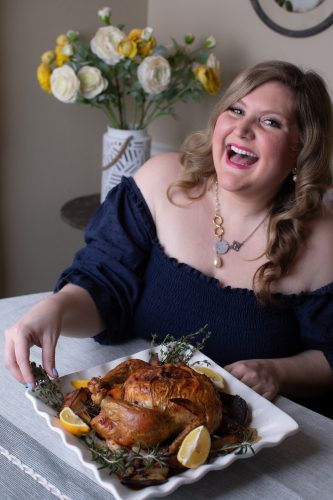
Katie-Rose Watson presents a roast chicken at her home in Rockwall, Texas. The food blogger behind The Rose Table is known for her Disney Dinners series and published a cookbook of the same name.
Watson credits her mother, an accomplished cook, for sparking her own love of cooking. As a German major at TCU, Watson cooked for her friends in her residence hall.
For a comforting meal at home, she craves her signature roast chicken. “I feel very chef-y when I roast a chicken,” she said. “I love a one-pan dinner, and for my roast chicken, I make it with potatoes and onions. When people show up at the house, all they can talk about when they walk in is the incredible smell.” She describes roast chicken as a perfect Sunday supper and cooks hers with garlic, butter, rosemary and sage.
Watson lives in Rockwall, Texas, east of Dallas. From there, she runs her own company, Katherine Rose Watson LLC, where she helps build brand awareness for clients in the arts, travel, lifestyle, wine and other fields. But her penchant for entertaining predates those entrepreneurial endeavors. After graduation she began to share recipes on a casual blog. Followers deemed her bacon-avocado-crab salad life-changing, which inspired Watson to blog in earnest. She launched The Rose Table in 2014. In 2021, she published a cookbook of the same name, which is available on her site and includes more than 70 recipes.
In 2018, Watson debuted her Disney Dinners, for which she creates full meals and experiences — think Snow White tea party with mini Black Forest cakes, cucumber radish tea sandwiches and gooseberry fool. Facebook invited her to join its coveted creator program, which propelled her success. To date, she has more than 40 million views on Facebook alone and boasts a strong TikTok following.
“I wanted the Disney Dinners to reflect that you can actually make your own magic,” she said.
As for her beloved roast chicken, Watson calls it a favorite in part because “it’s so easy and so cheap but seems so decadent.” She watched hours of YouTube videos to perfect her chicken-carving skills. (“I can now do it in my sleep.”) She’ll often pair the main dish with a blueberry salad with maple vinaigrette, a recipe that uses Marcona almonds. Both recipes are available on her website and in her cookbook.
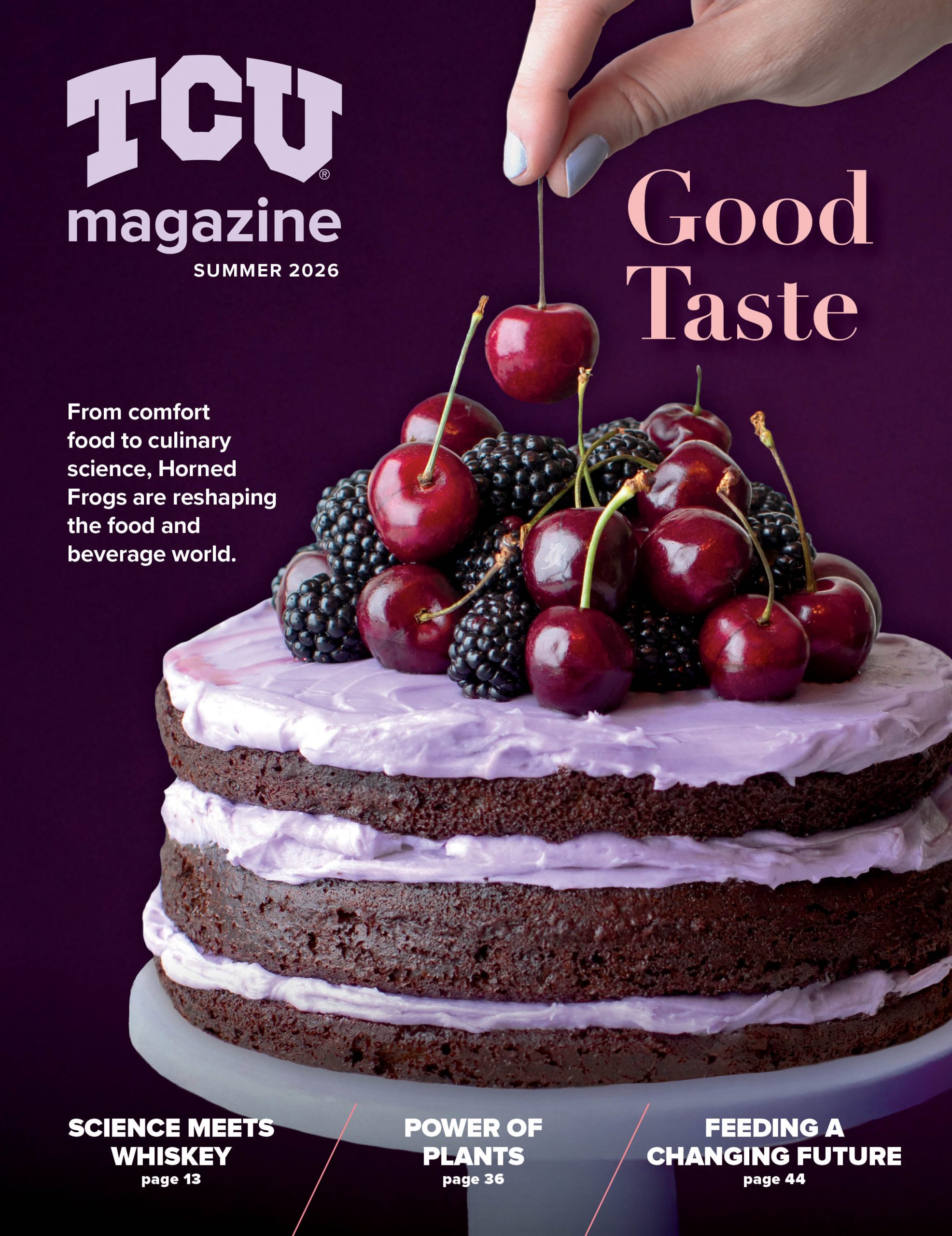
Watson’s chocolate lavender dream cake also graces the cover of TCU Magazine’s Summer 2026 issue. Find the recipe at therosetable.com.
Comfort Foods: Recipes
— The Rose Table’s Roasted Chicken —
This recipe comes from Katie-Rose Watson, who describes it as the perfect Sunday supper.
Serves 4 to 6
4 to 6 large red potatoes
2 small yellow onions, peeled
Olive oil
1 (5- to 6-pound) whole chicken, giblets removed
Sea salt
Freshly ground black pepper
1 lemon, halved, plus additional lemon wedges for garnish
1 head garlic, halved
1 bunch fresh thyme
4 sprigs fresh rosemary plus additional sprigs for garnish
3 sprigs fresh sage
2 tablespoons butter, melted
Kitchen twine
Preheat oven to 425°F. Cut potatoes and onions into quarters, taking care not to separate the onion layers, and add them to a large bowl. Drizzle with olive oil, using slightly less than you would for roasted potatoes, and toss gently. Transfer to a 13- by 9-inch roasting pan.
Rinse the chicken inside and out and pat dry with paper towels. Place the chicken breast-side up on top of the potatoes and onions. Generously sprinkle outside of chicken with salt and pepper.
Stuff chicken cavity with lemon halves, garlic halves, thyme, 4 sprigs rosemary and sage. Brush chicken with melted butter and sprinkle again lightly with salt and pepper. Tie legs together with kitchen twine. Use an additional piece of twine to secure the wings against the body to prevent burning.
Roast until the juices run clear when pierced between the leg and thigh, about 1½ hours. Remove from oven and loosely cover with aluminum foil. Let rest 20 to 30 minutes.
Carve chicken and arrange on platter with potatoes and onions. Spoon pan juices over the top. Garnish with fresh rosemary sprigs and serve with lemon wedges.
— Beef Bourguignon —
June Naylor Harris makes this classic French stew when celebrating special occasions at home, like New Year’s Eve or Valentine’s Day. Prepare your choice of baguette, egg noodles or potatoes to serve with it.
Serves 4
1 tablespoon olive oil
½ pound smoked bacon, diced
2 pounds beef chuck, cubed
Salt and pepper
5 carrots, roughly chopped
3 celery stalks, roughly chopped
2 yellow onions, roughly chopped
3 garlic cloves, chopped
½ cup sherry or brandy
1 (750-mL) bottle dry red wine
2 cups (about) beef stock
2 tablespoons tomato paste
4 sprigs fresh thyme, tied with string
2 bay leaves
4 tablespoons butter, room temperature, divided
3 tablespoons flour
1 pound frozen pearl onions
1 pound cremini or shiitake mushrooms, sliced
½ cup chopped Italian parsley, for garnish
Toasted French baguette, egg noodles or potatoes, for serving
In Dutch oven over medium heat, warm olive oil. Add bacon and cook until nearly crisp, about 7 to 8 minutes. Transfer bacon to a plate.
Sprinkle beef cubes with salt and pepper. Working in batches to avoid crowding, sear beef in bacon fat for 3 to 4 minutes per side. Transfer beef to plate with bacon.
Preheat oven to 250°F.
Add carrots, celery and onions to Dutch oven and sauté until beginning to soften, about 10 minutes. Add garlic and cook 1 minute more.
Pour in the sherry or brandy. Carefully ignite with a match to burn off the alcohol. When the flame subsides, return bacon and beef to Dutch oven.
Add red wine and enough beef stock to just cover the ingredients. Stir in tomato paste, thyme bundle and bay leaves. Bring to a simmer, cover and transfer to oven. Cook until beef is very tender, about 1½ hours.
Transfer Dutch oven to stovetop. In small bowl, mix half of butter with flour to form a paste. Stir mixture into stew, then add frozen pearl onions.
In separate saucepan, melt remaining butter over medium heat. Add mushrooms and sauté until just tender, about 5 to 7 minutes. Add mushrooms to stew.
Bring stew briefly to a boil, then reduce to simmer and cook for an additional 20 minutes. Adjust seasoning as needed.
Serve garnished with chopped Italian parsley, alongside toasted baguette, egg noodles or potatoes.
Food writer Celestina Blok ’02 weaves together Fort Worth culinary history with 60 recipes from chefs, bakers, bartenders and more in Cowtown Comfort. Among the offerings are shrimp and grits from Bonnell’s Fine Texas Cuisine, known for its farm-to-table dishes and award-winning wine program; yakisoba from Tokyo Cafe, a family-run Japanese restaurant; and buttermilk pie from Swiss Pastry Shop, an unassuming diner and bakery with a tempting pastry case.
Dinner Tonight
Courtesy of William Morrow
Since 2019, New York Times bestselling cookbook author Alex Snodgrass ’10 has released four titles filled with clean takes on comfort foods. Dinner Tonight focuses on what many of us need most — healthful recipes that are simple enough to prepare on a weeknight. Among the choices are roasted vegetable pita with herby tahini and one-pan coconut-lime chicken and rice.
Indian Instant Pot Cookbook
Courtesy of Callisto Publishing
Data scientist Urvashi Pitre ’89 MS, who founded a customer-relationship management company in Dallas, has written five cookbooks dedicated to the Instant Pot, an appliance with multiple cooking modes. In Indian Instant Pot Cookbook, she shares recipes for quick versions of traditional Indian dishes, including murgh makhani, for which she earned the nickname Butter Chicken Lady.
Food & Philosophy
Courtesy of TCU Press
Published by TCU Press, Food & Philosophy by Spencer Wertz ’65 (MA ’66), emeritus professor of philosophy, features essays on everything from food as art to the five flavors of Chinese cuisine. In his essays, Wertz, who has taught wine appreciation classes and once led a barbecue competition team, also explores historical recipes and symbolism in dining.
Hopped Up
Courtesy of Oxford University Press
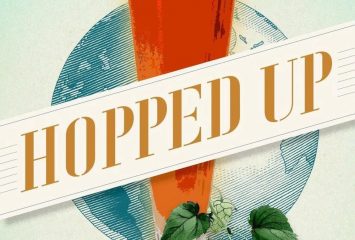
Food historian Jeffrey Pilcher ’93 PhD, a professor at the University of Toronto, explores the history of brewing around the world in Hopped Up: How Travel, Trade, and Taste Made Beer a Global Commodity. Beer aficionados will learn how technological, social and cultural factors have impacted the development and enjoyment of beers.
How to Taste
Courtesy of Mandy Naglich
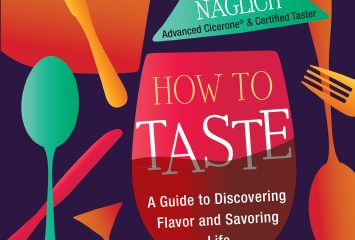
Consider stone fruit, dark chocolate or black tea — in professional taster Mandy Naglich’s How to Taste, readers learn to fine-tune the palate to discern flavors the way chefs, sommeliers and sensory scientists do. Naglich ’12 brings insights into the science of flavor, from judging acidity to understanding why food temperature and even background music can impact taste.
French Pastry Made Simple
Courtesy of Page Street Publishing
After a career in digital marketing, Molly Wilkinson ’09 completed her pâtisserie training at Le Cordon Bleu in Paris and made her home in Versailles, where she teaches in-person pastry classes and offers live and video instruction on her website. In French Pastry Made Simple, Wilkinson demystifies éclairs, madeleines, macarons and more for the home baker — including shortcuts.
The Rose Table
Courtesy of Katie-Rose Watson
With an ebullient spirit and solid culinary skills, publicist Katie-Rose Watson ’11 has earned more than 300,000 followers on social media for The Rose Table, where she shares everything from easy appetizer recipes to blueprints for elaborate Disney-themed dinner parties, including menus, place settings, music and more. Her cookbook, The Rose Table, features 70 of her favorite recipes for entertaining, such as rosemary-grilled salmon and chocolate lavender cake.
Table for One
Courtesy of Gabrielle McBay
Private chef and cookbook author Gabrielle McBay ’14, who owns Good Taste, a culinary production company, has counted among her clients celebrities such as Travis Scott and brands including Williams-Sonoma. In Table for One, her third cookbook, McBay shows readers how to cook for themselves in elevated, simple, small-yield recipes like strawberry basil ricotta toast or crispy shrimp fajita tacos.
Texas Landmark Cafes
Courtesy of Great Texas Line Press
In Texas Landmark Cafes, June Naylor Harris ’79 shares statewide restaurant recommendations including diners, barbecue joints, steakhouses and seafood spots. Harris, an award-winning food and travel writer, names such favorites as Cisco’s Restaurant & Bakery in Austin, where she suggests ordering the huevos rancheros with a side of beef picadillo-stuffed mini-bolillo rolls.
Vegan Mexico
Courtesy of Andrews McMeel Publishing
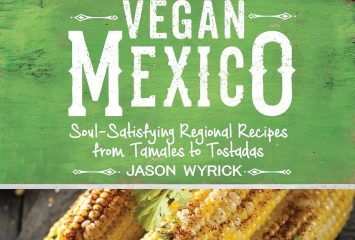
In addition to creating the menus and recipes for Dr. Neal Barnard’s 21-Day Weight Loss Kickstart book, vegan chef Jason Wyrick ’96, a Mexican food aficionado who runs a vegan meal delivery service in Phoenix, has written his own cookbooks. In Vegan Mexico, Wyrick shares regional cooking from Oaxaca to Veracruz through recipes including mushroom crêpes in poblano chile sauce.
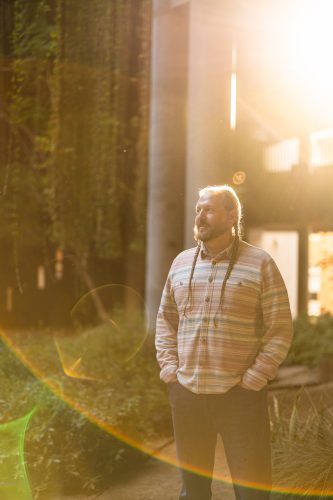
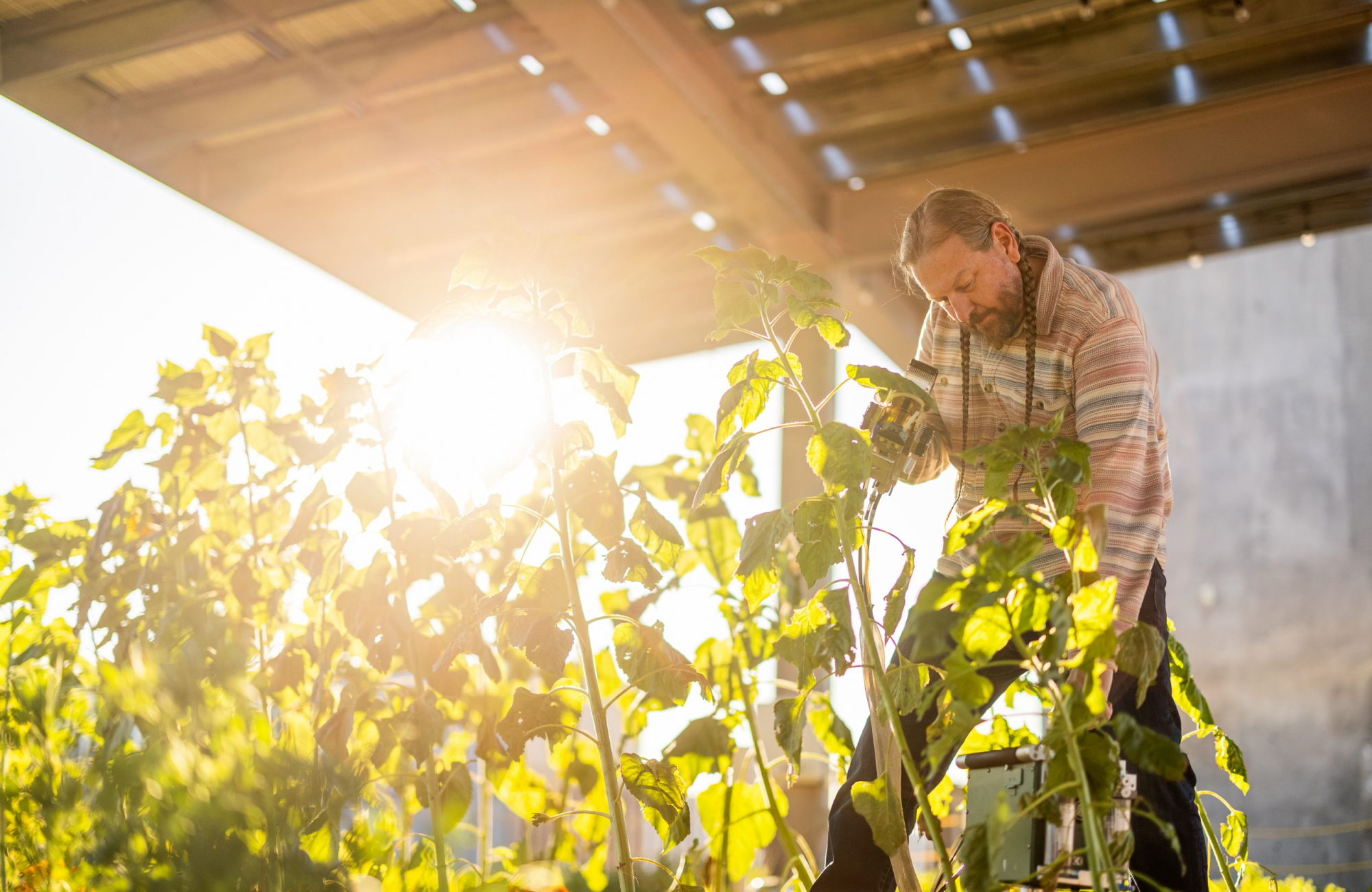
Flowers and vegetables grow beneath solar panels at Barron-Gafford’s research site on the University of Arizona’s Tucson campus, a practice known as agrivoltaics. Photo by Deanna Dent/PHXVis
Since widespread temperature record-keeping began in 1880, the planet’s hottest year was a matter of months ago: 2024. The second hottest was 2023. Heat and droughts are squeezing many farmers and ranchers: Fields dry up, vegetables wither, livestock pant for shade. Farms also suffer damaging rain and wind as weather patterns shift.
Faced with these pressures, many farms are veering away from sustaining the nation’s food supply. Millions of acres have been converted to housing and commercial development in recent decades. In addition, food prices often outpace inflation, and food insecurity has worsened in the last five years. One in 6 U.S. households is food-insecure.
Maggie Hanna ’15, a fourth-generation rancher in El Paso County, Colorado, deals with such problems every day as the city of Colorado Springs encroaches. The roar of a stock car racetrack floats over her pastures; other neighbors include a waste treatment plant, a power plant, a solar development and housing subdivisions. The river that waters Hanna Ranch faces extra runoff with every acre of land that gets paved over for development, and sometimes it floods. Calamities like hailstorms and fire also bedevil the ranch.
“It will always be more valuable to put a house on these acres than it will to keep grass right side up,” Hanna said.
For years, she has battled a proposed six-lane highway that would “reach around the city of Colorado Springs and literally will come down my driveway,” Hanna said. “If we are trying to move away from fossil fuels, why do we continue to build communities that are fully dependent on cars?”
Hanna has a different proposition for the land, one that defines her land management ethos: use sustainable ranching practices that include protecting, not paving over, the area’s native grasslands and habitat.
“We’re taking care of this place. We’re producing food and fiber,” she said. “And still we aren’t doing it enough to be considered a benefit to growing cities and municipalities.”
That tension between development and sustainable food production is accelerating across the globe.
Worldwide, more than 40 percent of agricultural production depends on groundwater extracted at rates that aren’t sustainable. Beneath the Great Plains, the Ogallala Aquifer, which waters one-fifth of the nation’s major crops, is drying up. It will require at least 6,000 years to refill naturally. Climate change is expected to slash yields of staple U.S. crops, including corn, soy and oats, in the next few decades. Given the resource depletion baked into modern food systems, some researchers consider much of our food to be like a fossil resource — as unrenewable as oil.
“It will always be more valuable to put a house on these acres than it will to keep grass right side up.” Maggie Hanna
Yet promising solutions are emerging from unexpected places: a grocery store magazine rack, a grove of mesquite trees sharing water with grass, a ranch where cattle rotate through smaller paddocks.
In 2013, Gina Jarman Hill was standing in a grocery line when a goat caught her eye. The charismatic creature’s photo on a magazine cover inspired her to buy a copy on impulse.
Leafing through the pages, she found an article about food waste in the United States. The information affected her profoundly.
“I was dumbfounded. I was just shocked at how much food was thrown away,” said Hill, now a TCU professor and chair of nutritional sciences. The U.S. Department of Agriculture estimates that the country wastes about one-third of its food supply. That amounted to 133 billion pounds and $161 billion worth of food in 2010 alone.
As a farmer’s daughter from the Texas Panhandle, Hill knew how much work goes into raising and preserving vegetables and other crops. Though she is a registered dietitian, she said the article was her first glimpse of the scope of the problem: “At that time, it wasn’t something that was being communicated very much to dietitians.”
As a doctoral student, Greg Barron-Gafford ’98, another Texas native, noticed something that contradicted decades of ranching wisdom. Observing greener grass under mesquite trees, he began to doubt that the grasses and trees competed for water, a belief that had long shaped a traditional management technique “based in 1950s science,” he said. The science had concluded that more mesquite trees meant less grass for cattle: “They thought if you knock down the trees, there’ll be more water for the grasses.”
But the opposite was true: The plants were sharing water. After studying mesquite trees and grasses, he found that shade provided by West Texas dryland trees cools the air and the ground, reducing water evaporation after rains and leading to lusher grasses.
Today, Barron-Gafford has turned that insight into work on agrivoltaics, a practice that allows crops and grazing animals to coexist with solar panels. The technique can ease the effects of a scorching sun.
These moments of revelation — a magazine article, greener grass under trees, a six-lane highway threatening a sustainable ranch — are helping TCU faculty and graduates answer some of the most urgent challenges facing food systems.
HOLISTIC LAND CARE
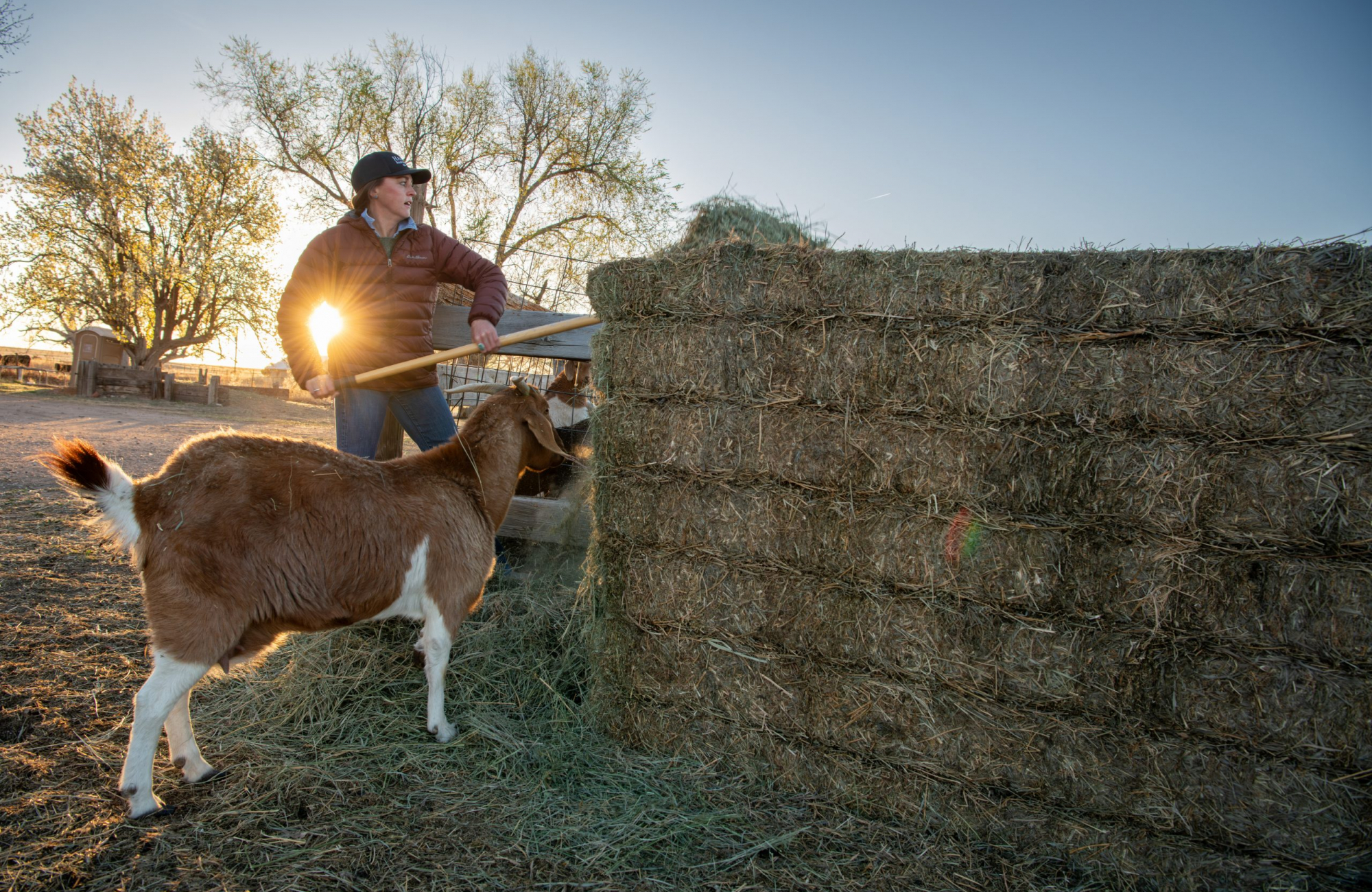
Produce, of course, as well as eggs and meat, begins on farms and ranches. For Hanna, who studied ranch management at TCU, tending to the land is a multigenerational family business. Living along Colorado’s Front Range, Hanna raises commercial Angus cattle and irrigated hay on approximately 14,000 acres just south of Colorado Springs. The operation includes sheep and goats, hunting, beehives and outreach programs, including to bird groups, artists, schools and community organizations.
From the late 1940s through the ’70s, her family ran the ranch much as their neighbors did, grazing animals in the same pasture for long periods with a few water stations. Then her father left to learn ranch management at TCU. Armed with new ideas, Kirk Hanna ’78 returned home to Hanna Ranch to put holistic management practices in place at a time when such approaches were barely on neighbors’ radars.
“At that time,” Maggie Hanna said, “all that stuff kind of made you a little bit of a kook.”
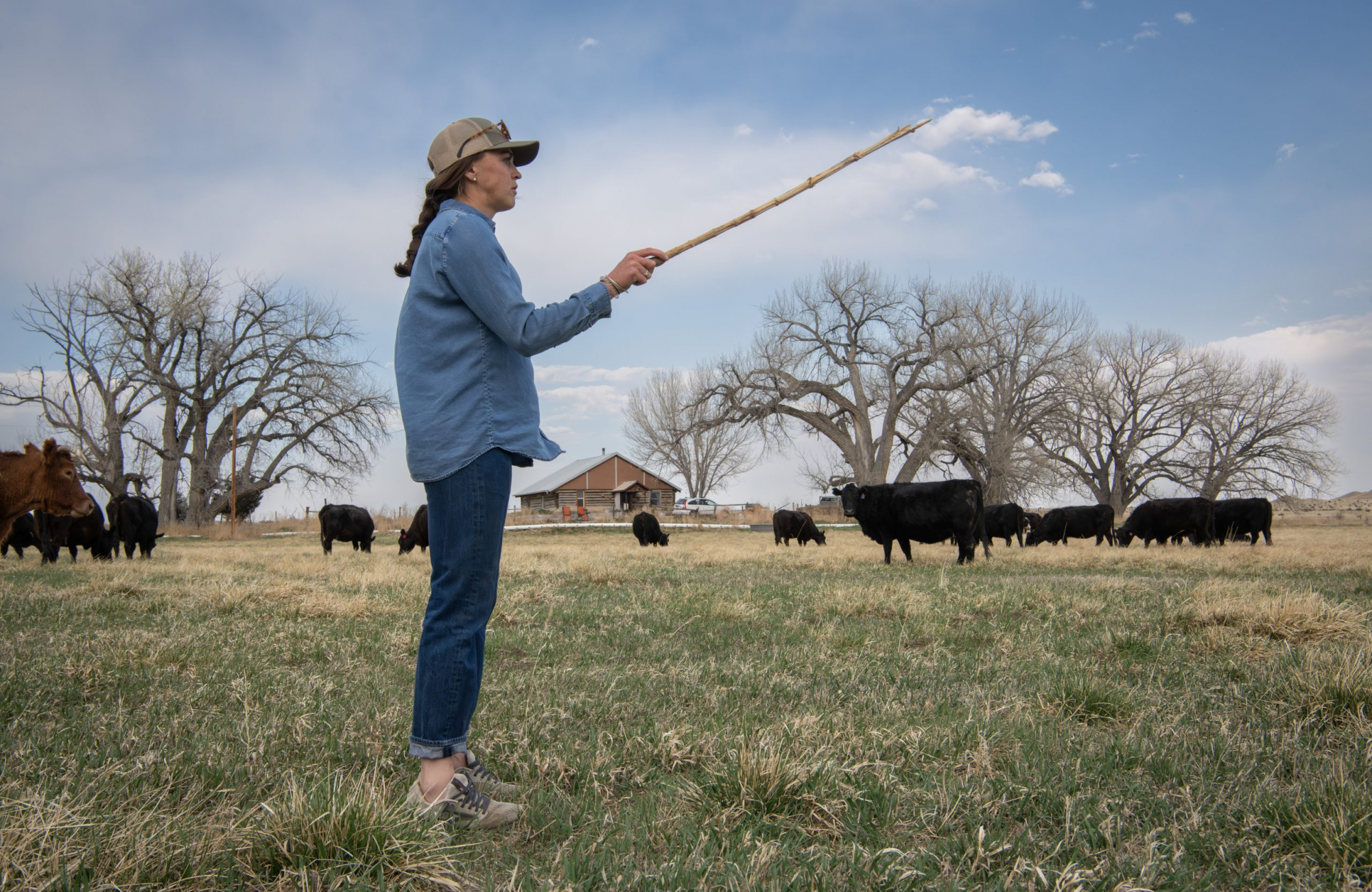
Fourth-generation rancher Maggie Hanna employs sustainable practices on her family’s Colorado ranch.
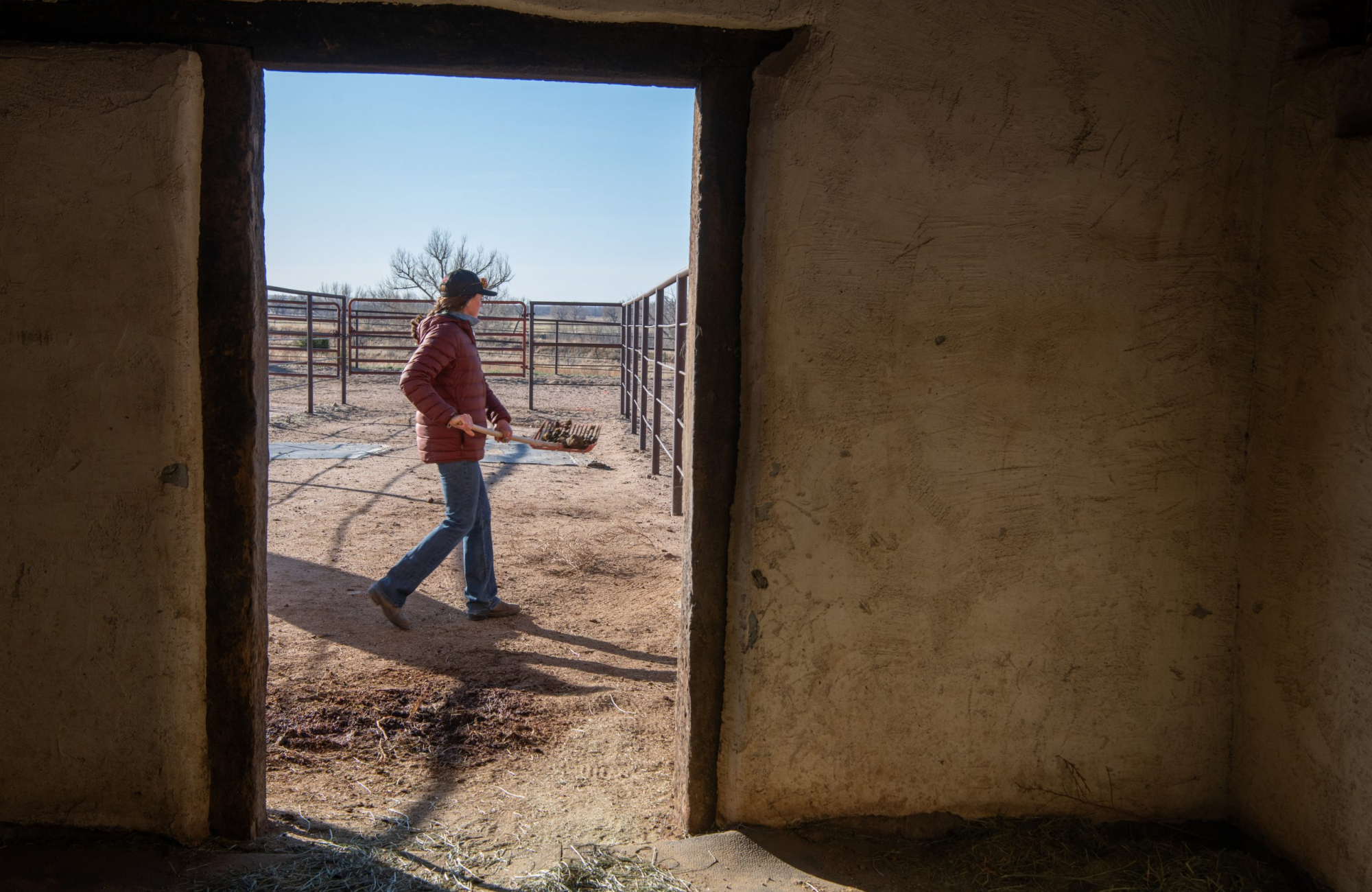
Hanna’s property, 14,000 acres south of Colorado Springs, faces growing pressure from the city’s expansion.
Hanna takes a head count after relocating part of her cattle herd to a new grazing area, a practice that helps preserve grasses and plants.
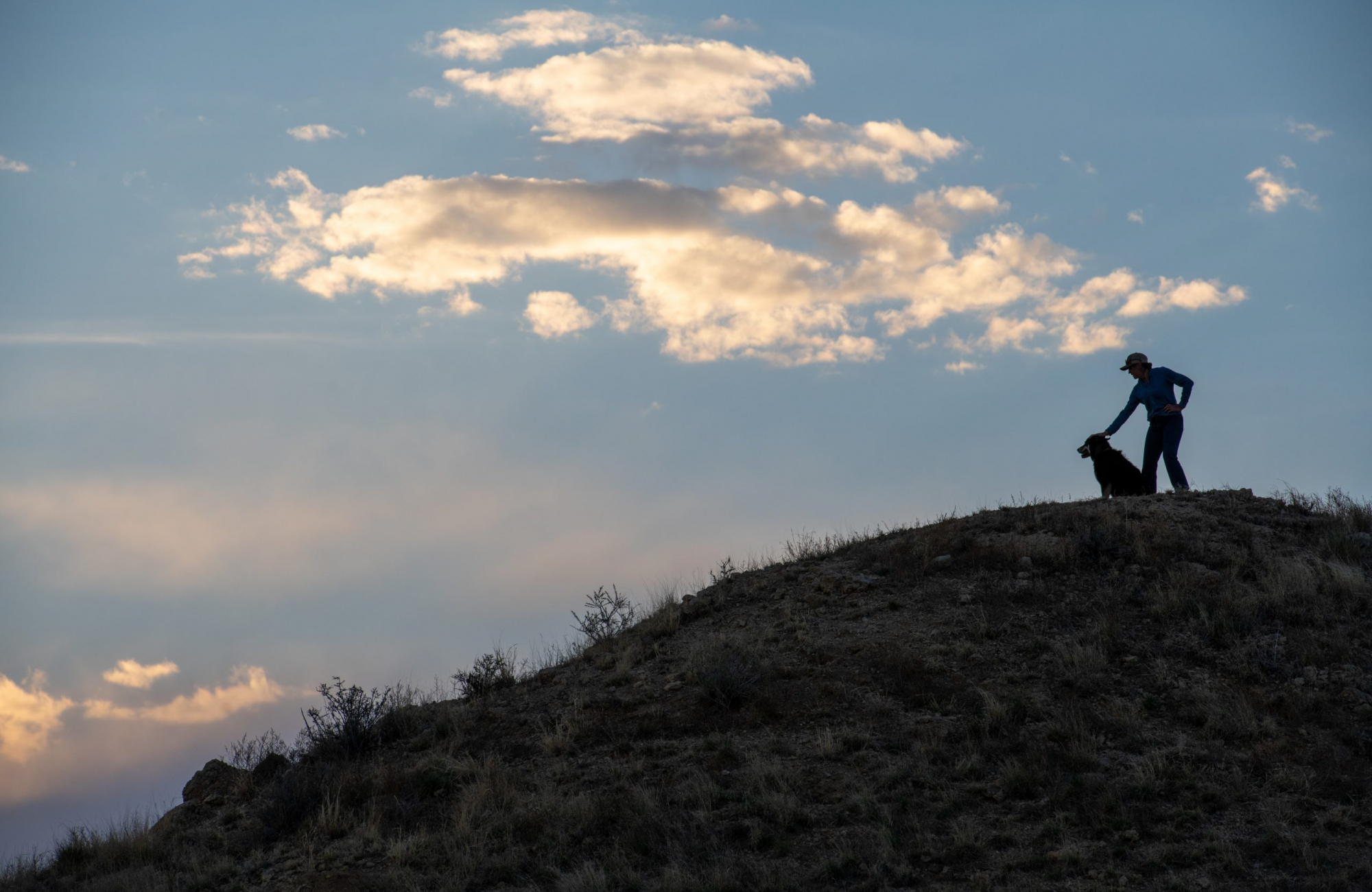
Hanna, with her dog Hidalgo, also works to conserve grasslands as director of the Central Grassland Roadmap Initiative.
The ranch avoids using cattle insecticides, plant pesticides and chemical fertilizers.
Photos by Chuck Bigger
Yet her father became a respected leader in area organizations, including the Nature Conservancy in Colorado and the Colorado Cattlemen’s Association, even as he faced community critics, including his own brother. Tragically, Kirk Hanna died by suicide when his daughter was 9. The family’s story was told in the 2014 documentary Hanna Ranch.
Today, Maggie Hanna continues her father’s holistic ranching legacy. The ranch avoids cattle insecticides, plant pesticides and chemical fertilizers. It rotates cattle frequently among smaller paddocks, which allows the land to rest and recover much as it did for millennia when bison roamed over it. Avoiding overgrazing means more healthy grasses and broad-leaf plants that help the soil absorb rainfall and fewer bare, impermeable spots — crucial in a climate with 12 inches of rainfall a year. “What catches water is functional soil and plants,” Hanna said.
As interest grows in financially rewarding producers for good stewardship — for example, with carbon credits or payment for ecosystem services — “data is the game,” Hanna said, referring to soil monitoring. “You have to know what you have to be able to put it on a market. … One of the incentives to being an early adopter is that I now have many years of data to show this is moving in a direction that I want.”
Hanna also works to conserve grasslands as director of the Central Grassland Roadmap Initiative. Holistic ranch management, she said, considers all the systems that play roles in the ranch’s capacity, including soil, water, family and community.
Meanwhile, though development pressures eased somewhat in 2025 amid changes in the economy, Hanna doesn’t think they will cease. El Paso County was home to 74,523 people in 1950, and as of 2026 to over 764,000. Officials expect nearly a million residents by 2040. And much of the development is happening outside city limits.
“The hard part of ranching — and ranching with perpetuity in mind and trying to live in a way that is regenerative or sustainable — is that we can’t get lazy. Even though those issues are not choking us today, they will reappear,” Hanna said. “We are never going to be farther from town.”
NEW POWER, NEW FOOD
Barron-Gafford has spent his career proving that shade is a resource. His research into agrivoltaics at the University of Arizona is helping farmers grow food and generate solar power on the same land. Photo by Deanna Dent/PHXVis
A 5,000-acre former ranch near Hanna’s property has converted to producing solar energy rather than food. Amid the West’s historic water crisis, many farms and ranches are doing the same. Drought and diminishing aquifers have severely restricted water supplies, often making irrigated farming impractical and driving land managers to adopt solar. Lands that once rippled green with thirsty crops like alfalfa and corn are turning black with solar panels.
“So many of the ranchers and farmers just don’t have enough water to sustain the previous herds or crop production they were doing,” Barron-Gafford said. “That means they need to find another income source to keep the farms alive. That big transition with solar going more into cropland is because people need to sell their land — they don’t have the water to produce like they used to.”
In one 2024 estimate, of 3,177 utility-scale rural solar projects constructed between 2012 and 2020, 43 percent were built on cropland, reports the U.S. Department of Agriculture. Twenty-eight percent more were built on pasture.
But there are ranch- and crop-friendly ways to install solar panels, and Barron-Gafford is proving it. As a professor at the University of Arizona, he studies agrivoltaics, the use of land for the simultaneous production of solar energy and agriculture. The technique can boost crop yields in harsh climates while preserving precious water and generating energy. And it lets farmers maintain their identity and livelihood as farmers and land stewards.
“The secret is out,” he said. “In some places, we might be able to have sustainable food production into a warmer and drier future because of the renewable energy.”
Barron-Gafford first built his knowledge through TCU’s environmental science program, where the interdisciplinary, solutions-oriented approach, he said, was “way ahead of the curve.” He added more knowledge through Arizona’s Biosphere 2, an enclosed laboratory of more than 3 acres funded by Fort Worth businessman and philanthropist Ed Bass. Barron-Gafford is now Biosphere 2’s director of food, energy and water resilience solutions.
In his PhD program analyzing the false “competition” between trees and grasses, Barron-Gafford realized that shade can be a resource. This simple truth became the foundation for his life’s work. “It was an aha moment,” he said. He started to see similar patterns elsewhere, like in a corner of a ballfield shaded by a solar panel: “The Bermuda grass was still green in the winter and in the heat of the summer when the irrigation was otherwise off.”
Looking at solar installations, he had an idea: “What if we put plants back into the system?”
Plants’ microscopic pores release water to cool down, which also cools their surroundings, he explained, “like your favorite Mexican restaurant in the summer with the misters going.”
With a 2013 seed grant, Barron-Gafford bought rolls of turfgrass plus a couple of solar panels, which he mounted on a toboggan to pull over bare dirt and grass. The grass cooled the overhanging solar panels by about 15 degrees, he found, boosting their efficiency. In turn, the panels’ shade cooled the soil, making it easier for plants to germinate and retain moisture. He later found that tomatoes, peppers and cilantro do well under solar panels’ shade.
WATER SAVINGS
In hot climates, plants slow photosynthesis during the hottest, brightest hours to conserve water, a phenomenon called midday depression. By buffering extreme heat and light, shade can create a more hospitable microenvironment for growing.
“You can actually cut out like two-thirds of the direct sunlight, and you don’t cut out two-thirds of the photosynthesis,” Barron-Gafford said. “People across the country have plants on their back porch that are doing just fine.”
That last point is key. Agrivoltaics’ ability to save water may allow otherwise doomed farms to continue growing food. One such water-starved farm in Colorado, unable to irrigate a hay crop through a single season and prohibited by zoning from switching outright to solar, began working with Barron-Gafford to install agrivoltaics. What became Jack’s Solar Garden was a rousing success. Beets, radishes, spinach, lettuce, kale, chard, beans, peppers and eggplant are among the many crops thriving under solar panels there, plus ducks to eat pests and the occasional sheep or cow that grazes off-season.
“The solar is installed exactly the same width and spacing as it would be if it was optimized for solar,” Barron-Gafford said. “We produce 8,000 pounds of food per acre in that space in what would have otherwise been a growing food desert because of a lack of water and a land-use transition.”
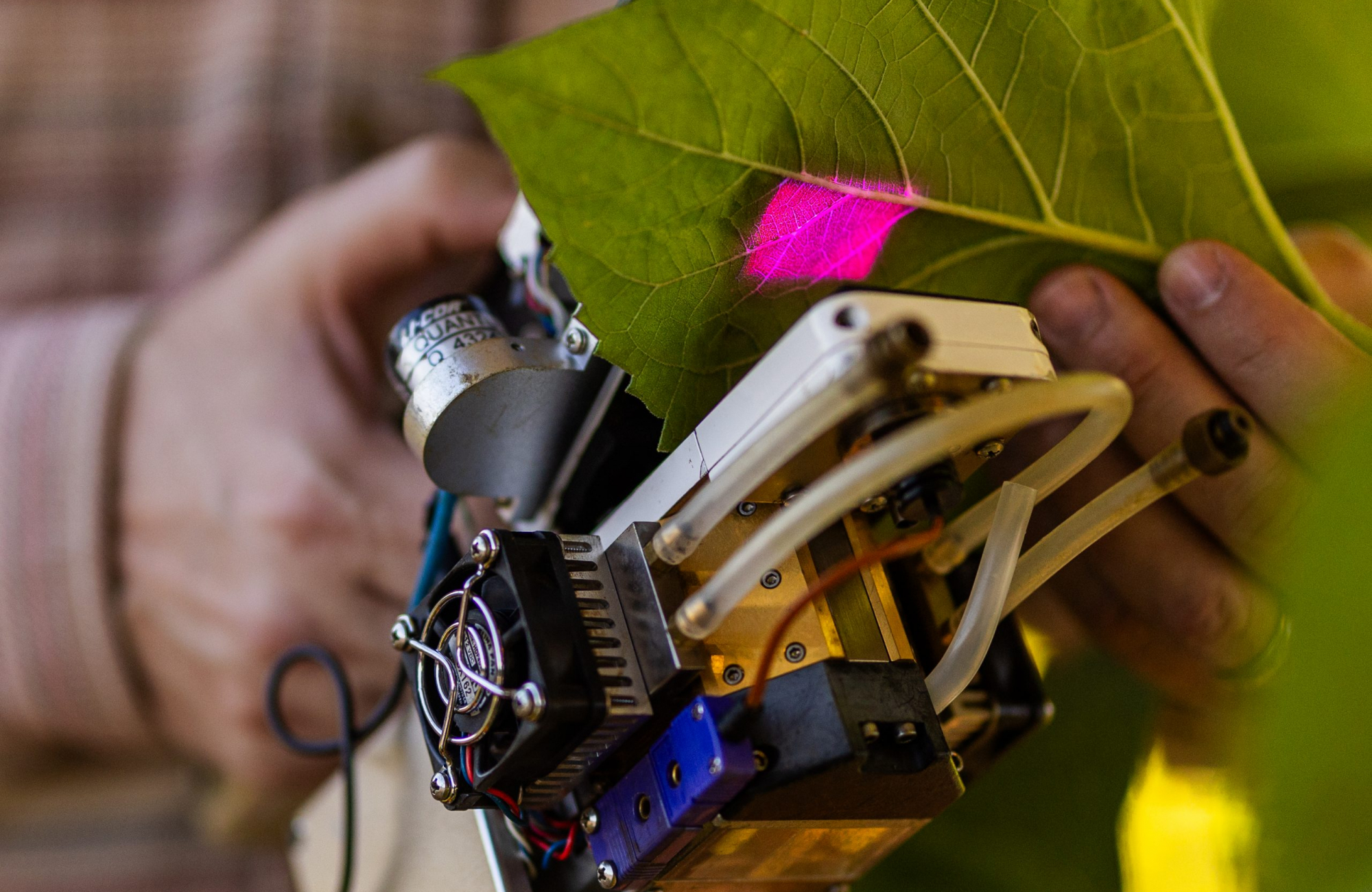
A LI-COR portable photosynthesis system — one of the instruments Barron-Gafford uses in his agrivoltaics research — rests among plants at the University of Arizona.
Plants’ microscopic pores release water to cool down, which also cools their surroundings, an advantage of agrivoltaics in hot climates.
By buffering extreme heat and light, shade can create a more hospitable microenvironment for growing everything from sunflowers to eggplant.
An aerial view of the University of Arizona campus in Tucson, with the Environment and Natural Resources building, home to Barron-Gafford’s agrivoltaics research, at center right.
Photos by Deanna Dent/PHXVis
Livestock, too, are increasingly part of the mix, giving rise to the solar grazing industry. Sheep are well-suited to graze under low-mount solar arrays, per the American Solar Grazing Association. And the shade protects forage plants and the sheep from too much sun.
“Solar grazing is really the easiest entry into agrivoltaics,” Barron-Gafford said. “It provides those same benefits that I was seeing with the mesquite tree for the forage [and] the sheep.”
In short, agrivoltaics may offer growers in a hotter, drier world more options, not fewer.
“I want a broader approach to a sustainable future,” Barron-Gafford said. “I don’t want to just solve one problem. I want to solve multiple.”
Those stacked benefits show up in other TCU-connected food innovations, reflecting the fact that even the most sustainably produced food creates waste and leaves neighbors hungry if distribution fails.
PREVENTING WASTE AND FEEDING NEIGHBORS
Following her revelation about the tons of food that wind up in American landfills, Hill said, she began teaching TCU students about food waste. Now “they get this message pretty early and often from our faculty in their lecture classes and through the food labs.”
In 2016, Hill began advising a group of students determined to save food from the trash. Today, TCU’s chapter of the Food Recovery Network works with campus cafeterias to rescue ingredients or prepared foods that don’t make it onto a tray, plus post-football game leftovers from the stadium suites. It all goes to Union Gospel Mission, a Fort Worth shelter for the unhoused.
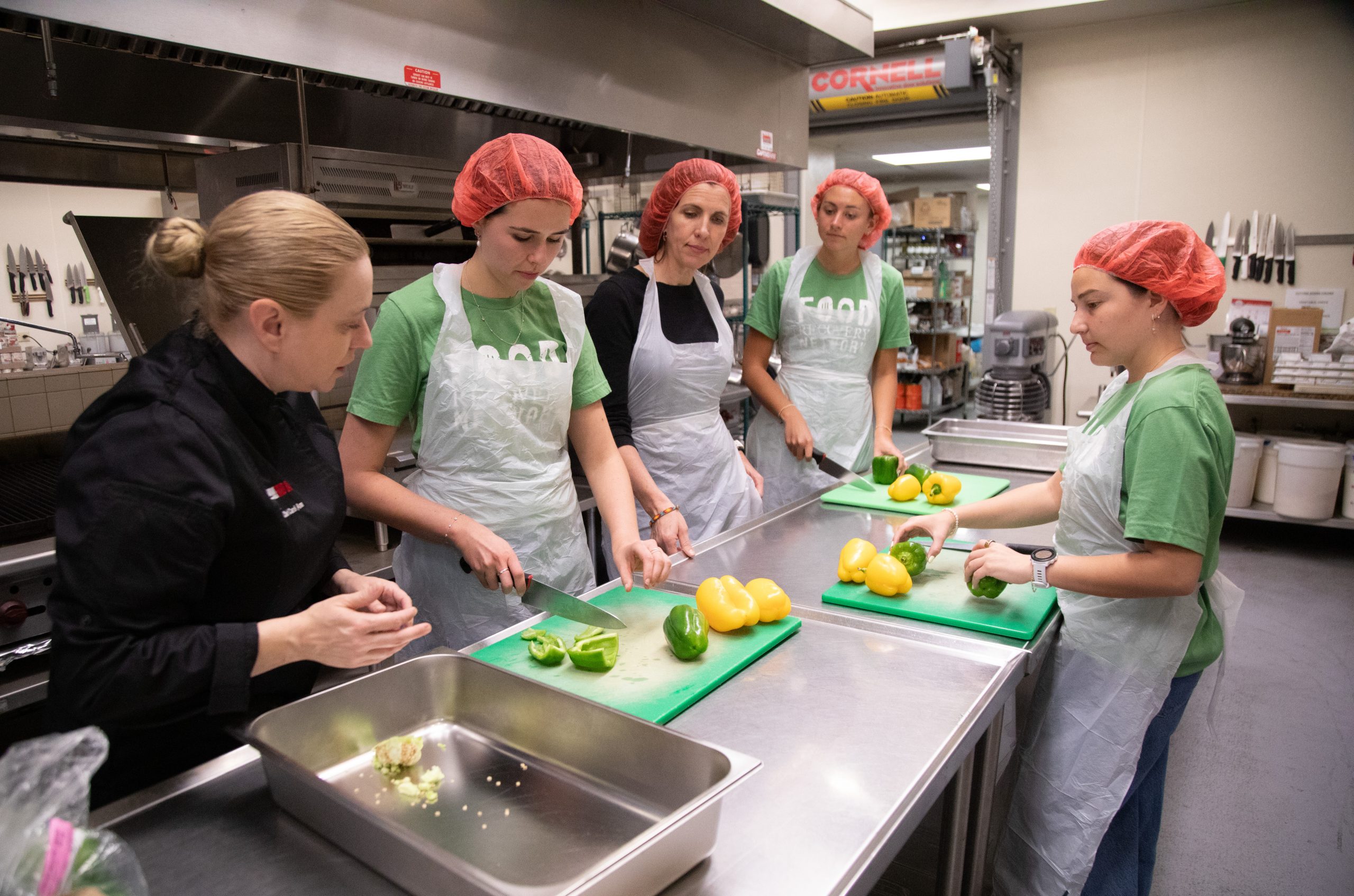
Chef Carol Ann Kroehler, left, gives a prep lesson at the Tarrant Area Food Bank. With a focus on healthy foods, the food bank has increased the share of fresh produce in its distribution to more than 40 percent. Photo by Joyce Marshall
“They get very excited for whatever we’re bringing,” said Megan McGeary, the chapter’s recent president. And it adds up: The record, set in fall 2017, was 10,000 pounds.
Students like McGeary also learn about food waste in class.
“Many people in our community struggle with finances, eating produce and managing food waste,” McGeary said.
Hill’s graduate course, Nutrition, Ecology, Food and Sustainability, examines various ecological issues related to food and nutrition, including food waste as well as how inputs like transportation, pesticides, water and land resources get wasted, stunting the amount of discarded food that could go to people in need. In another course, Community Nutrition and Public Health, students visit a landfill to witness firsthand how large the waste stream is and to discuss the relationship between food insecurity and food waste.
“All of us can do something about it, because the food waste from the consumer level is enormous,” Hill said. “It starts in the home, in your own refrigerator, in your own pantry.”
PAYING IT FORWARD
Julie Butner works to alleviate hunger as the head of the Tarrant Area Food Bank. Photo by Joyce Marshall
Union Gospel Mission isn’t the only place Horned Frogs protect food supplies and help ensure neighbors get fed. Julie Butner ’88, who studied nutrition and coordinated dietetics at TCU, steers a massive effort to feed residents of 13 Texas counties as president and CEO of the Tarrant Area Food Bank, a position she’s held since January 2020. With its community partners, the food bank distributes more than a million meals each week to a half-million people. Some 12 percent of its employees are TCU graduates.
During her time leading the food bank, Butner has worked to ensure that clients receive more nutritious foods. Charitable food organizations like the food bank increase their reach by pooling resources and buying items in bulk to cut costs. The food bank also keeps nutrition in mind, declining donations of sugary drinks and candy and investing in fresh, locally sourced foods that can be distributed both to partner agencies and the community served by the Tarrant Area Food Bank.
“We have been working to ensure that clients have greater access to nutritious options. With the opening of the Sid W. Richardson Agricultural Hub — where we source fresh Texas produce — we’ve increased the share of fresh produce in our distribution from 23 percent to more than 40 percent,” Butner said. “By being more deliberate and thoughtful about the kinds of food we distribute, we can impact not only individual lives but also the overall health and well-being of our community.”
Texas households are among the country’s hungriest, with 17.6 percent experiencing food insecurity, per Feeding America. In the 13-county area served by the Tarrant Area Food Bank, about 572,050 people are food-insecure, and one-third of them are children.
The 21st-century city encroaching on Hanna Ranch will not be the same city that Kirk Hanna came home to after gaining a different vision of food production at TCU. It will be hotter, drier, more crowded, with different types of energy. But it will also inherit people who learned, under those pressures, how to grow more food with less water, how to graze sheep in the shade of solar panels, how to rescue a thousand pounds of hot dogs and beans and get them to someone who needs them before midnight. The problems have compounded for decades. So has the know-how to solve them.
Ordering a teriyaki bowl in a campus dining hall is easy. Re-creating it at home — from making a shopping list to purchasing ingredients to cooking — is another story. For many TCU students, moving off campus means leaving behind a meal plan and facing a steep learning curve in the kitchen.
Samantha Davis, professor of professional practice in nutritional sciences, said she frequently hears students complain that they don’t know how to prepare meals and that it’s too expensive to buy food that isn’t overly processed. She began to wonder if there was a way to make cooking feel less overwhelming.
After researching more than 30 meal-planning apps, Davis discovered that none checked all the boxes for low-cost, easy recipes that don’t require much equipment and can be adjusted to dietary needs like food allergies. Her idea grew into the IDLmeals cooking app, designed by students for students — and anyone struggling to prepare meals. After three years of development, her team released the web version of the app in April. Once approved, mobile versions of the app will be available for Apple and Android devices.
In her prior role as a registered dietitian with Meals on Wheels Inc. of Tarrant County, Davis learned that older adults often face their own cooking challenges. Dietary advice from a doctor doesn’t always make sense in the context of one’s home, for instance, where a caretaker might remove the knobs from the stove to prevent a fire, leaving only a microwave to use.
“You have got to meet them where they are,” Davis said, “and that’s what we’re trying to do — meet students where they are.”
IDLmeals — its name can be read as either “ideal meals” or “idle meals,” emphasizing the recipes’ focus on nutritious and low-effort cooking — offers more than 100 recipes created by nutrition and dietetics students with their peers’ needs in mind.
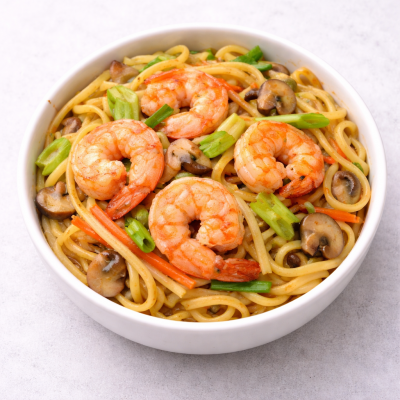
A beef rice bowl recipe, for example, requires only a few ingredients and takes about 20 minutes to prepare on the stovetop, using a single skillet. It makes four servings, which is enough to save as leftovers or share with roommates, for under $15. Other recipes include shrimp lo mein and chicken with snap peas and garlic noodles.
“We’ve got students with allergies, people are short on time, have no cooking skills … maybe don’t have a lot of money,” Davis said. “So that’s really how it was born.”
PEER-APPROVED RECIPES
Maci Jones, a senior dietetics major who worked on the app during her sophomore year, said that the team designed recipes with common constraints in mind.
“I tried to make recipes really straightforward and simple and take less time and not require a lot of in-depth skill,” Jones said. “Obviously, it’s college students. They want something quick and easy.”
Nutrition students, many of whom tested the recipes independently, prioritized ingredients such as ground beef, chicken, chickpeas, black beans, rice, sweet potatoes and other low-cost foods that can be bought in bulk and used in multiple recipes.
“Rather than calling for a fresh head of broccoli, we would use a bag of frozen broccoli florets. They have the same nutritional qualities, yet one is much faster to use and often cheaper,” said Matthew Loritz, a senior dietetics major who worked with Jones on the app. “It was also a great option for students who may be less comfortable preparing and chopping vegetables, who don’t have great knife skills yet.”
The time students spent developing and testing recipes counted toward the 200 hours of nutrition experience they need before applying to one of TCU’s dietetics programs, such as the combined bachelor’s and master’s that serves as a pathway to become a registered dietitian.
The recipe collection’s strength is in its ease — each dish takes 30 to 45 minutes, including prep and cook time.
Loritz said taking on a difficult workload his sophomore year gave him firsthand experience with not having much time or desire to cook. His favorite recipe is one for enchiladas that can be made using a variety of proteins.
Jones said the task of cooking chicken was daunting before she began her studies in nutrition.
“I think this will just give people more confidence in the kitchen and in their own skills,” Jones said, “and give them some staple recipes that they don’t have to think about before cooking.”
FROM CONCEPT TO CODE
TCU computer science students chose generated imagery, like this depiction of shrimp lo mein, to give the app’s recipes a clean, consistent look. AI illustration courtesy of IDLmeals
As nutrition students worked on recipes, the programming and design side of IDLmeals was unfolding across campus. During fall 2023, a group of computer science students worked on the IDLmeals app for their yearlong senior design project under the guidance of Bingyang Wei, department chair and associate professor of computer science.
Then-seniors Francisco Alarcon ’24, Paige Anderson ’24, Annalise Gadbois ’24, Eriife Aiyepeku ’24 and RC Reynolds ’24 saw potential in the IDLmeals project.
“It was something that was expandable,” Reynolds said. “You could envision it being brought to other campuses and actually making some sort of impact.”
When trying to crack the code on making the app user-friendly and geared toward college students, the computer science group decided to incorporate a feature to help users search for recipes they can make with limited cooking equipment, such as an air fryer or a hot plate. The team also included a feature that generates shopping lists, removing items the user already has at home. Users can browse recipes and mark them as favorites to revisit later.
“I really liked the grocery list, where I actually had little pictures of what you would need for each recipe,” Gadbois said. “It was super user-friendly.”
The app also includes photos of what the completed recipes should look like. Originally, nutrition students took photos as they tested their recipes — and planned to use those images in the app. The computer science team, however, decided that using photos without professional lighting or plating wasn’t the right approach. Their solution? To create AI-generated images of the meals.
“We found that this was a way to be able to represent the meal,” Anderson said, “but still make it look clean and look appetizing, and have one succinct look.”
Students were eager to come up with recipes.
“All the nutrition students took it very seriously,” Alarcon said. “We told them, ‘We need like 10, 20 more recipes,’ and they just went and did it.”
Finishing touches included a connection with the Kroger grocery chain, which provides TCU students with updated ingredient pricing. The app also incorporates features to make the user experience more personalized, including the ability to adjust spice and seasoning levels and scale recipe yield.
The computer science students presented their work at the Michael and Sally McCracken Annual Student Research Symposium in spring 2024. Since work on the IDLmeals project was ongoing, Alarcon elected to stay involved post-graduation, smoothing the transition to a new team.
Davis enlisted Ed Ipser ’84, adjunct computer science instructor, to oversee completion of the app’s design. She also recruited Michael DiCenso, president of DiCenso Consulting, a financial services and retirement plan consulting firm, as the IDLmeals CEO to manage business decisions, including how to reach its intended audience. All three contributed personal funding to support the project’s development.
Going forward, the team’s focus is to help the app grow, reaching students beyond TCU.
“It could expand to everyone,” Davis said, adding that she, too, struggles to fit meal preparation in amid work, exercise and the need for downtime. “There are not enough hours in the day.”
Davis is considering a future study to measure the impact the IDLmeals app makes on users’ cooking and eating habits.
“We are looking for our students … to feed themselves in an easy way without breaking the bank, without having lots of equipment, without having any skills, without having any time,” Davis said. “It’s not eating perfectly — we can still have a healthful diet without being perfect.”
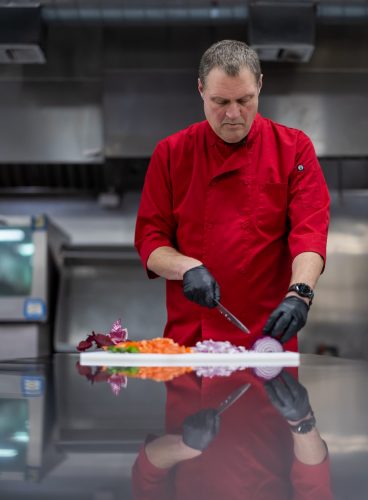
Wyrick chops vegetables for The Vegan Taste, the Phoenix-area meal delivery service he has run since 2005.
Jason Wyrick ’96 launched The Vegan Taste, which may be the United States’ first and longest-running vegan meal delivery service, in Phoenix in 2005. But he once led a very different lifestyle.
In his late 20s, Wyrick was overweight and diabetic. He changed his diet and lost over 100 pounds in less than two years, with most of his Type 2 diabetes symptoms going away within three months. The experience inspired him to become a vegan chef to help other people eat more healthfully.
A plant-based diet can provide many benefits, including lower body weight, reduced inflammation, a stronger immune system and reduced risk for diabetes, heart disease, stroke and other conditions.
“Without good food choices in front of people, people won’t change,” said Wyrick, who is dedicated to proving a plant-based diet can be delicious. For The Vegan Taste, he’s created dishes like biscuits and gravy, a Reuben melt and Thai red curry. The business makes and delivers about 1,500 meals every week.
THE FIRST STEP
Wyrick, a Texas native who grew up in Phoenix, was a lean basketball player in high school who could eat anything. But when he attended TCU and stopped playing sports, he gained weight.
Soon after graduating with a bachelor’s degree in philosophy, he became a vegetarian for ethical reasons. “I would do something stupid,” said Wyrick, who remained in Fort Worth for several years, “like open up a cream of mushroom soup, cook ravioli and douse it in the soup.”
By age 27, the 6-foot-3-inch Wyrick had reached 328 pounds and was diagnosed with Type 2 diabetes. “My diabetes was really out of control,” he said. “My eyesight was failing. I was sleeping 10 to 12 hours a day.”
Diabetes is a common condition. More than 40 million Americans — about 12 percent of the population — have diabetes, per the U.S. Centers for Disease Control and Prevention. More than 88 percent of Type 2 diabetes cases involve patients who were overweight or obese at diagnosis.
Wyrick realized he needed to make drastic changes to his lifestyle. He copied a friend’s recipe for success: By following a vegan diet, she had lost weight and reversed her diabetes. He began avoiding all animal foods, including meat, seafood, dairy, eggs and butter — except for Wednesday nights, when he would go to his favorite Mexican restaurant for all-you-can-eat enchiladas.
“I was still able to lose a bunch of weight, get rid of the diabetes in a few months, and as I felt better, I found that I was only going to eat those enchiladas out of habit, not because they tasted good,” Wyrick said. “It totally changed my life.”
The transformation coincided with Wyrick’s search for a more meaningful career. He gave up his marketing job at a tech company to enter the food profession, moving back to Phoenix in 2004.
The largely self-taught chef saw a need for vegan options in Phoenix and experimented with a variety of ideas, including catering, teaching cooking classes and starting a salsa company. Some ventures were successful, some not.
“I still remember the first big catering event [in Phoenix] I did,” Wyrick said. “It was a fundraiser for a friend. After the dinner, my friend brought me out of the kitchen and everyone gave me a standing ovation. I was blown away.”
That’s when he realized he could pursue a vegan food career and help people eat healthier.
“Knowing that I could make a big impact in their lives, save a bunch of animals and help the environment … it was all wrapped up in that very small moment,” Wyrick said.
Soon after, he began writing and publishing recipes, which became an online magazine, The Vegan Culinary Experience. When a friend asked Wyrick to help change his lifestyle after being diagnosed with prostate cancer, Wyrick launched the meal delivery service that would become The Vegan Taste.
The online magazine grew to 40,000 subscribers, but with a baby on the way, he decided to focus on the revenue-generating meal delivery service.
All the experience and exposure brought more opportunity: Wyrick co-wrote The New York Times bestselling book 21-Day Weight Loss Kickstart: Boost Metabolism, Lower Cholesterol and Dramatically Improve Your Health with Dr. Neal Barnard.
Type 2 diabetes starts as fat builds up in muscles, liver cells and elsewhere in the body, stopping insulin from working, said Barnard, president of the Physicians Committee for Responsible Medicine, a Washington, D.C.-based nonprofit organization that advocates for preventive medicine. Studies Barnard conducted with Yale University on the book’s diet found that people could reduce their liver fat by about one-third within 16 weeks.
Wyrick, now 52 and about 240 pounds, wrote about his personal health journey in the introduction to the book’s recipes. Among more than 60 recipes he created for the book, two of his favorites are Costa Rican rice and beans and curried tomato lentil soup. Wyrick later teamed up with Barnard on Power Foods for the Brain: An Effective 3-Step Plan to Protect Your Mind and Strengthen Your Memory.
“Jason understands the health and nutrition issues from both sides — one who worked to conquer his health issues and one who can guide others to do the same,” said Barnard, who teaches at George Washington University School of Medicine in Washington, D.C. “Jason also has a tremendous sensibility in the kitchen. He’ll make a fettuccine that will knock your socks off.”
CREATING RECIPES, COOKING MEALS
Wyrick has since written two of his own cookbooks, Vegan Tacos: Authentic & Inspired Recipes for Mexico’s Favorite Street Food and Vegan Mexico: Soul-Satisfying Regional Recipes From Tamales to Tostadas. Among the recipes is enchiladas mineras (miner’s enchiladas), a vegan version of red enchiladas loaded with vegetables and a little plant-based cheese.
He was the first vegan chef to teach in the Le Cordon Bleu program at the Scottsdale Culinary Institute in Arizona and has led vegan food tours in countries including Mexico and Italy. Wyrick opened Casa Terra, a vegan restaurant in Phoenix, in 2019, but it closed the next year after the city shuttered restaurants during the Covid-19 pandemic.
Running the restaurant was so stressful that Wyrick gained weight, triggering a return of diabetes. Through diet and exercise — he likes to lift weights and hike at Camelback and North mountains in the Phoenix area — Wyrick once again reversed his diabetes.
Despite those trying times, Wyrick and his wife, Madelyn Pryor, co-owner of The Vegan Taste, refocused on the meal delivery service, which really took off during the pandemic, he said. Pryor helps cook, puts finishing touches on meals and handles customer service.
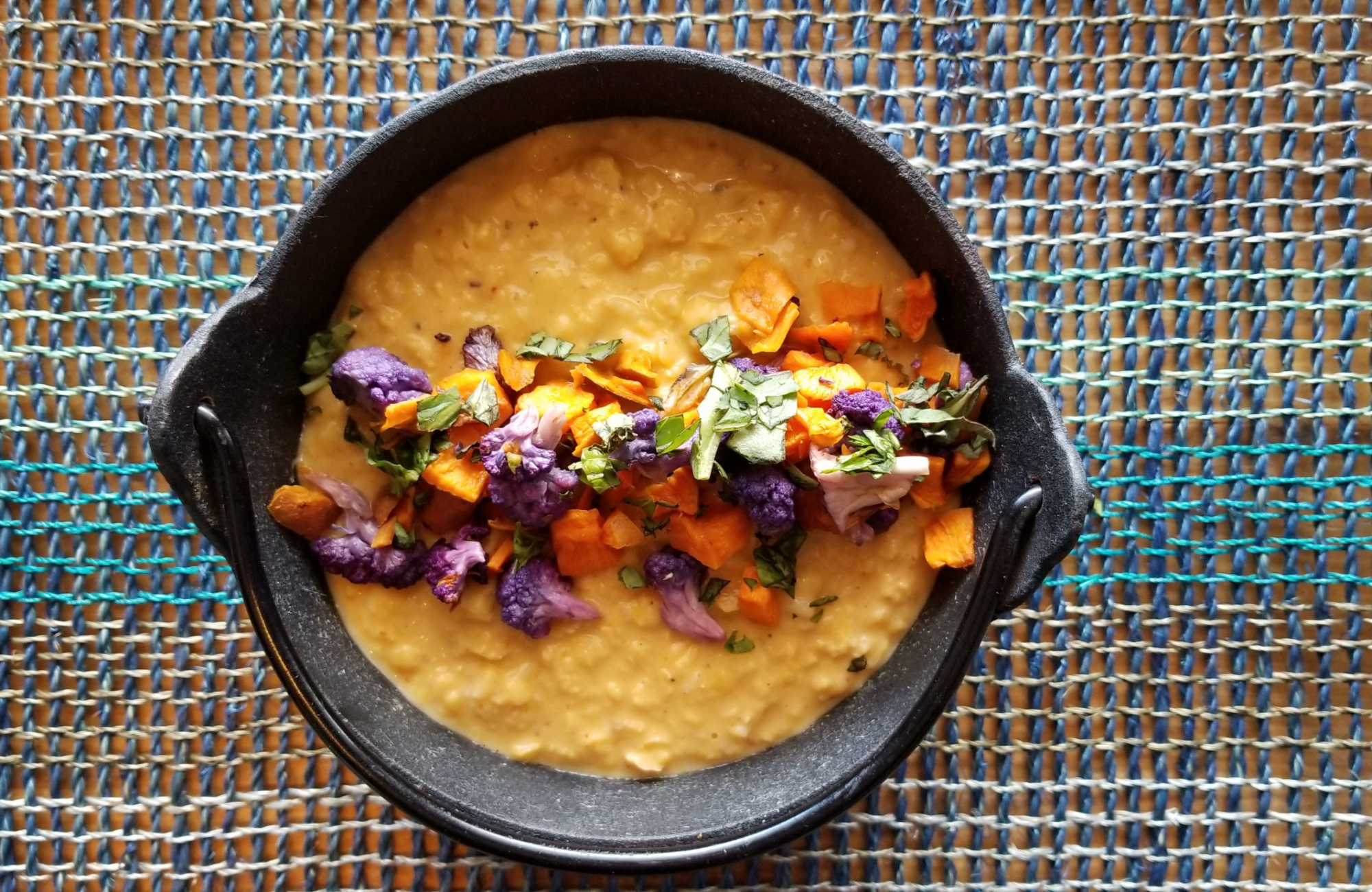
Wyrick created red curry lentils for The Vegan Taste.
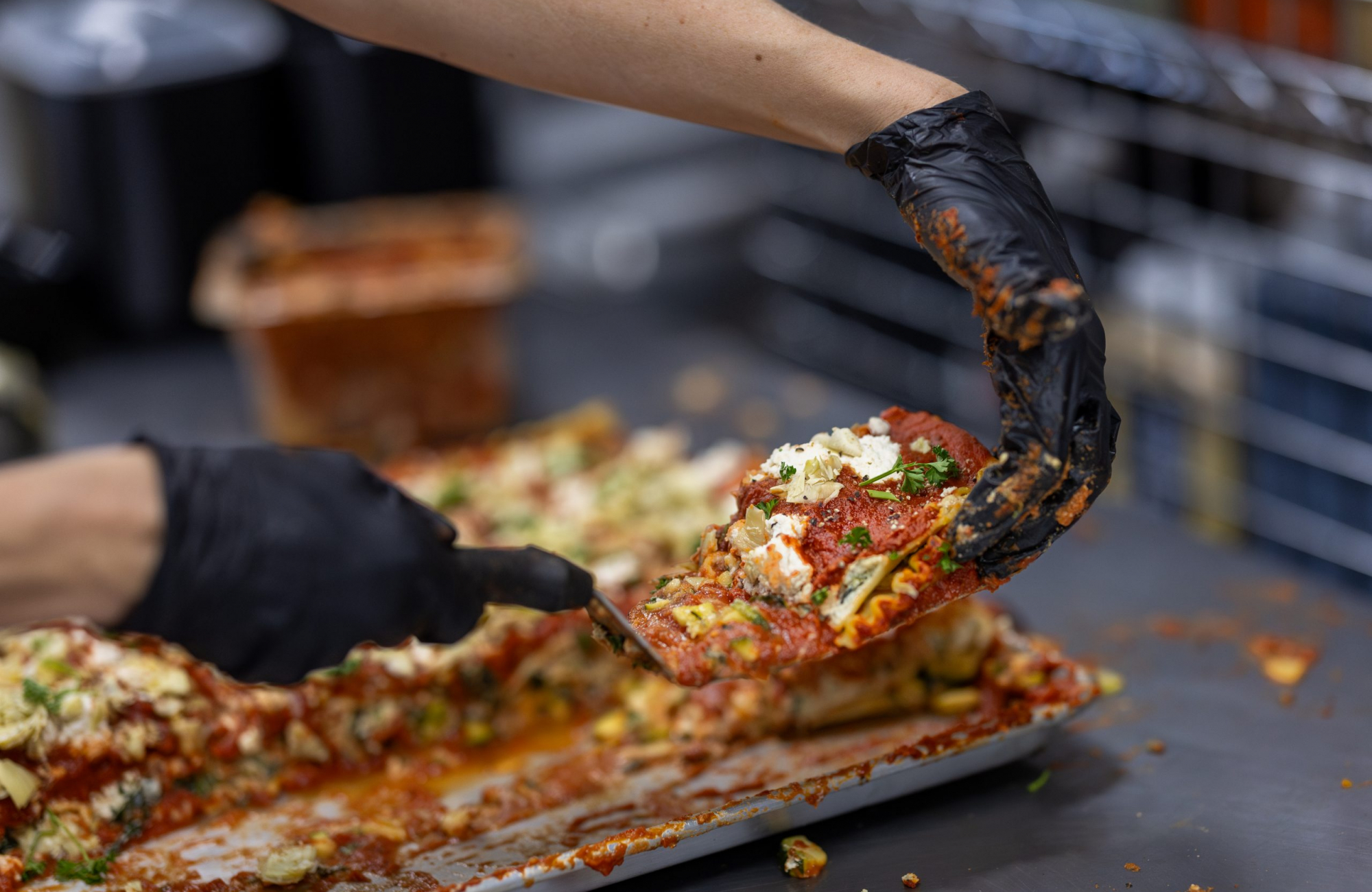
An employee slices vegan lasagna at The Vegan Taste.
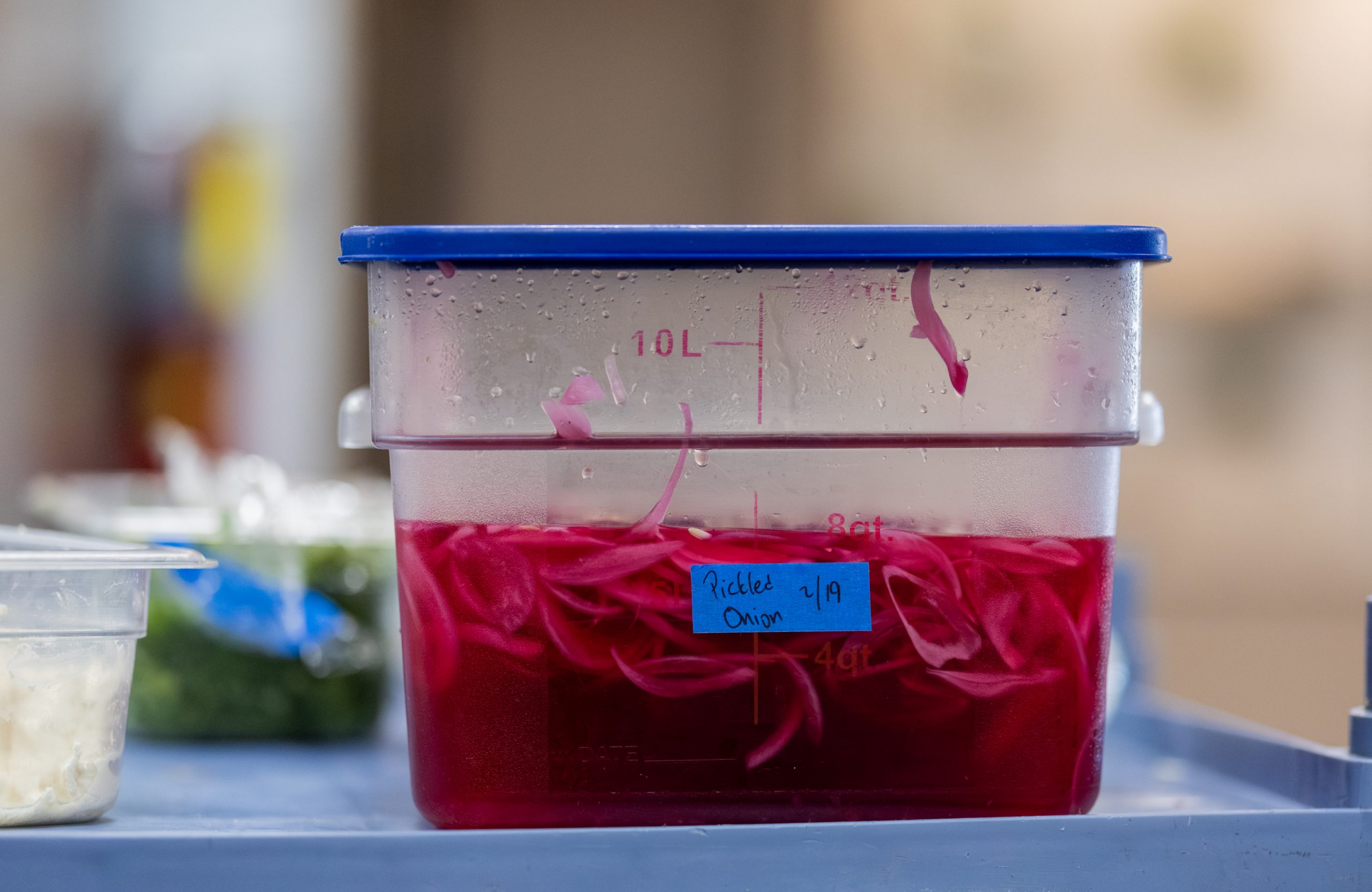
Pickled onions sit on a prep table in the kitchen at The Vegan Taste.
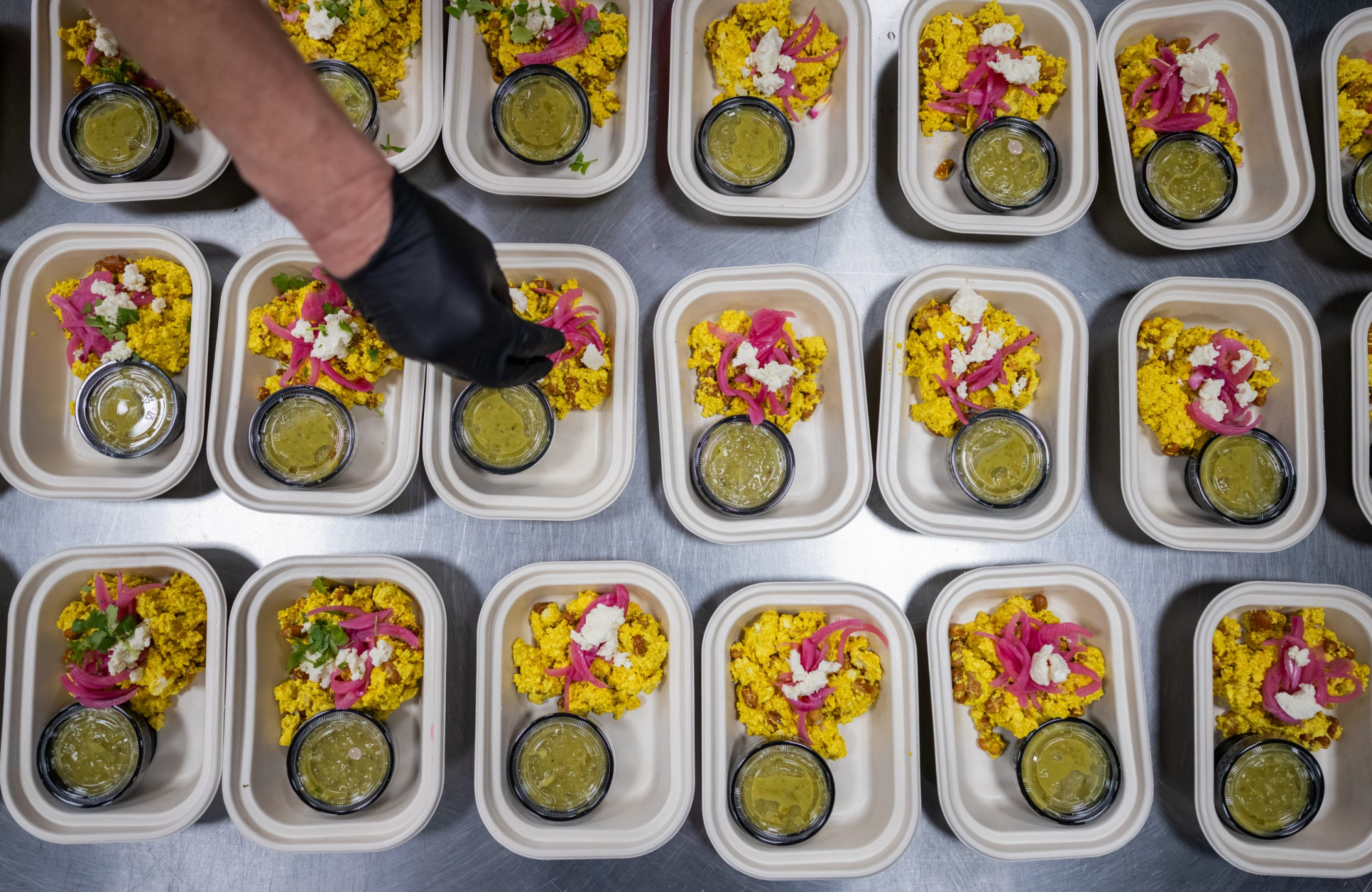
Wyrick assembles trays of tofu scramble chilaquiles for The Vegan Taste.
The Vegan Taste, which Wyrick said has become a multimillion-dollar business, has attracted customers like retiree Linda Nowacek of Scottsdale, Arizona, who found the meal service about five years ago.
“I have disabled hands and can’t cook anymore,” she said. “What’s really unique about Jason’s food preparation is that in addition to being vegan, he does organic as much as possible, and it’s oil-free, sugar-free, dairy-free and, for those who need it, gluten-free. Those are very hard constraints to work with when you’re trying to cook and not have it taste like cardboard. He does a great job. I’m definitely eating healthier.”
In addition to helping people through his meal prep business, Wyrick has informally coached others to lose weight through diet and reverse their diabetes diagnoses. Some of those people, he said, cut their A1C, a measurement of blood sugar levels, in half within about six months.
The Vegan Taste also donates food — about 15,000 meals a year — to families in need through local shelters, Wyrick said. Now his goal is to ramp up the charitable part of his business, perhaps reshaping it into a national nonprofit organization.
“I always got into this to help people, so it feels like a natural evolution,” he said. “It is a way to make the world better.”
Visitors to Fort Worth’s Kimbell Art Museum might assume the family fortune came from oil. Or cattle. Or cotton — the familiar currencies of Texas myth.
It was wheat.
Long before the museum’s vaulted concrete ceilings drew pilgrims of modern art, wheat profits moved through North Texas fields, mills and bank accounts, quietly underwriting a region’s rise. That fact startled even Rebecca Sharpless, a professor of history at TCU.
Her realization began years earlier, while she was researching the lives of farm women in Central Texas. She was struck, she said, by how vividly people recalled the food of their childhood — the taste of biscuits, the texture of bread dough. All foods that began as wheat.
If food could affect memory so powerfully, Sharpless began to wonder, shouldn’t venerable wheat regain its central role in North Texas history?
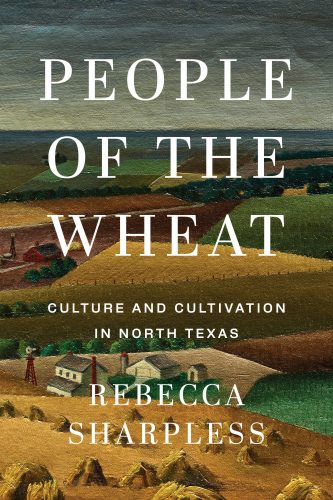
Her latest book, People of the Wheat: Culture and Cultivation in North Texas (University of Texas Press), draws on local histories, oral histories and old cookbooks to recover an unusual and largely unknown chapter in the agricultural history of Texas. In a state largely known for cattle and cotton, Sharpless traces how wheat gained a significant foothold in North Texas starting in the 1840s.
The book explores how wheat was cultivated, processed, sold and consumed in Cooke, Grayson, Denton, Collin, Tarrant and Dallas counties — what Sharpless calls the North Texas Wheat Belt — well into the 1970s.
Wheat’s influence transcended the agricultural markets. Fort Worth’s Burrus Mill sponsored a musical variety program on local radio station KFJZ, and fiddler Bob Wills and his band were among the first to perform on the show. They called themselves the Light Crust Doughboys, named after the mill’s Light Crust brand.
W. Lee “Pappy” O’Daniel, the sales manager for Burrus, allowed the band members, who were mill employees, to stop working as long as they practiced their music for eight hours a day. Wills would later become known as the father of Western swing. O’Daniel, who Sharpless describes as “one of the most notorious politicians in Texas history,” would go on to be elected governor of Texas and serve in the U.S. Senate.
FLOURISHING WITH FLOUR
Courtesy of University of Texas Press
Abandoned grain silos, some repurposed and some simply left standing, still dot the North Texas landscape — vestiges of the wheat heyday that once defined the region. So pervasive was wheat in 19th-century regional culture that in 1885 the Dallas County community of Sprowls’ Corner changed its name to Wheatland.
James Giesen, a historian of American agriculture at Mississippi State University, said Sharpless’ book accomplishes one of the best functions of history: “Seeing something in your backyard and realizing there’s a history there. That silo was built by somebody, and people worked there. Think about all these people and the lives they lived there.”
The crop — or the silo — is only part of the story: “This book is not really about wheat but about people: the people who planted wheat, harvested it, milled it, baked it and ate it,” Sharpless writes in the book’s introduction. “It’s about how people used wheat, wheat flour, and items made from wheat as organizing principles of their lives that determined how they spent their time and their money and how they prepared their food.”
William Cochran, a farmer who moved to North Texas from Tennessee, was among the first to bring wheat to Texas, planting it on a tract northwest of Dallas in 1845. Sharpless writes that Cochran and all his neighbors “were overjoyed at its astonishing yield.”
People living in the region at the time had come from other places, often areas with ready access to wheat and flour. But bringing flour to North Texas was too expensive and impractical for most newcomers.
So farmers were thrilled to find that winter wheat tolerated Texas weather and could be rotated with cotton, which is typically planted in spring and harvested in late summer. By 1860, Sharpless writes, 60 North Texas farmers were each growing more than 1,000 bushels of wheat.
More wheat created a need for mills, which entrepreneurs built to process the grain into flour.
“Mills created communities by fostering local businesses that drew customers from far and wide,” Sharpless writes. “They were items of wonder.”
FROM FIELD TO OVEN
Kitchens and dinner tables throughout North Texas showcased the mills’ success. Families long accustomed to cornbread with their meals started to enjoy biscuits as a new staple. Mothers made biscuits, often with ham or sausage, for children to take to school for lunch.
“Mills created communities by fostering local businesses that drew customers from far and wide. They were items of wonder.” Rebecca Sharpless
Many of the mills promoted the use of their flour by publishing cookbooks and hosting baking competitions and cooking shows. Sharpless writes that a cookbook published in 1909 by the Baptist Ladies’ Aid and Missionary Society of the First Baptist Church of Bowie, Texas, may have been the first to explicitly praise Texas flour. The book included recipes for breads, pies, cakes and more. The cookbook was popular enough to justify four editions.
Bewley Mills in Fort Worth brought in home economists and a “domestic economy expert” to host cooking schools in the early 20th century, Sharpless writes. “Each cooking demonstration and competition tried to yoke the idea of excellence with a certain brand of flour.”
There were rolls, muffins, gingerbread and fruit cobblers. “North Texans also fried wild game,” Sharpless writes. “Rabbit and squirrel pieces received a good coating of flour before they were ‘fried in lard till brown.’ ”
As Dallas and Fort Worth continued to grow in the mid-20th century, wheat production in North Texas began to wane. Wheat farming began moving to the Texas Panhandle around 1900, Sharpless writes, when farmers started digging wells and installing windmills to tap into groundwater for irrigation. “The drier air in West Texas discouraged disease, and observers also noted the benefits of the flat terrain,” she writes.
But the surprising influence of wheat’s heyday in Texas is still evident today, Sharpless said. “I had no idea. … If you had asked me, ‘What did they grow in North Texas?’ I would have said cotton. The idea that wheat played as big a role as it did … this really mattered to people. The choices that they made, the way they lived, the way they spent their money, the way they educated their children were all directly tied together and make us how we are today.”
In the pages of The Land of the Skinny Cow: Beef Politics in Cuba, 1927 to 1963, the stories read like crime fiction: butcher shops bombed in the night. Beef-motivated murders. Smugglers trafficking illegally slaughtered meat in suitcases and garbage bins. But for Bonnie A. Lucero, TCU’s Neville G. Penrose Chair in Latin American Studies and History, these were not plot points; they were archival discoveries, buried in decades of Cuban court records and newspapers, that revealed how a single commodity shaped a nation’s politics, identity and destiny.
Beef “would always come up unsolicited in conversation,” Lucero said, adding that the topic’s omnipresence piqued her interest. “Cattle and beef metaphors are infused throughout the entire culture.”
On a visit to the Cuban national archives in Havana, Lucero browsed dozens of collections for content on cattle and beef. She discovered that beef production and consumption were so deeply entwined with Cuban politics, history and culture that a book began to take shape.
BEEF OR BUST
A 1973 Cuban postage stamp from the Razas Bovinas (Cattle Breeds) series features the Criollo. Cattle and beef imagery, Bonnie Lucero notes, are “infused throughout the entire culture.” iStock/AlexanderZam
The title The Land of the Skinny Cow, forthcoming from Stanford Press in early 2027, draws on one of the many beef metaphors that sparked Lucero’s interest in the subject. The phrase los tiempos de la vaca flaca (skinny cow times) referred to periods of beef scarcity.
During the period covered in the book, 1927 to 1963, three different eras of politically influential ranching cartels controlled the beef supply and price and created shortages on the island. The government vacillated between cooperating with the beef barons and attempting to rein them in.
It was not just the industrial monopolies that made beef a persistently scarce commodity. Environmental factors such as drought and disease and ideological conflicts between the haves and have-nots in the country’s highly stratified society contributed to Cuba being what Lucero called “the land of the skinny cow, a place of enduring shortage and chronic scarcity.”
The story of Cuba’s obsession with beef began in the 1500s. For centuries, the Spanish colonial government requisitioned cattle from ranchers and provided beef to the people under what was called the pesa system, which “not only reflected an understanding that ranchers, by virtue of their privileged access to land, had an obligation to feed the public,” Lucero said. “It also bequeathed a deeply rooted sense of entitlement to affordable beef as a primary dietary staple to colonial denizens, regardless of status.”
During the colonial period, beef emerged as a central pillar of the Cuban diet, prized for its presumed associations with “strength, productivity and masculinity,” Lucero said. The Spanish dish ropa vieja, a slow-cooked beef stew, evolved into Cuba’s national dish. Other food sources — pork, poultry, seafood — were considered inferior, and their consumption was minuscule in comparison. The distribution of beef inextricably shaped Cubans’ expectations of their government.
During the late 1800s, Cuba’s cattle industry was decimated by three wars for independence and by land reallocated to booming sugar plantations. The government supplemented dwindling domestic beef supplies by importing tasajo, an inexpensive form of dried salted beef, from Uruguay. It became the dietary staple of the masses, popular in fried and stewed variations.
U.S. ranching and meatpacking firms, present in Cuba since the 1870s, reconstructed the Cuban beef industry by replenishing herds and building Havana’s first modern slaughterhouse and meatpacking plant. They turned the Cuban beef industry into a powerful economic and political force that gradually controlled prices and supply. This propelled the shift from a municipal monopoly on beef to privatization, Lucero said, which priced fresh beef beyond the budget of most Cubans and “upended the colonial ethos of social obligation and popular entitlement.”
To promote the domestic cattle industry, the Cuban government in 1927 imposed a protectionist tariff on imported beef — specifically, tasajo, which became prohibitively expensive. Prices for fresh beef and other sources of protein were even higher, in part due to collusion by two private companies controlling the market in Havana.
“It had a very tangible effect on people’s lives,” Lucero said. The global depression of the 1930s significantly reduced Cubans’ purchasing power, “but even if you had money, there was no affordable product to buy.”
Consumer protests prompted government intervention through price controls, direct distribution and rationing that repeatedly tried, but failed, to resolve persistent shortages over the next two decades. As revolutionary forces gained power in the lead-up to the 1959 overthrow of the government, Lucero said, “they recognized delivering beef to impoverished people as critical to consolidating political support.”
Eventually, the revolutionary government’s first agrarian reform law from 1959 to 1963 seized ranchland from cattle barons and redistributed it into cooperatives, marking the end of the country’s commercial beef industry. The law also led to diversification of the Cuban diet.
SEEDS OF REVOLUTION
Political cartoons in Cuba made mention of “the beef problem.” Illustration courtesy of Bonnie Lucero
Lucero’s fascination with these questions has deep roots. In 2006, she spent part of her sophomore year of college at the University of Havana. “I absolutely fell in love with the country,” she said. “The United States is a very individualistic place. But in Cuba at that time, there was still a beautiful solidarity among people just wanting to help each other.”
Lucero was thrilled to work on a PhD in history at the University of North Carolina at Chapel Hill under Louis Pérez Jr., an esteemed and prolific Cuban scholar. “I tell my graduate students that when you work on Cuba, you have to have three Ps: passion, persistence and perseverance, plus a sprinkling of humor because there will always be setbacks,” Pérez said. “Bonnie has a commitment that is very much driven by her passion for her subject. She’s one of those researchers who just dives into her material with both a broader vision and an eye for details.”
That talent served Lucero well in her research for The Land of the Skinny Cow. She read through 30 years of Cuban cattlemen magazines to learn about the industry and 40 years of newspaper articles to understand popular sentiments about beef. “The level of detail you can get from the everyday press is fantastic,” she said. “Beef made the news practically every day.”
She recruited an assistant for her research: then-sophomore Kate Spielbauer ’25, a biology and Spanish double major who took classes and completed independent studies with Lucero. A fluent Spanish speaker, Spielbauer skimmed through Spanish newspapers on microfilm at TCU’s Mary Couts Burnett Library and, with support from the history department’s Regina Memorial Endowment, accompanied Lucero on a research trip to Cuba in summer 2023.
Together, they spent hours poring through court cases at the Archivo Nacional de la República de Cuba in Havana as well as a provincial archive in Camagüey, the center of Cuba’s historic ranching region. Spielbauer helped Lucero translate court cases to discover all the ways beef became criminalized and contraband through bootlegging and smuggling. “Interpreting was a challenge but also like a scavenger hunt,” Spielbauer said. “You’d find new words and learn something new.”
Lucero has included some vignettes from those court cases in The Land of the Skinny Cow. Her narrative unfolds not just in words but through 52 illustrations that connect readers to the events and to the emotions behind the beef crisis. The cultural disdain toward other food sources comes through in a magazine cover’s depiction of a plate of fish titled, “¡Esto no es Carne!” (“This is not beef!”)
Another of her favorite images from that era depicts a father and son in front of the 16th-century El Morro fortress in Havana. The father says, “That castle is very old, almost as old as when there was beef in Havana.”
“Ensuring that people have enough to eat, especially the foods that are important to them, is the foundation of political stability,” said food historian Jeffrey Pilcher ’93 PhD. “Beef had this totemic importance for the Cuban people. What Bonnie’s book does very nicely is show the complexity of all these different actors within the beef industry in Cuba.”