
Ed Ferris ’88 and his wife once believed they’d never have children. Monica Phillips-Ferris ’89 had endured colon cancer at 24, which made childbearing unlikely. In 1995, the couple found out they were expecting a baby. Madeline arrived that year, and Edward Jr. followed in 2000.
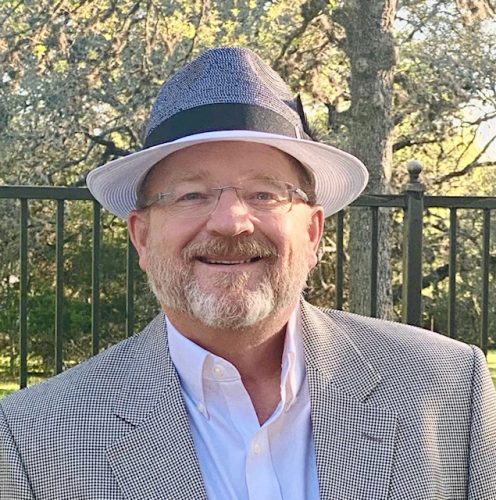
Ed Ferris is a father, author and founder of the Bubbles Project. Courtesy of Ed Ferris
The good times lasted several years for the San Antonio-based Ferris family. Ed Ferris, a Neeley School of Business marketing alumnus who had been a cheerleader at TCU, is now vice president for Jani-King, a chain of janitorial and disinfecting services, where he helps people start and develop their own businesses.
But hundreds of hospital visits awaited on the horizon. Diagnosed with colon cancer at 42, Ferris underwent surgery to remove two large tumors. In 2012, Monica Phillips-Ferris had surgery for a brain tumor.
The next year, the Ferris family set sail on a Christmas cruise to celebrate new beginnings. The children returned to school in time for flu season, and Madeline got sick. She tested negative for flu but never seemed to improve.
Madeline, who once broke her hand in the middle of a softball game but finished playing regardless, faced headaches that would leave her crying and immobile.
Doctors suggested seven chronic illnesses, ranging from polycystic ovary syndrome and digestive disease to multiple sclerosis. One doctor put her in a coma for several days. A surgeon spent 10 hours detaching and removing nerves from her head.
In her blog, (In) Sane in Chronic Pain, she wrote about losing normalcy, being tethered to medication schedules and enjoying James Arthur’s new album.
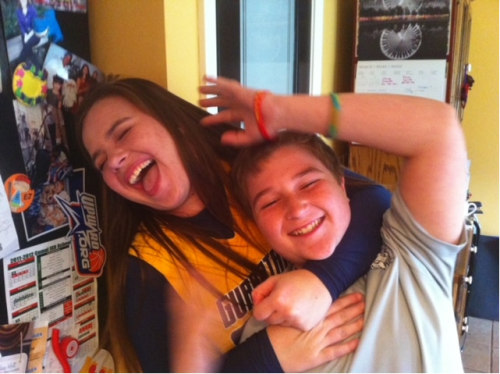
Madi and EJ had a close relationship, says their father. “She always used to joke, ‘You know I’ll take a bullet for you.’ And I don’t think it was a joke. She was so protective of him you can’t even imagine.” Courtesy of Ed Ferris
Madeline visited more than 250 physicians in five states starting in 2013. Four years later she slipped into a catatonic state in the bathtub and drowned at age 21.
Not wanting his daughter’s mission of uniting children with chronic pain to go unfulfilled, Ed Ferris developed an idea that would become the Bubbles Project. Named for his daughter’s softball moniker and personality, the nonprofit provides resources for families with a child facing chronic pain. Ferris said he is working toward purchasing land that will become a retreat for the Bubbles Project families to take a break or mourn the loss of a child.
Writing through his grief, Ferris published A Father’s Heart: Love, Life, Loss and How the Heart Goes On (Hope Kelley Book Publishing, 2020).
He shared life lessons he has picked up through the years.
Solve the problem. Don’t spend too much time looking back on what got you there or projecting too far forward in trying to design the future. Deal with what is in front of you and make the best decision you can at the time. The great thing about making a decision and acting on that decision is that if you are right, you move the process forward in a positive manner. If the decision turns out to be less than optimal, you get to make another one — a better one — armed with the experience from the previous.
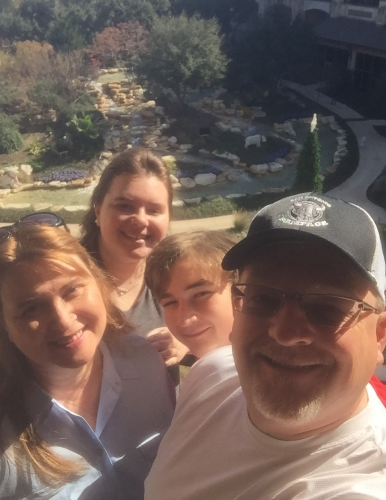
Monica, Madi, EJ and Ed Ferris banded together through the family’s health challenges. Ed said he wants to help kids and families facing a similar battle. “Many of them, like Madi, have multiple chronic illnesses. The mental, spiritual, financial, emotional toll that takes on the entire family is immense. Those people need help.” Courtesy of Ed Ferris
Keep a short memory. If someone has done you wrong, or if you have made a mistake, don’t carry it with you. Learn from it, make the correction and move forward. If you have had a success, learn from it and improve on it the next time; don’t dwell on it and expect it to define you going forward. You must win each day based on what you do with it.
Share your story. We all have a story to tell that can help someone else. Sometimes they are stories of success, and sometimes they are stories of failure or hardship, but your story can help others. Before I wrote my book, I thought it was just my story. After publishing it, I was amazed by the feedback from fathers, mothers and kids on how parts of our story spoke so directly to them and impacted their lives. The American Academy of Pediatrics reports that 10 to 20 million children and adolescents in the U.S. have some form of chronic illness or disability. The CDC found that one in 15 children have multiple chronic conditions like Madi.
Own your challenges. Everyone has challenges. Don’t look outside yourself and think, “If only …” We never know 100 percent of what others are going through, and when we do find out, most of the time we realize that we would choose our troubles over those of our peers.
Find small victories and celebrate them. Even in the darkest and hardest of times, there are small victories. Recognize those; celebrate them and build on them. Those victories will become the foundation on which you will build your future.
Give with gratitude. Be thankful for what you have, warts and all, and give of your heart and yourself with the knowledge that giving to others is the most fulfilling feeling that exists.
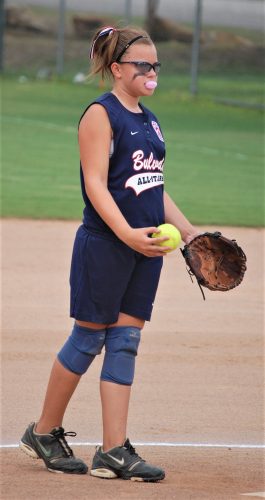
The Ferris kids were athletic — Madi in softball and EJ in ice hockey. The Bubbles Project gets its name from Madi’s personality and her pitching mound gum habits. Courtesy of Ed Ferris
Find a way to say yes. Many of us protect our time and ourselves by saying no. Changing that dynamic and finding a way to say yes in a way that may not be exactly the way it was anticipated, but in a way where both the questioner and questioned are satisfied, can open new opportunities and lead to experiences that would otherwise be lost.
Sometimes no words are necessary.
Reflect, don’t regret. The loss of a child is one of the most painful experiences a parent can go through. So much went into Madi’s situation that it would be both easy and paralyzing to look back, dissect each decision and each action, and allow regret to consume us. I absolutely HATE that Madi is no longer on this earth with us. But we have chosen to reflect rather than regret. Reflection allowed me to cherish and honor the gift that God gave me in my daughter, to escape from the negativity, to truly celebrate her life by sharing our story and to realize our story wasn’t as special as our relationship.
Know everyone’s job, but do yours.
Be willing to be different.
Focus on what you can do, not what you can’t.
Focus on the quality of your communication, not the quantity. Verify understanding by asking, “Does that make sense?” Confirm agreement: “Is that something you can see yourself doing?” If you start a comment with “I thought …” realize that the previous communications likely were not of a high enough quality.
Edited for clarity and length.
In January 2021, Jeff Walburn met with a contractor about renovations on his house. Having undergone a successful liver transplant 13 years prior, he was taking extra precautions to guard against the coronavirus: meeting outside, social distancing and limiting contact with surfaces.
Three days later, the contractor called to say he had tested positive for Covid-19. The following day, chest pressure and fatigue sent the 58-year-old Walburn of Weatherford, Texas, to urgent care. Doctors there gave him a Covid test and, after consulting with his transplant team, prescribed treatment.
The next day, the test confirmed he had contracted the virus.
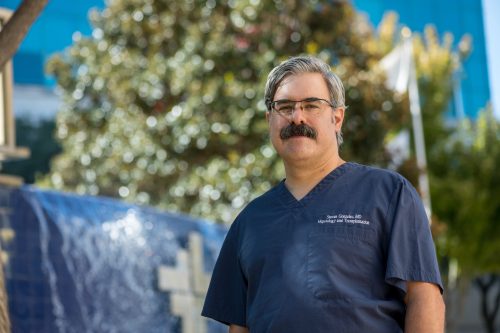
Dr. Stevan Gonzalez, an associate professor at the TCU School of Medicine, is medical director of liver transplantation at the Annette C. and Harold C. Simmons Transplant Institute. Photo by Leo Wesson
Walburn said his transplant physician, Dr. Stevan Gonzalez, later told him his goal had been to keep his patients out of the hospital because they might end up on a ventilator.
Over the next 10 days, more symptoms followed, including a miserable cough and loss of taste and smell. “The headaches were also excruciating,” Walburn said. “I could hardly sleep because of the headaches. They were so severe.”
Inside Walburn’s body, a cytokine storm was likely erupting. His immune system, in attacking the virus, had turned from friend to foe by generating a toxic number of cytokine proteins. As those immunity-enhancing chemicals flooded his body, they were interfering with its regular functions.
In many cases, those storms end up destroying heart and lung tissue and ultimately lead to death.
Walburn eventually recovered. For others battling Covid, an existing monoclonal antibody — given to kidney transplant patients to safeguard the new organ — could potentially stop the immune system’s overreaction and save lives.
The Fort Worth Clinical Sciences Working Group, made up of 15 North Texas physicians, has received approval from the U.S. Food and Drug Administration to conduct trials and test the drug in Fort Worth-area hospitals.
The drug they will test is basiliximab, a transplant rejection drug commonly known as Simulect. Results will show whether it can reduce inflammation caused by that cytokine storm in patients with the most severe cases of Covid-19.
In the early stages of the pandemic, medical professionals did not know what caused the novel coronavirus to turn fatal. While researchers across the world worked at a lightning pace to develop Covid vaccines, others eyed existing drug treatments to mitigate infections.
Covid patients “would rapidly go into respiratory failure, and their bodies would go into a state of shock. They would require an increase in oxygen support to their lungs and ultimately end up on life support.”
Stevan Gonzalez
Gonzalez, associate professor at the TCU School of Medicine, spent countless days and nights treating people in the intensive care unit of Baylor Scott & White All Saints Medical Center-Fort Worth, where he serves as medical director of liver transplantation at the Annette C. and Harold C. Simmons Transplant Institute.
Even when critically ill Covid patients received the most aggressive form of medical care he had to offer, their health often declined in a hurry, Gonzalez said. “They would rapidly go into respiratory failure, and their bodies would go into a state of shock. They would require an increase in oxygen support to their lungs and ultimately end up on life support.”
By March 2020, the world’s medical community had figured out that uncontrolled development of cytokines, proteins secreted by the immune system, were often the cause of Covid’s fatal turn.
“We had observed this kind of reaction to viral infections in the past,” Gonzalez said, “and looking at what was coming out in the cutting-edge research of Covid-19, we were understanding that the immune system had a major role in creating this reaction.”
Cytokines are the body’s natural immune response to a viral infection, said Dr. Stuart D. Flynn, the founding dean of the TCU School of Medicine. “When they [cytokines] work correctly, they are working every day for us clearing organisms out of our body, and we never know it.”
But the Covid-19 virus is a deadly stranger to the human body. Once infected, the body tries to create an appropriate immune response using those typically helpful cytokines to eliminate the virus. As the infection accelerates, that once reliable immune response turns into a bigger problem than the virus.
“The cytokine storm is this horrible state that leads to unchecked and unregulated inflammation,” said Dr. Mohanakrishnan Sathyamoorthy, a professor and the department chair of internal medicine at the TCU School of Medicine, who was looking at existing drug treatments that could neutralize the reaction. “In some patients, there is a dysregulation of intensity of this inflammatory response, and the result is you actually end up damaging your own tissue.”
Gonzalez, Flynn and Sathyamoorthy joined forces to launch a research group in hopes of curtailing the lethal immune response.
“I realized that this couldn’t be a solo project; this is a medical school level effort,” said Sathyamoorthy, who is also medical director of Baylor Scott & White’s Fort Worth Heart and Vascular Hospital. “The best way to think about how we can serve our community, science and medicine at large would be to create a working group.”
Sathyamoorthy recruited Flynn and Gonzalez to start, then enlisted faculty and physicians across Dallas-Fort Worth to participate.
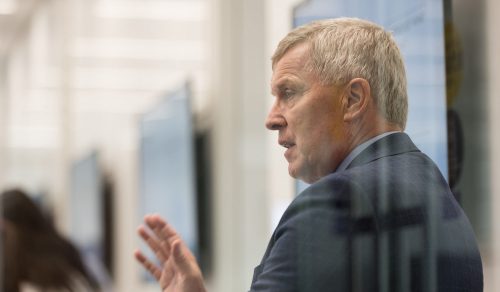
Dr. Stuart D. Flynn is the founding dean of the TCU School of Medicine. “We’ve set up this environment to build a much bigger attraction to [the medical] industry to want to come in here and do their clinical trials,” he said. “That is the ultimate goal.” Photo by Leo Wesson
By April 2020, the research group consisted of 15 physicians in leadership roles at major North Texas health organizations, including Baylor Scott & White, Texas Health Harris Methodist Hospital, JPS Health Network, Cook Children’s Medical Center and the medical school. The physicians represent a range of medical specialties, including infectious diseases, transplant immunology, cardiovascular medicine, pulmonary critical care medicine, pediatric critical care medicine, and pediatric oncology and immunology.
By mid-August 2020, as new daily Covid diagnoses in the U.S. hovered around 60,000, the group had developed multiple study proposals in hopes of lessening the pandemic’s devastation.
The first studied how a cytokine storm manifests inside the body and evaluated available medicines that might also treat the inflammation caused by a cytokine storm.
That search led them to basiliximab.
In 1998, the FDA approved basiliximab for treatment of kidney transplant patients. The monoclonal antibody, a type of synthetic molecule that mimics a natural protein, can inhibit the body’s immune response and keep it from rejecting a new kidney.

Dr. Mohanakrishnan Sathyamoorthy is the department chair of internal medicine at the TCU School of Medicine. He enlisted 15 North Texas physicians to join a working group dedicated to halting immune system overreaction in Covid patients. Photo by Leo Wesson
Basiliximab can also calm down the specific cytokine that attacks a viral intruder. The researchers submitted an Investigational New Drug (IND) application to the FDA seeking approval to test the proven anti-rejection drug on Covid patients.
In fall 2021, after almost a year of back and forth with the agency to complete rigorous revisions, the FDA granted approval to conduct trials with basiliximab. The physicians immediately strategized about how to enroll 300 patients in the Dallas-Fort Worth area.
Covid-19 patients at Texas Health Harris Methodist Hospital Fort Worth, Baylor Scott & White All Saints Medical Center-Fort Worth and John Peter Smith Hospital could take part.
IND applications are almost always sought by and granted to pharmaceutical or medical device corporations, so for a small physician working group to receive such approval without any funding is a positive development for the medical school and TCU, Sathyamoorthy said. “To get the trial underway and enroll the number of patients needed, we need significant financial support. Raising money to complete the job is the next great challenge in this journey, and one we can do together here in Fort Worth.”
Another key proposal was to establish a biorepository to store all the fragile research specimens. Floyd Wormley Jr., associate provost for research and graduate studies at TCU, volunteered freezers in the university’s research labs.
Any future medical researcher who wants to replicate or build on the basiliximab study will need to retrieve the tissues stored on the TCU campus.
“Everyone here has had an open-door policy and wanted to help,” Flynn said. “Everyone is excited. This is cool stuff for Fort Worth.”
The timing of the research is a boon for the newest students at the TCU School of Medicine. They studied cytokines in fall 2021, and some of the students are assisting with the research efforts.
“They will get the basic information of how these cytokines work, which is a beautiful thing,” Flynn said. “This whole issue of cytokines, cytokine storms and clotting — they are all intimately related.”
Walburn, already a believer in the power of anti-rejection drugs, said the research could be a game changer in battling Covid.
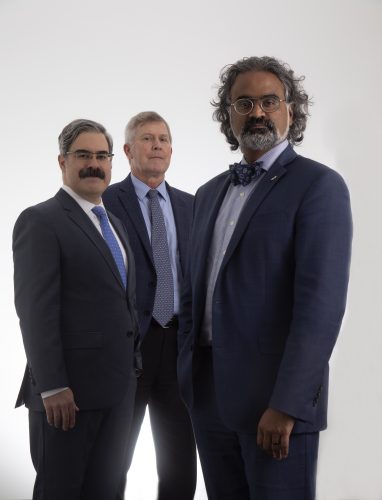
Dr. Stevan Gonzalez, Dr. Stuart D. Flynn and Dr. Mohanakrishnan Sathyamoorthy joined forces to launch a research group in hopes of curtailing a lethal immune response to Covid-19. Photo by Joyce Marshall
“I didn’t do anything without consulting Dr. Gonzalez. I trust him explicitly,” Walburn said. “If it wasn’t for his guidance [on treating the virus], I probably would’ve been in a hospital on a ventilator. I’m a strong advocate for anything that would lessen the symptoms of that monster because it is bad news and it’s rough.”
The road back to full health after contracting the virus and surviving the storm has been a long one for Walburn, as the effects have lingered for months.
“There’s times that my wife is cooking dinner and I can’t smell it,” he said. “The taste of things didn’t come back until about August.”
Walburn also had to rebuild his capacity for exercise since battling the virus. After the liver transplant, he used to train for up to 15 hours a week and had completed three half-Ironman events and the six-day, 350-mile Lone Star Circle of Life bike ride.
Even simple walks became a daunting task while he recovered from Covid.
If he took a short walk, he said, “My chest was hurting and I was short of breath. I didn’t realize it was going to be as hard as it was.”
But thanks to the marvel of modern medicine, he has a full recovery in sight, has received his vaccinations and is training to participate in a full Ironman event. After that? “I think I’ll summit Mount Kilimanjaro or Denali.”
At TCU since 2013, Lynn Jackson is mentoring the next generation of social workers. She is professor of professional practice and assistant dean for strategic initiatives in the Harris College of Nursing & Health Sciences. Jackson has served her community by helping offenders assimilate back into society, working for reproductive rights, conducting research and teaching.
Before you went to college, you volunteered in hospitals and wanted to be a nurse. Why did you choose to pursue social work as a career?
I was a candy striper for the Red Cross. I thought I wanted to be a nurse and I did a lot of volunteer work to get prepared. But when I started college, I thought about my strengths and weaknesses and realized that math and science — I hadn’t enjoyed it.
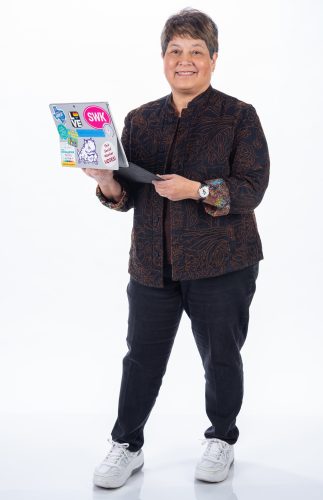
Lynn Jackson says social workers “can be strong advocates; we can be involved in the legislative system.” Photo by Glen E. Ellman.
I started to rethink how I wanted to help people. So I thought, “let me look for a different helping profession,” and that’s what led me to social work. I realized I could still be in the medical area if I wanted to; I could have everything I wanted by doing social work.
I did a lot of volunteer work in child welfare when I was in college. I loved the flexibility of the profession and the fact that it also had this social justice component to try to help people who were marginalized and didn’t have a lot of resources. It really fit with my own value structure.
I have always cared about people who struggled, from the time I was little. My sister and I would go and help this woman down the street, who was blind, with cleaning. She always offered to pay us, but my parents were against that; we did it because we wanted to — not because we got paid. My parents really instilled in me the value of giving back and helping other people.
As I learned more about the social work profession, I realized we could make a difference at a policy level, too. We can be strong advocates; we can be involved in the legislative system.
Why is social work important to our communities?
Historically, social work has been connected with social policies. If you go back to after the Great Depression, we didn’t have an infrastructure around social agencies or policies. That was why FDR was voted into office; we needed more infrastructure than just what a family or church could provide, which is historically how things have been done.
FDR was really smart and he had a lot of social workers helping him. There’s historical ways that social workers have formed labor policy and even policies around Social Security.
Unfortunately, we’ve also been involved in things that weren’t so great. There were social workers involved in putting the Japanese in internment camps. We were also involved with putting Native Americans into boarding schools.
What I’m hoping is that we’re educating people to be able to go, “Wait a minute.” Right now, for instance, our national association is looking to be an anti-racist organization. We really want to highlight how important that is, that we look at things through a social justice lens. That’s what really sustains me and helps me; we’re evolving and we’re trying to look at ways to make a difference.
You’ve worked with people in nursing homes and people who have been incarcerated. How did you figure out what you wanted to specialize in?
When I first graduated, I thought that I would work in child welfare; that’s what I had done during my internship. But probably my most rewarding job was working with offenders with drug and alcohol problems.
My first job was working for the housing authority because when I tried to get a job in child welfare, I just didn’t have enough experience. I worked for a nursing home and found out that I really liked older adults. Even my job working with offenders I started just as a part-time job doing some counseling and I ended up finding out how much I loved it.
I worked a lot in residential programs, with individuals with developmental disabilities or intellectual disabilities. I always liked working in residential programs because you could see them for longer periods of time and get to know them. I never liked it if I just saw someone once a week.
What did you find rewarding about working with offenders?
When I was in Florida, people were coming to us [residential program] instead of going to prison, and then some people were coming to us after they got out of prison. The idea was to provide drug and alcohol treatment in real time, help them be able to get a job and be out in the community while still having a little bit of a safety net as they were learning how to cope with problems or stress.
It was a wonderful opportunity to work one-on-one with people and do group work with them. At the time we didn’t realize that we were doing a lot of trauma informed care, especially for women who often had been abused as kids. That’s really the lens we look at all of this through.
It was challenging. Certainly it was a group of people I had never been around. I enjoyed that I found a lot of humanity there; some people made bad decisions, but it didn’t make them bad people. Seeing a woman deal with an addiction and past abuse, and work to get custody of her kids back — it was rewarding.
What inspired you to return to school after a decade in the field to pursue your master’s in social work — and after another decade in the field to complete your PhD in social work?
I always thought my journey would go more quickly than it did. I thought I’d be back in a master’s program within a couple of years and then write my PhD. But sometimes things get in the way. I was working and enjoyed my job, and then we bought a home and got into some debt, and then it was harder to go back to school.
As I had social work supervisors, I started thinking that I could do equally as good of a job if I had more education. I decided it was time, though it had been 10 years.
“It might take you longer than you think, but you still can accomplish something that you set out to do.”
Lynn Jackson
I thought I’d go back a couple of years later to get my PhD, but I loved what I was doing. I was working with offenders and really found a niche for myself. It took me longer than I thought, but I did go back to school again after 11 years. I tell people that story because I was a first-generation student. It might take you longer than you think, but you still can accomplish something that you set out to do.
My reason for going back to the PhD was this idea that I could teach. I really liked the flexibility of academia; the idea of being able to specifically teach field education with the internships really appealed to me. I can still do my advocacy work; I can still go to a rally or go speak with a legislator. All of that was really a good fit.
How did you come to be involved in advocacy and research about reproductive rights?
After I graduated with my master’s, I decided that I needed to do more work around women’s reproductive rights. I thought women weren’t going to be able to make any progress in jobs if they couldn’t control their ability to have children.
Which awards have you received?
I’m really proud of when I was a Women’s Health Hero [awarded by Our Bodies Ourselves in 2010] for my case management work with the National Network of Abortion Funds.
In 2020, I won the National Association of Social Worker Lifetime Award for our local area, Tarrant County, and I won it at the state level, too. That was for my work with the National Association of Social Workers — I was a branch chair, I was president of NASW Texas for two years and I was on the Women’s Issues Committee — but also my work as a social worker over the years and my volunteer work.
This is my last year as a representative to the national board that’s out of Washington. I really have loved my work with it; it was a way to just understand the profession more and get to provide something back to them, because I feel like the profession has given so much to me.
What does being the director of field work for the social work department entail?
I take the lead with all of the students and help match them to an agency. I’ll meet with the students individually, and we’ll talk: Do they have an interest in child welfare or older adults? Some of them want to work with homelessness. We have over 100 agencies that have agreed to take student interns.
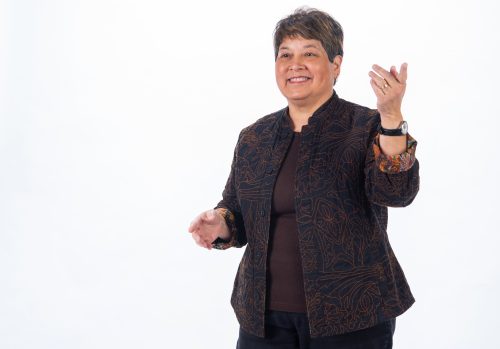
“We’re training students to be advocates and to set themselves apart,” says Lynn Jackson. Photo by Glen E. Ellman
Then we set it up. I do an orientation with the students and I do all the training with the instructors, so they understand what we expect, and then talk them through the evaluation process, what kind of activities we want to see, the path we want to see.
I also teach a seminar class, so the students are talking about what’s going on in their internships. We’ll do some in-class activities and we work in the leadership center so that everyone can get their top five leadership skills through the CliftonStrengths test. Students understand even if they don’t want to stand up in front of a group, they’re still a leader, even if they’re doing a one-on-one session with a client. All of our master’s students will take a social work licensing exam before they leave so we do prep work for that, and we do a mock interview process with all of our students.
I stay pretty busy just trying to make sure we have enough agencies and dealing with problems as they come up. We just brought on a new system for tracking; our students complete a log every week, telling us what they’ve done, so that we can make sure that they’re getting the kind of experience that we want them to.
My professional experience led me perfectly to be able to be on a faculty; a lot of my experience comes in handy. I’m able to normalize things for students, to work closely with their agency instructors to help them have a really good experience.
You’ve mentioned working with Harris colleagues to facilitate interprofessional learning. What makes the TCU social work department stand out from other programs?
It’s about how we can help our students understand the importance of working together in teams. All of the disciplines in Harris, as well as nutrition and public health, we all read a book together. We’re going to be looking this semester at values and ethics based on that book, and next semester we’re going to be looking at race. We’re teaching the students to learn about, from and with each other. I feel really proud of what we’ve been able to do — to show that when teams work together, they can improve patient care and the safety of the patient.
We are training every social work student at TCU to understand clients and systems from a trauma-informed lens because many community agencies use this approach. The other thing that we’re doing is looking at things from a social change perspective. It’s not enough to just recognize racism — we have to do something about it. We’re training students to be advocates and to set themselves apart.
Editor’s Note: The questions and answers have been edited for length and clarity.
Q. I enjoy my current job, but I’m thinking about changing fields. How do I prepare for a pivot to a different career?
A. We all know the “climbing the career ladder” metaphor, but that’s not the typical path for most employees. Instead, many career journeys resemble a lattice, with a range of twists and turns along the way.
American workers hold an average of 12 jobs before age 54.
Source: Bureau of Labor Statistics
Switching careers is a major life change, especially if it involves relocating. Before you start doing the math for moving trucks or commute changes, check what’s in front of you. If there is an open position at your company, talk to your boss about the possibility of a transfer.
If you’ve decided to switch companies for your career change, do some research into industries, companies and roles. (Pro tip: Mention the positive qualities that drew you to the job in your cover letter.)
Comb through job listings to evaluate requirements for experience, education and skills. Review LinkedIn profiles of people in similar roles at your company or field of interests. What are their backgrounds? Where/what was their role prior to their current job? Explore training options and opportunities to gain experience.
Format your résumé to highlight your relevant and related skills and qualifications. Craft your application letter with clear indications of your interest and qualifications. Include recent contacts you’ve made with the organization.
Alumni at any career stage can contact the Center for Career & Professional Development for
Comment below with your career questions or email tcumagazine@tcu.edu
Mike Caldwell is the executive director of TCU’s Center for Career & Professional Development. For more information about careers, visit careers.tcu.edu
When Emily Lund heard her 3-year-old say the words kinetic energy — a topic never discussed at home — she realized entertainment technology could indeed be an educational tool.
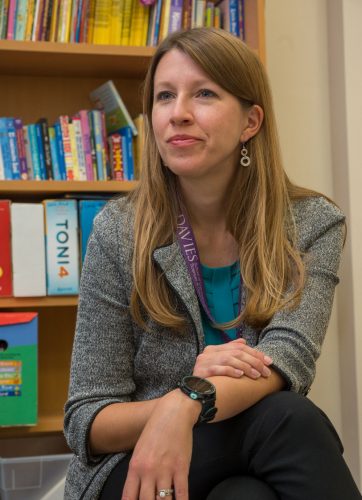
Emily Lund discusses ways to harness technology to help teach early literacy skills to children with communication disorders. Photo by Leo Wesson
“If you had asked me 10 years ago if I had any interest in thinking about the overlap of technology and language learning,” Lund said, “I would have said, ‘No, not interested.’ ”
Modern media often gets a bad reputation for causing developmental delays in young children, but Lund, an associate professor at the Davies School of Communication Sciences & Disorders, sees the opportunity for children to learn vocabulary and language skills in an entertainment context.
“I think it is really easy for television and technology to be demonized, especially in child development literature,” said Lund, also associate dean for research at the Harris College of Nursing & Health Sciences. “I started getting interested in how it can be harnessed and used.”
Lund partnered with Jean Rivera Pérez, an assistant professor in the Davies School, on two projects involving technology and language learning. Puerto Rico native Rivera Pérez said he intends to develop resources for Spanish-speaking and bilingual children with language disorders. “I decided to [better support] the Spanish-speaking Latinx community in the United States with research that feeds the needs of this population.”
Together they developed an app called Leyendo en Casa (Reading at Home) that English-speaking speech-language pathologists may use to educate parents in techniques to promote Spanish to their children with language disorders.
The professors then joined forces to investigate how technologies such as television programs or reading apps can help children who are learning a second language while also developing their native language. An indicator of how well children learn a language is the number of vocabulary words they are exposed to during their early years.
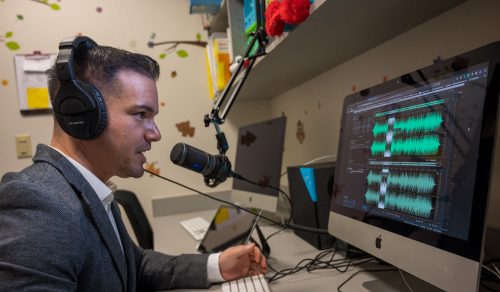
Jean Rivera Pérez investigates the use of technology in helping children learn a second language and expand their native tongue. Photo by Leo Wesson
The professors’ 2021 paper published in the Journal of Children and Media analyzes popular bilingual children’s television programs to determine which shows use educational strategies proven to help children learn words. Co-author Rachel Hart ’19 helped design a study using a coding system to analyze episodes of Dora the Explorer; Go, Diego, Go!; Maya & Miguel; Handy Manny; and Nina’s World.
School-age children learn approximately 3,000 to 4,000 new words a year through explicit cues, such as direct definitions, and implicit cues, such as visual images. Dual-language learners often speak different languages at home and in school, making it difficult to encounter enough words to promote both languages. They need additional exposure to both languages.
Hart, who recently earned a master’s degree in speech and hearing sciences at the University of North Carolina, Chapel Hill, transcribed the episodes and analyzed them for explicit cues, contextual cues and implicit cues. The goal was to determine which programs used the most effective instructional tools.
They scored Dora the Explorer and Go, Diego, Go! the best in terms of educational potential. Both programs used known vocabulary-learning techniques such as pausing to allow children to repeat a word or inserting a word in a jingle. The shows also incorporated cultural context, which Lund and Rivera Pérez said is an important part of learning a language.
A forthcoming paper from Lund and Rivera Pérez will investigate whether a language and literacy app based on discussion strategies can help Spanish-speaking parents teach their children language skills in Spanish and English.
While they wait for results, the professors said parents don’t need to feel guilty about encouraging a little screen time. “Obviously, everything in moderation,” Rivera Pérez said.
Lund said that TV allows for broad experiences and thus exposes children to more vocabulary. “Television is a great vehicle for expanding our world knowledge on all kinds of things and for using linguistic structures that I don’t typically use in my day-to-day interactions.”