TCU’s theatre program is known nationally for being very selective; most of the 16 to 20 incoming BFA students each year are recruited through national auditions, and the overall acceptance rate is less than 7 percent. Every theatre student who comes through the program has the talent to succeed as a professional performer.
Moderator Harry Parker ’80, professor of theatre, interviewed John Devereaux ’12, Jackie Raye ’16 and Alison Whitehurst ’12 about how a TCU education led to professional theatre success.
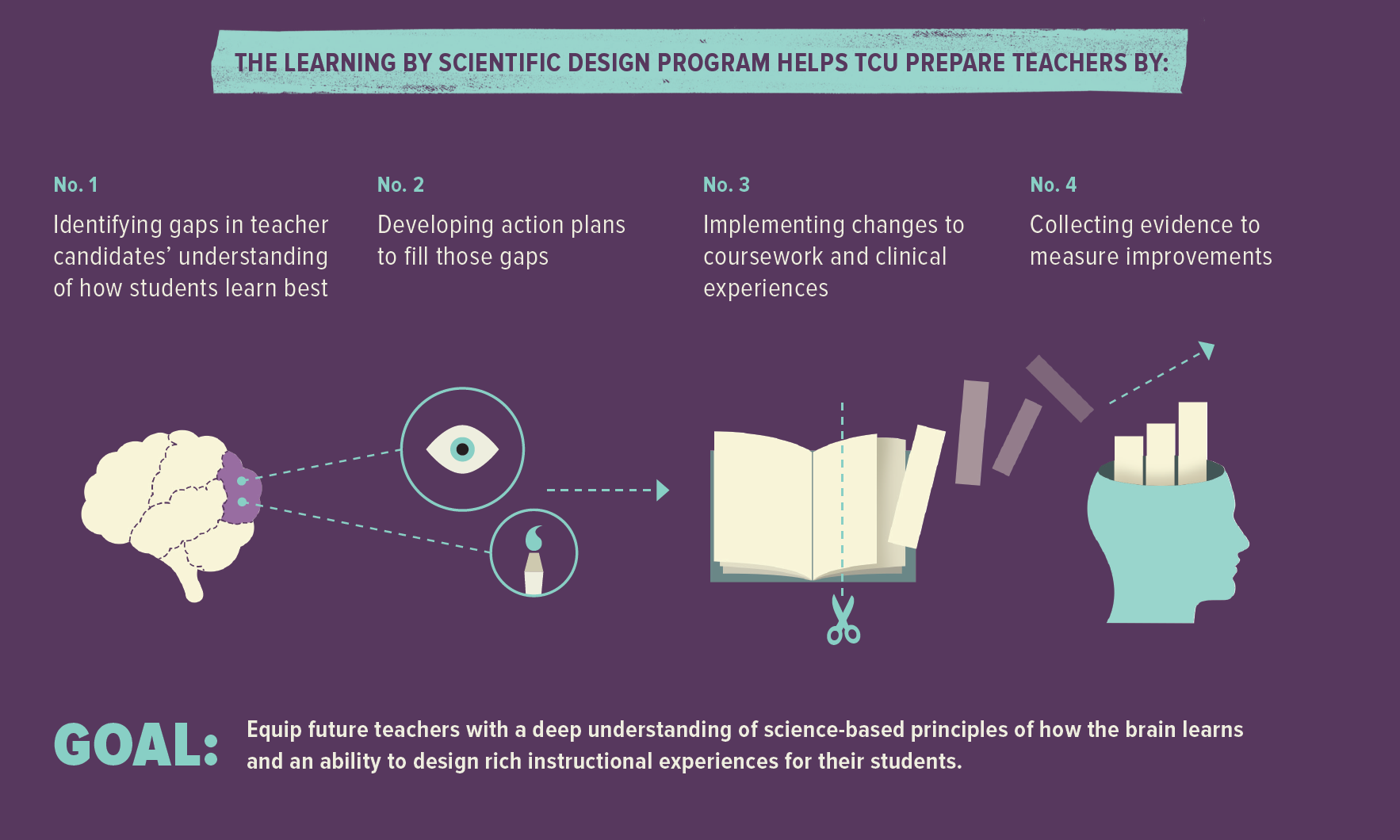
In 2020, TCU joined Deans for Impact, a national organization that aims to improve student learning by transforming the way educators teach. In 2021, College of Education faculty implemented the organization’s Learning by Scientific Design program, which disseminates evidence-based teaching strategies aimed at upgrading the ways universities prepare future teachers.
To begin, TCU faculty gauged their students’ knowledge of the principles of how people learn by analyzing results of assessments given to students pursuing careers in education. The professors then integrated these principles into junior- and senior-level teacher education classes. The improved pedagogy allows students preparing to be teachers themselves to practice research-based methods of delivering information to their own students.
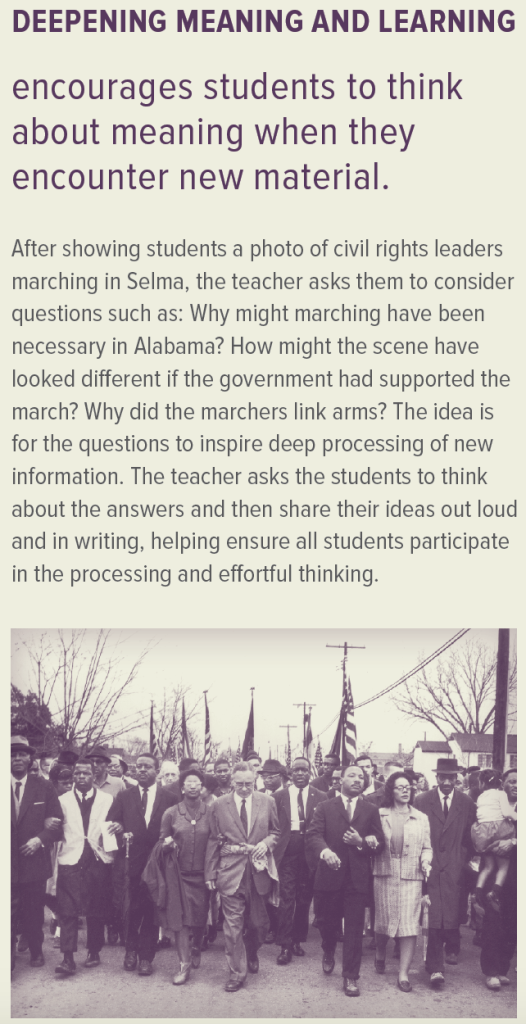
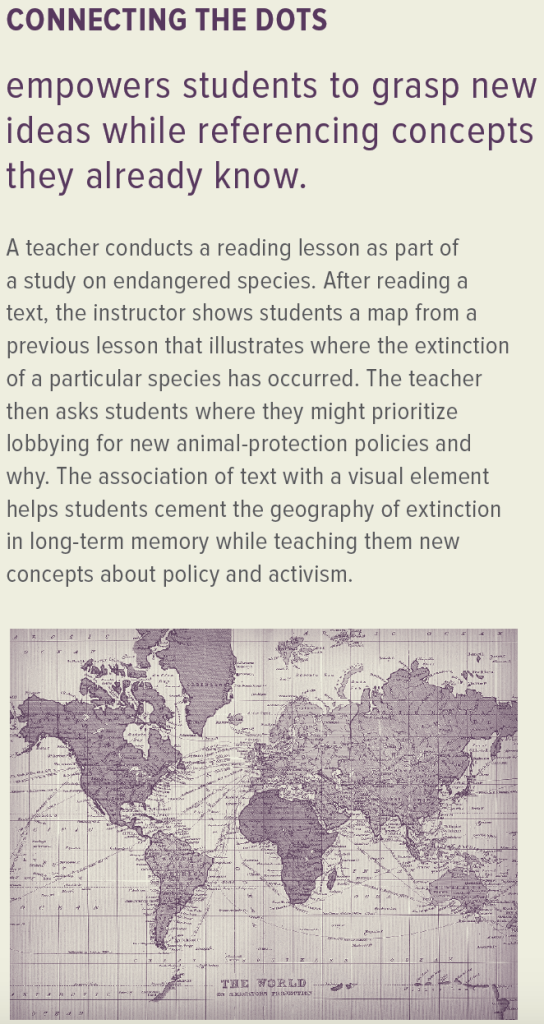
TCU IS FOCUSING ON TWO PRINCIPLES OF LEARNING BY DESIGN:
“As our teacher candidates transition to their roles as teachers of record, they will make hundreds of micro- and macro-instructional decisions about student learning. It’s critical that those instructional decisions are grounded and informed by the best scientific understanding of how we learn. We also believe that our teacher candidates will design more successful learning experiences for their own students if they incorporate principles of learning science into their instructional decisions.”
Frank Hernandez, dean of TCU’s College of Education
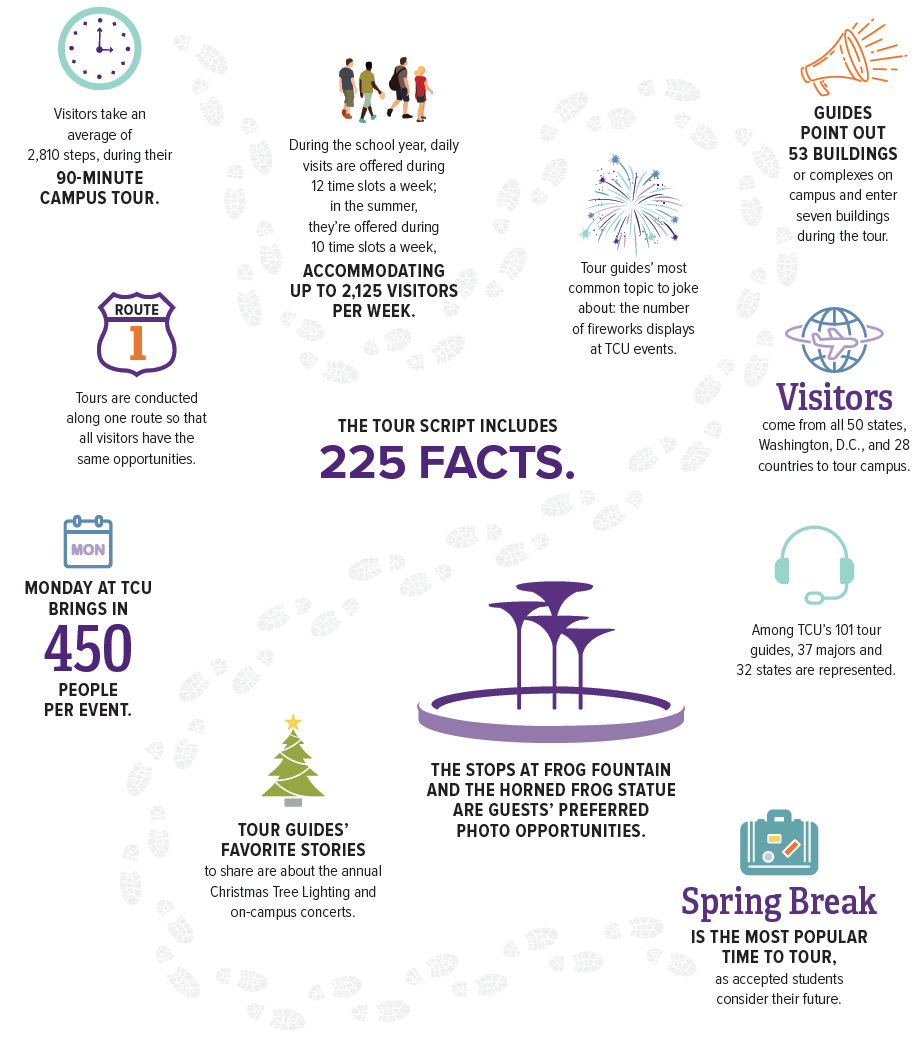
Seeing the iconic TCU brick in person and walking through the Campus Commons for the first time can be magical moments for prospective students and their families.
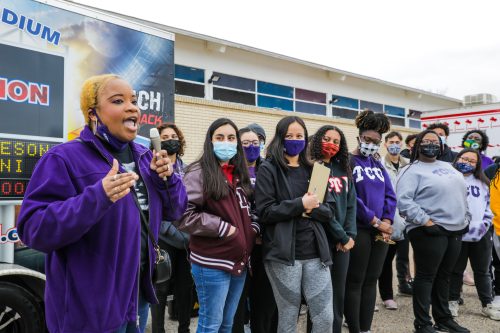
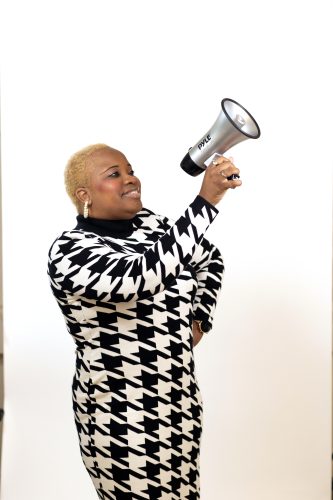
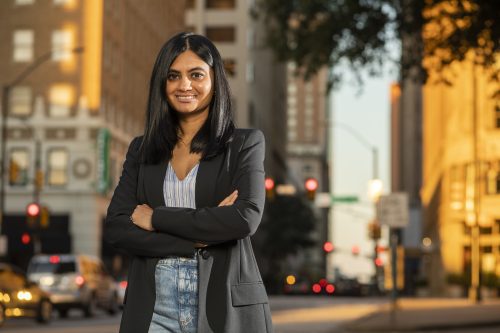
Timeka Gordon ’21 EdD, director of the Intercultural Center and Student Identity and Engagement, describes herself as a woman of faith who is passionate about helping people become the best version of themselves. Also director of TCU’s Community Scholars program, she facilitates the funding of full academic scholarships to students in Tarrant and Dallas counties. During her time on TCU’s staff — 14 years and counting — she earned a doctorate in higher education leadership.
Growing up, how important was education to you and your family?
My parents always instilled in me the importance of education. And they said that to all my siblings; we were expected to earn a bachelor’s degree. I was the first in my family to earn a master’s degree, and I am the only person in my family to earn a doctorate. So, I think that came as a surprise. But I wanted to show my nieces and nephews what was possible, and my parents supported me 100 percent. As a woman of color, they knew that I needed it to be taken seriously and to be given opportunities and have doors open for me.
You are a proud member of the Alpha Kappa Alpha sorority. What inspired you to join?
What first piqued my interest in joining a sorority was growing up watching A Different World. And I remember seeing Spike Lee’s Skool Daze. So that was my first awareness of it, even though my parents are Greek. My dad is an Alpha Phi Alpha and my mom was a part of an auxiliary group known as Alpha Angels. The creation of historically Black fraternities and sororities was a result of Black people not being able to join white fraternities and sororities in college. The women that I looked up to — the majority of them were Alpha Kappa Alphas. And so that’s how my interest in Alpha Kappa Alpha came to be.
The MLK on Main Street Committee selected Timeka Gordon, left, as a recipient of the 2021 MLK Stone of Hope Award. Photo by Amy Peterson
You published Beta Mu Omega: Where the Best Begins, over 75 Years of Timeless Service in 2013. Why did you write a book highlighting your sorority?
At the time, I was serving as the historian and archivist for the Beta Mu Omega chapter, the graduate chapter here in Fort Worth, of Alpha Kappa Alpha Sorority, Incorporated. Our international president wanted all chapters to write a history book. I was afraid, but I stepped into the fear. I said, “OK, I need some coconspirators” — Deidra Turner ’96 who, at the time, I worked for her husband, Dr. Darron Turner ’87, and then Paige Zinsou Ruiz ’11, who was a Community Scholar and had joined Alpha Kappa Alpha here at TCU. The three of us co-authored that book. At the time, our chapter was celebrating right around 75 years here in the city of Fort Worth. We divided up 25 years apiece, and we did the research. We talked to so many people, unearthed so much history on the impact that our chapter has had here in Fort Worth. It has inspired me to write more books in the future. I’m in the process of updating that history; I’ll be doing a second edition of that book, as well as sitting down and crafting my own book. Writing that history book also gave me the confidence to write my dissertation.
When did you first realize you had a passion for helping others get a college education?
Growing up, I was like the resident therapist in my friend group. But I think it was when I was an undergraduate at UT Arlington and I wanted to leave. I wanted to go to a HBCU [historically black college or university]. Although I had grown up in predominantly white or mixed neighborhoods, I struggled with a sense of belonging in that first semester. My mentor, Mr. Zeb Strong, was what I needed. That made me say, “I want to be him for folks that look like me.”
As director of the Intercultural Center and student identity and engagement, what is the most pressing issue?
In 2023, we still have students coming here who feel like they wouldn’t be welcomed here, or they wouldn’t be supported here. And you know that that is a huge task and undertaking, but I see the possibilities. I’m willing to put in the work, and I want the students and the TCU community as a whole to put in the work.
Are you nervous entering white spaces as a Black woman?
The reality is, before I even open my mouth, I am a Black woman with natural hair; sometimes I wear a weave, a wig, braids. And I’m outspoken, respectfully. I have earned the right to speak up. I have earned the right to hear my voice. I have earned the right to say that I know what I’m talking about. I have earned the right to say that my experiences and my life and those who look like me — and don’t look like me — that we matter.
I want to have a seat at the table among everyone else. And I want to be able to be heard, to know that what I say matters and is being considered and thought about, and that if I bring good ideas and things of value to the table, you will listen and implement. And I am good enough because God made me good enough. And my experience and my degrees have qualified me. When I show up as my authentic self, I’m giving you 100 percent; I am fully committed. And when I know that people are invested in me as my authentic self, then it’s a win-win for the both of us.
How can allies help?
“Speak up when you know things are being said and done to the detriment of the Black women that you call yourself a friend of, and then listen when we tell you that we’ve had these experiences.” – Timeka Gordon | Photo by Carolyn Cruz
Speak up when you know things are being said and done to the detriment of the Black women that you call yourself a friend of, and then listen when we tell you that we’ve had these experiences. Believe us when we tell you that we’ve been mistreated, or someone has said something disrespectful. Many times, what happens is colleagues, friends will hear it and see it and won’t call it out in the moment, but then want to text and call me afterwards. That’s not allyship; that’s not true support. Do it right then and there.
What does the Community Scholars program mean to you?
The Community Scholars program means everything to me; they are the reason I came to TCU. I was able to use my experiences as a person of color at UTA who lost her scholarship. When I first got here, if you made a mistake, you automatically lost it. It took a couple of years; I convinced the administration to allow me to say, “OK, if a student makes a mistake, can we reconsider? Can we give them another chance, put them on probation?” I’ve seen what the program has done for the students that have matriculated. And hands down, it has been life changing. I’ve loved the careers that they’ve gotten and the families that they’ve created.
When you’re in the process of selecting new Community Scholars, what are you looking for?
I look beyond the GPA and the class rank because TCU admissions looks at all of that. I look at the story: How will it change that student’s life? What sort of adversity have they had, and what has gotten them to this point? I’m looking for fighters, people that have been knocked down and can get back up, because this is not going to be easy. I’m looking for folks that understand that this is more than just a scholarship; the legacy of this program, and coming to an institution like TCU, it’s bigger than them. Do they want to be a part of the story?
How has the Community Scholars program surprised you?
What has surprised me is the number of Community Scholars that have gone on to earn doctorates. I’ve seen this number grow in the 14 years I’ve been here; I’m extremely excited. Some of the graduate programs that they’re going into are at Brown University and Harvard. The second thing is the increased number of Community Scholars studying abroad who had never left the state of Texas or the country. I know what it’s like to be counted out or not seen as valuable because of the color of our skin. But they are showing TCU and Fort Worth Black excellence, Latinx excellence, Asian excellence and Native American excellence.
How did it feel the first time a high school student cried in your arms upon hearing that they received a full scholarship?
I got really emotional. I pray to God before every notification, that he covers those that are not able to be awarded the scholarship and that God opens the door for them. And then I pray for those that we do have the opportunity to offer it to, and that they experience success and support. But the first student that cried in my arms, it was deep — I still remember to this day. I’m still in contact with the student years later, and he’s doing amazing things. But it just solidified for me why I’m here, why I’m doing what I’m doing.
What legacy would you like to leave?
The legacy I hope to leave is one that people can hear my name or look at a picture of me and say that I left everything that God put in me — I left it out here. It wasn’t about me; it was about trying to help other people. Whether that is in helping them succeed and accomplish a goal that they have for themselves to knowing that they are loved, seen, valued and heard.
Editor’s Note: The questions and answers have been edited for length and clarity.
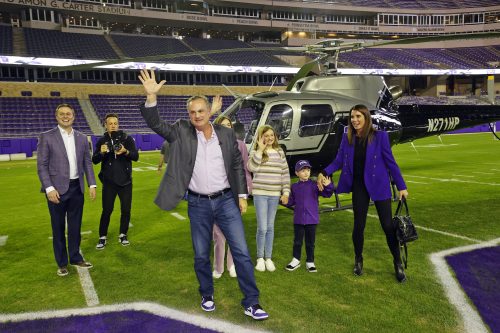
Nov. 29, 2021: Sonny Dykes is introduced as TCU’s new head football coach. The Dykes family flies into Amon G. Carter Stadium via helicopter.
The Dykes era at TCU started in grand fashion in November 2021. Courtesy of TCU Athletics | Ellman Photography
March 22, 2022: Spring football practice begins. For the first time in more than 20 years, practices are regularly open to the public.
Aug. 1, 2022: Fall camp opens. An intense competition for the starting quarterback role unfolds; Chandler Morris wins the job right before the season kicks off.
Sept. 1, 2022: The Carter Boys TV show debuts on ESPN+. The weekly show features game recaps, student-athlete interviews and more behind-the-scenes footage as the season unfolds.
Sept. 2, 2022: The Dykes era gets underway on a beautiful night in Boulder, Colorado. TCU beats the Colorado Buffaloes, 38-13. Quarterback Chandler Morris exits with an injury; Max Duggan steps in and never looks back. Derius Davis returns a punt for a 60-yard touchdown and later earns Big 12 Special Team Player of the Week honors.
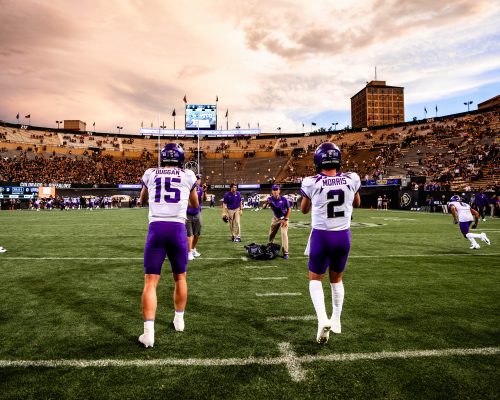
TCU quarterbacks Max Duggan and Chandler Morris warm up before the Frogs’ season-opening game in Boulder, Colorado. Morris won the starting job but was injured in the third quarter of the game. Duggan took over and went on to become the 2022 Heisman Trophy runner-up. Courtesy of TCU Football
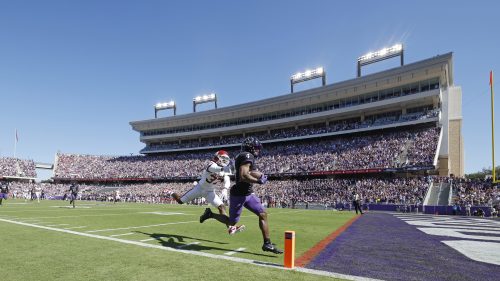
Oct. 1, 2022: TCU destroys the No. 18 Oklahoma Sooners in Fort Worth, 55-24, to move to 4-0. Dykes becomes the first TCU head football coach to win his opening four games since Francis Schmidt in 1929. The 49,094 fans in attendance constitute the second-largest crowd in Amon G. Carter Stadium history. Duggan’s 418 yards of total offense earn him Walter Camp National Player of the Week honors.
TCU receiver Taye Barber (4) scores a touchdown in the first quarter of the Frogs’ decisive 55-24 win over the Sooners. Courtesy of TCU Athletics | Ellman Photography
Oct. 2, 2022: TCU debuts in the 2022 AP Poll at No. 17, beginning a steady ascent up the season’s rankings.
Oct. 8, 2022: With ESPN’s College GameDay show stationed in Lawrence, Kansas, TCU beats the undefeated No. 19 Kansas Jayhawks, 38-31. Wide receiver Quentin Johnston nabs 14 receptions for 206 yards and later earns Big 12 Player of the Week honors.
Oct. 15, 2022: TCU outlasts No. 8 Oklahoma State in a double-overtime thriller, winning 43-40. The Frogs’ three consecutive wins over ranked opponents is a first in program history.
Oct. 16, 2022: TCU rises to No. 8 in the AP Poll, breaking into the nation’s Top 10 for the first time since 2017.
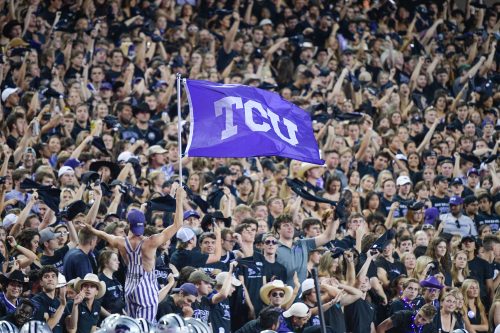
Oct. 22, 2022: The Frogs win a comeback game over No. 17 Kansas State, rallying from 18 points down to triumph 38-28. Students set an attendance record.
TCU fans wore black during TCU’s home win over Kansas State. Courtesy of TCU Athletics | Ellman Photography
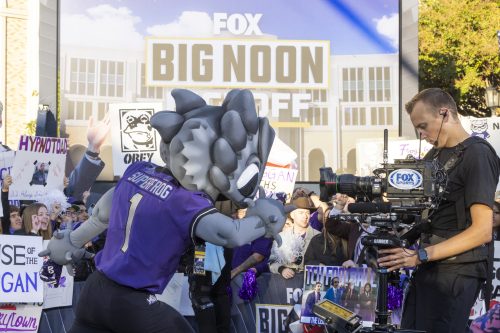
Nov. 5, 2022: With Fox’s Big Noon Kickoff show broadcasting live from Amon G. Carter Stadium, TCU beats Texas Tech, 34-24, to move to 9-0, its best record since the 2010 Rose Bowl season.
TCU hosted Fox’s “Big Noon Kickoff” show before the November win over Texas Tech. Courtesy of TCU Athletics | Ellman Photography
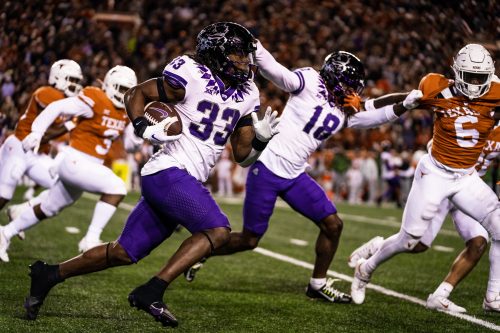
Nov. 12, 2022: With College GameDay hosting its show live from Austin, Texas, the Frogs beat Texas 17-10. Dykes becomes the first football coach in TCU history to begin his career 10-0. The Horned Frog defense holds eventual Doak Walker Award winner Bijan Robinson to 29 yards, while TCU running back Kendre Miller sprints for 138 yards on 21 carries.
TCU running back Kendre Miller (33) was pivotal in the Frogs’ November victory at Texas. Asked after the game if he was the best back in the Big 12 conference, Miller answered an emphatic “yes.” Courtesy of TCU Athletics
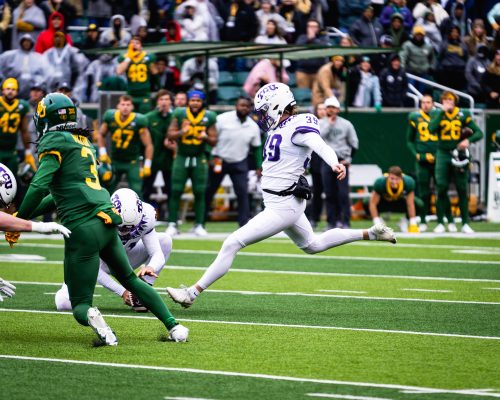
Nov. 19, 2022: TCU improves to 11-0 after beating Baylor in Waco, 29-28, thanks to Griffin Kell’s walk-off field goal. Kell earns Big 12 Special Teams Player of the Week accolades and cements his place in TCU lore.
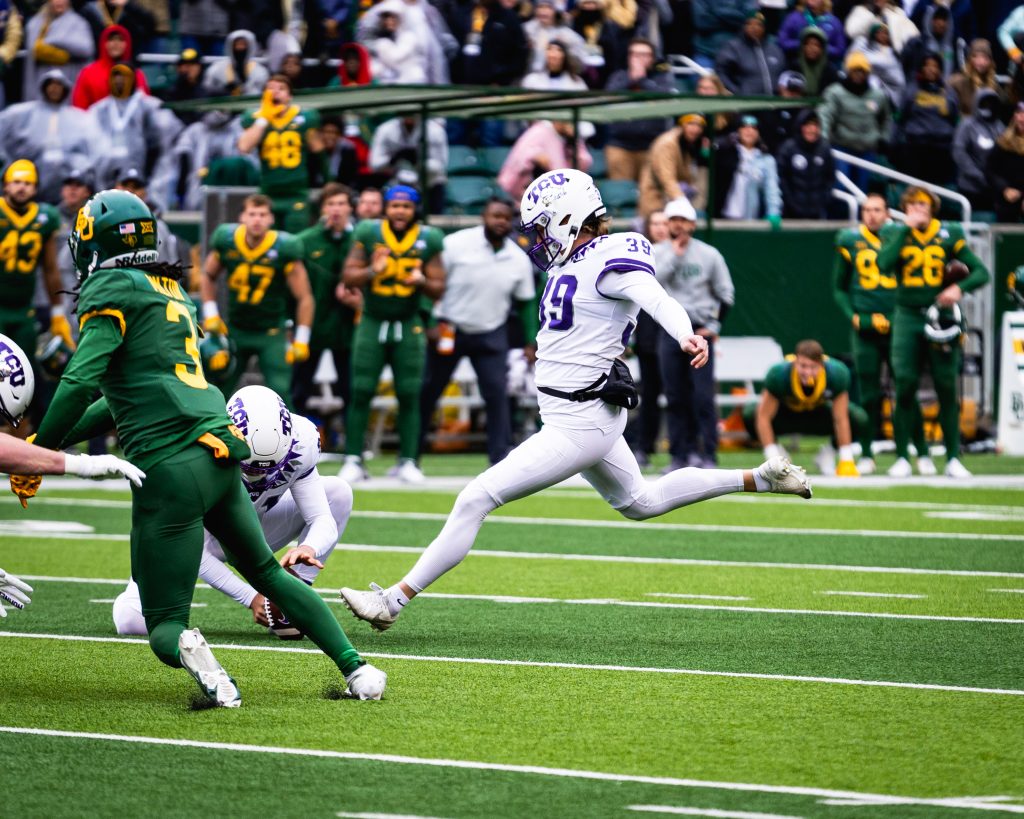
TCU kicker Griffin Kell (39) preserved the Frogs’ undefeated season with a walk-off field goal at Baylor in Waco, Texas. The successful execution of the play was dubbed “the bazooka on the Brazos.” Courtesy of TCU Athletics
Dec. 3, 2022: TCU falls in overtime to Kansas State in the Big 12 Championship game at AT&T Stadium in Arlington, Texas. Duggan leads a heroic effort to tie the game late with a 2-point conversion pass to tight end Jared Wiley.
Dec. 4, 2022: The College Football Playoff committee ranks TCU No. 3. The Frogs learn they will be the first Texas team to compete in the College Football Playoff when they will meet Michigan in the Vrbo Fiesta Bowl on New Year’s Eve in Glendale, Arizona.
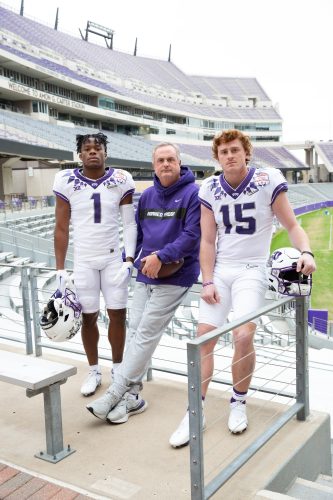
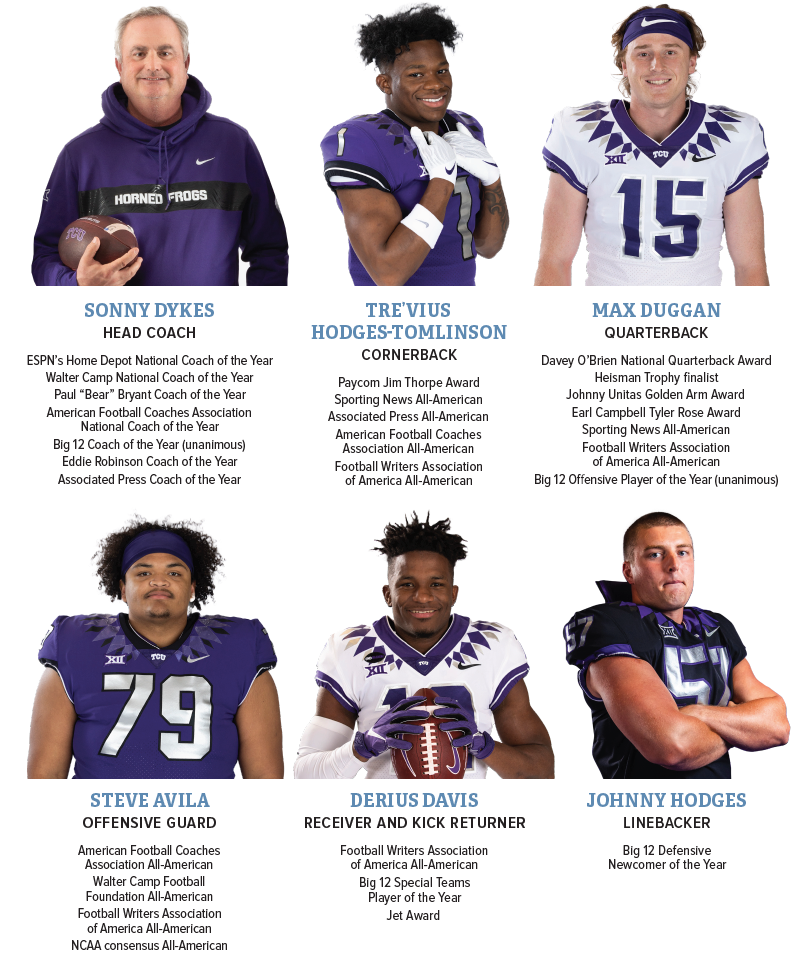
Dec. 10, 2022: Horned Frogs clean up during ESPN’s annual college football awards show. Duggan wins the Davey O’Brien National Quarterback Award and comes in second for the Heisman Trophy. Tre’Vius Hodges-Tomlinson wins the Paycom Jim Thorpe Award, given to the nation’s best defensive back. Dykes learns he is the ESPN Home Depot Coach of the Year.
TCU Football players cleaned up in the 2022 national awards. Tre’Vius Hodges-Tomlinson (1) was the second Frog in three years to win the Jim Thorpe Award. Head coach Sonny Dykes won 10 national coach of the year awards. Quarterback Max Duggan (15) won the Davey O’Brien National Quarterback Award, the Earl Campbell Tyler Rose Award and the Johnny Unitas Golden Arm Award. Photo by Carolyn Cruz
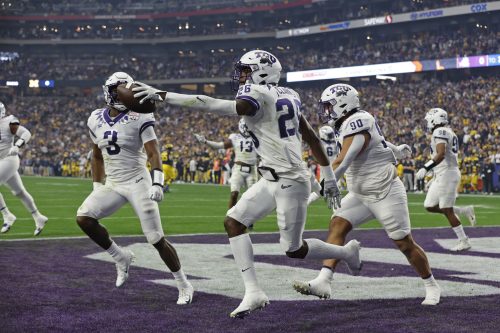
Dec. 31, 2022: In one of the most exciting and memorable games of the College Football Playoff era, TCU defeats Michigan, 51-45, in the Vrbo Fiesta Bowl in Glendale, Arizona. Two pick sixes by TCU defenders seal the heroic win. Viewership tops 21.7 million, bringing the TCU brand to center stage.
TCU beat Michigan in the Fiesta Bowl thanks in part to two pick sixes, including one by safety Bud Clark (26). Courtesy of TCU Athletics | Ellman Photography
Jan. 9, 2023: Georgia defeats TCU in the College Football Playoff national championship at SoFi Stadium in Inglewood, California. The Frogs are the first Big 12 or Texas team to play in the game. TCU finishes the season as the country’s No. 2 team.
After a February 2018 school shooting left 17 people dead in Parkland, Florida, Delta Air Lines CEO Ed Bastian decided to end the carrier’s discounted airfare program for National Rifle Association members.
“When you make a decision like that, it’s partisan and it’s public,” said Yashoda Bhagwat, an associate professor of marketing at TCU. “It’s either going to really upset your stakeholders or really please your stakeholders.”
Bastian’s decision satisfied some of the public outcry from people worried about gun ownership and its links to violence.
But then legislators in Georgia, the home state of Atlanta-based Delta, rescinded the carrier’s estimated $40 million tax break. NRA supporters threatened boycotts.
“I knew there would be backlash, but I didn’t anticipate the strength of the backlash from the NRA movement,” Bastian told Fortune magazine that August.
What if Delta’s corporate leaders had been able to predict investor and customer reaction — and its price tag — before making that decision on the discount program? How might Bastian have altered the delivery of his policy if he had known of the imminent fallout?
Bhagwat answered questions such as those in her award-winning paper “Corporate Sociopolitical Activism and Firm Value.” Her research is the first to examine the financial consequences of corporate sociopolitical activism, which she defines as the public demonstration of support or opposition to a partisan issue.
Take, for example, Nike’s support in fall 2017 for NFL players who knelt during the national anthem in protest of police brutality. In contrast, John Schnatter, CEO of Papa John’s Pizza, criticized NFL leadership for allowing the kneeling. The pizza chain found itself in the middle of a hot sociopolitical issue. A month later, Schnatter stepped down as chief executive of the company he founded.
“In the past, companies donated silently to political parties and then publicly participated in nonpartisan activities,” Bhagwat said. “But what’s the overall effect of them now publicly donating and getting involved in partisan issues? Investors, on average, don’t seem to like it.”
Leading a team of marketing researchers from around the country, Bhagwat analyzed 293 corporate sociopolitical actions initiated by 149 firms across 39 industries.
The scholars’ resulting Journal of Marketing paper won the 2020 H. Paul Root Award from the American Marketing Association and the Marketing Science Institute.
Awards are nice, but the research, if heeded, could help companies protect their brands and add shareholder value.
Off the Fence
Bastian represents a new breed of CEO who is somewhat forced to take a stand.
“We have found that consumers notice and react to firm silence when other firms in the same industry — competitors — engage in activism,” Bhagwat said. “They also notice when firms are silent on particular issues when they engage in activism on other related issues. In other words, consumers want consistency.”
Her ongoing research indicates that some consumers were angry at Nike for taking a stand on Black Lives Matter but remaining silent on protests in Hong Kong.
“We have found that consumers notice and react to firm silence when other firms in the same industry — competitors — engage in activism.” – Yashoda Bhagwat | Photo by Rodger Mallison
More than three years after the Parkland shooting, Bastian is reflective but unregretful. “Growing up in the business world, you’re generally taught to keep your head low and make sure you don’t land on the front page,” he said in a 2021 Fast Company article. In the last five years, “the level of the divisiveness in our society has actually elevated corporate leaders to a higher position of credibility in the public’s eye.”
Ed Stewart, assistant vice president for communications and marketing at DFW International Airport, knows Bastian well. From 2008 to 2010, Stewart was Delta’s managing director of external corporate communications.
Stewart said today’s CEOs are in a tough position because they’re often left with little choice but to respond to social unrest. Stewart cited examples of how his leadership team responded to airport employees after the disturbing video of George Floyd’s 2020 murder. Those efforts included the leaders holding listening sessions on race relations.
“It’s hard to tell your eyes you didn’t see what you thought you saw,” Stewart said. “Now you’re in a situation where you have to address the obvious elephant in the room that’s always been there. And you can’t sugarcoat it; you can only call it what it is.”
Stewart was in a far different climate when he started managing corporate messaging in 1990 as chief spokesperson for Southwest Airlines. Although he dealt with an outspoken CEO, the legendary Herb Kelleher, Stewart said today’s environment is trickier. Kelleher, a product of a bygone era, was known for his love of Wild Turkey whiskey and for lighting up cigarettes in public places,regardless of no smoking signs.
“Investors today are especially attuned to CEO personalities, but I believe they are becoming more used to big personalities and CEOs using their platforms to comment on social issues,” Bhagwat said. “I think how Kelleher would fare in today’s world would largely depend on how his views aligned with his customers’ views.”
Inherent Risk
Corporate sociopolitical activism involves potentially offending the personal values of at least some of a company’s customers, employees and lawmakers. On the flip side, Bhagwat said, activism can boost sales and build a brand by reflecting buyers’ core values.
Bhagwat’s team found that investors generally see corporate sociopolitical activism as risky; investors said outspoken, politically charged stances can jeopardize cash flows and may divert the firm’s efforts from activities that maximize shareholder value.
The researchers also found that it matters if a company’s actions deviate from the values held by customers, employees and lawmakers as well as from the firm’s brand image.
For example, Starbucks tends to attract customers on the progressive side, whereas Chick-fil-A customers lean toward the conservative. If those corporate leaders take a stand that goes against brand image, customers likely will penalize them.
Consider the backlash that Target Corp. faced when the retail giant announced an inclusive restroom policy for its 1,800 stores in support of transgender individuals. Target’s decision was spurred by a North Carolina law requiring people to use the restroom corresponding to their gender assigned at birth. Target announced in April 2016 that it would be sympathetic to transgender concerns.
Within months, the American Family Association, a conservative Christian advocacy group, collected over 1 million online signatures in a pledge to boycott Target.
Target faced an immediate dip in sales revenue in second quarter 2016.
Cathy Smith, Target’s chief financial officer, hit the media circuit to assuage investors’ fears. “Some of our guests clearly are uncomfortable with our policy, and some are supportive,” Smith said in an August 2016 National Public Radio story.
In response, Target announced it would spend $20 million to build more single-stall restrooms that can be locked for privacy.
Commitment Level
Bhagwat’s research found that investors watch a company’s commitment of time, capital and attention devoted to speaking out on politically charged issues, such as racial injustice, gun rights and gender identity.
After former President Donald Trump placed a hold on allowing refugees from Syria and six other Muslim-majority countries into the United States, Starbucks CEO Howard Schultz announced that the company would hire 10,000 refugees within five years.
While most corporate bosses stayed silent on the issue, Starbucks’ sociopolitical activism went beyond a statement to an actual hiring commitment. The world’s largest coffee chain quickly faced a firestorm on social media. In response, Schultz said the company would speed up a previous commitment to hire more veterans and military spouses.
Bhagwat’s team found that investors also notice who announces an activist stance, whether it’s an outspoken CEO or a lower-level spokesperson.
Investors also watch whether the stance promotes a business interest and whether the company is going it alone versus joining a chorus of other businesses.
If a company is the lone voice on an issue, offended customers are more likely to switch to competitors. But there is safety in numbers.
Competing Interest
Some corporate activism events proved harder to classify, Bhagwat’s research revealed. Overlapping factors sometimes create a public relationsquagmire. For example, a manager of a company such as Whole Foods might feel pressured to engage in liberal-oriented activism to appease a liberal-leaning customer base but also fear retaliation from a conservative legislature like Texas’.
“AS A SOCIETY, WE HAVEN’T SEEN THIS TYPE OF ENTHUSIASM AMONG STUDENTS SINCE PROBABLY THE LATE 1960S. STUDENTS ARE COMING TO CLASSES BELIEVING THEY CAN MAKE A DIFFERENCE BEYOND THEMSELVES AND BE A FORCE FOR GOOD.” Daniel Pullin, TCU President
Bhagwat’s team found that investor reaction is generally adverse when a sociopolitical action offends at least two key stakeholder groups. Her research could be used for predictive modeling to determine whether a proposed sociopolitical action is worth the likely fallout.
Bhagwat’s team singled out J.C. Penney’s 2011 hiring of CEO Ron Johnson from Apple, known for a highly progressive corporate culture. Johnson’s approach clashed with the conservative values of J.C. Penney’s stakeholders.
“Under Johnson, J.C. Penney invested in same-sex partner advertisements for Mother’s and Father’s Day in 2012,” Bhagwat’s research paper reported. “In April 2013, J.C. Penney finally accepted its ‘strategic mistakes’ after the free fall of its stock value and fired Ron Johnson.”
Bhagwat said the tension between shareholder value maximization and social responsibility is not new. Investors want to make money. Any deviation from a plan to get them the most return — no matter how noble the cause — raises eyebrows. However, because of its partisan nature, activism increases the risk for investors beyond the traditional corporate social responsibility role.
Building a Compass
Sociopolitical issues exist at the intersections of time, politics and culture, and the controversy surrounding them can evolve or resolve over time. Put another way, today’s sociopolitical issues might very well become tomorrow’s noncontroversial social responsibility efforts. To illustrate, the idea of universal women’s suffrage was contentious 100 years ago but became widely accepted in the United States.
Julie O’Neil, professor and associate dean for graduate studies and administration in the Bob Schieffer College of Communication, has spent years studying the impact of corporate social responsibility efforts. Over the last 10 years, she said, customers have increasingly demanded that brands do more than just make profits.
“People expect companies to get involved,” O’Neil said. “They’re saying that it’s not just the role of government to solve some of our big societal issues and problems, but the companies have a responsibility as well because they have big pocketbooks and deep areas of expertise. That expectation has shifted.”
Before engaging in a social project seemingly unrelated to the core business, companies should conduct an accountability and authenticity gut check, she said. “The CEO or someone in the company needs to ask, ‘Does this issue — whether it’s racism, the environment or women’s rights — does it align with the mission, purpose or values?’ ”
She cited Patagonia, the designer of outdoor clothing and related gear, as an example of a brand whose environmental activism matches its mission, purpose and values. Patagonia sponsored an online petition opposing the Dakota Access Pipeline, pointing to climate concerns and harm to working-class communities near the pipeline.
Daniel Pullin, TCU’s president and the former John V. Roach Dean of the Neeley School of Business, said the topic of corporate sociopolitical action is motivating students. Today’s business students are in a position to shape how corporate leaders respond to social issues, he said.
“As a society, we haven’t seen this type of enthusiasm among students since probably the late 1960s,” Pullin said. “Students are coming to classes believing they can make a difference beyond themselves and be a force for good.”
Those business students soon will be at the helm, navigating tomorrow’s complicated seas of moral obligations, societal pressures and fiduciary responsibilities. Bhagwat’s research is an award-winning guide to creating those capable leaders.
Housed on the first level of the Brown-Lupton University Union, TCU’s 1-year-old Intercultural Center has become a safe haven and community-building space for people of all cultures, identities and backgrounds.
The design may be new, but TCU students have been envisioning an intercultural center for decades.
THE CENTER PROVIDES A SPACE WHERE “STUDENTS ARE WELCOME TO BE THEIR AUTHENTIC SELVES WHILE ALSO APPRECIATING AND VALUING OTHERS’ ABILITY TO DO THE SAME.” Timeka Gordon
“Just to have a dedicated space on campus for students of color, LGBTQ+ students and international students — it says a lot because it’s a safe space for cultures that are not always represented,” said Shelby Johnson ’20 (MEd ’22).
Trung Nguyen ’21 EdD, a former assistant vice chancellor for student identity and success, said that when students became vocal in the last decade about building a more inclusive culture at TCU, administrators looked at how they could improve the college experience for everyone.
Student requests in 2015 led to construction of pillars in Worth Hills for the National Pan-Hellenic Council, which oversees Black fraternities and sororities. In 2016, other students issued a list of demands to administrators that included online sensitivity training for all campus constituents; a diversity, inclusion and belonging training module is now required for all faculty and staff.
Also in 2016, Nguyen said, social media activism further emphasized to TCU leaders the students’ desire to have a more inclusive campus culture and infrastructure.
In 2020, TCU held campus listening sessions to give the floor to students from historically marginalized and underserved groups.
“There was a lot of social unrest amongst the student body,” Johnson said, “and so we really wanted to do something about it.”
Chancellor Victor J. Boschini, Jr. embraced the request and tasked a vision committee with finding a place for it.
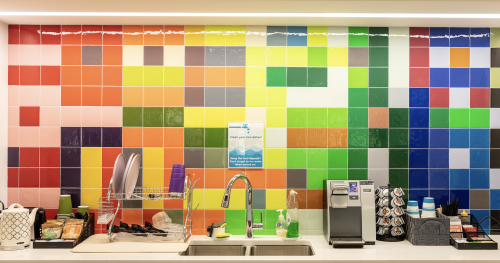
The kitchen area includes a colorful backsplash mosaic representing the colors of international flags. John Singleton, former director of international services, proposed the idea. Photo by Vishal Malhotra
Costs and available space prohibited construction of a building. The vision committee, which consisted of 14 students and staff members, looked for a suitable compromise in a large, central spot on campus.
Johnson said that at first she hesitated to accept the decision to host the space within the university union building. “I was very much like, ‘This doesn’t satisfy the demand.’ ”
The first look at the new space changed her mind.
“I was pleased with what they did,” Johnson said. “I was happy because they were able to bring some of the demands to light through that space, and the way that they transformed that area was just beautiful.”
Nguyen said the collaborative effort was a major success. “I was really proud that I was able to be involved in a process where TCU and our students worked together to create a space that the students loved but also TCU can highlight.”
Design Details
The Intercultural Center “is committed to cultivating a campus community that celebrates underrepresented students’ identities, cultures and experiences,” according to a purpose statement written by Timeka Gordon ’21 EdD, director of the center, the Community Scholars program and Student Identity & Engagement. The center provides a space where “students are welcome to be their authentic selves while also appreciating and valuing others’ ability to do the same.”
The center houses five formal university offices: Community Scholars Program, Gender Resource Office, International Services, Student Government Association and Student Identity & Engagement.
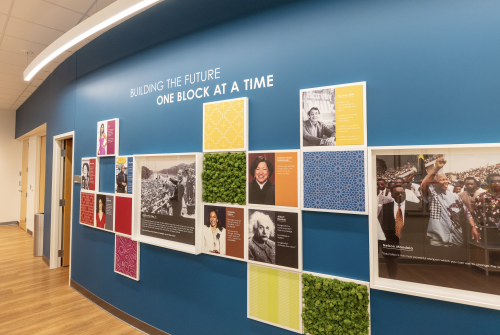
A wall in TCU’s Intercultural Center features inspirational quotes. The space’s design includes more variable colors than TCU’s traditional purple and white. Photo by Vishal Malhotra
Each aspect of the Intercultural Center, from the aesthetics to the operational components, was designed with student input.
“The spirit of the center is to make you feel at home, loved on and being in community,” Gordon said.
A kitchen features refrigerators, TVs, warming ovens, a large countertop and a backsplash mosaic representing the colors of international flags.
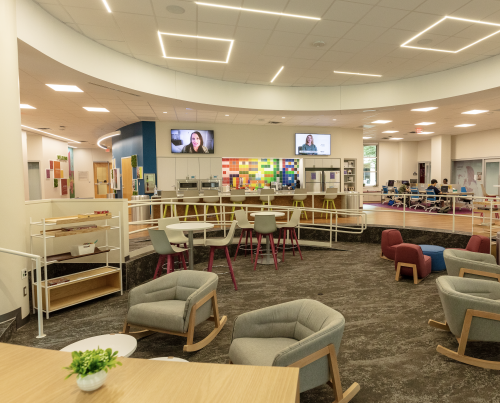
A pit area, referred to as the living room, includes movable furniture to encourage comfort and connection.
A multimedia conference room has a green screen that allows students to host meetings and create social media content.
“We got it to feel as homey as we could,” said vision committee member Mikea Jackson ’22. “I really wanted to advocate for student artists to touch the space, and obviously, their work speaks for itself.”
After construction, the vision committee noticed a huge blank wall at the center’s entrance. Jackson pushed for fellow committee member Kristian Gaytan, a senior political science and comparative race and ethnic studies major, and Brian Dickson Jr. ’22 to create artwork for the wall. The two were good friends from Fort Worth’s Young Men’s Leadership Academy, which both attended prior to TCU.
Together, Gaytan and Dickson painted the mural “The World Is Ours,” showcasing a Black woman and Mexican man; the Fort Worth skyline; a collection of colorful hands, flowers and butterflies; and the Earth.
This is the most colorful space on campus,” Gordon said. “It makes you smile and it makes your eyes get wide. All of that was intentional. Culture is about liveliness and fun and that’s what this space brings.”
A Model for Collaboration
The Intercultural Center now serves as a model to other institutions that desire similar spaces, Nguyen said. “It’s not just a representation of what TCU and students can do when working together. I think it’s a role model for higher ed across the country to show that when both sides are willing to listen to each other and work together, we can do some great things.”
During the 2021-22 academic year, the Intercultural Center had 331 reservations and 8,074 attendees.
Hosting cultural celebrations such as Día de los Muertos and Diwali, educational workshops on cultural competency, a voter registration drive and World Cup watch parties, the center has been versatile.
Jackson hopes the strong utilization of the Intercultural Center continues to keep the conversation alive regarding more space on campus.
CannonDesign partnered with TCU on the Intercultural Center, where students can study, lounge and engage. Photo by Vishal Malhotra
“I don’t think that we should stop here,” she said. “I do think there needs to be a larger space, but I do think it’s a start.”
Organizations can expect privacy in the conference room but not in the living room area. This policy encourages interaction. “The living room is reservable, but it’s an open space, meaning that if someone is sitting in there, you can’t boot them out,” Gordon said. “They’ll either naturally get up because they realize there’s a program or event happening or they’ll take a seat and engage.”
Gordon said she is interested in reconnecting with past Horned Frogs and engaging with community members who want to be part of TCU and hopes they will feel at home in the Intercultural Center.
“There are decades of students and alumni who have been challenged in their experience at TCU and had been wanting a space like this but didn’t have it while they were here,” Nguyen said. “I think we owe it to them to make sure that they feel as equally welcomed into that space as do our current students.”
One idea is to offer the center up as a tailgating spot for TCU’s ethnic and LGBTQ+ alumni affinity associations.
“Could you imagine a better tailgating spot?” Nguyen said. “Wouldn’t it be great for us to be able to partner with those alumni associations to say, ‘Hey, you want a tailgating space [away from] the heat when everyone else is out there and it’s 110 degrees?’ ”
Johnson said she’s a fan of the idea. “I feel like the more opportunities that TCU gives us as alums to come back and show support for current students, to show our Horned Frog pride, the happier I am to show up and attend.”
Jackson said the student sacrifice to establish the Intercultural Center shouldn’t be forgotten. Students worked hard while also juggling schoolwork, extracurricular activities, jobs and more.
Gaytan said he is pleased with how the center has taken shape and the mural’s role in helping create a place of inclusion. “We feel it’s had a tremendous impact on campus, and when people walk through it, they feel seen,” he said. “I feel like for us, the mission was accomplished.”
Dickson said the center is a place of refuge. “When you walk in the space, you don’t have to code switch,” he said. “You don’t have to prepare yourself to be somebody who you’re really not; you can just be yourself and just breathe because a lot of times walking on this campus, I’m very self-conscious. I’m like, ‘Who’s watching me?’ With the Intercultural Center, freedom is what I feel.”
One spring afternoon in the TCU Costume Studio, first-year musical theatre major Jess Willis was staining leather shoes black. Alex Colig ’22, who earned a BFA in fashion merchandising in May, was shaping and prepping press-on nails at one of the large, muslin-covered worktables. Two other students were labeling undergarments.
Costume Studio manager Michele Alford was overseeing their progress, flitting between her office and the main room.
While the studio is made enchanting by the people fashioning theatrical garments from everyday items — costumes begin to take shape as they’re pinned together on headless dress forms — the space itself is quite ordinary. It used to be a pizza parlor; the plain, windowed storefront in a small strip mall off West Berry Street could be mistaken for it still.
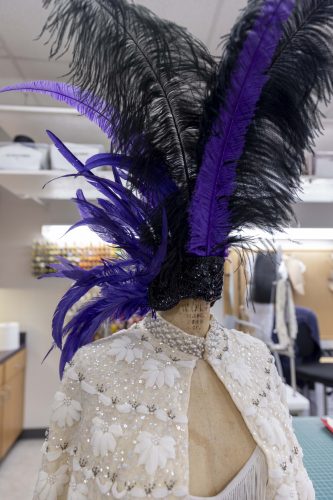
Down Greene Avenue, two old brick houses serve as the studio’s stockrooms, filled with vintage clothes, costumes, hats, wigs, shoes and patterns.
The studio is at a different end of campus than Ed Landreth Hall, which houses theatre classes as well as the performance venues where the completed costumes are needed.
“[We] joked that we need one of those old-fashioned railroad things … with the two people pumping,” said Alford, who had expertise in the fashion industry and as a theatre stitcher and dresser before she took the role with TCU in 2002.
Pinned-up inspiration boards in the back of the studio serve as a guide. In this case, they charted costumes for The Wild Party, a vaudeville musical based on the 1928 poem by Joseph Moncure March. The story follows a passionate couple, Queenie and Burrs, whose relationship falls apart. They decide to host a party with a cast of over-the-top characters; the evening descends into debauchery.
Hannah Le Beau takes the stage as Madelaine True in Theatre TCU’s production of “The Wild Party,” wearing a design created by the TCU Costume Studio for the spring 2022 show. Photo by Jill Johnson
Traditionally, characters in the musical have been dressed in elegant 1920s attire reminiscent of The Great Gatsby, but the TCU team reimagined the costumes.
“They’re vaudeville performers on Broadway in New York. They probably live in a big warehouse or apartment somewhere off Midtown,” said Murell Horton, associate professor of theatre. “And so, we’re just sort of like, ‘Shouldn’t they be clowns and acrobats and magicians?’ ”
Horton is the costume designer and mentor to student designers in the department. “I’m a storyteller first,” said Horton, an award-winning costume designer who worked for more than 25 years in New York.
Costume design begins with historical research, sketches and inspiration pieces pulled from stock or from stores. The next stage is fittings.
In the costume fitting for Queenie, portrayed by Annie Cahill ’22, Horton and Cahill, who earned a BFA in musical theatre in May, considered a corset top paired with a metallic gold fringe skirt sourced from the Anthropologie clearance rack.
“Now I didn’t want to give Queenie jewelry because of all the violence and stuff. … I didn’t want any of it to get tugged off,” Horton said, noting that the character is in an abusive relationship. The purpose of fittings is to study the actor’s movement in the clothing, Horton said. The designer and performer also assess which pieces need to be rigged for easier changing.
Collaboration
Students make up a large part of the studio’s rotating cast. “A lot of myfriends work here. We talk drama, we talk shop, we talk about life,” said Willis, now a sophomore. Most of the students who work in the studio are involved in theatre in some other capacity as well, whether in the classroom, on stage or backstage on the tech crew.
Alford said that she often asks the students how they feel about goings-on in the theatre department, such as how a post-mortem — an evaluation of the show’s run — went. It’s very democratic. “I’ve worked in some very toxic environments, especially in fashion. I’m in charge of the tone of the space,” Alford said. “And I’m not going to let it be a toxic work environment.”
D’Mariel Jones was a lead designer for “The Wild Party.” He also played one of the D’Armano brothers in the show. Photo by Jill Johnson
D’Mariel Jones ’22, who earned a BFA in musical theatre, was one of the lead designers for The Wild Party. He also played one of the D’Armano brothers in the show; the siblings are composers and entertainers. Though Jones intends to pursue performance and directing, his interest in fashion drove him to the studio.
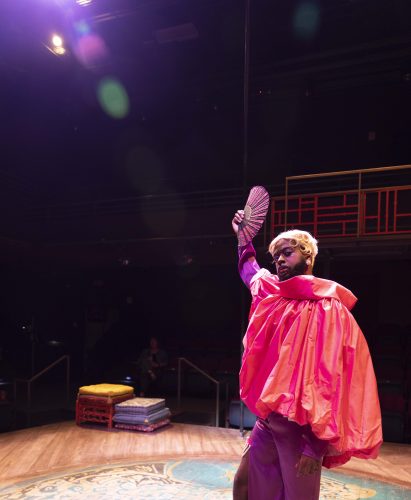
The costumes for the six characters he oversaw included vibrant colors, feminized suits and just “the craziest things imaginable.” For his character, Jones designed a pair of purple trousers and a matching purple jacket worn over a corset with a peplum; he completed the ensemble with heeled white boots and a ruffled pink cape.
“The fun thing about this show is that everything kind of goes,” Jones said.
Mission of Reuse
The studio has made reducing waste part of its mission. In 2018, theEPA estimated that the textile industry produced 17 million tons of materials, with only 2.5 million tons being recycled. The studio’s efforts include shopping at estate sales and making use of items already on hand.
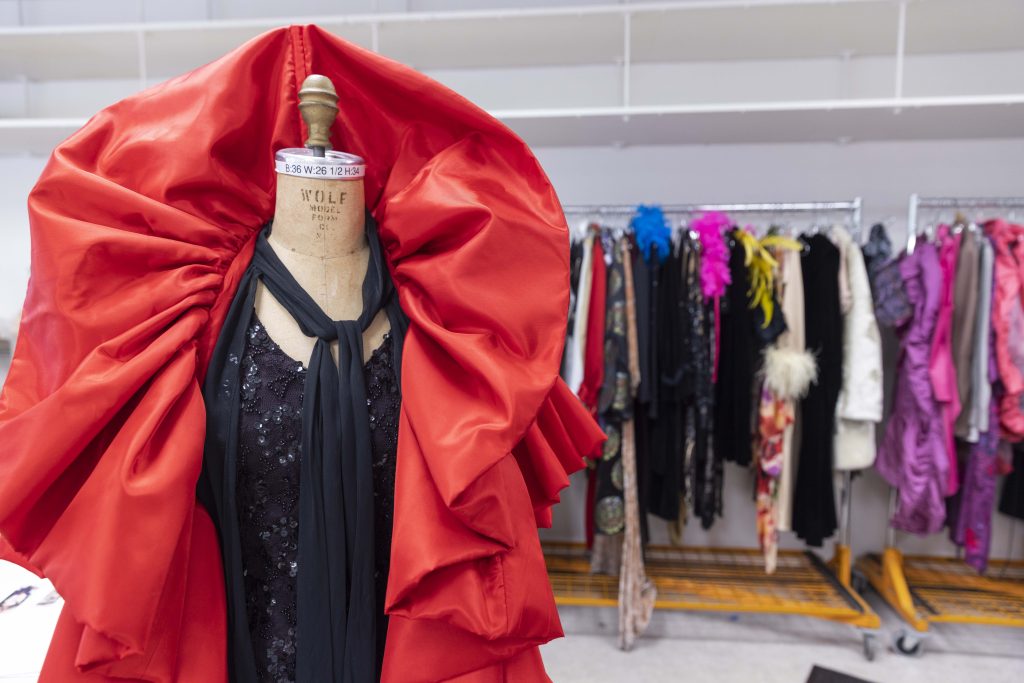
A bolt of bright red fabric received as a donation during the pandemic was pulled to create a dramatic cloak with voluptuous ruffles for The Wild Party. Designed by Jones and put together by Ryenne Bishop ’22, who earned a BFA in theatre studies, the cloak was just the latest example of how the studio uses secondhand materials to outfit actors in style.
Designers at the TCU Costume Studio find materials from places including thrift shops and estate sales. Photo by Jill Johnson
Floor-length silk curtains with slight water damage were among recent donations. Student workers ripped the curtains at the seams to store the salvageable material and lining on fabric bolts until they are needed in a show.
Damask tablecloths found at an estate sale were turned into men’s shirts for Tartuffe, and tea towels became folk aprons for Fiddler on the Roof. Estate sales are also good for sourcing props and accessories; recent finds included a brown derby hat and a lint brush for wool coats.
Keeping with its mission, when the studio can’t find a use for materials, it donates goods to the Welman Project, which serves local teachers, or Berry Good Buys, a thrift store benefiting SafeHaven of Tarrant County.
From Studio to Stage
On the night of the dress rehearsal, the studio’s work was put to the test. Roy Turpin, the staff costume technician who creates the patterns, said seeingthe costumes in context is a different experience. Inhabited by actors under the lights on the Hays Theatre stage, made to resemble a New York City loft, the costumes came alive.
The ruffled trim of the bright red cloak framed the face and form of Madelaine True, played by senior musical theatre major Hannah Le Beau. As she made her entrance, head held high, the floor-length cloak billowed behind her.
Cahill, sporting a Marilyn Monroe-style blond wig and red lipstick, revealed Queenie’s gold corset and skirt by dropping her long, black faux fur coat to the floor. The glittering fringed skirt accented her movements on stage.
Jones’ white boots shone as he stalked onto the stage as Oscar D’Armano. One leg, accented by a pearl garter, showed through a long slit as he snapped open a fan.
After the run of the show, the team piled costumes into a van and transported them back to the studio for laundering. Then they hung the costumes up in the stock houses, ready to be re-imagined.
Alford said important life skills are learned in the costume studio beyond sewing and ironing.
“Anybody would be better off in their life having worked here. You learn how to communicate and collaborate and lead teams,” she said. “We just make you hop in.”
A bright bolt of red fabric, donated during the pandemic, turned into Madelaine True’s cape for the 2022 production of “the Wild Party.” Photo by Jill Johnson
This season, TCU Football was going to be different.
That much was obvious from the introduction of its new coach, when Sonny Dykes landed in the middle of Amon G. Carter Stadium in November 2021 via TCU-emblazoned helicopter.
Different was the reason Dykes was there.
Change had come to the top of Horned Frog football after nearly a quarter-century of leadership under coach Gary Patterson. The university parted ways with the man who had led the program through the wilderness, into the Big 12 and to 11 seasons with double-digit wins.
The Sonny Dykes era at TCU started in grand fashion when the the head coach and his family landed via helicopter in November 2021. Courtesy of TCU Athletics | Ellman Photography
But college football had changed. Student-athletes — especially those playing major conference football — have new options to share in the sport’s massive profits or seek greener pastures without the burden of wasted transfer years. The power dynamics had shifted between coaches and the young men they lead, and TCU needed to adapt or risk being left behind in major college football again.
Frog football needed a new voice, a new direction and a commitment to college football in the 21st century — someone who would embrace developments like name, image and likeness licensing and the transfer portal.
The search, though national in scope, led TCU 40 miles east to Southern Methodist University, where Dykes was in the middle of rebuilding the Mustangs — and had possession of the Iron Skillet after two straight wins over the Frogs.
Dykes jumped at the opportunity to head to Fort Worth and into Big 12 football. Having served as an offensive analyst under Patterson in 2017, he saw the potential in TCU Football. “Growing up in Texas,” he said, “I always knew what this place could be.”
The change was evident immediately. From an aggressive social media strategy to recruiting philosophies that put a heavy emphasis on the transfer portal, to open practices and unprecedented access to players and coaches and a focus on mental health, nutrition and recovery, Dykes was a 180-degree turn from the previous regime.
The student-athletes were on board for a change, as the program had compiled a disappointing 23-24 record over the past four seasons. Thirty seniors dotted the roster for Dykes; only a handful had been on the team the last time TCU played in a bowl game (the 2018 Cheez-It Bowl).
Veteran leaders including linebacker Dee Winters, cornerback Tre’Vius Hodges-Tomlinson, running back Emari Demercado ’21 (MS ’22) and wide receiver Taye Barber ’21 ensured that the locker room was on board with the changes of the Dykes era.
“To our players’ credit, [buy-in] didn’t take as long this time as it usually does,” Dykes said. “Our guys were hungry and they were mature. They had a chip on their shoulder.”
“They were tired of losing,” said Damonic Williams, a first-year defensive lineman. “I would ask about last season and they would all say, ‘Don’t ask about last season, don’t bring it up.’ ”
At first the 2022 season didn’t look to be much different; TCU was picked to finish seventh in the Big 12 Conference and did not receive a single vote in preseason Top 25 polls.
Could a change at the top bring the Frogs out of irrelevance? Could new leadership produce different results?
A Solid Start
The first big question facing Dykes and offensive coordinator Garrett Riley was who would play quarterback. Max Duggan ’22, a three-year starter, and Chandler Morris, an Oklahoma transfer, were in an intense competition through the spring and into fall camp.
TCU quarterbacks Max Duggan and Chandler Morris warm up before the Frogs’ season-opening game in Boulder, Colorado. Morris won the starting job but was injured in the third quarter of the game. Duggan took over and went on to become the 2022 Heisman Trophy runner-up. Courtesy of TCU Football
Duggan had moxie and grit, Morris precision and poise. Duggan had earned the respect of the fan base with two wins over the University of Texas, including an epic performance as a first-year player in 2019. Morris, in his first career start, put up 531 yards of offense in a stunning upset of rival Baylor, forever endearing himself to fans.
The depth chart didn’t materialize until days before the season opener against Colorado in Boulder.
Morris was the starter; he took every snap for the first 30 minutes as the Frogs struggled to a 7-6 halftimelead over the Buffaloes. He led back-to-back scoring drives after the break to make it 17-6. But Morris’ night was over after he went down awkwardly on a hit late in the third quarter, and the legend of the House of Duggan was born.
Duggan started his year with a vintage 33-yard run, ultimately leading TCU into the end zone. A short field led to another quick score. The Frogs ended up winning easily.
The next week, Duggan torched Tarleton State for 390 yards and five touchdowns. Two weeks after that he brought the Iron Skillet back to Fort Worth by righting the ship against SMU.
Conference play kicked off when No. 18 Oklahoma came to Fort Worth in October. The Sooners had won six of the last seven conference championships and were expected to compete for another this season. TCU hadn’t beaten Oklahoma since 2014 and was a touchdown underdog on its home field.
A 55-24 shellacking of the Sooners showed how different this TCU team would indeed be.
“The Oklahoma game, that’s when we started to think we might be pretty good,” said Bud Clark, a sophomore safety.
Momentum built as the Frogs beat four ranked opponents in a row, a first in program history.
TCU receiver Taye Barber (4) scores a touchdown in the first quarter of the Frogs’ decisive 55-24 win over the Sooners. Courtesy of TCU Athletics | Ellman Photography
The wins didn’t come easily.
TCU trailed by 11 at the half to both Oklahoma State and Kansas State, but furious second-half rallies in each left the Frogs victorious.
The race toward the playoffs was on. The college football world started paying attention to the happenings in Fort Worth, and staying focused on the field became a top priority for TCU.
“No one talked about us before the season,” Duggan said after the Kansas State win. “We never listened to them. And now when people start talking about you, you do the same thing. You don’t listen to them or the outside noise. We only care about the people that are in this program and inside these walls.”
No matter who was saying what, this season, undefeated halfway through, was definitely different.
Magical Momentum
As TCU ran its record to 7-0, the program’s secret weapon came to the forefront: Hypnotoad.
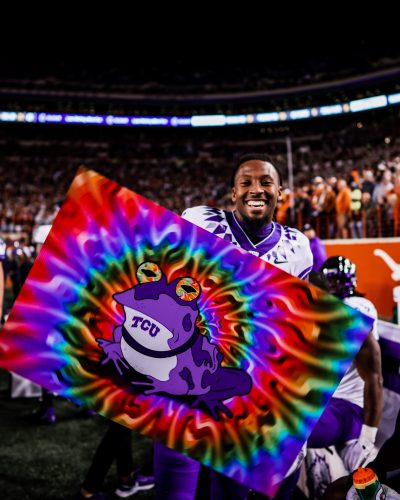
Appearing at TCU games as early as 2015, the Hypnotoad took on a life of its own in 2022. What started as a scoreboard video intended to distract opposing kickers became a rallying cry for the fan base and the team. Student-athletes started carrying a Hypnotoad flag into the stadium and holding signsbearing the cartoon’s likeness on the sideline during critical moments.
Star Horned Frog receiver Quentin Johnston holds a sign bearing TCU’s unofficial mystical mascot, the Hypnotoad. Courtesy of TCU Athletics
“There’s some magic in the Hypnotoad,” Dykes said during a November news conference. “There’s definitely no coincidence that it gets louder and strange plays go in our favor after seeing it.”
Whether due to a mesmerizing cartoon or on-field leadership, the resulting magic was undeniable.
By a November meeting with No. 18 Texas in Austin, the undefeated Frogs had risen to No. 4 in the nation.
The outside opinions were no different, though, as the Longhorns, soon to scuttle to the Southeastern Conference, were favored by 7.5 points. The blatant disrespect did not go unnoticed by those in purple. “That’s motivation for us,” said Alan Ali, a senior center. “We feel like underdogs.”
In a defensive masterpiece, TCU held the explosive Longhorn offense to 199 yards and kept it out of the end zone all night; the only touchdown Texas scored was a fumble return in the fourth quarter. TCU’s offense did just enough. A 75-yard run by Kendre Miller, a junior running back, and a 31-yard touchdown reception by Quentin Johnston, a junior receiver, provided the bulk of the action in a 17-10 TCU win.
With just two regular season games remaining, TCU was in the thick of the playoff conversation.
TCU had been here before. In 2010, the Frogs found themselves ranked third as the calendar turned to November but were never truly in the championship game discussion. That team finished its undefeated season by beating Wisconsin and hoisting the Rose Bowl trophy.
In 2014, the first year of the College Football Playoff, TCU would rise to third in the penultimate ranking, only to finish on the outside looking in when the four-team field was announced.
TCU players, staff and fans all wondered, would this year really be different?
The dream almost fell apart on a cold and rainy November day in Waco. But the Frogs refused to let the Bears play spoiler. Griffin Kell, a senior kicker, scrambled onto the field and booted a ball through the uprights as time expired in a play that became known as “the bazooka on the Brazos.” TCU was 11-0, on the cusp of something unprecedented.
TCU kicker Griffin Kell (39) preserved the Frogs’ undefeated season with a walk-off field goal at Baylor in Waco, Texas. The successful execution of the play was dubbed “the bazooka on the Brazos.” Courtesy of TCU Athletics
Redemption
With the team’s success came a bevy of individual honors.
TCU Football players cleaned up in the 2022 national awards. Tre’Vius Hodges-Tomlinson (1) was the second Frog in three years to win the Jim Thorpe Award. Head coach Sonny Dykes won 10 national coach of the year awards. Quarterback Max Duggan (15) won the Davey O’Brien National Quarterback Award, the Earl Campbell Tyler Rose Award and the Johnny Unitas Golden Arm Award. Photo by Carolyn Cruz
Duggan became the first Horned Frog to take home the Davey O’Brien National Quarterback Award — fitting as it is named for TCU’s Heisman Trophy-winning quarterback from the 1930s. Duggan was also selected as the Johnny Unitas Golden Arm winner and was the Heisman runner-up — TCU’s first finalist since LaDainian Tomlinson ’05 more than 20 years prior.
Dykes earned 10 National Coach of the Year awards, and Hodges-Tomlinson became the second Frog in three seasons to be the Jim Thorpe Award winner. Both Duggan and Hodges-Tomlinson were selected as All-Americans alongside Steve Avila ’22, a senior offensive lineman.
In a season full of memorable moments, none was more poignant than Duggan’s postgame news conference after TCU lost the Big 12 title game in overtime to Kansas State.
“There’s nothing I wanted more than to bring this school a championship,” Duggan said, choking back tears. “Today we fell short.”
The next day, those tears would dry when the Horned Frogs celebrated their first invitation to the College Football Playoff. No. 3 TCU would battle the No. 2 Michigan Wolverines — a venerable college football institution — on New Year’s Eve in Arizona.
After years of striving, this year’s team had a chance to do something different and remarkable: compete on the field for a national championship. TCU was the first team from Texas to qualify for the playoff.
“It feels good,” Dykes said. “The history of college football in the state of Texas means a lot to me. To be the first team from Texas is quite an honor.”
Scores of national media voices mocked TCU’s inclusion in the four-team field. Television host Paul Finebaum claimed, “This is not the old Big 12, this is the TCU Big 12.”
ESPN’s Stephen A. Smith threw salt onto familiar wounds by saying, “TCU, you know you ain’t those dudes.”
Even former Texas quarterback Chris Simms tweeted “TCU in the CFP? The Big 12 sucks, and I played in the Big 12.”
Michigan players also got in on the bulletin boardmaterial. A Wolverine linebacker forgot what conference TCU played in. Another defender dismissed the speed of the TCU skill players by saying, “We will be able to contain it. They have speed, but we have speed, too.”
Michigan quarterback J.J. McCarthy joked about TCU’s adaptable defensive scheme: “Well, if they stay in the 3-3-5, it’s gonna be a lot of smashing because it just opens up a lot of holes.”
The TCU student-athletes tuned it all out.
Fans from both sides descended on Glendale, Arizona, for a Fiesta Bowl playoff semifinal matchup during which previous games and salty words would be meaningless. Many people were forced to jump into rental cars and head west after a Southwest Airlines crisis canceled flights across the country.
Frog faithful weren’t going to miss what ended up being one of the greatest games in TCU Football’s long and storied history.
To start the afternoon, Michigan ripped off a 54-yard run on its first play from scrimmage.
The confident tune would change in a hurry because the Frogs came to play.
By halftime, TCU held a 21-6 lead.
A chaotic third quarter saw the teams combine for 44 points, 17 first downs and a staggering 420 yards, trading big plays after promising body blows.
Every time Michigan swung, TCU swung back, just as it had done all season.
Live on 21 million TV sets, the Frogs stretched the lead to 19, their biggest of the night, capping a 78-yard drive with a one-yard Duggan touchdown dive.
The Wolverines climbed within three in the fourth quarter, only to fall behind by 10 again when Duggan found Johnston on a shallow crossing route that resulted in a 76-yard touchdown.
The TCU defense forced a three-and-out on the ensuing Michigan drive, and a 31-yard punt return by senior wide receiver Derius Davis ’22 allowed the Frogs to tack on a field goal to make it 51-38 with 10 minutes to play.
That lead was insurmountable and ended up being a dagger in the heart of college football’s power structure. TCU was going to the national championship game.
A University Transformed
As purple confetti fell on the field of Glendale’s State Farm Stadium, so did the tears, with players, coaches and fans letting their emotions show.
Duggan put the win in perspective: “There’s been so many great teams that have come through and built this program up. They did a lot to get this program to where we’re at. And this means a lot to those guys, to our university, our fans that have continued to support us, have continued to have our backs.”
With a final game against Georgia slated for Jan. 9 in Los Angeles, TCU’s season wasn’t over, but the Horned Frogs had already won.
Just as in Arizona, the Horned Frog faithful turned out in Southern California, buying up their ticket allotment in minutes and flooding the Santa Monica Pier for a pep rally the day before kickoff.
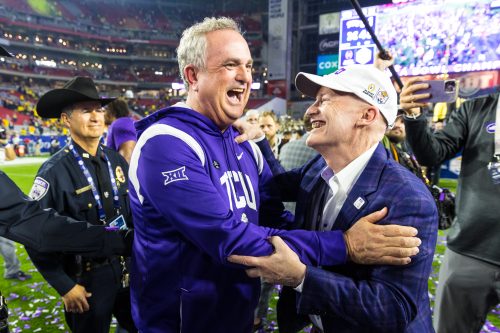
Sonny Dykes and TCU Chancellor Victor J. Boschini, Jr. celebrate after TCU’s playoff semifinal win over Michigan on Dec. 31, 2022. Photo by Amy Peterson
But the rain falling through the unattached roof of SoFi Stadium throughout the game turned out to be appropriate for the Frogs’ mood. The No. 1 Georgia Bulldogs took an early lead and never looked back on their way to a second consecutive national title.
“Tonight did not go the way we wanted it to,” Duggan said after the final game of his TCU career. “But tonight isn’t going to take away from this season and what we were able to do as a program.”
“Our fans answered the call every single time we asked them to do something,” Dykes said after the final news conference. “We’re proud of what we’ve done, proud of them and appreciate their support of us. It’s been a fun year.”
The national championship appearance was a remarkable way to kick off TCU’s 150th year, as the university conducted a study that calculated that the Frogs’ magical run netted the university at least $2.5 billion in media exposure.
“The boost that TCU received in national recognition and exposure is basically impossible to realistically calculate, though I know it is monumental,” said Chancellor Victor J. Boschini, Jr. “This season opened the door for many new people to learn a little bit about this wonderful place we call TCU.
“Hopefully, now it will stimulate them to find out even more in the days and months ahead.”
Things will be different when Dykes enters Year 2. With an increased profile come increased expectations, and TCU knows the world will be watching.
But there was no better time for the Frogs to catapult themselves into the college football limelight. The Big 12 welcomes four new teams to the conference as it prepares to say goodbye to Oklahoma and Texas, long the league’s standard-bearers.
In addition to realignment, the playoffs are expanding — in 2024, a 12-team field will make room for more schools to compete for a national championship.
No matter the continually shifting circumstances, TCU has proved that different is a winning formula for its team. While the university and its football program have adapted to the changing landscape, the longtime commitment to leadership remains the same.
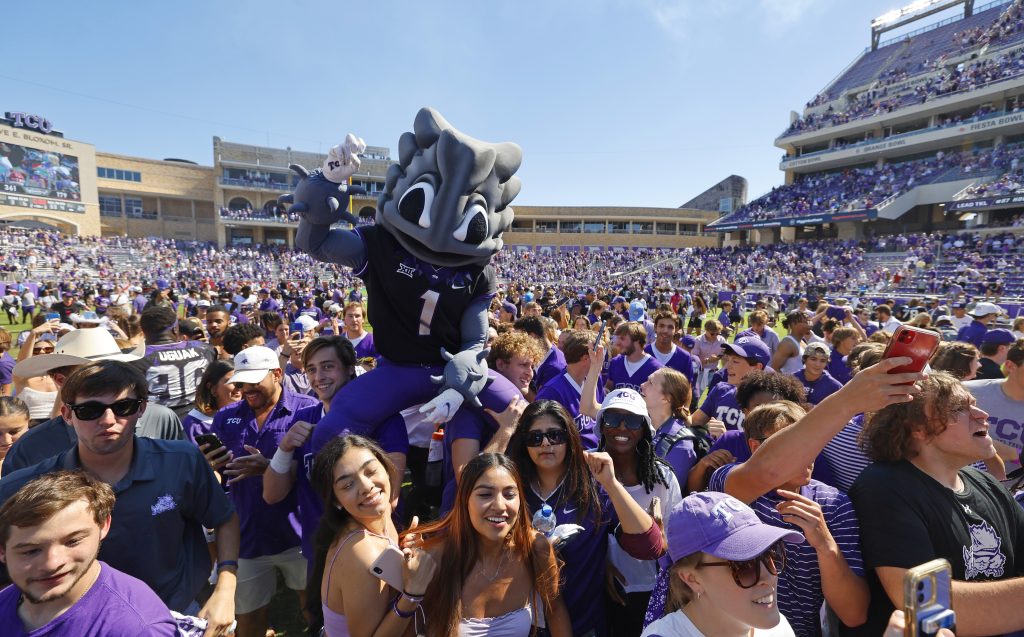
Fans stormed the field after TCU’s win over No. 18 Oklahoma in October 2022. The win was the first of four consecutive against ranked opponents, a first in TCU Football history. Courtesy of TCU Athletics | Ellman Photography
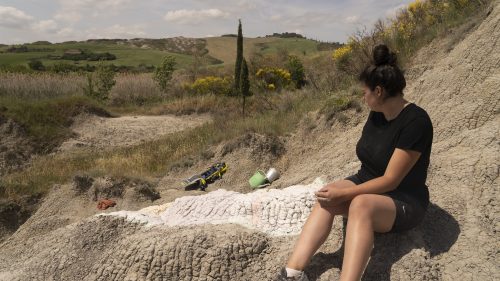
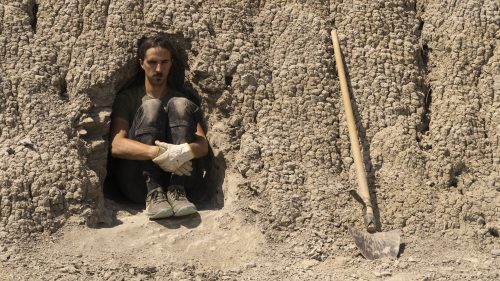
In Tuscany, artist Ben Loftis made use of the landscape, digging a nook into the side of a clay hill to house his body for a photographic work. Sarah Hunt created 75 small clay almonds and vessels to hold them, while Sheryl Anaya harvested plant matter to make dyes she used on fabric. Madi Ortega discovered inspiration in the hills she wandered, using chalk to draw a multicolored quilt atop a clay mound that she smoothed to serve as a natural canvas.
The TCU graduate students took part in a residency program in Italy in May 2022, offered to those entering the third year of their master’s in studio art program — the thesis year. Just the second group to experience this residency, the master’s candidates devoted their time to creating work, some of it site-specific, in an unstructured program led by Cameron Schoepp ’87 MFA, professor of art, and Adam Fung, associate professor of art. Both students and professors spent most of their time making art with materials largely found in nature during a 16-day stay in a century-old farmhouse.
Horned Frog Connections
The residency program started taking shape nearly five years ago thanks to Elliott Hill ’86, who serves on the university’s Board of Trustees.
La Foce overlooks the Val d’Orcia, a UNESCO World Heritage Site. Courtesy of Adam Fung
A recently retired Nike executive, Hill worked for the ubiquitous brand in Europe from 1998 to 2002, living in Amsterdam with his wife, Gina Hill, and their two children before returning to the United States to continue his career with the company.
Over the past two decades, the Hills made regular visits to southern Tuscany to see friends. Enchanted with life there, Elliott and Gina Hill — both of Italian descent and bearing Italian citizenship — eventually bought an old farmhouse ona 15th-century estate called La Foce, owned for centuries by the Origo family, with whom the Hills are now very close.
Animals, insects and birds resided in the farmhouse, which had cracked walls, missing windows and no electricity or plumbing — but boasted 360-degree views across the valley. The Hills hired local artisans and craftspeople to renovate the 1920s stone building and dubbed the home Cerreto, named for a nearby oak grove.
Offering Cerreto to TCU’s art program — along with funding to make the residency a reality — was a simple decision for the Hills.
“We collect and try to support artists with whom we have an emotional connection — to their work and to them as individuals. We decided we wanted to share our house with artists while honoring those who came from La Foce,” Elliott Hill said, referring to the Origo family, whose art-minded members have included a sculptor, a ballerina, authors and musicians. “We want to inspire students to continue chasing their dreams and following their passion.”
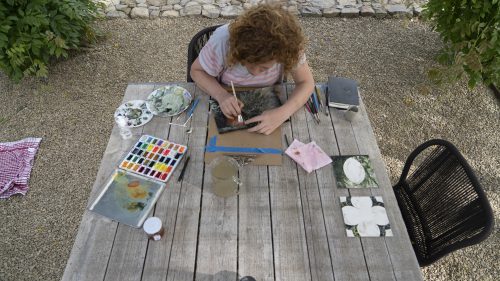
TCU MFA candidate Sarah Hunt works outdoors, using the Tuscan landscape as inspiration for her watercolor paintings. Courtesy of Adam Fung
As coordinator of TCU’s studio art graduate program, Schoepp made an exploratory trip to La Foce in 2018 with Richard Lane, director of TCU’s School of Art. After returning home, Schoepp worked with Fung to set parameters for the residency.
“We decided the grad students about to enter their third year made most sense; they’re at the right place to get an experience that mirrors residencies outside of academia,” Schoepp said. Fung added, “This sets them up for their thesis work by opening up pathways in their thinking.”
Schoepp believes putting the students in new settings imposes necessary fresh perspectives that a familiar home or school studio can’t, and being in a rural landscape lends itself to relaxed inspiration.
“They don’t make art in the house but are outside instead, which makes them think, ‘How do I make work in the wild?’ ” Fung said. “Cam and I both thought the open-air situation with no one around, unlike in the city, would be best.”
Art in Nature
The artists got to work as soon as they arrived at La Foce, overlooking the Val d’Orcia, about halfway between Rome and Florence. Some of the students had never been out of the United States, and one hadn’t flown before.
“It’s the most beautiful, extravagant place I’ve ever visited. And you’re so immersed in nature,” Anaya said. “You walk outside and look at the hills of Tuscany. So many wildflowers. Birds singing. One particular owl would hang outside our window all night.”
TCU MFA candidate Madi Ortega drew on a Tuscan clay mound with chalk. Courtesy of Adam Fung
Anaya said she appreciated working with materials within arm’s reach, such as the plants she used to make natural dyes. “The other graduate students and I also spent time pulling clay from the estate grounds. We dug a fire pit [for a kiln they crafted with Schoepp] to fire objects we made from the clay.”
In addition to the clay almonds and vessels she created, Hunt made watercolor and gouache paintings. Fung’s proficiency with drone cameras helped Hunt paint from night photos. “I took the night photography with different light sources that I inserted into the landscape and ultimately used a lot of that reference imagery to build a body of paintings,” Hunt said. She later exhibited the paintings in a small show at the Moncrief Cancer Institute in Fort Worth.
Ortega also worked in multiple mediums while abroad. “I found treasures on the ground, marking what or who had been there previously. I created watercolor paintings, drew on a clay mound and wasp nests with chalk, photographed insects from my walks, and made mud pies,” she said. “I drew and painted more than I’d ever been inspired to do before.”
Schoepp, a studio artist whose emphasis is sculpture, and Fung, a painter, delighted in creating work of their own. Days often involved hiking in the Tuscan hills, scavenging for items like wild porcupine quills they’d experiment with in making art back at the farmhouse.
Over dinner, they’d reflect on discoveries and find new directions. “Cooking meals for one another, sitting down and bouncing ideas for the week off each other, questioning possible routes through our thesis research, and offering close insight into our practices was important,” Hunt said. “These students have seen and critiqued my work across the last two years, and we trust one another.”
Schoepp and Fung took the students to an Etruscan museum near La Foce to see examples of early local art. Several of them gained insight by reading War in Val d’Orcia: An Italian War Diary, 1943-1944, a memoir by Iris Origo, who wrote in detail about La Foce and its surroundings.
TCU MFA candidate Ben Loftis dug out part of a clay hill for his photography project. Courtesy of Adam Fung
Anaya visited a cathedral near Siena dedicated to St. Agatha, the subject of her forthcoming thesis exhibition; she also found paintings of St. Agatha when the group visited Florence.
After more than two weeks in Tuscany, the students traveled to Venice for the international art exhibition Biennale Arte. A significant event since 1895, the exhibition offered exposure to cutting-edge contemporary art, just as Florence museums provided classic examples.
“One pavilion invited viewers to enter one at a time into a silent experience through many rooms … where domestic, industrial and outdoor environments are empty except for you; the quiet makes you a little uncomfortable,” Ortega said. “According to Gian Maria Tosatti, the artist who created the installation, viewers are met with the relics of Italy’s industrial success with new understanding of the status of our climate.”
Continuing the Experience
After Venice, the students extended their Italian travels and research studies, thanks to grants secured beforehand. Back home again, they continued to reflect on their life-changing Italian experience.
“One thing I was reminded of was to not be afraid to take risks and to keep on making work. I remembered the importance of structure and routine as well as prioritizing my studio practice,” Anaya said.
“This trip gave me time to understand what is important to me and to my artwork. I have a greater understanding of who I am as a 24-year-old,” Ortega said. “Apart from having new ideas for my practice, I have learned who I want to be as an artist and what I want to put into the world.”
Elliott Hill said he could relate to the students’ personal evolution. “Attending TCU helped change how I view the world and broadened my perspective. To combine our love of art and our love of TCU with our love of La Foce and the Origo family to offer something bigger for all involved — it’s a real gift for us to be part of this experience.”
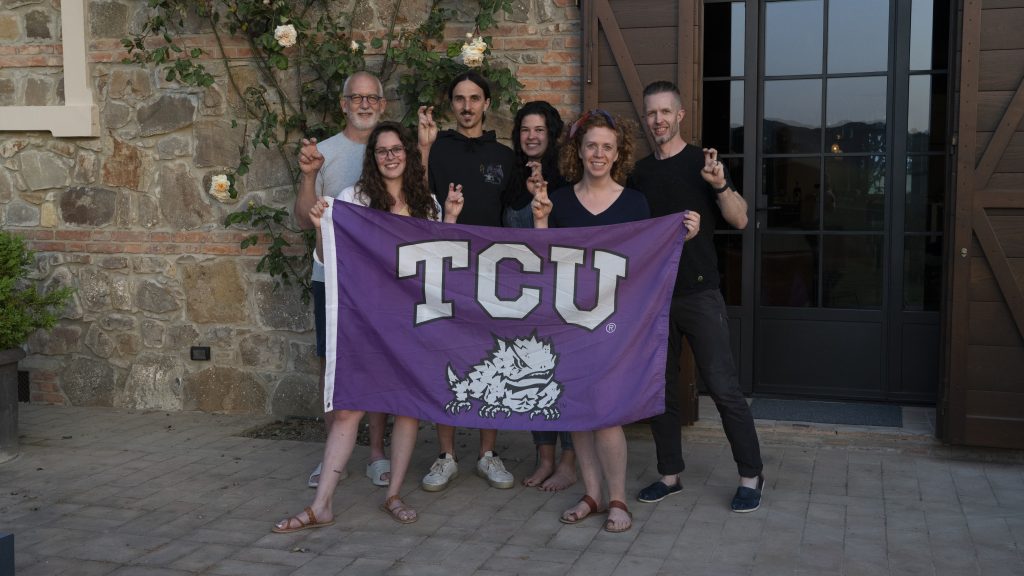
From left, Cameron Schoepp, Sheryl Anaya, Ben Loftis, Madi Ortega, Sarah Hunt and Adam Fung gather outside their temporary home in the Tuscan hills. Courtesy of Adam Fung